OCR for Logistics:
Automating BOL, POD & Shipping Documents
A mid-tier freight forwarder processes 60-100 bills of lading, 80+ proofs of delivery, and dozens of freight invoices and packing slips every single day. With manual entry consuming 10-15 minutes per document and error-correction loops that grow faster than volume, most logistics teams spend their time typing — not moving freight. OCR for logistics is the systematic approach to turning this document stream into structured data that feeds a TMS, ERP, or spreadsheet without per-carrier template maintenance or manual rekeying.
Key Takeaways
- Sixty to one hundred bills of lading a day, ten to fifteen minutes each — a logistics desk spends ten to fifteen hours on data entry before a single shipment moves.
- The OCR you deploy on invoices will fail on logistics documents because logistics uses code systems — SCAC, UN/LOCODE, ISO 6346 — not natural language, and a tool that extracts raw text
MAEUhas not automated the step of mapping it to a carrier name. - Semantic extraction reads fields by what they mean, not where they sit on a specific carrier's layout — one configuration processes every BOL format, and adding a new carrier costs zero template-maintenance hours.
What "OCR for Logistics" Actually Means — and How It Differs from General Document OCR
OCR for logistics is the automated extraction and structuring of data from the document types that move through supply chains: bills of lading, proofs of delivery, packing slips, customs declarations, and freight invoices. The goal is not just to digitize these documents into searchable text — it is to produce field-level structured data (container numbers, SCAC codes, HS codes, freight terms, port codes, quantities, charges) that can flow directly into a Transportation Management System, ERP, warehouse management system, or spreadsheet.
This distinction matters because a general-purpose OCR tool treats every document as "text on a page." It recognizes characters, but it does not know that COSU8102804 is a container number (with the check digit 4 governed by ISO 6346 rules) or that NL RTM is the Port of Rotterdam expressed as a UN/LOCODE. Logistics documents carry industry-specific codes and field relationships that generic OCR engines never learned during training. A tool optimized for invoice extraction will miss SCAC codes and container prefixes because its training data — AP invoices — never contained them in the first place, as our logistics extraction tool comparison found when AP-trained tools dropped below 60% on logistics-specific fields.
In practice, this means that OCR for logistics requires both semantic understanding (the ability to identify a field by what it means, not where it sits on the page) and domain-specific code knowledge (the ability to validate and normalize outputs against the standards that logistics systems expect). For a deeper look at how semantic extraction differs from traditional character recognition, see our guide on what AI OCR is and how it works.
Why Logistics Needs OCR: The Quantified Case
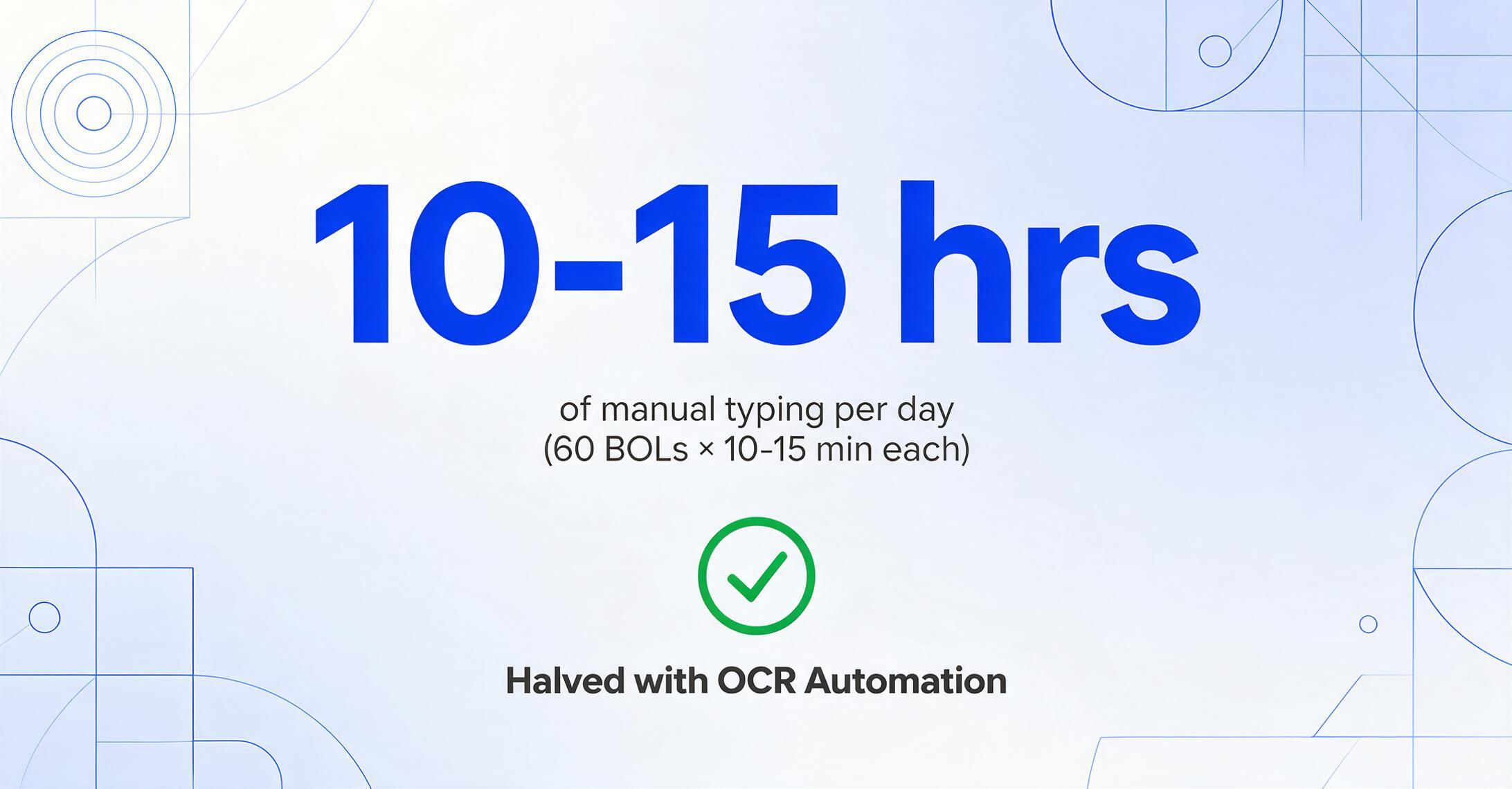
The scale of logistics document processing is rarely visible to teams outside operations. A freight forwarding desk handling 50-80 shipments per day receives each shipment's documentation as a separate PDF or image — often from a different carrier or forwarder with a unique format. With manual data entry consuming an estimated 10-15 minutes per document, a forwarder processing 60 BOLs per day spends 10 to 15 hours daily on typing alone before accounting for POD verification, freight invoice matching, and customs declaration preparation.
That time cost is compounded by error rates. Studies of manual data entry across logistics workflows consistently find error rates between 2% and 5% on routine fields — and higher on handwritten entries. On a BOL with 15-20 extractable fields, a 3% error rate means roughly one error every other document. In logistics, a single wrong HS code digit can trigger a customs hold. A mistyped container number can send a shipment into tracking limbo for days. A transposed weight figure can generate a freight chargeback that takes weeks to resolve.
For logistics teams processing high volumes, the business case for OCR automation is not theoretical. Automating BOL and freight invoice data entry has been shown to reduce processing time by more than half while simultaneously cutting error rates — freeing data entry staff to focus on exception handling and customer service rather than repetitive typing.
The Five Logistics Document Types That Need OCR
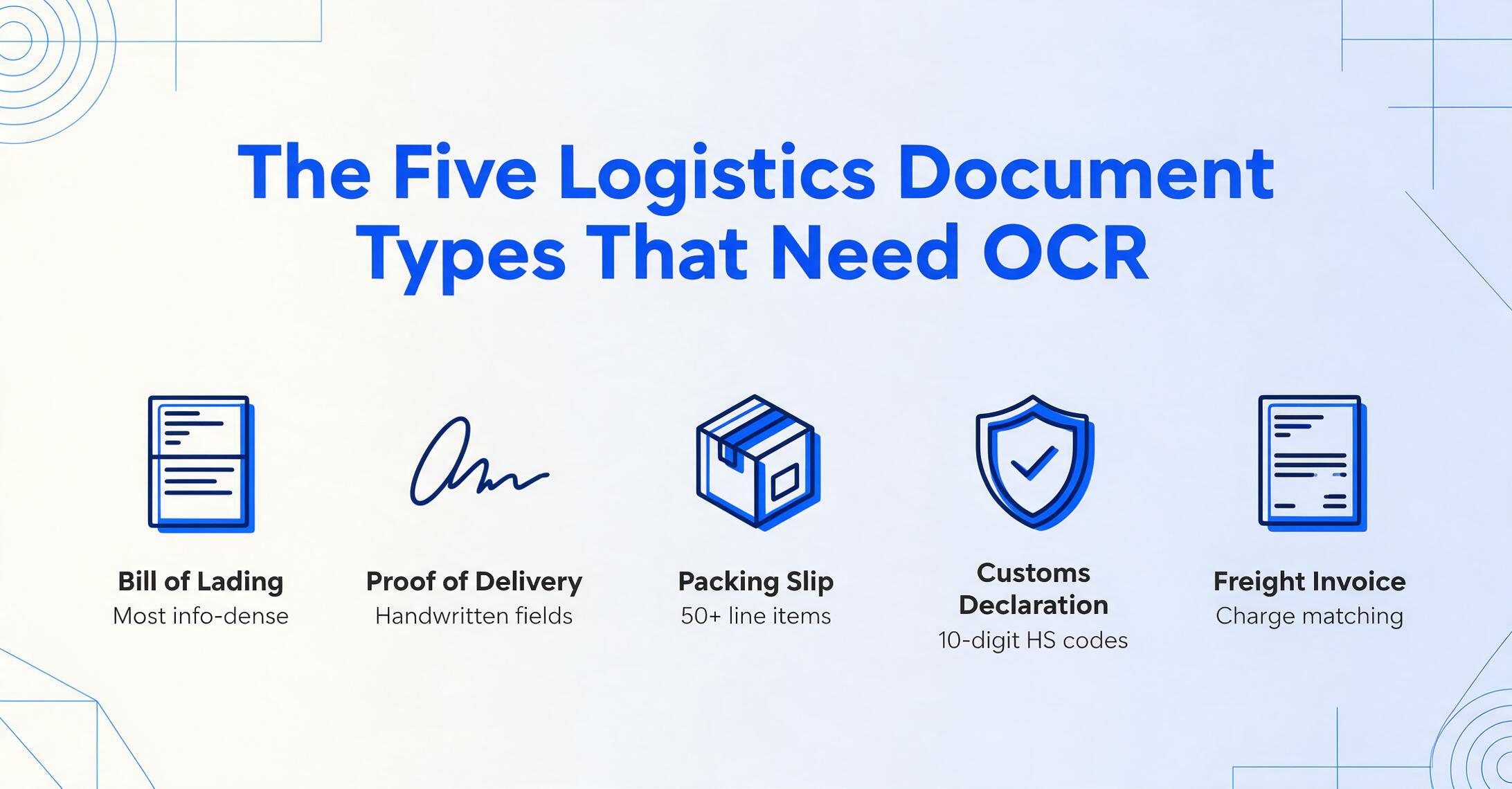
Logistics operations do not process one document type. They process a mixed stream of at least five, each with its own field set, legal function, and extraction challenge. Here is how OCR applies to each.
1. Bill of Lading (BOL)
The bill of lading is the most information-dense document in logistics. It serves as a receipt, a contract of carriage, and a document of title — whoever holds the original can claim the goods. A single ocean BOL can carry the shipper name and EORI number, the consignee, the notify party, the vessel name and voyage number, the port of loading and port of discharge (each expressed as a UN/LOCODE), container numbers (ISO 6346 format with check digits), seal numbers, cargo descriptions, gross and net weights, package counts, freight terms (prepaid or collect), the INCOTERM rule (FOB, CIF, FCA, etc.), and often multiple line items with HS codes. Fields shift position by carrier — Maersk places the container number in the top-right quadrant; MSC puts it mid-page below the vessel name. A house BOL may reference a master BOL number that a straight BOL does not carry. For a complete breakdown of this document type, see our dedicated guide on bill of lading data extraction. To extract BOL fields into a spreadsheet in seconds — no per-carrier setup — use the bill of lading to Excel tool.
2. Proof of Delivery (POD)
The POD is the terminal document of the shipping cycle: it confirms that goods arrived, in what condition, and who accepted them. The extraction challenge is that the most important fields on a POD are the least machine-readable. Delivery signatures are handwritten — often a quick scrawl that even a human reader would struggle to parse. Delivery timestamps may be written in by the driver. Damage notations ("1 carton crushed — refused"), partial quantity annotations ("Received 47 of 50"), and late-arrival stamps are typically handwritten in margins. The best handwriting OCR tools in 2026 handle clean block printing at 85-95% accuracy, but cursive signatures and margin notes remain a human-verification layer for most logistics workflows. Semantic AI extraction mitigates this partially: a model that understands the document structure can at least direct the verifier to the correct location on the page rather than making them scrutinize every field.
3. Packing Slip
Packing slips accompany every shipment and list what is inside each carton or pallet: item descriptions, SKU codes, quantities, batch or lot numbers, and sometimes HS codes and country-of-origin markings. The extraction value of packing slips lies in receiving efficiency: automatically matching received quantities to the purchase order, flagging short shipments before the supplier invoice arrives, and feeding the WMS without manual item-level keying. Packing slips tend to be simpler in layout than BOLs but carry higher line-item density — a single slip can list 50+ SKUs, and each line must be accurately captured for inventory reconciliation. Template-based OCR struggles here because every 3PL and supplier formats the slip differently. Semantic extraction, which reads fields by meaning rather than coordinate position, handles this variability natively.
4. Customs Declarations
Customs declarations — the Single Administrative Document (SAD) in the EU, the CBP 3461 in the US, the CDS declaration in the UK — are where extraction accuracy intersects directly with legal compliance. Each field on a customs declaration maps to a regulatory data element: the HS code determines the duty rate, the country of origin determines trade agreement eligibility, the declared value determines the tax base for VAT and customs duties. A single incorrect digit in an HS code can result in overpayment of duty or, in the case of controlled goods, a shipment seizure and penalty. Customs declarations also incorporate data from other documents in this list — the BOL provides the transport details, the commercial invoice provides the value, the packing slip provides the line-item quantities — making cross-document consistency a key validation requirement. OCR for customs documents must therefore operate at higher confidence thresholds than general-purpose extraction.
5. Freight Invoice
The freight invoice is the financial reconciliation document of logistics. It itemizes the charges for a shipment: base freight rate, fuel surcharge (often 10-25% of total), accessorial charges (liftgate, inside delivery, residential surcharge), detention or demurrage fees, and any negotiated discounts. The manual audit burden on these invoices is significant — a single overcharge may be $50-$200, and at scale, systematic overbilling can cost tens of thousands annually. Automated freight invoice extraction enables AP teams to match billed amounts against contracted rates, flag surcharge discrepancies, and route exceptions for review without manually typing charge line items into a spreadsheet. The extraction challenge specific to freight invoices is the variety of charge codes and abbreviations (often carrier-specific) that describe the same service differently across carriers.
What Makes Logistics Documents Uniquely Hard for OCR
Logistics documents are not simply "invoices with different fields." They present a set of structural challenges that traditional OCR — and even many general-purpose AI extraction tools — were not designed to handle.
Proprietary Code Systems That Require Domain Knowledge
Logistics operates on codes, not natural language. A BOL does not say "the carrier is Maersk Line"; it says MAEU — the carrier's SCAC code. Ports are not written as "Rotterdam, Netherlands"; they appear as NL RTM, the five-character UN/LOCODE assigned by the UNECE. Container numbers follow ISO 6346: four owner-code letters (e.g., MSCU), six serial digits, and a check digit that can be mathematically validated. HS codes are 6-to-10-digit commodity classifications maintained by the World Customs Organization. An OCR system that does not recognize these code structures will output raw text that requires manual re-encoding before it is useful. A system that does recognize them can validate outputs — for example, confirming that an extracted container number passes the ISO 6346 check-digit calculation — reducing the downstream verification burden significantly.
Handwritten POD Signatures and Margin Annotations
The documents that carry the highest operational value — proofs of delivery — are also the ones with the least machine-readable content. Drivers sign with hand-written scrawls. Recipients jot delivery exceptions in margins. Timestamps are written in by hand. For the carrier, these handwritten fields are the legal record of delivery and condition. For the OCR system, they represent the hardest extraction scenario: variable handwriting on two-dimensional space with no fixed field boundaries. Traditional OCR drops below 50% accuracy on messy POD annotations. Modern AI extraction with vision-language models fares better, maintaining 75-90% on neat hand-printing and 60-75% on cursive, but these are not straight-through-processing numbers — human verification on handwritten fields remains a necessary checkpoint for most logistics workflows.
Multi-Language and Multi-Character-Set Documents
International logistics means international documents. A shipment from Shanghai to Hamburg generates documentation that may include Chinese characters (货物描述), German (Gefahrgutklasse), and English — sometimes on the same page. Customs declarations in Thailand use Thai script. Japanese ports appear in kanji. Latin American BOLs often mix Spanish and English. Traditional OCR engines are language-specific: you configure them for English or German, and the recognition accuracy degrades outside the configured language set. AI vision models trained on multilingual document corpora handle this more gracefully because they process visual patterns, not character sets, but accuracy still varies significantly by script. A logistics OCR solution intended for global operations must be evaluated not on English-only accuracy but on its performance across the language mix that the operation actually encounters.
Variable Carrier Formats with No Standardization
There is no standardized template for a bill of lading. Maersk, MSC, CMA CGM, COSCO, Hapag-Lloyd, ONE, and Evergreen — the seven largest ocean carriers — each uses a different layout. Field placement varies between carriers, between the master BOL and the house BOL, and sometimes between the same carrier's electronic and paper versions. Air waybills from FedEx Express look nothing like DHL Express documents — for air cargo extraction specifically, see our air waybill (AWB) to Excel tool. Truck carrier PODs range from multi-page color forms to thermal-printed single sheets with handwritten additions. Template-based OCR requires a separate configuration for each variant — a maintenance burden that grows with every new carrier relationship. Semantic AI extraction, which locates fields by meaning rather than coordinates, processes all variants through a single configuration. This is the core difference between traditional OCR and modern AI extraction for logistics.
INCOTERMS and Trade Term Variability
INCOTERMS 2020, published by the International Chamber of Commerce, defines 11 trade terms — from EXW (Ex Works) to DDP (Delivered Duty Paid) — that determine risk transfer, cost allocation, and insurance obligations for each shipment. A single BOL may list the INCOTERM as "CIF Shanghai," but other documents for the same shipment may reference "CIF" differently in contract terms. Extracting the INCOTERM is straightforward for most OCR tools; interpreting it — understanding that FOB applies only to sea freight while FCA applies to any mode — requires domain logic that general-purpose extraction does not provide.
Legacy OCR vs Modern AI Extraction for Logistics
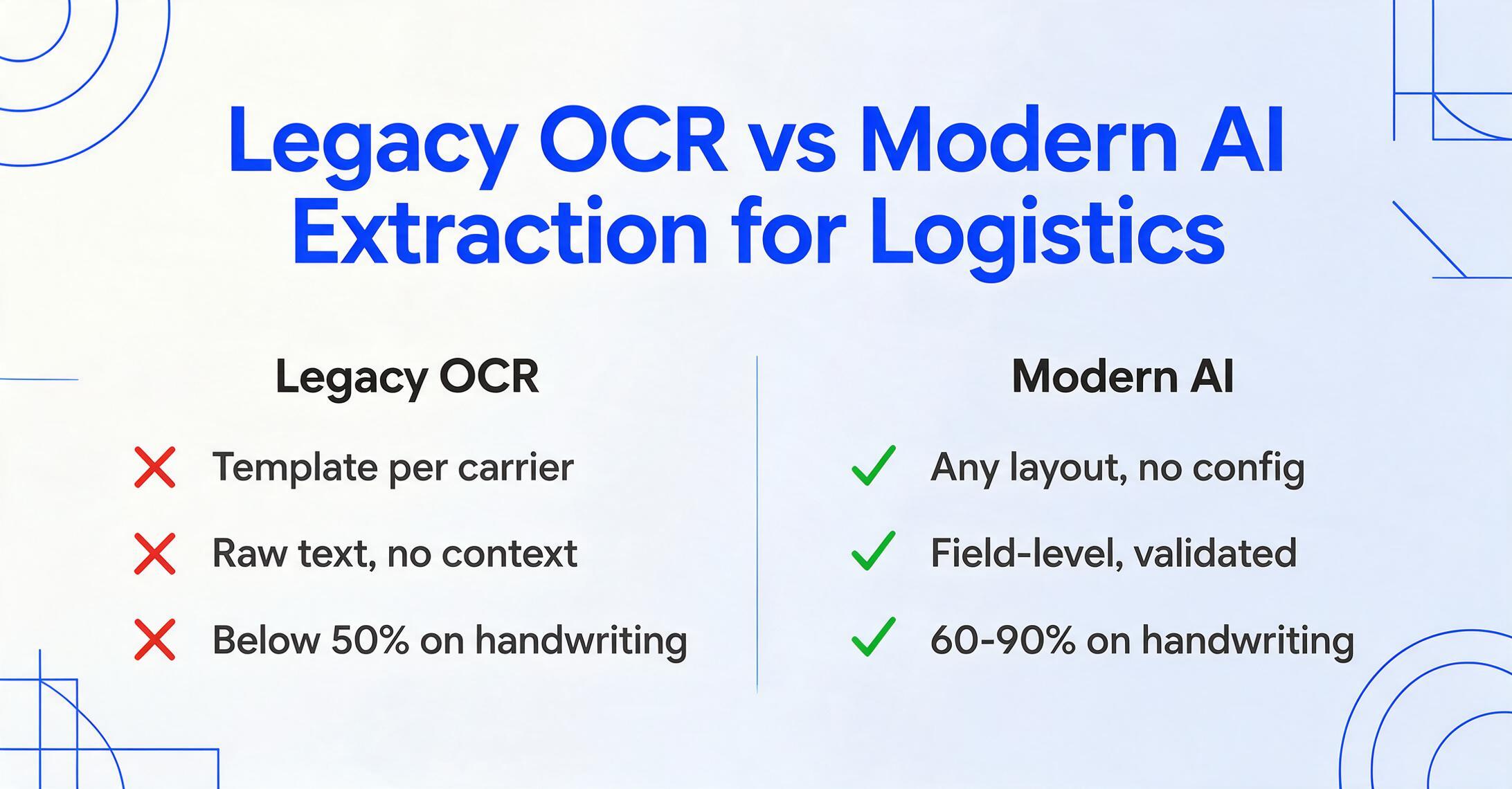
The difference between traditional OCR and modern AI extraction is not an incremental upgrade — it is a different approach to reading documents. Here is how the two compare across the dimensions that matter for logistics.
| Dimension | Traditional OCR | AI Vision-Language Extraction |
|---|---|---|
| How it reads | Character by character, line by line | Holistically — processes the page as an image and understands layout |
| Carrier format handling | Needs per-format template or zone configuration | Reads any layout; no per-carrier configuration needed |
| Code recognition | Outputs raw text (e.g., "MAEU") without context | Identifies field type; can validate format (e.g., SCAC = 2-4 letters) |
| Handwriting tolerance | Below 50% on messy POD annotations | 60-90% depending on legibility; still needs human verification |
| Multi-language | Language-specific; degrades outside configured set | Multilingual by default; handles mixed-script documents |
| Field-level output | Produces a text block; fields must be manually identified | Maps extracted values to user-defined or AI-identified fields |
| Setup time | Hours or days to configure templates per carrier | Minutes; upload a document and define what you need |
The table above makes the case clearly: for logistics operations that deal with multiple carriers, multiple document types, and a mix of printed and handwritten content, traditional OCR requires per-format maintenance that erodes the ROI of automation. AI vision-language models that process documents semantically handle the variability at the point of reading rather than at the point of configuration. For a deeper comparison of these two technological approaches, see our article on AI OCR versus traditional OCR.
Key Fields in Logistics Document Extraction
Below is a field-level breakdown of what each logistics document type contributes to the data flow. The specific fields you extract will depend on your workflow — an operations team needs shipment tracking data, while an AP team needs charge details — but understanding the full field map guides tool evaluation.
| Document Type | Key Extractable Fields | Unique Challenges |
|---|---|---|
| Bill of Lading | BOL number, shipper, consignee, notify party, vessel name, voyage number, port of loading, port of discharge, container numbers (ISO 6346), seal numbers, cargo description, HS codes, gross/net weight, packages, freight terms, INCOTERM | Fields shift position by carrier; house vs master BOL variation; SCAC code extraction; multi-line cargo descriptions; check-digit validation for containers |
| Proof of Delivery | Delivery date/time, recipient name, signature image, delivery status, damage notations, partial quantity, POD reference number, carrier name | Handwritten signatures and margin notes; variable document quality (thermal paper fades); non-standard timestamp formats |
| Packing Slip | Packing slip number, PO number, shipper/receiver, item descriptions, SKU codes, quantities per SKU, unit of measure, batch/lot numbers, total cartons, gross weight, HS codes (on exports) | High line-item density (50+ rows); inconsistent column ordering across suppliers; printed-vs-handwritten quantity corrections |
| Customs Declaration | Declaration number, declarant EORI, exporter/importer details, HS code (10-digit for EU/US), country of origin, declared value, currency, gross/net weight, transport mode, container numbers, invoice references | Regulatory validation required (HS code structure, country code ISO 3166); multi-page declarations; cross-document consistency checks needed; high cost of errors |
| Freight Invoice | Invoice number, carrier name, SCAC code, PRO number, BOL reference, base freight charge, fuel surcharge, accessorial charges, total amount, payment terms, NMFC class (LTL) | Carrier-specific charge codes for the same service; fuel surcharge formulas vary; detention calculations differ by contract; chargeback risk on incorrect amounts |
The practical test for any extraction tool: does it pass a BOL from Maersk and an MSC BOL through the same configuration and extract both container numbers with field-level accuracy? If not, the tool requires per-carrier maintenance, and the per-unit cost of extraction will not decrease as you add carriers.
Compliance and Regulatory Considerations
Logistics document extraction is not purely an efficiency play — it intersects with regulatory obligations at multiple points. Understanding these compliance implications matters during tool evaluation because not all extraction workflows require the same level of validation rigor.
UCP 600 and Letters of Credit. Article 20 of the Uniform Customs and Practice for Documentary Credits (UCP 600) governs bills of lading presented under letters of credit. A discrepancy between the BOL data and the credit terms — the goods description, the port of loading or discharge, the "shipped on board" notation date, or the consignee name — can trigger a bank rejection, delaying payment by weeks. For exporters using L/C as a payment mechanism, the OCR tool must support field-level validation against predetermined rules, not just bulk text extraction. AI tools capable of validating BOL data against L/C terms can identify potential discrepancies before documents are presented to the bank.
U.S. Customs and Border Protection (CBP). For shipments entering the United States, the CBP's Automated Commercial Environment (ACE) requires specific data elements: the importer of record number, the HS code at the 10-digit HTSUS level, the country of origin (ISO 3166 alpha-2), the declared value in USD, and the bill of lading number. Each field has a defined format and acceptable value range. An OCR solution that extracts these fields without validating format compliance shifts the validation burden to the customs broker.
ISO Standards. The logistics industry's code systems are governed by international standards with defined validation rules. Container numbers can be verified against the ISO 6346 check-digit algorithm. UN/LOCODEs can be checked against the UNECE master datafile. SCAC codes can be confirmed against the NMFTA registry. An extraction tool that performs these validations at the point of extraction — flagging a container number with an invalid check digit before it enters the TMS — eliminates a significant downstream error-correction loop.
Export Controls. For shipments of controlled goods (ITAR, EAR), the cargo description and HS code classification determine whether an export license is required. OCR systems that extract these fields can trigger automated compliance checks, reducing the risk of shipping controlled goods without the required authorization.
For a broader perspective on how document extraction fits into the financial side of logistics operations, see our guide on AI data entry for accounting teams — the principles of automated data validation apply equally to freight invoice processing and customs valuation.
How to Choose the Right Logistics OCR Tool
Every logistics operation is unique in carrier mix, document volume, and downstream system landscape. The following framework helps evaluate tools by the dimensions that actually affect logistics workflows — not generic feature checklists.
Tools like ImageToTable.ai that use Custom Column Extraction — you define the fields by name, and the AI locates them semantically anywhere on the page — are particularly well-suited to logistics because they handle multiple carrier formats through a single setup. You define columns like "Container Number," "SCAC Code," "Port of Loading," and "Freight Terms," and the same configuration works on a Maersk BOL, an MSC BOL, and a truck carrier POD without adjustment. For teams processing high volumes of mixed freight documents, this format independence is the single largest driver of automation ROI. If your evaluation spans the full document mix — BOLs, freight invoices, customs declarations, and packing lists together, not just OCR on a single document type — our logistics document extraction buyer's guide covers the cross-document evaluation criteria in depth.
The Google Sheets add-on option is also relevant for smaller logistics teams or freight brokers who manage shipment data in spreadsheets rather than a dedicated TMS. By extracting shipping document data directly into Google Sheets — container numbers alongside PO numbers and freight charges — the add-on replaces manual spreadsheet entry without requiring a system migration. If your operation currently reconciles shipment data in a spreadsheet, this approach delivers the benefit of automation within the tool your team already uses.
Frequently Asked Questions
Can OCR read handwritten signatures on proof of delivery documents?
Partially. Modern AI-powered OCR with vision-language models can read neat, printed-style handwriting at 75-90% accuracy, but cursive signatures and rushed handwriting remain difficult — accuracy drops to 60-75% on messy entries. For PODs where the handwritten signature or damage notation is the legal record, most logistics workflows treat OCR extraction of these fields as a "review before use" step rather than straight-through automation. The practical value of OCR on PODs is not eliminating human review entirely — it is reducing the time required to locate and verify handwritten fields from minutes to seconds.
Does OCR work with international shipping documents in multiple languages?
Yes, AI-based OCR tools handle multilingual documents significantly better than traditional OCR engines. Vision-language models trained on multilingual document corpora process all scripts within a single model — they do not require per-language configuration. However, accuracy varies by script. Latin-script languages (English, French, Spanish, German) perform best. Chinese, Japanese, and Korean characters present more recognition difficulty due to character density and stroke complexity but are well within the capability of current-generation AI models. Always test the tool on your actual document mix rather than relying on English-only benchmarks.
How does container number validation work in OCR extraction?
Container numbers follow the ISO 6346 format: four owner code letters, six serial digits, and one check digit. Advanced OCR tools can validate the extracted container number against the ISO check-digit algorithm — the system mathematically confirms that the nine-character prefix produces the tenth check-digit character. This validation catches one of the most common manual data entry errors in logistics: a single transposed digit in a container number that would normally take days to identify. If the extracted number fails validation, the tool flags it for review rather than passing the error downstream.
What is the difference between template-based BOL extraction and semantic extraction?
Template-based extraction requires you to define the coordinates and field labels for each carrier's BOL format. When a carrier updates its layout — or when you add a new carrier — the template breaks or must be configured from scratch. Semantic extraction reads the document by understanding what each field means, not where it sits. You define the fields you want (BOL number, container number, port of loading), and the AI finds them anywhere on the page. This means one configuration works across every carrier format, and no maintenance is required when a carrier changes its layout. For logistics operations that deal with multiple carriers, semantic extraction is the practical difference between automation that scales and automation that creates a new maintenance burden.
How accurate is AI extraction on logistics documents compared to manual data entry?
On clean machine-printed BOLs from major carriers, modern AI extraction achieves 90-99% field-level accuracy on standard fields (shipper, consignee, vessel, ports). On logistics-specific codes like SCAC and UN/LOCODE, accuracy on printed content typically stays above 85%. Handwritten content drops to 60-90% depending on legibility. These numbers compare favorably to manual data entry, which typically achieves 95-98% accuracy on routine fields but at much lower speed — 10-15 minutes per document versus 5-10 seconds per document with AI. The key metric is throughput: AI extraction handles 60-100 documents in the time a manual operator processes one, making it appropriate for high-volume logistics operations even when a human verification step remains for handwritten fields.
Can I export extracted shipping document data directly into my TMS or ERP?
Most AI extraction tools offer CSV or Excel export as a baseline. Many also provide API access for automated data transfer to TMS and ERP systems. Some tools offer direct integrations with platforms like CargoWise, SAP, Oracle, QuickBooks, and Xero, or can pipe data through Zapier, Make, or Power Automate. The output format and integration method are critical selection criteria: if the extraction tool's data requires manual reformatting before it enters your operational systems, the automation benefit is significantly reduced. For spreadsheet-based workflows, tools with a Google Sheets add-on allow direct insertion of extracted data into sheets without intermediate file exports.
What INCOTERMS should I expect to appear on logistics documents?
The 11 INCOTERMS 2020 rules are divided into two categories. For any mode of transport: EXW (Ex Works), FCA (Free Carrier), CPT (Carriage Paid To), CIP (Carriage and Insurance Paid To), DAP (Delivered at Place), DPU (Delivered at Place Unloaded), and DDP (Delivered Duty Paid). For sea and inland waterway only: FAS (Free Alongside Ship), FOB (Free on Board), CFR (Cost and Freight), and CIF (Cost, Insurance and Freight). For containerized shipments, FCA or CIP are typically more appropriate than FOB or CIF, though FOB remains commonly — and often incorrectly — used. A competent extraction tool should recognize all 11 terms and their abbreviations.
Put Shipping Document Extraction to Work
Logistics operations do not have the luxury of standardizing their document intake. BOLs arrive from 20 different carriers in 20 different layouts. PODs come back from drivers with handwritten signatures and margin notes. Packing slips, freight invoices, and customs declarations each add their own field complexity and validation requirements. The question is not whether you can eliminate all manual processing — for some fields, especially handwritten signatures, human verification remains the right checkpoint. The question is whether you can eliminate the 10-15 minutes per document of manual data entry that currently consumes your team's bandwidth while adding no operational value.
Modern OCR for logistics — powered by semantic AI extraction rather than template-based character recognition — makes this possible by understanding shipping documents the way a logistics professional does: by identifying what each field means, validating it against industry standards, and outputting it in the format your downstream systems expect. One configuration works across every carrier format, every language, every document type.
Upload a real BOL, POD, or packing slip and see what your document stream looks like as structured data — in seconds, not minutes.
Try It on Your Own Document →No sign-up required. Files are processed securely.