OCR for Government 2026:
Public Records, FOIA & Compliance Digitization Guide
The NARA M-23-07 mandate — which took effect June 30, 2024 — requires all permanent federal records to be managed electronically. But for state and local agencies processing 2-5 million documents annually, with FOIA requests consuming 15-30 staff hours each, the challenge is not simply scanning paper into PDFs. It is making those digital records searchable, redactable, accessible under WCAG 2.1 standards, preservable as PDF/A for decades, and auditable from ingestion through release. This guide covers what OCR for government actually requires — beyond character recognition — and how AI-powered extraction changes what is possible across the full compliance lifecycle.
Key Takeaways
- A black-box overlay — the most common FOIA redaction method in government — leaves every redacted word extractable, recoverable, and legally discoverable.
- Template-based extraction needs a separate template for every form layout from every department — 500 agencies means 500 templates, each silently breaking when forms are updated.
- Semantic AI extraction reads documents by understanding what a field means rather than where it sits — so 500 agencies' different layouts feed one workflow without a single template to maintain.
Why Government Digitization Demands More Than Basic Scanning
A mid-size municipality manages 2-5 million documents — building permits, property records, police reports, court filings, vendor contracts, meeting minutes, and tax assessments. Paper storage costs $25-40 per square foot annually. A single FOIA request can require 15-30 staff hours to locate, review, redact, and produce responsive records. Multiply that by the hundreds of open requests many agencies carry at any time, and the operational drag is enormous.
Basic document scanning solves the storage problem — it moves paper offsite and frees office space. But a scanned PDF without searchable text, without structured metadata, without redaction-ready formatting, and without accessibility tags is still effectively locked. An image-based PDF cannot be searched for a case number, cannot be screened by a redaction tool for PII, cannot be read by a screen reader, and does not meet the NARA 36 CFR § 1236 Subpart E digitization standards for permanent records.
OCR — Optical Character Recognition — is the layer that turns a scanned image into usable digital content. But the type of OCR matters. Traditional OCR reads character shapes and outputs undifferentiated text: every word on the page comes out as a string with no labels. The invoice number, the case docket number, the permit expiration date, the vendor name — all land in the same text blob. A human still has to copy each value into the correct column. That is why a 99.5% character accuracy rate can coexist with a workflow that still takes 15-30 hours per FOIA request: the text is recognized, but it is not parsed, labeled, or ready for the next compliance step.
AI-powered document extraction — the next generation of OCR — introduces semantic understanding. Instead of reading character shapes, vision models read a document the way a human does: they recognize that a string on line 12 of a court filing is the case number because they understand the structural role that field plays. This distinction between character recognition and document comprehension is not academic. It determines whether a public records office can respond to a FOIA request in 2 hours or 2 days.
The Document Types That Define Government OCR
Government agencies do not process one type of document. They process dozens, each with distinct field structures, layout conventions, and regulatory requirements. The variation across document types is the first reason why template-based OCR breaks down in the public sector.
| Document Type | Key Extraction Fields | Unique Compliance Requirement |
|---|---|---|
| Building Permits | Permit number, applicant name, property address, valuation, issue date, expiration date | Municipal code references, fee schedule applicability |
| Court Filings / Dockets | Case number, party names, filing date, document type, judge assignment | Bates numbering, page-level integrity, FRCP compliance |
| FOIA Request Responses | Request number, requester name, date received, exemption codes applied, response date | Exemption tracking (b)(1)-(b)(9), redaction codes per NARA guidelines |
| Police Reports | Incident number, reporting officer, date/time, location, involved parties, charges | CJIS Security Policy, victim/witness PII redaction |
| Tax Assessment Records | Parcel ID, assessed value, property address, tax year, exemptions claimed | State Uniform Accounting System codes, GASB compliance |
| Vendor Contracts / Purchasing | Contract number, vendor name, award amount, term dates, renewal clause | Public procurement law, bid tabulation retention |
| Vital Records | Certificate number, registrant name, date of event, jurisdiction | State-specific privacy laws, restricted access tiers |
| Grant Applications | Grant number, applicant organization, award amount, period of performance | 2 CFR 200 compliance, single audit requirements |
Each document type comes from a different department, often a different software system or paper form, and follows its own layout convention. A county clerk's marriage license application bears no structural resemblance to a sheriff department's incident report. The core challenge of government OCR is not recognizing characters on a page — it is mapping diverse, inconsistent document formats into a unified data structure that can feed a records management system.
Redaction and OCR — Why the Order Matters
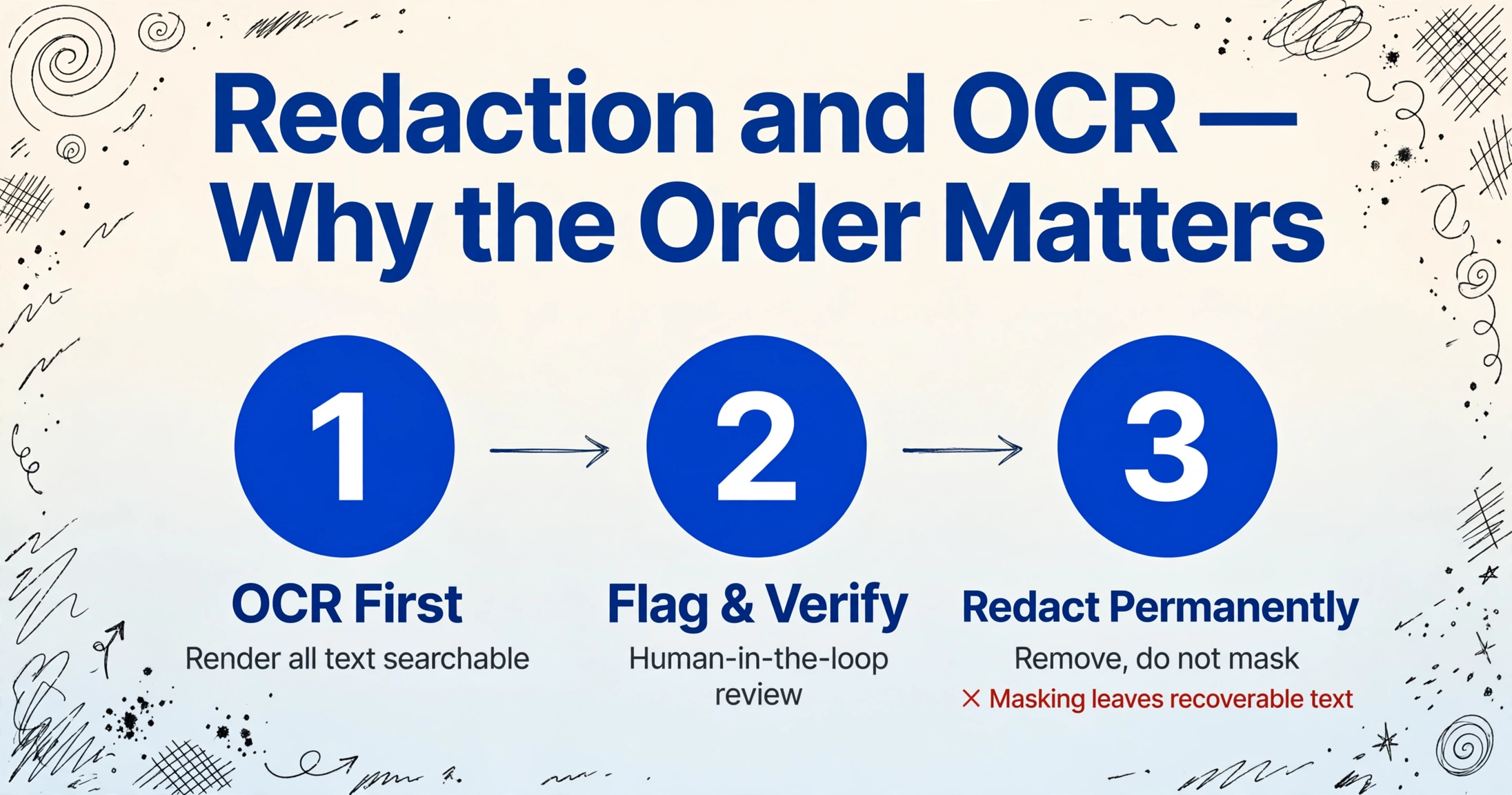
FOIA requires agencies to release responsive records with exempted information redacted. The exemption codes — (b)(1) through (b)(9) for federal agencies — cover everything from national security (b)(1) to geological information about wells (b)(9), with the most common being (b)(6) personal privacy and (b)(7) law enforcement. A single FOIA response can require dozens or hundreds of individual redactions across thousands of pages.
Here is the technical sequence that many government digitization plans get wrong:
Before any redaction tool can identify PII — social security numbers, dates of birth, names of minor children, financial account numbers — the document must have a machine-readable text layer. This is where AI OCR with Named Entity Recognition (NER) capability adds value: it can automatically flag candidate sensitive entities across thousands of pages, reducing the manual search surface from 100% to a reviewed subset.
AI flags potential PII; a trained reviewer confirms each flag. This is not fully automatable — context-dependent decisions (is this "John Smith" a public official whose name must be disclosed, or a witness whose identity must be protected?) require human judgment. The review step produces a verified redaction list.
Permanent redaction removes the underlying text from all layers — visible text, hidden text, metadata, and annotations. Black box overlays or highlight covers are not redaction; the text beneath remains extractable. Output must be a clean PDF with no recoverable content. The E-Government Act of 2002 and FOIA regulations require this level of thoroughness.
The released document must remain navigable and searchable for the requester. Non-exempt portions retain their OCR text layer. This is where proper sequencing matters: if you OCR after redaction, the redacted areas are permanently excluded. If you OCR before redaction but fail to sanitize the OCR layer, you may leak redacted content in the text layer.
The practical takeaway: OCR must be applied early enough to enable automated PII detection, but the OCR output layer must be permanently removed from redacted regions in the final document. Not all OCR tools handle this sanitation step correctly. When evaluating government OCR solutions, ask specifically whether the tool strips text layers from redacted regions — not just whether it can "redact" with black boxes.
PDF/A and Long-Term Archival Requirements
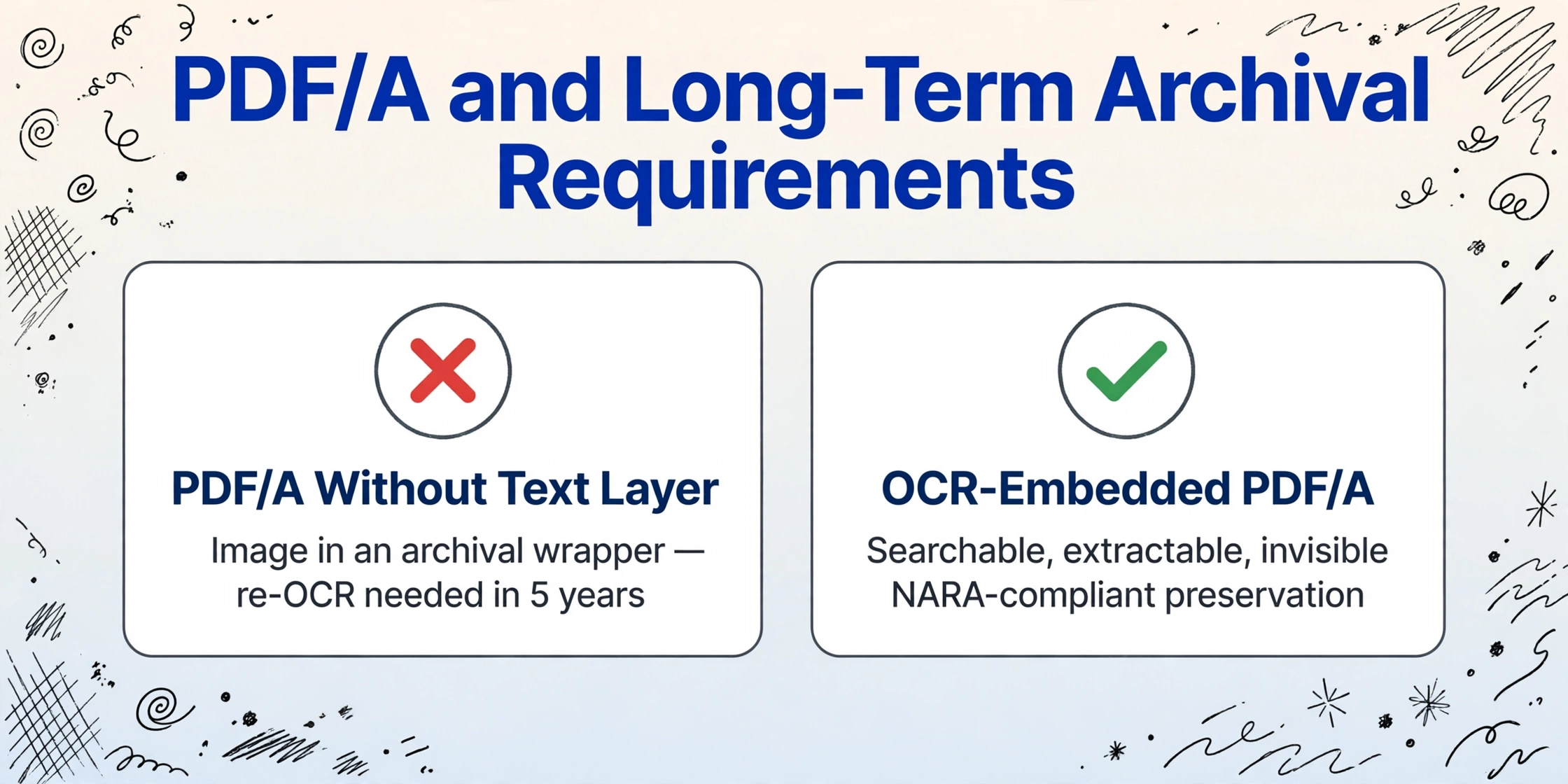
NARA's 36 CFR § 1236 Subpart E requires that digitized permanent records meet specific format and quality standards. The most relevant standard for document preservation is PDF/A — an ISO-standardized version of PDF designed for long-term archiving. Unlike standard PDFs, which may depend on external fonts, linked images, or software-specific features that degrade over time, PDF/A embeds everything the file needs into itself: fonts, color profiles, metadata, and device-independent rendering instructions.
For government agencies, PDF/A is not optional for permanent records. The Federal Agencies Digital Guidelines Initiative (FADGI) sets the implementation benchmarks, and NARA's transfer guidance specifies that digitized permanent records must conform. But here is the intersection with OCR: a PDF/A file without a recognized text layer is an image in an archival wrapper. It passes the format test but fails the usability test. When a FOIA request comes in five years from now for that record, staff will need to re-OCR the entire document from scratch because the 2026 OCR text layer was not preserved.
The correct approach is OCR-embedded PDF/A: the recognized text is stored as a hidden layer within the PDF/A file itself — searchable, extractable, but invisible to the viewer. This preserves both the archival integrity of the bitonal image and the functional searchability of the text. Any government OCR workflow that does not produce PDF/A with embedded text layers is creating a future FOIA backlog, because every future request will require reprocessing the same documents.
When selecting an OCR solution for government use, confirm that the output supports PDF/A-1 or PDF/A-2 conformance with embedded OCR text layers. PDF/A-2 offers improved compression and support for advanced graphics, which matters for documents that contain photographs, maps, or scanned signatures alongside text.
Inter-Agency Format Variance — Why Templates Fail
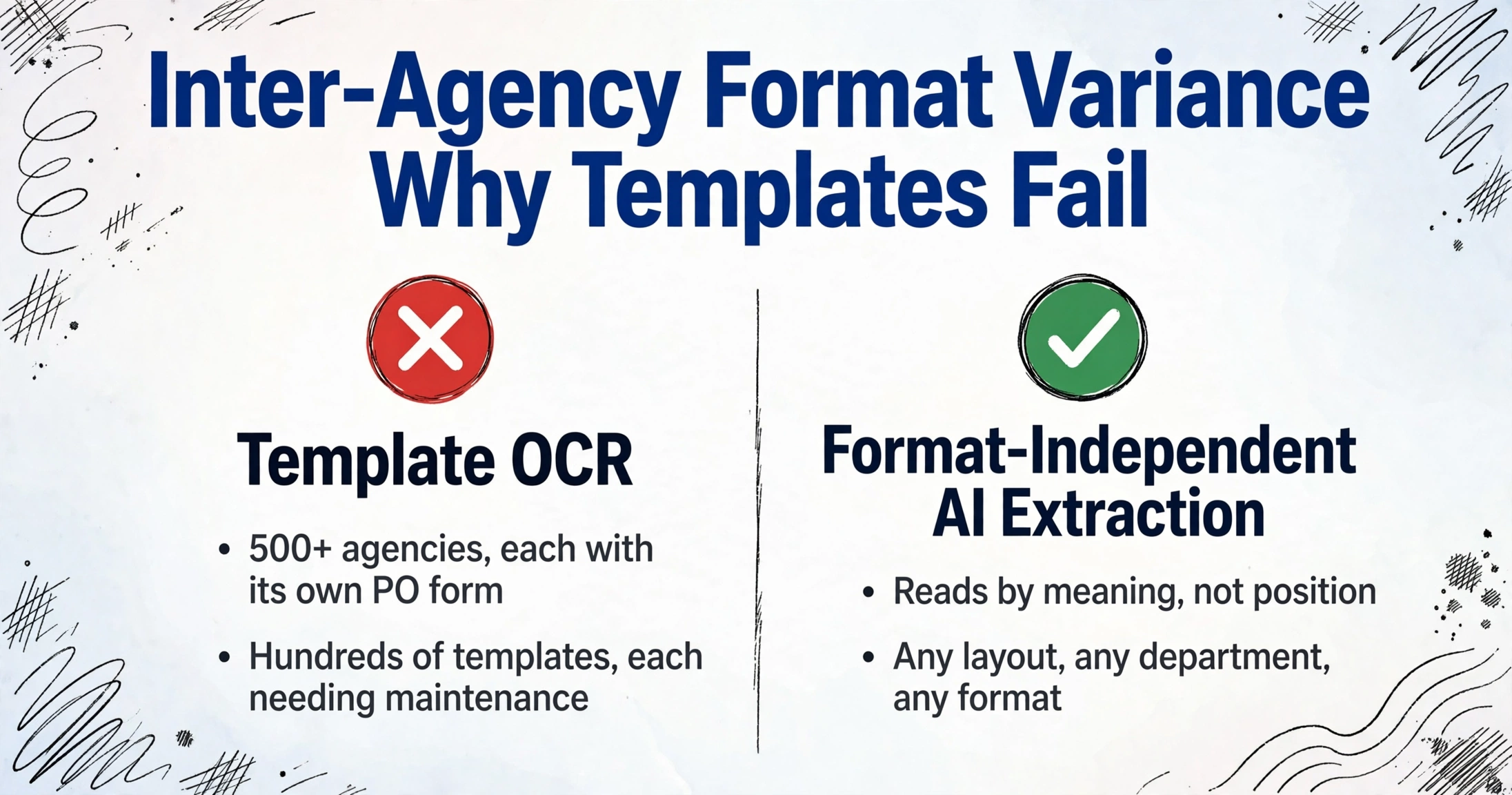
Template-based OCR — the approach used by traditional IDP platforms — requires a pre-built extraction template for each unique document layout. The user draws zones around each field position, assigns a label, and deploys the template. When the next vendor submits a slightly different form — different font, different column order, different label terminology — the template breaks and requires manual rework.
Government agencies face this problem at scale. Consider a single state procurement office that processes purchase orders from 500+ agencies, each with its own PO form. Or a county clerk receiving court filings from 15 different judges' chambers. Or a city FOIA office managing requests that span police, planning, finance, public works, and parks departments — each with its own recordkeeping formats. Template-based OCR would require hundreds or thousands of individual templates, each needing maintenance when forms are updated.
Format-independent extraction — where the AI reads documents by semantic understanding rather than by position — eliminates the template bottleneck. Instead of mapping where data sits on a page, you define what data you need: permit number, applicant name, valuation, expiration date. The AI locates those values in any layout, from any department, in any format. This approach mirrors how government records management actually works: the data categories are stable across agencies (every permit has a permit number), but the visual presentation of those categories varies wildly. The same format-variance challenge appears in banking document processing, where financial institutions must handle statement formats from hundreds of different banks.
This is the same paradigm shift that AI OCR brings to document understanding more broadly — moving from position-based recognition to semantic-based extraction. For government agencies managing records from dozens of sources, this shift is not a convenience upgrade; it is the difference between a project that scales and one that requires permanent template maintenance staff.
ADA and WCAG Accessibility Compliance
Title II of the Americans with Disabilities Act requires that state and local government services — including digital records — be accessible to individuals with disabilities. The Department of Justice has reinforced this through the Web Content Accessibility Guidelines (WCAG) 2.1 Level AA standard, which applies to digital documents and records provided to the public.
For OCR in government, this means three specific deliverables:
A scanned document without OCR is an image. Screen readers (JAWS, NVDA, VoiceOver) cannot interpret image-based text. The OCR text layer must be embedded as tagged PDF content — not just as a hidden overlay — so that assistive technology can read it in logical reading order.
Government documents are often multi-column (court filings, legislative reports, grant applications). Traditional OCR frequently concatenates columns into a single text stream — column 1 line 1, column 2 line 1, column 1 line 2 — making the output unintelligible to a screen reader. AI OCR that understands page layout preserves the logical reading order.
Tables, checkboxes (common in government forms), and signature lines require tag annotations to be accessible. Automated detection of these elements — and conversion into tagged PDF structures — is not a standard OCR feature. AI vision models can identify tables and form fields by understanding what they are, making automated tagging possible in a way that character-level OCR cannot achieve.
ADA accessibility is not a secondary concern in government OCR. The baseline capability of traditional OCR — recognizing characters and outputting text — does not produce accessible documents. Producing WCAG 2.1 AA-compliant output requires a higher level of document understanding that includes layout analysis, semantic tagging, and reading order preservation. Agencies that fail to account for this at the procurement stage may find that their entire digitized repository is inaccessible and requires costly remediation.
Chain of Custody and Audit Readiness
Digitized government records must be demonstrably authentic and unaltered. FOIA, the Federal Rules of Evidence, and state public records laws require that agencies can prove a digital record is what it claims to be — that it was created from the original paper document at a specific time, by an authorized operator, and has not been modified since capture.
This chain of custody requirement has concrete implications for OCR workflows:
- Immutable source image: The original scanned image must be preserved as a bitonal master, separate from any OCR processing. OCR should operate on a copy, not alter the original.
- Process logging: Every OCR operation — when it ran, what software version, what settings, what output was generated — must be logged and retained. This metadata supports the authenticity claim if the record is challenged.
- Checksum verification: Cryptographic hashes (SHA-256) of the source image and the OCR output should be computed and stored. Any future verification can compare hashes to confirm no undetected modification occurred.
- Version control for redacted releases: When a FOIA officer releases a redacted document, the agency must retain both the unredacted original (with chain of custody) and a log of what was redacted under which exemption code. The OCR text layer in the released version must be verified to contain none of the redacted content.
Most commercial OCR tools are not designed with these audit requirements in mind. Government agencies should look for solutions that offer API-level access to process logs, support checksum generation, and allow the OCR workflow to be integrated into a broader records management system that handles the chain-of-custody tracking.
For legal contexts — particularly OCR applied to legal documents and court filings — the chain of custody requirements are even more stringent. FRCP Rule 34 requires that electronically stored information be produced in a "reasonably usable" format. An OCR-processed document where the text layer can be shown to have been generated from a verified source image, through an audited process, meets that standard. One where the source cannot be traced may be challenged.
For agencies that handle processing across departments or need to consolidate document intake from external sources, tools like Collection Link — which generate a shareable upload link so third parties can submit files directly into a processing queue — help maintain a clean chain of custody by centralizing the intake point and eliminating ad-hoc email attachments or USB transfers.
Frequently Asked Questions
Does OCR-processed output meet NARA's digitization standards for permanent records?
Yes, provided the output conforms to 36 CFR § 1236 Subpart E requirements. This means the digitized image must meet FADGI quality benchmarks, the metadata fields specified in the regulation must be captured at the file or item level, and if OCR is used, the text layer must be embedded appropriately. NARA does not require OCR for permanent records, but agencies that choose to use it must follow the updated transfer guidance on appropriate use of OCR technology. The key is that OCR output does not replace the original bitonal image — it supplements it as a searchable layer.
Can I redact a document after OCR, or do I need to OCR it again?
You must OCR the document before redaction, use the text layer to identify and flag PII for review, apply permanent redaction that removes both the visible content and the underlying text layer in redacted areas, and then verify that no recoverable text remains in the redacted regions. Applying OCR after redaction would mean the redacted content was never searchable for automated detection — which undermines the efficiency gain of using OCR for FOIA processing in the first place. If you are working with documents that have already been redacted incorrectly (e.g., with black box overlays that leave text recoverable), re-scanning the physical redacted document and applying OCR to the new scan is sometimes the safest remediation path.
Is OCR a requirement for ADA compliance on government documents?
Not explicitly by statute, but in practice yes. WCAG 2.1 AA compliance requires that non-text content have a text alternative. A scanned PDF page as an image contains no text that a screen reader can access. OCR is the only practical way to create that text layer. However, basic OCR alone — even high-accuracy OCR — does not guarantee ADA compliance. The output must also preserve logical reading order, tag tables and form fields correctly, and maintain document structure. AI OCR with layout understanding is significantly more likely to produce WCAG-compliant output than traditional character-level OCR.
How does OCR handle documents from multiple agencies with different form layouts?
Traditional template-based OCR requires a separate template for each unique layout — impractical when an agency receives documents from hundreds of sources. Format-independent AI extraction solves this: you define the data fields you need (permit number, applicant name, issue date, etc.) and the AI locates them in any layout by understanding what each field means semantically. No templates, no training per form type. This is the same technology used for legal document extraction across different court formats, where similar format variance challenges exist.
What accuracy should I expect from OCR on government records?
On clean, typed documents — printed forms, typed reports, computer-generated records — modern AI OCR achieves 95-99% field-level accuracy for clearly defined extraction fields. Accuracy drops on handwritten forms (85-95% for block print, lower for cursive), carbon-copy form pages (common in older government records), damaged or faded originals, and documents with stamps or seals overlapping text. For permanent records where 100% fidelity is required — such as vital records (birth/death certificates) — a human verification step after AI extraction is recommended. The National Archives' Quality Management Guide for digitization provides a framework for acceptable error rates based on record type.
Can OCR handle batch processing for large FOIA request responses?
Yes — batch processing is essential for FOIA work because single requests routinely span hundreds or thousands of pages. AI OCR platforms that support batch-first workflows can ingest multiple documents simultaneously, apply consistent extraction rules across all pages, and merge outputs into a single structured file. This is significantly more efficient than processing each document individually, particularly when the same FOIA request covers records from multiple departments with different formats. The key capability to look for is batch-level output consolidation: one FOIA request should produce one searchable output, not a folder of individual files.