How to Extract AU PAYG Payment Summary Data
for Payroll Reconciliation (2026 Guide)
Every July, payroll teams across Australia face the same bottleneck: by the 14th, each employee must receive a PAYG withholding payment summary covering the financial year that ended on 30 June. For the roughly 1.3 million businesses that run payroll through Xero, MYOB, or Employment Hero, the software generates those summaries automatically. The reconciliation step — verifying that the figures on every summary match what the payroll system actually paid — still happens in a spreadsheet, and for firms without fully integrated reporting, that means someone retypes ABNs, TFNs, gross payments, and tax withheld from dozens or hundreds of certificates into Excel by hand.
Key Takeaways
- Single Touch Payroll was supposed to retire PAYG payment summaries — but STP-exempt employers, closely held payees, and five years of mandatory pre-transition records mean traditional certificates still arrive on payroll desks every July in five incompatible visual layouts.
- A template-based OCR tuned to Xero's layout will silently miss the Gross Payments field on an MYOB summary that places it in a different position — and the first sign of trouble won't be a red cell in your spreadsheet but an ATO data-matching query arriving months after you thought the year was closed.
- Field-level semantic extraction processes all five payroll formats in one batch by matching the concept of a field rather than its coordinates on the page — and a Computed Column checking Gross Payments × 12% against actual super contributions catches SG shortfalls across your entire workforce before you open Excel.
What a PAYG Payment Summary Contains — and What Each Field Means for Reconciliation
The PAYG (Pay As You Go) payment summary, formally the PAYG payment summary – individual non-business (NAT 0046), is the end-of-year certificate Australian employers must issue to every employee who had tax withheld during the financial year. It is the Australian equivalent of the UK P60 and the US W-2 — same function, entirely different tax system. The Australian Taxation Office mandates seven distinct PAYG payment summary types, but the individual non-business form is by far the most common — it covers standard employees receiving wages or salaries.
Understanding what each field represents for reconciliation — not just its label — is what determines whether your extracted spreadsheet reconciles against your payroll records on the first pass, or generates an afternoon of cross-referencing. Here are the fields grouped by their reconciliation function:
Identity & Reference Fields
- Payer ABN — Australian Business Number, 11 digits. Anchors every row to the correct employer entity. Critical when your organisation runs multiple ABNs for different divisions.
- Payee TFN (Tax File Number) — 9-digit personal tax identifier. The primary employee key for ATO cross-referencing. A missing or incorrect TFN triggers higher withholding rates and reconciliation mismatches.
- Period During Which Payments Were Made — typically 1 July to 30 June of the income year. Confirms the summary covers the full financial year, not a part-year period.
Core Payment & Tax Figures
- Gross Payments — total salary, wages, allowances, bonuses, and commissions paid during the financial year. This is the figure you reconcile against your payroll system's year-to-date gross earnings report.
- Total Tax Withheld — total PAYG withholding deducted and remitted to the ATO. Must match the sum of every pay-run withholding amount on your activity statements (labels W1 and W2).
- Reportable Fringe Benefits Amount — the grossed-up value of fringe benefits exceeding $2,000 in the FBT year (1 April to 31 March). Reported separately because it affects income tests for Medicare levy surcharge and other government benefits, even though it is not included in the employee's assessable income. The UK equivalent — P11D benefits reporting — serves a similar function under a different tax code, though the gross-up calculation and reporting thresholds differ.
Superannuation Fields
- Reportable Employer Super Contributions (RESC) — super contributions above the Super Guarantee minimum (12% in 2025-26). This includes salary sacrifice arrangements and additional voluntary employer contributions. Standard SG contributions are not reportable. A common reconciliation error: mistaking total super paid for RESC.
- Employer SG Contributions — while not a field on the payment summary itself, this must be verified independently: 12% of each employee's ordinary time earnings, capped at the quarterly maximum contribution base ($62,500 for 2025-26, equating to $7,500 per quarter maximum).
Lump Sum & Termination Payments
- Lump Sum A — unused annual leave paid on termination. Taxed at concessional rates.
- Lump Sum B — unused long service leave paid on termination. Separate from Lump Sum A because different tax treatment applies.
- Lump Sum D — tax-free component of a genuine redundancy or early retirement scheme payment. Not assessable income, but must still be reported.
- Lump Sum E — payments that relate to earlier income years (back pay). These may be eligible for tax offset to prevent bracket creep pushing the lump sum into a higher marginal rate.
- Allowances — separately itemised on the summary. Common types include tool allowance, travel allowance, and first aid allowance. Each allowance type may have different tax treatment.
If an employee received an employment termination payment (ETP) during the year, the employer must issue a separate PAYG payment summary – employment termination payment (NAT 70868) within 14 days of the payment. The regular individual non-business summary will still show the salary portion, creating a two-document reconciliation scenario for departing employees — a detail that catches payroll teams off guard if they only expect one certificate per person.
The core extraction principle: You define the output columns your reconciliation spreadsheet needs — "Employee Name," "TFN," "Gross Payments," "Total Tax Withheld," "Reportable Employer Super Contributions" — and the AI locates each value on each payment summary by understanding what the field means semantically, not where it sits on the page. The same column definition works across Xero's PDF layout, MYOB's printed summary format, Employment Hero's template, and scanned paper certificates from a previous payroll year because the AI reads field meaning, not template position.
Why the Same PAYG Data Looks Different Across Payroll Systems
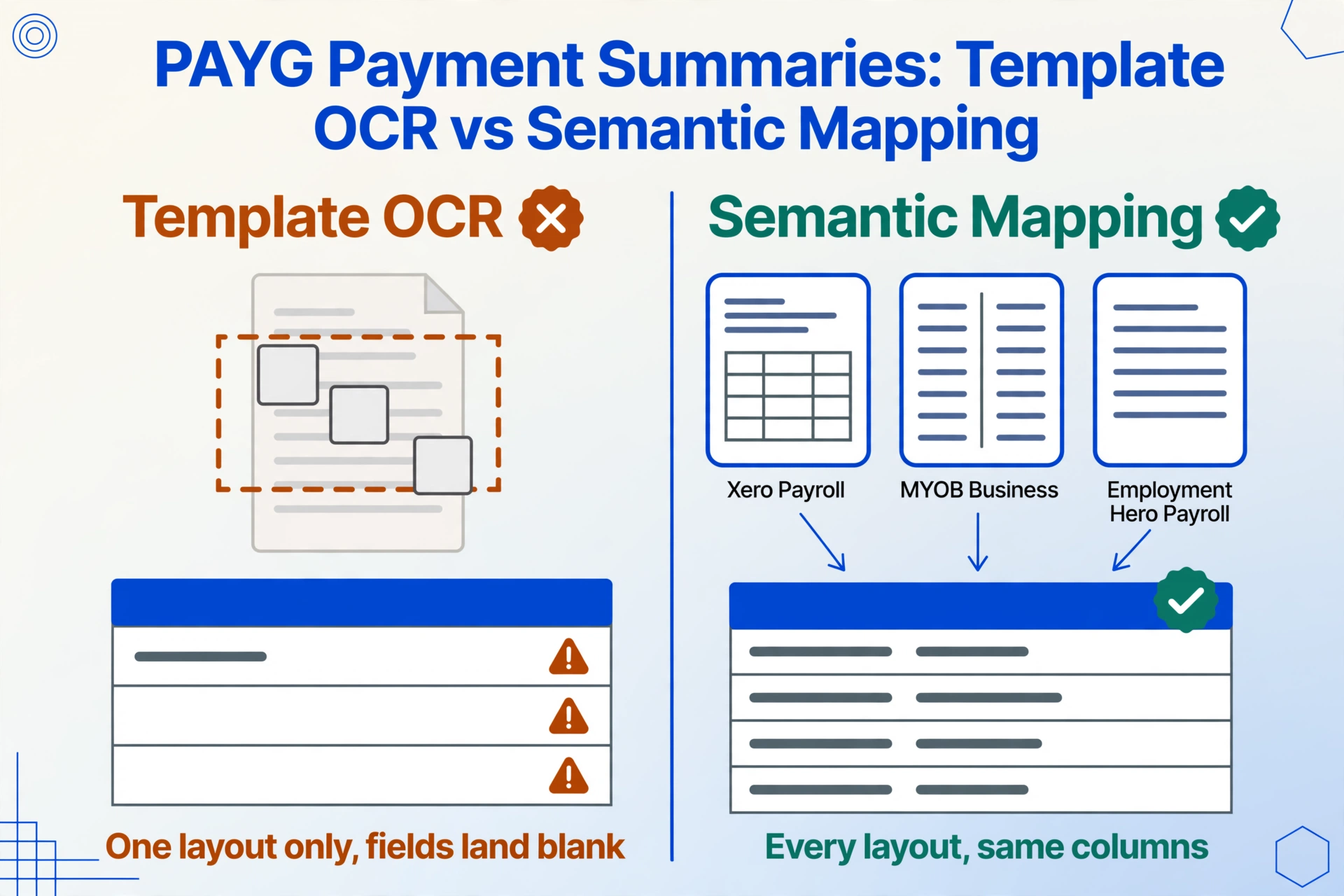
If every PAYG payment summary had identical box positions, extraction would be solvable with any template-based OCR tool. But the ATO does not mandate a single visual layout — it specifies the data content. Under the PAYG payment summary forms and guidelines, the ATO provides triplicate forms for manual completion, but self-printed summaries (generated by payroll software) may use any layout as long as all prescribed fields appear.
Every major Australian payroll platform renders the same ATO-mandated data differently. Xero Payroll — Australia's dominant cloud accounting platform with over 60% market share — places the payer ABN and employee TFN at the top of the summary, with payment figures in a single table block below. MYOB Business, holding roughly 23% of the market, often uses a two-column format with identity fields on the left and payment details on the right. Employment Hero Payroll stacks everything in a vertical list. KeyPay uses yet another arrangement. The paper summaries ordered from the ATO's publication service follow the NAT 0046 triplicate design, which differs again from every software-generated layout.
This is not a bug in the system. It is the natural consequence of a regulatory framework that mandates what data must appear rather than how it must be laid out — the same design principle behind the UK's P60 specification RD1, which similarly permits substitute form layouts. The result for anyone doing extraction is that a template-based tool configured for Xero's layout will fail on MYOB's and vice versa.
The gross payments field illustrates this in a way that costs real time. Xero might print "Gross Payments" in bold with the dollar figure on the same line. MYOB might print "Gross payments" as a row label in a table with the value in an adjacent cell. Employment Hero might use "Total gross payments" in a bordered box. A template looking for the exact string "Gross Payments" at a specific pixel coordinate catches one format and misses the other two. Semantic extraction — reading by field meaning rather than by position — handles all three because it understands that whether labelled "Gross Payments," "Total Gross," or "Gross YTD," the concept being extracted is the same.
Setting Up Your PAYG Extraction Workflow
The workflow that replaces manual retyping has three steps. The first — defining your column schema — is what you do once and reuse across every payroll provider, every tax year, and every employee batch.
Define your output columns — once, for every summary format
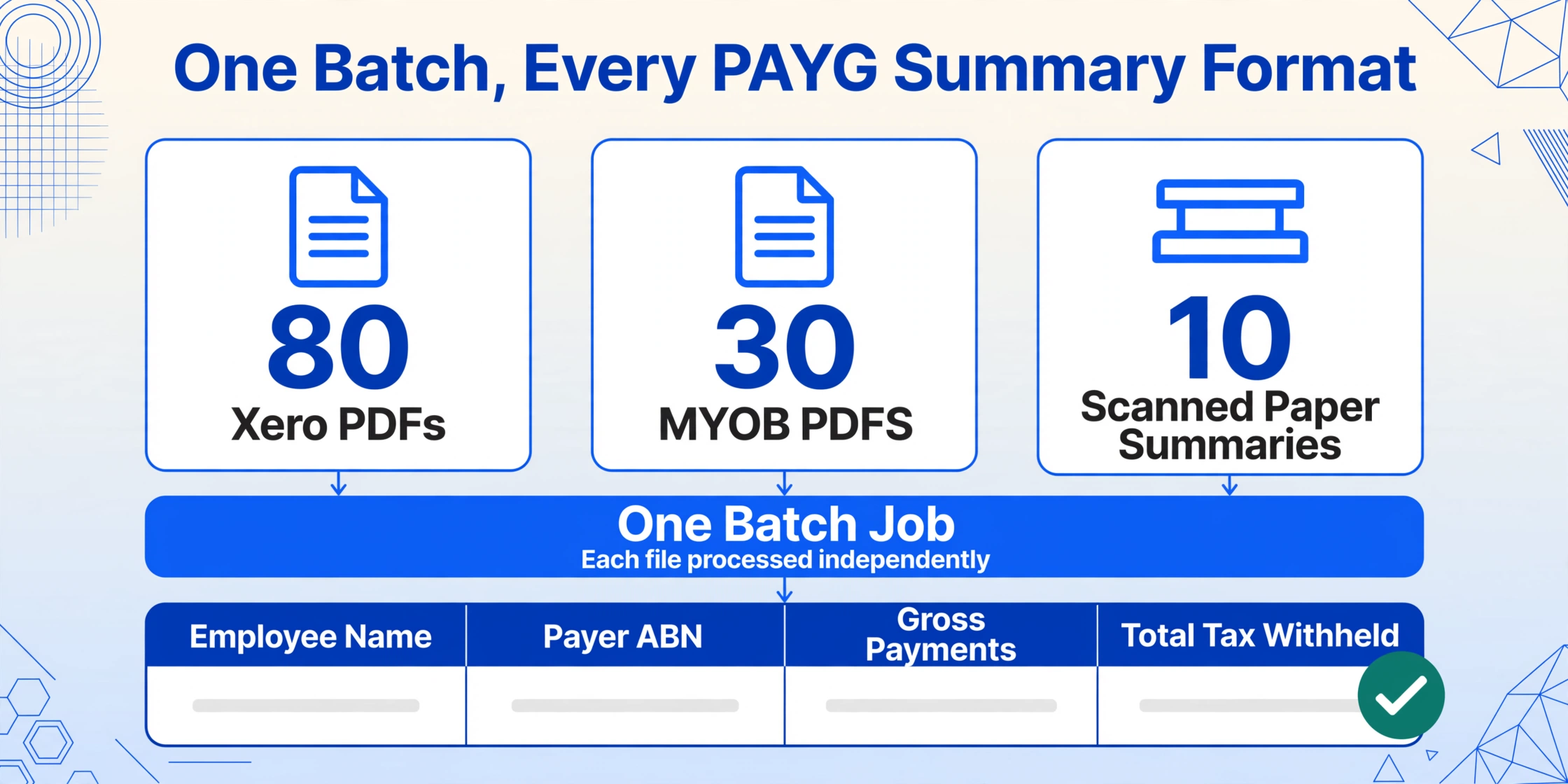
Type the field names exactly as you want them to appear as column headers in your reconciliation spreadsheet. For a comprehensive reconciliation workbook, a practical starting set is: Employee Name, TFN, Payer ABN, Gross Payments, Total Tax Withheld, Reportable Fringe Benefits Amount, Reportable Employer Super Contributions, Allowances, Lump Sum A, Lump Sum B, Lump Sum D, Lump Sum E, Period Start, Period End. This is Custom Column Extraction: you define the output schema, and the AI maps each document's fields to your columns by semantic meaning — the same column names work across every payroll provider's payment summary format. You can also add a Computed Column — for instance, a column named "SG Check (Gross Payments × 12%)" to flag discrepancies between actual super reported and the statutory minimum — which the AI calculates during extraction so you get variance detection built into the output rather than as a separate Excel step.
Upload all summaries in one batch
Drop in the full folder — 80 PDFs from Xero, 30 from MYOB, and 10 scanned paper summaries from a contractor who still mails physical certificates. Batch processing handles them all in a single job: each file is processed independently with your column schema applied, and all results are merged into one unified spreadsheet. Files can be digitally generated PDFs from payroll software, scans of printed summaries, or phone photos of certificates — the AI processes all three input types.
Export to Excel and begin reconciliation
Download the merged spreadsheet as an Excel file. At this point you have one row per employee per payment summary type, with every field already in its own column. The next step — reconciliation against your payroll system — now becomes a spreadsheet-native operation rather than a data entry exercise: VLOOKUP on TFN to your payroll register, SUM of gross payments against the payroll year-to-date report, cross-check of total tax withheld against the quarterly BAS totals (labels W1 and W2). The five hours that would have been spent retyping is now five minutes spent verifying.
The workflow scales naturally. For a mid-size firm with 120 employees, the batch upload takes a few minutes to process, and the resulting Excel file is immediately ready for the reconciliation checks described in the next section. The same column schema works next year — the fields on a 2025-26 summary are identical to the fields on a 2026-27 summary, and the AI adapts to any layout changes your payroll software introduces between tax years.
Why this matters at scale: A payroll officer processing summaries for 120 employees across two payroll systems saves roughly five hours of manual data entry — but more importantly, eliminates the transcription errors (transposed TFN digits, misread lump sum amounts) that trigger ATO reconciliation queries and eat the time you thought you saved.
Files are processed securely and not stored.
Reconciliation: What to Check After Extraction
With the extracted spreadsheet in hand, the reconciliation phase moves from data entry to verification. The checks below are the ones that matter for payroll accuracy and ATO compliance — grouped by the evidence source you are reconciling against.
Gross payments vs payroll year-to-date report
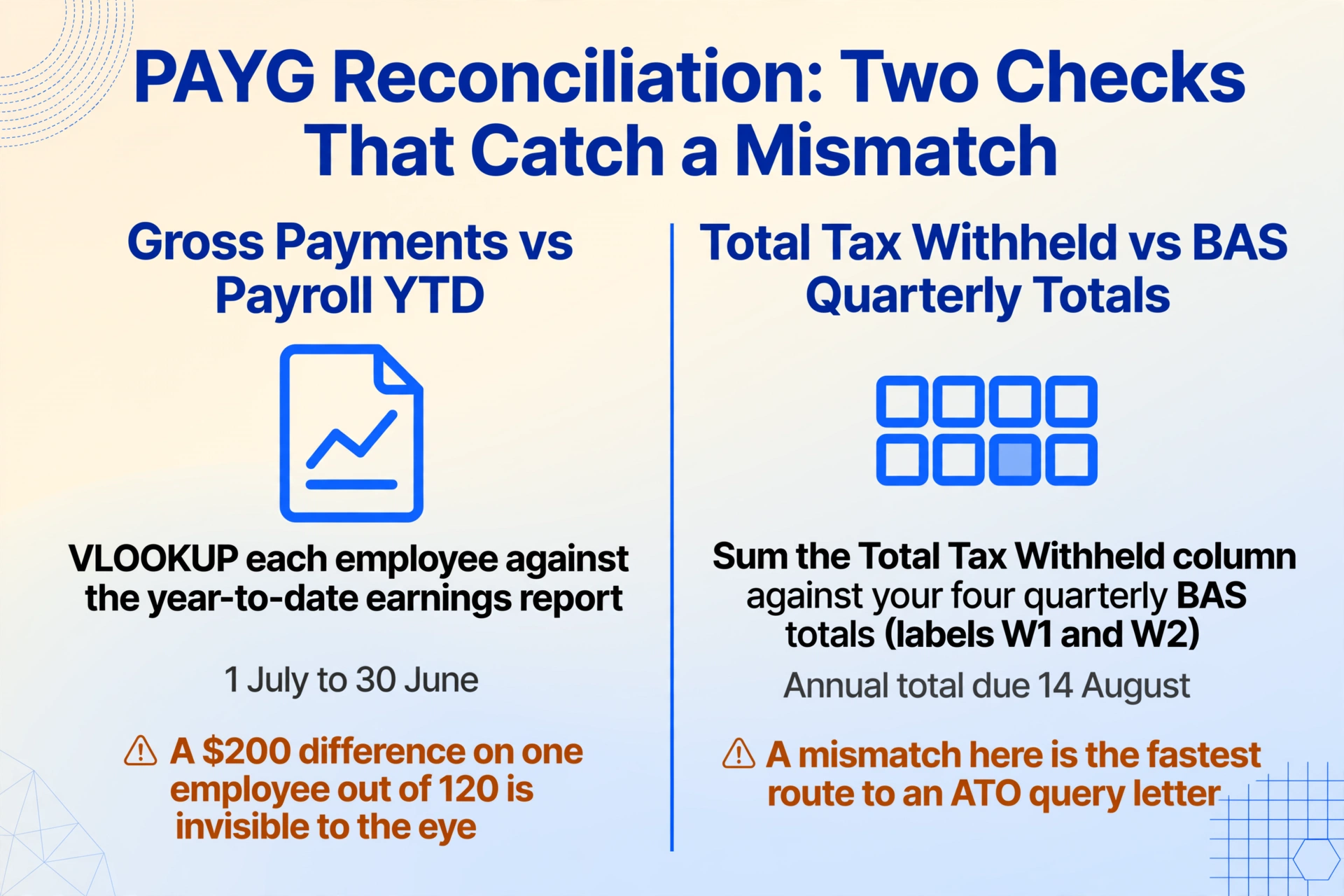
Run your payroll system's year-to-date earnings report for the financial year (1 July to 30 June) and VLOOKUP each employee's gross payments from the extracted spreadsheet against it. Discrepancies here are the most common — and the hardest to spot manually. A difference of $200 on one employee out of 120 is invisible to the eye but catches the attention of the ATO's data-matching algorithms. Common causes: a manual pay adjustment entered directly in the payroll system after the final pay run, a bonus paid in June but processed in the July pay run, or an employee whose pay cycle straddles the financial year boundary.
Total tax withheld vs BAS quarterly totals
Sum the Total Tax Withheld column from your extracted spreadsheet and compare it against the sum of PAYG withholding amounts reported on your four quarterly Business Activity Statements (labels W1 for total salary and wages, W2 for total amounts withheld). The ATO's data-matching system compares the annual total of PAYG withholding reported on the PAYG payment summary annual report (due 14 August) against the amounts you declared on BAS throughout the year. A mismatch here is the fastest route to an ATO query letter. If your organisation has employees across multiple states — and therefore potentially multiple payroll tax jurisdictions — run this check per state grouping to catch location-level errors.
Super contributions vs statutory minimum
For employees earning below the maximum contribution base ($62,500 per quarter, or $250,000 annually), verify that employer super contributions equal at least 12% of ordinary time earnings for the 2025-26 financial year. For employees above the cap, verify the quarterly contribution is exactly $7,500 (12% × $62,500). A Computed Column during extraction — "SG Variance (12% × Gross Payments − RESC)" — makes this a single-column sanity check rather than a manual calculation across 120 rows. From 1 July 2026, Payday Super requires contributions to reach the employee's fund within seven business days of each pay date — making reconciliation even more granular, as timing mismatches will be detectable per pay period rather than per quarter.
Employee count cross-check
The number of rows in your extracted spreadsheet should match the number of employees who received a payment summary. Count includes: full-time, part-time, casual employees who had tax withheld, and former employees who worked any period during the financial year. It excludes contractors paid under an ABN (unless voluntary withholding applied) and employees paid entirely under the tax-free threshold with zero withholding. A shortfall here means someone didn't get their certificate — which, for employees who need it to lodge their tax return, becomes urgent when the 14 July deadline has already passed.
When a discrepancy survives all four checks: the most common root cause is a timing difference. Either the payroll system recorded a June payment as accruing to the current financial year while the payment summary included it in the next (because the payment date fell on or after 1 July — which is correct under ATO rules), or a pay adjustment was processed after the finalisation declaration was submitted. Before amending any summary, confirm the payment date against your bank records — the date funds left your account is what determines which financial year the payment belongs to.
What the STP Transition Means for Payment Summaries — and Why They Haven't Disappeared
Single Touch Payroll (STP) has been mandatory for all Australian employers since the 2019-20 financial year. Under STP, payroll data — including gross wages, PAYG withholding, and super contributions — is reported to the ATO with every pay run. At the end of the financial year, employers submit a finalisation declaration by 14 July, and employees access their income statement (the STP-era term replacing "payment summary" or the older "group certificate") through their myGov account rather than receiving a physical document from their employer.
The assumption that follows — that PAYG payment summaries are obsolete — is incorrect in three specific scenarios that collectively affect thousands of Australian employers:
1. STP-exempt employers. Certain employer categories — including withholding payer number (WPN) holders and employers granted specific ATO exemptions — are not required to report through STP. These employers must still issue paper PAYG payment summaries by 14 July and lodge a PAYG payment summary annual report (using the PAYG payment summary statement, NAT 3447) by 14 August.
2. Closely held payees. Directors, family members of a family business, and certain trust beneficiaries — classified as "closely held payees" — may be reported through STP but have a separate finalisation deadline of 30 September. Some employers choose to issue these payees a traditional PAYG payment summary as an interim document while STP data is still being finalised.
3. Prior-year records and legacy systems. Employers that transitioned to STP partway through a financial year or changed payroll providers retain payment summary obligations for the pre-transition period. Historical summaries from years before the STP switch — which the ATO requires employers to keep for five years — exist only as scanned PDFs or printed copies, not as STP income statements in myGov. During an audit, a tax agent review, or an employee dispute about a prior year's earnings, these legacy summaries must be locatable and extractable.
For the payroll officer doing reconciliation in July 2026, the practical reality is that the "STP means no more payment summaries" narrative breaks down at the edges — and the edges are exactly where the hardest reconciliation work lives. Employees who left mid-year and received an ETP payment summary. Contractors paid under a voluntary withholding agreement who need a business and personal services income summary (NAT 72545). A prior-year correction that requires re-issuing a 2023-24 summary while the current year's STP data is already finalised. Each edge case is a document that exists only as a PDF or paper form — and each one needs to be extracted into the same reconciliation spreadsheet.
This is also why the UK equivalents — P60 extraction, P45 leaver forms, CIS deduction statements, and batch P60 processing — follow the same extraction logic despite operating under an entirely different tax year and withholding system. The document type changes; the reconciliation challenge does not.
Creating a Repeatable Audit Trail Across Tax Years
The ATO requires employers to retain payroll records — including payment summaries — for five years from the date they were prepared or obtained. For a business that has been issuing PAYG payment summaries for a decade, that is potentially ten years of certificates across three payroll software migrations, two STP transition periods, and a filing cabinet's worth of scanned paper records.
A spreadsheet containing every field from every summary, with one row per employee per tax year, serves three functions beyond the immediate reconciliation task:
ATO audit readiness
If the ATO requests evidence of PAYG withholding for a specific employee in a specific year — for instance, during a review triggered by an employee's tax return discrepancy — having a searchable spreadsheet with the employee's TFN, gross payments, and tax withheld for that year means retrieving the answer in seconds rather than digging through archived payroll software that no longer runs on your current operating system.
Year-over-year comparison
A single spreadsheet with tabs per financial year lets you VLOOKUP an employee across years — spotting anomalies like a $0 tax withheld in a year where gross payments were $85,000, or a sudden jump in reportable super contributions that signals a salary sacrifice arrangement you were not aware of. These patterns are invisible when each year's summaries live in separate PDF folders.
Payroll software migration
When switching from MYOB to Xero — or from any legacy system to a cloud platform — the extracted spreadsheet of prior-year summaries becomes the source of truth for historical employee data. Opening balances, prior-year earnings, and accumulated leave entitlements all need to be manually entered into the new system. Starting from a verified extraction rather than a manual retype eliminates the most common source of migration errors: a TFN keyed in with two digits transposed, which surfaces months later as an ATO mismatch notice.
Frequently Asked Questions
Does STP mean I no longer need to issue PAYG payment summaries?
For the majority of employees at STP-reporting employers — yes. Once you finalise your STP data by 14 July, employees access their income statement through myGov. You do not need to give them a separate paper or PDF payment summary for periods reported through STP. However, if your business has closely held payees, STP-exempt operations, or prior-year records from before your STP transition, those scenarios still require traditional payment summaries — and those summaries still need to be extracted and reconciled.
Can AI extraction handle both digital PDFs and scanned paper PAYG summaries?
Yes. AI-powered extraction reads the visual content of the document — whether it originated as a digitally generated PDF from Xero or a scanned copy of a triplicate NAT 0046 form with handwritten corrections — and extracts fields based on their semantic meaning. Scanned documents with moderate skew, varying lighting, or aging paper stock still extract correctly because the AI does not rely on a clean template alignment.
What if an employee has both a regular PAYG summary and an ETP payment summary?
Process both documents in the same batch. The regular individual non-business summary contains salary, allowances, and lump sum payments A-E. The ETP summary (NAT 70868) contains the taxable component of the termination payment and the tax withheld on it. Both feed into the same reconciliation spreadsheet — you will have two rows for that employee (one per document type) with different field sets. Group them by TFN to see the employee's complete year-end picture in one view.
How does the Australian financial year affect extraction for employees who started or left mid-year?
The Australian financial year runs 1 July to 30 June. A PAYG payment summary covers the period during which payments were made, not the period during which work was performed. If an employee started on 15 June 2026 and their first pay was processed on 1 July 2026, that payment belongs to the 2026-27 financial year and appears on next year's summary — even though the work happened in the 2025-26 year. The "Period During Which Payments Were Made" field on the summary confirms the date range. When reconciling, always match on payment date, not work date.
Does batch extraction work when summaries come from different payroll providers?
Yes — in fact, this is the strongest use case for semantic extraction. Upload Xero-generated summaries, MYOB summaries, and scanned paper certificates in the same batch. Because the extraction reads field meaning rather than template position, "Gross Payments" on a Xero layout and "Gross payments" in a different position on an MYOB layout are recognised as the same field and placed in the same column. The output is one unified spreadsheet with consistent columns regardless of the input format mix.
What's the difference between RESC and standard SG contributions on a PAYG summary?
Reportable Employer Super Contributions (RESC) are contributions above the Super Guarantee minimum. Standard SG contributions — the compulsory 12% of ordinary time earnings your business pays to meet its legal obligation — are not reportable and do not appear on the payment summary. RESC typically includes salary sacrifice arrangements (where the employee voluntarily directs part of their pre-tax salary into super) and any additional employer contributions beyond the statutory minimum. A common reconciliation mistake is adding RESC to gross payments to get total remuneration — RESC is reported to the ATO for income test purposes but is not included in the employee's assessable income.
Can I set up automated detection of reconciliation mismatches during extraction?
Yes — using Computed Columns, you can embed validation rules directly into the extraction step. For example, a column defined as "SG Check (if Gross × 0.12 > RESC then 'OK' else 'REVIEW')" flags employees whose reported employer super appears below the statutory minimum before you even open the spreadsheet. Similarly, a column comparing total tax withheld against an expected effective tax rate range can surface outliers — an employee with $85,000 in gross payments and $3,000 in tax withheld is almost certainly an error, and Computed Columns catch it at extraction time rather than during manual review.
Making July Reconciliation Routine Instead of a Crunch
The deadline does not change. Every year, the ATO requires STP finalisation and — for exempt or deferred employers — PAYG payment summary issuance by 14 July. What can change is how much of the two-week window between 1 July and the deadline is spent retyping numbers versus verifying them.
For a payroll team processing 120 summaries across two payroll platforms, the difference between manual entry and extraction is the difference between spending the week of 10 July hoping nothing was mistyped — and spending it on a Friday morning confirming that the reconciliation spreadsheet matches the payroll register, then sending employees their income statement notifications before lunch.
The extraction workflow described here works the same way next year, with the same column schema, regardless of which payroll software your organisation is running by then. The fields on the PAYG payment summary — defined by the ATO, not by your software vendor — will not change. What changes each year is the employees, the figures, and the pressure of the July deadline. Removing the retyping step means the pressure lands on verification, not data entry — and verification is where a payroll officer's expertise belongs.