OCR Handwriting Accuracy:
Why 90% CER Still Means Wrong Totals
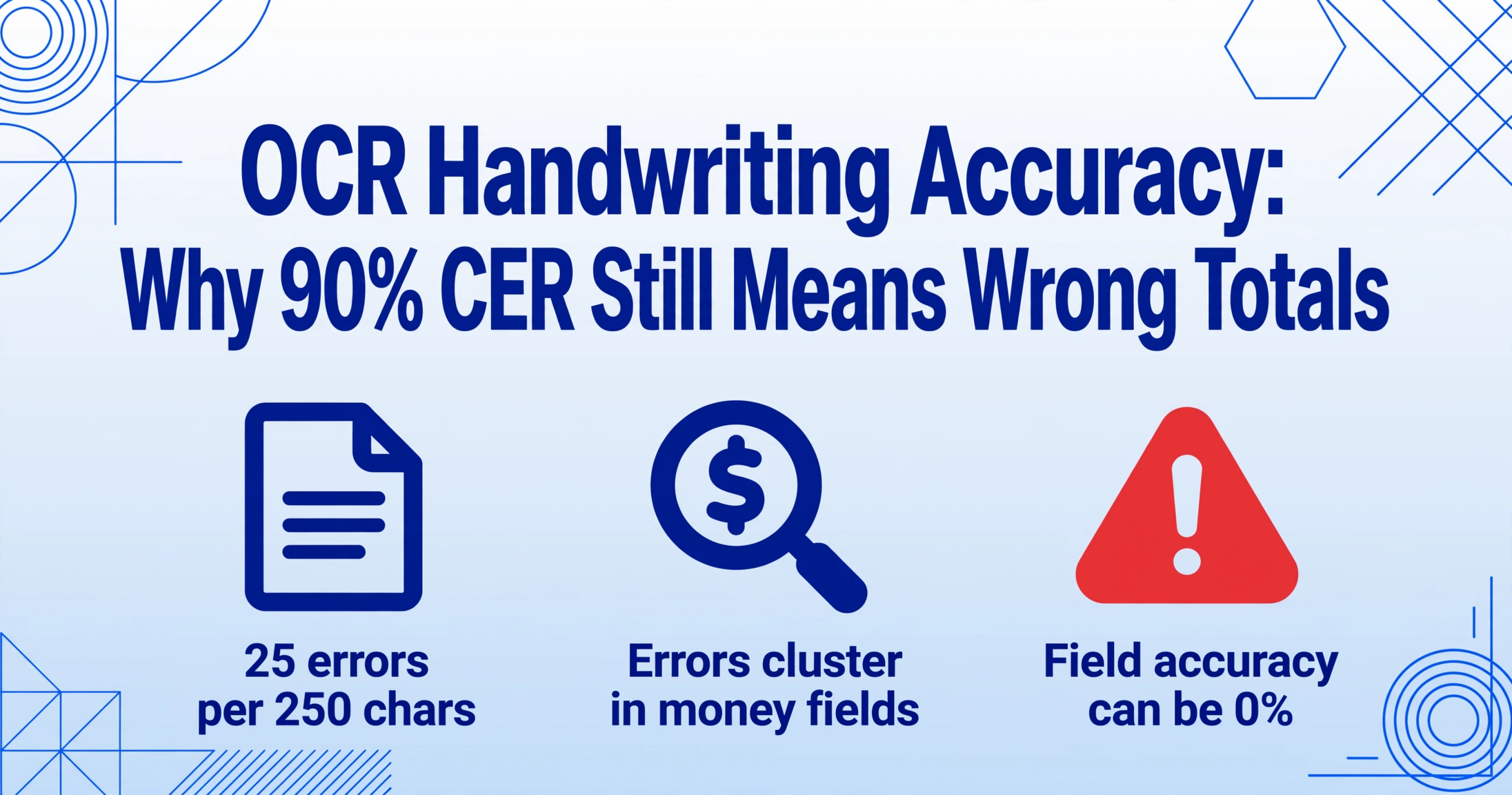
When an OCR vendor claims "90% accuracy on handwriting," they are talking about character-level recognition — whether individual letters and digits were read correctly, on average, across the page. But that average hides a devastating problem: a 10% character error rate does not produce 10% bad data. It produces catastrophic failures on specific fields, because handwriting errors cluster in the places that matter most — totals, dates, identifiers — and a single wrong digit in an invoice total or a meter reading makes the entire extraction wrong. The gap between "90% character accuracy" and "usable field-level data" is the most expensive misunderstanding in document automation today.
Key Takeaways
- "90% handwriting OCR accuracy" means 1 in 10 characters is wrong — and the errors cluster in your totals and meter readings, not in the letterhead.
- An 8-digit handwritten total at 90% CER has a 57% chance of containing at least one mistake — you didn't eliminate manual work, you just renamed data entry to "verification" and still check every value.
- Stop chasing character-level accuracy. Semantic extraction — where the AI knows "Qty Received" is a number and "Invoice Date" is a date — eliminates impossible interpretations before they reach your spreadsheet.
What "90% Accuracy" Actually Measures on Handwriting
Character Error Rate (CER) is the standard metric for evaluating handwriting recognition. It counts every substitution (a "5" read as "6"), insertion, and deletion, then divides by total characters. The industry benchmark for printed text — clean, high-resolution, standard fonts — is a CER below 1%, meaning 99% or better character accuracy.
Handwriting changes the math completely. An independent comparison of major OCR tools found that on handwritten print (block letters), ABBYY FineReader achieved 95.2% accuracy and Adobe Acrobat managed 88.6%. On cursive handwriting, the gap widened: ABBYY at 91.7%, Adobe at 79.3%, and Readiris at 84.9%. These are best-in-class results from dedicated desktop OCR — not mobile photos or mixed documents.
For real-world business documents — handwritten invoices, delivery notes, meter reading sheets — effective character accuracy often lands between 80% and 90%. And here is the problem: those 10–20 errors per 100 characters are not distributed evenly. They cluster in the characters where being wrong costs you money.
To understand how different OCR accuracy metrics relate to each other, start with our guide on CER, WER, and field-level accuracy.
Why Handwriting Is Fundamentally Different for OCR
The reason handwriting OCR accuracy lags so far behind printed-text OCR is not simply that handwriting is "messier." The problem is structural: handwriting does not have stable character shapes. A printed "a" in Arial, Times New Roman, and Courier shares the same essential structure — a closed loop with a stem. A handwritten "a" might be closed with a loop, open like a "u," written as a single stroke, or simplified to a dot. The same writer produces different shapes depending on speed and pen angle. Across multiple writers, the variance explodes. For a step-by-step walkthrough of why this structural difference matters at the character level — and how AI reads around it — see our deep dive on how handwriting recognition works.
This creates three distinct failure modes:
Segmentation failure
Traditional OCR relies on clear boundaries between characters. Cursive writing connects letters, making it impossible for a character-level engine to know where one ends and the next begins. A "n" followed by "i" written quickly becomes visually identical to an "m" — and the OCR has no way to decide which interpretation is correct without understanding the word.
Shape ambiguity
The same digit written differently by two people — or the same person on different days — can look more like a different digit than like its own variant. A hastily written "7" with no crossbar matches a "1." A "9" with a short loop could be a "4" or an "8." An OCR model trained on millions of examples still faces fundamental ambiguity when the visual signal itself is underdetermined.
Context blindness
Traditional OCR reads each character in isolation. It does not know that a field labeled "Total" should contain a number, or that a field labeled "Date" should match a date format. Without this contextual constraint, the engine has no way to rule out impossible interpretations — reading the "S" in a handwritten "Smith" as a "5" because the stroke pattern happens to match.
The third failure mode is the most consequential. Context blindness is what separates traditional OCR from AI-based extraction. A traditional OCR engine applies the same character-matching logic to every pixel. A modern vision-language model reads the document semantically: it identifies that a field is numeric, that a date must conform to a format, that a total must be consistent with line items. These constraints dramatically reduce plausible character interpretations.
The CER Trap: Why 90% Character Accuracy Can Mean 0% Field Accuracy
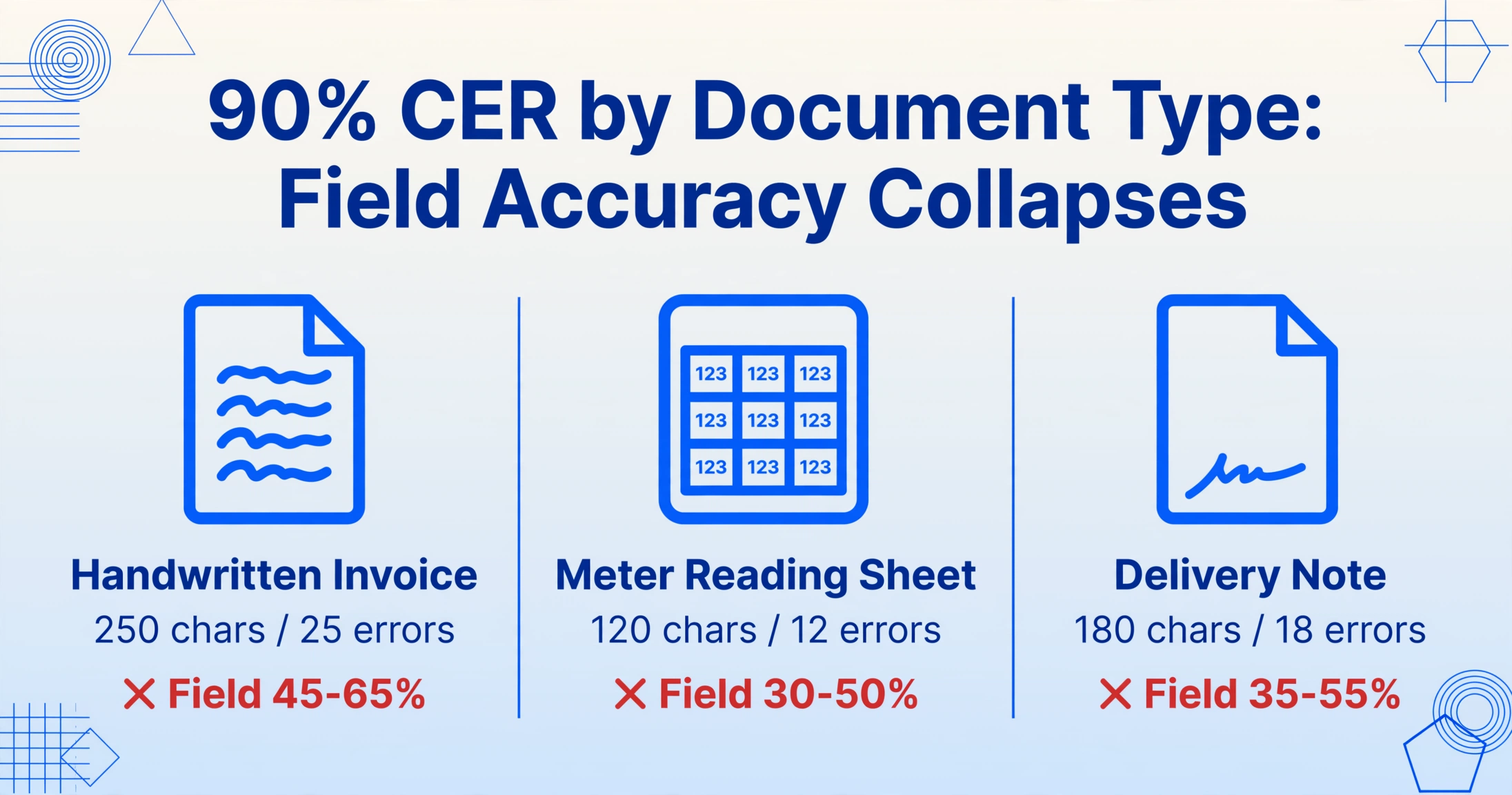
Consider a handwritten invoice with 250 characters — vendor details, line items, quantities, prices, subtotal, tax, and total. A handwriting OCR engine achieves 90% CER: 25 characters wrong out of 250.
The question that decides whether the extraction is useful: which 25 characters?
| Document type | Total characters | CER 90% = errors | Field-level result | Business impact |
|---|---|---|---|---|
| Printed invoice | 200 | 2 errors (99% CER) | 98-100% | May process without review |
| Handwritten invoice | 250 | 25 errors | 45-65% | Most fields wrong — requires full manual re-entry |
| Meter reading sheet | 120 (numeric only) | 12 errors | 30-50% | Wrong readings → incorrect billing |
| Delivery note (qty + signatures) | 180 | 18 errors | 35-55% | Wrong quantities → inventory mismatch |
A 90% CER on a handwritten meter reading sheet means roughly 1 in every 10 digits is wrong. Since readings are exclusively numeric and the difference between "0013847" and "0013841" is a billing discrepancy that compounds over thousands of meters, the field-level failure rate makes the extraction unusable without 100% human verification. You are not saving time — you are just moving the data entry work to a verification step that still requires looking at every value.
Three Real Documents, Three Failure Modes
The abstraction of CER numbers becomes concrete when you look at actual handwritten documents and trace where the errors land.
1. Handwritten Invoice — Total Field Collapse
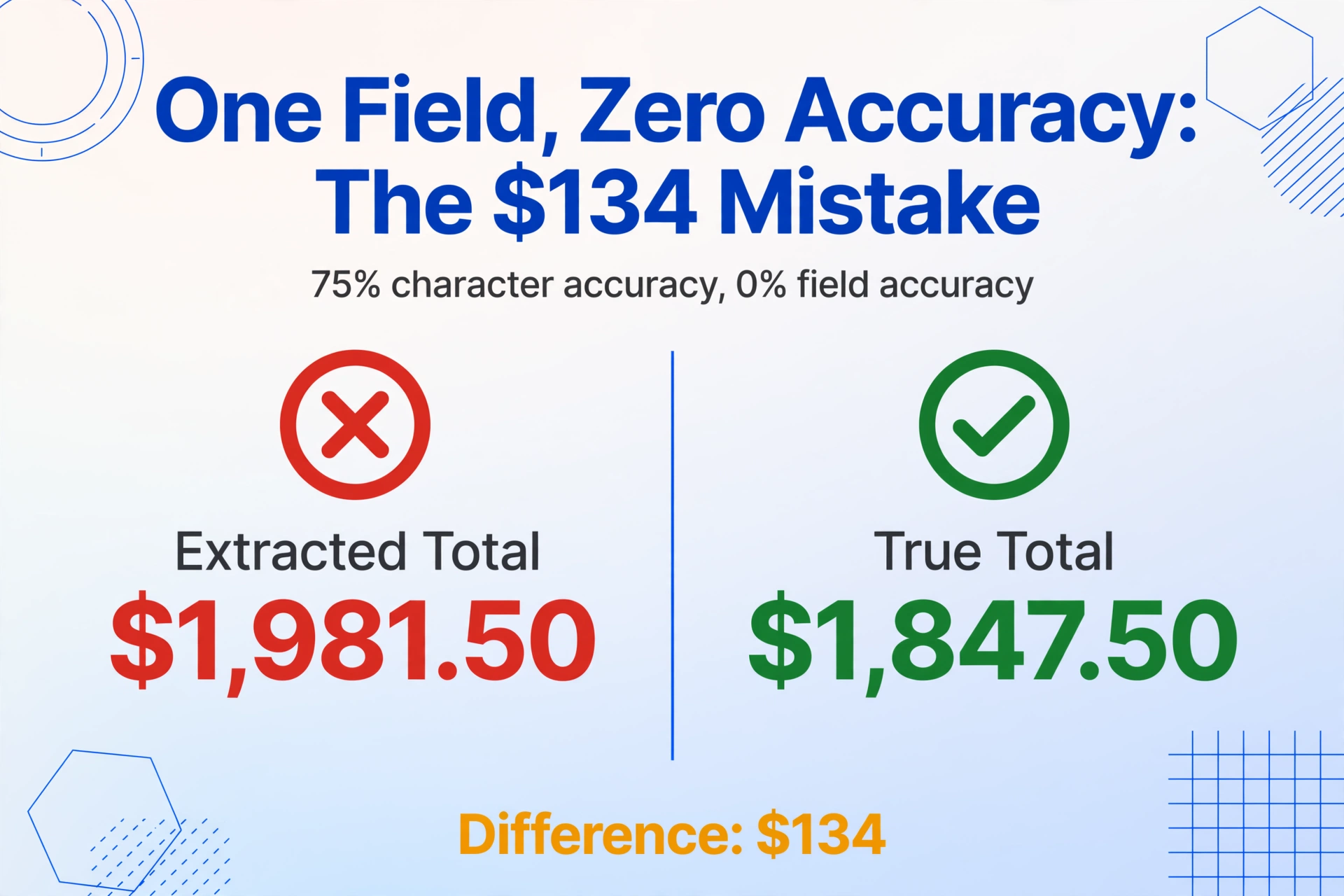
A small contractor submits an invoice for materials. The header is neatly typed, but the line items, quantities, and the final total are handwritten. The total field reads "$1,847.50." The OCR engine misreads the handwritten "4" as a "9" and the "7" as a "1." The extracted total becomes "$1,981.50" — a difference of $134. The character accuracy on this single field is 75% (6 out of 8 characters correct). The field accuracy is 0%. The page-level CER still reports 88-92% because most of the header text printed perfectly — but the one field the invoice exists to communicate is wrong, and wrong by enough to trigger a payment dispute.
This is not an edge case. Handwritten numbers are the most error-prone input for OCR because digits have fewer distinguishing features than letters — a "4" and "9" differ by a single closed loop, a "3" and "8" by whether the top loop is closed, a "1" and "7" by a crossbar that may not be present in the writer's style.
2. Delivery Note — Quantity Confusion
A delivery note has pre-printed headers: "Item," "Qty Ordered," "Qty Received." The quantities are circled or struck through by hand. Handwriting OCR fails here because quantities written as quick ticks or circled numbers are ambiguous — a "6" with a circle around it can be confused with an "8." In a warehouse context, where a single misread quantity of 120 units versus 180 units determines whether inventory gets reordered, a 10% character error rate on the Qty Received column means a stockout or a write-off.
3. Meter Reading Sheet — Cascading Errors
Meter readers record readings on paper route sheets — grids of meter IDs, previous readings, current readings, and consumption. The characters are exclusively digits, written quickly in small cells at an angle. A single-digit error cascades: if the current reading of 03842 is read as 03892, consumption increases by 50 units. Aggregated across 5,000 meters per route, billing errors compound into tens of thousands of dollars. The utility industry loses an estimated $90-100 billion annually to non-technical losses including incorrect billing — and a meaningful portion stems from misread handwritten sheets.
Numeric-only fields are simultaneously easier and harder for OCR: the character set is tiny, but the ambiguity is extreme because variation within a single digit class can exceed variation between classes. A "7" without a crossbar and a slanted "1" with a serif can be visually indistinguishable.
What You Can Actually Do About Handwriting OCR Accuracy
The realistic picture is not hopeless — but it requires understanding the constraints and choosing the right approach. Here is what moves the needle.
1. Choose Semantic Extraction Over Character Recognition
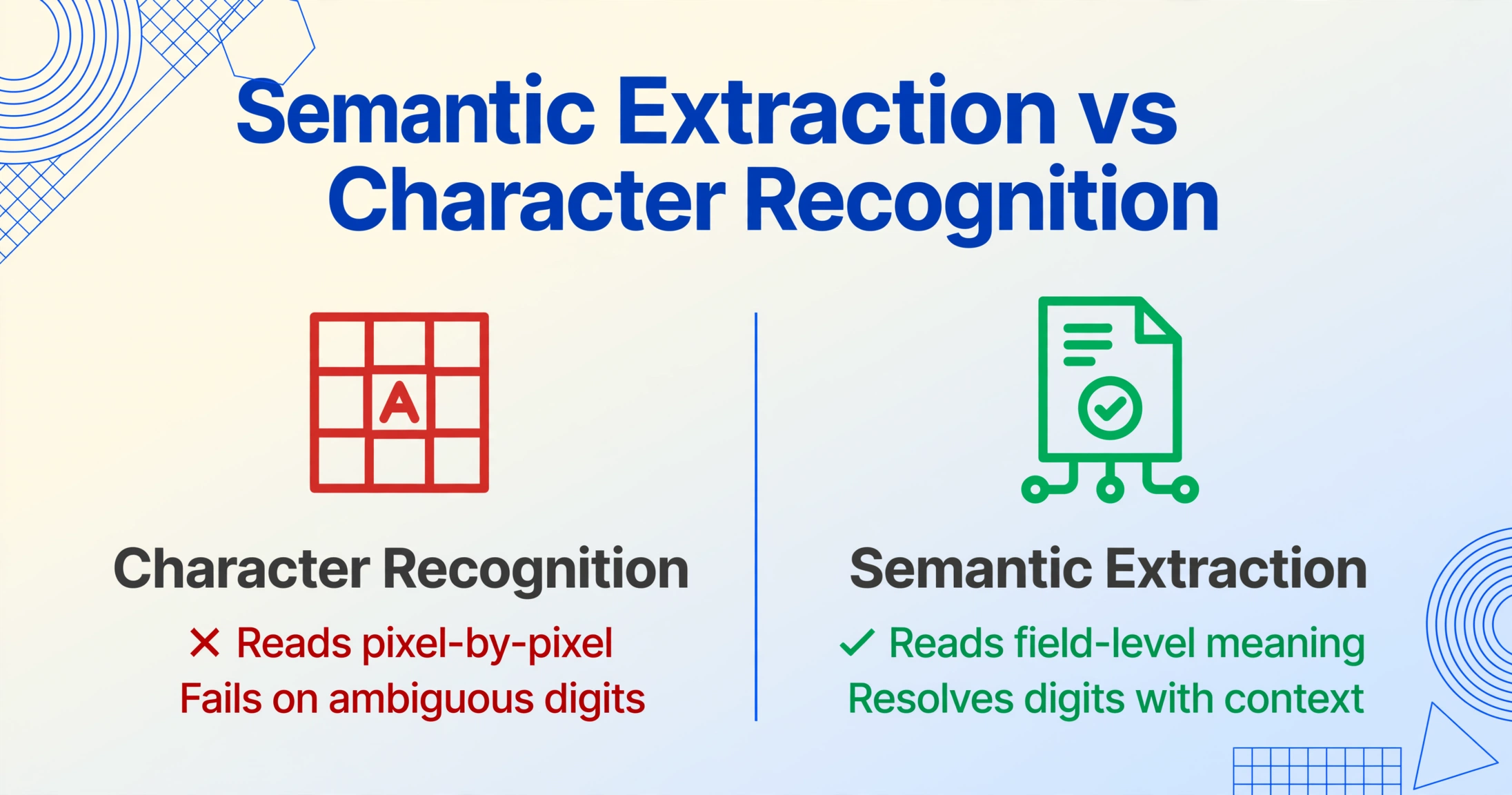
The single biggest difference between a tool that handles handwriting acceptably and one that does not is whether it reads the document semantically or pixel-by-pixel. Traditional OCR treats handwriting as a character recognition problem. AI-based extraction treats it as a field-level semantic problem.
When an AI model knows that "Qty Received" should be a number, it uses that constraint to resolve ambiguous digits. When it knows that "Date" must conform to a format, it rules out invalid dates. This semantic constraint dramatically reduces CER on critical fields — not by improving character recognition, but by telling the engine which answers are impossible.
ImageToTable.ai uses this semantic approach. You define the columns — "Meter ID," "Current Reading," "Consumption" — and the AI locates each value by understanding what it means, not where it sits. The best handwriting OCR tools in 2026 all leverage this semantic extraction paradigm, outperforming traditional engines on handwritten documents.
See it in action on a meter reading sheet — a document type where handwriting accuracy matters most:
Files are processed securely and not stored.
2. Control Input Quality
Handwriting OCR accuracy drops sharply below 200 DPI and on photos taken at an angle or in uneven lighting. The single cheapest accuracy improvement is standardizing capture: scan at minimum 300 DPI, use a document feeder for bound documents, and avoid uncontrolled mobile photos. This can improve CER by 5-15 points compared to casual mobile capture — more than any algorithmic improvement currently delivers.
If mobile capture is unavoidable (as it often is for field meter readings), use a capture app that enforces straight-on angle, even lighting, and a contrast check before accepting the image. The difference between a careful photo and a quick one is often the difference between usable extraction and garbage output.
3. Build a Verification Workflow, Not a Blind Pipeline
No handwriting OCR system — no matter how advanced — should feed data directly into billing or inventory systems without a verification step. The question is not whether errors will occur but whether they will be caught before they cause damage.
When errors do occur, they follow recognizable patterns — and most are preventable. Our handwriting extraction failure modes guide classifies the eight most common failure patterns and the fix for each, so you can tell whether the problem is your capture process, your field design, or the tool itself.
A practical approach: run handwritten documents through extraction, route outputs with confidence scores below a threshold (typically 85-90%) for human review, and focus attention on totals, quantities, and identifiers rather than every character. This targeted verification catches 10-20% of high-impact errors without requiring 100% manual re-entry. The workflow: batch process through a semantic AI extraction tool, review flagged fields, correct and confirm, then export to your accounting or billing system.
This hybrid approach — AI extraction + targeted human review — delivers both the speed gain of automation and the accuracy guarantee business-critical data requires. Different document types produce dramatically different accuracy outcomes, which is why testing on your actual documents is essential before committing to any workflow.
Frequently Asked Questions
What is the real accuracy of handwriting OCR in 2026?
The honest answer depends on handwriting type and input quality. On neat block-print in structured forms at 300 DPI, the best systems achieve 85-93% character accuracy. On cursive or mixed handwriting from mobile photos, effective character accuracy drops to 65-80%. Field-level accuracy — the metric that matters — is typically 10-25 points lower than character accuracy. A vendor claiming "95% handwriting accuracy" without specifying CER vs field-level and without describing the test set is almost certainly reporting the best-case character-level number from a curated set. For the accuracy breakdown by handwriting type — printed, neat cursive, and messy script — see our reference on whether AI can read handwriting from photos.
Is cursive handwriting harder for OCR than print?
Yes, significantly. Independent comparisons show cursive handwriting OCR accuracy lagging 10-15 percentage points behind printed handwriting recognition on the same tools. ABBYY FineReader scores 95.2% on handwritten print but 91.7% on cursive — and Adobe Acrobat drops from 88.6% on print to 79.3% on cursive. The reason is structural: cursive connects characters, eliminating the clear segmentation boundaries that traditional OCR depends on. AI-based vision models handle this better than traditional OCR by using word-level context to resolve ambiguous character boundaries, but cursive remains the harder problem.
Can AI handwriting OCR replace manual data entry?
For structured documents with neat handwriting and quality inputs, AI handwriting OCR can reduce manual data entry by 70-80% — but it should not replace human review entirely. The realistic target is a hybrid workflow: AI extracts all fields, flags low-confidence results for review, and a human verifies only the flagged values. The cost of an uncorrected extraction error in billing is typically 10-20 times the cost of catching it during review.
Why does handwriting OCR fail on numbers specifically?
Digits have fewer distinguishing visual features than letters — the difference between "4" and "9" is a single closed loop, between "7" and "1" is a crossbar that may not exist. When a document is mostly numbers — meter readings, quantities, prices — the per-digit error rate compounds because every character is a high-ambiguity character. A 90% CER on all-text handwriting might translate to 80% per-digit accuracy on numeric fields, making field-level extraction near-certain to fail on at least one critical value.
Should I trust a vendor's "90% handwriting accuracy" claim?
Not without asking three questions: (1) Is that character-level or field-level? (2) What document types were tested — block print, cursive, or mobile photos? (3) How many unique handwriting styles (10 writers or 500)? Most vendors report CER on a curated test set of neat block-print from a small number of writers. On real-world documents from dozens of writers with varied input quality, effective accuracy is usually 10-20 points lower. Any vendor who cannot or will not answer these three questions with specific numbers has likely done no real-world testing on handwriting.