How Does Handwriting Recognition Work?
Why AI Beats Traditional OCR
Think of how you read a friend's messy handwriting on a sticky note. You don't decode each letter individually — you see the whole word at once, fill in ambiguous characters from context, and use the note's structure ("groceries:" at the top, "$" before a number) to make sense of it. That's how AI reads handwriting: holistic understanding rather than letter-by-letter decoding. Traditional OCR does the opposite — it isolates each character, matches it against a template, and collapses the moment letters connect. The architectural difference is measurable at the character level: on the IAM handwriting benchmark, frontier AI models post roughly a 1.2% character error rate while Tesseract, the most widely used open-source OCR engine, returns 12.5% — and on cursive that gap only widens. It's not a calibration gap — it's two fundamentally different ways of seeing a page.
Where this fits: this page is the mechanism deep dive — how the technology works under the hood. For the definition and landscape, start with what AI handwriting recognition is; for accuracy by handwriting type, see can AI read handwriting from photos.
Key Takeaways
- Most people reach for OCR to read handwriting because it's the only tool they know. OCR was built for typewriters in the 1970s and its core assumption — that characters exist as separable standardized shapes — is false for every handwritten word ever written.
- OCR can't be "improved" for handwriting because the problem isn't accuracy tuning — it's architecture. Character segmentation collapses on cursive connections, font-based feature matching fails on variable stroke pressure, and the engine has no document context to resolve ambiguity.
- AI reads handwriting the way you do: recognizing whole words visually, filling gaps from context, and using document structure to decide whether an ambiguous squiggle is a "5" or a "6." The architecture shift from character-by-character to holistic reading creates a 40-point accuracy advantage on cursive.
Why Traditional OCR Goes Blind on Handwriting
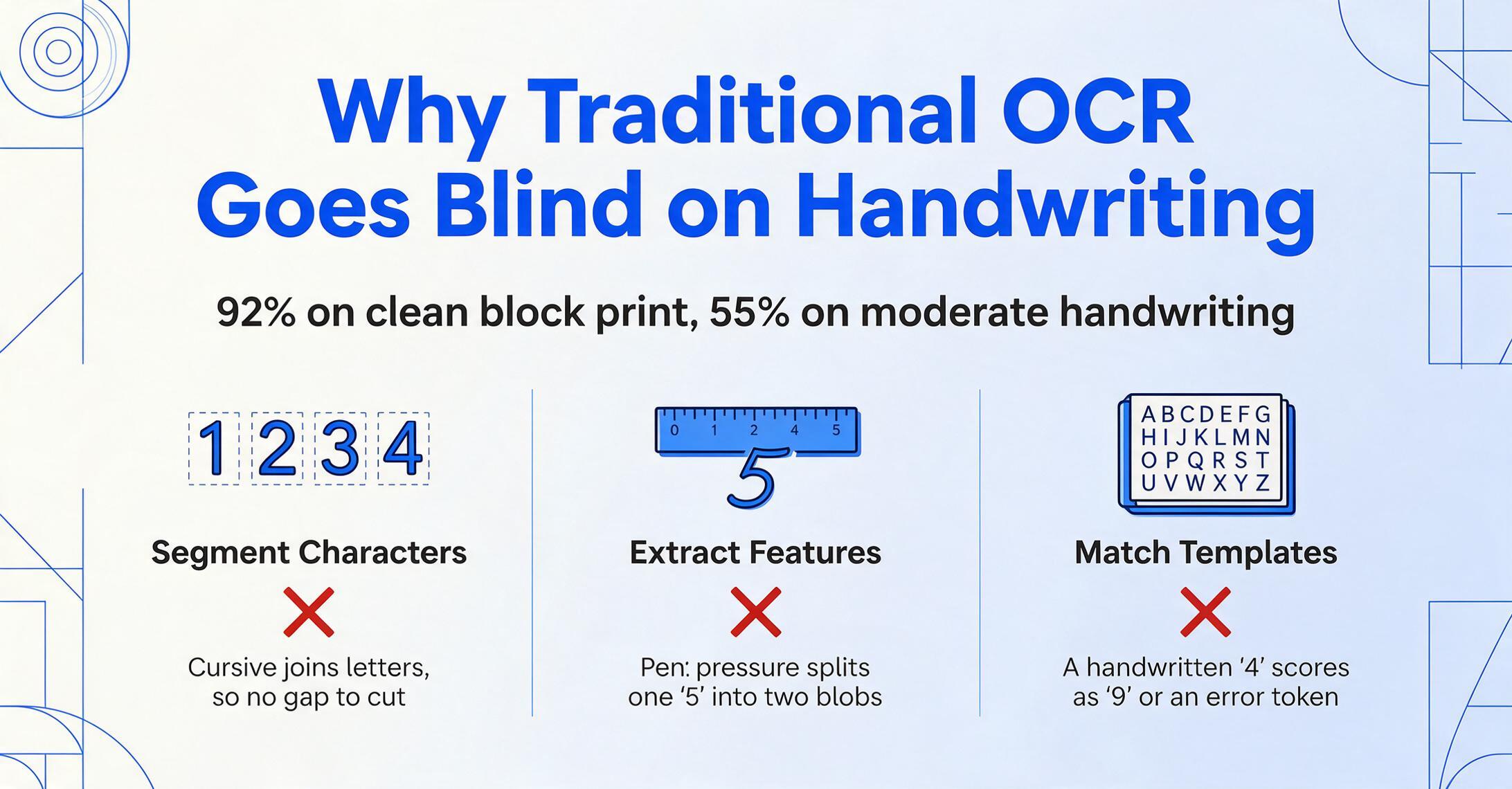
Traditional OCR was designed in the 1970s for typewriters and printed forms. Its architecture rests on three sequential assumptions — and handwriting breaks every one of them.
Step one: character segmentation. The engine detects white-space gaps between characters and isolates each glyph into a bounding box. This works on Courier New; it collapses on cursive, where the connection between an "a" and an "r" leaves no gap to detect. A 2025 study found that traditional OCR drops from 92% accuracy on clean block print to 55% under moderate handwriting degradation — conditions that barely register as noise for printed text.
Step two: feature extraction. Once isolated, the engine measures each character's geometric properties — stroke count, curve angles — and compares them against stored feature vectors. Handwriting defeats this because a ballpoint's variable pressure can fragment a single "5" into a blob plus a separate dash. The feature vector doesn't match any template — not because the character is wrong, but because the library was built for fonts, not hands.
Step three: template matching. Extracted features are scored against a database trained exclusively on typefaces. The engine's best guess on a handwritten "4" is often "9," "A," or an error token. It can't ask for help — it outputs its best guess and the error cascades downstream.
Segmentation errors feed malformed features into a font-based matcher, producing garbage. On the IAM Handwriting Database — 13,353 text lines from 657 writers — Tesseract, the most widely deployed open-source OCR engine, returned a 12.5% Character Error Rate. On cursive, its Word Error Rate exceeds 95% (codesota.com, 2026). That's not a tuning problem. It's an architecture built for separated characters confronting a medium that deliberately connects them.
How AI Reads Handwriting: From Characters to Context
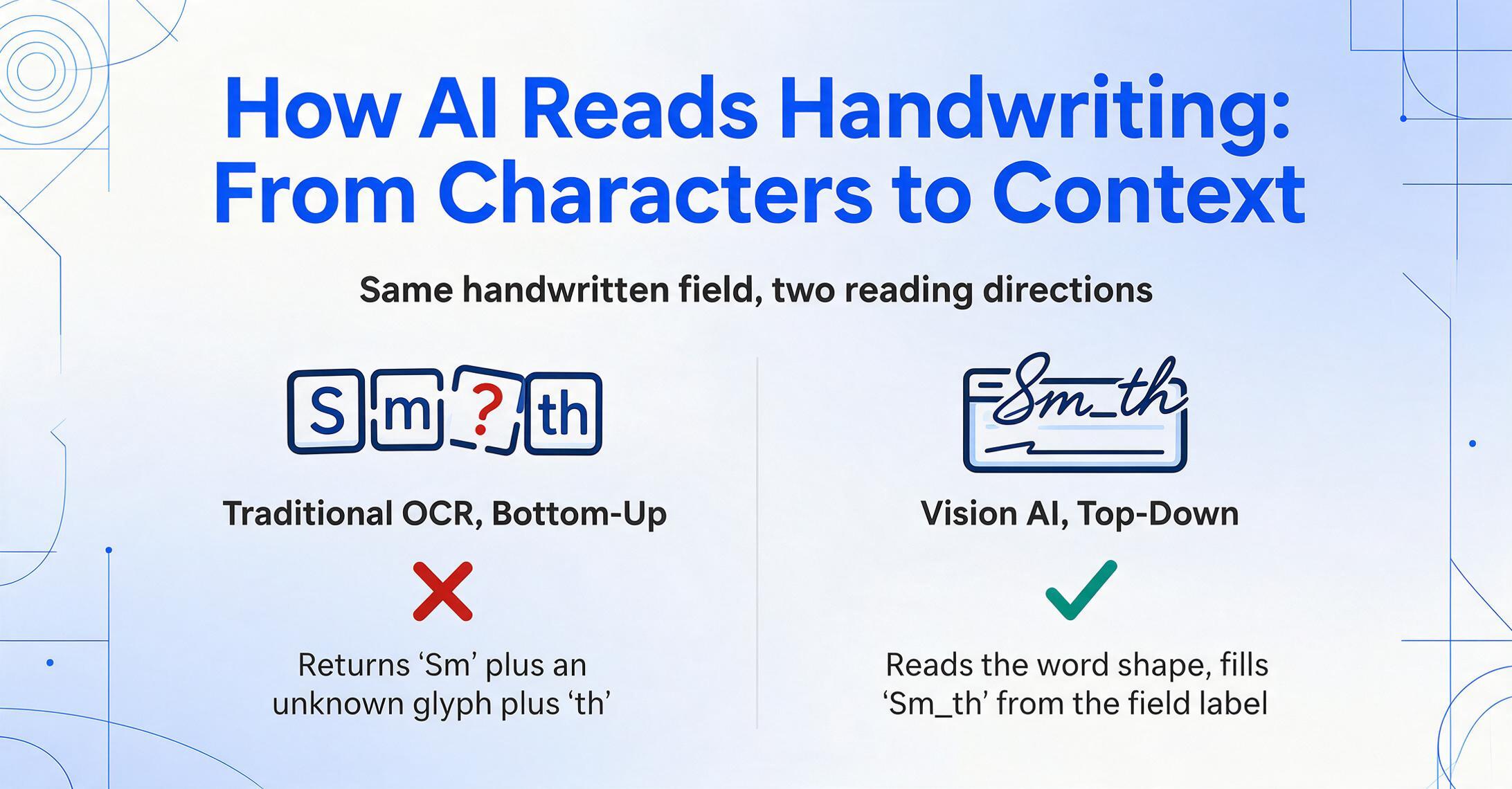
Modern AI handwriting recognition — powered by vision-language models — inverts the traditional OCR pipeline entirely. Instead of building words from characters (bottom-up), it recognizes words as visual wholes and uses document-level understanding to disambiguate individual strokes (top-down). This is the same cognitive strategy you use when reading a handwritten note.
Holistic word recognition. Rather than segmenting a page into individual characters, vision AI processes the entire image through a deep neural network that extracts visual features at multiple scales simultaneously — strokes, letter fragments, word shapes, line patterns. A word like "Total" isn't pieced together from T-o-t-a-l. It's recognized as a unified visual pattern, the same way you recognize a friend's face without cataloging individual features. Cursive connections don't confuse a model that never segmented characters to begin with.
Context-based disambiguation. A handwritten entry with a faint or missing character in "Sm_th" leaves traditional OCR returning "Sm" plus an unrecognized glyph plus "th." A vision AI sees the word shape and the surrounding context — this is the "Customer Name" field, and the document is from a known contact — and fills the gap from context. The same mechanism resolves a handwritten "1" from "l," "0" from "O," and "7" from "1" — by asking: what makes sense in this field?
Stroke variation robustness. Trained on millions of images from thousands of writers, vision AI has seen an enormous range of handwriting styles, pen types, and writing surfaces. A fountain pen's variable stroke width, a ballpoint's pressure variations, a pencil's faint graphite — these are all in the training distribution. The model abstracts away surface-level variation and focuses on underlying character structure, without needing each writer's style in a template library.
Document-level semantic understanding. This layer transforms handwriting recognition from a transcription tool into a data extraction engine. The label "Invoice Number" tells the model the handwritten value next to it should be an alphanumeric code, not a date. This is Custom Column Extraction: you define the column names you want — "Date," "Vendor," "Total" — and the AI locates each handwritten value by understanding what it means semantically, not by matching a template position. For a deeper look at what AI handwriting recognition can actually do, see whether AI can read handwriting from photos and at what accuracy.
The Accuracy Gap: OCR vs AI on Handwriting
The difference between how these two approaches work isn't academic — it produces a measurable gap that determines whether a tool is usable or useless on a given document.
| Handwriting Type | AI Vision Model (2026) | Traditional OCR | Gap |
|---|---|---|---|
| Printed block letters | 90–95% | 60–80% | 15–25 pts |
| Neat cursive | 80–88% | 30–50% | 38–50 pts |
| Messy cursive | 65–75% | 10–25% | 40–55 pts |
| Heavily degraded / stylized | 45–60% | <10% | 35–50 pts |
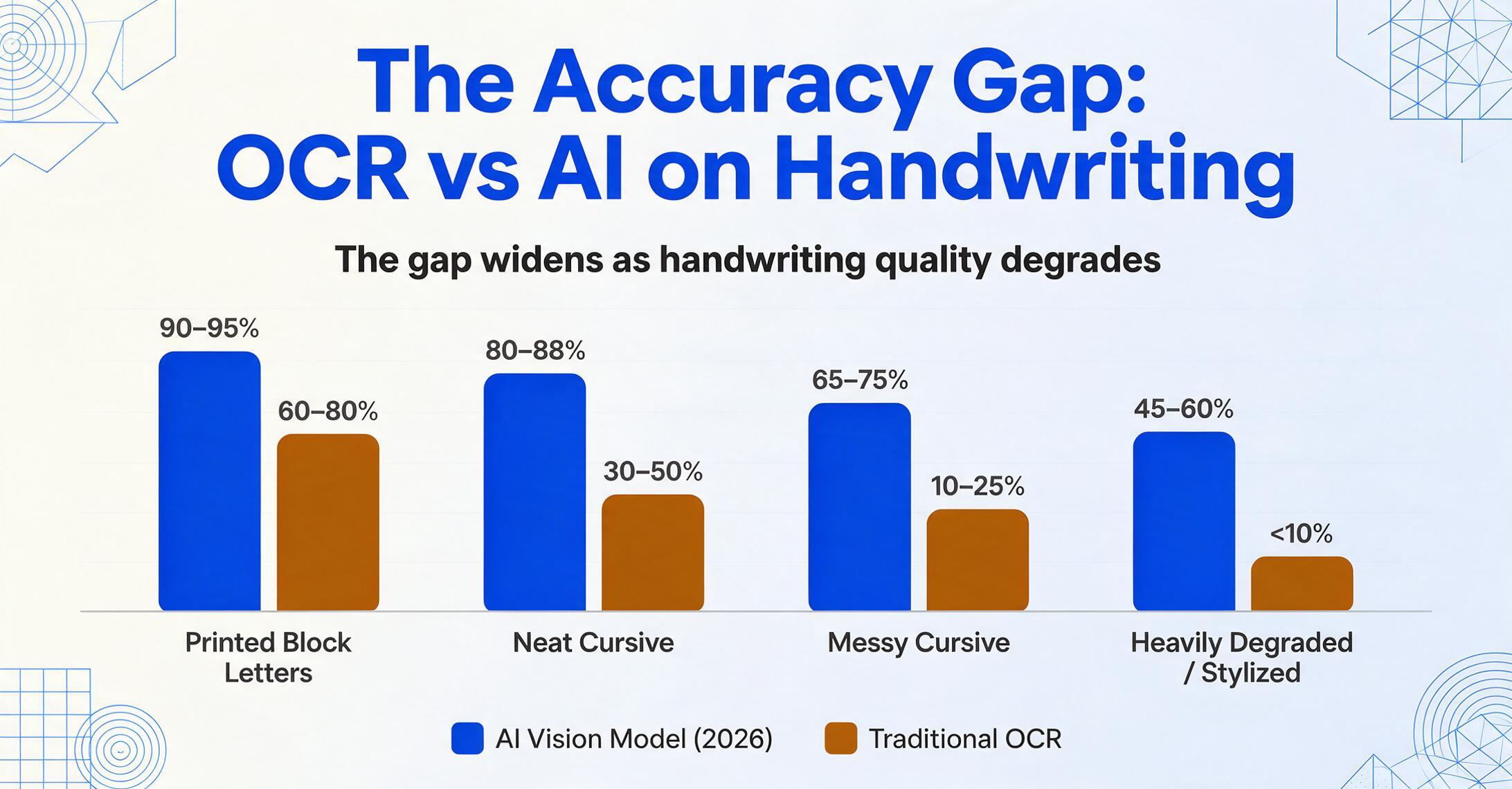
These are raw recognition figures — how many characters and words come back correctly at the transcript level. Field-level accuracy, where each extracted value lands in the correct spreadsheet column, runs higher, because document context disambiguates ambiguous characters; the field-level numbers are the subject of our AI vs traditional OCR comparison.
The gap widens as handwriting quality degrades — exactly where you most need the tool to work. On printed block letters, traditional OCR is serviceable. On neat cursive, the gap jumps to roughly 40 points — usable data vs retyping everything manually. By messy cursive, traditional OCR returns gibberish on more than three-quarters of words. AI, while imperfect at this level, at least returns data worth reviewing rather than discarding.
Independent benchmarks confirm this at the character level. On the IAM Handwriting Database, GPT-5 achieves ~1.22% Character Error Rate — fewer than 2 errors per 100 characters — while Tesseract scores 12.5% CER (codesota.com, April 2026). On the handwritingocr.com 2026 Word Error Rate benchmark, the best specialized tools achieve under 1% WER on clean cursive, while cloud OCR APIs range from 8% to 23% WER — meaning up to a quarter of all words come back wrong from paid cloud services. For a full accuracy walkthrough, see AI handwriting recognition vs traditional OCR.
What Types of Handwriting AI Handles Best — and Where It Still Struggles
The accuracy numbers above answer "how different is AI from OCR?" The next question is: how will AI perform on my documents? The answer depends on three variables.
Structured forms with labeled fields produce the best results. When a document has clear field labels — "Date," "Employee Name," "Hours" — and handwritten values in designated spaces, AI uses those labels as semantic anchors. The model knows the content below "Date" should match a date pattern, which constrains recognition and suppresses errors. If your documents are forms with pre-printed labels and handwritten answers in block letters or neat cursive, expect 90%+ field accuracy.
Consistent single-writer documents perform significantly better than multi-writer sets. When the same technician fills out 50 inspection forms, the AI implicitly learns their stroke patterns across pages — the way they form "7"s, the slant of their "t"s. The first few pages establish the pattern; subsequent pages benefit. AIMultiple's 2026 benchmark of 100 cursive samples from fixed contributors found top models achieved production-usable semantic similarity on consistent single-writer sets.
Unstructured free-form notes — pages of handwritten prose or margin annotations — push AI into its weaker performance band. Without field labels to anchor extraction, the model does raw transcription rather than structured extraction. A 2025 review found GPT-4.1 dropped from ~85% on clean single-page handwriting to ~65% by the third page of multi-page notes, where the model began inventing text not present on the page.
The practical threshold: if two people reading the same handwriting agree on what it says, AI will likely get it right. If humans disagree, AI will guess wrong. For specific failure patterns and fixes, see our guide to handwriting extraction failure modes.
Frequently Asked Questions
Does AI handwriting recognition need to be trained on my handwriting?
No — and this is a fundamental difference from older ICR systems that required 10–20 training samples per writer. Modern vision AI is pre-trained on millions of handwriting samples across thousands of writers. It handles new handwriting zero-shot: upload from a writer the model has never seen, and it extracts without setup. For more, see what AI handwriting recognition is and how vision AI reads cursive.
How does AI tell the difference between a handwritten "5" and "6" or "1" and "7"?
Through context. A handwritten "5" and "6" can look identical in isolation — but the AI doesn't read them in isolation. If the field is labeled "Total" and the document shows line items with known prices, the model can validate whether a "5" or "6" produces a mathematically coherent result. This context-based disambiguation is why field accuracy far exceeds raw character recognition rate — the AI uses the document as a whole to resolve local ambiguities.
Can AI extract data from handwritten forms, or does it just transcribe text?
AI extracts structured data — this is the key difference from basic handwriting-to-text transcription. Instead of outputting a raw text block, the AI places each value in its own column: "Invoice Number: 1042," "Date: 3/15/26," "Total: $847.50." The mechanism is Custom Column Extraction: you define the output columns, and AI maps each handwritten field by understanding what it means, not by finding it at a fixed pixel coordinate.
Why can't traditional OCR just be improved for handwriting?
Because the improvement needed isn't an enhancement — it's a rewrite of the fundamental architecture. Traditional OCR's character-segmentation assumption is baked into every layer. "Improving" it for handwriting requires replacing segmentation with holistic recognition, replacing font-based feature extraction with learned visual features, and adding document-level context understanding — at which point you've built an AI vision model. Several cloud OCR providers have added ML layers on top of their traditional engines for handwriting, but the results (60–70% on cursive) reflect the limits of patching a mismatched architecture. The leading solutions have moved to vision-language models rather than trying to retrofit character-based OCR.
Does handwriting recognition work on phone photos or only on scans?
Phone photos work well — and are now the most common input type for AI handwriting recognition. Modern vision models handle perspective distortion and uneven lighting that break traditional OCR. A well-taken phone photo (straight-on, even lighting, at least 200 DPI) produces accuracy within 3–5 percentage points of a flatbed scan. Since 2024, model robustness to real-world image artifacts has made phone-camera input practical for business handwriting workflows.
The difference between traditional OCR and AI handwriting recognition is not a matter of degree — it's a matter of architecture. One reads letters. The other reads documents. On structured handwritten forms with clear field labels, that architectural difference translates to a 40-point accuracy advantage — the difference between getting a spreadsheet and getting gibberish.
Start with what AI handwriting recognition is for the definition and landscape. Then test the accuracy claims — see what AI reads on real handwriting across different styles and document types. If you're evaluating tools, our comparison of AI vs traditional OCR on handwriting breaks down the numbers by document type.