How to Read CBP Form 7501
Without Chasing False Variances
A 7501 total and a broker invoice total often disagree for a reason that is not an error. The 7501 entry summary reports merchandise under tariff treatment. The invoice reports money the broker collected or advanced. Until those two jobs are separated, every variance looks like a billing problem, and the real ones hide in the same list.
The form is shorter than its reputation. Most of its numbered blocks describe identity. The money sits in the line block and the fee summary. What takes time is reading a month of them against broker invoices, payments, and landed-cost records, where broker reconciliation repeats the same three or four differences.
Key Takeaways
- An $84,250 ocean entry can carry a $2,437.15 total, and the gap between them is a false variance your team will chase every month.
- $670.86 is where MPF stops, so a $500,000 entry pays that cap while its 0.3464% rate would come to $1,732.00.
- Build the duty ledger at two grains, one row per entry and one row per line, so an entry-level fee is counted once and every line total still traces back.
The Entry Number Is the Join Key
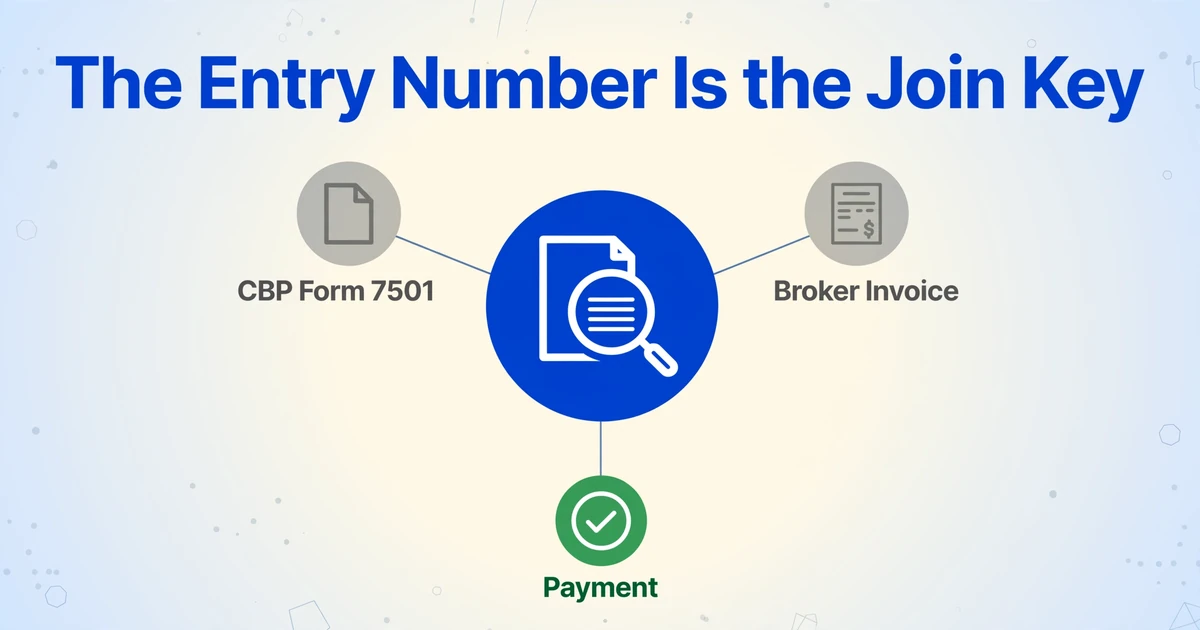
The entry number is the only field that links the 7501, the broker invoice, and the payment without ambiguity. CBP Form 7501, commonly called the 7501 entry summary, is the declaration that tells U.S. Customs and Border Protection what was imported, how it was classified and valued, and what duty, tax, and fees are owed. It is not a bill, even when the broker sends it in the same packet as one. CBP says it relies on the form to determine appraisement, classification, origin, and the other facts of the entry.
Start with Block 1. The entry number is eleven characters: a three-character filer code, a seven-digit number, and a check digit. Then confirm the entry date, the entry type, the importer of record in Block 30, and the broker or filer code. Entry type matters because a standard consumption entry (01), an antidumping or countervailing duty entry (03), and an informal entry (11) follow different rules. So does the name in Block 30. If a courier or broker is listed as the importer of record, the entry and any refund may sit in its name, even when your company paid the freight bill. The same identity checks are the ones that catch customs declaration data entry errors before they turn into a delay.
The current form is the 02/26 revision. Older PDFs may number some blocks differently, so a template keyed to last year's layout can read the right box label and the wrong value. A February 2026 thread in r/CustomsBroker described 7501s generated by NetCHB on a form version that expired on 31 March 2025, with field misalignment causing downstream reimbursement problems. The entries themselves were fine. The PDF rendering was the failure point.
| Role | What they control | What they need from the ledger |
|---|---|---|
| Importer of record | The accuracy of the declaration and the duty paid, even when a broker prepares it | Entry-level totals and a line-level trail back to the commercial invoice |
| Customs broker | Preparation and transmission of the entry summary in ACE, CBP's Automated Commercial Environment, and often the duty advance | A clean entry number and a way to answer line-level questions |
| AP clerk | Approval and coding of the broker invoice, and avoiding a duplicate payment | Pass-through versus service charges, payment method, and the PMS reference |
| Landed-cost analyst | Allocation of duty, fees, and freight to a shipment or SKU | Entry-level fees stored once, line-level values, and a stated allocation basis |
A correct duty total attached to the wrong importer or entry is still a control failure.
Record the liquidation status too. It is CBP's final computation of the duties on an entry, and the correction route changes once it happens. The same dollar difference has a different remedy depending on where the entry sits.
A 7501 Line Is a Tariff Stack, Not an Invoice Line
One commercial invoice line can become several entry line numbers, and one entry line can carry several HTS numbers. CBP's instructions define a line as one commodity from one country with a net quantity, entered value, HTS number (the 10-digit classification that sets the duty rate), charges, rate of duty, and duty. That definition is narrower than "a row on the supplier's invoice." A single product can be split by origin, value component, or tariff treatment before it reaches the entry summary.
Chapter 99 is the usual reason. Chapter 99 of the Harmonized Tariff Schedule of the United States (HTSUS) holds temporary and trade-remedy provisions, including Section 301 and Section 232 additional duties. Those provisions are reported beneath the ordinary Chapter 1-97 classification on the same entry line, not as a separate merchandise line. CBP's August 2026 guidance sets the order: Chapter 98 first if it applies, then Chapter 99 additional duties and trade remedies, then other Chapter 99 uses, then the Chapter 1-97 classification. The entered value generally stays on the Chapter 1-97 line.
Take a steel article from China subject to both Section 301 and Section 232. One invoice line can appear on one entry line with a Section 301 subheading, a Section 232 subheading, and the ordinary Chapter 1-97 code. That is three HTS numbers for one commercial item. If you compare the number of invoice lines with the number of 7501 lines, the counts will not match. If you demand that each line amount match independently, they will not match either.
CSMS #69668138 is the current reference for that sequence. The practical test is different: group the related entry lines back to the commercial item or purchase order, keep both the ordinary and the Chapter 99 codes, and reconcile the commercial value once across the group. Sum only the duties and fees that are genuinely additive. When the same check runs across a batch, the volume of HTS lines becomes the bottleneck; batch customs declarations and HS codes covers that workflow.
Entered value creates the second false variance. It is not the bottom line of the supplier invoice. Under the entry summary value rules in 19 CFR 141.61, invoice information is restated with the applicable deductions and additions. International freight and insurance are generally excluded from transaction value when separately identified. Assists, packing, royalties, and proceeds may be added. A currency conversion can move the number again.
That is why "the 7501 value is lower than the invoice" is not automatically a broker error. Ask for the valuation bridge: which invoice amounts were excluded, which additions were applied, what exchange rate was used, and how the result was distributed across the lines. Document the bridge, and the variance is resolved.
The entered value belongs on the Chapter 1-97 line. The Chapter 99 line carries the additional duty treatment, not a second value.
MPF and HMF Are Entry-Level Charges
MPF and HMF are charged on the entry, not on each line, and MPF stops being a flat percentage at the floor and the ceiling. The merchandise processing fee is an ad valorem fee of 0.3464% on formally entered merchandise under 19 CFR 24.23. For fiscal year 2027, which began on 1 October 2026, CBP set the minimum at $34.58 and the maximum at $670.86 per formal entry. The ad valorem rate did not change. The limits did.
The harbor maintenance fee is 0.125% of the value of cargo loaded on or unloaded from a commercial vessel under 19 CFR 24.24. It has no cap. It also has no place on an air shipment. If an air entry shows HMF, that is a real question, not a formatting difference.
The formula is short enough to put in a spreadsheet:
MPF = MIN(MAX(Entered Value × 0.003464, 34.58), 670.86)
HMF = Entered Value × 0.00125, vessel cargo only
Here is a two-line ocean entry with an entered value of $84,250, one dutiable line at 3.4%, and one free line:
| Line or charge | Calculation | Amount |
|---|---|---|
| Line 001 duty | $60,000.00 × 3.4% | $2,040.00 |
| Line 002 duty | $24,250.00 × Free | $0.00 |
| MPF | 0.3464% of $84,250.00 | $291.84 |
| HMF | 0.125% of $84,250.00 | $105.31 |
| Entry total | Duty + MPF + HMF | $2,437.15 |
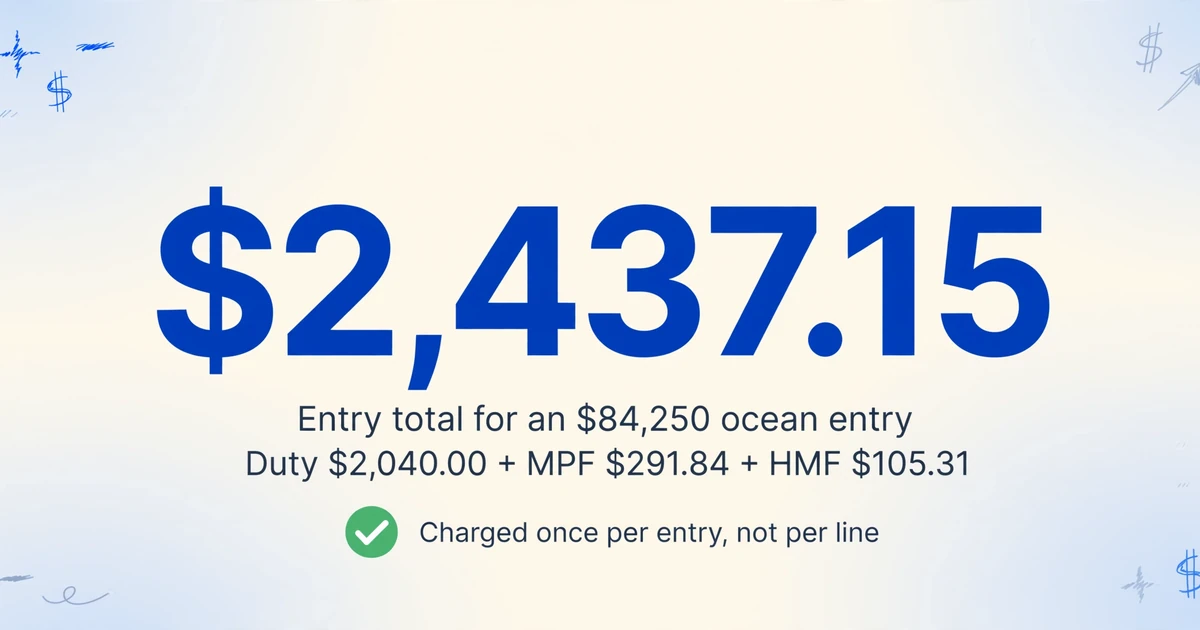
In this example, the supplier invoice shows $84,250 as goods value. The 7501 total is $2,437.15. Comparing those two numbers directly is a common false variance, and it is not an error.
Now raise the entered value to $500,000. The raw MPF calculation is $1,732.00. The FY2027 cap is $670.86, which is 0.134% of value. The floor and the ceiling do the work at the ends of the range.
This is where a duty ledger built from ACE line-level data can go wrong. ACE reports have a line-level MPF field, but a 2024 comment in an r/CustomsBroker thread described the gap: "we can only pull the raw MPF calculation in ACE, and not what Customs prorated to make all the lines add up." A separate entry-level "MPF paid" field reflects the limit. If you sum the line-level field and compare it with the broker's disbursement, you can be off by the cap or the floor, not by a data-entry slip.
The FY2027 notice also matters for entries that straddle 1 October. Use the limits in force on the entry date, not the limits in force when you do the reconciliation. A September entry and an October entry with the same value can carry different MPF.
The Broker Invoice Contains Two Kinds of Money
Only one part of a broker invoice should match the 7501; the rest is a service bill. The pass-through side is duty, MPF, HMF, internal revenue (IR) tax, and any antidumping or countervailing duty deposit. These are government amounts the broker collected or advanced. Each should trace to a line or a fee code on the entry summary. The service side is the broker's charge or a third-party service it passes through: entry fee, Importer Security Filing, bond, document handling, a per-line surcharge, storage, or delivery. These follow the broker agreement or the provider's rate, not the tariff schedule.
| Invoice line type | Examples | What it should tie to |
|---|---|---|
| Pass-through | Duty, MPF, HMF, IR tax, AD/CVD deposit | The 7501 line duty and the Other Fee Summary |
| Service charge | Entry fee, ISF, bond, advancement, handling, storage, delivery | The broker's rate card or your contract |
A useful review compares three evidence sets without expecting them to look alike: the 7501 (what was reported), the broker packet (what was billed), and purchasing records (what was bought). The entry number anchors the first two. The purchase order, commercial invoice, and shipment reference connect the third. Compare at the level each source supports, and close a variance only when the bridge is documented.
Payment method adds a trap. A Periodic Monthly Statement, or PMS, lets eligible entry summaries be paid together instead of one payment per entry. The CBP statement or bank debit is then a settlement total for several entries. Allocate it back to the listed entry numbers before you treat any single entry as paid. If the broker also advanced the duty and billed it on the invoice, a duty disbursement on that invoice can mean the same money leaves twice: once by statement, once to the broker. Check the payment method on the entry before approving a duty line.
One more invoice question belongs in the contract. If the agreement includes a per-line charge, does "line" mean the Column 31 line number or every HTS number on the entry? The two diverge as soon as Chapter 99 layers apply, and a three-line entry can carry far more than three HTS numbers.
Pass-through money should tie to the 7501 to the cent. Service money should tie to the rate card.
Six Variance Patterns and the Test for Each
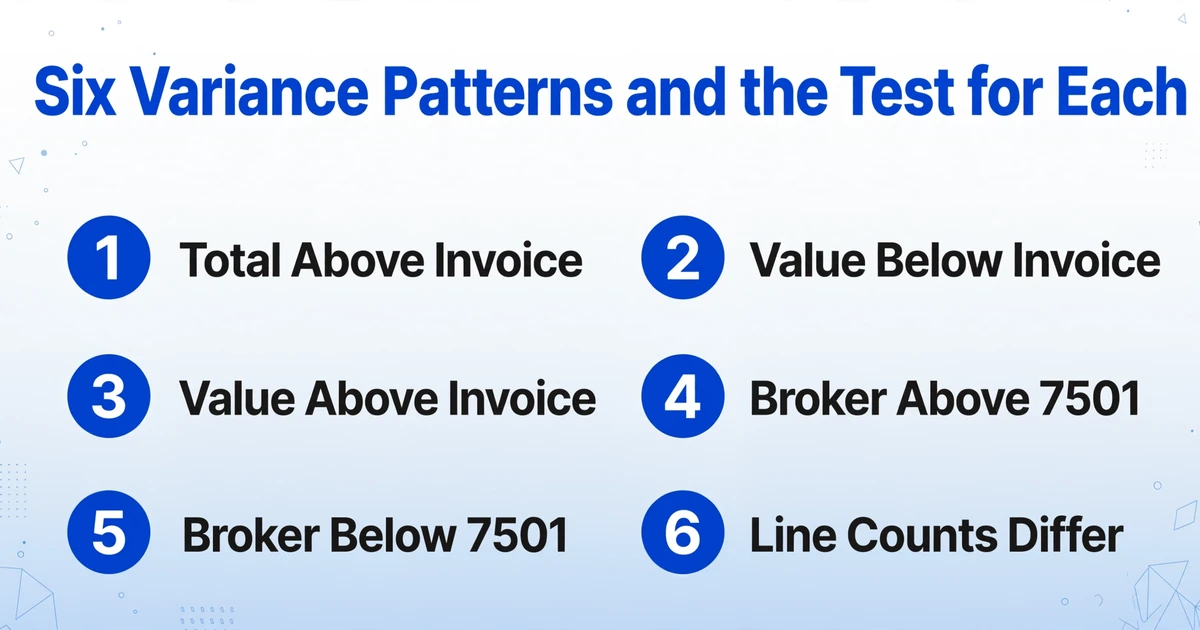
Most apparent mismatches fall into six patterns, and each one has a test that takes minutes. The table below is the diagnostic layer. It assumes the entry identity has already been confirmed and the form version is current.
| What you see | What it usually means | Test | What to do |
|---|---|---|---|
| 7501 total is above the commercial invoice total | Chapter 99 additional duty, MPF, HMF, or IR tax is included in the total | Compare duty before fees; list every Chapter 99 line | Separate duty from fees; do not net the total against the invoice |
| Entered value is below the invoice value | Freight and insurance were excluded, or a valuation deduction was applied | Read the 19 CFR 141.61 bridge; compare the FOB value, not the invoice bottom line | Request the bridge before treating the difference as an error |
| Entered value is above the invoice value | Assists, packing, royalties, or a related-party adjustment were added | Check the additions and the exchange rate in the bridge | Confirm the basis with the broker; correct it if the basis is wrong |
| Broker invoice is above the 7501 government charges | Service fees, bond, ISF, advancement, or a duplicate disbursement | Subtract the service lines and compare pass-through only | Approve service charges against the rate card; query the duplicate |
| Broker invoice is below the 7501 government charges | Duty was advanced by the broker or paid directly by PMS | Check the payment method and the statement reference | Allocate the statement to the entries; do not pay the duty twice |
| Line counts differ | Chapter 99 stacking, a content split, or line consolidation | Group by PO or commercial invoice; compare total entered value once | Do not test one-to-one; reconcile the group |
A rate difference is a separate case: compare the HTS number and special program indicator (the code that carries a preference claim) with the product master and the broker's entry data. Extraction can show the mismatch and the source page; the classification call belongs to the importer and the licensed broker.
A variance is resolved when someone can explain why the two numbers differ.
Build the Duty Ledger at Two Grains
A duty ledger needs two tables, one row per entry and one row per reported line, because mixing the two double-counts fees. It is the running record of what each entry owed and what was paid, organized so every total can be traced to a line. The header table holds the entry-level facts and the amounts that are assessed once. The line table holds the tariff detail and the amounts that can be traced to a line. Every line points back to its header through the entry number.
The entry header
Keep these fields at the entry grain: entry number, entry date, entry type, importer of record, broker, port, liquidation status, broker invoice number, payment method and PMS reference, total entered value, total duty, total IR tax, total other fees, grand total, and review status. The header is where a variance note belongs, because "unresolved" is a property of the entry.
The line table
Keep these fields at the line grain: entry number, line number, description, ordinary HTS number, every Chapter 99 number, country of origin, entered value, rate, duty and IR tax, source file and page, and an exception note. If a line carries more than one HTS number, store the stack in one cell. A second line for the Chapter 99 code will double the entered value when someone sums the column. On a 7501 with continuation sheets, treat the first page as the header source and the continuation pages as line sources.
Six checks that keep the ledger honest
| Check | Formula | What a failure means |
|---|---|---|
| Ad valorem line duty | Entered value × rate = duty, rounded to cents | A wrong rate, a wrong value, or a specific-rate line that needs a manual calculation |
| Line value roll-up | Sum of line entered value = header total entered value | A missing line, a duplicated line, or a continuation sheet that was not captured |
| Line duty roll-up | Sum of line duty = header total duty | A dropped line, or duty that was split across a Chapter 99 line |
| MPF | MIN(MAX(header entered value × 0.003464, 34.58), 670.86) = header MPF | Line-level MPF was summed, or the wrong fiscal-year limits were used |
| HMF | Header entered value × 0.00125 = header HMF, vessel only | An air or non-vessel entry, or HMF repeated on every line |
| Grand total | Total duty + total IR tax + total other fees = grand total | A fee is missing, or an entry-level charge was counted twice |
A common ledger error is a right number in the wrong grain. If MPF is repeated on every merchandise row, the fee column looks complete and the total is wrong. The same happens when a broker invoice total is pasted onto each line of an entry. Store the entry-level charge once, then allocate it to SKUs in a separate step if the business needs that view. Keep the unallocated total visible so the allocation can be proved.
This is where Custom Column Extraction fits. In the To Table workflow, which returns a spreadsheet rather than a Word document, you type the column names you want, and the AI reads each 7501 and fills the matching value by understanding what the field means, not by matching a fixed position. For the line table, name the line-level fields (Line Number, HTSUS, Chapter 99, Entered Value, Rate, Duty) and the tool returns one row per line, with the entry number repeated for grouping. For the header, run a separate column set at the entry grain.
Batch processing matters when a month contains forty entries with continuation sheets. The tool processes multiple files and merges each run into one table. Computed columns, where the calculation is written into the column name, handle the arithmetic checks: re-multiply value by rate on ad valorem lines, or compare the sum of line duty with the header total. Review Mode with Bbox closes the trust gap: click a cell and the original area on the PDF is highlighted, so a reviewer can see whether a value came from the line block or the fee summary.
Use a sample file. Files are processed securely and not stored.
The boundary is firm. The tool does not file entries, validate ACE data, choose an HTS classification, or decide between a post-summary correction and a protest. It also does not compare a 7501 with a broker invoice field by field. It extracts both into structured tables, and the join stays in Excel, Google Sheets, or your ERP. The finance team owns the reconciliation rule.
The same two-grain design travels to non-US declarations. The boxes and fee names change, but the principle does not: entry-level charges once, line-level values once, and a source page for every number. The customs declaration extraction guide covers why fixed templates break on multi-format packets, and the manual versus AI comparison covers the batch question.
From Duty Ledger to Landed Cost
The duty ledger tells you what customs charged; landed cost tells you what the shipment cost, and the two numbers diverge on purpose. Landed cost is the total cost to get the goods into your hands: goods value, freight, insurance, duty, fees, brokerage, and delivery. Customs value is the base for duty, and it generally excludes international freight and insurance when they are separately identified. Adding freight to the duty base overstates duty. Leaving freight out of landed cost understates the cost of the goods.
Allocate freight by weight or volume, not by value. Freight is bought by weight and volume, so a value-based allocation pushes too much cost onto the expensive, light item and too little onto the heavy, cheap one. Keep each Chapter 99 layer in its own column so a change in Section 301 or Section 232 is visible. Broker service fees belong in landed cost, but they are not duty. If the business needs duty per SKU, allocate the actual entry-level MPF and HMF once, using a stated basis, and keep the entry total beside the allocated total. Do not recompute MPF as 0.3464% of each SKU's value; the cap or floor can make that wrong in both directions.
Freight belongs in landed cost, not in the duty base. Chapter 99 belongs in its own column, not blended into the HTS rate.
The Pre-Payment Check
Five checks catch the errors that matter before the broker invoice is approved. They are ordered by cost of failure, not by difficulty.
Prove the entry identity
Match the entry number, importer of record, entry type, and entry date to the shipment file. A correct total on the wrong entity can survive several approvals.
Recompute two lines
Pick the largest ad valorem line and one free line, multiply entered value by rate, compare with Column 38, and confirm every Chapter 99 number is present and in order.
Recompute the fees at entry level
Apply the FY2027 MPF floor and cap to the header entered value, apply HMF only for vessel cargo, and compare with the fee summary, not a sum of line-level fields.
Split the broker invoice
Put every pass-through amount against its 7501 source and every service charge against the rate card. An unmatched duty line goes to review before approval.
Check the payment path
Confirm whether the entry was paid by ACH, PMS, or a broker advance, allocate a PMS debit back to its entries, and record the statement reference so the same payment cannot be approved twice.
The check works as a monthly control. It makes the ledger usable in the next month, when the same supplier, broker, and Chapter 99 stack appear again with different numbers. What makes a duty ledger useful is the ability to explain any number in it without reopening forty PDFs.
Frequently Asked Questions
What is the difference between CBP Form 7501 and a broker invoice?
The 7501 is the entry summary filed with CBP. It records the merchandise, classification, value, duty, tax, and fees for one entry. A broker invoice is a bill. It can include the government amounts the broker collected or advanced, plus the broker's own service charges. Only the pass-through part should match the 7501. The service part should match the broker agreement.
Why is the total duty higher than the HTS rate suggests?
The rate on the Chapter 1-97 line is only the base duty. A Chapter 99 provision can add Section 301, Section 232, or another additional duty on the same line. The total can also include MPF, HMF, and IR tax, which are not duty. Separate the base duty, the Chapter 99 layers, and the fees before comparing the number with the invoice.
How is MPF calculated on a 7501?
For a formal entry, MPF is 0.3464% of entered value under 19 CFR 24.23. For fiscal year 2027, the minimum is $34.58 and the maximum is $670.86 per entry. Use the limits in force on the entry date. Do not sum a line-level MPF field and assume it equals the amount paid; the floor and cap are applied at the entry level.
Does HMF apply to air shipments?
No. The harbor maintenance fee is 0.125% of the value of cargo loaded on or unloaded from a commercial vessel. An air, rail, or truck entry should not carry it. If HMF appears on an air entry, ask the broker to explain the mode of transport before you approve the invoice.
Can I build a duty ledger from 7501 PDFs?
Yes. Extract the entry header fields and the line block as two tables, keep the entry number as the key, and run the six checks in this guide. A batch extraction tool can turn a folder of PDFs into the starting table. The reconciliation rule, the allocation basis, and the approval decision remain with your team.
What should I do if the 7501 is wrong?
Do not correct it inside the ledger. Record the exception and ask the broker to review the entry. Before liquidation, the correction route is usually a post-summary correction; after liquidation, it changes. Your broker and importer of record should decide which route applies. The ledger's job is to preserve the evidence and the open question.
The Ledger Should Explain the Difference
A 7501 records a declaration, a broker invoice records a bill, and a commercial invoice records a sale. Once those three records are kept in their own lanes, most of the scary variances turn into ordinary questions with a document behind them. The ones that remain are the ones worth chasing. A duty ledger earns its place when it can show that difference, line by line, without asking anyone to trust a total.