Reconciling Proofs of Claim
Starts With the Obligation
A proof of claim can match the debtor's schedule to the cent and still be the wrong claim. If the claim names a creditor's former trade name and the schedule lists the entity that acquired the business, two identical amounts describe two different legal persons. The same thing happens when one amount includes default interest and the other is the principal balance on the petition date, or when an amended claim sits in the register beside the original it was meant to replace.
Bankruptcy claims analysis follows an order for that reason. First establish that the claim, the schedule and the invoice refer to the same obligation. Then compare what each record says is owed, and record which page proves it. This is written for the analyst or paralegal who has to defend each row, not for the disclosure statement.
Key Takeaways
- A proof of claim can match the debtor's schedule to the cent and still be the wrong claim.
- The match runs on four keys before any dollar is compared: debtor entity, creditor legal identity, obligation reference, and period plus currency.
- Amount confirms a match but cannot create one, so every exception needs the page that proves it.
What Proof of Claim Reconciliation Compares
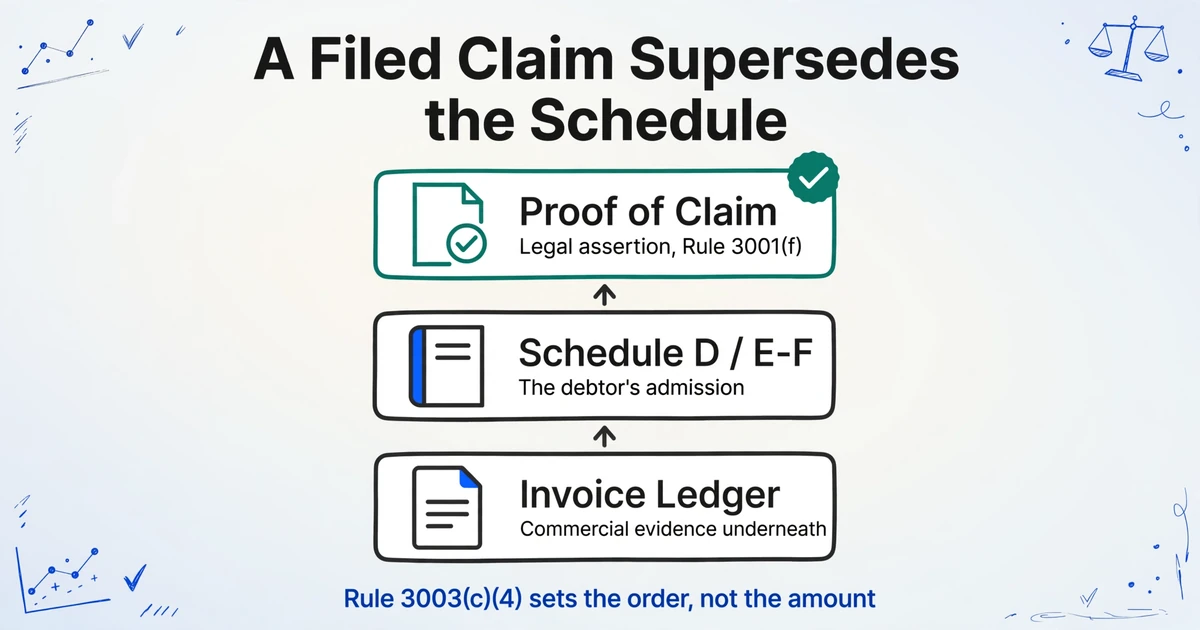
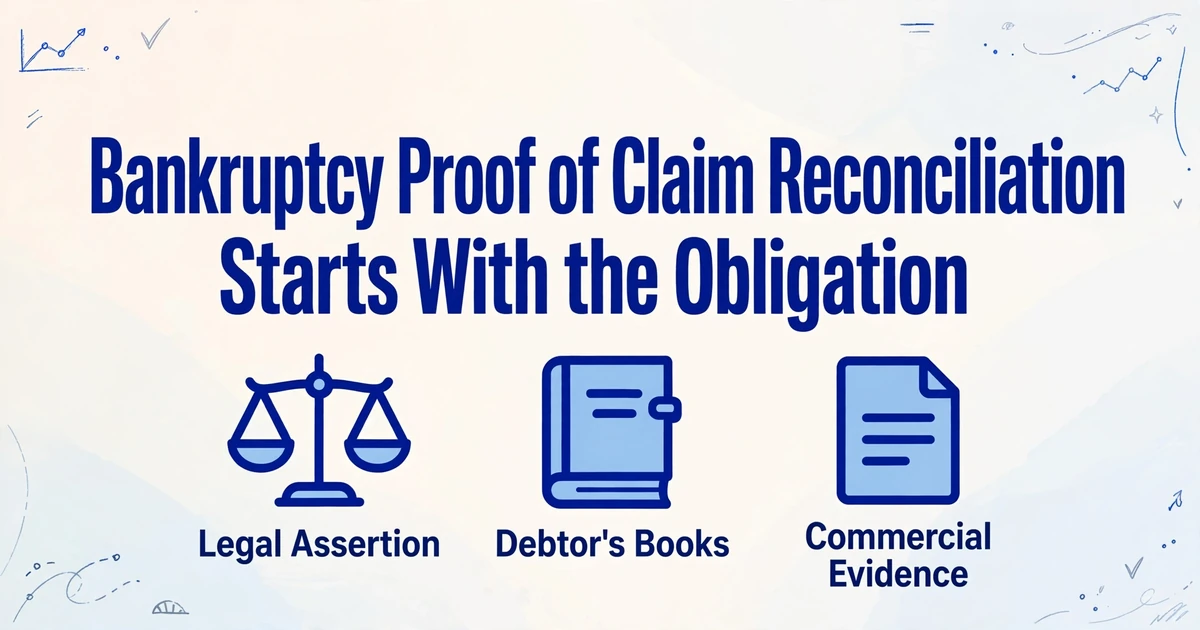
Reconciling proofs of claim with schedules and invoices means comparing three records created for different purposes, each answering a different question. The proof of claim is the creditor's legal assertion. The schedules are the debtor's admission, prepared from its books in the first days of the case. The invoice or receivables ledger is the commercial evidence underneath both.
The proof of claim is filed on Official Form 410, which must substantially conform to the form under Bankruptcy Rule 3001(a). It states the amount owed as of the petition date, the basis for the debt, whether any part is secured or entitled to priority, and attaches the writings that support the claim. A properly executed and filed claim is prima facie evidence of its validity and amount under Rule 3001(f). It is the number the estate has to deal with unless someone objects.
The schedules are the debtor's version, organized by the entity that owes the debt. Schedule D covers secured claims and Schedule E/F covers unsecured claims. Each line carries the creditor, the amount, the dates incurred, the basis, the last four digits of the account, whether the claim is contingent, unliquidated or disputed, and whether it is subject to offset. Under 11 U.S.C. § 1111(a), a scheduled claim not listed as disputed, contingent or unliquidated is deemed filed, and the schedule is prima facie evidence of its validity and amount under Rule 3003(b)(1). Under Rule 3003(c)(4), a properly filed proof of claim supersedes the scheduling.
A proof of claim is not a second copy of the invoice. It is a legal assertion about the invoice as of a date.
| Record | Created by | Answers | Usually missing |
|---|---|---|---|
| Proof of claim (Form 410 plus attachments) | The creditor, or its counsel or agent | What the creditor asserts as of the petition date, in what classification, and on what documentary basis | A reliable link to the schedule line; an itemized breakdown on a commercial claim |
| Schedules D and E/F | The debtor, from its books and records | Which debtor entity owes the debt, what the books show, and whether the claim is disputed, contingent or unliquidated | Interest and fee detail; invoice-level composition; later amendments |
| Invoice or receivables ledger | The creditor's billing or ERP system | The underlying obligation, invoice by invoice, including dates, line items, credits and currency | The claim number, the bankruptcy classification, and the treatment after filing |
Four roles touch this comparison. In a case with a claims agent, the agent dockets the claims, maintains the official register, the running list of every filed claim and its claim number, and often monitors schedule-to-register variances; court guidelines describe the agent as independent and not a source of legal or financial advice on a claim. The debtor's counsel and financial advisor build the reconciliation and decide which differences justify an objection. Creditor's counsel checks the client's claim against the schedules and decides whether to amend or respond. The claims analyst or paralegal does the row-level match. In a smaller firm one person may hold two roles, which is why the file has to be readable by someone who did not build it.
The Match Runs on Four Keys, and Amount Is Not One of Them
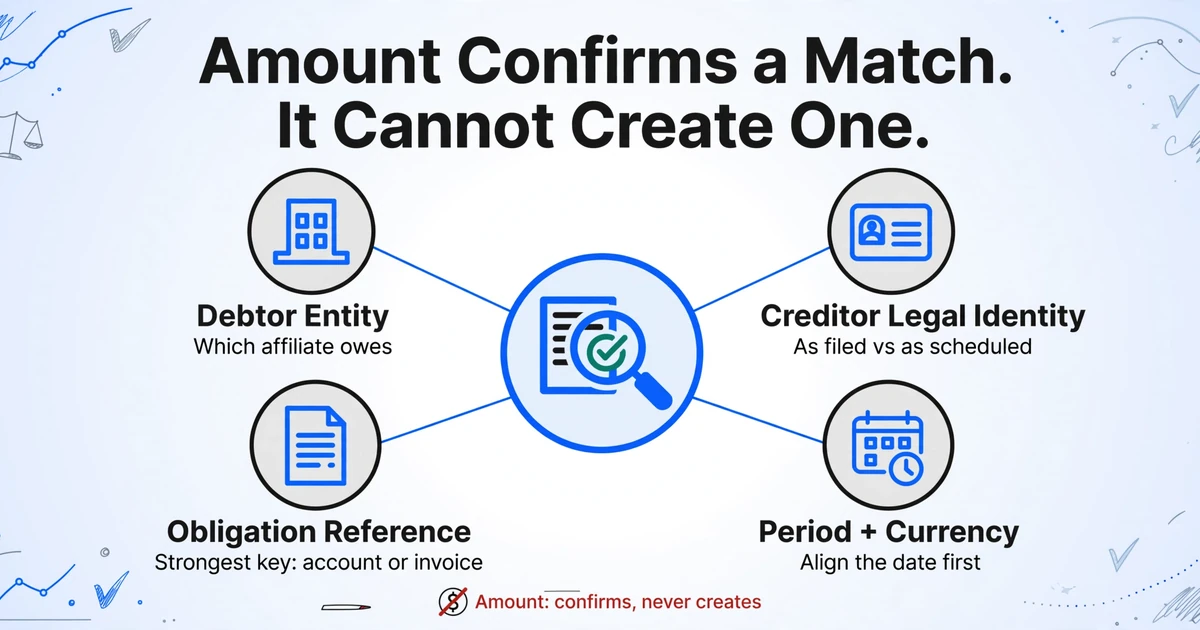
The match is established on four keys before any comparison of dollars makes sense: debtor entity, creditor legal identity, obligation reference, and period plus currency. An amount can confirm a match that is already supported by those keys. It cannot create one.
Debtor entity comes first in any jointly administered case. The same creditor can be scheduled against several affiliates, and a claim against the parent is not the same claim as a claim against the operating subsidiary. Court guidelines for claims agents say that in jointly administered cases the creditor should be told which entity scheduled it. If the claim names a different debtor from the schedule line, the row is an entity exception even when the number is correct.
Creditor names differ for ordinary reasons. The vendor master may use a short trade name, while the claim uses the legal entity that survived a merger. The claim may be filed by a transferee after the original creditor sold the position. Official Form 410 anticipates this: Box 3a, "Debtor May Have Scheduled Account As," reports a change in the creditor's name, a transferred claim, or another difference from the schedule. The box is evidence, not an excuse to force a match. Capture the name as filed, the name as scheduled, and the explanation in three separate columns.
The obligation reference is the strongest key. Both Schedule E/F and Form 410 ask for the last four digits of the account number the creditor uses to identify the debtor. The claim attachments usually include invoice, purchase order, contract or lease numbers. That reference connects the legal assertion to the commercial document. A name match with no account or invoice reference is weak, and a reference match with a different name is a normal name-change case until the transfer or merger documents say otherwise.
Period and currency prevent false variances. The claim is measured as of the petition date. The ledger may include items dated before and after that date, and a foreign currency invoice converted at a different rate or on a different day will not equal the dollar figure in the claim. Record both dates, the currency and the conversion date. A variance that disappears once those fields are aligned was never an amount problem.
Two situations look like duplicates but are not. A claim transferred under Bankruptcy Rule 3001(e) can appear in the register under the transferee while the schedule still shows the original creditor, and the transfer notice explains it. A parent guarantee and an affiliate trade claim can describe the same underlying debt from two directions. Neither should be collapsed without reading the documents.
Name similarity is a hint, not a key. The evidence is the account reference, the invoice number, or the transfer notice.
Most Amount Differences Come From What Each Record Includes
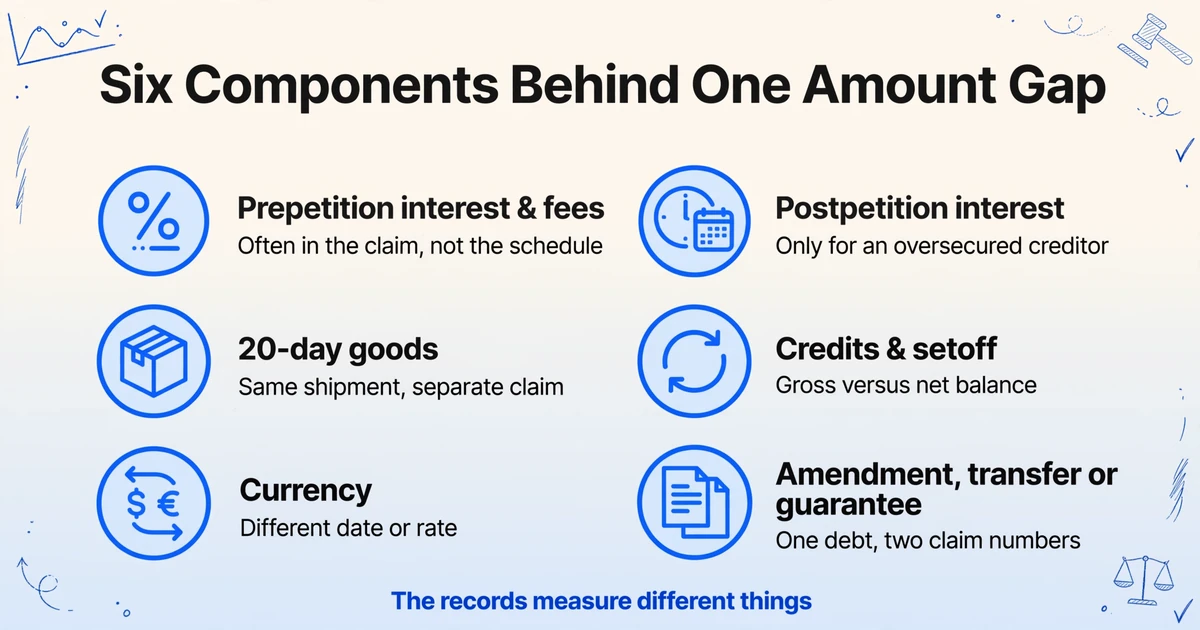
The amounts usually diverge because the records measure different things. The claim total is the creditor's asserted obligation, usually measured as of the petition date. The scheduled amount is the debtor's book balance, often net of credits and frequently without interest. The invoice ledger is the open-item detail, which may include invoices outside the claim and may exclude invoices the creditor never entered.
Form 410 Box 7 asks whether the claim amount includes interest or other charges, and if the answer is yes, an itemization is required. That requirement is strongest in individual debtor cases, where Rule 3001(c)(2)(A) requires a statement of principal, interest, fees and other prepetition charges. A corporate chapter 11 claim is not subject to the same rule, so a commercial claim can arrive as a single total with a stack of invoices behind it. The analyst reconstructs the components from the attachments.
| Component | Where it appears | Why the records diverge |
|---|---|---|
| Prepetition interest and fees | Claim Box 7 and the attached statement | The schedule may carry principal only, or a net book balance that never included the charges |
| Postpetition interest | Claim total, usually for a secured creditor | 11 U.S.C. § 506(b) allows it only to the extent the creditor is oversecured; an unsecured claim that adds it is an exception |
| 20-day goods | A separate administrative claim or a priority portion | 11 U.S.C. § 503(b)(9) treats goods delivered in the 20 days before the petition as an administrative expense, so the same shipment can appear in a prepetition schedule and in a separate claim |
| Credits, payments in transit, setoff | Invoice ledger and the schedule's offset box | One record is gross and the other is net, so the difference is a payment or a credit rather than a disputed balance |
| Currency | Invoice ledger and the claim's dollar amount | The conversion date or rate differs, which produces a variance with no substantive dispute behind it |
| Amendment, transfer or guarantee | Claim Box 4, transfer notices, and the guarantee documents | The same obligation is asserted under two claim numbers, so counting both double counts the debt |
Duplicates deserve their own pass. Form 410 Box 4 asks whether the claim amends one already filed and, if so, for the original claim number and filing date. When the register contains both and the analyst keys on creditor plus amount, the same obligation looks like two claims. A transfer under Rule 3001(e) can create a second entry for the same position, and a guarantee claim can do the same across entities. These are different legal routes to the same debt, not data-entry errors.
At the extreme end, a 2014 Federal Reserve Bank of New York study of the Lehman Brothers case recorded 67,000 claims with a face amount of $1.16 trillion. Initial claims were reduced to $764 billion after adjusting for duplicate, inflated and invalidly filed claims, and about $214 billion, or 28 percent of the total, was double counted through guarantee and affiliate claims. A clean amount match in that pool was not proof that the obligation was unique.
A Reconciliation Workflow That Leaves a Trail
The workflow has five steps, and the first is to freeze the record set so every later comparison has a fixed reference point. A reconciliation that starts from whatever file happens to be open is not reproducible, and an objection file has to be reproducible.
Freeze the record set and the reference date
Download the claims register export from the claims agent, or the court's register if no agent was appointed; add the schedules and every amendment, and the creditor's open receivables at the petition date. Record the case number and the download date. Use the court-assigned claim number as the row identifier, because every objection, stipulation and register entry cites it.
Define one column set for each record type
Write the column names before extracting anything. The common keys are claim number, creditor as filed, debtor entity, account last four and claim amount. Claims add interest included, basis of claim, amends claim number and attached invoice numbers. Schedules add scheduled amount, disputed or contingent or unliquidated, and offset. Invoices add invoice number, invoice date, purchase order, currency and open balance. The same key needs the same spelling in every set, because the column names you type become the headers of the output.
Extract each set with the same discipline
ImageToTable.ai uses Custom Column Extraction: you type the column names you want, and the AI locates each value by meaning, not by a fixed position on a template. Upload a batch of claim forms or schedule pages and each document lands as a row in one spreadsheet. For a claim form that runs across several pages, Multi-Page Merge can fold the pages into one row when the claim number repeats. Keep an attached invoice schedule as a separate extraction if you need one row per invoice. Then use Review Mode with Bbox locating: click a claim amount or a Box 3a entry and the original page highlights the line, so you can confirm the value before it enters the exception file.
Join on the obligation key, not on the name
Keep the extracted claim and schedule rows in two tabs and join them with XLOOKUP. Match claim to schedule at the claim level on debtor entity plus account last four, then match invoice lines to the claim's attached invoice schedule on invoice number. A name-only join will either miss a legitimate transfer or merge two affiliates. Calculate the variance after each join, as a spreadsheet formula, so the arithmetic stays visible. The extraction puts values in columns; the joins decide which values belong to the same obligation.
Classify the exception and attach the evidence
Give every unmatched or partially matched row a code: NAME, ENTITY, AMOUNT-INTEREST, DUPLICATE, NO-SCHEDULE-LINE, NO-INVOICE, or CURRENCY. Add the claim page, schedule page, invoice number and reviewer's initials. A code without a page reference is an opinion; the page reference is what lets counsel answer an objection or draft one.
Files are processed securely and not stored.
The demo runs one document at a time, which is enough to see how the column names land on a claim form or an invoice. The join across the three records happens in your spreadsheet. If the extraction itself needs a second look, the methods in spot-checking a batch extraction are the right control, and for the failure modes that show up in long legal documents, verifying every extracted field against its source covers the page-level check.
A Useful Exception File Answers Four Questions Per Row
A useful exception file says which claim, which obligation, what differs, and which page proves it. The layout below is illustrative and uses invented names, but the columns are the ones that survive contact with a claims agent, opposing counsel and a partner who has five minutes to review it.
| Claim No. | Creditor as filed | Creditor as scheduled | Debtor entity | Invoice / account | Claim amount | Scheduled amount | Interest included | Variance | Exception code | Source pages |
|---|---|---|---|---|---|---|---|---|---|---|
| 1042 | Northline Paper Holdings LLC | Northline Paper Co. | Meridian Converting LLC | INV-8841 / acct 4412 | 148,920.00 | 141,200.00 | Yes | 7,720.00 | NAME + AMOUNT-INTEREST | Claim p.1 Box 3a, p.4; Sch. E/F p.22; INV-8841 |
Two conventions make the file usable. The claim number is the first column, because Rule 3007(e) requires an omnibus objection, a single filing that covers multiple claims, to list claimants alphabetically, cross-reference each claim number, and cover no more than 100 claims. The objection is served at least 30 days before the hearing or the deadline for the claim holder to request one under Rule 3007(a)(1). A creditor that misses the deadline risks an order sustaining the objection, which is why the file has to be findable by claim number and readable by someone who did not build it.
The second convention is review order. Work entity and name exceptions before amount exceptions, because an entity mismatch can make the amount comparison meaningless. Within the amount exceptions, sort by dollars so the largest exposures get the first review. That order is a judgment call, but it is the judgment that turns a thousand-row spreadsheet into a short list of decisions.
An amount that matches is a data point. The obligation behind it is the finding.
The Output Is a Working File, Not a Legal Conclusion
The output is a reconciled working file, not a determination that a claim is valid, secured, priority or allowable. Allowance is decided under 11 U.S.C. § 502 and, if contested, by the court. The file can show that the claim and the schedule disagree on principal, that the claim includes interest the schedule does not, or that two claim numbers point at the same invoice. It cannot decide whether the interest is recoverable, whether the guarantee creates a separate claim, or whether the estate has a setoff.
The same boundary applies to the mechanical work. The tool does not file a claim with the claims agent or the court, and it does not update the official register. It does not resolve creditor entities across name variants automatically; an alias table still has to be reviewed against merger, assignment and transfer documents. It does not match a claim to a schedule line on its own. It extracts the fields that make the match possible, and the join, the variance and the exception code remain your work. A computed column can handle arithmetic inside one record, such as a total minus an itemized principal, but a variance between two records is a spreadsheet formula after the join.
Accuracy is high on printed tables: the product publishes up to 99 percent recognition on printed tabular data at 5 to 10 seconds per page. Claims are not all printed tables. They arrive as scans, with handwriting, redactions, exhibits and multi-page attachments. Use Review Mode to check the amount and the Box 3a/Box 4 entries against the page, and sample the batch before the whole file is trusted. Verify the fields that carry the decision, not every field equally.
None of this makes the analyst optional. It removes the retyping, page flipping and copy-paste that produce silent errors, and leaves the parts that require a person: reading the basis of the claim, deciding whether a name change is documented, and judging whether an exception is worth an objection. For a small firm without a dedicated claims team, the batch discipline used in small-firm legal document extraction applies here, with the claim number in place of the Bates number. The cross-record logic also resembles cross-document contract verification, except a contract portfolio is built to be read together, while a claim set comes from three separate processes. Quarter-end client invoice reconciliation starts from the same principle but stays inside one commercial relationship.
FAQ
Can proof of claim reconciliation be automated?
The extraction and the join can be automated, and the comparison can be reduced to a sortable exception list. The determination cannot. Whether a claim is allowable, whether interest is recoverable, and whether two filings describe one obligation are legal judgments that depend on the documents and the applicable plan or order.
What if the creditor name on the claim does not match the schedule?
Treat it as a name exception until the documents explain it. Check Form 410 Box 3a for a stated reason, check for a transfer under Bankruptcy Rule 3001(e), and check whether a merger or asset purchase changed the legal entity. A name change is common and often legitimate. A similar name is not proof of the same creditor, and a different name is not proof of a different one.
Why is the claim amount higher than the scheduled amount?
Start with the components. The claim may include prepetition interest, fees or expenses the schedule never carried. It may include postpetition interest available only to an oversecured creditor under 11 U.S.C. § 506(b). It may include a 20-day goods claim under 11 U.S.C. § 503(b)(9) that the schedule lists elsewhere or not at all. It may also be a gross balance against a net schedule that already reflects credits or payments in transit.
Is a claim that matches the schedule automatically allowed?
Matching the schedule removes one reason to object, not every reason. A scheduled claim that is not listed as disputed, contingent or unliquidated is deemed filed under 11 U.S.C. § 1111(a), and a properly filed proof of claim supersedes the scheduling under Rule 3003(c)(4). A party in interest can still object on other grounds, and the plan can still treat the claim in a way the creditor disputes.
Does this replace the claims agent's register?
No. The claims agent maintains the official register and the docket, and the court's claim numbers are the ones used in pleadings. The reconciliation file is a working layer on top of the register, built to explain differences and support an objection, a response or a stipulation.
The claim number is how the court identifies the dispute. The obligation is what the dispute is about. Reconciliation works when the file keeps those two ideas separate: the claim number on every row, the obligation as the thing being tested, and the amount as one attribute of the obligation rather than the definition of it. Run one claim set through the column workflow and see how many rows resolve to a single obligation.