Contract Data Verification Across Documents Ends as a Short Exception Report
When a legal operations team starts pulling data out of contracts, the first pass usually goes better than expected. The AI reads the party names, the dates, the amounts, the renewal terms, and builds a workable table. Then the team hits the part that has nothing to do with reading. In a legal-ops thread on Reddit, one reviewer said it plainly: "The painful part is usually not getting data out of the contract once. It is proving that the extracted data is consistent enough to rely on" (r/legaltech).
The same thread named the concrete version of that problem. A number can be "technically correct in one exhibit and wrong in the operative clause, and automated tools often surface both without telling you which controls." So the reviewer ends up holding two documents open and tracing one value across both, because the master agreement, the exhibit, the amendment, and the renewal letter each restate the same facts. This article covers that verification step: which fields need checking, why manual cross-checking breaks, and how the whole portfolio can be checked against itself in one table so the output is a short exception report (these fields look normal, these need review) instead of a second reading of everything.
Key Takeaways
- The painful part of contract review is not the first extraction, it is proving that the same value agrees across the master, the exhibits and the amendments.
- 6.57 percent is the error rate of reading a value from a source document and entering it into a record by hand, against 0.29 percent for direct keying.
- Put the same field from every document into one column and the table runs the check for you, returning a short exception report of the values that need review.
What Contract Data Verification Actually Involves
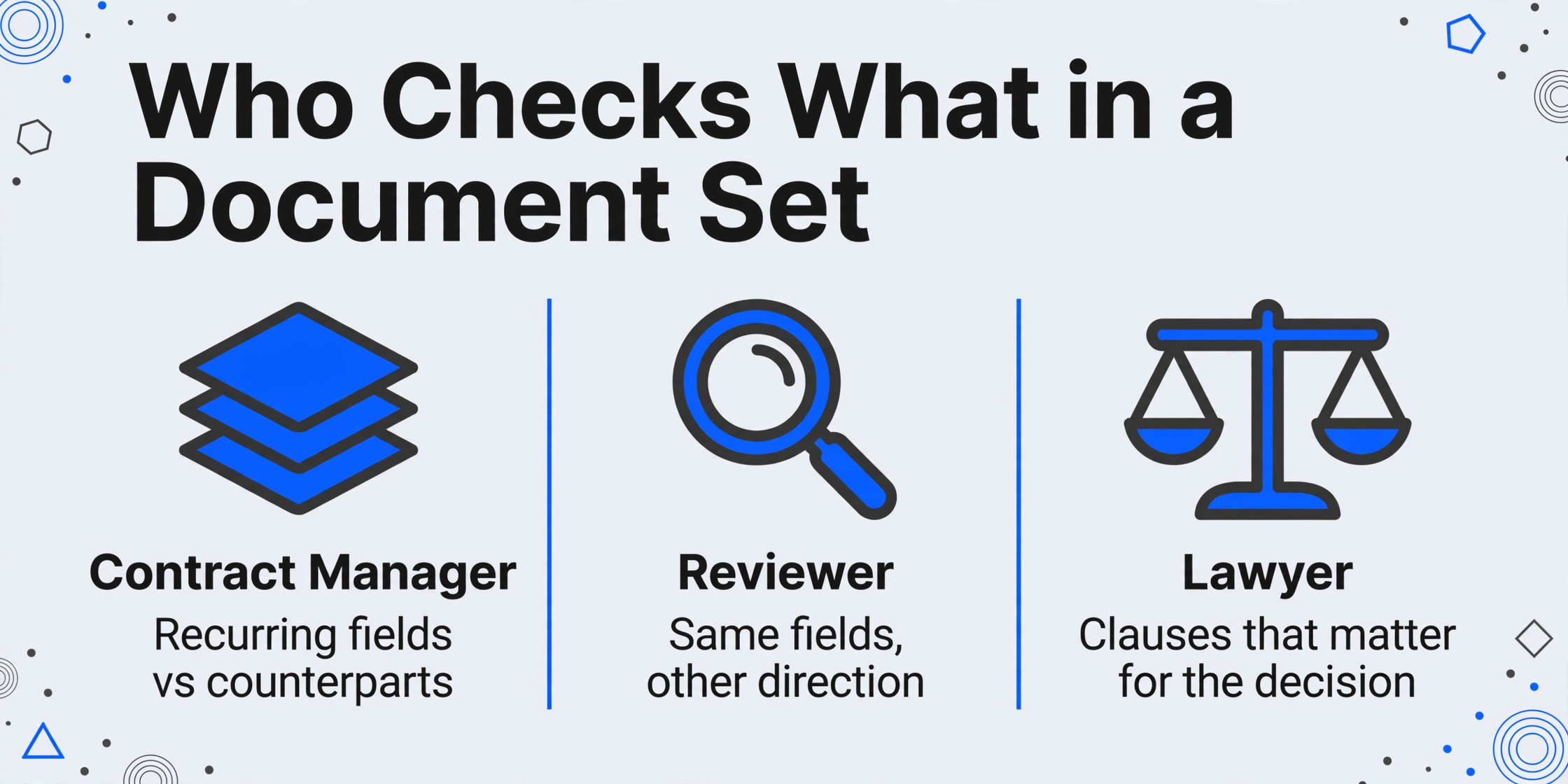
Contract portfolios are built out of documents that point at each other. A master agreement defines the commercial relationship, exhibits and schedules carry the detail (fee schedules, statements of work, price lists), amendments change parts of the original, and renewal letters extend it. Each document restates facts that also appear in the others: the legal entity names, the effective date, the payment amount, the currency, the notice period, the governing law. Cross-document contract data verification is the process of confirming that every restatement agrees with every other one before any of the extracted data is reported or acted on.
A single contract is rarely the unit of trust. The unit is the document set, and the set is only as reliable as its least consistent member.
The verification work has a fixed shape even in small teams. The person who assembled the set (paralegal, contract manager, or legal operations analyst) checks each recurring field against its counterpart in the related documents. The reviewer who will rely on the data checks the same fields from the other direction. And the lawyer who advises on a dispute or a renewal checks the specific clauses that matter for the decision at hand. The same three roles appear whether the set is a national rollout with one service agreement and forty exhibits, or a small firm's lease files with a contract, its addendum, and its assignment.
| Who checks | What they compare | Where it goes wrong |
|---|---|---|
| Contract manager or legal ops analyst | Entity names, effective dates, amounts, renewal terms across the master, exhibits, and amendments | Reads documents one at a time, so a drift between two exhibits is invisible |
| Reviewing attorney or paralegal | Payment figures, notice periods, termination terms against the operative clauses | Checks the documents they remember, not the full set; exhibit and operative clause get compared only when a question arises |
| The team relying on the data | Reported totals and obligations against the source documents | Trusts the first document they open; the controlling clause lives in another file |
The scale of this work is not a niche problem. ACC's 2019 global legal department benchmarking found inside lawyers averaging 173 contracts reviewed per year, with an average contract cycle time of 30.9 days (ACC 2019 Benchmarking Report). CLOC, the Corporate Legal Operations Consortium, treats contract turnaround time as one of the core metrics that legal departments report on (CLOC State of the Industry). And the cost of every review cycle is heavy: IACCM research across 700+ organizations put the average cost of processing a basic everyday contract at $6,900, including about five hours of legal time and eighteen hours of contract management and procurement time per agreement (WorldCC, The Cost of a Contract). Reading a contract twice instead of once is not markup. It is a second full pass at that hourly cost.
Why Manual Cross-Checking Between Documents Breaks
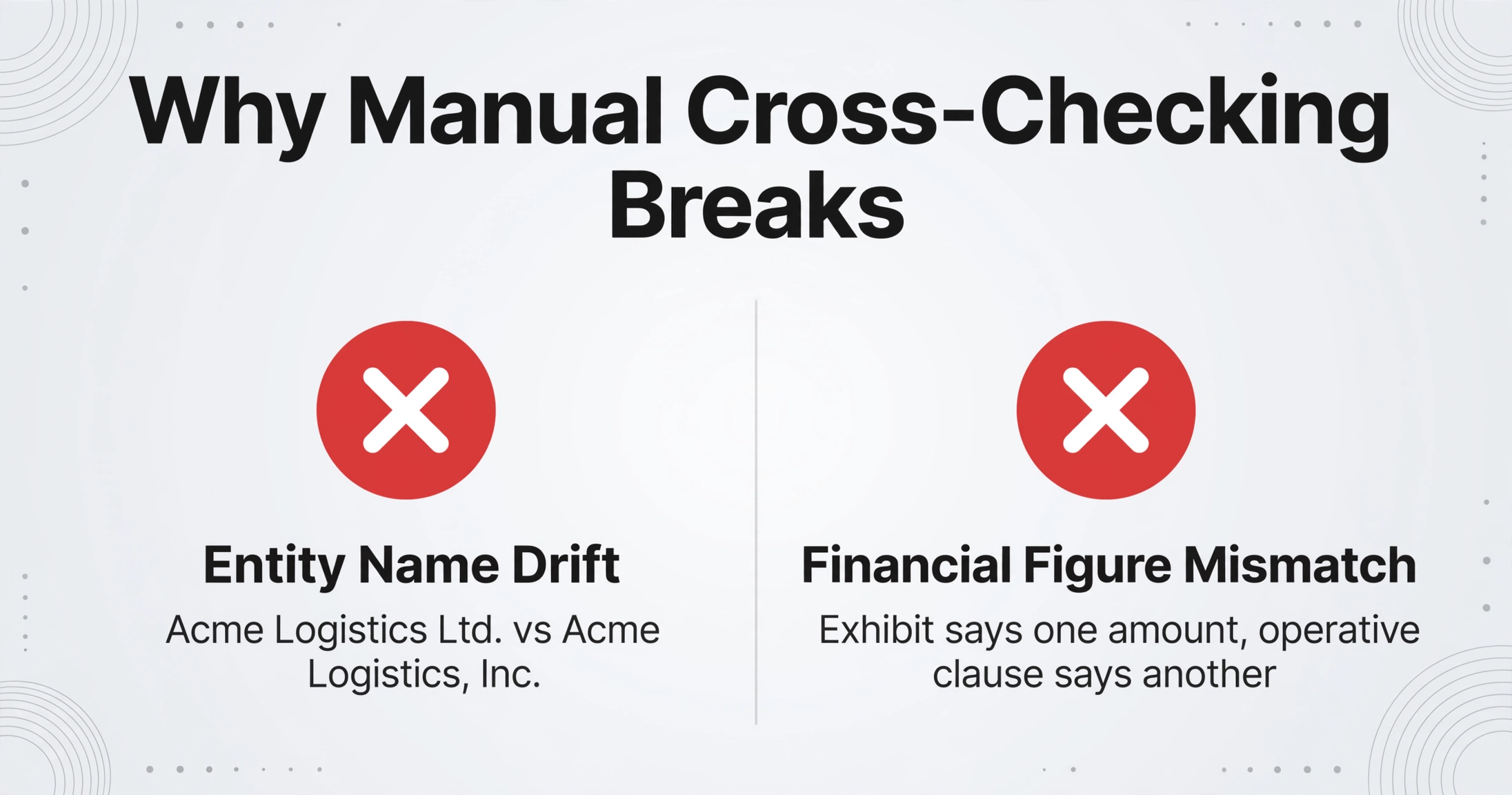
Cross-document verification fails for three reasons, and each one is about the documents disagreeing rather than the extraction being wrong.
Entity names drift across documents. The master agreement names "Acme Logistics Ltd.", the statement of work uses "Acme Logistics, Inc.", and the renewal letter shortens it to "Acme". Each document is internally consistent. Compared against each other, they are three different counterparties. Legal-name drift is one of the most common failure modes in contract data projects, and it tends to surface late, inside a report or a signature block rather than during review (common contract extraction project pitfalls).
Financial figures recur in places that are each locally right. A payment amount can appear in the operative payment clause, in the fee schedule exhibit, in a change order, and in the invoice. The amount in the exhibit is correct as stated in the exhibit. The amount in the operative clause is correct as stated in the operative clause. The disagreement is between the two documents, and no single reading reveals it. A legal-ops commenter on the same Reddit thread described exactly this: "financial figures are among the worst offenders because a number can be technically correct in one exhibit and wrong in the operative clause, and automated tools often surface both without telling you which controls."
Manual double-checking is where transcription errors actually live. The reviewer reads a figure from one document and looks for it in the other, typing or matching by eye. A 2023 systematic review of manual data abstraction measured the pooled error rate of reading a value from a source document and entering it into a structured record at 6.57 percent, against 0.29 percent for direct keying with the source in front of the operator (Garza et al., 2023). A reviewer who verifies a portfolio by re-typing its numbers is running one of the least reliable processes available, at the exact point where the data starts being relied on.
None of this is a mystery to the lawyers doing it. The 2021 EY Law and Harvard Law School Center on the Legal Profession survey of 1,000 contracting professionals found that more than half of organizations said contracting inefficiencies had cost them business, while 99 percent said they lacked the data and technology to improve the process (EY × Harvard, 2021). The gap is not awareness that verification matters. It is a way to run the comparison without re-reading every file.
Cross-Document Consistency on a Single Spreadsheet
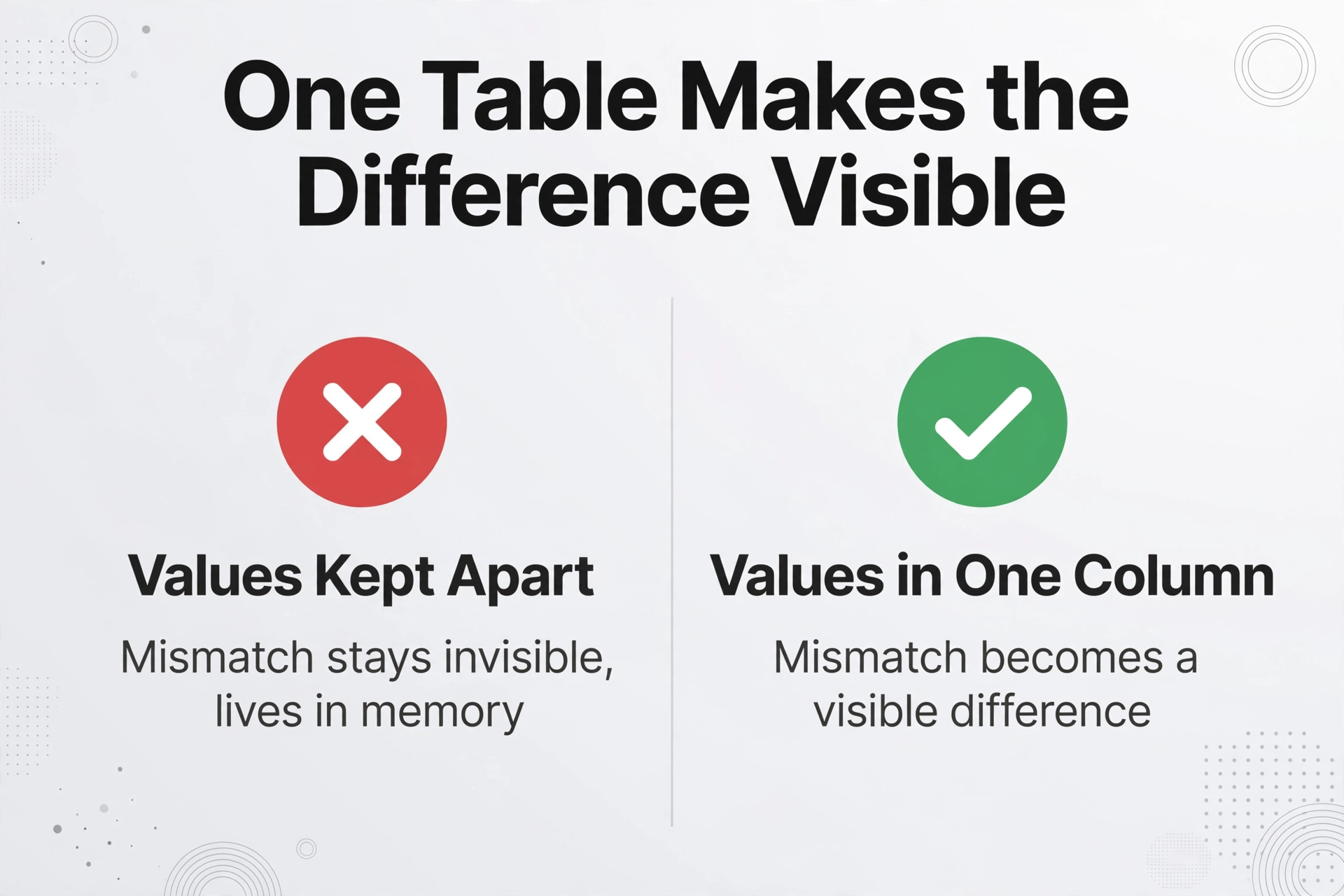
The fix starts with an observation: documents only disagree when their values are kept apart. Put the same field from every document into the same column of one table, and a mismatch between one agreement and the next becomes a visible difference instead of a memory. That is the mechanism at the center of the contract to Excel workflow that most extraction projects already use for the first pass.
The setup is one pass over the whole set. In ImageToTable.ai, you type the column names you want once: Entity name, Effective date, Payment amount, Auto-renewal, Notice period, Governing law. The tool uses Custom Column Extraction, which means the AI locates each value anywhere on the page by understanding what the column name means, not by matching a template position (a fuller look at how contract extraction works). Upload the master agreement, all exhibits, the amendments, and the renewal letters as one batch, and every document lands as a row in the same spreadsheet with the same columns. A field that recurs across the set now sits in one vertical column where differences are easy to see.
Then the table does the comparing. Because the same field from every document now sits in one column, a mismatch between the exhibit and the operative clause becomes a row you can find by sorting that column or by pointing a spreadsheet formula at it. The extraction's job is putting the values side by side in one column; the comparing is then a sort away, and it needs no tool-side rule about which document controls.
Files are processed securely and not stored.
Flagged cells are where Review Mode comes in. Hover or click a flagged value in the result table and the tool highlights the exact spot on the original document where that value was read, so you can see, for example, whether the $4,250 in the fee schedule is sitting next to a table title that says "superseded". Click a located region on the document and it jumps back to the matching cell. If a value was edited, one click shows the AI's original reading and lets you restore it. This is the layer that answers the question the Reddit commenter raised: when the same figure appears in the exhibit and in the operative clause, which one does the review trust. You do not trust the tool's word for it, you follow the cell back to the page.
The finished output is the exception report. Sort or filter the shared column, and the rows that disagree with the controlling document stand out from the rows that match. That is the "these 40 fields look normal, these 8 need human review" report the original thread asked for, produced without re-reading the set. The single-batch question of whether rows align and totals are sane is handled separately by the usual extraction spot-check methods and the seven-point verification checklist for extracted spreadsheets; those check the quality of one batch, while the shared column shows how the documents compare with each other. For small firms and teams that need the same control without a full review day, the batch clause extraction workflow used in small law firms is the same pipeline with lighter volume.
What a Consistency Check Still Can't Decide for You
An exception report narrows the review, it does not remove it. When the exhibit says one amount and the operative clause says another, the tool can point at both readings, but which document controls is a drafting and negotiation question that belongs to a lawyer. A spelling variant between "Acme Logistics Ltd." and "Acme Logistics, Inc." can be a genuine error or a legitimate registered name change, and the difference matters. And the clauses themselves, whether a provision is an obligation or a discretion, a cap or a floor, is interpretation that no column check performs.
Even the largest platforms treat verification this way. Ironclad's own documentation on AI-suggested contract metadata states plainly that AI predictions "cannot be guaranteed to be perfectly accurate, we recommend verifying your records if your business requires complete accuracy" (Ironclad Support). The product design that came out of the Reddit conversation is honest about the same boundary: the tool surfaces value-level and entity-level mismatches, and the judgment stays with the reviewers.
The goal is not to automate the lawyer out of the loop. It is to shrink the loop to the fields that actually differ, so the eight genuinely uncertain values get the review hours instead of all forty-eight.
FAQ
Can one tool really compare contract data across different documents?
Yes, in the sense that matters: define the same column names for every document in the set, upload them as one batch, and each agreement becomes a row in the same spreadsheet. Any field that appears in several documents then sits in one column, where a sort or a spreadsheet formula shows which rows disagree. The tool lines the values up; it does not decide which document controls.
What kinds of mismatches does cross-document verification catch?
It surfaces value-level and entity-level disagreement: party names that differ between documents, dates that do not line up, amounts that are right in one exhibit and wrong in the operative clause, notice periods stated differently in the body and the schedule. It does not interpret whether a clause is enforceable or which version of a term controls; those questions still go to a lawyer.
Does this replace the lawyer's review?
No. The exception report replaces the mechanical part of review, the repeated tracing of the same figure across two documents, and concentrates human attention on the cells that disagree. The judgment about which value is right, whether the difference is material, and what the contract means remains legal work. The Reddit thread that motivated this workflow asked for exactly that split: a boring report saying forty fields look normal and eight need human review, not a tool that decides for you.
How is this different from verifying a single extraction batch?
Single-batch verification checks the extracted table itself: column alignment, row counts, ranges, and spot checks against the source documents. Cross-document verification checks the relationships between documents: the same entity, date, or amount appearing in more than one agreement and disagreeing. A table can be a flawless extraction of every document and still contain contradictions, because the contradictions live between files, not inside them. The two checks run together in practice, but they answer different questions.
The next time your team pulls a contract portfolio into a spreadsheet, the question to ask is not whether the extraction is accurate. It is whether the extracted data agrees with itself, across the master, the exhibits, the amendments, and the renewals, and whether the answers come back as a short list of values that need a human decision. That list is the entire deliverable. Upload your own contract set and see how many fields come back as 'needs review'.