Customs Declaration
Data Entry Mistakes That Cost You
A single mistyped digit in an HS code on a 12-container shipment from China to Los Angeles can trigger a 5-day customs hold, $24,000 in demurrage, and a CBP exam fee before a penalty notice even arrives. Most customs clearance failures don't start with a regulatory change or a customs broker's judgment call. They start with someone typing the wrong thing into a form.
Key Takeaways
- One mistyped digit in a six-digit product classification code triggers the identical customs hold, penalty structure, and storage fees as deliberate fraud — CBP (U.S. Customs) cannot distinguish a typo from a lie — and this single keystroke error alone accounts for 22% of all clearance delays.
- Under federal customs law you can hand off the filing to a licensed broker, but you cannot hand off the penalty — if the broker types the wrong code, CBP pursues you, the importer, for up to five years of back duties on every single shipment filed under that same error.
- The solution is not slower typing or better training — it is removing the retyping step from the workflow entirely: ImageToTable.ai extracts product codes, declared values, and countries of origin directly from your source documents into one validated table, so no human retypes a single number between your supplier's invoice and the customs filing portal.
What "Data Entry" Actually Means in a Customs Filing
"Data entry" in a customs context doesn't mean one person filling out one form. A single import declaration pulls data from at least four source documents — the commercial invoice, the packing list, the bill of lading, and the certificate of origin — plus whatever the importer's internal ERP system says. Each document was likely generated by a different party in a different country. And according to the International Chamber of Commerce, the average international trade transaction involves 36 original documents and 240 copies.
Every time that information moves from one document to another — from a supplier's commercial invoice PDF into a broker's filing system, from a packing list into a customs entry form — someone is re-keying it. A 2024 academic study published in the International Journal of Shipping and Transport Logistics identified manual re-keying at each handoff as the primary source of documentation amendments that delay clearance. The problem compounds: a value typed correctly on the invoice gets mistranscribed on the packing list, and that discrepancy flags the entire entry when CBP's Automated Commercial Environment (ACE) portal cross-checks the two.
The root cause of most customs holds isn't classification complexity or changing regulations. It's the mundane fact that the same data point — a six-digit HS code, a declared value, a country of origin — passes through three to five sets of human hands before it reaches customs, and every handoff is an opportunity for error.
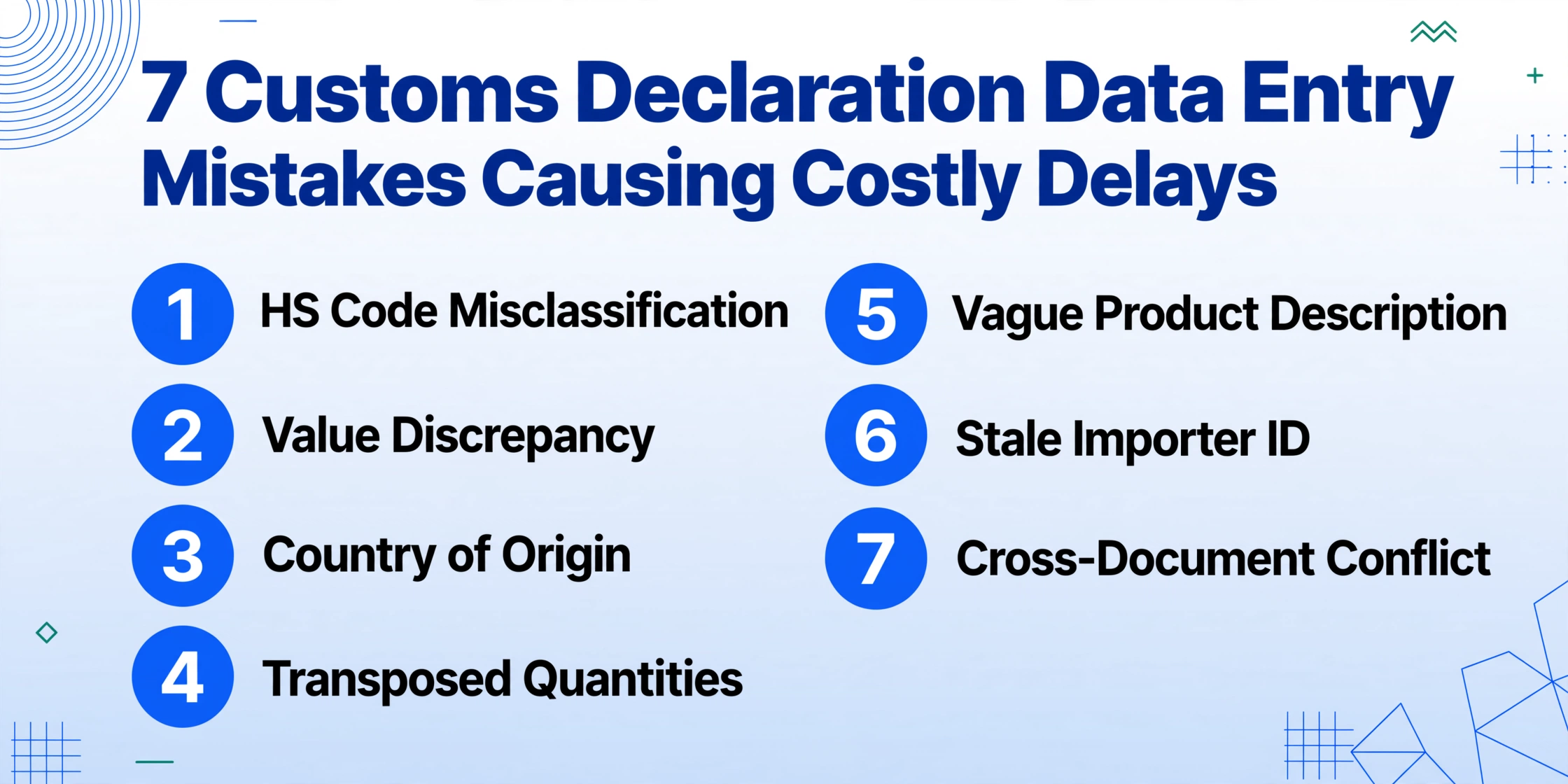
Mistake 1: The HS Code Nobody Double-Checked
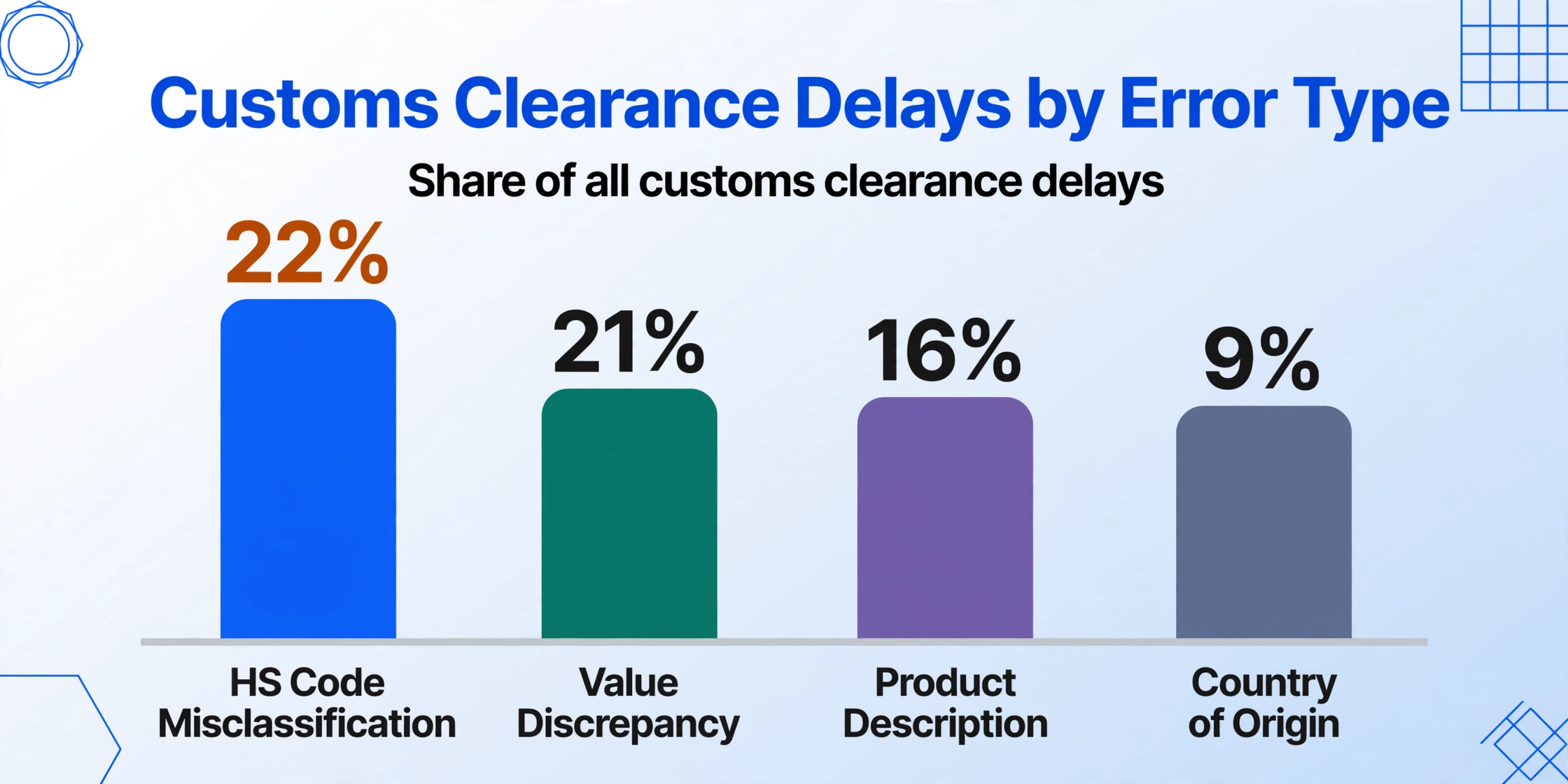
HS code misclassification accounts for 22% of all customs clearance delays, according to Jay Group's analysis of U.S. customs hold data — the single largest preventable cause. The Harmonized System has over 5,000 six-digit headings at the global level, and the U.S. Harmonized Tariff Schedule (HTS) expands that to over 17,000 unique 10-digit codes. A one-digit difference can pull your product from a duty-free Free Trade Agreement rate into a 25% Most Favored Nation rate, or into Section 301 or 232 surcharges that double or triple the landed cost.
Why does this happen at the data entry level? Three patterns repeat constantly. First, recycling an old code across product lines without checking whether a supplier change altered the material composition — a manufacturer switched from all-cotton to a cotton-poly blend, and the fiber content change shifted the classification. Second, picking a code that "sounds right" from memory instead of consulting the tariff schedule — "electronic components" covers dozens of distinct headings with duty rates ranging from 0% to 35%. Third, the exporter providing a code that was correct in their country but doesn't map to the importing country's tariff schedule.
Under 19 U.S.C. § 1592, CBP treats even negligent misclassification as a penalty-triggering event. For dutiable goods, penalties range from 0.5 to 8 times the value of the lost duty depending on the level of culpability, per CBP audit data compiled by C.H. Robinson. For non-dutiable items, fines range from 20% to 80% of the goods' value. And CBP can go back five years from the entry date to recover underpaid duties on all prior shipments that used the same wrong code — a compounding liability that turns a one-time typo into a six-figure exposure.
A mid-size importer misclassifying 50 entries over two years at a $200-per-entry duty shortfall faces not just a $10,000 back-duty bill, but penalties of up to $40,000 under the gross negligence tier (four times the underpaid duties). That's before counting the demurrage on each held shipment.
Mistake 2: Declared Value That Doesn't Match the Invoice
Value discrepancies cause 21% of customs delays — nearly as many as HS code errors. CBP's ACE targeting system flags any mismatch between the declared value on the entry summary (CBP Form 7501) and the commercial invoice. Even a $50 difference can trigger a manifest hold.
The data entry trap here is straightforward: the supplier's commercial invoice might list the value in one currency, the freight forwarder's internal system converts it for logistics purposes using a different exchange rate, and the broker enters a third number rounded for convenience. Multi-currency shipments amplify this — a container with goods sourced in USD, EUR, and JPY has three conversion points, each a potential discrepancy. Another common scenario: the importer declares the ex-factory price but the invoice includes freight charges and insurance (CIF terms). CBP expects the transaction value to be declared as defined under Incoterms — and mismatches between the Incoterm used and the value entered are a fast path to a commercial enforcement hold.
Post-Brexit, U.K. customs authorities have seen a surge in value-related holds as businesses accustomed to intra-EU trade (where no customs declarations were required) now file declarations with valuation errors. The 2025 repeal of de minimis treatment for low-value shipments in the U.S. means even small-value parcels now face full entry review — a $35 value discrepancy that would have passed under de minimis now triggers the same scrutiny as a $35,000 one.
Mistake 3: Country of Origin — Especially When It's Complicated
Country of origin errors account for 9% of customs delays. The field seems straightforward until you deal with a product that has components from three countries, assembled in a fourth, packaged in a fifth. CBP uses a "substantial transformation" standard to determine the true country of origin, and if the declarant picks the country where the goods shipped from (not where they were made), the entry is incorrect.
This error is uniquely expensive because origination errors don't just delay one shipment — they retroactively invalidate Free Trade Agreement claims on every shipment filed under the same incorrect origin. If an importer has been claiming USMCA preferential treatment based on a wrong country of origin determination, CBP can claw back the full MFN duty rate on every past entry under that claim, plus interest. According to C.H. Robinson's customs audit data, this is one of the most common findings in CBP Focused Assessments — the intensive audits that follow when CBP identifies a pattern of errors across multiple entries.
The data entry fix is conceptually simple but operationally hard: maintain a product-level master data record that maps each SKU to its verified country of origin (with the "substantial transformation" analysis documented), and never let the origin field be filled from the ship-from address on the invoice. The two are not the same thing, and confusing them is what creates the error.
Mistake 4: Transposed Quantities and Weights
A freight forwarder in Dubai once entered a product's net weight as 2,500 kg instead of 250 kg — a single zero transposition. CBP flagged the discrepancy between the airway bill and the packing list, triggering a full cargo inspection that held the shipment for five days and cost the importer $1,200 in exam fees, which doesn't include the demurrage clock ticking at $150 per day per container.
Quantity and weight errors are classic data entry failures: a carton count of 47 typed as 74, a weight in pounds entered where kilograms are expected, a decimal point moved one place because someone typed 12.5 as 125. These errors survive submission because quantity fields are numeric — there's no semantic validation that says "this carton count looks wrong for this commodity." CBP's targeting system compares the declared quantity against typical trade patterns for that HS code. A statistically improbable weight deviation relative to similar shipments of the same commodity triggers a statistical validation hold — not because CBP suspects fraud, but because the number doesn't pass the algorithm's anomaly detector.
This is a case where the error doesn't need regulatory knowledge to fix. It needs a second pair of eyes on the numbers before submission, or better yet, a system that extracts the quantity directly from the source documents and flags internal inconsistencies before the entry is filed.
Mistake 5: Incomplete Product Descriptions
Product description errors account for 16% of customs clearance delays — a category that has gotten worse, not better, over the last two years. "It used to be that if you put anything in the Description of Goods field, the customs broker would fix it for you," Thomas Taggart, Head of Global Trade for Passport, told Jay Group. "Now, customs agencies are putting that responsibility back on the shipper. If you don't provide enough information or if the product description doesn't tell the customs authority exactly what's in the box, they are likely to take a closer look at your shipment."
CBP now rejects descriptions like "electronics," "textiles," "spare parts," or "gift" as insufficient. A compliant description must answer three questions: what is the product (material, function), what is it made of (composition), and what is its intended use. "100% cotton men's woven shirts" clears. "Garments" doesn't.
The data entry failure here isn't ignorance — it's that the person keying the description is working from a product database that uses internal SKU names ("SKU-4421-BLK-L") rather than customs-compliant descriptions. The gap between how a warehouse labels a product and how customs requires it to be described is the gap where holds happen.
Mistake 6: Missing or Stale Importer Identification
Every customs declaration requires a valid importer identification number — an IRS Employer Identification Number (EIN) for U.S. entries, an EORI number for EU entries, or the local equivalent in each jurisdiction. When a company changes its registered address, merges with another entity, or lets its customs bond expire, any entry filed under the old ID number is rejected at the gate.
This error category is pernicious because it's invisible until it fails. A logistics coordinator filing the same EORI they've used for three years won't know it's now invalid until the entry bounces — and by the time the rejection notice arrives, the shipment is already sitting at the port with the free-time clock running. Under CBP rules, the importer of record bears responsibility for keeping identification current, even if a customs broker is filing on their behalf (19 U.S.C. § 1484). A missing or expired customs bond alone can trigger a $10,000 recordkeeping penalty per entry.
Mistake 7: Inconsistency Across Documents
Perhaps the most frustrating hold type: every individual document is internally correct, but two documents contradict each other. The commercial invoice says 500 units, the packing list says 480. The bill of lading lists the consignee as the corporate entity, the commercial invoice lists a subsidiary's trading name. The declared value on the entry summary is $48,000, but the commercial invoice three pages back in the filing shows $48,500 after including shipping.
CBP's ACE portal performs automated cross-document validation, comparing fields across the entry summary, the commercial invoice, and the packing list. When numbers don't match, the system generates a hold automatically — no human customs officer makes a judgment call, the algorithm flags the inconsistency and the container stops. A Unicargo analysis of demurrage triggers found that even a $50 discrepancy between invoice and packing list values can flag an entry for manual review, and CBP exam fees alone run $300 to over $2,000 per container before demurrage starts accruing.
This error isn't caused by lack of knowledge — it's caused by the fact that three different parties (supplier, freight forwarder, customs broker) filled out three different documents using three different versions of the same data, and nobody checked them side by side before submission.
Why Manual Re-Keying Creates These Errors in the First Place
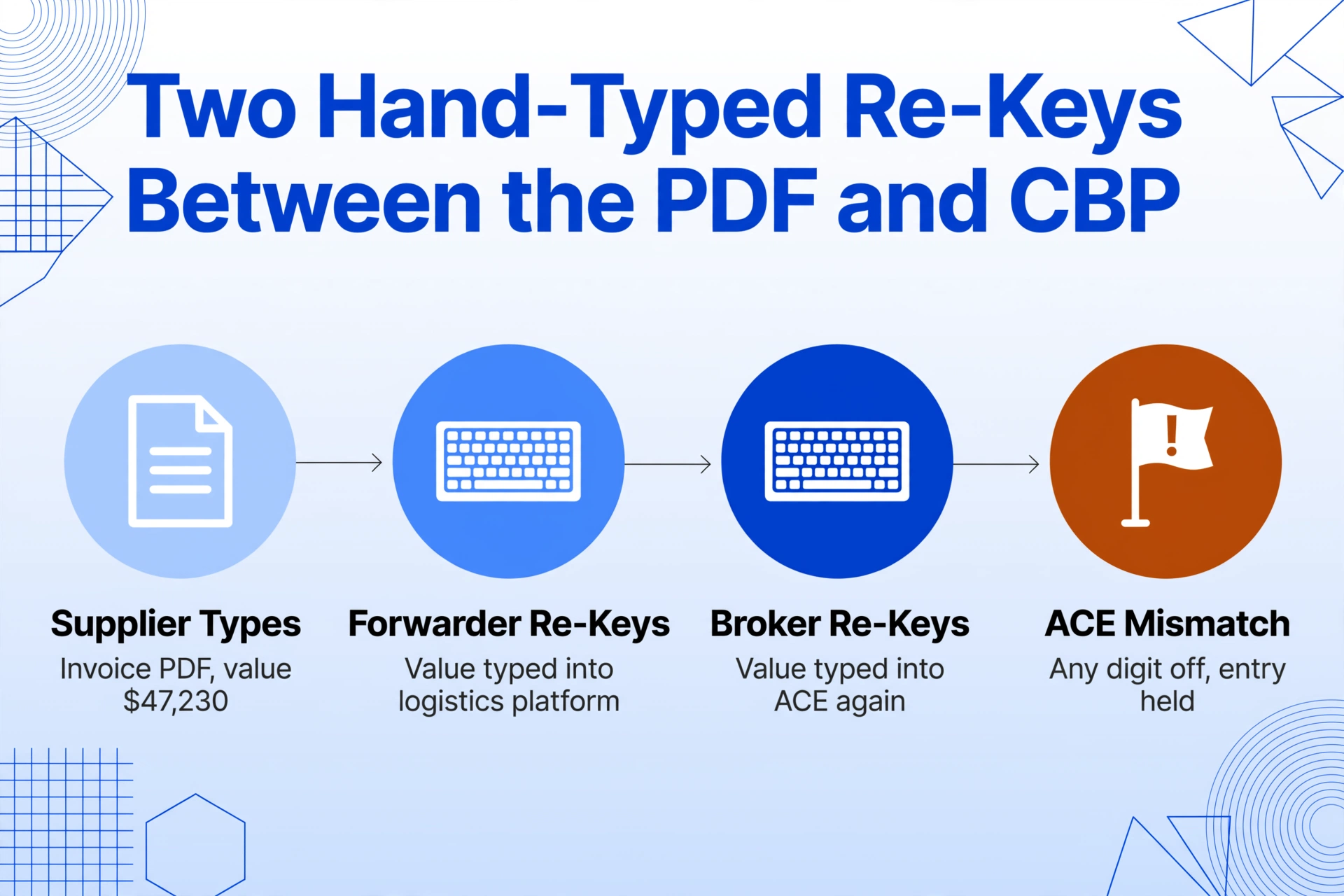
Step back and trace the journey of one data point — say, a commercial invoice value of $47,230. The supplier in Vietnam types it into their invoicing system and exports a PDF. The freight forwarder in Singapore opens the PDF, reads the value, and types $47,230 into their logistics platform. The customs broker in Los Angeles receives both documents, opens the PDF, reads the value, and types the same number into CBP's ACE portal via the entry summary. That's two manual re-keyings between the source document and CBP's system — and at each step, the chance of a transposition, an off-by-one-digit error, or a currency conversion mistake compounds.
This isn't a training problem. It's a workflow design problem. When the only way to get data from a PDF into a filing system is to read it with human eyes and type it with human fingers, errors are statistically inevitable. The question isn't whether an error will occur — it's which entry, and how expensive the hold will be when it does.
The ICC's finding of 36 documents and 240 copies per transaction isn't just a logistics statistic — it's a map of error vectors. Every copy point is a re-keying point. Every re-keying point is a potential customs hold.
How Structured Extraction Changes the Workflow
The alternative to manual re-keying is structured data extraction: instead of reading each document and typing its contents into a filing system, you extract every data field from the source documents into a structured table — one row per shipment, columns for HS code, declared value, country of origin, quantity, consignee, and product description — and validate the entire set before submission.
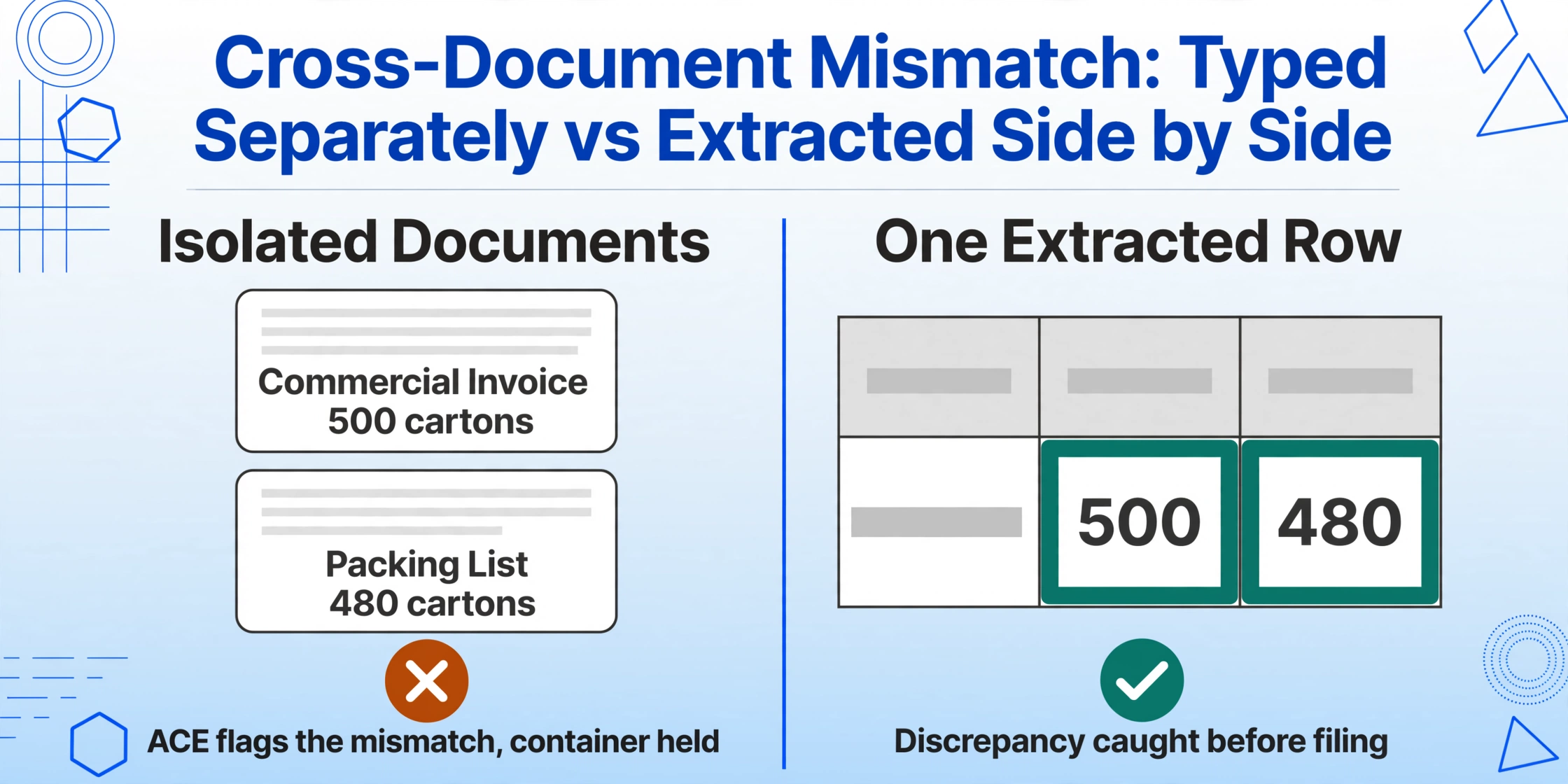
Here's what that looks like in practice. You upload the commercial invoice, packing list, bill of lading, and certificate of origin for a shipment. A vision AI model reads each document and extracts the relevant fields — not by matching templates or knowing the layout in advance, but by understanding what the field means (a "column-name extraction" approach: you tell the tool which data points you want, and it locates them anywhere on each page by their semantic meaning rather than their pixel position). The extracted fields populate a row in a spreadsheet, side by side. You can immediately spot that the commercial invoice says 500 cartons while the packing list says 480 — because both numbers appear in the same row. You can cross-reference the declared HS code against a master classification database. You can batch-process an entire shipment's worth of documents — 12 commercial invoices, 12 packing lists — into one table and validate all 12 entries before a single one reaches CBP.
This doesn't eliminate the regulatory knowledge requirement; you still need someone who understands HS classification rules and valuation methodology. But it eliminates the re-keying step that creates most of the errors those rules are designed to catch.
Files are processed securely and not stored.
For shipments involving multiple countries of origin — a growing scenario as supply chains diversify — batch extraction lets you process all declarations for a multi-origin shipment in one pass, with each line item's origin field extracted directly from the supplier documentation rather than manually re-typed. Read our guide on exactly how to set up structured extraction from customs forms — the approach covers everything from single-country declarations to complex multi-origin filings.
A Pre-Submission Checklist That Actually Catches Errors
Even with extraction tools, a final human review catches what algorithms might miss. Here's a practical checklist, informed by CBP's "reasonable care" standard under 19 U.S.C. § 1484, that addresses the seven error categories above:
- HS code cross-check: For each product line, verify the 10-digit HTS code against the official CBP CROSS rulings database or an authoritative classification tool. If the code was inherited from a previous shipment more than 12 months ago, re-verify — HS codes are updated every five years by the WCO, with the next revision expected in 2028, and interim rulings can shift interpretations.
- Value consistency: Compare the declared value on the entry summary to the commercial invoice line by line. Confirm the Incoterm matches the valuation basis. For multi-currency shipments, use the exchange rate published on the filing date, not the invoice date.
- Origin vs. ship-from: For each line item, verify that the country of origin on the declaration is the country where substantial transformation occurred — not the country the goods shipped from. Document the transformation analysis per SKU.
- Quantity and weight reconciliation: Sum the quantities across all packing lists and compare to the total declared on the entry summary. A mismatch of even one carton can trigger a statistical validation hold.
- Description audit: Read every product description as if you're a CBP officer who's never seen this product before. Does it answer: what it is, what it's made of, and what it's used for? Strip out internal SKU codes and warehouse shorthand.
- Importer ID validity: Confirm the EIN/EORI is current, the customs bond is active with sufficient coverage, and the registered address matches the entry. This takes 30 seconds to verify but hours to fix after a rejection.
- Cross-document reconciliation: Before filing, place the commercial invoice, packing list, and bill of lading side by side (or in the same spreadsheet). Verify that the consignee name, total quantity, declared value, and HS codes match across all three.
Frequently Asked Questions
How much does a customs data entry error actually cost?
Costs stack in layers. A single misclassified HS code can trigger: (1) a CBP exam fee of $300-$2,000+ per container, (2) demurrage at $75-$300 per container per day — escalating daily — so a 5-day hold on 5 containers at $150/day is $3,750, (3) penalty exposure under 19 U.S.C. § 1592 ranging from 0.5x to 8x the lost duty, and (4) retroactive duty collection going back five years. A mid-size importer with 50 entries over two years using a wrong HS code can face $50,000+ in combined demurrage, duties, and penalties — on a single recurring error.
Can a customs broker's error still be the importer's responsibility?
Yes, explicitly. Under 19 U.S.C. § 1484, the importer of record retains legal responsibility for the accuracy of every declaration, even when a licensed customs broker prepares and files the entry. CBP's "reasonable care" standard means the importer is expected to provide accurate information to the broker and to review declarations for errors. You can delegate the filing — you cannot delegate the liability.
Does AI extraction work on handwritten or stamped customs forms?
Vision AI models can read handwriting, stamps, and mixed printed/handwritten documents — customs forms from smaller trading partners are often partially handwritten, especially certificates of origin and inspection reports. The accuracy depends on legibility: clearly printed handwriting processes reliably; heavily cursive or smudged stamps may produce lower confidence results that require human review. The key advantage over manual entry is that the extraction output can be validated against a second source — if the declared value extracted from a stamped certificate doesn't match the commercial invoice in the same batch, the discrepancy is flagged before it becomes a CBP hold.
How do I handle HS codes when the WCO updates the Harmonized System?
The WCO updates the HS nomenclature every five years, with the next major revision (HS 2028) approaching. Each revision renumbers some headings, splits existing codes, and creates new ones. If your product database uses the previous version's codes, you need to map each SKU to its new classification before filing the next entry. The most common pipeline error: a supplier continues providing the old HS code on commercial invoices after the revision takes effect, and the importer files that code without checking the effective date. Treat the WCO revision schedule as a hard deadline to audit every active HS code in your product master data.
What's the fastest way to fix a customs entry error after submission?
If the error is discovered before CBP flags it: file a Post-Entry Amendment (PEA) or Post-Summary Correction (PSC) through your broker — these are routine corrections for clerical errors. If CBP has already detected the error and issued a hold or a Request for Information (CBP Form 28), respond with the corrected documentation immediately — delays in response extend the hold and increase demurrage exposure. If the error involves underpaid duties, consult a customs attorney about filing a Prior Disclosure, which is a voluntary notification to CBP that can significantly reduce penalty exposure. The worst approach is doing nothing and hoping the error isn't noticed — CBP's ACE portal compares entries across time, and patterns of consistent misclassification surface even if no single entry triggers a hold.
Is this tool a replacement for a customs broker?
No. A customs broker provides regulatory expertise — classification rulings, valuation methodology, PGA requirements, trade program eligibility — that no extraction tool replaces. What an extraction tool replaces is the step where a human reads a PDF and retypes the data into a filing system. That step is the source of most data entry errors, and eliminating it reduces the errors a broker needs to catch. The broker's judgment becomes the review layer, not the data entry layer.
The customs declaration form on your desk isn't the problem. Neither is the HS code system, as arcane as it can be. The problem is that the data on that form has to travel through too many hands — each one retyping the same fields — to reach the one system that decides whether your container moves or sits. Cutting those re-keying steps eliminates the errors that cause most customs holds. And the fewer holds you have, the less time you spend explaining demurrage bills to your CFO.