5 German Customs Declaration
Data Mistakes That Trigger Delays and Audits
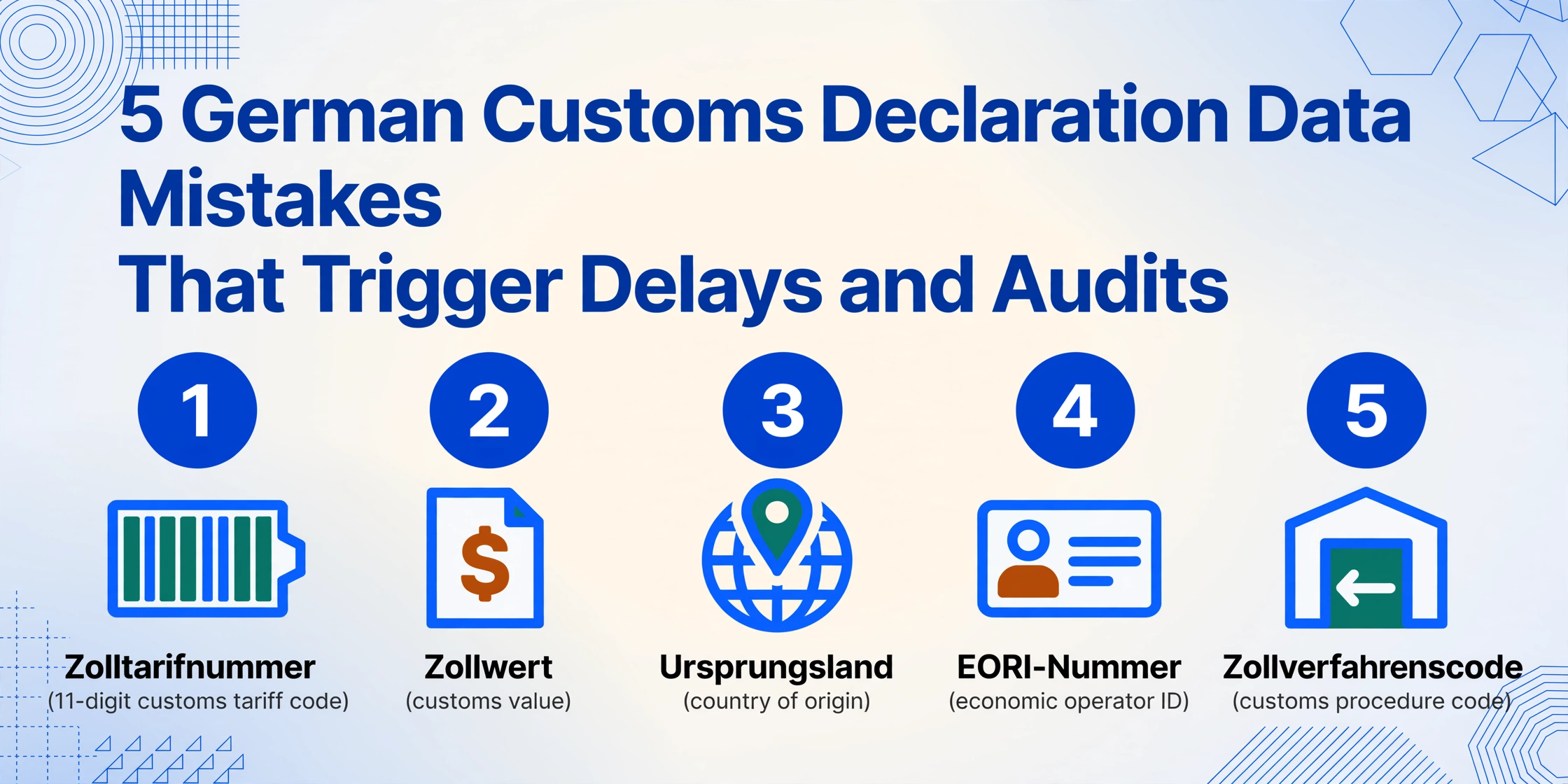
A German customs declaration (Zollanmeldung) is not a single data entry. It is a set of ten to fifteen interdependent fields — tariff classification, customs value, country of origin, EORI identifiers, and procedure codes — where an error in one field does not stay in that field. It cascades. A wrong 11-digit Zolltarifnummer changes the duty rate. An incorrect Ursprungsland voids the preferential tariff the importer was counting on. A Zollverfahrenscode entered as free circulation (4000) when the goods were meant for bonded warehousing (7100) triggers an immediate duty payment that was supposed to be deferred — and the only way to recover it is a formal Erstattungsantrag (refund application). Each of the five errors below is common enough that German customs brokers see them weekly. Each is serious enough that it cannot be ignored once made. And each, critically, has a data-capture fix — a way to prevent the error from entering the declaration in the first place — that replaces the manual transcription step where the error originates.
Key Takeaways
- Five common German customs declaration errors — wrong tariff code, underdeclared customs value, incorrect country of origin, EORI mismatch, and wrong procedure code — all start the same way: someone reads a value from a document and types it into a system.
- None of these errors originates in the broker's ATLAS filing or the complexity of UCC regulations — every wrong digit, miscategorized origin, and mismatched EORI enters in the manual transcription step between the document and the keyboard.
- Prevent each error at the source by moving data capture upstream of the keyboard — extract tariff codes from product specs, compute CIF customs values from transport documents, and match procedure codes against operational intent, turning manual transcription into verification.
What follows are five Zollanmeldung-specific data errors — errors that exist because a German customs declaration carries fields with legal and financial consequences far beyond the spreadsheet cell where the wrong value is typed. Each error is described as it appears in practice, traced to its root cause in the manual data-entry workflow, and paired with a fix that prevents the error at the point of data capture rather than correcting it after submission.
Error 1: Wrong HS Code Classification — When One Digit Changes the Duty Rate
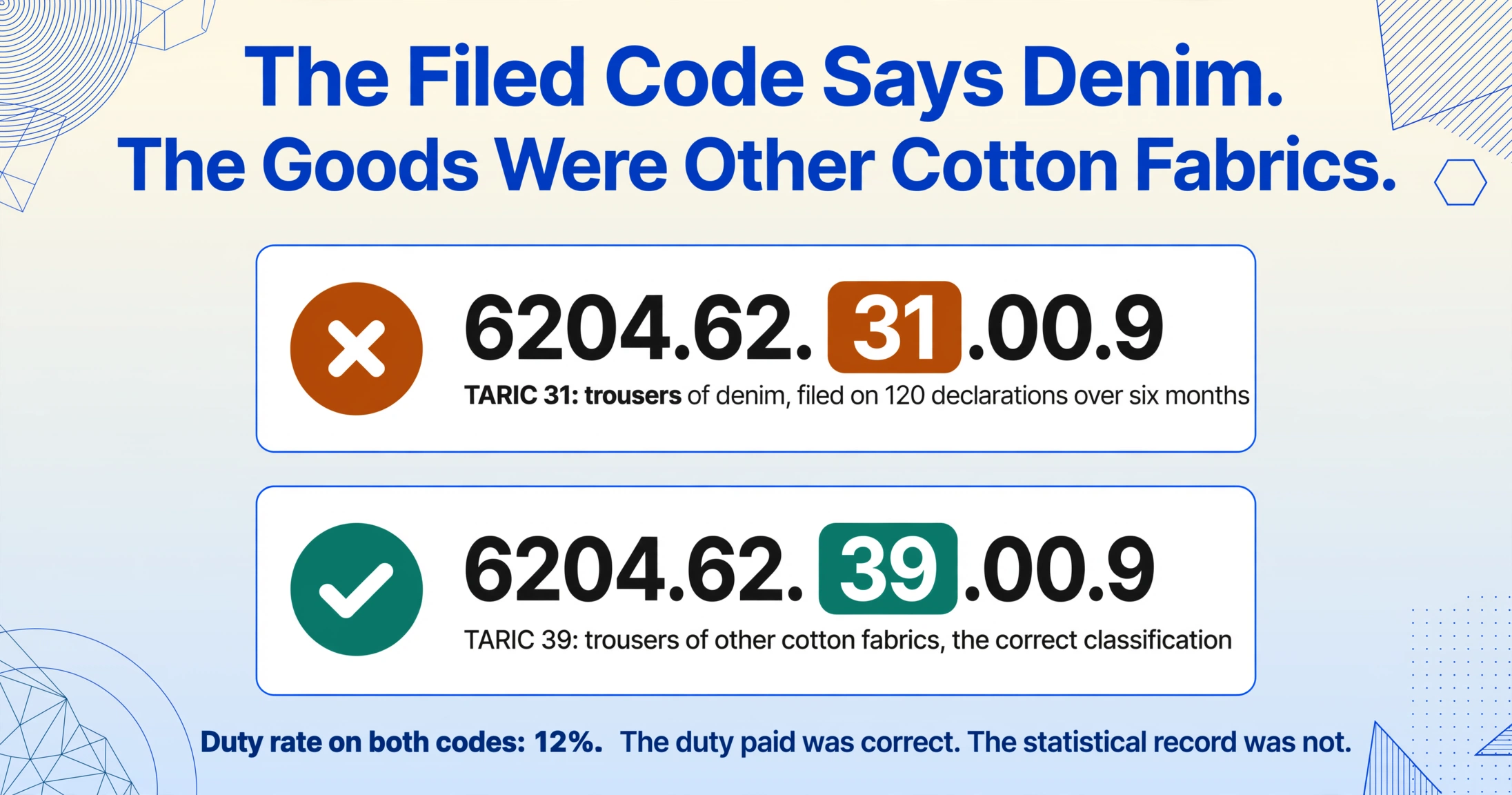
What it looks like. An importer bringing cotton trousers from Vietnam into Germany classifies the goods under Zolltarifnummer 6204.62.31.00.9. The correct code is 6204.62.39.00.9 — a single-digit difference at the ninth position, where the TARIC sub-classification distinguishes between trousers of denim (31) and trousers of other cotton fabrics (39). The importer files 120 declarations with the wrong code over six months. The duty rate on both codes is 12% — so the duty paid is correct. What is not correct is that the goods are tracked under the wrong statistical heading in the German foreign trade statistics, that the importer's binding tariff information (verbindliche Zolltarifauskunft, or BTI) on file applies to a different code, and that if the EU were to impose a safeguard measure or anti-dumping duty on denim trousers specifically — a real possibility given the EU's active textile safeguard monitoring — the importer's declarations would be caught in the measure's scope despite the actual goods not being denim, because the importer declared them under the denim code.
What actually happened. The German Zolltarifnummer is an 11-digit classification built from four layers: the first six digits are the international Harmonized System (HS) code administered by the World Customs Organization, digits 7–8 are the EU Combined Nomenclature (KN), digits 9–10 are the EU TARIC (Integrated Tariff) encoding trade defence measures and tariff suspensions, and digit 11 is the German national code for VAT rates and national restrictions. For imports into Germany, the full 11-digit code is mandatory under ATLAS. For exports, the 8-digit KN code suffices. The difference matters because a TARIC-level error at digits 9–10 can trigger an entirely different trade measure — anti-dumping duties, countervailing duties, quota restrictions, or tariff suspensions — even when the underlying duty rate appears identical.
The German Federal Ministry of Finance (Bundesfinanzministerium) has reported that approximately 68% of customs delays at the ports of Hamburg and Frankfurt originate from HS code misclassification. A one-digit error in the tariff code does not just risk the wrong duty rate — it can trigger an ATLAS rejection cycle. ATLAS validates the tariff code against the EZT-online database in real time. If the code does not match a valid entry or if it conflicts with other declared data elements, ATLAS rejects the declaration. The goods remain uncleared. Terminal storage costs (Lagergeld) begin accumulating — at Hamburg's container terminals, roughly €10–15 per TEU per day after the free storage period. The importer's delivery schedule slips. The seller's payment terms may be breached. A single-digit tariff code error on one declaration, if not caught until after the ATLAS rejection, costs not just the amendment cycle but a cascade of operational delays that the tariff code itself gives no hint of.
The error also has an audit trail consequence. Under Article 33 of the UCC, the customs authorities may conduct post-clearance audits (Zollprüfung) for up to three years after the declaration was accepted. If an audit reveals that the importer consistently used the wrong tariff code — even if the duty paid was accidentally correct — the finding is not "no harm done." It is a classification governance failure. The customs authority may require reclassification of all affected entries, recalculation of duties for the entire three-year lookback period, and, if the correct classification would have resulted in a higher duty rate, retroactive payment with interest (Säumniszuschlag) under the German Fiscal Code (Abgabenordnung).
The fix. The tariff code should be extracted from the supplier's product specification or the commercial invoice, not manually looked up and typed for each declaration. Define a dedicated column — Zolltarifnummer (11-digit German Customs Tariff Code) — and apply an Inferred Column: HS Chapter (derive from Zolltarifnummer: output 2-digit number with chapter description, e.g. "62 — Articles of Apparel"). The AI reads the product description from the invoice, extracts the declared tariff code, and infers the HS chapter. The cross-check — does the chapter inferred from the code match the product type described in the invoice? — catches the most common class of tariff-code errors, where goods are entered under a code from the wrong chapter entirely. For the complete extraction workflow, the guide to extracting German customs declaration data to Excel details the column definitions that feed this cross-check.
Error 2: Zollwert Miscalculation — When the Wrong Incoterm Produces an Underdeclared Customs Value
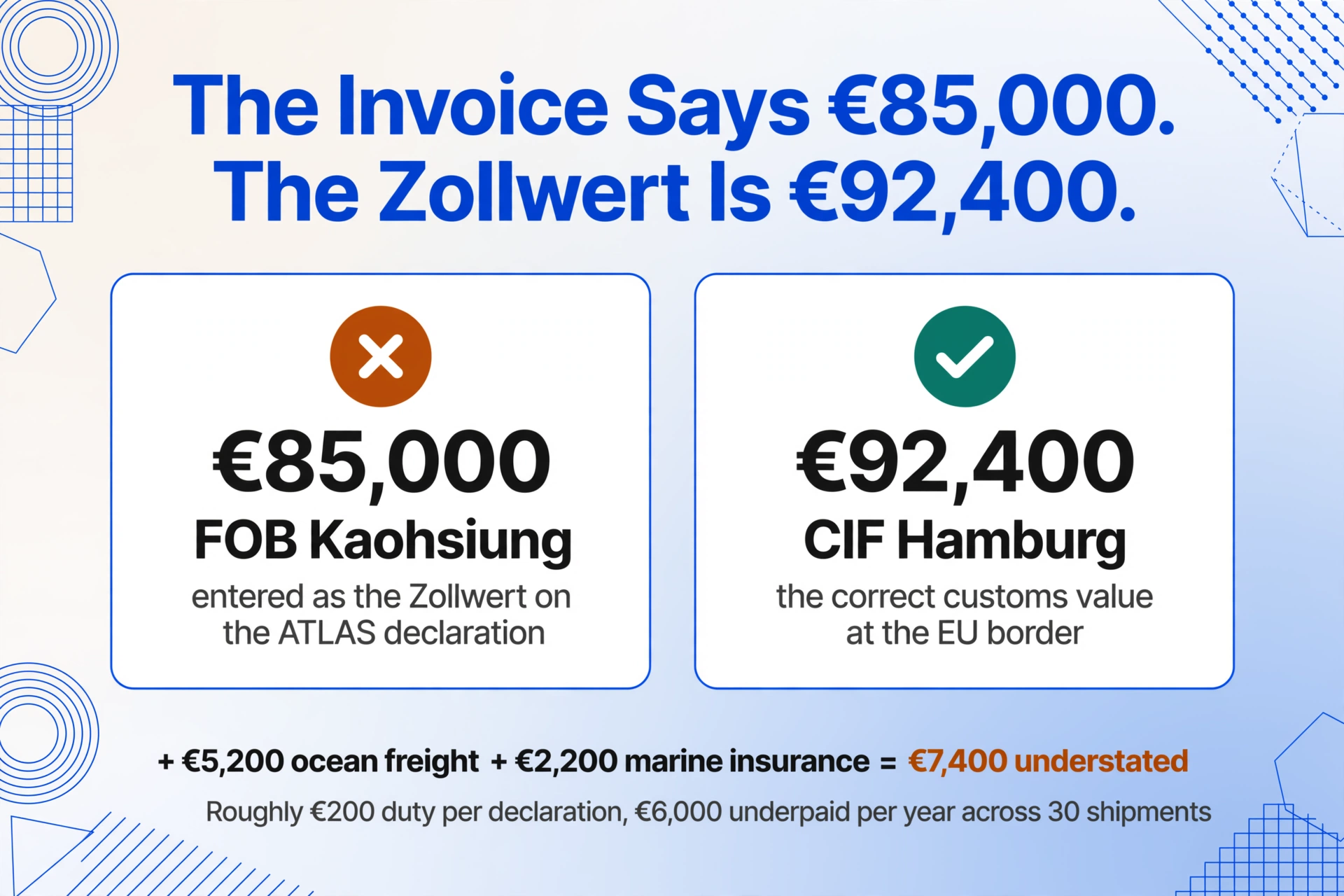
What it looks like. A German importer purchases machinery from a Taiwanese supplier. The commercial invoice (Handelsrechnung) shows €85,000 — the FOB Kaohsiung price. The importer enters €85,000 as the Zollwert on the ATLAS declaration. The correct customs value is €92,400 — the CIF Hamburg value, which is the FOB price plus ocean freight (€5,200) and marine insurance (€2,200). The declaration understates the customs value by €7,400. The duty underpayment on each affected declaration is the duty rate multiplied by €7,400 — on machinery at a 2.7% MFN rate, roughly €200 per declaration. Across 30 machinery shipments per year, the annual underpayment is €6,000. The customs authority discovers it during a routine post-clearance audit — not because €200 per shipment triggers an alarm, but because the freight and insurance amounts are visible on the freight forwarder's invoice and the insurance certificate, both of which the customs auditor requests as part of the standard audit file.
What actually happened. The customs value (Zollwert) for imports into the EU is determined under Articles 70–74 of the UCC. The primary method is the transaction value — the price actually paid or payable for the goods, adjusted for certain elements. The critical adjustment for German importers is that the customs value must be assessed on a CIF (Cost, Insurance, Freight) basis at the EU border. If the supplier's invoice states the FOB price — the value of the goods loaded onto the vessel at the port of export — the importer must add the cost of freight to the EU border and the cost of insurance during transit. If the invoice states the EXW (Ex Works) price, the importer must add all transport, insurance, and handling costs from the factory gate to the EU border.
This is not an obscure rule. It is the most common customs value error in German import practice, because the supplier's invoice and the customs value base are different numbers by design — the invoice states what the buyer paid the seller; the customs value states what the goods cost to bring to the EU border. Under German law, an incorrect customs value declaration that results in a duty underpayment is treated as a tax underpayment under Section 370 of the Fiscal Code (Abgabenordnung). If the error is deemed negligent — which is the default finding when a company importing regularly lacks a documented customs valuation procedure — the importer faces not just the retroactive duty plus interest, but a penalty of up to the amount of the underpaid duty. The liability for incorrect customs value declarations remains with the importer even when a customs broker files the declaration — under Article 77(3) UCC, the importer is the customs debtor and bears ultimate responsibility for the accuracy of the declared value.
The fix. The customs value must be calculated from the supplier invoice and supporting transport documents, not manually looked up from the invoice total. Define a column — Zollwert (Customs Value in EUR, CIF EU Border) — and add a Computed Column: Declared vs CIF Gap (Zollwert — Sum of Invoice Value + Freight + Insurance). The AI extracts the invoice value, the freight charge from the bill of lading or transport invoice, and the insurance from the insurance certificate, then computes the CIF customs value and flags any gap exceeding a threshold. The importer verifies the computed Zollwert against the declared value on the Zollanmeldung — the same cross-check that a customs auditor performs during a Zollprüfung, shifted from post-clearance correction to pre-submission verification.
Error 3: Ursprungsland Wrong — When the Preferential Tariff Is Lost Because the Origin Field Says the Wrong Country
What it looks like. A German importer sources furniture from a Vietnamese manufacturer. Vietnam and the EU have a free trade agreement (EVFTA, effective August 2020) that eliminates duties on most furniture categories. To claim the preferential rate, the declaration must state Vietnam as the Ursprungsland (country of origin) with a valid EUR.1 movement certificate or origin declaration on the invoice. The importer's AP clerk, entering the declaration data into the internal spreadsheet for the monthly import report, sees "Shipped from: Port of Ho Chi Minh City" at the top of the commercial invoice and "Country of Manufacture: Vietnam" in the product description. The clerk types "VN" in the Ursprungsland column. What the clerk does not see — because it is not stated anywhere on the commercial invoice — is that the furniture frames are manufactured in Vietnam but the upholstery fabric, which constitutes 45% of the product's ex-works value, is imported from China and does not meet the EVFTA's product-specific rules of origin for furniture. The goods do not qualify for the preferential rate because they fail the rule-of-origin test. The declaration claiming the preference is incorrect. If the customs authority verifies the origin — and origin verification is a standard part of FTA post-clearance audits — the preferential duty rate is revoked, the MFN duty becomes payable retroactively, and the importer faces a duty recovery that may span years of past declarations.
What actually happened. The country of origin (Ursprungsland) on a German Zollanmeldung is not the country the goods were shipped from (Versendungsland). It is the country where the goods were wholly obtained or, for goods produced in more than one country, where they underwent the last substantial, economically justified processing or working — the non-preferential origin rule under Article 60 of the UCC. For preferential origin — which determines eligibility for reduced or zero duty rates under EU free trade agreements — the rules are even stricter: each FTA specifies product-specific rules that define what constitutes sufficient processing to confer origin. The exporter issues a certificate of origin (EUR.1 or origin declaration) stating that the goods meet the rules. The importer's obligation is not to verify origin — that is the exporter's certification — but to ensure that the origin declared on the Zollanmeldung matches the origin claimed on the certificate, and that the certificate exists and is valid for the shipment.
The error occurs when a person manually transcribing the Zollanmeldung data sees a shipment from a Vietnamese supplier and enters "VN" as the origin without checking whether the supplier has provided a valid origin certificate — or worse, when the supplier's country of incorporation (Vietnam) is entered as the origin when the goods were actually manufactured in a different country and only shipped from Vietnam. Under Article 61 of the UCC, the customs authority may require the importer to prove origin. If the goods were declared with a preference claim and the importer cannot produce the certificate, the preference is denied, the MFN duty is assessed, and the importer's compliance record accumulates an origin-declaration error that makes future origin claims subject to heightened scrutiny. For an importer sourcing from multiple FTA-partner countries, this error transforms what should be a systematic duty-saving process — claiming preferences where valid — into a compliance risk that makes the importer reluctant to claim preferences at all, leaving legitimate duty savings unclaimed out of fear of an audit.
The fix. The country of origin should be cross-referenced against the origin certificate, not typed from memory. Define a column — Ursprungsland (Country of Origin, ISO Code) — alongside Präferenznachweis (Preference Document: Certificate of Origin EUR.1 / Origin Declaration on Invoice / None). The AI extracts the origin claim from the commercial invoice and the preference document reference. An Inferred Column flags mismatches: Origin Check (Compare: Supplier Country on Invoice vs Country on Origin Certificate — output "OK" if matched, "MISMATCH" if different, "NO CERT" if preference claimed without certificate reference). This turns the origin field from a manual entry — where the person types the supplier's country by default — into a verified data point backed by the document trail. For the wider context of how data-entry errors cascade through import workflows, the same principle applies to the consumption tax discrepancies triggered by manual seikyusho data entry in the Japanese system — a structurally identical problem where a field carries tax consequences far beyond the spreadsheet cell.
Error 4: EORI-Nummer Mismatch — When the Wrong Economic Operator Is Declared as Importer of Record
What it looks like. A German subsidiary of a US parent company imports electronic components from a supplier in Japan. The subsidiary holds a DE EORI number (format: DE + 15 digits). The parent company in the US also holds a DE EORI number, obtained through a fiscal representative for EU VAT purposes. The AP clerk preparing the internal import report for the month sees the parent company's name on the commercial invoice as the buyer and enters the parent company's DE EORI number in the EORI field. The Zollanmeldung is filed with the parent's EORI as the importer of record. The customs authority processes the declaration. The import VAT (Einfuhrumsatzsteuer) assessment is issued to the parent company's EORI-linked tax account. The German subsidiary — the entity that actually receives the goods, sells them to customers, and needs to deduct the import VAT as input tax — has no record of the import in its customs account. The import VAT cannot be claimed as a Vorsteuerabzug (input tax deduction) on the subsidiary's Umsatzsteuervoranmeldung (UVA) because the customs assessment names a different legal entity. The tax advisor discovers the mismatch during the quarterly VAT reconciliation. Fixing it requires a correction of the customs declaration — a formeller Antrag auf Berichtigung — which can take weeks to process and may require the involvement of both the customs office and the tax office (Finanzamt).
What actually happened. The EORI number (Economic Operators' Registration and Identification number) is a mandatory identifier for every economic operator involved in EU customs procedures, established under Regulation (EC) No 312/2009 and effective since July 1, 2009. It replaced the old German Zollnummer. A DE EORI number is assigned by the Generalzolldirektion (GZD, the central customs authority) and is validated through ATLAS on every declaration. Unlike a VAT number (Umsatzsteuer-Identifikationsnummer, DE + 9 digits), which identifies a business for intra-EU trade and VAT purposes, an EORI number identifies a business specifically for customs operations. The two numbers serve different functions and link to different administrative systems — customs duty and import VAT on one side, domestic VAT obligations on the other.
The mismatch error occurs most commonly in three scenarios: (1) a multi-entity corporate group where the purchasing entity on the commercial invoice differs from the importing entity that physically receives the goods and claims import VAT — the clerk types the EORI of the payer, not the importer; (2) a freight forwarder filing as an indirect representative (indirekter Vertreter) who uses their own EORI as the declarant but fails to correctly identify the importer's EORI in the consignee field — under Article 18 UCC, the indirect representative must specify whose customs declaration they are making, and an incorrect consignee EORI puts the importer outside the customs record for that shipment; (3) a company that has multiple EORI numbers across different EU member states — a German subsidiary with a DE EORI and a Dutch subsidiary with an NL EORI — where the clerk selects the wrong EORI from a dropdown in the filing software because the shipment is routed through Rotterdam but the importer of record is the German entity.
The financial impact of an EORI mismatch is not the correction fee. It is the blocked import VAT deduction. If a German importer cannot deduct import VAT as input tax because the customs assessment was issued to the wrong EORI, the VAT paid at the border becomes a cost rather than a pass-through — and at 19% standard rate on a customs value of €100,000, that is €19,000 locked in the wrong tax account until the declaration is corrected. The UCC Article 173 provides for post-clearance amendments where the incorrect data was supplied in good faith, but the amendment is not automatic — it requires a formal application to the customs authority, supporting documentation, and processing time during which the blocked VAT remains unrecovered.
The fix. The EORI number must be verified against the entity that physically receives the goods and is registered for import VAT — not the entity that pays the supplier's invoice. Define a column — EORI-Nummer (Importer of Record EORI, DE + 15 digits) — and extract the EORI directly from the Zollanmeldung or the ATLAS filing confirmation. Cross-reference it against the importer's own EORI master record. The extraction step here is not the fix — it is the verification that the EORI on the declaration matches the entity that should be the importer of record. For importers processing multiple declarations per month, batch-extracting EORI fields from all Zollanmeldungen into one spreadsheet enables a single-session verification: filter by EORI, confirm that all entries show the correct entity's EORI, and flag any declarations where a different EORI appears. This is the same batch-verification principle described in the batch processing guide for German customs declarations — one extraction, one verification session, every declaration checked rather than occasionally spot-checked.
Error 5: Zollverfahrenscode Wrong — When the Wrong Procedure Code Triggers an Immediate Duty Payment
What it looks like. An importer brings industrial components from Switzerland into Germany. The goods are destined for a bonded warehouse (Zolllager) in Hamburg, where they will be held as inventory and withdrawn in batches as customer orders are filled. The customs procedure for bonded warehousing is Zollverfahrenscode 7100. The AP clerk entering the monthly import summary sees the shipment details and selects the default procedure code — 4000, release for free circulation — because that is the code used for the importer's other shipments and the clerk does not know that this specific shipment was arranged as a bonded-warehouse entry. The declaration is filed with procedure code 4000. ATLAS processes it normally. The duty is calculated on the full customs value and charged immediately to the importer's deferment account (Aufschubkonto). The importer expected to pay duty gradually as the goods were withdrawn from the warehouse. Instead, the full duty on the entire shipment — approximately €14,000 — is debited in one payment cycle, creating an unplanned working-capital outflow that the importer's finance team discovers when the Aufschubkonto statement arrives.
What actually happened. The Zollverfahrenscode on a German customs declaration is a four-digit code that specifies which customs procedure the goods are being entered into. It is composed of two parts: a two-digit code for the requested procedure (das beantragte Verfahren) and a two-digit code for the preceding procedure (das vorhergehende Verfahren). The most common codes for German importers are:
| Code | Procedure | Duty Timing | Cash-Flow Impact |
|---|---|---|---|
| 4000 | Release for free circulation, no preceding procedure | Immediate upon clearance | Duty debited within Aufschubkonto payment terms, typically within 30 days |
| 7100 | Customs warehousing (Zolllager) | Suspended until goods are removed from warehouse | Duty deferred indefinitely — paid only when goods leave the warehouse for free circulation, possibly months after entry |
| 4051 | Release for free circulation, preceding: inward processing (active Veredelung) | Immediate, on the processing value only | Duty charged on value added by processing abroad, not full goods value |
| 5100 | Inward processing (active Veredelung) | Suspended — duty assessed only if goods are not re-exported | Zero duty if goods processed and re-exported; duty on processing waste only |
The procedure code error is particularly dangerous because it is invisible to ATLAS validation. ATLAS validates that the code is a valid code and that the code is available for the type of goods and the declarant's authorizations. What it cannot validate is whether the importer intended to use a different procedure. If the importer is authorized for both free circulation (4000) and warehousing (7100), ATLAS will accept either code. The system validates correctness of form, not correctness of intent. The error surfaces only when the duty is debited — or, in the opposite direction, when the importer expected to pay duty immediately and the goods were entered under warehousing, and the importer's deferment account statement shows no duty charge for a shipment that should have generated one, creating a duty liability that is not on the importer's radar.
Correcting a wrong procedure code is not as simple as filing an amended declaration. If the goods have already been released under the wrong procedure — which they will be, because the error is invisible at clearance — changing the procedure requires demonstrating that the error was made in good faith and that the goods were handled in accordance with the intended procedure. For bonded warehousing, this means showing that the goods physically entered the warehouse and were recorded in the warehouse stock system under the warehouse entry number. If the warehouse records show the goods entered and stored, but the customs declaration shows free circulation, the importer faces two inconsistent legal positions: the goods are in the warehouse (which requires warehousing procedure) but the declaration says they entered free circulation (which means they should have left the warehouse and been delivered to customers). Reconciling these positions requires a formal application to the customs office, supporting documentation from the warehouse operator, and processing time that can extend across multiple payment cycles.
The fix. The Zollverfahrenscode must be matched against the operational intent — not defaulted to the most commonly used code. Define a column — Zollverfahrenscode (Customs Procedure Code, 4-digit) — and pair it with an Inferred Column: Procedure Description (from Zollverfahrenscode: output the procedure name in German, e.g. "4000 — Überführung in den zollrechtlich freien Verkehr / 7100 — Zolllagerverfahren"). The inference converts the opaque four-digit code into a human-readable procedure description, which acts as a self-check: the person verifying the extraction output sees "Überführung in den zollrechtlich freien Verkehr" and can immediately confirm whether this matches the intended treatment for that shipment. The check takes seconds per declaration and catches the error before the declaration is filed — the point at which correction costs nothing. For the broader context of how manual data entry creates gaps that cascade through customs workflows, the analysis of the German import data re-entry problem traces how the gap between ATLAS output and importer input creates exactly the conditions where procedure-code errors go undetected until the duty is debited.
The Common Thread: Every Error Starts Between the PDF and the Keyboard
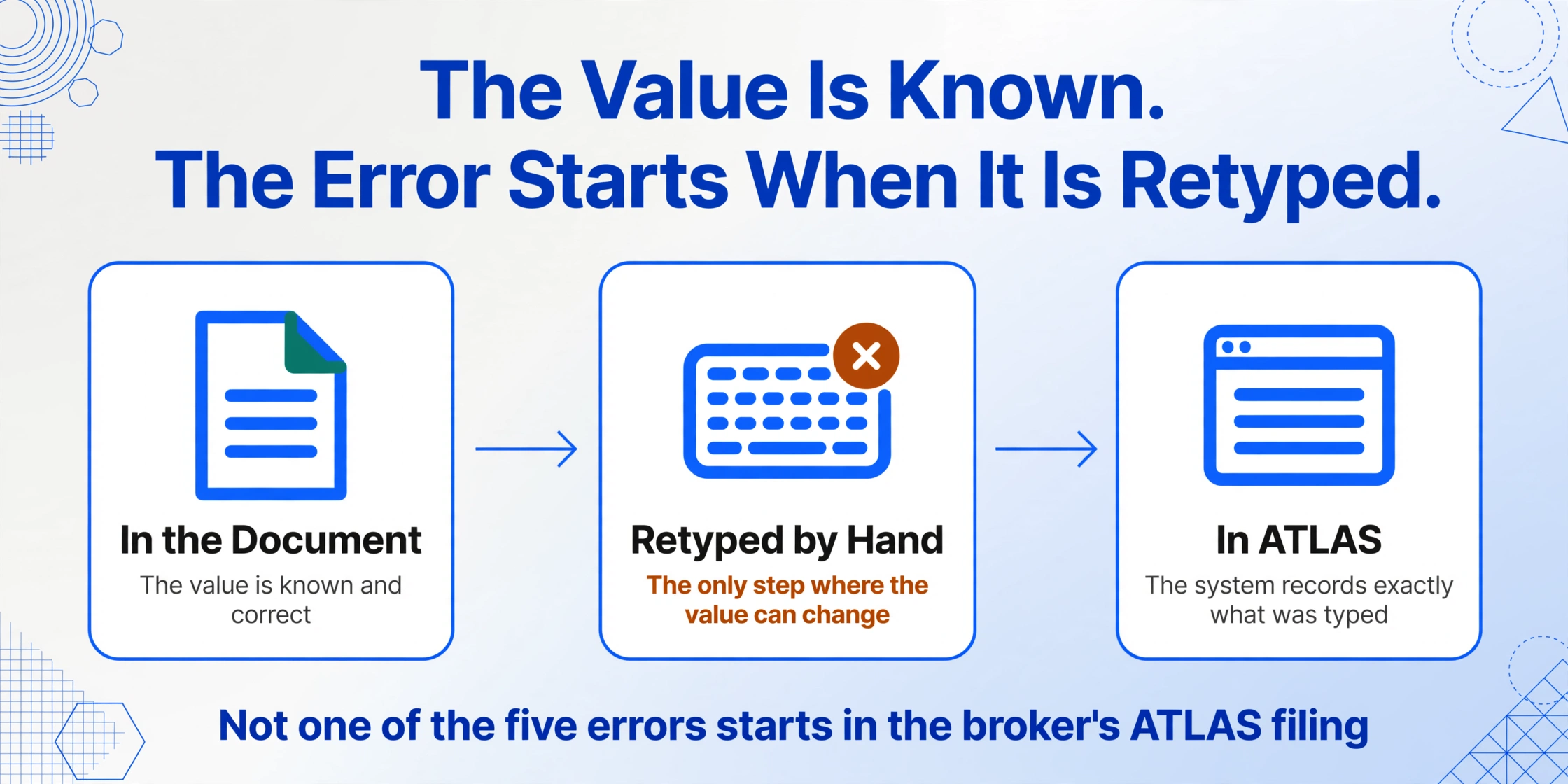
Step back from the five individual errors and a pattern emerges. Not one of them originates in the customs broker's ATLAS filing. Not one of them is caused by the tariff schedule being too complex, the origin rules being too obscure, or the procedure codes being too numerous. Each error originates in the manual transcription step — the moment when a person reads a value from a document and types it into a system. The 11-digit Zolltarifnummer, the CIF-adjusted Zollwert, the verified Ursprungsland, the correct EORI, the intended Zollverfahrenscode — every one of these values exists somewhere in the importer's document trail before the declaration is filed. The error is not that the value is unknown. The error is that the value is known but must be retyped, and the retyping step introduces a gap between what the document says and what the system records.
This is the same structural pattern that underlies the five Japanese seikyusho data entry errors that trigger consumption tax discrepancies — a different document, a different tax system, but the same mechanism: a field carries a financial consequence, the field is manually transcribed, the transcription error is invisible until a downstream system rejects it, and the fix costs orders of magnitude more than preventing the error would have cost. The German customs declaration and the Japanese invoice are different documents but the same data problem wearing different tax codes.
The structural solution is the same for all five errors: move data capture upstream of the keyboard. Define the fields once — Zolltarifnummer, Zollwert, Ursprungsland, EORI-Nummer, Zollverfahrenscode — and let extraction pull them from the source documents into a structured table before anyone types them into the declaration or the internal report. The person who used to type them becomes the person who verifies them — checking that the extracted Zolltarifnummer matches the BTI on file, that the computed CIF value includes freight and insurance, that the origin field has a supporting certificate. Verification catches errors. Transcription introduces them. The fix is not better training, more careful data entry, or double-key verification. It is removing the transcription step from the workflow.
FAQ — German Customs Declaration Data Errors
Can German customs brokers correct these errors after the declaration is filed?
Yes, under Article 173 UCC, the declarant may request amendment of a customs declaration after the goods have been released, provided the amendment does not make the declaration applicable to goods other than those it originally covered. The practical limitation is time and process. An amendment requires a formal application to the customs office that accepted the declaration, supporting documentation proving the correct data, and processing time that varies by customs office workload. During this period, the duty has already been assessed on the incorrect data. If the amendment results in a higher duty, the difference is payable with interest. If it results in a lower duty, a refund (Erstattung) must be separately applied for under Article 116 UCC. The amendment process works — but it is reactive, not preventive. Preventing the error at the point of data capture avoids the amendment process entirely.
Who bears liability for these errors — the importer or the customs broker?
The importer bears ultimate liability for the accuracy of the customs declaration, regardless of who files it. When a customs broker files as a direct representative (direkter Vertreter) under Article 18 UCC, the broker acts in the importer's name and on the importer's behalf — the importer is the declarant and the customs debtor. When a broker files as an indirect representative (indirekter Vertreter), the broker acts in their own name but on the importer's behalf — the broker and the importer are jointly and severally liable for the customs debt. In both cases, if the importer supplied the incorrect data to the broker (the wrong Zolltarifnummer, the wrong Zollwert), the importer bears the financial consequence. The broker's liability is for errors they introduce themselves — not errors in the data the importer provided. This is why verifying the data before it reaches the broker is the importer's responsibility, not the broker's.
How does the Binding Tariff Information (BTI) process help prevent HS code classification errors?
A BTI (verbindliche Zolltarifauskunft) is a binding decision issued by the customs authority that confirms the correct tariff classification for a specific product. It is valid for three years across all EU member states and legally binds the customs authority to accept the stated classification for imports of the described product. For importers dealing with products where classification is ambiguous — goods with multiple materials, assembled products, products with a novel function — obtaining a BTI eliminates the classification ambiguity at the source. The BTI number is entered on the Zollanmeldung, and ATLAS cross-validates the declared tariff code against the BTI. If the code does not match the BTI, ATLAS rejects the declaration. This makes the BTI the strongest available guardrail against classification errors — but it requires the importer to apply for the BTI before the goods ship, which means identifying the classification risk in advance, not reacting to an ATLAS rejection at the border.
Can these errors be caught by extracting data from the Zollanmeldung PDF after the fact?
Yes — but the value is post-clearance verification, not pre-submission prevention. Extracting Zollanmeldung data from the PDF after the declaration is filed enables the importer to audit their own declarations for consistency: the same commercial invoice value should map to the same CIF-adjusted Zollwert, the same product should carry the same Zolltarifnummer across all declarations, and the same shipment type should use the same Zollverfahrenscode. The extraction provides the dataset for this audit — one row per declaration, consistent columns across all declarations — without manual re-entry. This is the same dataset that feeds the monthly tariff summary. The ideal workflow is both: pre-submission verification (cross-checking the tariff code against the BTI, the customs value against the transport documents, the origin against the certificate) and post-clearance audit (verifying that the filed declarations are consistent across the month and across filing channels).
Every one of these five errors starts the same way: a value is read from a document and typed into a system. The fix is not better typing. It is removing the typing step.
Extract Your Customs Data