Verify Tenant Income When
the Documents Disagree
A $6,200 gross paycheck does not arrive in a bank account as $6,200. After federal and state withholding and FICA, roughly $4,500 lands. A landlord who checks the application's $6,200 against three months of deposits will see a shortfall of about $1,700 a month and conclude the applicant overstated income. Nothing was overstated. The two numbers measure different things, and that mistake runs through almost every tenant proof of income review.
Key Takeaways
- A $6,200 gross paycheck lands in the bank as about $4,500, which is enough to make an honest applicant look $1,200 short on rent.
- The 3x rent test runs on gross income, so net deposits fail tenants who qualify and a take-home figure can look inflated against the application.
- Normalize every document to monthly gross first, then ask for the missing document rather than treating the gap as forgery.
Income documents are the most commonly reported forgery in rental applications. In the National Multifamily Housing Council's January 2024 pulse survey of 75 owners, developers and managers, 93.3% reported fraud in the previous twelve months, and 84.3% of those had seen applicants falsify or fabricate pay stubs, employment references or other income documentation (NMHC, January 2024). The same survey put the average share of eviction filings tied to fraudulent applications at 23.8% over three years.
A packet can fail a review without being forged. A failed review usually means a few honest documents that measure different things, compared in the wrong pairs.
Rental application income documents arrive in whatever format the employer and the bank use. Three people divide the work: the applicant assembles the packet and states a monthly figure, the landlord or property manager sets the standard and decides what to request, and the employer or its HR or payroll provider is the only party who can confirm that the person works there and what they are paid.
Each document in a tenant income packet answers a different question
A pay stub proves a pay period, a W-2 proves a calendar year with one employer, a tax return proves declared annual profit, and a bank statement proves money arrived. That is why a packet can be entirely genuine and still disagree with itself.
The usual advice lists acceptable documents by applicant type. That list is necessary but not sufficient, because it does not tell you what each document is entitled to prove. The table below does.
| Document | What it establishes | What it does not establish | Where it usually disagrees |
|---|---|---|---|
| Pay stubs, two or three consecutive | Current employer, pay frequency, gross for the period, deductions, and year-to-date through a date | Annual income on its own, or that the employer exists | Against bank deposits (net, not gross) and against the application (monthly, not per period) |
| Form W-2 | Wages one employer reported for a calendar year, and the tax withheld | Current employment or the current rate | Against current stubs after a raise, a job change, or pre-tax deductions that lower Box 1 |
| Form 1040 with Schedule C | Declared annual income after business expenses, and adjusted gross income | Cash available this month, or that the business is still running at the same level | Against gross receipts and against total bank deposits |
| Bank statements, two or three months, all pages | Money that actually arrived and left, and a rent payment record | The source of any single deposit | Against net pay (timing) and against any gross figure (definition) |
| Offer or employment verification letter | Stated salary, position and start date | That pay has started, or that the terms will hold | Against stubs that do not exist yet |
| Benefit award letter | The current monthly amount from Social Security, VA, a pension or a voucher | Continued eligibility for the full lease term | Against the application when the amount was left out of household income |
Read the packet against that table before you read it against the application. The first job when you verify tenant income is to separate what each document proves from what it merely shows, and most accusations of a fake document start with a real one being asked to prove something it was never meant to prove.
The 3x rent test runs on gross income, so deposits will always look short
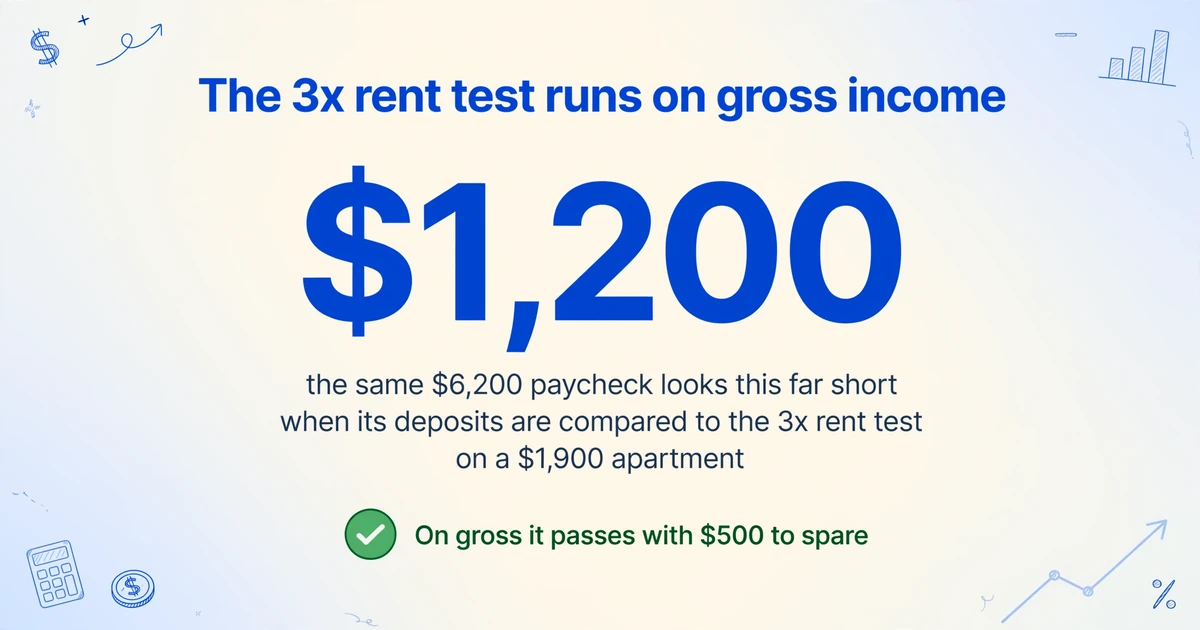
The standard rent-to-income screen compares gross monthly income to monthly rent, not take-home pay. The common version requires gross monthly income of three times the rent, and the 40x version used in New York states the same idea as an annual figure. Take-home pay is not the benchmark because it varies with filing status, benefits and retirement contributions, which makes it a poor common measure.
Run the numbers on a $1,900 apartment. The 3x threshold is $5,700 a month in gross income. An applicant paid monthly whose stub shows $6,200 gross passes with $500 to spare. Her deposits, after about 27% in withholding and payroll tax, total roughly $4,500 a month. Compared to deposits, she fails by $1,200 and the file looks fraudulent. The error runs both ways: an applicant who fills in take-home pay makes the documents look higher than the application, and a landlord may read that as inflation.
Convert every income figure to monthly gross before comparing anything. Every later comparison depends on that one normalization.
Pay frequency is the second normalization trap. The same gross amount annualizes differently depending on how often it is paid, and the difference is large enough to move an applicant across the line.
| Frequency printed on the stub | Monthly gross | Example at $3,100 per period |
|---|---|---|
| Weekly | Gross × 52 ÷ 12 | $13,433 |
| Biweekly (every two weeks) | Gross × 26 ÷ 12 | $6,717 |
| Semimonthly (twice a month) | Gross × 2 | $6,200 |
| Monthly | Gross as printed | $3,100 |
Two stubs at $3,100 produce $6,717 a month on a biweekly cycle and $6,200 on a semimonthly one. The $517 gap has nothing to do with the applicant's honesty. It comes from whether the employer pays 26 or 24 times a year, which is why the frequency has to be read off the stub before the multiplication. The field-level guide to payslip extraction covers the gross, net, deduction and YTD lines.
A W-2 describes last year, which is the wrong year for a new job
A W-2 is historical evidence and cannot establish current income after a job change or a raise. An applicant who earned $58,000 last year and started a $72,000 job in March has income understated by $14,000 if you annualize the W-2, which can fail a household that qualifies. The reverse is worse: an applicant who lost a job in February and submits the prior-year W-2 as if nothing changed. The document is real and describes a job that no longer exists.
The federal assisted-housing rulebook is explicit about the direction to take. HUD's regulation at 24 CFR 5.609(c)(1) requires income to be estimated for the upcoming twelve-month period from current circumstances, not copied from the prior year (eCFR, 24 CFR 5.609). That rule governs subsidized housing rather than private leases, but the logic travels: the question is what the applicant will earn during the lease, and a prior-year tax form answers a different question.
Year-to-date figures create a related error. YTD gross divided by calendar months elapsed understates income whenever the applicant did not work the whole year. An applicant who started in March and shows $48,000 YTD by October was paid for eight months, not ten: $6,000 a month, not $4,800. A mid-year raise blends the old rate and the new one, so annualizing YTD lands between them and matches neither. Use the current period gross times the frequency, and confirm the effective date from the stub or a letter.
Annualize the current rate, not the calendar. A start date, a raise or a gap makes YTD a blended number that describes no month in particular.
A bank statement shows money moved, not money earned
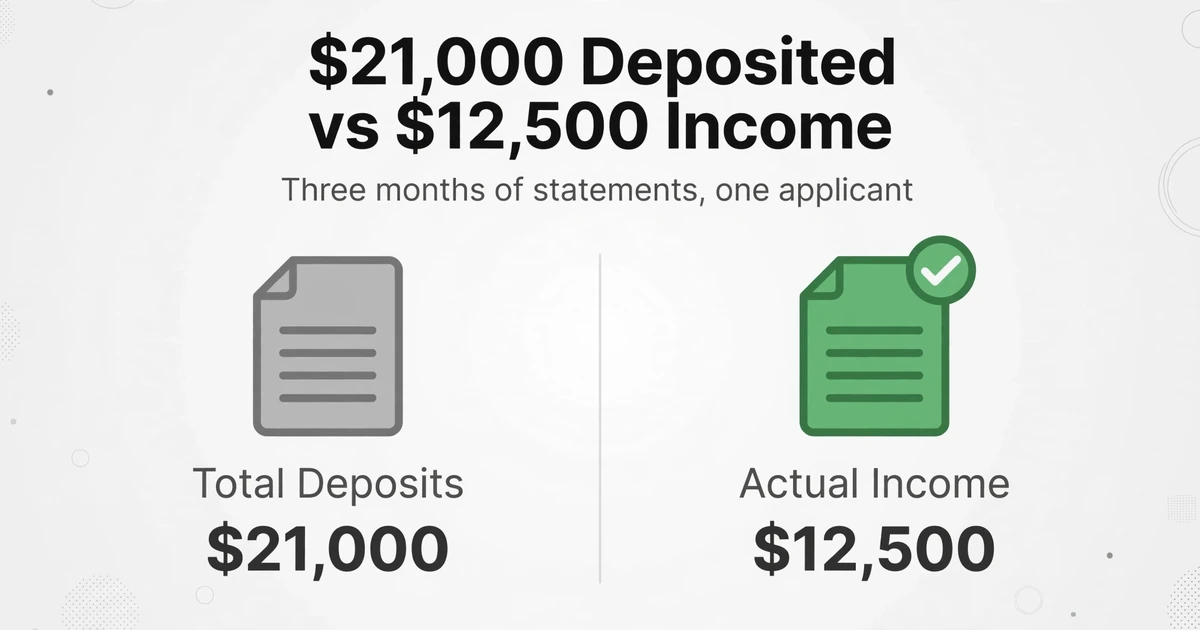
Deposits are the weakest income evidence in the packet because a deposit records a transfer without recording its source. The total-deposits line is a starting point for a conversation, never a verified earnings figure.
Three months of statements can show $21,000 arriving and contain $12,500 of income. The rest is a transfer from the applicant's savings, a tax refund, a loan disbursement, a security deposit returned by the last landlord, or a roommate's share of groceries sent through a payment app. None of it is rent-paying income, and all of it looks identical on the statement. A renter on r/Landlord described submitting Uber earnings, a Venmo statement and a bank statement while noting that "our money is all over the place and deposits happen in all three accounts," and the reply was blunt: none of it was proof of steady income (r/Landlord, March 2023).
Self-employed applicants concentrate the problem. Schedule C reports gross receipts at the top and net profit at the bottom, and the two can differ by more than half. A business with $140,000 in receipts and $52,000 in net profit supports a household at $52,000, not $140,000, because suppliers, subcontractors, platform fees and equipment came out of the difference. A 1099-K is also a gross figure: it reports payments before fees and refunds, and the IRS requires reporting only above $20,000 and 200 transactions in a calendar year (IRS Publication 1099). A 1099-NEC now has a $2,000 threshold for payments made in 2026, so a small client may issue none at all. The absence of a 1099 is not evidence of unreported work.
Income is a deposit with a source and a recurrence. A deposit with neither is a transfer, and transfers belong on a different line.
The comparison only works when every document lands in the same columns
Six PDFs in six layouts make the comparison a reading exercise, and reading is where the errors enter. The mechanical fix is to decide the columns first, then let the extraction land every document in the same ones.
Custom Column Extraction works in that order. You type the column names you want, such as Applicant, Document, Employer or payer, Pay frequency, Period end, Gross this period, YTD gross, Total deductions, Net this period and Stated monthly income, and the AI locates each value on each document by understanding what the label means rather than by matching a fixed position. The same column set accepts a payroll stub from one processor, a W-2 from another employer and a bank statement from a third bank, which matters because a rental packet almost never arrives in one format.
- Write the columns before you open the files. Include one column for what the application stated, so the comparison is visible rather than remembered.
- Upload the whole packet as one batch. Batch processing sends multiple files through together and merges the results into one spreadsheet, with your column names as the headers.
- Fold multi-page scans into one row. When a packet arrives as one long scan, or a bank statement runs to eight pages, turn on Multi-Page Merge and group by the applicant's name, provided the name appears on each page, so the pages fill one row instead of eight.
- Add the two computed columns that do the arithmetic. A computed column calculates a value during extraction rather than extracting a printed one.
Net check (Gross this period − Total deductions − Net this period)returns the difference when the stub does not reconcile, andMonthly gross (Gross this period × 26 ÷ 12)converts a biweekly batch in the same pass. If one batch mixes pay frequencies, run one batch per applicant so the multiplier in the column name stays true. - Raise the tier for phone photos. Pay stubs photographed on a kitchen table are the normal case. Model Tier sets the processing level, and Premium uses a stronger vision model for dense handwriting and complex layouts.
- Check the source of a number before you use it. Review Mode with Bbox highlighting lets you click an extracted cell and see where on the original page the value came from. That is how you catch a monthly figure pulled from the YTD line instead of the current-period line.
None of this compares the documents for you. The row puts the values side by side, and the judgment about which one is right stays with the person reading it. What changes is that the gap becomes a subtraction on a screen instead of a search through six PDFs.
Files are processed securely and not stored.
Fabricated pay stubs usually fail arithmetic before they fail inspection
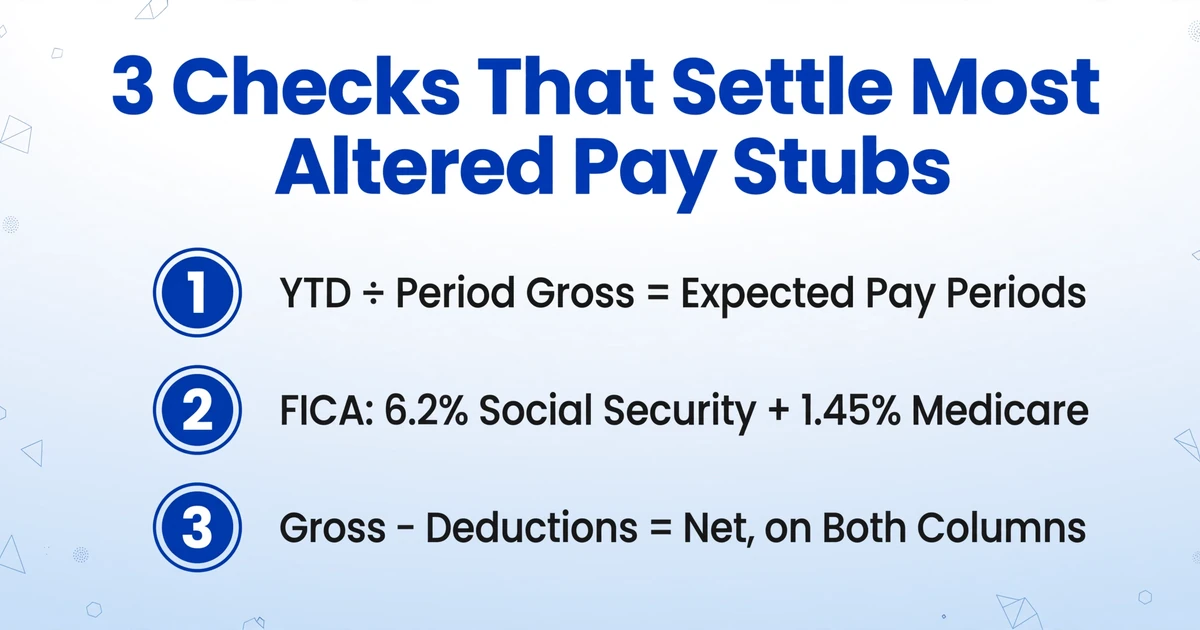
Three checks settle most altered pay stubs in under a minute, and none of them requires a forensics tool. They test whether the numbers on the page could have come from a payroll system at all.
Year-to-date divided by the current period. YTD gross divided by this period's gross should equal the number of pay periods that have elapsed by the pay date. A biweekly employee paid on October 3 has had roughly 20 pay dates, so a $3,200 period implies about $64,000 YTD. A stub showing $38,000 needs an explanation: a recent start date or a large mid-year raise. If neither is documented, the current-period figure was likely typed in without touching the YTD column. Rounding does not produce a 30% gap.
FICA against gross. Social Security withholding is 6.2% of Social Security wages up to the 2026 wage base of $184,500, and Medicare is 1.45% with no wage base limit (IRS Publication 15, 2026). On a $3,200 check, expect about $198.40 for Social Security and $46.40 for Medicare. Pre-tax benefits can move the wage base a little, so allow small differences. A missing FICA line on a W-2 employee's stub is not a small difference.
Net rebuilt from the listed lines. Gross minus every listed deduction should equal net, on the current period and on the YTD column. Altered stubs often change gross and leave net alone, or change net and leave the deductions untouched.
Then compare the stub to the bank statement. Net pay should arrive as a deposit of the same amount on or near the pay date. This is the check a fabricated stub rarely survives, because the person who edited the PDF does not control the bank's record. If the arithmetic passes but the deposit is missing or a different amount, the deposit is the fact to work from.
Employer identity is a separate check. Look up the company and the phone number yourself instead of using the number printed on the stub, because that number can route to someone prepared to confirm the story. State business registries publish formation dates, so a company that claims four years of payroll but was formed four months ago is a different problem from a formatting error. The arithmetic and the deposit match carry more weight than the layout, because a recycled template on a real employer is hard to see.
Arithmetic catches the careless forger. It does not certify the document, and a real stub can fail a check because of a mid-year raise or a bonus.
An inconsistency is a reason to request another document, not a finding of fraud
The correct next step after a gap is a specific request for the document that resolves it, written in neutral language. Accusation is both unfair and legally risky, and it is unnecessary: a genuine applicant can produce one more document.
A landlord on r/Landlord described the approach that works after suspect stubs: tell the applicant the income could not be verified from the submitted stubs, require two months of bank statements and the last two years of tax returns by a date, and say nothing about forgery. The poster's reasoning was that a genuine applicant can comply and a fabricated packet will move on (r/Landlord, August 2021).
| What the gap looks like | What to request |
|---|---|
| Application figure matches deposits but not gross | Nothing yet. Recalculate to gross first, then ask the applicant which basis they used. |
| One stub, or a stub set that does not cover a full cycle | Two or three consecutive stubs, preferably the PDF from the payroll portal rather than a screenshot. |
| YTD progression breaks between stubs | The full set from the first pay date of the year, or an employment verification through HR. |
| Deposits exceed net pay with no explanation | Full statements with all pages, plus a source for the large deposits, or a business bank statement if self-employed. |
| W-2 employer differs from the current stub | An offer letter or a written confirmation of the start date and rate, not an explanation of the old job. |
| Self-employed income claimed from gross receipts | Schedule C and the last two returns, plus six to twelve months of business statements. |
Two rules keep the process defensible. First, apply the same written standard to applicants in comparable circumstances, and write the standard down before you screen anyone. Second, keep income documents and consumer reports in separate lanes. Credit, eviction and criminal history come from a consumer reporting agency, and if a report like that played any part in a denial, a higher deposit or a co-signer requirement, the Fair Credit Reporting Act requires an adverse action notice naming the agency and explaining the right to a free copy and to dispute it (FTC, 2023). Documents you read yourself are not a consumer report, but the screening product's recommendation is.
Vouchers need their own line. In jurisdictions with source-of-income protections, HUD warns that ignoring voucher payments when judging whether an applicant can afford the unit can itself be discrimination, and that requiring employment-based income can exclude qualified applicants (HUD). Washington writes the arithmetic into statute: the voucher or subsidy is subtracted from the monthly rent before the income threshold is applied, so a 3x standard runs against the tenant's share (RCW 59.18.255). The error the statute is written to prevent is applying the multiple to the full rent while ignoring the subsidy.
This method produces a defensible comparison, not an eligibility decision
The extraction step puts values in columns and runs only the arithmetic you define. It does not run a credit check, an eviction search or a background check, and it does not authenticate a document. Document forensics, meaning a determination that a file was altered, is a separate service with its own tools.
It also does not compare documents for you or decide which number is correct. A computed column can tell you that gross minus deductions does not equal net on one stub. It cannot know that the W-2 belongs to a job the applicant left, or that a deposit is a transfer from savings. Those are judgments about context, and context is what the person reading the packet supplies.
Three more boundaries matter. The tool does not verify employment with the employer, which is the only confirmation that the job exists. It does not calculate qualifying income under a housing program's rules, so a subsidized-housing file still needs the program's own method. And it does not decide eligibility: the standard, the exceptions and the adverse action stay with the landlord and, where applicable, local law.
Exports contain Social Security numbers, account numbers and addresses. Store them under your own retention rule, share only what a specific request needs, and delete what you no longer need. If you are building the rest of the workflow, the comparison of document extraction tools for property management covers how this fits beside a property management system, and spot-check sampling is the right follow-up once a batch has been processed.
After approval, the lease brings its own document problem: the terms, dates and renewal clauses in rental lease agreement data have to be tracked for the life of the tenancy. The income packet is the front end of that record, not the whole of it.
Tenant Proof of Income: Frequently Asked Questions
What counts as proof of income for a rental application?
Recent pay stubs, a W-2, tax returns, 1099 forms, bank statements, an offer letter, an employment verification letter and benefit award letters all count. The right mix depends on how the applicant earns. An employee is best documented with consecutive stubs plus the prior-year W-2, a self-employed applicant with two years of returns and business statements, and a new hire with an offer letter plus the first stub once pay begins.
Should the 3x rent rule use gross or net income?
Gross. The common version of the rule is monthly rent times three equals required gross monthly income, and the 40x annual version states the same idea a little more strictly. Comparing gross income to net deposits will fail applicants who qualify, because withholding and payroll tax take a quarter or more of a paycheck before it reaches the bank.
How many pay stubs should I ask for?
Three consecutive stubs is a common private-market request, and it is enough to see one full pay cycle and check that YTD grows by the right amount between stubs. The federal assisted-housing standard is stricter: HUD's verification appendix asks for the most recent four to six consecutive stubs and requires the pay frequency to be confirmed before annualizing. Pick a number, write it into your criteria, and apply it to everyone.
Can I accept bank statements instead of pay stubs?
Yes, and for self-employed or variable-income applicants you usually have to. Treat them as evidence of deposits, not of income. Ask for all pages of two or three months, and ask for the source of any deposit that is large, round, or inconsistent with the claimed work. A statement without a source is the weakest document in the packet.
How do I verify a self-employed applicant's income?
Use net profit, not gross receipts. Ask for the last two filed returns with Schedule C, six to twelve months of business bank statements, and recent invoices or a profit and loss statement if the tax return is more than a year old. Compare the net profit to the deposits, and exclude transfers between the applicant's own accounts. A 1099-K is a gross figure and should not be used as income on its own.
Can this tool tell me whether a pay stub is fake?
No. It extracts the values and can calculate a reconciliation column such as gross minus deductions minus net. Deciding whether a document was altered is a forensic judgment, and the arithmetic checks in this article are screening steps rather than proof. A stub that passes every check can still be altered, and a genuine stub can fail one because of a raise or a bonus.
Does it run a credit or background check?
No. Credit, eviction and criminal history come from a consumer reporting agency, not from the income documents. This workflow covers the income packet only, and any decision that relies on a screening report carries the FCRA adverse action notice requirement.
The packet is not a pile of documents to be believed or disbelieved. It is several measurements of the same income, and the job is to explain the difference between them.