Why 確定申告 Data Assembly Costs
Japanese Freelancers More Than They Realize
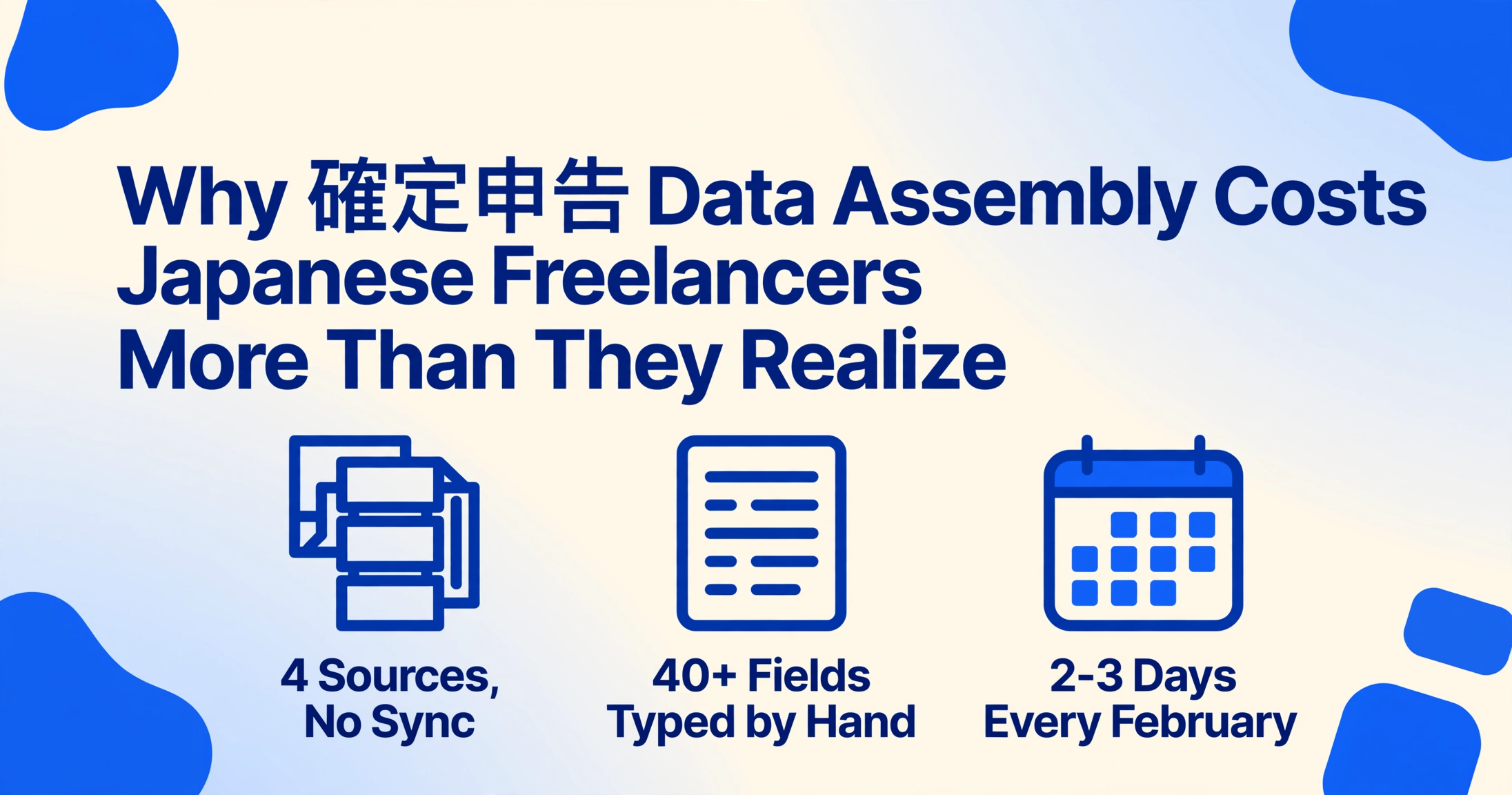
Every February, roughly 4 million sole proprietors and freelancers in Japan begin assembling their kakutei shinkoku (確定申告, final tax return). The filing deadline — March 15 under the Income Tax Act Article 120 (所得税法第120条) — is fixed. The digital side of this process is well-known: e-Tax (国税電子申告・納税システム) provides an online filing portal, the NTA's Preparation Corner (確定申告書等作成コーナー) guides filers through form entry, and accounting software like freee, Yayoi (弥生), and MoneyForward automates the return generation. What the digital ecosystem does not solve — and what the 4 million people filing each year discover anew every February — is that the return is a digital output form that demands input from physical sources. The data assembly phase — the two to four weeks spent gathering numbers from bank passbooks (通帳, tsūchō), paper receipts, insurance certificates, and last year's return — is still manual. And it is the phase that determines whether your February is about review or about data entry.
Key Takeaways
- Assembling a 確定申告 return means locating numbers across four separate physical sources — 通帳 pages, thermal-paper receipts, insurance certificates, and last year's return — and typing them into 40-plus form fields across three sheets with no visual guardrails between adjacent deduction lines.
- e-Tax and accounting software digitized the filing endpoint but left the data assembly upstream untouched — the freelancer is the integration layer between paper and pixels, and at a 1% per-field error rate across 40 fields, one in three self-prepared returns contains at least one transcription mistake.
- Upload all four source-document stacks in one batch instead of transcribing them line by line — the extraction reads every field by its meaning, and the February you used to spend typing numbers from a passbook becomes a February you spend verifying a completed return and finding deductions worth more than the hours they cost.
The Four Physical Streams That Feed Into a Digital Return
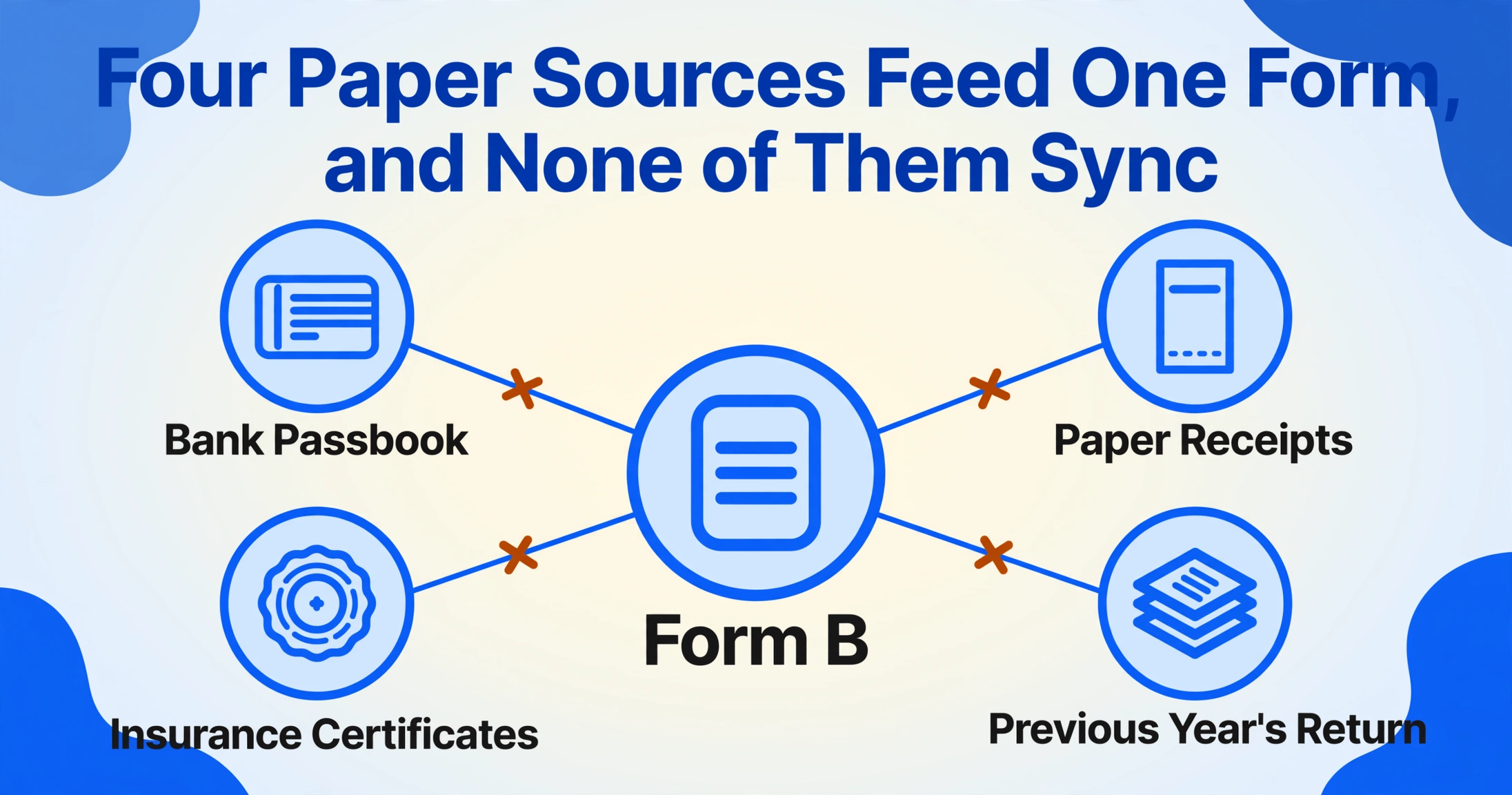
A freelancer filing 確定申告 does not start with a blank form and fill it from memory. The Form B (B様式) has over 40 fields distributed across Sheet 1 (第一表), Sheet 2 (第二表), and the income statement (収支内訳書 or 青色申告決算書). Every one of those fields requires a number, and the numbers live in four separate physical or semi-physical sources — none of which talk to each other.
Bank Passbook (通帳): The Income Ledger
- What it is: A printed passbook issued by the bank, recording every deposit (お預り金額) and withdrawal (お支払金額) in chronological order, with running balance (差引残高). Japan is one of the last major economies where paper passbooks remain a primary financial record — Japanese Bankers Association (全国銀行協会) data shows that over 70% of individual account holders still maintain an active passbook.
- What it feeds into: Business income (事業所得, 収入金額) on Sheet 1, plus the corresponding expense deductions (必要経費) — the freelancer must identify which deposits are business revenue, which are personal transfers, and which are tax refunds.
- Why it's painful: A passbook for an active freelancer can hold 200-plus transactions per year. Identifying business income requires cross-referencing each deposit against issued invoices (請求書) — a matching exercise across two separate document stacks.
Paper Receipts (領収書): The Expense Trail
- What they are: Receipts for business expenses — train tickets, office supplies, software subscriptions, client meals, equipment purchases. Under the Invoice System (インボイス制度) effective October 2023, each receipt from a registered qualified invoice issuer (適格請求書発行事業者) must include the issuer's registration number (登録番号) and the consumption tax breakdown (8% or 10%) to qualify for the input tax credit.
- What they feed into: Necessary expenses (必要経費) on the income statement, which directly reduces taxable income. Each receipt's consumption tax amount feeds into the consumption tax calculation.
- Why it's painful: Thermal paper receipts fade within months. Receipts from convenience stores and small vendors often use handwritten amounts that are difficult to read. Mixed-rate receipts — a bento (8% consumption tax) and a notebook (10%) on the same strip — require manual splitting that accounting software cannot automate from a photo.
Insurance Certificates (控除証明書): The Deduction Proof
- What they are: Annual certificates issued by insurance providers and pension authorities — National Pension (国民年金) payment certificate, National Health Insurance (国民健康保険) premium statement, life insurance deduction certificate (生命保険料控除証明書), earthquake insurance certificate (地震保険料控除証明書), iDeCo (イデコ) contribution statement.
- What they feed into: The seven-line deduction block on Sheet 1 (所得から差し引かれる金額): social insurance (社会保険料控除), small business mutual aid (小規模企業共済等掛金控除), life insurance (生命保険料控除), earthquake insurance (地震保険料控除), medical expenses (医療費控除), spouse deduction (配偶者控除), dependents (扶養控除). Each deduction line requires a specific certificate — and up to ¥650,000 in total deductions rides on getting every number right.
- Why it's painful: These certificates arrive by postal mail across December and January. Each issuer uses a different format. A freelancer with three insurance policies, iDeCo, and national pension receives five to seven separate certificates — and must transcribe the payment amount from each into the correct deduction row without confusing which certificate corresponds to which deduction category.
Previous Year's Return: The Reference Baseline
- What it is: A copy of the prior year's filed 確定申告 — either a printed PDF from e-Tax, a copy retained from the tax office submission, or the data stored in accounting software.
- What it feeds into: Prepaid tax amounts (予定納税額), which are calculated from the previous year's tax liability under the Income Tax Act Article 107 (所得税法第107条). Also serves as a reference for carry-forward losses (繰越損失) — blue return filers can carry forward net operating losses for up to three years under the Special Taxation Measures Act Article 25-2 (租税特別措置法第25条の2).
- Why it's painful: The freelancer who filed on paper in 2023, switched to freee in 2024, and filed via e-Tax in 2025 has three years of returns in three different formats — a paper copy in a file folder, a PDF exported from freee, and an e-Tax XML confirmation. Extracting the prepaid tax amount from each to verify this year's calculation means opening three different documents and finding the same field in three different layouts.
The assembly problem is not that any single stream is impossibly hard. It is that none of them converge automatically. The freelancer is the integration layer — the human middleware between four document stacks and a 40-field tax form. Every February, 4 million people perform this integration manually. And the integration layer is where errors multiply.
The Form Itself: Why 40+ Fields Across Multiple Sheets Makes Manual Entry Error-Prone
Form B is not a simple income-minus-expenses calculation. It is a seven-block computational structure with intermediate subtotals, cross-sheet references, and fields that auto-populate from earlier sections. A freelancer transcribing numbers from the four physical streams into the form — whether on paper, through the NTA Preparation Corner, or in accounting software — must navigate a layout that was designed for computational completeness, not for data entry efficiency.
The deduction block alone illustrates the problem. Social insurance (社会保険料控除) is line 21. Small business mutual aid (小規模企業共済等掛金控除) is line 22. Life insurance (生命保険料控除) is line 24. Earthquake insurance (地震保険料控除) is line 25. Medical expenses (医療費控除) is line 27. Each line has a specific row number, and the row numbers do not change — but the printed value is different for every filer, and the source certificate for each deduction arrives in a separate envelope. A freelancer transcribing five deduction amounts from five certificates into five form lines has five opportunities to transpose a number, skip a line, or enter a payment amount (支払金額) where a deduction amount (控除額) belongs — two different numbers from the same certificate, with different tax consequences.
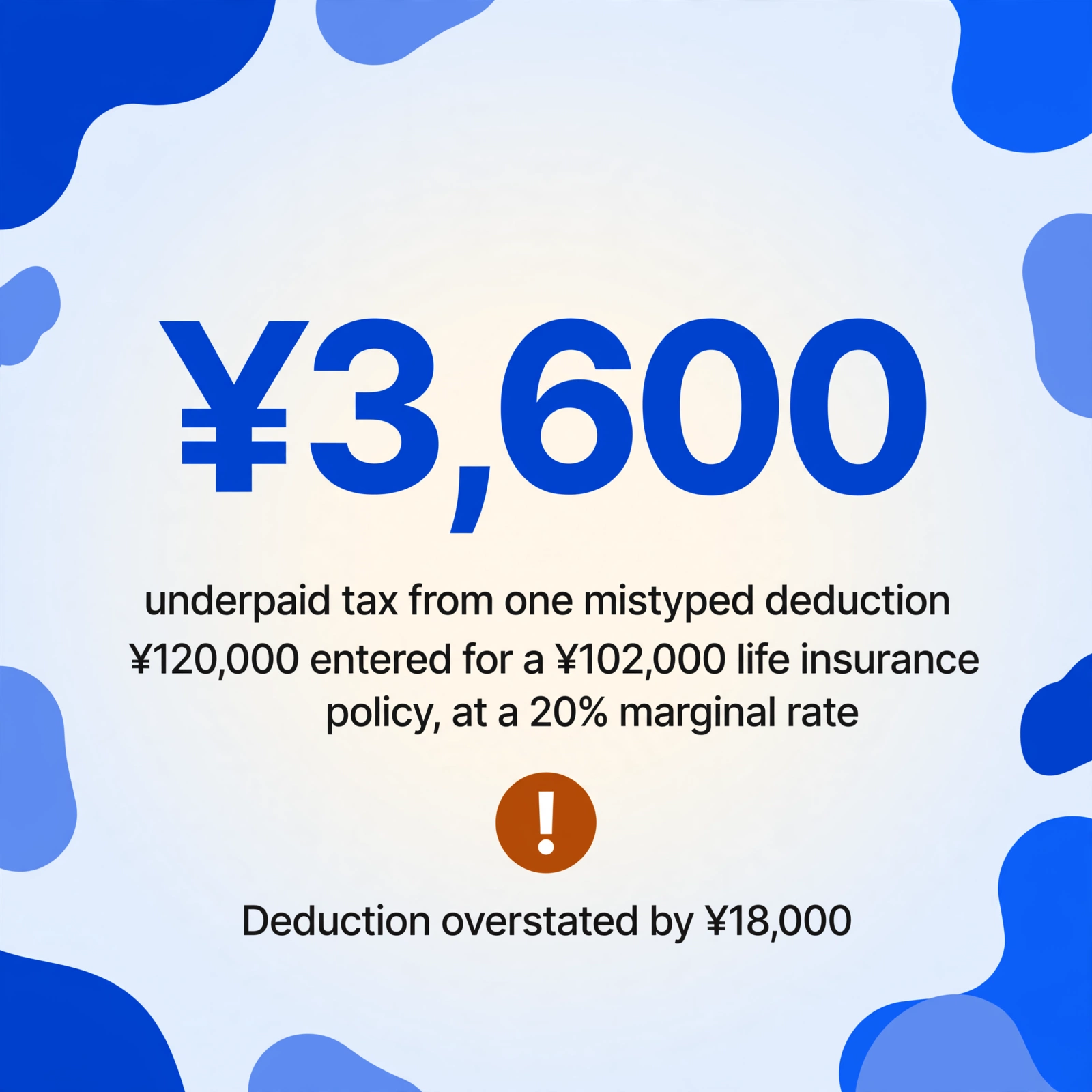
A single misplaced digit in the deduction block is not a cosmetic error. Entering ¥120,000 for life insurance instead of ¥102,000 overstates the deduction by ¥18,000. At a 20% marginal tax rate, that is ¥3,600 in underpaid tax — plus potential penalties of 5–20% of the underpaid amount under the National Tax Violation Act (国税通則法) if the error is discovered in an audit. The form's layout — fixed row numbers with no visual guardrails between adjacent deduction lines — makes this error class inevitable at scale.
The Aoiro Shinkoku Complication: Double-Entry Bookkeeping on Top of Everything Else
Freelancers filing under the blue return system (青色申告, aoiro shinkoku) — the option chosen by most self-employed filers because it unlocks the ¥650,000 special deduction under the Special Taxation Measures Act Article 25-2 (租税特別措置法第25条の2) — face an additional layer of complexity. Blue return filing requires double-entry bookkeeping (複式簿記): every transaction must be recorded as both a debit and a credit in the general ledger (総勘定元帳), and the resulting trial balance (合計残高試算表) must reconcile to zero before the Blue Return Financial Statement (青色申告決算書) can be generated.
The financial statement itself has three components that white return filers never touch: a balance sheet (貸借対照表) listing assets, liabilities, and net worth; a profit-and-loss statement (損益計算書) breaking down revenue and expenses by category; and a detailed expense schedule showing monthly totals for each expense category. A freelancer whose bookkeeping has been cash-basis all year — recording income when it arrives and expenses when they're paid — must convert to accrual-basis at year-end for the balance sheet. This is not a data entry problem. It is an accounting methodology problem layered on top of the data assembly problem, and it arrives in the same four-week window as everything else.
The blue return's ¥650,000 deduction is the largest single deduction on the form — but claiming it requires maintaining a general ledger that reconciles to zero. A freelancer who discovers in February that their ledger does not balance faces a choice: spend days finding the discrepancy, or file a white return (白色申告) and forfeit the ¥650,000 deduction. The structural tension is that the incentive to file blue (¥650,000) is enormous, but the compliance burden (double-entry bookkeeping) is the same burden that drives freelancers to tax accountants — who then charge ¥110,000–¥165,000 per return, per the market rates observed across Japanese tax accountant offices. The system gives you ¥650,000 with one hand and takes ¥150,000 with the other — unless you can close the bookkeeping gap yourself in February.
The Structural Gap: e-Tax Is Digital Output, but the Input Is Still Physical
Japan's tax administration has invested heavily in digital filing infrastructure. The e-Tax system, operated by the National Tax Agency (国税庁, NTA), accepts electronic submissions of individual income tax returns with My Number card authentication. The NTA's Preparation Corner provides a web-based form builder that guides filers through each section. Accounting software — freee, Yayoi, MoneyForward — generates the return as a finished PDF or e-Tax XML package ready for one-click submission. From the NTA's perspective, the filing pipeline is digital end-to-end.
From the freelancer's perspective, only the last mile is digital. The data that fills the form — the income totals, the expense amounts, the deduction figures — still originates from physical documents that must be located, read, transcribed, and verified before the digital form can be populated. The freelancer who opens the NTA Preparation Corner on February 20 and arrives at the "Business Income (事業所得, 収入金額)" field still needs to walk to the desk drawer, open the bank passbook (通帳), tally 12 months of business deposits by hand, and type the result. The form builder cannot read the passbook. The accounting software cannot read the passbook unless the freelancer has been manually entering transactions all year. The digital filing pipeline is a highway — but the on-ramp is a staircase.
This is the structural gap that the term "確定申告 automation" obscures. Automating the form-filling and the submission is a solved problem. Automating the data assembly — the four-week upstream phase where numbers migrate from paper to screen — is not. And the gap is invisible in the marketing language of "AI-powered tax filing" because the NTA, the software vendors, and the tax accountant industry all measure automation from the point where the data is already digital.
The same structural gap exists in other areas of Japanese small business finance. The paper passbook (通帳) manual data entry problem — where small business owners hand-copy transaction data from a passbook into accounting software — is the same phenomenon: a digital destination that demands a manual journey. And it is not unique to Japan. A UK freelancer facing the SA100 Self Assessment paper problem experiences the same structural gap — HMRC's online filing system is digital end-to-end, but the P60, bank statements, and expense receipts that feed into the SA100 are still paper.
The Compounding Cost: Why Each Error Creates More Work, Not Less
Manual transcription errors in 確定申告 do not fail independently. They compound — an error in one field cascades into errors in derived fields, and correcting the cascade requires retracing every step from the error point forward.
Consider the sequence. A freelancer transcribes business income from the passbook as ¥4,200,000 — but the correct figure, after excluding a ¥300,000 personal transfer, is ¥3,900,000. The ¥300,000 overstatement survives all the way to taxable income. The tax calculation on that inflated base produces a higher tax liability. The prepaid tax from last year — already calculated and paid — now looks insufficient against the inflated liability, making it appear the freelancer owes additional tax. The freelancer pays the inflated amount. The following year, the NTA's prepaid tax calculation — based on the inflated liability — demands higher advance payments. One transcription error in February 2025 cascades into an overpayment in March 2025, an inflated prepaid demand in July 2025, and a corrective filing requirement when the discrepancy is eventually discovered.
The irony is that the freelancer is not incompetent. They are performing a task — matching values from four different physical document stacks to 40-plus form fields across three sheets — that exceeds the reliable accuracy of human visual transcription. Research on manual data entry accuracy in financial contexts consistently finds error rates of 1–3% per field under normal working conditions. At 40 fields per return, a 1% per-field error rate produces a 33% probability that at least one field contains an error. For 4 million filers, that is over 1.3 million returns with at least one transcription mistake — and each mistake triggers the compounding correction cycle described above.
What Changes When the Assembly Phase Becomes Automated
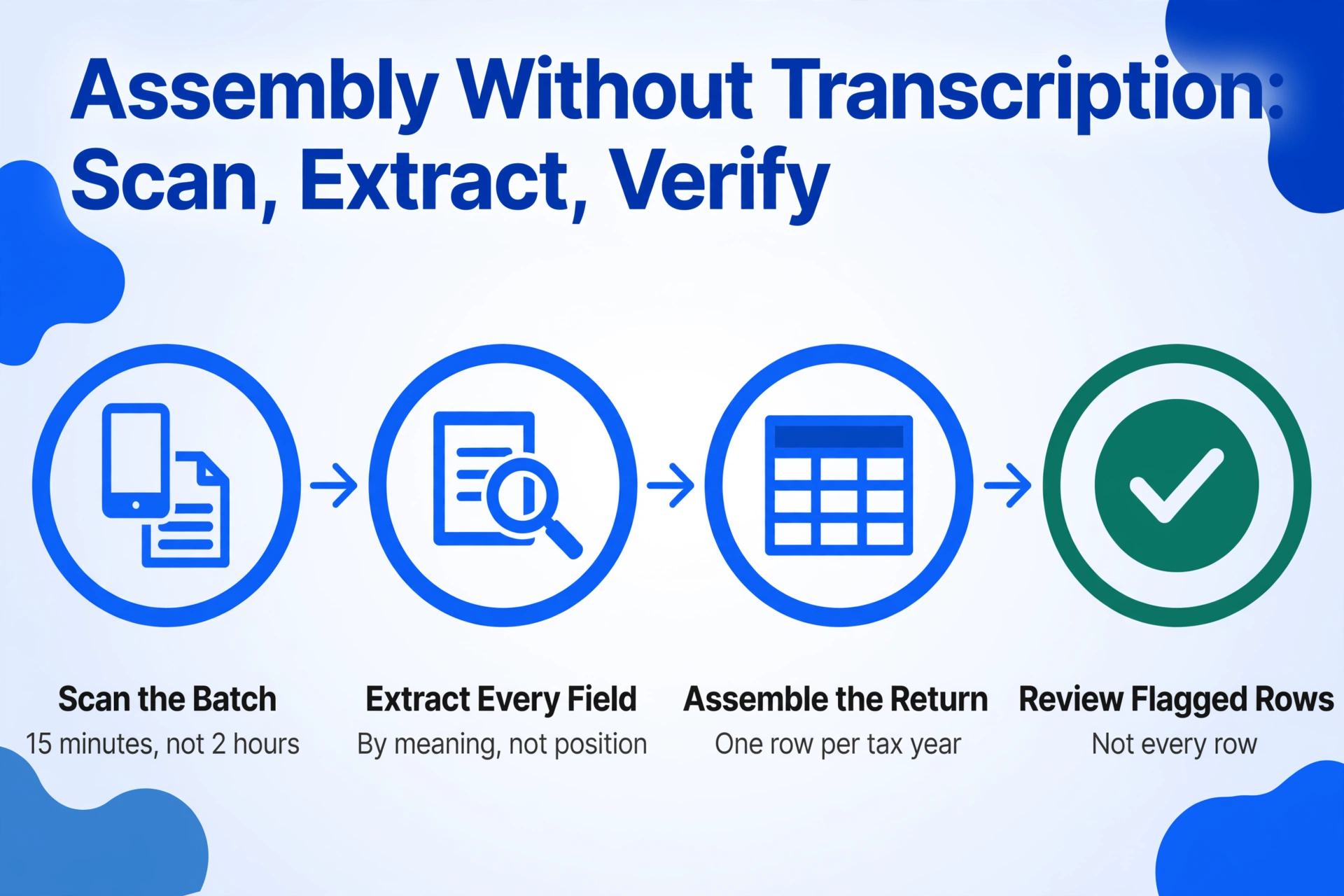
The solution is not a better form. It is removing the human transcription step from the assembly pipeline entirely. Instead of the freelancer reading numbers from four document stacks and typing them into a form, the freelancer scans or photographs the source documents — the passbook pages, the receipts, the insurance certificates, the previous year's return — and uploads them into a single batch. An extraction tool that reads Form B (B様式) fields by their semantic meaning — "this value is the Medical Expense Deduction, regardless of which line it appears on" — pulls every field from every document and assembles the return in a spreadsheet, one row per tax year, every field in its column.
The freelancer's role shifts from transcriber to verifier. Instead of spending two hours typing numbers from paper to screen — and another hour double-checking for transcription errors — the freelancer spends 15 minutes scanning, receives a completed spreadsheet, and reviews the output. A Computed Column that cross-checks the sum of individual deduction fields against the printed total on Sheet 1 catches the most common error class — deduction arithmetic mismatches — automatically. The freelancer reviews the flagged rows, not every row. The time recovered shifts from keystrokes to verification — and verification is a task the human brain is better at than the AI, while transcription is a task the AI is better at than the human.
For freelancers who work with a tax accountant (税理士), the same extraction pipeline benefits both sides. Instead of handing the accountant a stack of documents that they retype into their own analysis spreadsheet — a process that takes the accountant roughly two hours per client return — the freelancer provides an extracted spreadsheet with every field already in columns. The accountant opens the file, imports it into their tax software — Yayoi Tax, TKC, or MJS via CSV import — and begins the review immediately. The two hours the accountant would have spent retyping becomes two hours of tax strategy discussion. At the accountant's fee of ¥110,000–¥165,000 per return, that shift in how the time is spent is the difference between paying for data entry and paying for professional judgment.
Frequently Asked Questions
Doesn't accounting software like freee already handle data entry automatically?
Accounting software automates the bookkeeping and return-generation steps — it does not automate the upstream data assembly. freee can automatically import bank transactions if the freelancer has connected their bank account via API, but many regional banks and Japan Post Bank (ゆうちょ銀行) have limited or no API support. For those accounts, the freelancer must still manually enter passbook transactions or upload CSV exports. Receipts must be photographed one by one through freee's mobile app — the app's OCR reads the amount and date, but the freelancer must still categorize each expense (which account code) and confirm the consumption tax classification. freee automates the calculation and form-filling. It does not automate the four-week upstream phase of gathering numbers from physical documents — and that phase is where the majority of the time goes.
Can't I just give everything to a tax accountant and skip the assembly problem entirely?
You can — and many freelancers do. But the accountant still performs the assembly step, and you pay for it through their fee. A tax accountant receiving a shoebox of receipts, a passbook, and a stack of insurance certificates in February charges you for the time it takes to organize, transcribe, and verify that data — typically ¥110,000–¥165,000 for a sole proprietor return. If you instead provide the accountant with an extracted spreadsheet where every field is already in columns, the accountant's work shifts from data entry to data review — and the fee reflects the review time, not the entry time. The assembly problem does not disappear when you hire an accountant. It shifts from your desk to theirs, and you pay for the shift.
What if I have both employment income (給与所得) from a side job and business income (事業所得) from freelancing?
This is the standard case for millions of 副業 (side business) holders in Japan — not an edge case. If you have both employment income and business income, you need two sets of source documents: the withholding slip (源泉徴収票, gensen chōshūhyō) from your employer showing salary, withholding tax, and social insurance deductions; and your business records — passbook, receipts, invoices — for the freelancing income. Both streams feed into the same Form B. Employment income goes into the 給与 section on Sheet 2. Business income goes into the 事業 section on Sheet 1. The assembly problem doubles because the source documents for each income type are independent and arrive at different times — the withholding slip typically arrives in January, while business records accumulate all year.
Is the assembly problem worse for first-time filers?
Yes, and by a significant margin. A freelancer filing 確定申告 for the first time has no baseline workflow. They do not know which deductions require which certificates. They do not know that insurance certificates arrive by mail in December and January — and that losing one means requesting a reissue from the provider, which takes one to two weeks during the busiest period. They do not know that the prepaid tax amount on this year's return comes from last year's return — and if they did not file last year, they need to calculate it from scratch. The first filing season is a discovery process as much as a calculation process, and the discovery happens under a fixed deadline. An extraction workflow that reads whatever documents the freelancer has — even if they are incomplete, even if the freelancer does not yet know which certificates are missing — surfaces what is present and what is absent, so the freelancer knows what to request before the deadline, not after.
How does the invoice system (インボイス制度) make the assembly problem worse?
The Qualified Invoice System (適格請求書等保存方式), effective October 2023, requires freelancers who are registered as qualified invoice issuers (適格請求書発行事業者) to track the issuer's registration number (登録番号) and consumption tax rate (8% or 10%) for every business expense receipt they want to claim as an input tax credit. Before the invoice system, a freelancer could sum all expense receipts and apply the consumption tax rate. Now, each receipt that supports a consumption tax credit must be individually classified by tax rate, and the issuer's registration number must be verifiable against the NTA's public database. The assembly phase now includes per-receipt consumption tax classification — adding a verification step to a process that was already manual. At 150 receipts per year, that is 150 additional classification decisions — and getting the rate wrong on even one receipt creates a consumption tax discrepancy that can trigger a correction request.
The Real Cost Is Not the Hours. It Is the February That Could Have Been.
The time cost of manual 確定申告 assembly is quantifiable: roughly two to three full working days spread across the four-week window between mid-February and mid-March, per freelancer, per year. Multiply by 4 million filers and the aggregate is staggering. But the real cost is not the hours spent typing numbers. It is what those hours displace: the client work that could have been done, the tax planning that could have been performed, the evening that could have been spent not reconciling a passbook against a spreadsheet.
The 確定申告 is a statutory obligation — the deadline does not move, and the consequences of late filing (5–20% penalty on tax owed, plus delinquency interest) are substantial. But the assembly phase that precedes filing is not statutory. It is an artifact of a system where the filing endpoint is digital but the data sources are not. Closing that gap — replacing the human transcription step with extraction that reads documents by semantic meaning — does not eliminate the obligation. It eliminates the part of the obligation that nobody pays you for, and that nobody designed the system around: the four weeks you spend being the integration layer between paper and pixels.