Year-End Tax Adjustment in Japan:
Why Data Entry Is Still Done Manually
The Japanese payroll software market includes some of the most sophisticated HR platforms in Asia. SmartHR — Japan’s largest cloud HR platform with roughly 60,000 corporate clients — digitizes the employee questionnaire, generates withholding certificates, and files reports electronically. freee HR & Payroll (freee人事労務) serves approximately 380,000 business entities. Yayoi Payroll (弥生給与) has been running payroll calculations for decades. Between them, these platforms can handle the arithmetic of year-end tax adjustment (年末調整, Nenmatsu Chosei) to the yen — applying the National Tax Agency’s annually updated withholding tables, calculating social insurance contributions across two parallel insurance systems, and reconciling twelve months of withholding against each employee’s actual tax liability. And then an employee hands HR a paper postcard from their life insurance company, and the structural gap between what payroll software does and what the process demands becomes impossible to ignore.
Key Takeaways
- Sixty-seven hours — that's what a 200-employee company loses every December typing insurance premiums from paper postcards into payroll fields, not because the calculation is hard (Japan's payroll software does it to the yen), but because the software was never built to read documents it didn't generate.
- Japan's Myna Portal (the national digital identity gateway) was designed to receive electronic insurance certificates — but the data hits a wall where the portal's export format connects to nothing, so employees download digital data that HR must still retype into SmartHR or freee by hand.
- ImageToTable.ai reads insurance certificates by meaning rather than position — one batch upload processes all 400 mixed-format documents into a single spreadsheet, replacing 67 hours of manual typing with verification.
The Problem Payroll Software Was Not Built to Solve
Payroll platforms in Japan are genuinely excellent at calculation. They apply the NTA’s progressive withholding tax tables — rates ranging from 5% on the first ¥1.95 million of taxable income to 45% on amounts above ¥40 million — factor in the employment income deduction (給与所得控除) that follows a progressive statutory formula, compute social insurance premiums at the current prefectural rates, and reconcile the total tax already withheld during the year against the final annual liability. When December arrives, the system knows each employee’s year-to-date salary, bonuses, overtime, withholding tax, and social insurance contributions to the last yen.
The problem is not the output. It is the gap between where the raw data originates and where the payroll system expects it to arrive.
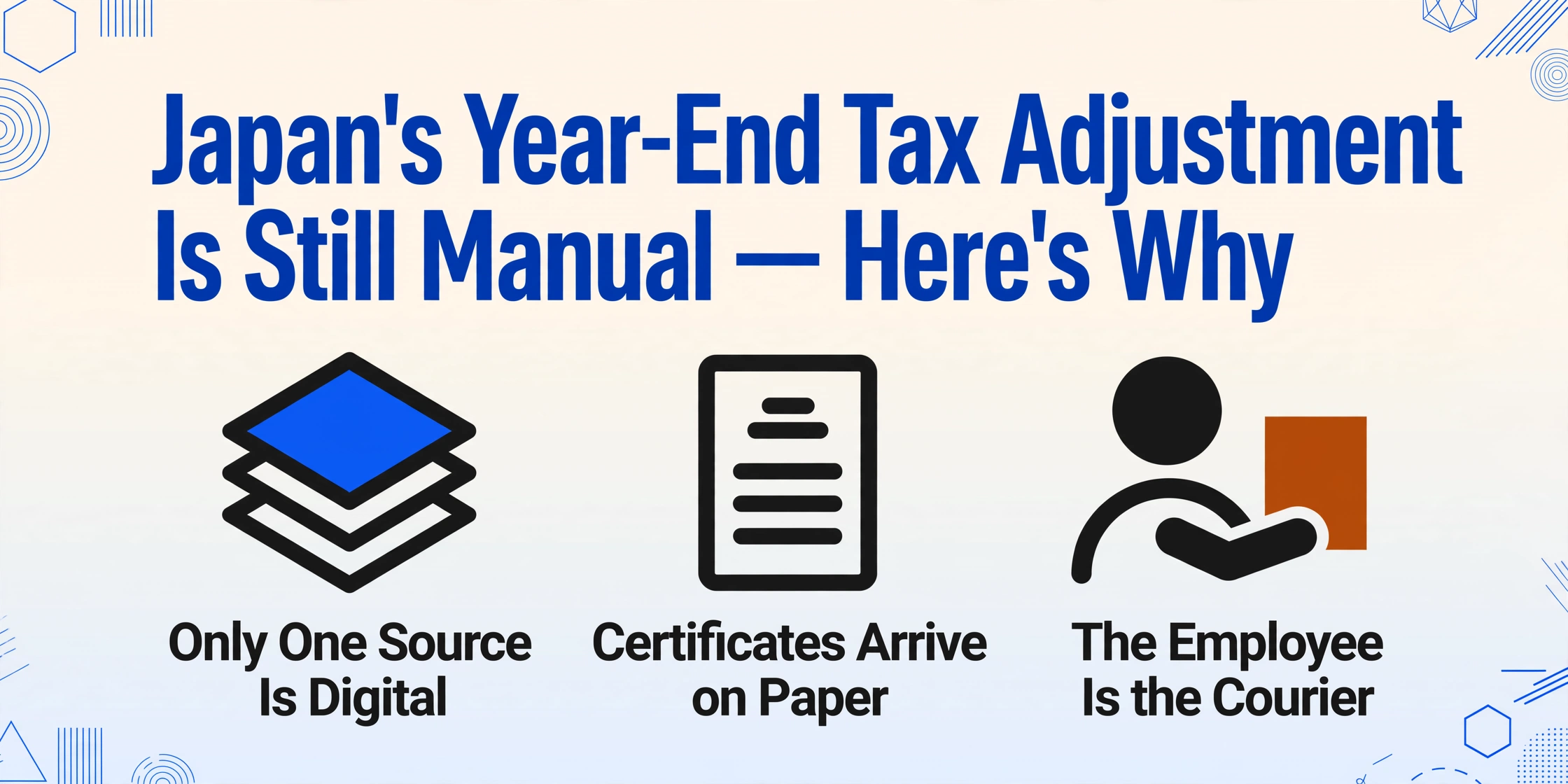
Year-end tax adjustment under Article 190 of Japan’s Income Tax Act (所得税法第190条) requires data from three independent sources, only one of which lives inside the payroll platform:
Source 1 — Payroll records. Monthly salary, bonuses, allowances, overtime payments, withholding tax remitted, and social insurance premiums deducted. This data is already digital. The payroll system owns it.
Source 2 — Employee declarations. The Dependent Deduction Declaration (扶養控除等(異動)申告書) lists every dependent: spouse’s estimated income, children’s ages and student status, elderly parents’ living arrangements. The Insurance Premium Deduction Declaration (保険料控除申告書) declares life insurance premiums paid, earthquake insurance premiums, and social insurance paid outside the employer’s system. The Basic Deduction Declaration (基礎控除申告書) estimates the employee’s total annual income. None of this information exists in the payroll system before the employee provides it.
Source 3 — Third-party deduction certificates (控除証明書). Insurance companies issue insurance premium deduction certificates (保険料控除証明書). Banks issue mortgage balance certificates (住宅借入金等特別控除証明書) for the housing loan tax credit. Each certificate contains specific yen amounts, policy numbers, contract dates, and insurance type classification codes that control which deduction formula applies. These documents are issued by external organizations. The payroll system cannot generate them, cannot predict them, and — critically — cannot read them.
Payroll software automates Source 1 completely. For Source 2, platforms like SmartHR and freee HR & Payroll have built employee self-service portals where staff fill in digital questionnaires that feed directly into the calculation engine. This is genuine progress — it eliminates the paper declaration form for the employees whose companies use these platforms.
But Source 3 remains outside the closed loop. Insurance certificates are still issued by insurance companies, not by payroll software vendors. And when those certificates arrive as paper postcards or PDFs printed by the employee, someone has to read the numbers and type them in. The most sophisticated payroll platform on the market cannot extract data from a document it did not generate.
The structural insight: Year-end adjustment is not a data-processing problem that one piece of software can solve. It is a data-collection problem that requires bridging three document streams — one internal, two external — each controlled by a different organization with no incentive to standardize output for payroll software consumption.
The Paper Declarations That Refuse to Die
Employee declarations are digitizable — SmartHR and freee have proven that with their questionnaire-based interfaces. But the declarable information originates somewhere else. An employee filling in the Insurance Premium Deduction Declaration does not know their premium amounts from memory. They are copying numbers from the insurance certificates that arrived in the mail. The digital questionnaire shifts the transcription burden from HR to the employee, but it does not eliminate the transcription.
The Dependent Deduction Declaration (扶養控除等申告書) illustrates a deeper paper dependency. This form requires the employee to declare each dependent’s name, My Number, birthdate, relationship to the employee, and estimated total income for the year. For non-resident dependents — common among foreign employees supporting family overseas — the form also requires proof of remittance (送金関係書類) and proof of family relationship (親族関係書類). These supporting documents arrive as bank transfer receipts, family registry extracts, and translated certificates. They are not standardizable data formats. They are proof, and proof in Japan’s administrative culture defaults to paper.
The National Tax Agency has built a digital pathway. The Year-End Adjustment Software (年調ソフト), available free from the NTA, supports electronic import of deduction certificates via the Myna Portal (マイナポータル). Under the 2020 tax reform, insurance companies can issue electronic deduction certificates (電子的控除証明書) that employees download through Myna Portal and import directly into the NTA’s software. In principle, this closes the loop: insurer → Myna Portal → NTA software → calculation.
In practice, the loop is still fragmented. Adoption of electronic deduction certificates remains incomplete. Many insurers default to paper postcards. Many employees have not set up Myna Portal accounts — Japan’s My Number card adoption reached only approximately 74% of the population as of late 2024, and the Myna Portal account activation rate is lower. Most importantly, the NTA’s electronic import path works only within the NTA’s own software. It does not bridge to SmartHR, freee, Yayoi Payroll (弥生給与), or MoneyForward Cloud Payroll. An employee who downloads their insurance data through Myna Portal and then submits it to an employer using SmartHR has moved the data from paper to digital — and then watches it get re-entered manually because the formats do not connect.
The paper declarations are not a failure of technology. They are a structural artifact of a system where the document issuer, the document recipient, and the document processor are three different entities using three different systems. No single digitization effort — no matter how well-funded — can fix all three endpoints simultaneously.
The Insurance Certificate Conveyor Belt: Digital at the Source, Paper at the Destination
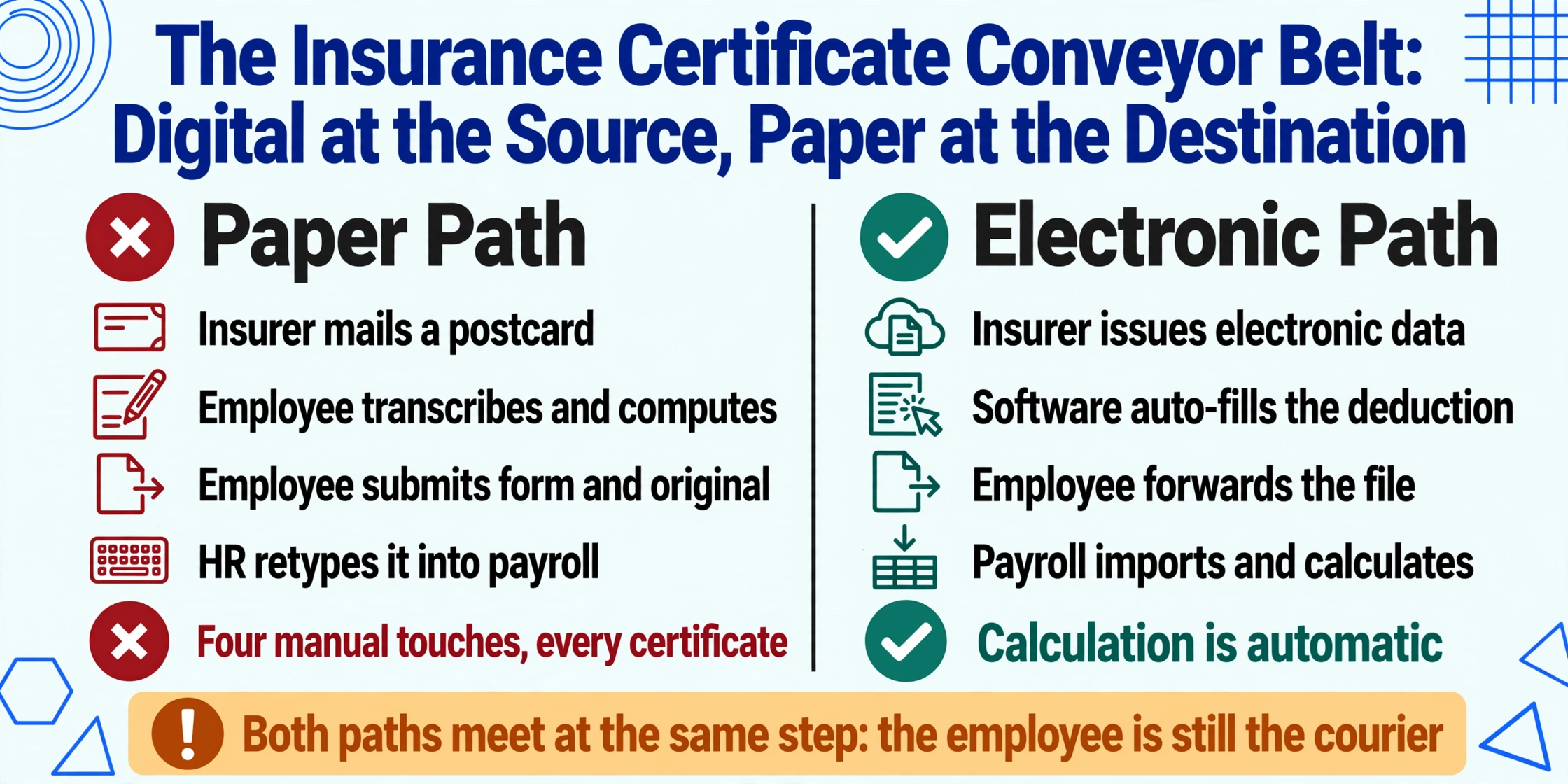
A 2024 analysis by RSM Shiodome on the digitalization of year-end adjustment maps the precise gap: in the current workflow, an insurance company issues a physical postcard proving the employee’s premium payments (Step 1). The employee transcribes the contents of that postcard onto the Insurance Premium Deduction Declaration form and calculates the deduction amount (Step 2). The employee submits the physical form and the original postcard to their employer (Step 3). The employer manually enters this data into the payroll system, calculates the annual tax, and reconciles (Step 4).
In the digitalized version of this workflow, the insurance company issues electronic data (Step 1). The employee imports this data into year-end adjustment software that auto-fills the deduction calculation (Step 2). The employee submits the electronic data to the employer (Step 3). The employer imports the data into a payroll system that calculates the tax automatically (Step 4).
The bottleneck is between Steps 1 and 3. Even when the insurance company issues an electronic certificate, the employee still acts as the courier — receiving the data, then forwarding it to the employer. If the employee prints the PDF and submits paper, or if the employer’s payroll system cannot accept the electronic format the insurer provided, the digital chain breaks and reverts to manual entry.
Multiply this by the number of insurance relationships a typical Japanese employee holds. General life insurance (一般生命保険料), personal pension insurance (個人年金保険料), and nursing care/medical insurance (介護医療保険料) each fall under separate deduction categories with different caps. Earthquake insurance has its own deduction calculation with a separate cap. A single employee might submit certificates from Nippon Life (日本生命), Dai-ichi Life (第一生命), Meiji Yasuda (明治安田), and a regional earthquake insurer — each certificate in a slightly different format, each requiring its premium amount to land in the correct field of the payroll system.
For a company with 200 employees and an average of two insurance certificates per employee, that is 400 individual certificates each containing premium amounts, policy numbers, and classification codes that must be transcribed accurately. The tax calculation takes seconds per employee. The data assembly takes weeks.
The January 31 Deadline: How Time Pressure Rewards Manual Overrides
Under Article 226 of the Income Tax Act, employers must issue a withholding tax certificate (源泉徴収票, Gensen Choshu-hyo) to every employee by January 31 of the following year. The year-end adjustment itself must be completed by the end of December so that any refund or additional withholding appears in the December paycheck — the final payroll run of the calendar year.
This creates a compression pattern that repeats identically across every company, every year:
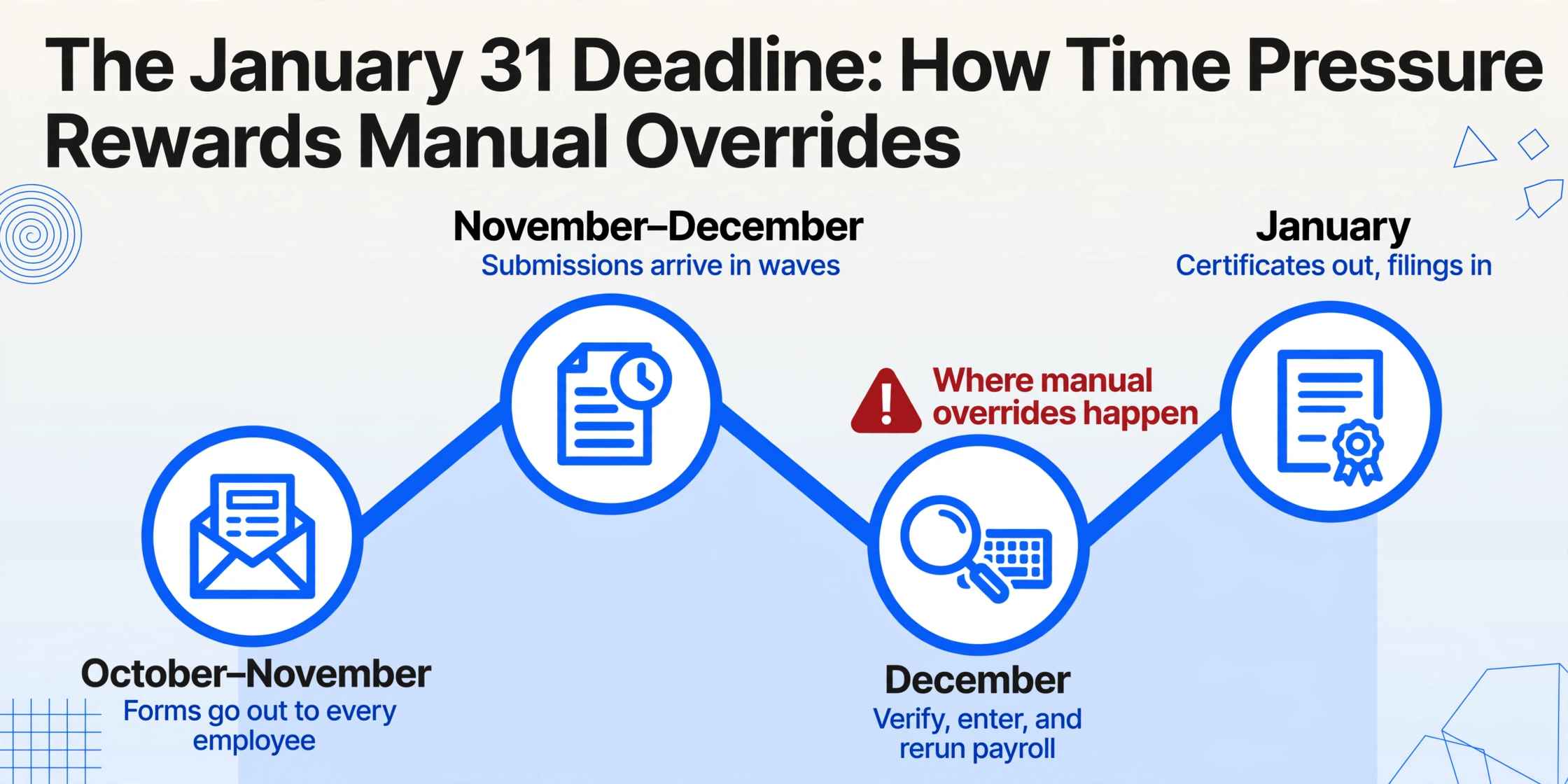
October–November: HR distributes declaration forms to employees. Deadlines are set internally — typically mid-November to early December.
November–December: Employees submit their completed declarations along with insurance certificates, mortgage balance statements, and dependent documentation. Submissions arrive in waves. Some employees submit on day one. Others require three reminders. Certificates get lost, found, re-requested from insurers.
December: HR must verify every employee’s submitted data — cross-checking declared insurance premiums against the certificates, confirming dependent eligibility against income thresholds, verifying housing loan balances — then enter the verified data into the payroll system, run the year-end calculation, and process the December payroll with the adjustment included.
January: Issue withholding tax certificates to all employees. Submit the withholding tax summary (法定調書合計表) to the tax office. File municipal residence tax reports for each employee with their respective municipalities.
The entire cycle runs roughly 10–12 weeks. The data entry window — the period between receiving certificates and needing to run the December payroll calculation — is narrower, often 3–4 weeks.
When the deadline tightens and there are still 50 employees’ insurance certificates waiting to be entered, the fastest path is the manual one: open the PDF, read the number, type it. When a certificate arrived as a photo of a postcard taken on the employee’s phone, there is no batch import path — only transcription. When two HR staff members face processing 200 employees in three weeks, the short-term incentive structure pushes toward the behavior that consumes the most long-term labor: manual data entry, repeated annually.
The deadline does not cause manual data entry. It structurally rewards it. Every year, HR teams face the same trade-off: invest time engineering a more efficient workflow for this year’s formats, or just type it and make the deadline. The compliance pressure — late filing penalties start at 15% for self-reported late filing, 20% for NTA-initiated corrections, with fraud penalties reaching 35–40% — reinforces the instinct to get it done over getting it efficient. The right long-term decision is rarely the right December decision.
The deadline feedback loop: Time pressure → manual entry is fastest this year → no infrastructure is built for next year → next December, manual entry is again the fastest path. Breaking this loop requires a solution that is faster than manual entry on the first use — not just after setup and training.
Where It Gets Worse: Foreign Subsidiaries and the Language Multiplier
For foreign-affiliated companies (外資系, gaishikei) operating subsidiaries in Japan, the same process carries an additional operational tax.
The forms are entirely in Japanese. The insurance certificates from Nippon Life, Dai-ichi Life, Meiji Yasuda, and other domestic insurers are Japanese-language documents. The NTA’s year-end adjustment software defaults to Japanese. Most payroll platforms — even relatively internationalized ones — present their year-end adjustment interfaces in Japanese only.
A typical foreign subsidiary’s HR team consists of one bilingual HR manager and several Japanese-speaking payroll clerks. The bilingual manager is the sole bridge between the Japanese-language source data and the English-language output that global headquarters requires. When the regional HR lead in Singapore or the global compensation team in New York requests the annual compensation summary — in English, in Excel, with columns labeled “Gross Salary,” “Income Tax Withheld,” and “Social Insurance Contributions” — every data point that the payroll system exports in Japanese must be manually translated.
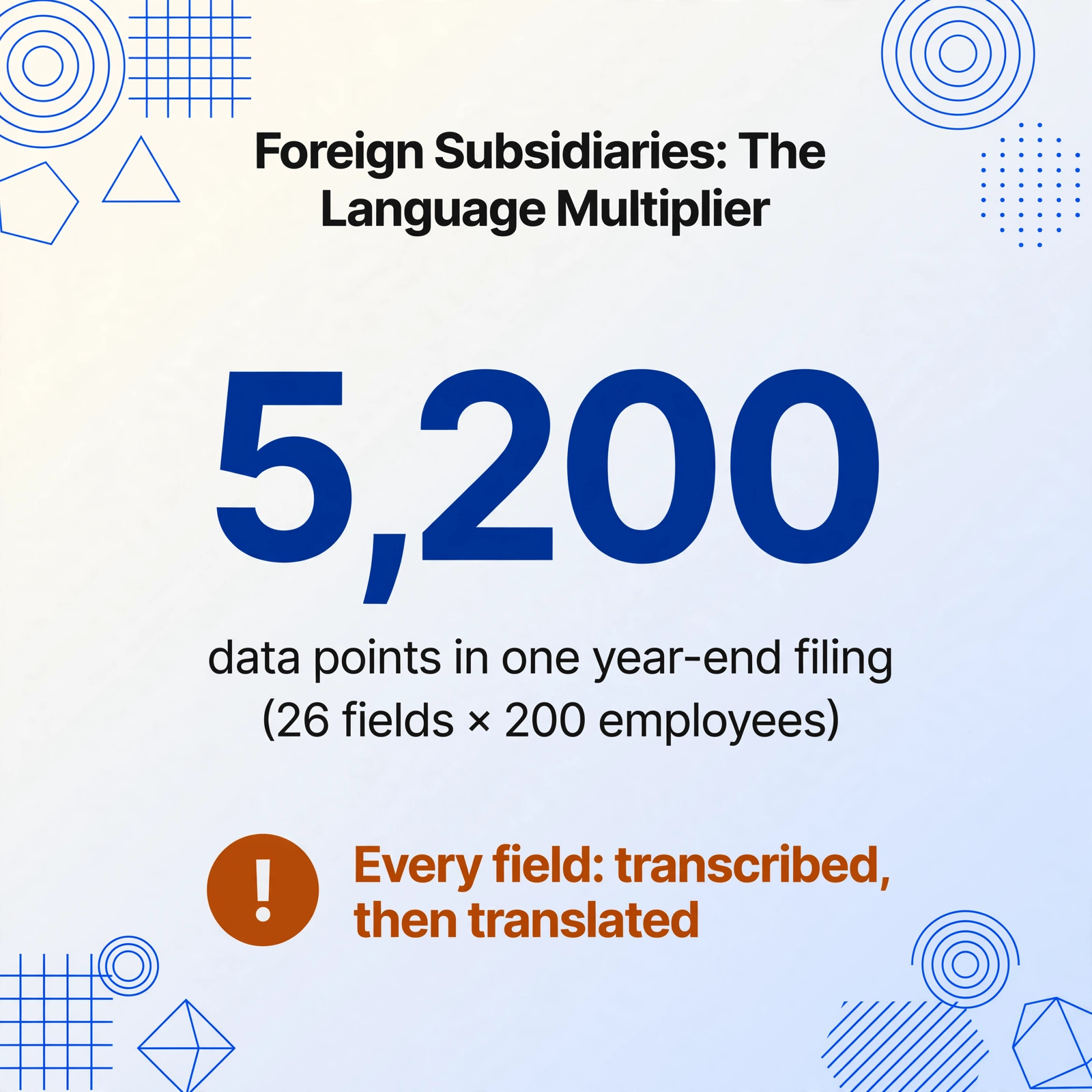
This language layer compounds every other manual burden. A withholding tax certificate (源泉徴収票) contains 26 defined fields. For 200 employees, that is 5,200 data points. If each field requires both transcription and translation — 支払金額 to “Gross Salary,” 源泉徴収税額 to “Income Tax Withheld,” 社会保険料等の金額 to “Social Insurance Contributions,” 給与所得控除後の金額 to “Income After Statutory Deduction” — the per-certificate processing time jumps because the person doing it must understand both the Japanese tax terminology and the English reporting format the destination requires.
There is also a format familiarity gap. A Japanese payroll clerk who has processed year-end adjustments for ten years can glance at an insurance certificate and immediately identify which code goes in which field. A newly hired HR coordinator at a foreign subsidiary, processing their first year-end adjustment (年末調整) cycle, faces a steep learning curve on top of the manual data entry burden. The forms do not explain themselves. The NTA’s official guidance and the English-language income tax guide covers the basics but does not walk through the field-by-field mapping that payroll data entry requires.
As explored in the cost analysis of manual year-end processing, the per-certificate labor cost runs approximately ¥1,167 for a domestic Japanese company. For a foreign subsidiary, the language translation step adds roughly 30–40% to that per-certificate time, pushing the fully loaded processing cost well above ¥1,500 per certificate. The language barrier is not a separate problem from manual data entry. It is a multiplier applied to every existing inefficiency in the stack.
What Actually Changes the Equation
The structural knot described above — three document sources, paper-default certification, compressed deadline, language friction — will not be untied by a single regulatory change or software update. The document issuers (insurers, banks), the document recipients (employees), and the document processors (HR/payroll teams) operate on different systems with different incentives. Coordinated reform across all three is unlikely on any visible timeline.
What can change is the interface between the paper document and the payroll system. If the insurance certificate, the dependent declaration, or the mortgage balance statement can be photographed or scanned and have its data extracted directly into a structured format — without a human reading and typing each field — the bottleneck shrinks to the one variable the HR team controls: the upload button.
This is what column-name extraction does. Instead of drawing boxes around fields on a template (the approach used by traditional OCR tools, which fails when every insurer formats its certificates differently), you type the column headers you want — for example, “Employee Name,” “Life Insurance Premium (一般生命保険料),” “Personal Pension Premium (個人年金保険料)” — and the AI reads each document to locate those values by understanding what they mean, not where they sit on the page. The same column definitions work across postcards, printed PDFs, emailed scans, and phone photos because the extraction is semantic, not coordinate-based.
Combined with batch processing — uploading multiple documents at once and receiving a single merged output file, one row per document — the workflow shifts from opening each certificate individually to processing all certificates in one operation. The single-certificate extraction approach removes the per-document manual data entry. The batch approach removes the repetition of opening and closing 400 files.
Files are processed securely and not stored.
None of this eliminates the regulatory complexity. Article 190 still applies. The January 31 deadline still applies. The three document sources still operate independently. What changes is that HR stops being the transcription layer between them. The data moves from document to spreadsheet directly, and the staff who previously spent 67 hours typing insurance premiums into payroll fields can spend those hours on verification, employee communication, and the compliance work that actually requires human judgment.
Frequently Asked Questions
Can payroll software already handle year-end adjustment digitally?
Partially. SmartHR, freee HR & Payroll (freee人事労務), and MoneyForward Cloud Payroll can calculate the tax adjustment once all data is in the system and generate the required forms. But data entry — getting the numbers from insurance certificates and dependent declarations into the system — remains manual for most companies because these documents originate outside the payroll software. The payroll platform can calculate with data it has. It cannot extract data it has not received.
Doesn’t the NTA provide free year-end adjustment software?
Yes. The NTA’s Year-End Adjustment Software (年調ソフト) is free and supports electronic import of deduction certificates via the Myna Portal. However, it requires employees to have Myna Portal accounts and insurers to issue electronic deduction certificates — both of which still have incomplete adoption. As of 2025, paper certificates remain the majority channel for insurance premium documentation. And the NTA software’s electronic import path does not connect to third-party payroll platforms.
How much manual labor does year-end adjustment actually consume?
A full processing cycle per employee — collecting certificates, verifying declared amounts against source documents, entering data into the payroll system, and cross-checking — takes approximately 20 minutes for a straightforward case. For 200 employees, that is roughly 67 hours of HR labor: nearly two full work weeks of a single person’s time. Employees with multiple insurance policies, mortgage deductions, non-resident dependents, or mid-year job changes require additional verification time. The per-certificate cost analysis breaks this down in detail with Japanese HR salary data.
Can AI extraction handle Japanese-language tax documents reliably?
Yes. Modern vision-language models are multilingual. They recognize Japanese characters (kanji, hiragana, katakana), mixed horizontal/vertical layouts common in Japanese forms, and numeric formats specific to Japan (¥1,234,567 with commas as thousand separators). Extraction accuracy on printed Japanese text in structured documents is comparable to English. The challenge is not language recognition — it is the document format variability (postcard vs. PDF vs. photo vs. scan) that makes template-based extraction fail, which is exactly why semantic extraction works across formats.
Will Japan’s year-end adjustment ever go fully digital?
Not on any near-term timeline. The three-party structure (insurer → employee → employer) means full digitization requires coordinated action across insurance companies, government agencies, payroll software vendors, and individual employee behavior. The 2020 tax reform enabling electronic deduction certificates was a genuine step forward, but adoption remains incomplete. The more practical approach is to accept that paper and PDF documents will persist and bridge the gap at the extraction layer — the point where documents meet the payroll system — rather than waiting for all three parties to standardize simultaneously.
One January Is All It Takes to Know
The structural forces keeping year-end tax adjustment manual — three-source data collection, paper-default certification, compressed processing windows, language friction for foreign subsidiaries — are not going to resolve themselves. They are features of the regulatory architecture, not bugs waiting for a software patch. Article 190 of the Income Tax Act has been in force for decades. The insurance industry’s transition to electronic certificates will happen on its own timeline, not on HR’s schedule. The January 31 deadline will keep arriving every year.
What changes is whether the data enters your payroll system through a keyboard or through extraction. One year of running your actual year-end adjustment cycle through extraction — your own employees’ certificates, your own column definitions, your own reporting requirements — is the only test that matters. Try it on a sample batch this year, before the November crunch. The answer to whether a 67-hour January becomes a 4-hour January is not in anyone else’s case study.