Why UK Freelancers Dread the SA100
Long Before They File
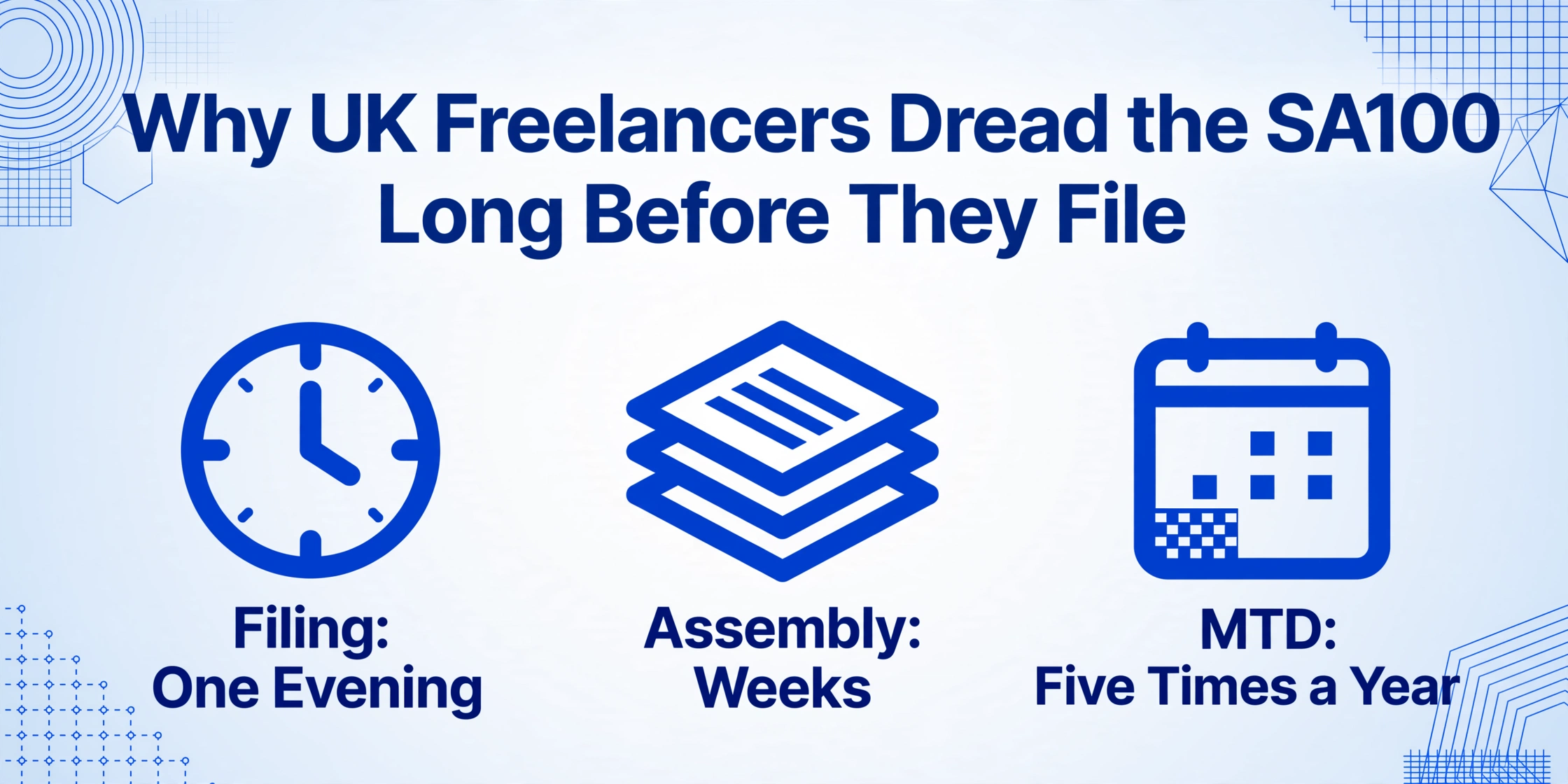
The Self Assessment deadline gets all the attention, and it deserves very little of it. Submitting the return — the actual act of logging into the HMRC portal and clicking through the boxes — takes most self-employed people an evening. The part that ruins December and January isn't the filing. It's everything that has to happen before a single figure can be typed into the SA100: the months of hunting down bank statements, exporting payment platform transactions, matching receipts to expenses, and manually translating all of it into the shape His Majesty's Revenue and Customs (HMRC) expects. That preparation work is where the dread lives, and almost nobody talks about it as the real problem — because it never shows up as a line on any bill.
Key Takeaways
- The SA100 takes an evening to file — the weeks of translating bank statements, PayPal exports, invoices and receipts into HMRC's form boxes is an invisible second job nobody budgets for.
- Starting April 2026 Making Tax Digital turns that annual preparation into a quarterly obligation — the translation work you dread in January will repeat four extra times a year.
- Semantic extraction reads your documents by meaning instead of page position — one column definition works across a bank statement, a Stripe report, and a photographed receipt without retyping a single figure.
The Deadline Isn't the Problem — the Weeks Before It Are
The 31 January online filing deadline has become the whole story of Self Assessment, and that framing hides where the effort actually goes. The numbers tell you how the country treats it: for the most recent cycle, more than 11.4 million people filed on time, but 475,722 of them left it to deadline day itself — and 27,456 filed in the final hour, between 23:00 and 23:59 on 31 January. Over a million missed the deadline entirely and took the automatic £100 penalty.
It's tempting to read that as a nation of procrastinators. It isn't. Filing is fast; nobody spends three months clicking portal boxes. What people put off is the assembly — the reconstruction of a full year of financial activity from documents scattered across banks, platforms, and inboxes. The deadline is just the moment the accumulated dread finally forces the work to happen. The paperwork was the problem all along; 31 January only sets the alarm.
What a Self-Employed Person Actually Has to Assemble
Start with the form itself. The SA100 is HMRC's main Self Assessment return, and it's structured across six pages numbered TR1 to TR6. For a page-by-page field reference across every TR page and supplementary form, see our complete guide to UK SA100 data extraction. But the SA100 alone rarely describes a working freelancer's affairs. Self-employment income goes on the SA103 supplementary pages. Employment income — from a part-time PAYE job, or a role held earlier in the tax year — goes on SA102. Rental income goes on SA105. Someone with a job, a freelance side business, and a let flat is filling in the SA100 plus three supplementary forms before they've reported a single expense.
Here's the counterintuitive part: all of that paperwork resolves to a surprisingly short list of figures. Your ten-digit Unique Taxpayer Reference (UTR), your total income per category, your allowable expenses, your net profit, your tax due, and your payments on account — for most people the whole return is a dozen or so numbers. The pages are long; the actual data is not. The pain isn't the volume of numbers. It's where those numbers have to be gathered from.
For a typical sole trader, the shortlist of source documents looks like this:
Income Sources
- Bank statements — often from two or three accounts, personal and business, because income and costs rarely stayed neatly separated all year.
- Payment platform exports — PayPal, Stripe, or a marketplace payout report, each with its own format and its own fee structure baked in.
- Invoices issued — the record of what you billed, which may or may not match what actually cleared.
- Dividend vouchers — for anyone drawing from their own limited company.
Deductions & Prior Employment
- Expense receipts — the shoebox, the phone camera roll, the email attachments folder. Every allowable cost needs a supporting document.
- P60 or P45 — from any employment during the tax year, carrying pay and tax already deducted under PAYE.
- Mortgage interest statements — for landlords claiming finance-cost relief.
- Pension and Gift Aid records — small but easy to forget, and each shifts the final calculation.
None of these documents were designed to talk to each other, and none of them were designed to feed the SA100. That mismatch — not the number of documents — is the structural source of the pain, and it's worth being precise about why.
Why It Feels Like Translation, Not Filing
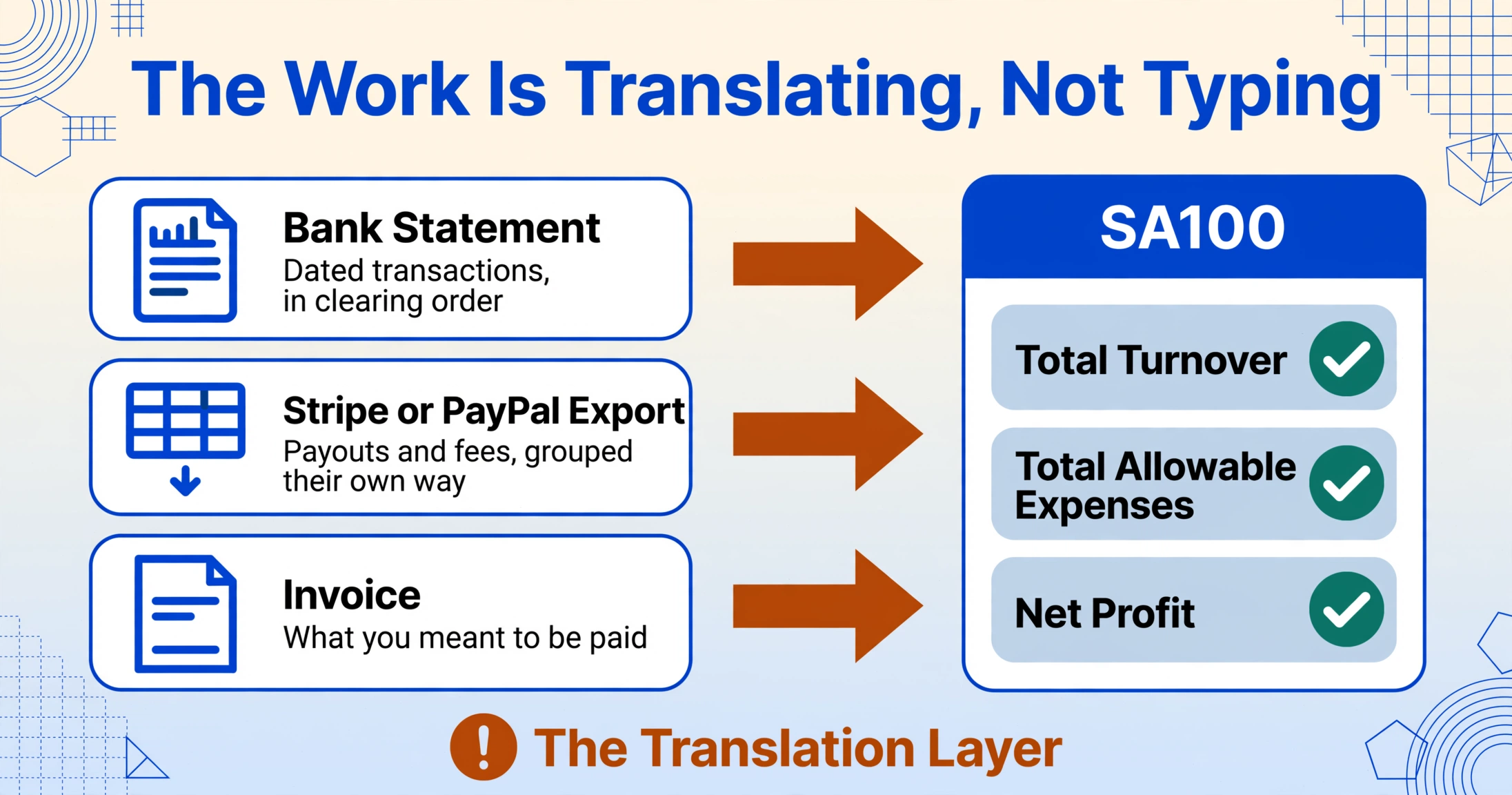
The reason Self Assessment preparation feels so heavy is that you're not really copying data — you're translating it. Every source document speaks its own language. A bank statement lists dated transactions in the order they cleared. A Stripe export groups payouts and fees on its own logic. An invoice states what you intended to be paid. The SA100 asks none of those questions. It asks for a single figure: total turnover for the tax year. Total allowable expenses. Net profit.
Getting from one to the other means holding the meaning of a figure in your head while you move it. This transaction is income; that one is a refund; that one is a personal expense that shouldn't be here at all; these six lines together are the "office costs" box. You are acting as a human translation layer between the language documents are written in and the language HMRC's form boxes require. That cognitive work — deciding what each figure means before it can be placed — is invisible, unmeasured, and exhausting. It's also why the task can't simply be rushed: speed up the typing and you still haven't sped up the deciding.
This is the same friction that turns routine payroll documents into a manual bottleneck elsewhere in the UK tax system. The reasons UK payroll teams still manually re-enter P60 data every May, and why P45 processing stays stubbornly manual, come down to the same structural gap: a document says one thing, a destination form expects another, and a person is left to bridge the two by reading and retyping.
The Reconciliation Trap Nobody Warns You About
The translation problem gets sharpest at reconciliation — the point where you try to make your income figure agree across every source that recorded it. This is where self-employed people quietly lose whole evenings, and the payment platforms make it worse by design.
PayPal is the classic example. As one small-business owner put it on Reddit, PayPal "basically does not show you a running balance on statements. It is impossible to do bank reconciliation like you would normally do in a normal bank." Without a running balance, you can't simply tie the closing figure to your books — you have to reconstruct it transaction by transaction, separating sales from refunds from fees.
Accountants, meanwhile, raise the bar in the other direction. A recurring complaint in r/smallbusiness describes accountants asking for "a source document for every individual transaction. Not a payout summary. Not the Stripe invoice" — the primary receipt behind each line. That request is reasonable for compliance, but it turns a single payout figure into dozens of documents that each have to be found, matched, and labelled. The gap between "I know roughly what I earned" and "I can evidence every pound of it in HMRC's categories" is precisely the gap Self Assessment forces you to close, by hand, once a year.
Multiply that across two or three accounts and a couple of payment platforms, and the reconciliation isn't a step — it's the majority of the job. The SA100 boxes are waiting patiently at the end; the war is fought upstream.
It's Not That You're Disorganised
The dominant narrative around Self Assessment — repeated in every accountant's January blog post — is that the pain is your fault: you should have kept better records, you shouldn't have left it so late, you need a system. There's some truth to it, but it misdiagnoses the problem. Even the well-organised freelancer who files receipts monthly still faces the translation layer at year-end. Good habits reduce the search time; they don't eliminate the work of reshaping a year of documents into HMRC's format.
The evidence that this is structural, not personal, is in what people actually fear. In a YouGov survey of people who had filed a tax return, the single biggest concern — cited by 34% — was worrying about making a mistake, ahead of understanding the tax rules (28%) and the deadline itself (19%). People aren't mostly afraid of running out of time. They're afraid of getting a figure wrong, because the manual translation from source document to form box is exactly where errors creep in — a transposed digit in a UTR, an expense in the wrong category, income counted twice across a bank statement and a PayPal export.
This is a shared condition, not an individual failing. The UK has roughly 4.4 million self-employed people, according to Office for National Statistics figures — a population that IPSE, the Association of Independent Professionals and the Self-Employed, exists to represent. Every one of them meets the same wall each year. When millions of capable people all find the same task grim, the task is the problem — not the people.
MTD for ITSA: The Problem Is About to Get Quarterly
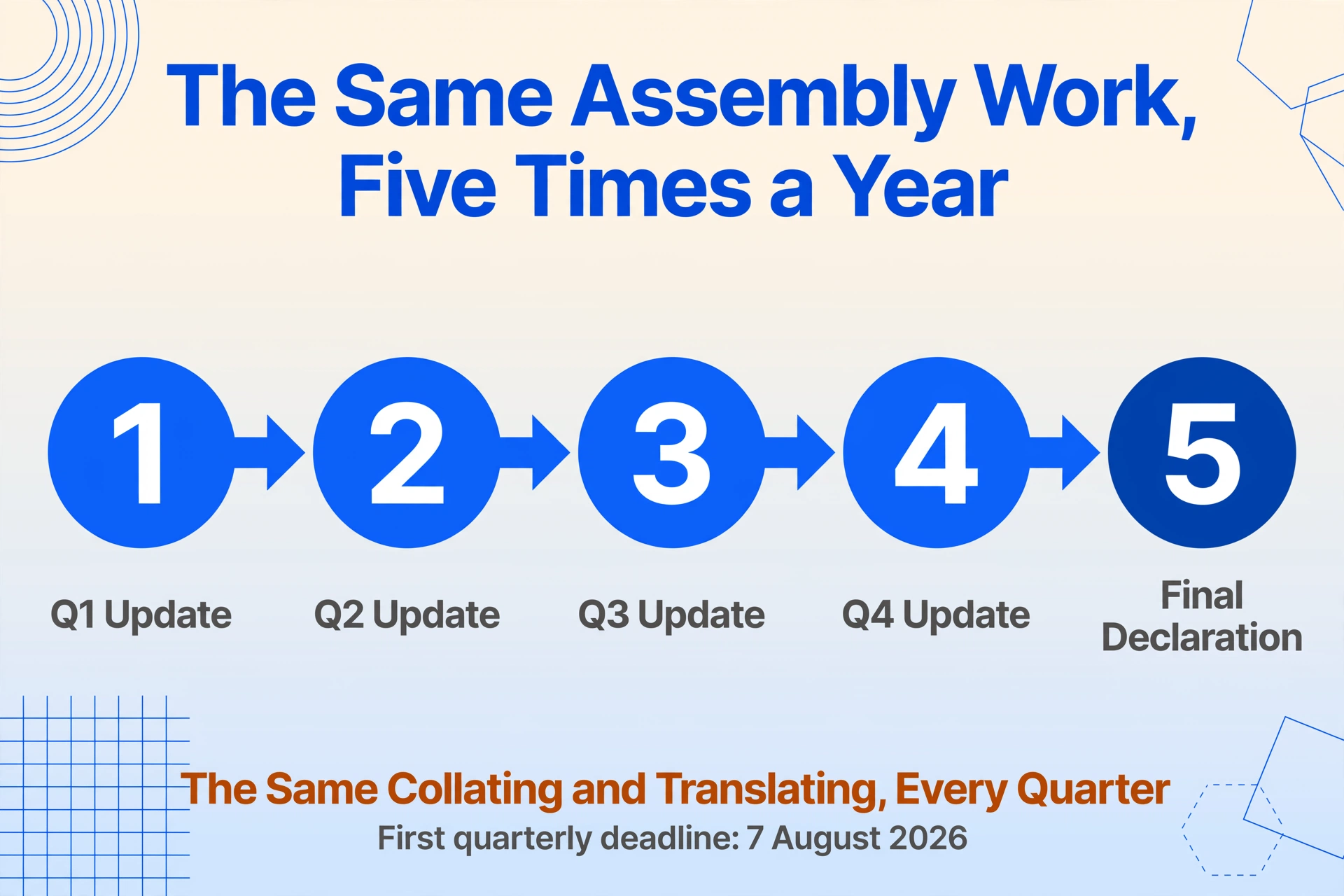
If the annual version of this is painful, the near future is worse, and it's already legislated. Making Tax Digital for Income Tax Self Assessment (MTD for ITSA) changes the rhythm of the whole exercise. From 6 April 2026, it becomes mandatory for sole traders and landlords with gross income over £50,000 from self-employment and/or property. From 6 April 2027 the threshold drops to £30,000, and from April 2028 to £20,000.
The government's own impact assessment expects around 780,000 people to join in April 2026, with a further 970,000 in April 2027. And the change isn't cosmetic. Instead of one annual return, those in scope must keep digital records and submit a summary of income and expenses every quarter — four quarterly updates plus a final year-end declaration, as the Chartered Institute of Taxation (CIOT) sets out. The first quarterly update deadline lands on 7 August 2026.
Read that against everything above. The part of Self Assessment that hurts — collating source documents and translating them into the right figures — is exactly the part MTD multiplies. The deadline never was the bottleneck; the preparation was, and now the preparation happens four extra times a year. Which is why the question worth asking isn't "how do I survive January," but "how do I make the assembly itself lighter, because I'm about to do it far more often."
Where the Pain Actually Compresses
If the structural problem is a manual translation layer between source documents and form boxes, the only real relief is to automate that layer — not the filing, which was never the hard part, but the reshaping of statements and receipts into clean, categorised figures.
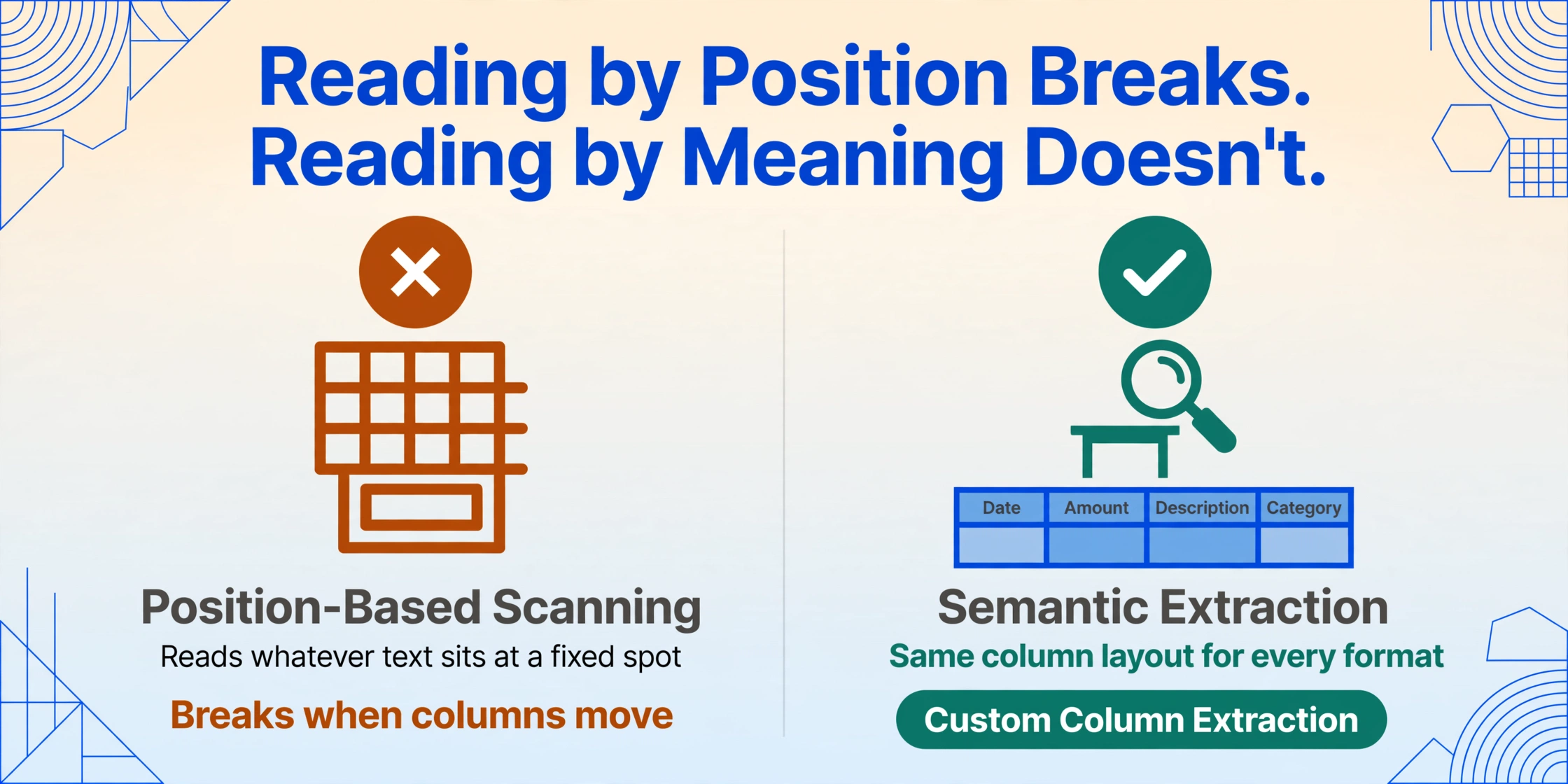
This is a different job from what old-fashioned OCR does. Traditional scanning tools read a document position by position — they output whatever text sits at a given spot on the page. That breaks the moment a PayPal export and a bank statement lay out their columns differently, which they always do. The approach that actually fits Self Assessment is semantic: you tell the tool what you want, by meaning, rather than pointing at where it sits.
That's the idea behind Custom Column Extraction. Instead of drawing boxes around fields, you type the column names you need — "Date," "Amount," "Description," "Category" — and the AI reads each document and locates the matching value by understanding what the field means, wherever it appears on the page. A bank statement, a Stripe payout report, and a photographed receipt can all be poured into the same column layout, because the definition is based on meaning, not position. You can even add an inferred column — for example, a "Category (options: Income / Allowable Expense / Personal / Refund)" column — and the AI classifies each line as it extracts, doing the "what does this figure mean" decision that used to sit entirely in your head. It reads printed statements, PDF exports, and phone photos of paper receipts alike, and merges multiple files into one spreadsheet in a single pass.
From there, the mechanical steps are the ones already documented in the rest of this cluster: the full walkthrough of extracting SA100 Self Assessment data into Excel, and — for an accountant handling many clients — batch-processing multiple SA100 returns into one summary spreadsheet. If you're the one gathering documents from other people — an accountant collecting records from clients, or a business owner chasing receipts from staff — a Collection Link lets you share a simple upload page (they enter a short code, no account needed) so their files land straight in your processing queue instead of your inbox.
None of this changes the tax rules or removes the need to think about your figures. What it removes is the retyping and the reshaping — the hours spent being a human translation layer. And with MTD making that layer a quarterly obligation, compressing it is no longer a January convenience. It's the difference between four manageable updates a year and four Januaries.
Frequently Asked Questions
Why is preparing a Self Assessment harder than actually filing it?
Filing is a short, mechanical step — logging into HMRC and entering a dozen or so figures. Preparation is the hard part because the figures have to be reconstructed from documents that were never designed to feed the SA100: bank statements from multiple accounts, PayPal or Stripe exports, invoices, and receipts. You spend the time deciding what each figure means and which box it belongs in, not typing it.
Which documents do I actually need to complete an SA100?
For most self-employed filers: bank statements for all accounts used for business, payment platform transaction exports (PayPal, Stripe, or marketplace payouts), invoices issued, expense receipts, any P60 or P45 from employment during the tax year, and — if relevant — dividend vouchers and mortgage interest statements. Self-employment income is reported on the SA103 supplementary pages, employment on SA102, and rental income on SA105, all attached to the main SA100.
Does having an accountant remove the paperwork burden?
Not the collating part. An accountant handles the filing and the tax judgement, but you still have to provide the source data — and accountants often ask for a source document for every transaction rather than a single summary. That request is what turns one payout figure into dozens of documents to find and label. The preparation bottleneck stays with you regardless of who submits the return.
Will Making Tax Digital make Self Assessment easier or harder?
In the short term, harder for the assembly work. MTD for ITSA is mandatory from 6 April 2026 for those with income over £50,000 (over £30,000 from April 2027, over £20,000 from April 2028). It replaces one annual return with four quarterly updates plus a final declaration. The digital record-keeping requirement can reduce year-end scrambling over time, but the effort of turning source documents into categorised figures now recurs every quarter instead of once a year.
Can I extract data from a scanned or photographed paper SA100 or bank statement?
Yes. Semantic extraction reads printed documents, PDF exports, and phone photos of paper alike, because it locates values by meaning rather than by fixed pixel position. You define the columns you want, and the same definition works across a bank statement, a Stripe report, and a photographed receipt — merging them into one spreadsheet. It doesn't decide your tax treatment for you, but it removes the manual retyping that sits between the documents and your figures.
The next time the dread arrives — and with MTD, it will arrive more than once a year — it's worth naming what's actually causing it. Not the deadline, not your discipline, but the hours spent translating a year of mismatched documents into HMRC's boxes by hand. That's the layer worth removing. See what your own statements and receipts look like when the reshaping is done for you.