Why the P45 Form
Costs UK Payroll Teams More Than They Realise
In 2024, 34% of the UK workforce changed employer or left the labour market entirely — roughly 11 million people — according to CIPD analysis of the Annual Population Survey. Every single one of those leavers triggered a legal obligation under Regulation 36 of the Income Tax (PAYE) Regulations 2003: the employer must issue a P45 within the leaving pay period or "without unreasonable delay." That obligation is not the problem. The problem is that despite Real Time Information (RTI) digitising Part 1 of the P45 in 2013, the remaining three parts — 1A for the employee's records, 2 and 3 for the new employer — still follow a distribution chain designed in 1944, the year the form was introduced. Somewhere in that chain, between a leaving date and the first pay run at a new job, paper gets lost, figures get keyed in wrong, and HMRC's systems default to an emergency tax code that the employee may not notice for weeks — or ever.
Key Takeaways
- Eleven million UK job changes in 2024 triggered eleven million P45s — and at a conservative field error rate, statistically one in every ten manually retyped P45s enters a payroll system with at least one wrong digit.
- The real cost is not the correction call to HMRC — it is the mistyped NI number from five years ago, sitting undetected in a payroll archive, waiting for an inspection that triggers a penalty of up to £3,000 per employee.
- The P45 data is already printed on the form — extract it directly and the payroll administrator becomes a verifier, closing the gap between Employer A's payroll output and Employer B's payroll input without a single keystroke of data creation.
The Form That RTI Was Supposed to Kill
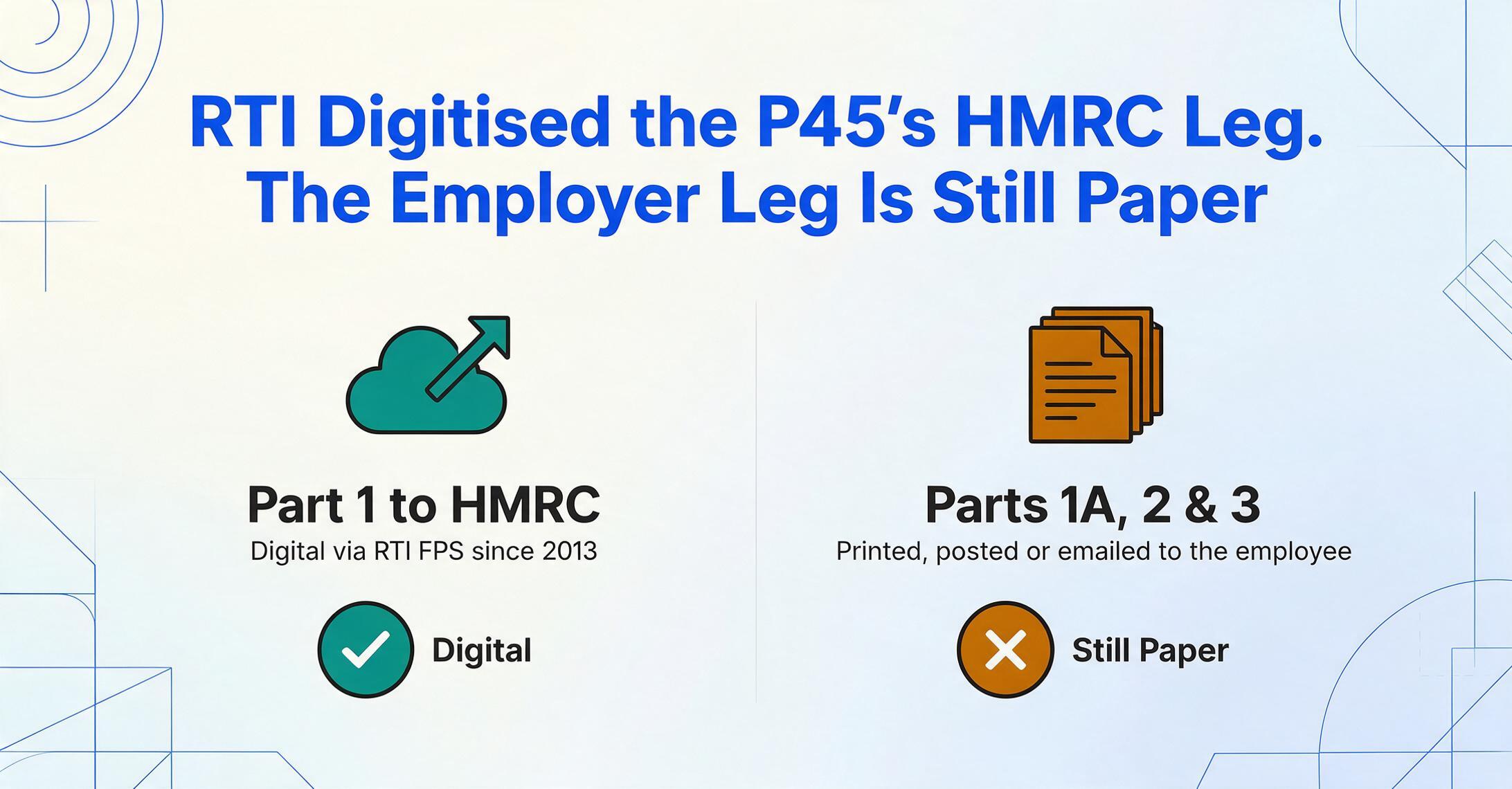
Before RTI came into force in 2013, the entire P45 was a physical paper chain: employer filled out four carbon-copy parts, posted Part 1 to HMRC, handed Parts 1A, 2, and 3 to the departing employee. Delays, lost mail, and manual data entry at the HMRC end were endemic. RTI was sold as the structural fix: leaver information would flow electronically from the employer's Full Payment Submission (FPS) directly to HMRC in near real time. Part 1 became redundant — payroll software generates the FPS, HMRC receives the data, the employee's tax record updates.
That is exactly where the digital transformation stopped.
Parts 1A, 2, and 3 remain physical documents. The employee must receive them — on paper, or as a PDF printed or emailed from the employer's payroll software. The employee must keep Part 1A for their own records. They must then deliver Parts 2 and 3 to their new employer, who must manually enter the year-to-date pay, year-to-date tax, tax code, and National Insurance number into their payroll system before the first pay run. Under HMRC rules, if the new employer runs payroll without a P45, the employee goes on an emergency tax code. The form that was supposed to become obsolete in 2013 is, in 2026, still the only mechanism for transferring cumulative tax data between two unconnected payroll systems.
The structural reality: RTI digitised the employer-to-HMRC leg of the P45. It did nothing for the employer-to-employer leg. Every part of the leaver process that RTI didn't reach is now a seam between systems — and at every seam, a person types.
A P45 for Every Leaver: The Volume Nobody Counts
The P45 is not an occasional document. It is generated for every leaving event — resignation, redundancy, retirement, dismissal, end of a fixed-term contract, even death. Most of those events begin with an HR letter, and extracting a signed termination letter to Excel captures the last working day, reason for separation, and final pay details alongside the P45. For an economy with 34% labour churn and a PAYE workforce of roughly 33 million, the arithmetic is straightforward: millions of P45s every tax year. The CIPD's 34% figure splits into 27.4% who move to a new employer and 6.6% who leave the labour market. Even taking only the job changers — the ones whose P45s must physically reach a new employer — that is close to 9 million P45s in transit annually.
The churn is not uniform. Hospitality runs at 52% turnover. Construction, retail, and professional services sit well above the national average. A construction firm with 400 site workers will process more P45s in a year than a similarly-sized financial services firm handles in five. A hotel chain with 1,200 staff across seasonal peaks may issue P45s to 600 leavers per year. In these high-churn industries, the P45 pipeline is not a compliance afterthought — it is a recurrent operational load that nobody's staffing budget explicitly accounts for.
The downstream numbers compound the scale. A mid-sized payroll bureau handling 30 SME clients with an average of 15 employees each manages 450 P45s per year — just for leavers. An accountancy practice filing self-assessment returns for 100 clients needs P45 figures from each client's previous employments during the tax year, often across multiple jobs. In every one of these scenarios, the P45 exists. The data is printed on the page. But moving it from the page into the system that needs it — payroll software, tax return, benefit claim calculation — is still a typing exercise.
Replacing that typing with a P45 to Excel pass does not change how the form travels — the four parts still move exactly as described. It removes the keyboard step at the receiving employer and leaves the payroll administrator checking figures rather than entering them.
The Four-Part Distribution Problem
To understand why the P45 remains a structural failure point, you have to follow each part through its intended journey — and see where the breaks happen.
Part 1 — HMRC. This is the part RTI solved. Payroll software submits it as part of the FPS on or before the employee's final payday. HMRC receives it. The employee's tax record updates. This leg of the journey has been digital since 2013 and, for the most part, works.
Part 1A — Employee records. The employer generates this alongside Parts 2 and 3. It must reach the employee — ideally on their last working day, or with their final payslip. In practice, the timing depends on when the final payroll run processes. If the final pay is not calculated until after the employee has left — common when holiday pay, notice pay, or bonuses are involved — the P45 is issued later. The employee who left on the 10th and started a new job on the 17th has already had their first pay run at the new employer by the time the P45 arrives. At that point, Parts 2 and 3 are late. The payroll clock at the new employer has already ticked.
Parts 2 and 3 — New employer. The employee must physically deliver these to the new employer before the first pay run. If they arrive late — or never — the payroll department falls back to the HMRC Starter Checklist, which assigns an initial tax code without year-to-date figures. The Starter Checklist determines whether the employee gets a cumulative code (if this is their only job and they have had no other employment in the tax year) or a basic-rate BR code (if it is a second job). If the checklist is filled in wrong — a "this is my only job" declaration when it is a second job, for example — the tax code is wrong from day one. And unlike the P45, the Starter Checklist contains no previous earnings data. It cannot resume the cumulative tax calculation. It can only guess.
There is a less obvious failure mode: the late P45 scenario. As BrightPay's documentation for payroll administrators explicitly addresses the case where "a new employee may sometimes give their new employer a P45 after their first pay and after an FPS submission has been submitted to HMRC." By the time the P45 arrives, HMRC may have already issued a tax code based on the Starter Checklist data. The payroll administrator must now decide: use the HMRC-issued code or the P45 figures? The documentation directs them to use whichever code HMRC sent — which means the P45 data the employee spent two weeks chasing may not even be entered. The form arrived. It just arrived too late to matter.
The distribution chain has at least seven handoff points: final payroll run → P45 generation → Part 1 via FPS → Parts 1A/2/3 to employee → employee retains 1A → employee delivers 2/3 to new employer → new employer enters data into payroll → new FPS submitted. Each arrow is a breakpoint. No single entity owns the entire chain.
From Missing Part 2 to Emergency Tax: The Cost Cascade
When Parts 2 and 3 do not reach the new employer before the first pay run, the employee is placed on an emergency tax code — typically 1257L W1 (week 1) or 1257L M1 (month 1). These codes treat each pay period as a standalone tax period with no year-to-date adjustment. The standard personal allowance is divided equally across pay periods rather than applied cumulatively against total earnings to date.

The arithmetic is brutal. On a £30,000 annual salary, an employee on the cumulative 1257L code pays roughly £290 in tax per month. On the emergency M1 code, the deduction is approximately £400 — a difference of £100 to £150 per month. For an employee who has just started a new job, possibly after a gap in income, that £100 reduction in net pay is not an abstract compliance concern. It is a real cash-flow hit.
HMRC states that tax code corrections "can take up to 35 days from when you start your job." In practice, the timeline depends on three separate systems aligning: the previous employer must have submitted the leaver FPS, the new employer must have submitted the starter FPS, and HMRC's systems must reconcile the two. A delay at any point pushes the correction window beyond 35 days. The employee who was emergency-taxed for two pay periods may be emergency-taxed for a third — and by then, they are £300 to £450 down. HMRC will refund the overpayment, but the refund mechanism depends on what happens next. If the correction arrives within the same tax year, the employer adjusts future deductions. If it arrives after the tax year ends — which can happen with late corrections — the employee must claim the refund directly, through the Personal Tax Account or by phone. HMRC estimates up to one million people per year fail to claim back overpaid tax.
The broader tax code error statistics tell the same story from the other direction. In 2023/24, 5.6 million people overpaid income tax — £3.5 billion in total. Research by The Tax Refund Company found that 36% of employees had been on at least one wrong tax code in a four-year window, losing an average of £204 each. Not all of these errors originate from missing P45s. But a missing P45 is the most structurally preventable cause in the chain — and the most distributed. There is no single payroll system, no single employer, no single HMRC process that owns the handoff. So there is no single entity that can be held accountable for fixing it.
Why the Paper Persists: Institutional Inertia Meets the Backup Problem
HMRC's own Transformation Roadmap, published in July 2025, lays out over 50 projects: a new PAYE portal, digitalising Inheritance Tax services, an AI-powered compliance engine, voice biometrics for helplines. The word "P45" does not appear once. In an agency that is "removing the reliance on paper tax code notices" and testing "new ways of telling people about changes to their tax position," the employer-to-employer leaver form — the document that, more than any other single piece of paper, determines whether an employee starts a new job on the right tax code — is absent from the digital agenda.
There are two reasons for this, and they are structural rather than bureaucratic.
First: the P45 serves as a backup system. When RTI FPS submissions fail, when payroll software produces a corrupted file, when an employer filed online but the new employer cannot receive electronic tax codes because their software is out of date — the paper P45 is the fallback. As long as the backup exists, the primary RTI pipeline does not need to be perfect. Removing the backup would require making RTI genuinely fault-tolerant, which is a far larger project than issuing a digital form. From HMRC's perspective, the cost of eliminating the paper P45 is not the cost of the form. It is the cost of making the entire digital infrastructure bulletproof enough that the backup is no longer needed. That bill is never itemised in a Transformation Roadmap because nobody has asked for it to be.
Second: the handoff sits between employers, and HMRC's remit is taxpayer ↔ HMRC. The P45 gap exists in the space between Employer A's payroll output and Employer B's payroll input. That space is not regulated by HMRC in the way that FPS submissions are. There is no "P45 electronic handoff standard." There is no mandated format for Parts 1A, 2, and 3 beyond HMRC's design specification for printed P45s — A4 white paper, minimum 80 gsm, pure black ink only. The specification governs what the form looks like, not how its data moves between systems. That gap is nobody's job to close.
The Manual Entry Factor Nobody Measures
The seams between systems — between the P45 PDF and the new employer's payroll input screen, between the paper form and the spreadsheet — are where the data gets retyped. And retyping is where errors happen.
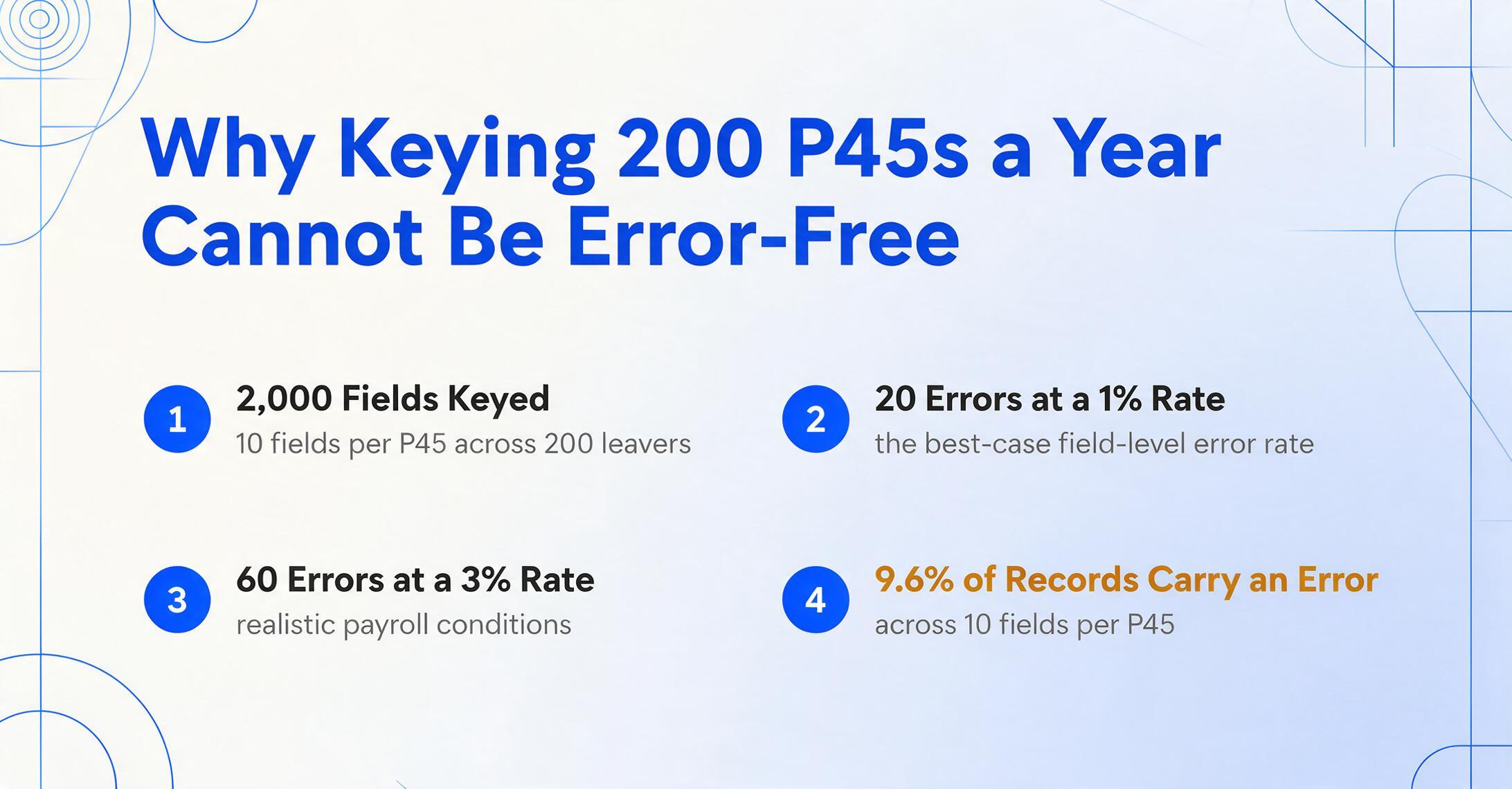
Manual data entry research converges on a field-level error rate of 1% to 4% for trained operators. In payroll, industry surveys have found that approximately 20% of payroll runs contain at least one error — not 20% of fields, but 20% of entire payroll cycles. For a mid-sized employer handling 200 leavers per year, each P45 carrying roughly 10 keyable fields — National Insurance number, leaving date, tax code, total pay to date, total tax to date, student loan indicator, week/month number, and the employee's personal details — that is 2,000 fields typed per year. At a 1% field error rate: 20 mistyped fields. At the more realistic 3% rate for payroll conditions — time pressure, format variation between employers, P45s arriving as scans rather than searchable PDFs — the figure is 60 errors per year.
Record-level error compounds faster than payroll teams anticipate. With 10 fields per P45 and a 1% field-level error rate, the record-level error rate — the probability that a given P45 contains at least one mistake — is approximately 9.6% (1 − 0.99¹⁰). Nearly one in ten manually entered P45s contains at least one error. For the 450-employee payroll bureau, that is roughly 45 P45s per year with a data error somewhere in the record — and each one is a potential wrong tax code, a potential duplicate P45 correction, a potential HMRC compliance query.
The cost of these errors is not the correction time itself, although that is significant — a single wrong tax code can require a call to HMRC, an amended FPS submission, a corrected payslip, and a conversation with an employee who noticed the mistake. The real cost is the cumulative compliance exposure. HMRC requires employers to retain payroll records for at least three years. Under an inspection, the employer must be able to demonstrate that the figures in their payroll system match the figures on the source documents. A spreadsheet with a mistyped P45 figure — with no audit trail showing when the error was introduced, by whom, or what the original value was — is an unverifiable record. The penalty for inadequate records is up to £3,000 per employee. The P45 that was entered correctly does not create the liability. The P45 that was entered with one wrong digit, and entered five years ago, living quietly in the archive, does.
The systemic failure is not the P45 itself. It is the combination of four-part paper distribution and manual data entry — a 1944 process grafted onto a 2013 digital RTI backbone, with the seam between them filled by keyboard strokes that nobody audits.
Breaking the Cycle: What Changes When the Keyboard Disappears
The P45's paper problem is not fixable by asking HMRC to eliminate the form. The paper serves a backup function that RTI depends on, and HMRC's transformation priorities are elsewhere. What is fixable is the typing.
When a P45 arrives — whether as a PDF from a previous employer's payroll software, a scan of a paper form from a pre-RTI holdout, or a photograph a leaver texted from their last job — the data on it does not need to be retyped. Document extraction tools that understand the semantic structure of a P45 can read the tax code, the year-to-date pay and tax figures, the leaving date, the NI number, and the student loan indicator directly from the page. The output is not a PDF. It is a structured row of data — the same columns a payroll administrator would type into a spreadsheet, generated in seconds. The keyboard that was the seam between systems becomes a verification step instead of a creation step.
This is what the companion guide to extracting P45 leaver data into Excel for payroll covers in detail: how to take a P45 from any format — printed, scanned, PDF — and turn it into structured payroll data without retyping a single field. The technology exists. The P45 exists. The gap between them is measured in keystrokes.
For the wider context of why manual payroll data entry remains a structural risk across the UK's tax documentation landscape, the analysis of manual P60 data entry in UK payroll traces the same pattern — end-of-year certificates generated by software, consumed by people, typed into spreadsheets — and what it costs the departments that process them.
Frequently Asked Questions
Can I get a replacement P45 if I lost mine?
No. HMRC explicitly states that previous employers cannot issue a replacement P45. If you lose your P45 or never receive it, your new employer must use the HMRC Starter Checklist instead. This means you will not benefit from the cumulative tax calculation that the P45 enables — you will likely be placed on an emergency tax code until HMRC corrects your record.
What happens if my new employer runs payroll before receiving my P45?
You will be placed on an emergency tax code — typically 1257L W1 or M1 — which treats each pay period independently rather than cumulatively. On a £30,000 salary, this means approximately £100 to £150 more tax deducted per month than under the correct cumulative code. HMRC states that the correction can take up to 35 days. The overpaid tax is refundable — either through reduced deductions in subsequent payslips if corrected within the tax year, or by direct claim to HMRC after the tax year ends.
Why doesn't HMRC make the whole P45 digital?
Part 1 is already digital — it is submitted to HMRC electronically via RTI's Full Payment Submission. Parts 1A, 2, and 3 remain physical because they serve an employer-to-employer handoff function that RTI was not designed to replace. HMRC's current transformation work prioritises taxpayer-facing digital services — a new PAYE portal, digital tax code notices — rather than the inter-employer data transfer gap. The paper P45 also functions as a system backup: if RTI submissions fail, the paper form provides a fallback mechanism for tax data continuity.
Is my employer fined for not issuing a P45?
There is no fixed, standalone penalty solely for failing to provide a P45. However, it can contribute to wider PAYE non-compliance findings. Employers face penalties of up to £3,000 per employee for inadequate or inaccurate payroll records, and RTI filing penalties range from £100 to £400 per month depending on employer size. Employees who do not receive a P45 can escalate to HMRC, which may trigger a compliance review of the employer's payroll practices.
Do I get multiple P45s if I worked multiple jobs in the same tax year?
Yes. Each employer you leave during the tax year must issue a separate P45. If you held two jobs simultaneously and left both, you will receive two P45s — each showing only the pay and tax from that specific employment. This creates a data aggregation problem: your new employer or accountant needs to combine figures from multiple P45s to understand your total tax position. Every merge point is a potential manual calculation error.
Is a P45 the same as a P60?
No. A P45 is issued when you leave a job and covers your pay and tax from the start of the tax year to your leaving date. A P60 is issued at the end of the tax year (by 31 May) to every employee still on the payroll as of 5 April, covering the full tax year. An employee who left in December gets a P45 in December. The same employee does not get a P60 from that employer — but the employer who issued the P45 must still retain the records for HMRC compliance purposes for at least three years.