The Real Cost of a Manual SA100
Is Not the Accountant's Fee
A UK accountant charges most sole traders £150 to £400 to file a Self Assessment return, and that fee is the only number anyone puts on the process. It is also the cheapest and most visible part of it. The expensive part never appears on an invoice: it is the hours you spend before the accountant sees anything — pulling twelve months of income and expenses out of bank statements, invoices, and a shoebox of receipts, and reconciling them into figures the SA100 can accept. Hiring an accountant does not remove that work. It moves the deadline. This is a framework for pricing the part of your tax return that nobody bills you for, so you can produce your own number instead of assuming it is free.
Key Takeaways
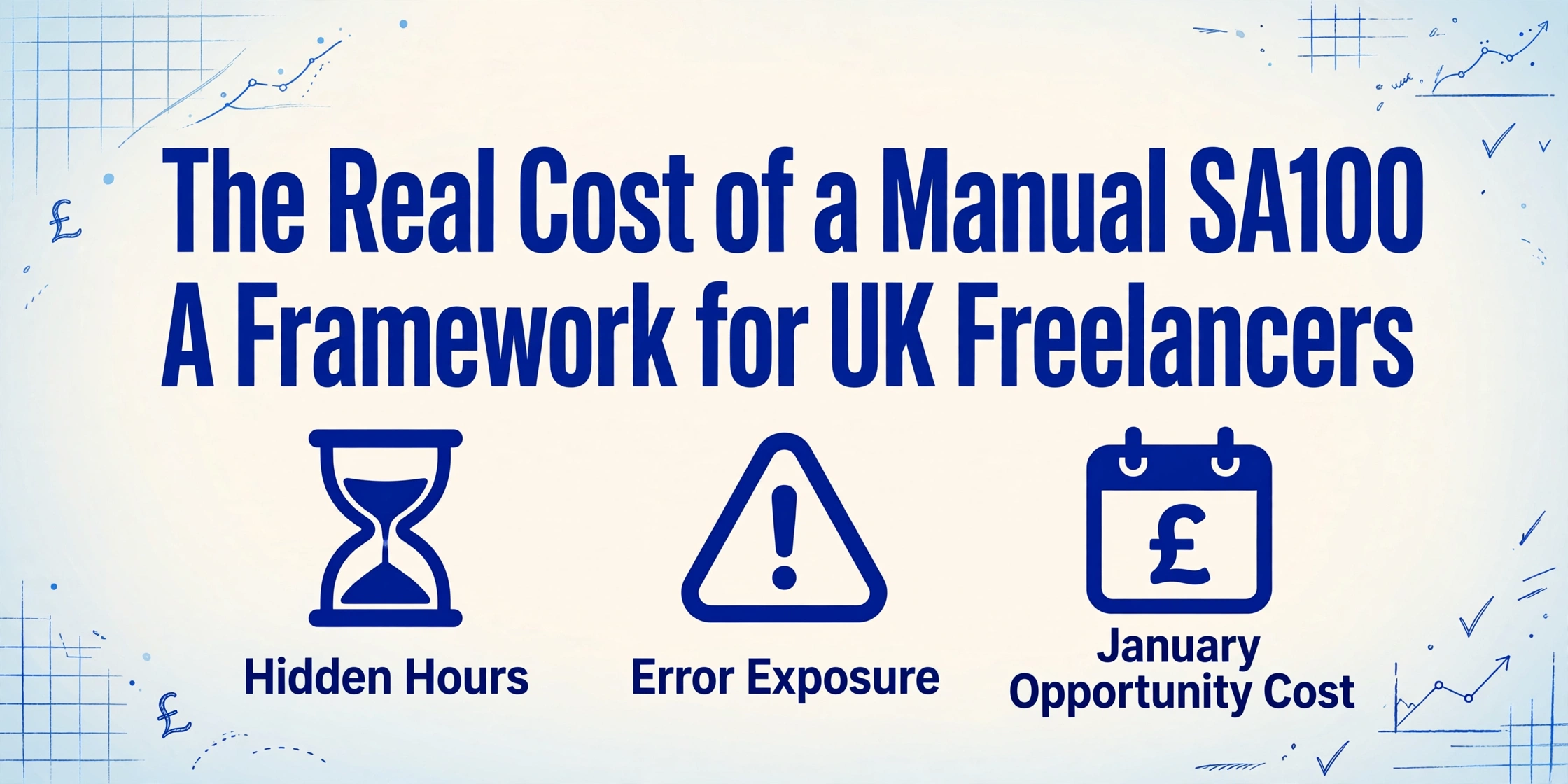
- You budget £250-£400 for an accountant to file your SA100, but the 10 to 15 hours you spend gathering and reconciling bank statements, invoices, and receipts before they see a single figure costs you £590 or more at a freelance hourly rate, and that number has never appeared on an invoice because you are its only source.
- HMRC's Schedule 24 penalty adds up to 30% of the understated tax when a figure on your return is wrong through carelessness, and when you hand-key a year's worth of income and expenses from a dozen different document formats at least one transcription slip crosses from 'could happen' to 'expected', adding an uncharged error cost that your accountant's fee was never priced to cover.
- Every SA100 cost you pay in hours, error risk, and lost January billables begins with the same motion — reading a figure off a document and typing it — and removing that motion from the process turns a year of receipts into sorted totals before you even open the return.
The Accountant's Fee Is the Visible Cost — Not the Whole One
Start with the number everyone quotes, because it anchors the whole calculation. For the 2025/26 tax year, a straightforward Self Assessment — one employment plus a single extra income source — costs roughly £150 to £250 plus VAT through a UK accountant. Add self-employment with allowable expenses, rental income, dividends, or foreign earnings and the fee climbs toward £400 and beyond; complex returns with capital gains or multiple properties routinely reach £600 or more. There is also a timing surcharge that most freelancers discover the hard way: leave the work until January and firms commonly add a rush fee of £50 to £150, because the entire client base arrives in the same four weeks.
That range is real, and it is not the subject of this article. The trap is treating it as the total cost. An accountant prices the filing — checking the figures, applying the allowances, submitting the return under your UTR. They do not price the gathering, because they never do the gathering. You do. A good accountant will hand you a checklist and wait: bank statements for every account, sales invoices, purchase receipts, mileage logs, a P60 or P45 if you also had employment, pension and Gift Aid records, and last year's return for the carried-forward figures. Assembling that into a clean set of category totals is the labour the SA100 actually demands, and it lands on you whether you file yourself or pay someone to submit what you assembled.
The scale of this is not marginal. More than 11.5 million taxpayers filed a Self Assessment return for the 2023–24 tax year, and around 1.1 million missed the 31 January deadline — roughly one in eleven — each triggering an automatic £100 penalty, according to HMRC's own filing statistics. People do not miss the deadline because filing takes long. They miss it because the gathering does, and the gathering is the cost we are about to break down.
Three Costs Hiding in One Annual Ritual
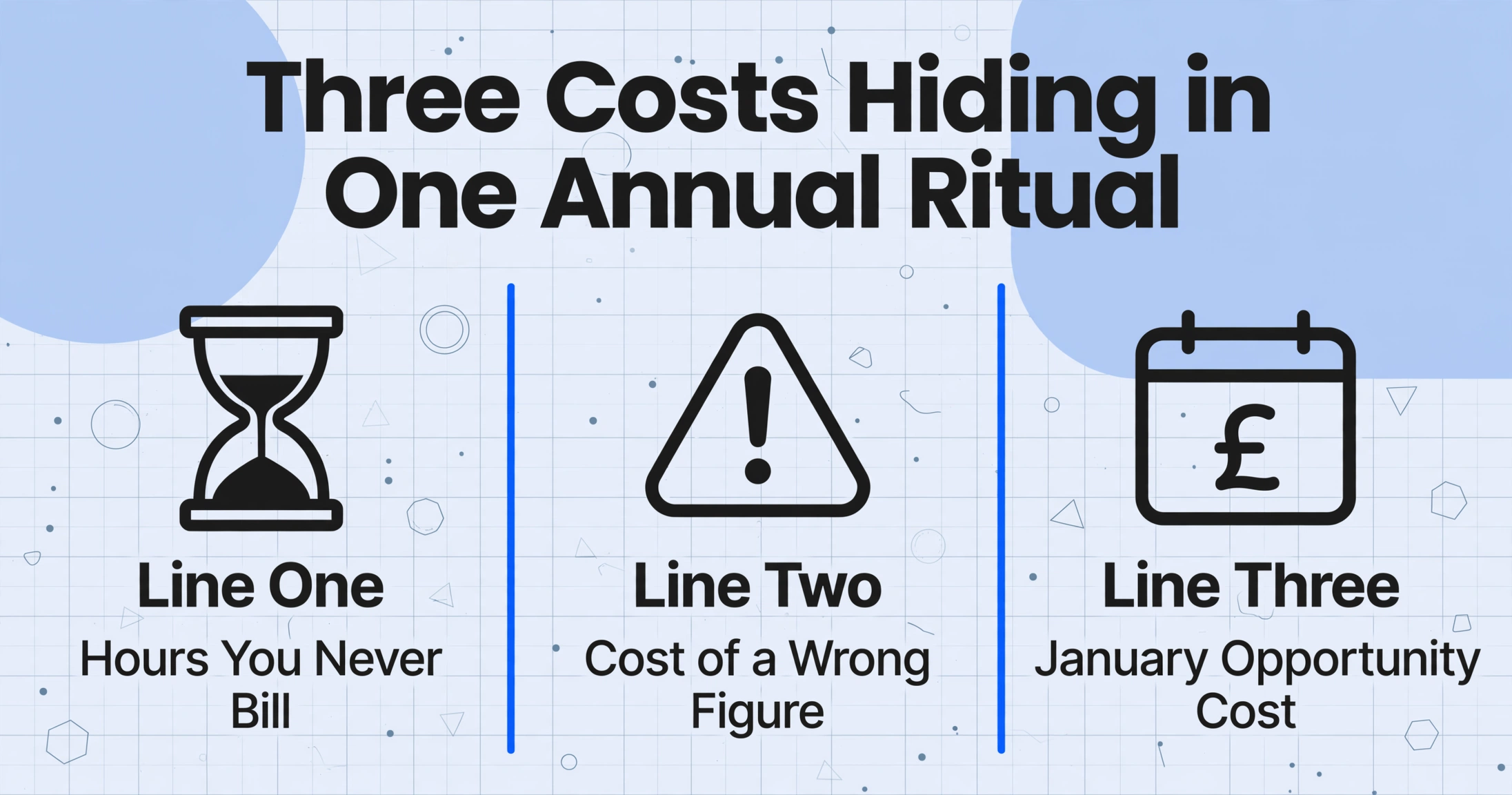
Whether you do the whole return yourself or only prepare the figures for an accountant, the cost of a manual SA100 splits into three lines that behave differently and have to be added separately. Lumping them into one vague sense of "tax season is a pain" is exactly why the number never gets calculated.
- Line One — the hours you never bill. The time spent locating documents, reading figures, categorising expenses, and reconciling totals, priced at what an hour of your working time is actually worth.
- Line Two — the cost of a wrong figure. The penalty and interest exposure attached to a mistyped income total or a missed allowance, weighted by how likely manual entry is to produce one.
- Line Three — the January opportunity cost. The billable work you displace when the return collides with your busiest month, plus the harder-to-price cognitive tax of carrying an unfinished return for weeks.
To keep the arithmetic concrete, we will run a single example throughout: a self-employed designer with two income sources — freelance client work and one rental flat — who bills at a mid-market rate, keeps reasonable but not pristine records, and files online before the 31 January deadline. Substitute your own figures at each step; the formulas at the end let you rebuild the whole thing for your situation.
Line One — The Hours You Never Put on an Invoice
The reason freelancers assume their own time is free is that it never leaves the bank account. But an hour spent categorising receipts is an hour not spent on billable work, and that hour has a market price. YunoJuno's 2025 Freelancer Rates Report, drawn from more than 261,000 freelance contracts, put the average UK day rate at £390 and the average hourly rate at £49 an hour. Your own figure is whatever a client pays for your time — that is the correct rate to value the tax-prep hours against, because those are the hours you are giving up.
Now the time itself. For a freelancer with a couple of income streams and a year of expenses to categorise, the gathering-and-reconciling step is not the twenty minutes it takes to type figures into HMRC's online form once they are ready. It is the days beforehand: downloading and cross-referencing bank statements against invoices, sorting business from personal spending, chasing the two suppliers who never sent a receipt, working out the business-use proportion of a home office and a phone bill, and separating rental income and expenses into the figures the SA105 property page needs. Ten to fifteen hours across a return with two income sources is a conservative, realistic figure for someone who has not kept running records — and far more if the shoebox has gone untouched since April.
At twelve hours of collation and a £49 hourly rate, the gathering step alone costs a freelancer around £590 in displaced billable time each tax year — more than the accountant's fee, and entirely invisible because it never appears as a payment. This is Line One, and for most freelancers it is already larger than the number they thought was the whole cost.
Notice what this does to the "should I pay an accountant?" question that dominates every forum thread on the subject. On r/HENRYUK, the recurring conclusion in the "do self assessment yourself or pay someone" discussion is that it "depends on how much you value your own time and the opportunity cost." That instinct is right — but the calculation people run is fee-versus-zero, when it should be fee-versus-your-hours. The accountant does not reduce Line One. Reducing Line One requires changing how the gathering is done.
Line Two — What a Single Wrong Figure Can Cost
Manual transcription has a measurable error rate, and on a tax return an error is not a cosmetic problem — it is a compliance exposure with a published price list. The exposure has three layers, and most people only picture the first.
Late filing. Miss the 31 January online deadline and HMRC applies an automatic £100 penalty even if you owe no tax. If the return is still outstanding three months later, daily penalties of £10 begin and run for up to 90 days (a £900 cap); at six and twelve months, further penalties of £300 or 5% of the tax due, whichever is greater, are added. A return twelve months late reaches at least £1,600 before the tax itself, per HMRC's published penalty schedule. This is the layer everyone fears — and, because it is a fixed, predictable trigger, the easiest to avoid.
Inaccuracy. This is the layer the £100 headline hides. Under Schedule 24 of the Finance Act 2007, a document given to HMRC that understates tax through a careless inaccuracy — the category a transcription slip or a miscategorised expense falls into — attracts a penalty of up to 30% of the potential lost revenue, on top of the unpaid tax. Transpose two digits in a turnover figure, or drop a decimal place in an expense total, and the understated tax is not just repayable; it carries a percentage penalty. And a wrong figure works in both directions: overstate income by mistake and you overpay tax the return will not automatically refund.
Late payment. Even if the return is filed on time, an underpayment discovered later accrues interest and late-payment penalties. From April 2025, HMRC charges 3% of the unpaid tax after 15 days, a further 3% after 30 days, and interest at an annual rate that rises from day 31 onward. A figure that was wrong on the return becomes a bill with a compounding surcharge attached.
None of these is certain in any given year, which is precisely why they get left out of the mental cost. The honest way to include them is probabilistically: estimate your exposure and multiply by the likelihood that hand-keyed figures trigger it. Across the years you will file, a non-trivial expected cost sits on this line — and unlike the accountant's fee, it does not shrink when you file earlier. It shrinks only when the figures stop being wrong. The anatomy of why the SA100 paper trail is so error-prone for the self-employed traces exactly where these mistakes originate — the fragmentation of income across platforms, banks, and clients that guarantees something gets mistyped.
Line Three — The Opportunity Cost of January
Line One prices the hours the return consumes. Line Three prices when it consumes them. For most freelancers the SA100 is not spread evenly across the ten months HMRC allows between the 6 April tax-year end and the 31 January online deadline. It is compressed into the final weeks — and January is rarely a quiet month for a working freelancer. New-year client projects kick off, invoices from December need chasing, and the payment on account due the same day competes for the same cash and attention.
Every hour spent reconciling last year's receipts in January is an hour not spent on the work that pays this year's bills. If tax prep eats the equivalent of a day and a half during your busiest fortnight, that is not merely twelve hours at your hourly rate — it is twelve hours drawn from a window when your time is scarcest and most valuable. That is why the opportunity cost of a January return can exceed the raw labour cost of the same hours done in a slow June.
There is a fourth cost here that resists a spreadsheet but is real enough that IPSE and every freelancer forum name it repeatedly: the cognitive tax of carrying an unfinished return. Knowing the SA100 is undone sits in the background for weeks — the low-grade dread, the deadline arithmetic running while you try to work, the sleep lost the night before the 31st. It does not belong in the numeric total, but leaving it out entirely understates what the manual process actually takes out of you.
Your Own SA100 Cost, in Four Expressions
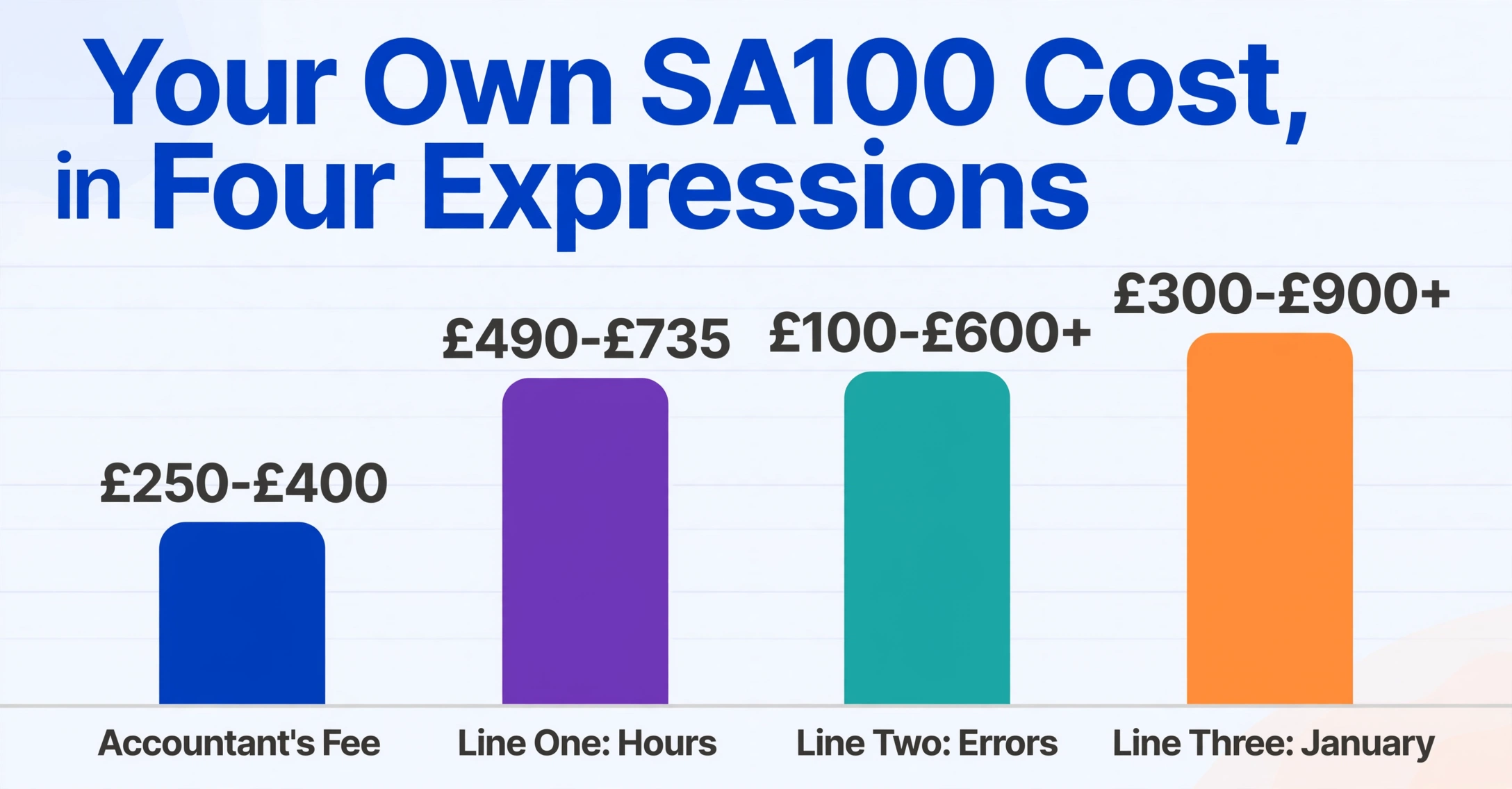
With the three lines separated, the total cost of a manual Self Assessment becomes a function of your own situation rather than an industry average. Here is the tally for the running example — the designer with client work and one rental flat, valuing time at £49 an hour and filing before the deadline:
| Cost Line | Annual Total (example) | Calculation Basis |
|---|---|---|
| Accountant's fee (if used) | £250–£400 | Sole trader with self-employment + property income, filed before January |
| Line One — collation hours | £490–£735 | 10–15 hrs gathering & reconciling × £49/hr displaced billable time |
| Line Two — error exposure | £100–£600+ | £100 automatic penalty risk + Schedule 24 careless inaccuracy (up to 30% of understated tax) + late-payment interest, prorated by probability |
| Line Three — January opportunity cost | £300–£900+ | Peak-month hours displaced from billable work, valued above the flat hourly rate |
| Total per tax year | £1,140–£2,600+ | Probability-weighted true cost of the SA100 data step |
The striking result is that the accountant's fee — the only line most freelancers ever count — is rarely the largest one. To build your own figure, substitute into four expressions:
- Line One = hours spent gathering and reconciling × your hourly billing rate
- Line Two = (£100 late-filing risk + expected inaccuracy penalty + late-payment interest) × the probability manual entry triggers each
- Line Three = peak-month hours displaced × the premium value of your time in your busiest weeks
- Accountant's fee = the quoted price, which removes the filing labour but not Line One
Run those numbers and the DIY-versus-accountant debate reframes itself. The question is not "is £300 worth it?" It is "which of these lines does each option actually reduce?" An accountant reduces the filing labour and, through their expertise, some of Line Two. Neither an accountant nor a spreadsheet template touches Line One — until you change the mechanism by which the gathering happens.
Where Extraction Changes the Arithmetic
Every one of the three lines traces back to the same root operation: a person reading a figure off a document and typing it into a total. Line One is that operation repeated hundreds of times across a year of receipts; Line Two is what happens when one of those keystrokes is wrong; Line Three is the same operation done under time pressure. Remove the manual reading-and-typing and all three lines move at once. That is what document data extraction does, and it is worth being precise about how, because the value is on the gathering side — not in "filing your tax return for you," which no extraction tool does.
The mechanism is Custom Column Extraction: instead of matching fixed positions on a page — the approach template tools take, which breaks the moment a supplier uses a different invoice layout — you type the column names you want once, and the AI locates each value on every document by understanding what the label means. Upload a year of receipts, invoices, and bank statement pages and name your columns "Date," "Supplier," "Amount," and "VAT," and the extracted values become the rows of one spreadsheet, whatever format each document arrived in. The step-by-step version of that workflow is covered in the companion guide to extracting Self Assessment data into Excel, and the same logic applied to any HMRC form is in the tax form data extraction use case.
Two features attack Line One directly. An inferred column is one whose value the AI works out rather than reads: add a column named Category (options: Travel/Office/Meals/Software/Other) and the tool assigns each receipt to a category even though the word "Category" appears nowhere on it — turning the manual sort-into-piles step into a single pass. A computed column then does the arithmetic: define a column that sums each category, and you get the subtotals the SA103 self-employment page expects without adding them by hand. What took a day of sorting and a calculator becomes a spreadsheet you sanity-check.
Files are processed securely and not stored.
The gathering step also has a hidden cost this model assumes away: chasing the documents in the first place — the client who owes you an invoice copy, the letting agent's year-end statement, the accountant asking for one more receipt. A Collection Link addresses it: you generate a shareable link, send it to whoever holds the paperwork, and they upload files straight into your processing queue after entering a short code, with no account to create. For a freelancer collating income across several clients, that removes the "waiting for the file" delay that pushes the whole return into January. If you prepare returns for others, the same batch approach scales — the guide to consolidating multiple SA100s into one summary spreadsheet covers processing a stack of returns at once.
At roughly ten seconds of processing per document versus the minutes of finding, reading, categorising, and typing it by hand, extraction does not shave Line One — it collapses it toward a verification glance. And because the AI reads labels rather than depending on your keyboard accuracy at 11pm on 30 January, the error rate that drives Line Two falls with it. This is the same arithmetic that makes manual processing quietly expensive for UK payroll teams handling P60s and employers processing P45 leaver data — the visible typing was never the cost.
Why This Calculation Gets Bigger in April 2026
The framework above assumes you do the gathering once a year. From 6 April 2026 that assumption stops holding for a large group of freelancers. Making Tax Digital for Income Tax Self Assessment (MTD for ITSA) becomes mandatory for sole traders and landlords whose combined qualifying income from self-employment and property exceeds £50,000, with the threshold dropping to £30,000 from April 2027. HMRC expects around 780,000 people to enter the regime in the first phase, per its official MTD for ITSA policy paper.
The change that matters for this cost model is frequency. MTD replaces the single annual return with four quarterly digital updates plus a year-end finalisation, kept in HMRC-recognised software such as FreeAgent, Xero, QuickBooks, or Sage. If your income and expenses are still gathered by hand, Line One does not stay at twelve hours a year — it recurs every quarter. The collation burden that this article priced as an annual event becomes a roughly four-times-a-year event, which is exactly the point at which keeping structured digital records from the start stops being optional and starts being the only sustainable way to feed the software. Extraction turns each quarter's pile of receipts into rows your MTD tool can import, rather than a fresh transcription marathon four times over.
FAQ — The Cost of a UK Self Assessment
How much does an accountant charge to do a Self Assessment in the UK?
For 2025/26, a simple return with one employment and one extra income source typically costs £150 to £250 plus VAT. Adding self-employment expenses, rental income, dividends, or foreign income pushes the fee toward £400, and complex returns with capital gains or multiple properties often reach £600 or more. Filing in January rather than earlier commonly adds a rush fee of £50 to £150. The fee covers checking and submitting the return — not gathering and reconciling your figures, which you still do.
Is it cheaper to do my own SA100 than to pay an accountant?
Only if your own time is genuinely free, which for a freelancer it is not. The accountant's fee removes the filing labour, but the largest cost — the hours spent collating a year of income and expenses — falls on you either way. Value those hours at your billing rate and compare that to the fee: for many freelancers with more than one income source, the DIY route costs more in displaced billable time than the accountant charges, before counting the higher error risk of doing it under deadline pressure.
What is the penalty for filing my Self Assessment late?
HMRC applies an automatic £100 penalty the moment you miss the 31 January online deadline, even if you owe no tax. After three months, daily penalties of £10 begin (up to £900); at six and twelve months, further penalties of £300 or 5% of the tax due, whichever is greater, are added. A return twelve months late reaches at least £1,600 before the tax itself. Separately, understating tax through a careless error can attract a penalty of up to 30% of the lost revenue under Schedule 24 of the Finance Act 2007.
Can AI extract data from my receipts and bank statements for a tax return?
Yes — that is where the tool saves the most time. You upload receipts, invoices, and bank statement pages, name the columns you want (Date, Supplier, Amount, VAT), and the AI reads each document and fills the rows, whatever layout it arrived in. An inferred column can categorise each receipt automatically, and a computed column can sum each category into the totals your SA103 self-employment page needs. The honest limit: it produces the structured figures that feed your return — it does not file the SA100 with HMRC for you, and heavily degraded or handwritten documents reduce accuracy, so a verification pass still matters.
Does Making Tax Digital change how much my tax admin costs?
For those it covers, it changes the frequency, which changes the cost. From 6 April 2026, sole traders and landlords with qualifying income over £50,000 must keep digital records and file four quarterly updates plus a year-end finalisation instead of one annual return. If you still gather your figures by hand, the collation work recurs each quarter rather than once. Keeping structured digital records from the start — extracting receipts and invoices into a spreadsheet as they arrive — is what keeps the per-quarter cost from multiplying.
What documents do I need to gather before filling in the SA100?
It depends on your income sources, but a self-employed filer typically needs: bank statements for all accounts, sales invoices, purchase receipts, mileage records, a P60 or P45 if you also had employment, pension and Gift Aid records, interest and dividend statements, and last year's return for carried-forward figures. Property income goes on the SA105 page and needs its own rental income and expense records. The gathering and reconciling of all this — not the typing into HMRC's form — is the part that consumes the hours.
The real cost of your Self Assessment was never the accountant's fee. It is the hours of collating income and receipts, the exposure of a mistyped figure, and the billable work January swallows — and all three trace back to reading documents by hand. Turn a year of receipts into sorted totals, then see whether that changes your number.
Extract Your Tax Documents