The Real Cost of Manual P45 Processing
A Framework for UK Payroll Teams
Manual P45 handling is the only payroll task that bills an employer twice for the same form. You pay once on the way out — issuing a P45 (the "Details of employee leaving work" certificate) to every leaver — and again on the way in, when a new starter hands you the P45 their last employer produced and someone has to read it and type it into your payroll. The first bill is small, because payroll software generates the leaver's certificate automatically. The second bill is where the cost actually lives, and it is almost never measured, because the number that gets typed — a tax code, a pay-to-date figure — rides forward into the employee's next payslip, and a single wrong digit does not stay a payroll problem. This is a framework for pricing both halves of that bill, so you can produce your own annual number instead of assuming it rounds to zero.
Key Takeaways
- The expensive P45 is not the one you issue — it is the one you receive, because that is where a human retypes a tax code into your payroll and where a single wrong digit begins its journey.
- A mistyped P45 figure does not stay on your desk: it lands the employee on an emergency tax code, generates a complaint to your payroll team, and opens an HMRC correction loop — one error, three desks, none of it billed to the two minutes of typing that caused it.
- At 15% average UK turnover a 200-person company touches roughly 60 P45s a year, and the wrong ones can sit undetected in a payroll archive where HMRC's £3,000 records penalty waits for an inspection.
Why the P45 Bill Arrives Twice
Every UK employer is both a producer and a consumer of P45s, and the manual cost sits on opposite sides of those two roles. When someone leaves, you must issue them a P45 — the obligation is set out in Regulation 36 of the Income Tax (PAYE) Regulations 2003, which requires the certificate on cessation of employment. When someone joins, they arrive carrying a P45 from their previous employer, and you become the consumer: you have to get the figures off that certificate and into your payroll system to set the new starter's tax code correctly.
The form itself is built for this hand-off. A P45 has four parts: Part 1 goes to HM Revenue and Customs (HMRC) — now transmitted electronically through Real Time Information (RTI) rather than posted; Part 1A is the employee's own copy to keep; and Parts 2 and 3 are the two the leaver gives to their next employer, who uses them to register the starter and apply the right tax code from day one. Each part carries the same core data set: the leaving date, total pay to date and total tax to date for the current tax year, the tax code at leaving, the National Insurance number, the student loan deduction status, and the Week 1/Month 1 indicator that says whether the code was applied cumulatively.
The tax year those figures relate to runs from 6 April to 5 April, and the pay-to-date and tax-to-date numbers only make sense inside it — which is precisely why they cannot simply be ignored and re-entered from zero. They are the running total the new employer needs to continue the employee's tax position without a reset. The pain analysis in why UK payroll teams still process paper P45s by hand traces how that hand-off breaks in practice; this article prices what the breakage costs. To do that we separate the two roles, because they carry very different bills.
The Issue Side: Cheaper Than It Looks, But Not Free
Issuing a P45 is the cheap half, because modern payroll software does the work. Mark an employee as a leaver, enter the leaving date, and the software calculates the year-to-date figures, generates all four parts, and files Part 1 to HMRC through RTI in the same final pay run. Sage Payroll, BrightPay, Xero Payroll, Iris and Moorepay all handle this as a standard function — there is no manual transcription involved in creating the certificate. If the leaver side were the whole story, this article would end here.
Two residual costs survive the automation, though. The first is distribution and correction: getting the certificate to the leaver, and reissuing it when a departing employee disputes a final figure or the leaving date is entered wrong — a handful of minutes each, concentrated on the messier exits. The second is quieter and larger: the record. HMRC requires payroll records to be kept for at least three years from the end of the tax year they relate to, and warns that if you do not keep adequate records it "may estimate what you have to pay and charge you a penalty of up to £3,000." An automatically generated P45 sitting in your software is a defensible record. A figure someone re-keyed into a spreadsheet, with no link back to the source certificate, is not.
So the issue side is genuinely low-cost — call it a few minutes per leaver plus a standing records obligation. Hold that thought, because the moment you switch from producing P45s to consuming them, the arithmetic changes completely.
The Receive Side: Where the Typing Actually Happens
The receive side is expensive because it is the only point in the whole P45 lifecycle where a human still retypes structured data into a payroll system. Your software generated the leaver's certificate; it cannot read the one a new starter brings you from a different employer's software. Someone has to open that PDF or paper form, read the tax code, the pay-to-date and tax-to-date figures, the National Insurance number and the student loan indicator, and key each one into your new-starter record.
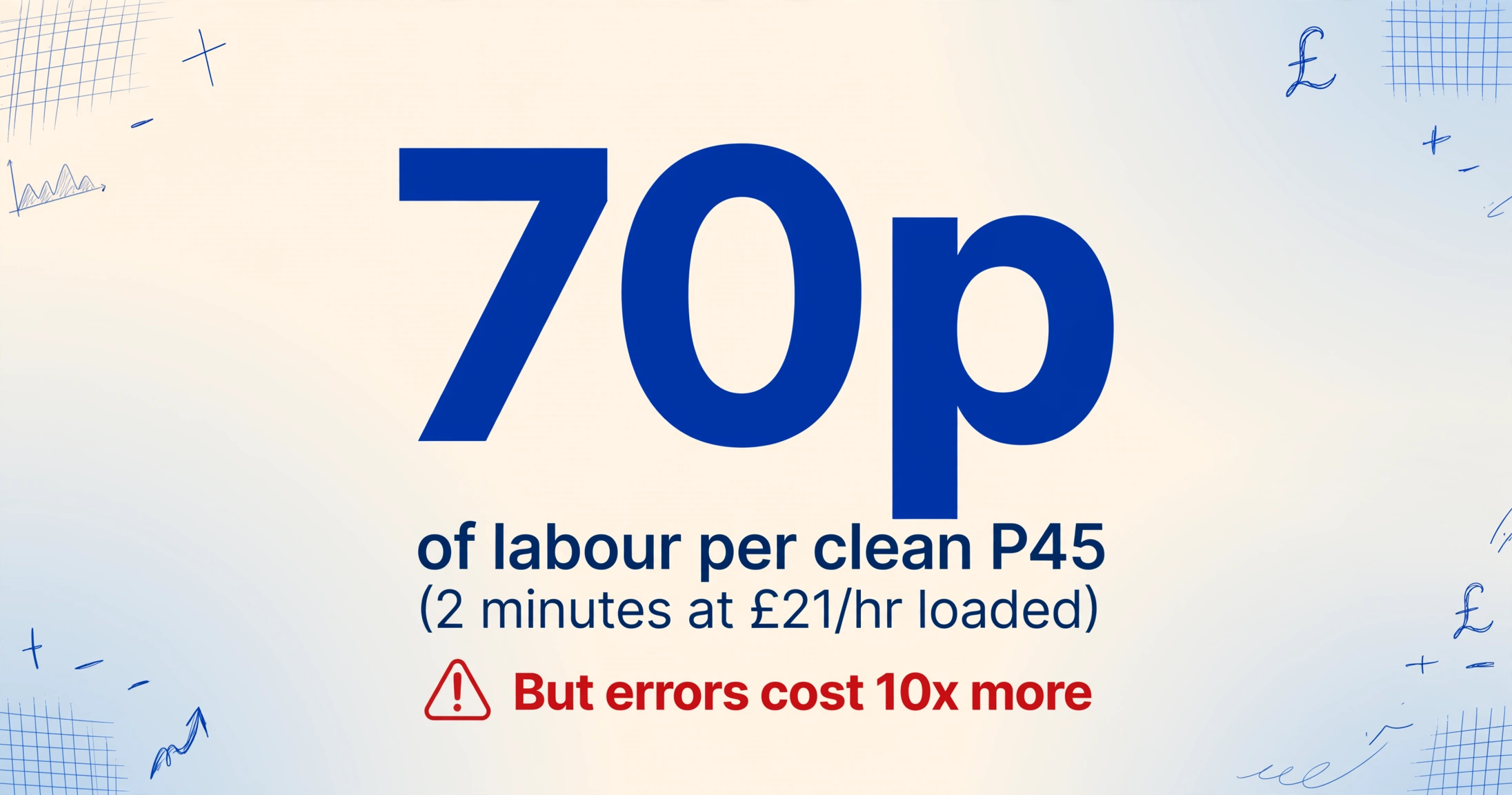
Price the labour honestly with two inputs. The rate: a UK payroll administrator earned £27,000 to £33,000 in Robert Half's 2026 salary guide, a median near £29,750 gross. Gross is not employer cost — add employer's Class 1 National Insurance at 15% on earnings above the £5,000 secondary threshold (the rate in force since April 2025 and frozen through 2027/28), plus auto-enrolment pension, and spread it across roughly 1,700 effective working hours a year, and the loaded cost lands near £21 per hour. The time: transcribing the five fields a new-starter setup needs, then glancing back to verify, takes about two minutes per P45 when the certificate is clean — three or four when it is a faint photocopy or the student loan position needs cross-checking.
Two minutes at £21 an hour is about 70 pence of labour. That is why nobody costs it. But labour is only the first of four things a received P45 can cost, and it is the smallest. The others begin the instant a keystroke is wrong.
Manual data entry has a measurable error rate: field-level accuracy for trained operators sits near 1% under good conditions and rises to 3–4% under time pressure and mixed document quality. Across the five fields a P45 setup touches, a 1% per-field rate gives roughly a 5% chance a given record carries at least one error; at 4%, that chance is closer to one in five. The field that matters most is the tax code, because it is short, it looks like noise, and it is applied immediately. A tax code entered as 1275L instead of 1257L — two digits transposed — silently changes the employee's tax-free allowance and will not announce itself until the payslip is wrong. (A standard 2025/26 code of 1257L signals the full £12,570 personal allowance; the letter and the number both carry meaning.)
The Emergency-Tax Cascade: One Wrong Digit, Three Desks
A mistyped or missing P45 figure does not stay a payroll problem — it becomes the employee's problem, then HMRC's, then yours again. This is the cost line unique to the P45, and it is the reason the receive side dwarfs the issue side. When the correct prior-pay and tax-code information does not reach your payroll — because the P45 was late, lost, or keyed in wrong — HMRC's rules leave your software no choice but to apply an emergency tax code. An emergency code is one ending in W1, M1, X or NONCUM, and it taxes the employee "based on what you're paid in that week or month only," ignoring everything earned and taxed earlier in the year.
Follow the money to see who pays. On a £30,000 salary, a non-cumulative W1/M1 code can withhold noticeably more in the first affected month than the correct cumulative code — the employee is temporarily overtaxed by a meaningful chunk of a month's take-home while the reliefs they are owed are held back. That overpayment is eventually refunded once HMRC updates the record through RTI, but the friction in between lands on three separate desks:
- The employee's desk. A first payslip that is hundreds of pounds light. On Reddit's r/UKPersonalFinance, one new starter described being "taxed over 50% on first paycheck," then discovering after phoning HMRC that "our payroll did submit wrong P45 details, which caused the overtaxing issue." The over-tax was real; the cause was a transcription error upstream.
- Your payroll desk. The complaint comes to you first. Someone has to field it, re-check the P45 against what was entered, correct the record, and — where no valid P45 arrived at all — capture the details on HMRC's Starter Checklist (the process that replaced the old P46) to set the starter declaration. That is 20 to 30 minutes of unbillable time per incident, spent reassuring an anxious new hire rather than on payroll's actual work.
- HMRC's desk. The correction loop runs through HMRC's systems, and until the record is fixed the employee "stays on the emergency tax code until they've paid the correct tax for the year."
None of this appears on an invoice. It is absorbed as "just how onboarding goes" — which is another way of saying nobody has costed it. And unlike the labour line, this cost does not shrink as your team gets faster at typing. It shrinks only when the wrong figure stops being entered in the first place.
The Penalty and Records Exposure
The most expensive P45 error is the one no one notices, because it converts into an HMRC penalty years later. Two exposures sit behind a mistyped certificate, and both are probabilistic rather than certain — which is exactly why they get left out of the cost conversation.
Records. The £3,000 records penalty is not a fine for getting a number wrong — it is a fine for being unable to prove the number was right. When an inspector asks you to substantiate a figure and the only evidence is a cell someone typed into a spreadsheet with no audit trail back to the source P45, HMRC can treat the records as inadequate. A wrong National Insurance number is the classic case: entered once in the format QQ 12 34 56 C, transposed by two characters, it can sit in a payroll archive undetected for years, misattributing contributions until an inspection surfaces it.
Inaccuracy. Where a wrong P45 figure flows into a filing that understates tax, Schedule 24 of the Finance Act 2007 applies a penalty that is a percentage of the potential lost revenue, not a flat fee. A careless inaccuracy — the category a transcription error falls into — carries 30% of the lost revenue; deliberate is 70%, deliberate and concealed 100%. HMRC's own CC/FS7A factsheet confirms it will not charge a penalty where you took reasonable care — but a spreadsheet with no verification step is a hard place to demonstrate reasonable care after the fact.
The correct way to include these in the model is probabilistically: multiply the exposure by the likelihood that manual entry triggers it, across your headcount and multiple tax years. The number is small in any single year and uncomfortable in aggregate — which is the defining property of a cost that never gets measured.
From One Leaver to a Year: Scaling the Bill
The per-event cost looks trivial; the per-year cost does not, because P45s are a high-frequency event that recurs with every hire and every departure all year round. This is what separates the P45 from the P60, whose cost lands in a single May batch — the companion framework for what manual P60 processing costs UK employers each tax year models that annual spike. The P45 bill instead accrues continuously, indexed to your staff turnover.
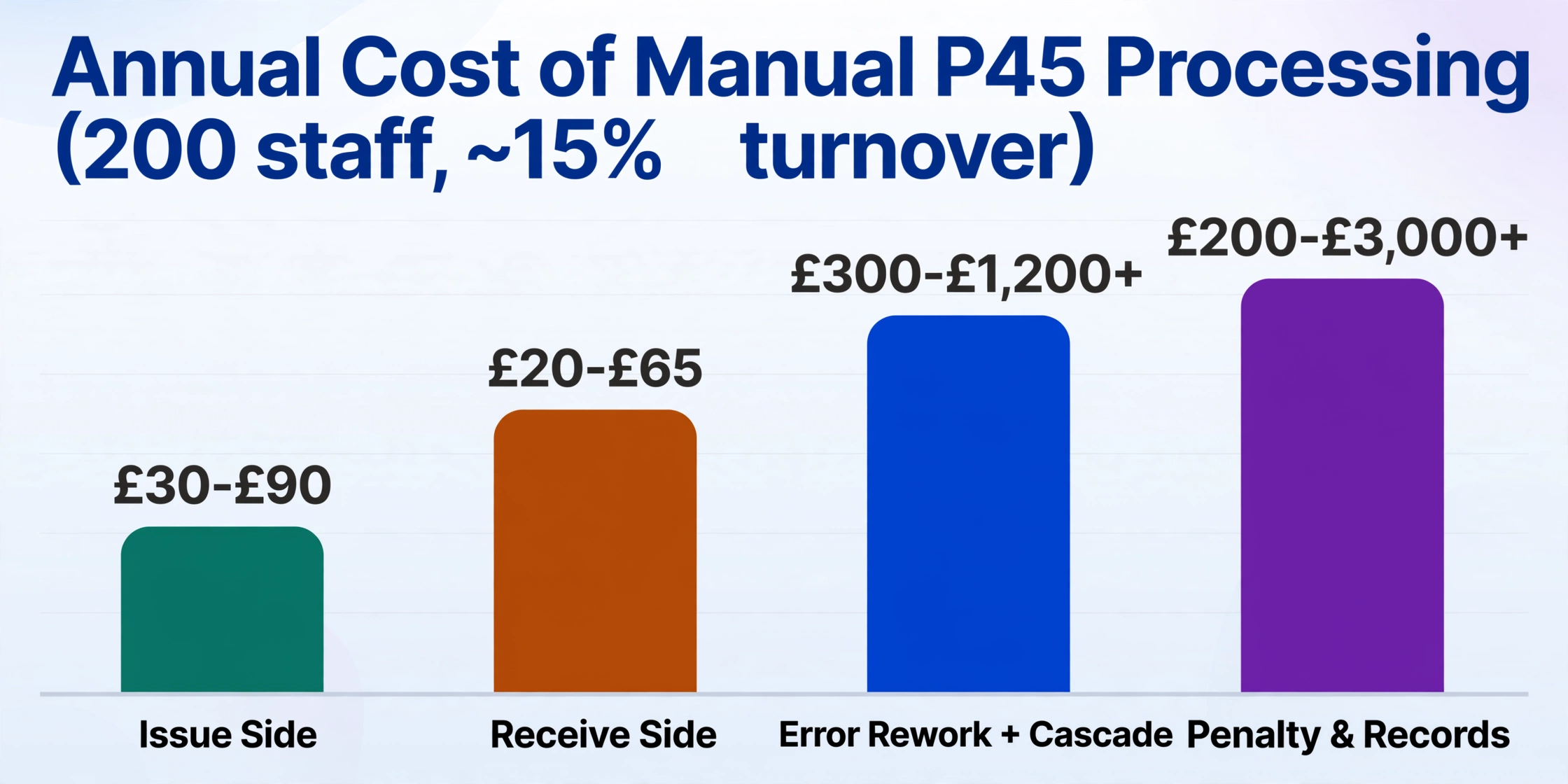
The CIPD puts average UK turnover — the "churn" rate of workers changing or leaving employers — at around 34% across 2022–2023, and its Spring 2025 employer survey placed the average annual figure near 15%, with wide industry variation: roughly 25% in public administration up to over 50% in hospitality. Take a stable 200-person company at the 15% average. That is about 30 leavers a year — 30 P45s issued — and, as those roles are refilled, roughly 30 new starters arriving with P45s to be read in. Call it 60 P45 touchpoints a year, split across the two bills.
| Cost Line | Annual Total (200 staff, ~15% turnover) | Calculation Basis |
|---|---|---|
| Labour — issue side | £30–£90 | ~30 leavers × software-generated + a few minutes' distribution/correction × £21/hr loaded |
| Labour — receive side | £20–£65 | ~30 starters × 2–4 min transcription × £21/hr loaded |
| Error rework + emergency-tax cascade | £300–£1,200+ | 5–20% of received P45s carry an error → 1.5–6 incidents × ~25 min correction + employee/HMRC resolution time (unbillable) |
| Penalty & records exposure | £200–£3,000+ | Schedule 24 careless inaccuracy (30% of lost revenue) + up to £3,000 records penalty, prorated by probability across tax years |
| Total — 200 staff | £550–£4,300+ | Probability-weighted annual cost of the manual P45 step |
The spread is wide on purpose, and the shape of it is the point: the two labour lines — the only ones anyone ever thinks about — are the two smallest. To build your own figure, substitute into four expressions:
- Issue labour = leavers per year × minutes per certificate ÷ 60 × your loaded hourly rate
- Receive labour = new starters per year × minutes per P45 ÷ 60 × your loaded hourly rate
- Error + cascade = received P45s × your record-level error rate × (correction time + expected employee/HMRC resolution cost)
- Penalty exposure = inaccuracy and records exposure × the probability manual entry triggers it, summed across tax years
A payroll bureau reconciling starters across several client payrolls multiplies the receive side by every client at once, which is why bureaux feel this cost first. For the batch version of that workflow — many leavers into one exit database — see how to batch-process monthly P45 leaver forms into an employee database. Whatever your number, it is driven by the error line, and the error line is driven by one operation: a person reading a figure off a certificate and typing it into a cell.
Where Extraction Changes the Arithmetic
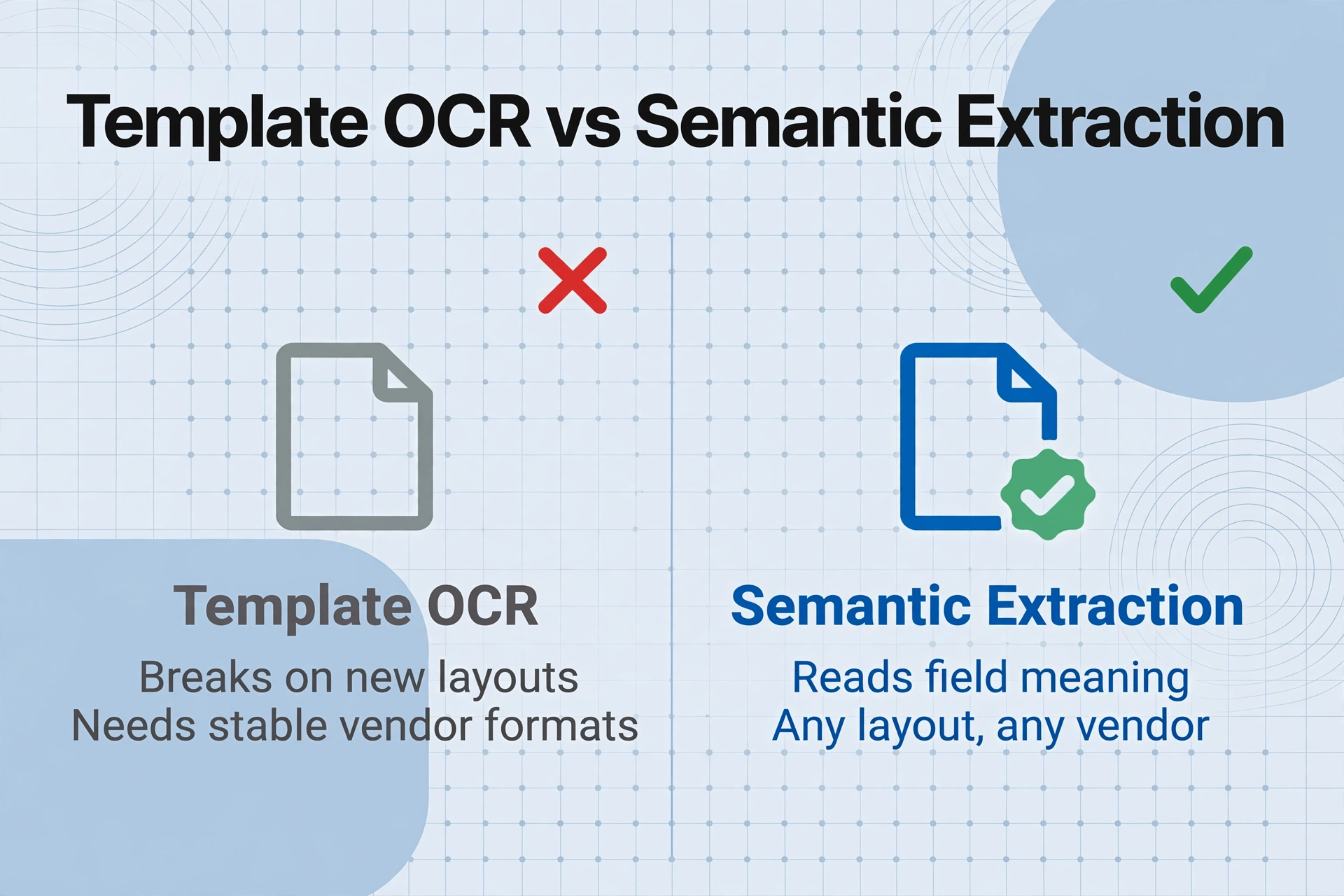
Remove the retyping and all four cost lines move at once. That is what a document-extraction tool does, and it is worth being precise about how, because the mechanism is different from the payroll software you already run. Payroll software is built to generate P45s from its own database; it cannot read a P45 that originated in someone else's system — a previous employer, a different provider, a scanned paper form. An extraction tool works the opposite way: it reads the certificate you were handed.
Rather than matching fixed positions on a page — the approach template-based tools take, which breaks the moment a different payroll system lays the P45 out differently — semantic extraction reads what each field means. This is Custom Column Extraction: you type the column names you want once — "Tax Code," "Total Pay to Date," "Total Tax to Date," "NI Number," "Student Loan" — and the AI locates each value on every P45 in the batch by understanding the label, whether the form came from Sage, BrightPay, Xero or a handwritten HMRC-ordered template. The columns you define become the headers of your spreadsheet; the source layout does not matter. The step-by-step version, from upload to one clean row per new starter, is in the guide to extracting UK P45 leaver data into Excel for payroll.
The lever that attacks the error line directly is the computed column — a column whose value the AI calculates during extraction rather than reads off the page. Define a check such as "flag if Tax Code is not a valid HMRC format" and the tool surfaces a transposed code before it reaches payroll, turning verification from a full re-read into a glance at one column. The same extraction logic applied to routine wage documents is covered in the pay stub to Excel use case.
Files are processed securely and not stored.
The gathering step has its own cost the model quietly assumes away — chasing new starters for the P45 their last employer was slow to issue. A Collection Link addresses it: you generate a shareable link, send it to the new hire, and they upload their P45 directly into your processing queue after entering a short verification code, with no account to create. It closes the "waiting for the file" gap that is the single most common reason a starter ends up on an emergency code in the first place.
At roughly ten seconds of processing per document versus two to four minutes of typing, extraction does not shave the labour line — it removes it, leaving a verification glance. And because the AI reads labels rather than relying on keyboard accuracy, the error rate that drives the cascade and the penalty exposure falls to the automated floor. The arithmetic that made manual P45 handling look free was never wrong about the labour. It was wrong about which line mattered.
FAQ — UK P45 Processing Cost
Can't my payroll software just import a new starter's P45 automatically?
Only for the RTI data HMRC sends you after registration, and only once the starter is set up — which requires the P45 figures to be entered first. Your software generates P45s for your own leavers, but it cannot read a P45 produced by a different employer's system. That inbound certificate is a PDF or a piece of paper, and getting its figures into your new-starter record is the manual step this framework prices. Extraction fills that specific gap.
What actually happens if a P45 tax code is entered wrong?
The employee is taxed on the wrong figure from their first payslip at the new job. If the error means their prior pay and tax cannot be carried forward correctly, HMRC's rules apply an emergency tax code — one ending in W1, M1, X or NONCUM — which taxes them on that period's pay alone and usually overtaxes them temporarily. The overpayment is refunded once HMRC updates the record through RTI, but the correction consumes payroll time and generates a direct complaint from the new hire.
Is there a fine specifically for getting a P45 wrong?
Not a single named P45 fine, but two exposures attach to it. HMRC can charge a penalty of up to £3,000 for failing to keep adequate payroll records, and under Schedule 24 of the Finance Act 2007 a careless inaccuracy that understates tax carries a penalty of 30% of the potential lost revenue. Both are probabilistic — they surface on inspection or when a wrong figure flows into a filing — which is why they belong in a cost model weighted by likelihood, not treated as certainties.
How much does manual P45 processing cost per employee?
The visible labour is tiny — about two to four minutes per received P45, or roughly 70p to £1.40 at a £21 loaded hourly rate for a UK payroll administrator. The real per-employee cost only appears when a certificate carries an error: at a 5–20% record-level error rate, one in five to one in twenty new starters triggers correction labour, an emergency-tax complaint, and potential penalty exposure that together run to tens of pounds per affected hire — and occasionally far more if a wrong figure reaches a tax filing.
Can AI read P45s from different payroll providers without setup?
Largely, yes. The P45 follows an HMRC-prescribed data set, so the variation between a Sage, BrightPay or Xero certificate is cosmetic — fonts, positions, logos — rather than structural. Semantic extraction reads the field labels, so it treats "Total pay to date" on one layout and "Pay to date" on another as the same value, with no per-provider configuration. The honest limit: heavily degraded photocopies, handwritten amendments, and non-standard templates reduce accuracy, so the realistic gain is eliminating the bulk of the typing and its error rate, not every edge case.
We only have a few leavers a year — is this cost even worth measuring?
For a small, low-turnover employer the annual labour is genuinely negligible, and honesty matters here: if you process five P45s a year cleanly, automation saves you minutes. The case strengthens with turnover and with the error tail — a bureau reconciling starters across many client payrolls, a hospitality or retail employer at 30–50% turnover, or any team where one wrong tax code a year already generates a complaint and an HMRC call. Run your own numbers through the four expressions above; if the error line stays near zero, manual entry is fine.
The cost of manual P45 processing was never the two minutes of typing. It is the wrong digit that rides forward into someone's tax code, the complaint it triggers, and the HMRC exposure it leaves behind — repeated with every hire and every leaver, all year. Put your own numbers through the four lines, then see whether reading the certificate instead of retyping it changes the total.
Extract a P45 and Check the Figures