The Real Cost of Manual 確定申告 Data Assembly
Is Not the Tax Accountant's Fee
A Japanese freelancer paying a tax accountant (税理士, zeirishi) ¥80,000 to file a 確定申告 (kakutei shinkoku, final tax return) sees one number on the invoice and assumes that is what the annual ritual costs. The real cost never appears on any invoice: it is the two to three weeks every February spent locating a bank passbook (通帳, tsūchō), sorting a year of thermal-paper receipts, collecting insurance deduction certificates (控除証明書) from December mail, cross-referencing last year's return for prepaid tax figures (予定納税額), and typing every number into a form whose 40-plus fields span three sheets — a data assembly phase that no accountant removes and no accounting app automates, priced at whatever your freelance hour is actually worth. This article separates the visible fee from the invisible labour and gives you a framework to produce your own number instead of treating the weeks before March 15 as free.
Key Takeaways
- The ¥80,000 you pay a 税理士 for 確定申告 filing is rarely the largest number on the bill — at fourteen hours of passbook reconciliation, receipt sorting, and certificate transcription priced at ¥3,500 an hour, your own assembly labour adds ¥49,000 that no accountant's fee was priced to cover.
- The most expensive item on a freelance 確定申告 is never the accounting — a single miscategorised passbook entry collapses the ¥650,000 blue return deduction to ¥100,000, creating a ¥165,000 tax swing from a transcription error that manual data entry produces at a one-in-three probability across Form B's 40-plus fields.
- Every yen of assembly cost traces back to reading figures off physical documents by eye, which means the mechanism that collapses all three cost lines at once is AI locating each field by what it means — 収入金額 is 収入金額 whether it sits on line 15 of a freee PDF or line 14 of a Yayoi printout.
The Tax Accountant's Fee Is the Visible Cost — Not the Whole One
Start with the costs that appear on an invoice, because they anchor the calculation. For the 2026 filing season — covering income earned in 2025 — a Japanese freelancer (個人事業主, kojin jigyō nushi) filing a 確定申告 has two main ways to get the return done, and each comes with a published price.
A local tax accountant (税理士) handling a sole proprietor return with one or two income streams typically charges ¥50,000 to ¥150,000 for the annual filing, according to the Japanese Federation of Certified Public Tax Accountants' fifth Fact-Finding Survey. Boutique firms serving freelancers with overseas income or multiple revenue sources range from ¥150,000 to ¥300,000. For freelancers who want ongoing support, a monthly advisory contract (顧問契約, komon keiyaku) — which includes both monthly bookkeeping and year-end filing — costs ¥20,000 to ¥50,000 per month, or ¥240,000 to ¥600,000 per year. Accounting software — freee, 弥生 (Yayoi), or MoneyForward Cloud (マネーフォワード クラウド) — costs roughly ¥12,000 to ¥13,000 per year for the sole proprietor tier, or about ¥1,000 a month.
Those are real numbers, and none of them is the subject of this article. The trap is treating the smallest of them — or even the largest — as the total cost of the 確定申告 process. A tax accountant prices the filing: checking the figures, applying the deductions, submitting the return via e-Tax. They do not price the assembly, because they never do the assembly. You do. A good accountant will hand you a checklist and wait: bank passbook pages for every account, receipts categorised by expense type, insurance deduction certificates (生命保険料控除証明書, 地震保険料控除証明書), National Pension (国民年金) and National Health Insurance (国民健康保険) payment records, iDeCo (イデコ) contribution statements, and last year's return for carried-forward figures. Gathering those from four separate physical sources, reconciling the numbers, and typing them into whatever form or software the accountant needs — that is the labour the 確定申告 actually demands, and it lands on you whether you file yourself or pay someone to submit what you assembled.
Every time you open a passbook page to tally twelve months of business deposits by hand, or sort a shoebox of receipts into expense categories, you are paying a cost the accountant's fee was priced not to cover — and that cost recurs every February, year after year, regardless of how much you pay for the filing.
Three Costs Hiding Behind One Annual Ritual
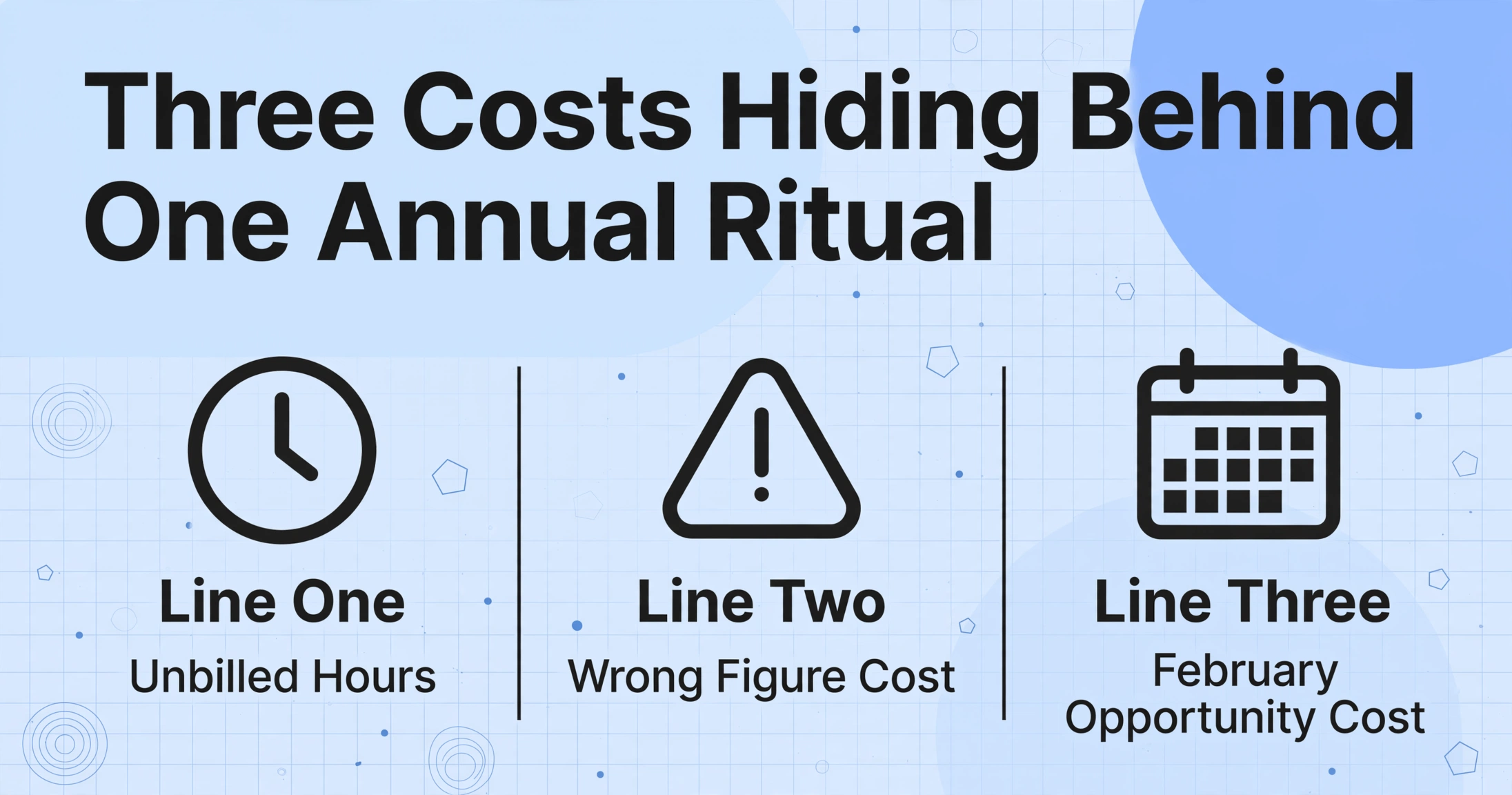
Whether you do the full return yourself or hand assembled figures to a tax accountant, the cost of manual 確定申告 assembly splits into three lines that behave differently and have to be added separately. Treating them as one blur of "確定申告が面倒 (the tax return is a pain)" is exactly why the figure never gets calculated.
- Line One — the hours you never bill. Time spent locating passbook (通帳) pages, sorting receipts, collecting insurance certificates, cross-referencing last year's return, typing every figure into accounting software or the NTA Preparation Corner (確定申告書等作成コーナー), and reconciling totals. Priced at what an hour of your freelance time is actually worth.
- Line Two — the cost of a wrong figure. The penalty and interest exposure attached to a mistyped deduction or miscategorised income, weighted by how likely manual transcription is to produce one — plus the risk that a miscategorised entry breaks your double-entry bookkeeping and drops your blue return (青色申告) deduction from ¥650,000 to ¥100,000.
- Line Three — the February opportunity cost. The billable client work you displace when four weeks of tax assembly collide with your regular workload, plus the 青色申告-白色申告 gap — the structural cost of filing white return (白色申告) to avoid the bookkeeping burden of blue (青色申告), which forfeits ¥550,000 in deductions.
To keep the arithmetic concrete, we will run a single example throughout: a freelance web developer in Tokyo earning ¥5 million in annual revenue from two to three regular clients, with roughly 150 transactions across two bank accounts, about 100 receipts per year, and five insurance and deduction certificates arriving by mail across December and January — filing a blue return (青色申告) with double-entry books and e-Tax submission. Substitute your own figures at each step; the formulas at the end let you rebuild the whole thing for your situation.
Line One — The Hours Spent Assembling Four Document Stacks Into One Return
The reason freelancers treat their own tax-prep time as free is that no invoice arrives for it. But an hour spent gathering and reconciling source documents is an hour not spent on client work, and that hour has a market price. Japanese freelance rates vary by industry, but a mid-market developer, designer, or consultant billing by the hour commands ¥3,000 to ¥5,000. Even at the low end of professional services — ¥3,000 an hour — the time invested in tax assembly is not negligible. At the lower bound of bookkeeping labour — ¥1,500 to ¥2,500 per hour for dispatch 経理 staff — the hours still add up to a meaningful annual cost that no one budgets for.
The time itself is not the twenty minutes it takes to type figures into freee's tax module once everything is clean. It is the process beforehand, which breaks into four distinct phases corresponding to the four physical document streams:
- Passbook (通帳) reconciliation. Locating the passbook — or passbooks, for freelancers with separate business and personal accounts — flipping to the right pages, identifying which deposits are business revenue versus personal transfers or tax refunds, cross-referencing deposits against issued invoices (請求書), and tallying twelve months of business income by hand. For a freelancer with two accounts and 150 transactions per year, this alone takes two to four hours concentrated in the weeks before filing — more if the passbook has sat unrecorded since April.
- Receipt sorting and categorisation. A year of business receipts — train tickets, software subscriptions, client meeting meals, equipment purchases — stored in a drawer, an envelope, or a folder that has not been opened since January. Each receipt must be sorted by expense category (勘定科目, kanjō kamoku), its consumption tax rate identified (8% or 10% under the Invoice System, インボイス制度), and the total per category summed. Thermal-paper receipts from convenience stores have faded. Mixed-rate receipts — a bento box (8%) and a notebook (10%) on the same strip — require manual splitting. At 100 receipts, this is three to five hours of sorting, reading, and categorising — often done in a single weekend in February.
- Insurance and deduction certificate transcription. Five to seven certificates arrive by postal mail across December and January: National Pension (国民年金) payment certificate, National Health Insurance (国民健康保険) premium statement, life insurance deduction certificate (生命保険料控除証明書), earthquake insurance certificate (地震保険料控除証明書), iDeCo contribution statement. Each certificate uses a different layout from a different issuer, and each number — the payment amount (支払金額), not the deduction amount (控除額), which may differ — must be transcribed into the correct line on Form B (B様式). At two to three minutes per certificate including verification, this is roughly one to two hours.
- Entry and reconciliation. Typing all gathered figures into accounting software or the NTA Preparation Corner (確定申告書等作成コーナー), verifying that deduction totals match the printed sum on Sheet 1 — seven deduction lines each with a source document, each with a specific row number — and checking that the income total on the income statement (収支内訳書 or 青色申告決算書) reconciles with the amounts carried onto Form B. Three to five hours, and more if the freelancer discovers in February that their double-entry ledger does not balance.
At fourteen hours of assembly — the midpoint for a freelancer with moderate complexity — and a ¥3,500 hourly rate, the data assembly step alone costs roughly ¥49,000 each tax year. At the upper end, twenty hours at ¥5,000 per hour reaches ¥100,000 — matching or exceeding what a local tax accountant charges for the entire filing. This is Line One, and for most freelancers it already equals or exceeds the only number they thought was the whole cost.
Notice what this does to the "should I hire a tax accountant?" question that dominates every freelancer forum. The discussion on r/JapanFinance and Yahoo 知恵袋 frames the choice as a ¥50,000 to ¥150,000 fee versus zero — the impression being that doing it yourself costs nothing. But when you include Line One at freelance billing rates, the DIY route costs ¥49,000 to ¥100,000 in displaced labour — roughly the same as the accountant's fee, before counting the error risk that professional review reduces. The comparison is fee-versus-your-hours, and your hours at freelance rates win that comparison in one direction only: toward reducing the manual step.
Line Two — What a Wrong Figure Costs in Japan's Penalty and Interest System
Manual transcription has a measurable error rate, and on a tax return an error is not a cosmetic problem — it is a compliance exposure with a published price list published by the National Tax Agency (国税庁, NTA). The exposure has three layers, and most freelancers only picture the first.
Late filing (無申告加算税). Miss the March 15 deadline — March 16 in 2026, since the 15th falls on a Sunday — and the NTA applies a penalty of 5% to 20% of the tax owed under the National Tax Violation Act (国税通則法). A voluntary late filing before the NTA initiates an audit attracts the lower 5% rate; filing after an audit notice pushes it to 15–20%. Separate from the penalty, delinquency tax (延滞税, entai zei) accrues daily starting the day after the deadline, per NTA Tax Answer No.9205. For the period covered by income earned in 2025 and filed in 2026, the rate is 2.4% per annum for the first two months past the due date, rising to 8.7% per annum thereafter. A freelancer who files three months late on ¥200,000 of unpaid tax owes roughly ¥4,800 in delinquency interest — on top of the late-filing penalty — and the clock runs from the day after the deadline, not the day the tax office notices.
Understatement (過少申告加算税). If the NTA determines that a filed return understated tax due, an additional penalty of 10% to 15% of the understated amount applies. A transcription slip — entering ¥4,200,000 as business income instead of ¥3,900,000 after failing to exclude a ¥300,000 personal transfer — creates an overstatement that drives a higher tax calculation. The ¥300,000 difference at a 20% marginal rate produces ¥60,000 in overpaid tax; at a 30% marginal rate plus 10% resident tax, ¥120,000. The overpayment itself is eventually recoverable through a corrective filing, but the cash is gone in the interim — and the preparatory tax installments (予定納税) for the following year, calculated automatically from the inflated return under Income Tax Act Article 107 (所得税法第107条), will also be inflated. One mistyped figure in February 2026 cascades into an overpayment in March, an inflated prepaid demand in July, and a corrective filing cycle that can stretch into the following year.
The blue return deduction gap. The most expensive transcription error is the one that does not change a tax calculation directly but breaks the record-keeping standard that supports the largest deduction on the form. A blue return (青色申告) with proper double-entry books (複式簿記) and e-Tax filing entitles the filer to a ¥650,000 deduction from taxable income under the Special Taxation Measures Act Article 25-2 (租税特別措置法第25条の2). If the double-entry structure breaks — for instance, because a miscategorised passbook entry debited 売上 (sales) instead of 事業主借 (owner's loan) and the general ledger no longer balances — the deduction collapses to ¥100,000 for simplified bookkeeping (簡易簿記). The gap is ¥550,000 of extra taxable income. At a 20% income tax bracket plus approximately 10% resident tax (住民税), that is roughly ¥165,000 in additional tax — more than twice the accountant's fee. The NTA's official guidance on No.2072 lays out the tiered requirements. From 2027 (令和9年分), the top tier rises to ¥750,000 for e-Tax filers with excellent electronic records (優良な電子帳簿), while paper filing drops to ¥100,000 — making the gap between getting it right and getting it wrong ¥650,000, not ¥550,000.
A miscategorised passbook entry does not destroy the blue return on its own. But across a year of manual transcription — 150 transactions categorised by hand, 100 receipts sorted by expense type, seven deduction lines transcribed from seven certificates — the probability that enough entries are misclassified to call the records into question is not zero. And the stakes are a ¥165,000 swing in tax paid. This is Line Two, and it is the line that never appears in the fee-versus-free calculation because it is probabilistic — but across the years you will file, a non-trivial expected cost sits on this line.
The mechanism by which manual assembly produces these errors is explored in detail in the companion article on why Japanese freelancers still hand-enter 確定申告 data every February. Research on manual data entry accuracy consistently finds error rates of 1–3% per field. At 40 fields per return, a 1% per-field error rate gives a 33% probability that at least one field contains a mistake — and each mistake triggers the compounding penalty cycle described above.
Line Three — The February Opportunity Cost: Client Work Lost to Tax Assembly
Line One prices the hours the 確定申告 consumes. Line Three prices when it consumes them. The individual income tax filing window — February 16 to March 15 — is fixed by statute, and for most freelancers the assembly work is compressed into the four weeks leading up to it. February is rarely a quiet month: new-year client projects kick off, invoices from December and January need chasing, and the tax assembly sits on top of a full workload. Every hour spent reconciling a passbook in February is an hour not spent on billable work — and those are the hours when billable work is most available.
The structural dimension of Line Three is the 青色申告 versus 白色申告 (white return) choice. A freelancer who cannot maintain double-entry books — or who discovers in February that they did not maintain them — faces a decision: spend days reconstructing the ledger, or file a white return (白色申告). The white return requires only simplified bookkeeping (単式簿記) — a simple list of income and expenses — but forfeits the ¥650,000 blue return deduction entirely, replacing it with a ¥100,000 deduction. The gap, as calculated above, is roughly ¥165,000 in extra tax at the 20% bracket. A freelancer who files white to avoid the bookkeeping burden is paying ¥165,000 to avoid work that extraction can collapse to minutes — but the cost of the white-return choice is rarely calculated in advance because it arrives as a February crisis, not a January budget item.
There is a third cost here that resists a spreadsheet but is real enough that every freelancer forum names it repeatedly: the cognitive tax of carrying an unfinished 確定申告 for weeks. The low-grade dread, the weekend lost to receipt sorting, the arithmetic running in the background while you try to work. It does not belong in the numeric total, but leaving it out entirely understates what the manual process actually takes.
Your Own Final Tax Return (確定申告) Assembly Cost, in Four Expressions
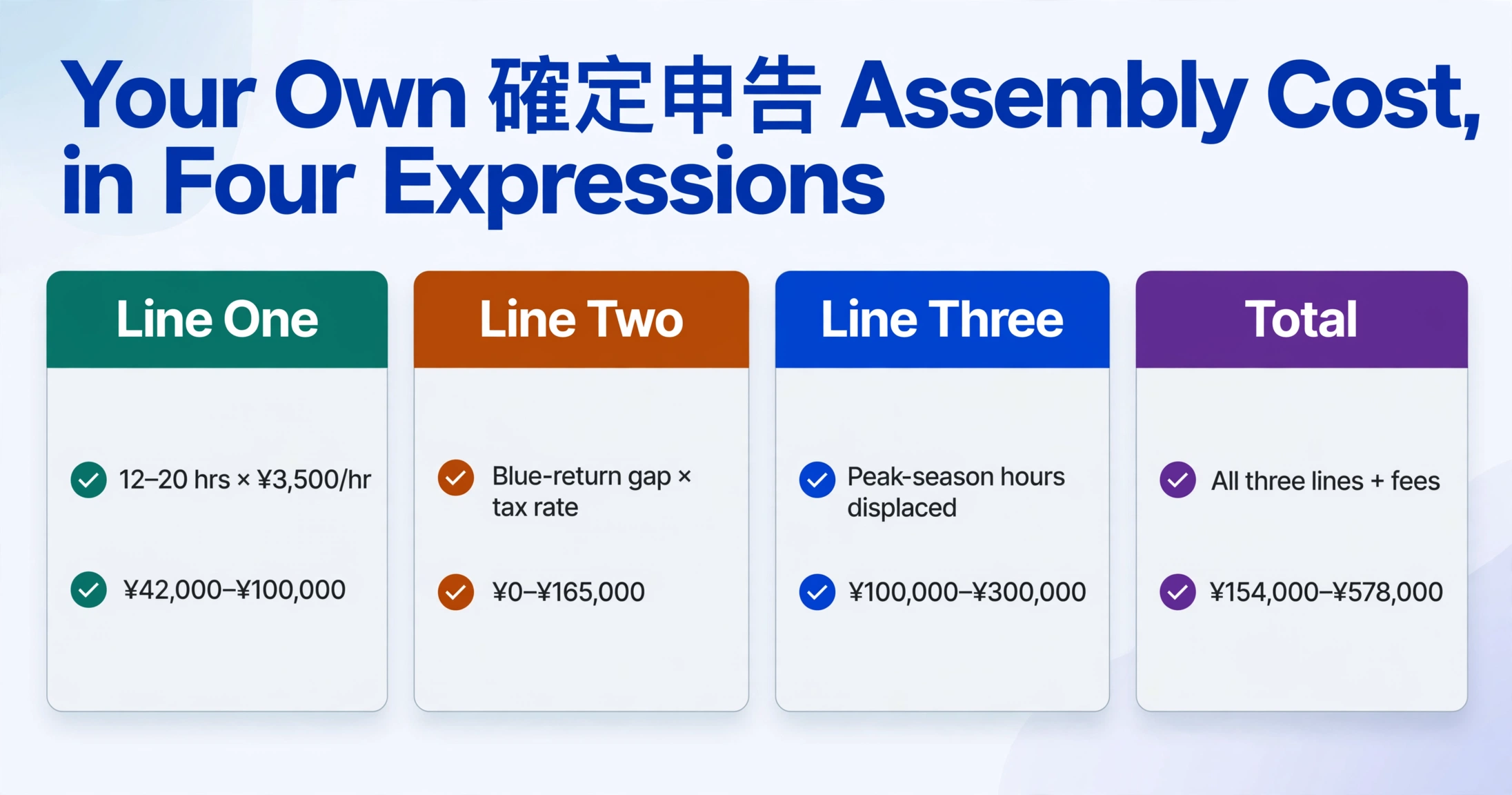
With the three lines separated, the total cost of manual 確定申告 data assembly becomes a function of your own situation rather than an industry average. Here is the tally for the running example — the Tokyo freelancer with ¥5 million in revenue, two bank accounts, 150 transactions, 100 receipts, and a blue return filing:
| Cost Line | Annual Total (example) | Calculation Basis |
|---|---|---|
| Tax accountant fee (if used) | ¥50,000–¥150,000 | Sole proprietor return with 2–3 income sources, local 税理士 |
| Accounting software subscription | ¥12,000–¥13,000 | freee/MoneyForward/Yayoi sole proprietor tier, annual |
| Line One — assembly hours | ¥42,000–¥100,000 | 12–20 hrs gathering & reconciling × ¥3,500/hr freelance rate |
| Line Two — error exposure | ¥0–¥165,000 | ¥550,000 blue-return deduction gap × (20% income tax + ~10% resident tax), probability-weighted |
| Line Three — Feb-Mar opportunity cost | ¥100,000–¥300,000 | Peak-season hours displaced from billable work, valued at or above the normal hourly rate |
| Total per tax year | ¥154,000–¥578,000 | Probability-weighted true cost of manual 確定申告 data assembly |
The striking result is that the tax accountant's fee — the only line most freelancers ever count — is rarely the largest one. To build your own figure, substitute into four expressions:
- Line One = hours spent gathering passbook data, sorting receipts, transcribing certificates, and reconciling totals × your hourly billing rate
- Line Two = (late-filing penalty risk + expected understatement penalty + ¥550,000 blue-return deduction gap × your marginal tax rate × probability your records break) + delinquency interest exposure
- Line Three = peak-month hours displaced from billable work × the premium value of your time in the busiest weeks + cost of forfeiting blue return to file white
- Tax accountant fee = the quoted price, which removes the filing labour and some of Line Two's error risk, but not Line One or Line Three
Run those numbers and the DIY-versus-accountant debate reframes itself. The question is not "is ¥80,000 worth it for someone else to file my return?" It is "which of these lines does each option actually reduce?" An accountant reduces the filing labour and, through professional review, a portion of Line Two. Neither an accountant nor an accounting software subscription touches Line One — until you change the mechanism by which the assembly happens.
Where Extraction Changes the Arithmetic
Every one of the three cost lines traces back to the same root operation: a person reading a figure off a physical document and typing it somewhere else. Line One is that operation repeated across four document stacks — the passbook, the receipts, the certificates, the previous return — compressed into a four-week window. Line Two is what happens when one of those typed figures lands in the wrong field or the wrong expense category. Line Three is the same operation done under time pressure, displacing the client work that pays your bills. Remove the manual reading-and-typing and all three lines move at once. That is what document data extraction does, and the value is concentrated on the assembly side — not in filing your 確定申告, which no extraction tool does, but in turning the four source-document stacks into structured data your accounting software or tax accountant can work with immediately.
The mechanism is Custom Column Extraction: you type the column names you want once, and the AI reads every document and locates the values by understanding what the labels mean — 収入金額 (revenue), 必要経費 (necessary expenses), 社会保険料控除 (social insurance deduction) — regardless of whether the document is a freee-generated PDF, a Yayoi printout with different font spacing, or a scanned paper return from 2022. The step-by-step workflow for a single return is covered in the guide to extracting 確定申告 Form B data to Excel. For a tax accountant office processing multiple client returns, the guide to batch-processing 50 client tax returns into one summary spreadsheet covers the same approach scaled across a season's worth of filings.
Two features attack Line One and Line Two directly. An inferred column is one whose value the AI works out rather than reads: add a column named Expense Category (options: 旅費交通費/消耗品費/通信費/接待交際費/減価償却費/その他経費) and the tool assigns each receipt to its correct 勘定科目 — a categorisation step that took an afternoon of sorting becomes a verification pass. A computed column then does the arithmetic: define a column that sums the individual deduction fields and compares the total to the printed deduction total on Sheet 1, outputting "OK" or "CHECK" — catching the most common error class, deduction arithmetic mismatches, before the return reaches the tax office. The same approach that makes manual processing quietly expensive for Japanese small business owners transcribing passbook data and for UK freelancers collating SA100 returns applies here — the visible typing was never the real cost.
Files are processed securely and not stored.
At roughly ten seconds of processing per document versus the minutes of reading, categorising, typing, and cross-checking by hand, extraction does not shave Line One — it collapses the assembly phase toward a verification glance. And because the AI reads field labels by their meaning — 社会保険料控除 is 社会保険料控除 whether it appears on line 21 of a freee PDF or line 20 of a Yayoi printout — the transcription error rate that drives Line Two falls with it. The freelancer who used to spend February typing numbers from a passbook spends February reviewing an assembled return and finding deductions worth far more than the hours they cost.
FAQ — The Cost of Manual Final Tax Return (確定申告) Data Assembly in Japan
How much does a tax accountant (税理士) charge to file a 確定申告 in Japan?
For a sole proprietor with one or two income sources, a local tax accountant typically charges ¥50,000 to ¥150,000 for the annual filing. Freelancers with overseas income, multiple revenue streams, or complex deductions may pay ¥150,000 to ¥300,000 at boutique firms. A monthly advisory contract (顧問契約) that includes ongoing bookkeeping and year-end filing costs ¥20,000 to ¥50,000 per month. The fee covers checking the figures, applying deductions, and submitting via e-Tax — not gathering and reconciling your source documents, which you still do. The earlier you engage an accountant (ideally before January), the more likely you avoid rush fees and the more time they have for review rather than emergency data entry.
What is the penalty for filing my 確定申告 late?
Missing the March 15 deadline triggers a late-filing penalty (無申告加算税) of 5% to 20% of the tax owed, depending on whether you file voluntarily before an audit or after the NTA initiates one. Separately, delinquency tax (延滞税) accrues daily: 2.4% per annum for the first two months past the deadline, rising to 8.7% thereafter (for the period covering 2025 income filed in 2026). Both penalties are calculated on the tax underpaid, not the total tax — but they compound, and a return three months late with ¥200,000 unpaid can attract roughly ¥10,000 to ¥20,000 in combined penalties and interest before the principal tax itself.
What is the difference in cost between filing a blue return (青色申告) and a white return (白色申告)?
The blue return entitles you to a ¥650,000 special deduction (青色申告特別控除) — rising to ¥750,000 from 2027 for e-Tax filers with excellent electronic records — in exchange for maintaining double-entry books (複式簿記) and filing electronically. The white return requires only simplified bookkeeping (単式簿記) — a list of income and expenses — but the special deduction is capped at ¥100,000. The gap is ¥550,000 of additional taxable income. At a 20% income tax bracket plus approximately 10% resident tax, that gap costs roughly ¥165,000 in extra tax. From 2027, paper-based blue return filing drops to ¥100,000, making the white return effectively equivalent for paper filers — and making the e-Tax + electronic records route the only way to capture the full deduction.
Do Japanese accounting apps like freee and MoneyForward eliminate the data assembly work?
Partially. All three major apps — freee, MoneyForward Cloud, and 弥生 (Yayoi) — automate journal entry (自動仕訳) when they can match transactions to a bank feed, and generate the 確定申告 form as a finished PDF ready for e-Tax submission. They do not read paper passbook pages for accounts without API access. They do not categorise a shoebox of physical receipts unless you photograph each one through the app's mobile OCR — which still requires manual expense-category confirmation. They do not transcribe insurance deduction certificates that arrive by mail. The apps automate the calculation and form-generation steps. The assembly step — gathering numbers from physical documents — remains manual, and it is where the majority of the hours go.
Can AI extract data from my passbook, receipts, and insurance certificates for 確定申告?
Yes — that is where the tool saves the most time. You upload passbook pages, receipt photos, insurance certificates, and last year's return as a single batch, name your columns once (日付, 摘要, お支払金額, お預り金額, 収入金額, 必要経費, 社会保険料控除, etc.), and the AI reads each document and fills the rows by understanding what each field means — not where it sits on the page. An inferred column can assign expense categories (勘定科目) automatically, and a computed column can cross-check deduction totals against the printed sum on Sheet 1. The honest limit: it produces the structured figures that feed your return or your accountant's review — it does not file the 確定申告 with e-Tax for you. Heavily worn passbooks where magnetic-stripe ink has faded, or receipts on degraded thermal paper, may reduce accuracy, and a verification pass still matters.
How many hours does a Japanese freelancer actually spend on 確定申告 data assembly?
For a freelancer with two to three income streams, roughly 150 annual transactions across two bank accounts, about 100 receipts, and five to seven deduction certificates, the full assembly cycle — locating passbook pages, sorting and categorising receipts, transcribing insurance certificates, entering figures into accounting software or the NTA Preparation Corner, and reconciling totals — typically takes 12 to 20 hours in the weeks leading up to the March 15 deadline. The range widens sharply if records have been left unorganised since the previous tax year, because catching up on twelve months of transactions in one sitting introduces both a time penalty and an accuracy penalty. A freelancer facing a shoebox untouched since April may spend an entire weekend — or two — on assembly alone.
The real cost of your 確定申告 was never the tax accountant's fee. It is the hours spent assembling four document stacks into one return, the ¥550,000 deduction gap at risk when a miscategorised entry breaks your double-entry books, and the client work February swallows every year — all three tracing back to reading documents by hand. Turn passbook pages, receipts, and certificates into structured rows, then run the numbers again.
Extract Your Tax Documents