The Real Cost of Manual Passbook Data Entry
Is Not the Monthly Software Fee
A Japanese small business owner paying ¥1,000 a month for an accounting app sees one number on the credit card statement and assumes that is the cost of keeping the books. The real cost never appears on any statement: it is the hours spent each month opening a bank passbook (通帳), reading every line — 日付, 摘要, お支払金額, お預り金額, 差引残高 — and typing it into a screen over and over, correcting the entries the software guessed wrong, and wondering whether a miscategorised transfer will cost you the ¥650,000 deduction on your blue tax return (青色申告特別控除) that you built your pricing around. This article separates the visible cost from the invisible ones and gives you a calculation framework to build your own number instead of treating your time as free.
Key Takeaways
- Five hours of manual passbook transcription per month costs ¥12,500 at Japanese bookkeeping rates — the invisible labor dwarfs the ¥1,000 app subscription you thought was the whole picture.
- One miscategorised passbook entry can collapse your blue tax return deduction from ¥650,000 to ¥100,000 — a ¥550,000 swing in taxable income hiding behind what looked like a routine typing slip.
- Your accounting app was built to auto-categorise bank feeds but never designed to read a passbook page — you pay the subscription and then pay again with the hours spent correcting its guesses.
The Cheapest Line on Your Bookkeeping Bill Is the One You Already Pay
Start with the costs that show up on a statement, because they anchor the calculation. For the 2026 tax year, a Japanese sole proprietor (個人事業主) keeping double-entry books for a blue tax return has three main ways to get the work done, and each comes with a published price.
A tax accountant (税理士) with a monthly advisory contract (顧問契約) costs ¥30,000 to ¥40,000 per month for a small business, and that typically includes both journal entry and year-end tax filing. A specialised bookkeeping outsourcing service (記帳代行) ranges from ¥5,000 to ¥15,000 per month for roughly 50 to 100 journal entries, or ¥30 to ¥80 per entry on a volume basis — firms like 記帳代行ドットコム quote ¥5,500 for 50 entries. An accounting app subscription — 弥生 (Yayoi), freee, or MoneyForward Cloud (マネーフォワード クラウド) — costs roughly ¥12,000 to ¥13,000 per year for the personal sole proprietor tier, or about ¥1,000 a month.
Those are real numbers, and none of them is the subject of this article. The trap is treating the smallest of them — the ¥1,000 monthly app subscription — as though it makes the problem go away. An accounting app automates journal entries it can match to a bank feed. It does not read the paper passbook (通帳) your bank mailed you. It does not interpret a handwritten 摘要 entry like "給与" (salary deposit) or "振込 タナカ" (transfer from Tanaka). It does not know, without your correction, whether "セブンイレブン" on the お支払 column is a supplier payment or lunch. The app guesses, and every guess you correct is a cost the ¥1,000 subscription was supposed to eliminate. The gathering and correcting is the labour the passbook actually demands, and it lands on you whether you use freee, Yayoi, or a paper ledger.
Every time you open a passbook page and type a line into your accounting software, you are paying a cost the app subscription was priced not to cover — and that cost recurs every month, not once a year.
Three Costs Hiding Behind One Monthly Ritual
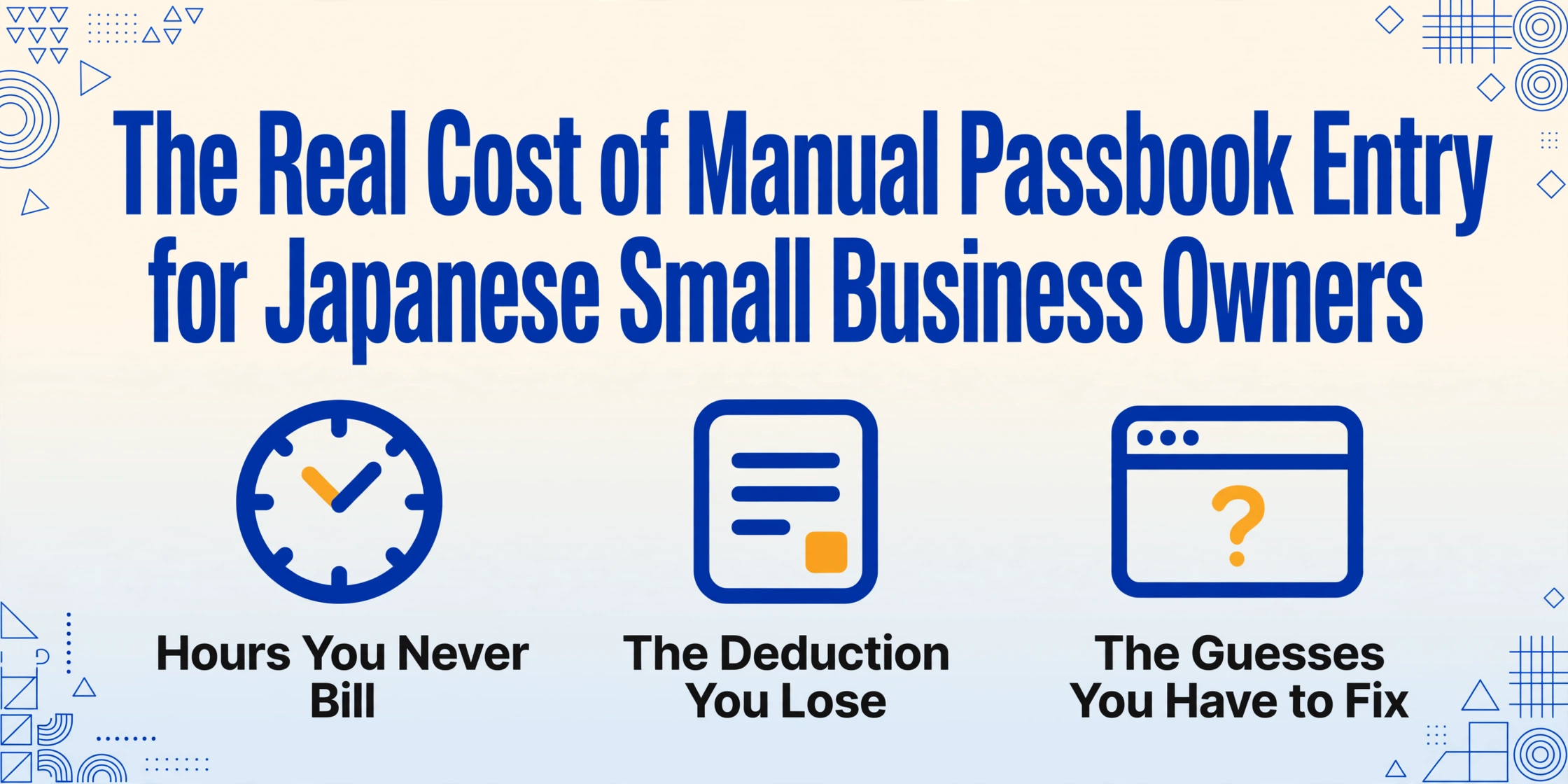
Whether you do the full set of books yourself or hand reconciled figures to a tax accountant, the cost of manual passbook data entry splits into three lines that behave differently and have to be added separately. Treating them as one blur of "経理が面倒 (bookkeeping is a pain)" is exactly why the figure never gets calculated.
- Line One — the hours you never bill. Time spent locating passbook pages, reading each transaction line, typing the date and amount and 摘要 into your accounting software, categorising what the software could not, and reconciling the balance (差引残高). Priced at what an hour of bookkeeping labour actually costs in Japan.
- Line Two — the deduction you lose when a figure is wrong. A blue tax return (青色申告) with properly kept double-entry books entitles you to a ¥650,000 deduction from taxable income. A return filed with simplified records — or records where a miscategorised entry broke the double-entry structure — drops that deduction to ¥100,000. The gap is ¥550,000 of extra taxable income, and manual passbook transcription is where the miscategorisation usually begins.
- Line Three — the software you pay for that still needs you. The monthly subscription that was supposed to automate everything, reduced to a guessing engine you spend time correcting — and the cost of that correction time layered on top of the subscription fee.
To keep the arithmetic concrete, we will run a single example throughout: a small business owner (個人事業主, sole proprietor) with three bank accounts producing roughly 30 to 50 passbook transactions per month across deposits, withdrawals, transfers, and fees — keeping daily records and filing a blue tax return with the ¥650,000 deduction. Substitute your own figures at each step.
Line One — The Hours Spent Transcribing a Passbook Page by Page
The reason small business owners treat their own bookkeeping time as free is that no invoice arrives for it. But an hour spent opening the passbook, locating the next unrecorded page, and typing each line is an hour not spent on billable work — and that hour has a market price. Japanese bookkeeping staff earn roughly ¥1,500 to ¥2,400 per hour as dispatch workers (派遣), with experienced hands commanding ¥2,000 to ¥2,500. A certified bookkeeper (簿記2級) with practical experience brings ¥1,800 to ¥2,200 per hour. Your own rate as the business owner is whatever revenue you generate in an hour of core work — but even at the low end of the market, bookkeeping labour in Japan is not cheap enough to treat as negligible.
The time itself is not the five minutes it takes to enter a single passbook page into freee once the figures are clean in your head. It is the process beforehand: pulling the passbook from the drawer, flipping to the right page, reading the handwritten 摘要 field — bank passbook entries in Japan use abbreviated codes (給与, 振込, 公共料金, カ)ド引落) that an accounting app may not map correctly to its chart of accounts — deciding the correct expense category (勘定科目), and checking whether the running balance in the passbook (差引残高) matches what your software shows. For a sole proprietor with three accounts and 30 to 50 transactions a month, the gathering and entering and correcting takes three to eight hours a month — and more if the passbook has sat unrecorded for a quarter.
At five hours a month of passbook transcription and a conservative ¥2,500 hourly rate — what a part-time bookkeeper costs — the manual entry step alone represents about ¥12,500 per month, or ¥150,000 a year. That is more than ten years of MoneyForward subscriptions, and it is entirely invisible because no one sends you a bill for your own time. This is Line One, and for most small business owners it already dwarfs the cost they thought was the whole picture.
Notice what this does to the "should I outsource my bookkeeping?" question. The 記帳代行 comparison pages frame the choice as ¥5,000 monthly fee versus zero — the impression being that doing it yourself costs nothing. But when you include Line One at market bookkeeping rates, the DIY route costs ¥150,000 a year in displaced labour, while the 記帳代行 service costs ¥60,000 to ¥180,000 — and both options still require you to organise and deliver the passbook copies. The comparison is not fee-versus-zero. It is fee-versus-your-hours, and your hours at bookkeeping rates win that comparison in one direction only: toward automation.
Line Two — The ¥550,000 Deduction Gap That Starts with a Wrong Description (摘要)
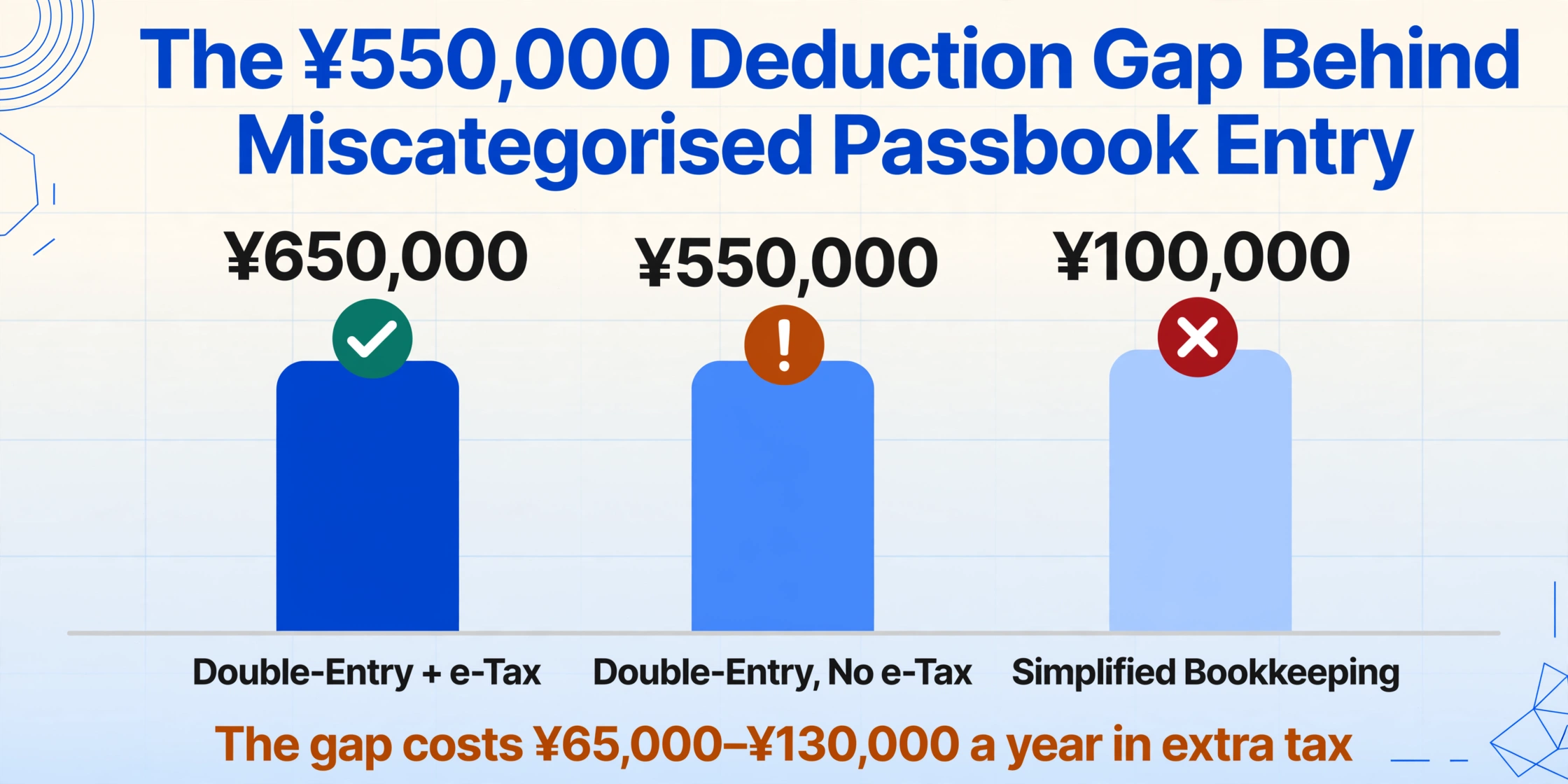
The blue tax return special deduction (青色申告特別控除) is one of the most valuable tax mechanisms available to a Japanese sole proprietor, and the gap between its three tiers is what manual passbook entry quietly puts at risk.
Under Article 25-2 of the Special Taxation Measures Act (措置法第25条の2), a blue return filer who keeps proper double-entry books, attaches a balance sheet and profit-and-loss statement to the return, files on time, and submits via e-Tax or keeps compliant electronic books (優良な電子帳簿) can deduct ¥650,000 from taxable income. Drop the e-Tax requirement and the deduction falls to ¥550,000. Fail to maintain the double-entry standard — for instance, because transactions were categorised inconsistently or records were incomplete — and the deduction collapses to ¥100,000 for simplified bookkeeping (簡易簿記). The difference between ¥650,000 and ¥100,000 of untaxed income at the 10% bracket is ¥55,000 in extra tax paid — at the 20% bracket, ¥110,000 — and that is before resident tax (住民税), which adds roughly 10% and brings the total effective tax impact to roughly ¥65,000 to ¥130,000. The NTA's official guidance on No.2072 lays out the tiered requirements in full.
The connection to passbook entry is direct. Double-entry bookkeeping demands that every transaction is recorded with a matching debit and credit — a passbook deposit of ¥50,000 with 摘要 "給与" requires both the bank account credit and the correct income account debit. Get the category wrong — debit 売上 (sales) instead of 事業主借 (owner's loan), or mistype 雑所得 (miscellaneous income) for what should be 事業所得 (business income) — and the double-entry structure no longer balances cleanly. One miscategorised passbook line does not destroy the return on its own. But across a year of manual transcription, the probability that enough entries are misclassified to call the records into question is not zero — and the stakes are a ¥550,000 swing in taxable income. The anatomy of why manual passbook entry breaks down at scale is explored in the companion article on why Japanese small businesses still hand-copy passbook data.
Separately, from 2027 (令和9年分), the top deduction tier is set to rise to ¥750,000 while the ¥550,000 tier is being eliminated — the gap between getting it right and getting it wrong widens further, making the transcription accuracy question more expensive, not less.
Line Three — The Software You Pay for That Still Needs You to Fix Its Entries
Accounting apps market automatic journal entry (自動仕訳) as the reason to subscribe. The bank feed pulls in transaction data and the software guesses the account — a genuine time-saver for standardised transfers like "Amazon カード引き落とし" or a recurring rent debit. The problem is everything the bank feed does not see: a paper passbook entry written by a bank clerk, a 摘要 abbreviation the algorithm has never encountered, a transfer from a client whose name does not match any registered payee. The software guesses. You fix the guess. The subscription you pay for is, on passbook-heavy months, a prediction engine with a correction interface.
MoneyForward Cloud's personal plan starts at ¥11,880 per year (税込), freee's starter plan at ¥12,936, and Yayoi's self-service tier at ¥11,800. All three offer automatic journal entry and e-Tax filing, and all three leave passbook data as the part of the workflow requiring the most manual intervention. A MoneyForward user on the r/JapanFinance discussion threads consistently reports needing to manually adjust roughly 30% of automatically categorised entries for a sole proprietor with multiple income streams. If you are spending five hours a month on passbook entry and a third of that is correction rather than initial input, the effective cost of the app is not ¥1,000 a month — it is ¥1,000 plus the correction time that the marketing copy implied you would not need. An accounting app reduces the writing of a journal entry to a click. It does not reduce the reading of a passbook page to a glance — and the reading is where the hours go.
Your Own Passbook Entry Cost, in Five Expressions
With the three lines separated, the total annual cost of manual passbook data entry becomes a function of your own situation rather than an industry average. Here is the tally for the running example — a sole proprietor with three accounts, 40 transactions per month, filing a blue tax return with the ¥650,000 deduction:
| Cost Line | Annual Total (example) | Calculation Basis |
|---|---|---|
| Accounting app subscription | ¥12,000–¥17,000 | freee/MoneyForward/Yayoi sole proprietor tier, annual |
| Line One — passbook transcription hours | ¥90,000–¥240,000 | 3–8 hrs/mo reading and typing passbook entries × ¥2,500/hr × 12 months |
| Line Two — 青色申告 deduction gap | ¥0–¥130,000 | ¥550,000 deduction lost × (10%–20% income tax + ~10% resident tax), weighted by probability of miscategorised entries |
| Line Three — software correction time | ¥27,000–¥72,000 | ~30% of Line One hours spent correcting auto-categorisation errors × ¥2,500/hr |
| Total per tax year | ¥129,000–¥459,000 | Probability-weighted true cost of manual passbook data entry |
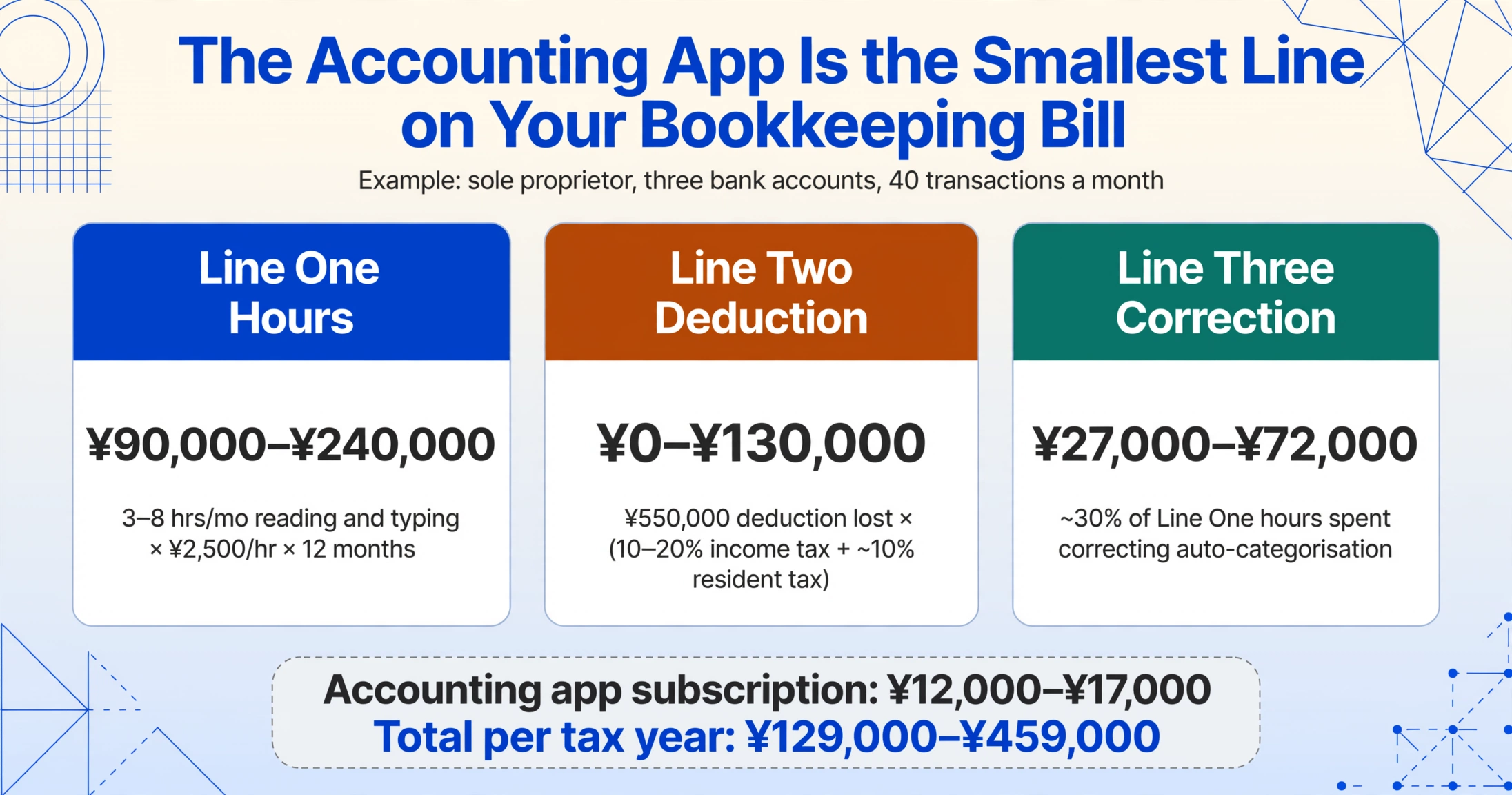
The striking result is that the accounting app subscription — the only line most small business owners ever count — is the smallest by an order of magnitude. To build your own figure, substitute into five expressions:
- Line One = monthly hours spent reading passbook entries and typing them into your accounting software × your chosen hourly rate
- Line Two = (¥650,000 − your deduction tier if records break) × (your marginal income tax rate + ~10% resident tax) × probability manual errors trigger a deduction downgrade
- Line Three = estimated correction ratio × Line One — the portion of those hours spent fixing auto-categorisation rather than doing fresh entry
- App subscription = your annual software fee, roughly ¥12,000–¥17,000
- Alternative = 記帳代行 monthly fee × 12 — compare this to Lines One through Three to see whether outsourcing or automation is the better arithmetic for your situation
Run those numbers and the app-versus-outsourcing debate reframes itself. The question is not "is ¥1,000 a month worth it for automatic journal entry?" It is "which of these lines does each option actually reduce?" An accounting app reduces the keystrokes but not the reading. A 記帳代行 service reduces the hours but not the document organisation — and costs about what Line One costs at market rates. Neither touches the accuracy risk that feeds Line Two, because both depend on human transcription somewhere in the chain.
Where Extraction Changes the Arithmetic
Every one of the three cost lines traces back to the same root operation: a person reading a figure off a passbook page and typing it somewhere else. Line One is that operation repeated for every transaction across every account every month. Line Two is what happens when one of those typed figures lands in the wrong account — the wrong 勘定科目. Line Three is the same operation layered on top of a software subscription that was meant to remove it. Remove the manual reading-and-typing and all three lines move at once. That is what document data extraction does, and the value is concentrated on the input side — not in filing your tax return, which no extraction tool does, but in turning passbook pages into rows your accounting software can import without your fingers on the keyboard.
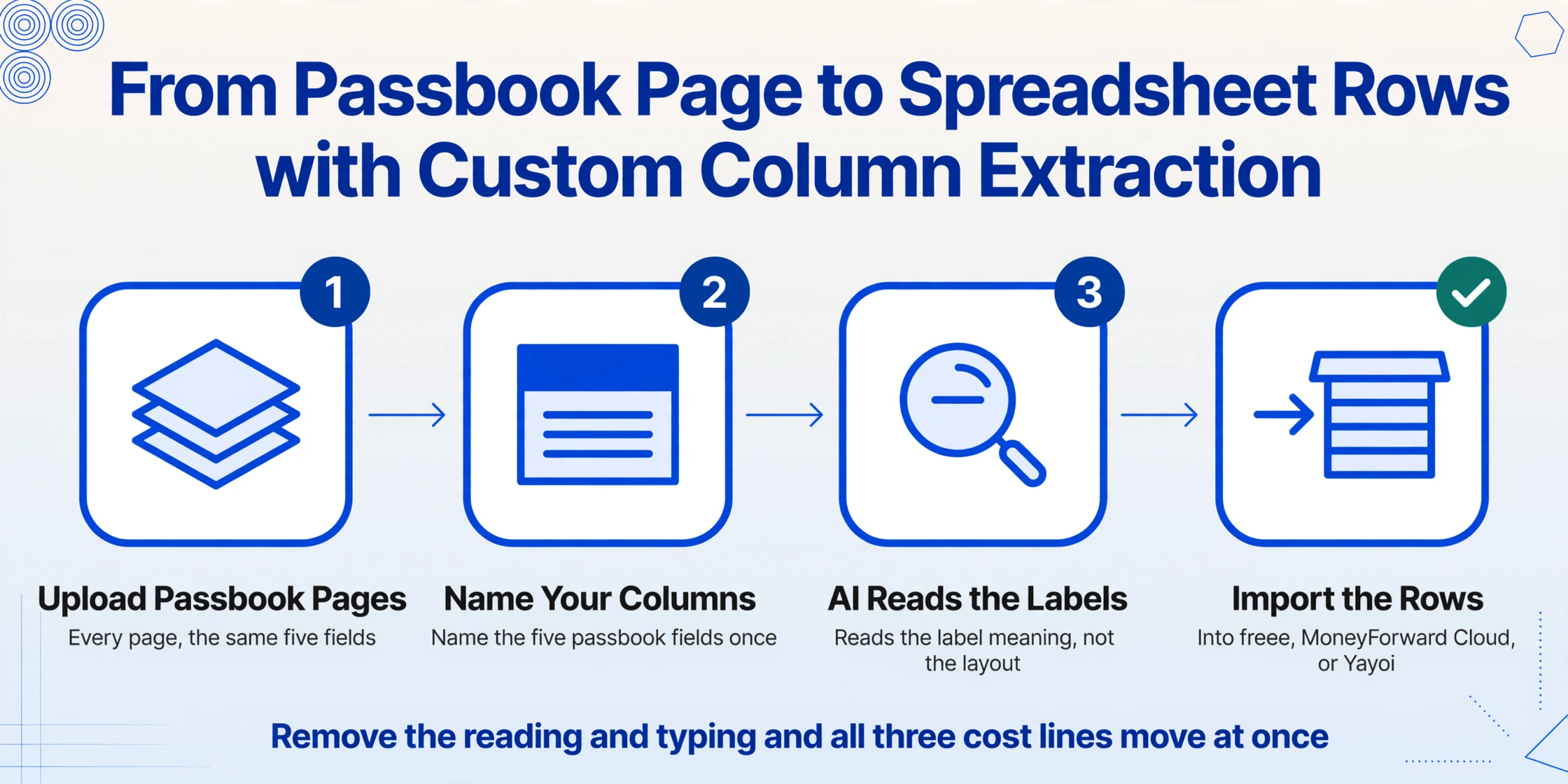
The mechanism is Custom Column Extraction: you type the column names you want once, and the AI reads every passbook page and locates the values by understanding what the labels mean — お支払金額, お預り金額, 差引残高 — regardless of the bank's exact layout or handwriting style. A bank passbook is one of the most consistently structured documents in Japanese finance: every page has the same five fields in the same order. Upload the pages and name your columns "Date (月日)," "Description (摘要)," "Withdrawal (お支払金額)," "Deposit (お預り金額)," and "Balance (差引残高)," and the extracted values become the rows of one spreadsheet. The step-by-step version of that workflow is covered in the guide to extracting Japanese bank passbook data to Excel. The guide to batch-processing three years of passbook pages into one annual spending ledger covers how the same approach scales beyond a single month.
A feature that directly attacks the categorisation risk on Line Two is the inferred column: add a column named Category (options: 売上/事業主借/雑収入/経費/事業主貸) and the tool assigns each passbook line to its correct accounting category — or at minimum produces a starting categorisation you verify rather than build from zero. A computed column then does the balance check: define a column that subtracts withdrawals from deposits and compares the result to the stated balance, and every passbook page is arithmetically verified in the same pass. What took an evening of cross-checking becomes a spreadsheet you scan.
Files are processed securely and not stored.
At roughly ten seconds of processing per passbook page versus the minutes of reading, typing, categorising, and balance-checking by hand, extraction does not trim Line One — it collapses the reading-and-typing step to a verification glance. And because the AI reads labels rather than depending on your keyboard accuracy at 11pm before the March deadline, the categorisation risk that feeds Line Two falls with it. The same arithmetic that makes manual processing quietly expensive for UK freelancers filing SA100 returns and for Australian small businesses preparing quarterly BAS applies here — the visible typing was never the real cost.
FAQ — The Cost of Manual Passbook Data Entry in Japan
How much does it cost to outsource passbook data entry to a Japanese bookkeeper?
A bookkeeping outsourcing service (記帳代行) charges roughly ¥5,000 to ¥15,000 per month for 50 to 100 journal entries, or ¥30 to ¥80 per entry on a volume basis. A tax accountant (税理士) with a monthly advisory contract starts at roughly ¥30,000 per month for a sole proprietor and includes both journal entry and year-end filing. What neither option changes is that you still need to organise and deliver the passbook pages — the gathering step remains yours. Compare the fee to the hours you spend doing it yourself, valued at bookkeeping market rates (¥1,500–¥2,500/hr), to see which direction the arithmetic points for your volume.
What is the 青色申告特別控除 and how much can I lose if my records are wrong?
The blue tax return special deduction (青色申告特別控除) lets a sole proprietor deduct ¥650,000, ¥550,000, or ¥100,000 from taxable income depending on how the records are kept. The top ¥650,000 tier requires double-entry bookkeeping (複式簿記) plus e-Tax filing or compliant electronic bookkeeping. Drop to simplified bookkeeping (簡易簿記) and the deduction falls to ¥100,000 — a ¥550,000 swing in taxable income. At a 10% income tax rate plus ~10% resident tax, that gap costs roughly ¥110,000 in extra tax. Miscategorised passbook entries that break the double-entry structure are one of the most common reasons sole proprietors lose the top tier. The NTA's official guidance is at No.2072 青色申告特別控除.
Do Japanese accounting apps like freee and MoneyForward handle passbook data automatically?
Partially. All three major apps — freee, MoneyForward Cloud, and 弥生 (Yayoi) — offer automatic journal entry (自動仕訳) via bank feed integration. The system works well for standardised electronic transactions but does not read paper passbook pages. For passbook entries, the workflow is still manual: you type the date, 摘要, amount, and balance into the app, and the software may guess the accounting category (勘定科目) — a guess you often need to correct. The subscription reduces the writing step but not the reading step, and for passbook-heavy months the reading is where the hours go.
Can AI read a Japanese bank passbook and extract the transaction data?
Yes — passbook pages are among the most consistently formatted documents in Japanese banking, which makes them an unusually strong match for extraction. You upload passbook photos or scanned pages, name your columns once (日付, 摘要, お支払金額, お預り金額, 差引残高), and the AI reads each line and fills the rows. What was five hours of manual transcription becomes a spreadsheet you verify. An inferred column can then assign each line to the correct accounting category, turning a categorisation step that used to take hours into a review pass. The honest limit: heavily worn passbooks where the magnetic stripe ink has faded may reduce accuracy, and a verification glance at the extracted balance against the passbook's stated balance still matters — but that glance replaces the entire typing step, not adds to it.
Is it cheaper to do my own passbook entry or pay a 記帳代行 service?
It depends on your volume and how you value your time. At five hours a month of passbook entry and a ¥2,500 hourly rate — the low end of part-time bookkeeping labour in Japan — doing it yourself costs ¥150,000 a year in displaced time. A 記帳代行 service for 50 entries a month costs ¥60,000 to ¥180,000 a year. At the low end the service saves money. At the high end it costs about the same before accounting for the accuracy risk: a professional bookkeeper categorises more consistently, which protects the ¥650,000 deduction that manual DIY puts at risk. The honest comparison is not fee-versus-zero — it is fee-versus-your-hours-plus-error-exposure, and your hours at minimum wage already tilt that calculation toward reducing the manual step.
How many hours a month does a small business owner spend on passbook data entry in Japan?
For a sole proprietor with two to three bank accounts and 30 to 50 transactions per month, the full cycle — locating passbook pages, reading each line, typing entries into accounting software, correcting auto-categorisation, and checking the running balance — typically takes three to eight hours a month. The range widens sharply if passbook pages are recorded quarterly rather than monthly, because catching up on 80 to 150 entries in one sitting introduces its own accuracy penalty. A sole proprietor who has let the passbook sit since April and faces the January-to-March tax filing window may spend a full weekend on it.
The real cost of your passbook data entry was never the ¥1,000 app subscription. It is the hours spent transcribing every line by hand, the 青色申告 deduction at risk when an entry lands in the wrong account, and the software that promised automation but left the reading step on your desk. Turn passbook pages into spreadsheet rows, then run the numbers again.
Extract Your Passbook Data