The Real Cost of Manual BAS Entry
for Australian Small Business
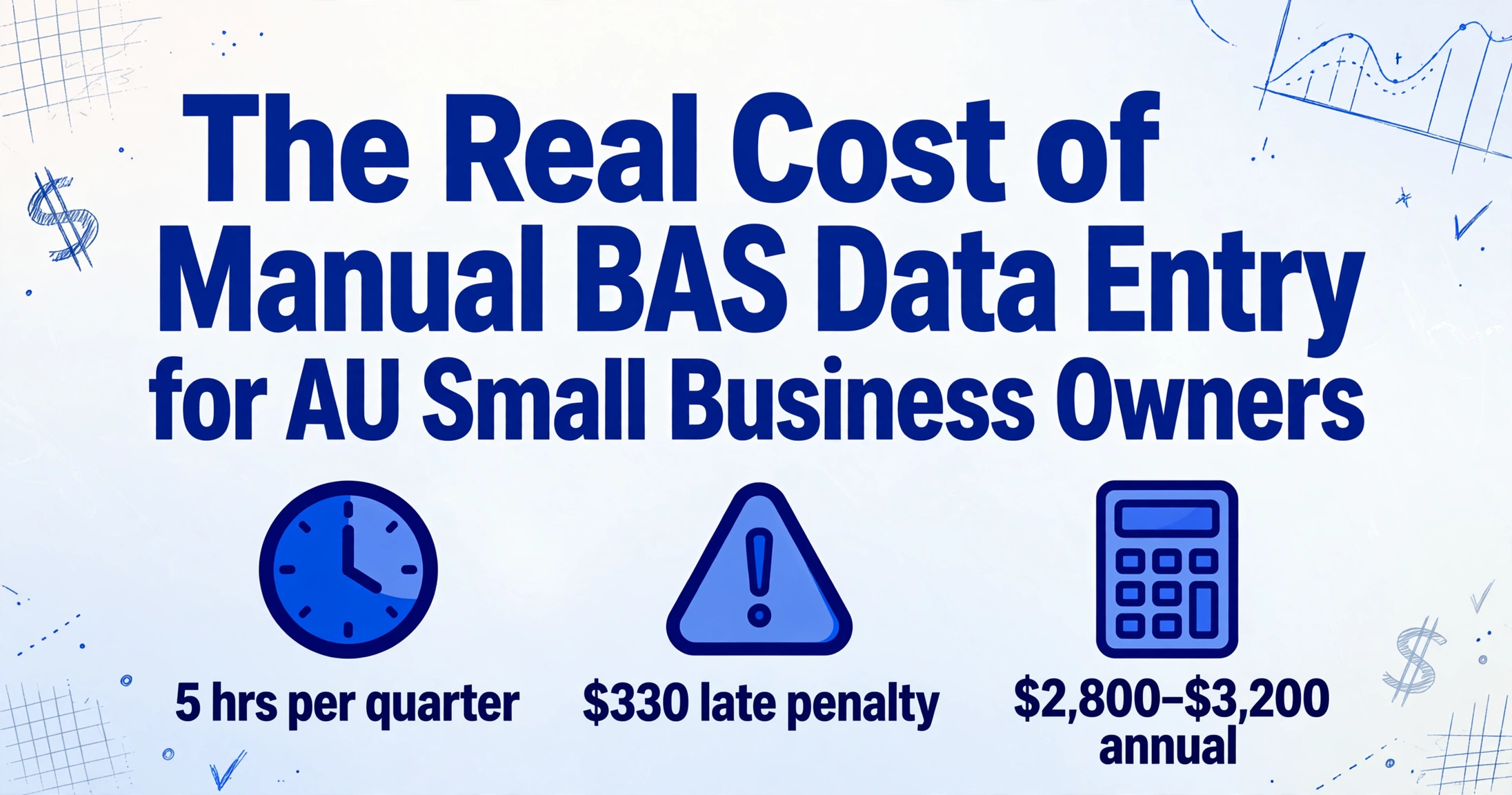
In the 2024 financial year, the ATO issued $935 million in failure-to-lodge penalties — a 40% increase on the year before. Separately, the latest ATO GST gap estimate puts unrecovered GST at $8.7 billion, or 9.4% of theoretical GST, with small business a significant contributor. Between these two numbers sits a routine that happens four times a year in over 2.7 million GST-registered entities: someone sits down with a pile of supplier invoices, bank statements, and payroll records, and types numbers into a form. The visible cost is the hours. The invisible cost — the errors that trigger ATO queries, the late penalties, the year-end accountant's bill for cleaning up four quarters of misclassified transactions, the evening and weekend hours a business owner spends on compliance instead of earning — is what this article calculates. Not with averages and generalisations. With a framework you can plug your own numbers into.
Key Takeaways
- You know your bookkeeping hours cost you about $1,200 a year — but that number is only 40% of what manual BAS entry is actually costing you.
- The other $1,600 lives in places your P&L never links together: $330 ATO late penalties that apply even when you owe nothing, $200–$600 in accountant cleanup fees to fix four quarters of manual-entry errors, and $1,000-plus in billable hours you gave up to type numbers instead of earning.
- Collapse all five cost components into one annual number — once you see $2,800 on a single line, you can compare it against the $190 alternative where documents are read by machine and the typing step never happens.
Where the Visible Cost Comes From
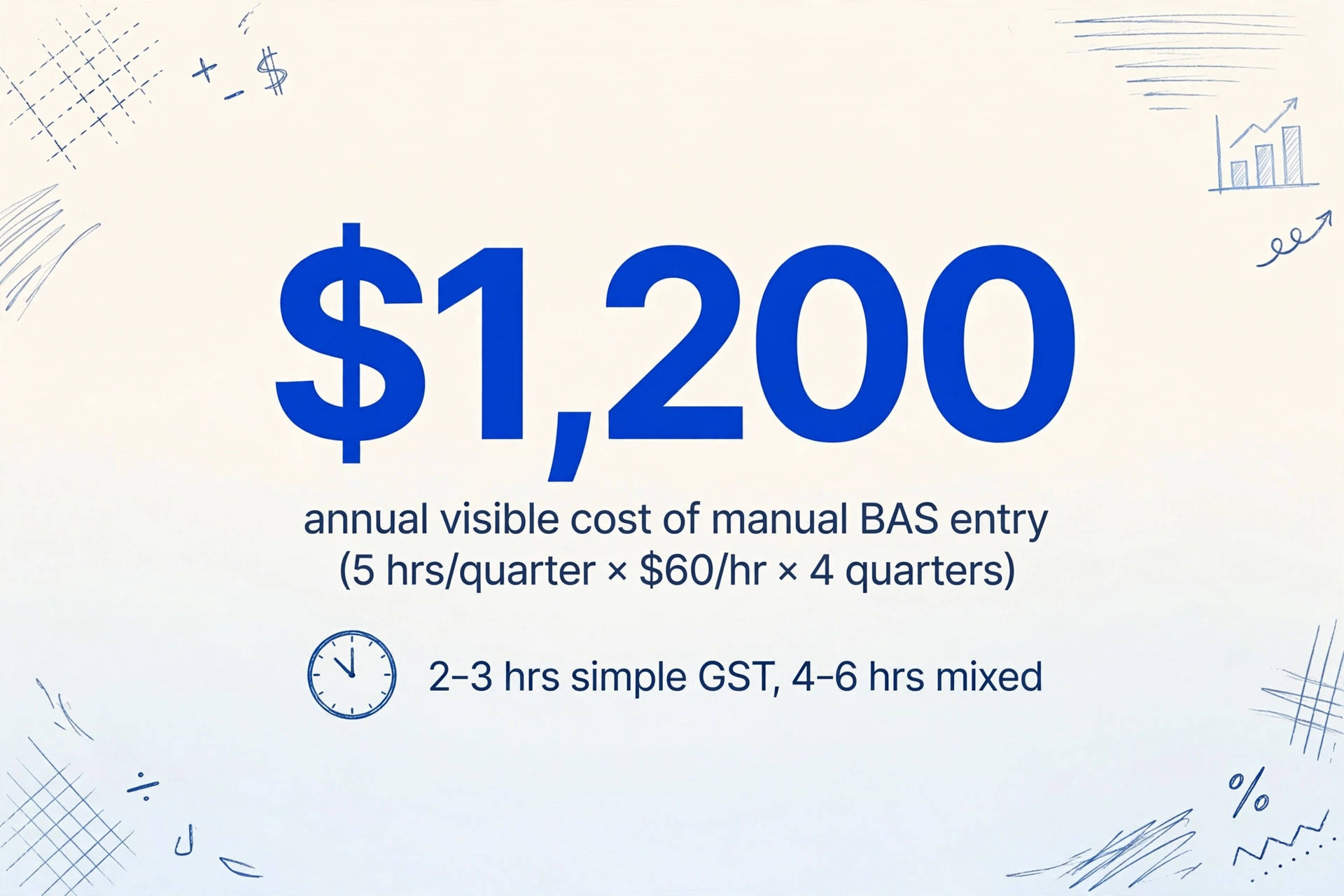
The part that appears on an invoice — or in the mental arithmetic of a business owner deciding whether to do the BAS themselves — is hours multiplied by an hourly rate. It is the simplest number and the one most people stop at.
Australian bookkeeping rates for BAS-capable work sit in a well-documented range. An experienced bookkeeper handling GST coding and BAS preparation charges between $55 and $80 per hour, according to multiple 2026 pricing surveys from Arbour Advisory and Scale Suite. A registered BAS agent — who can also lodge on your behalf, giving you the extended ATO deadline — charges $80 to $150 per hour. A business owner doing the work themselves is consuming time at their own effective hourly rate, which for a sole trader running a trade or professional service business is typically $70 to $150.
Time is the harder number. A small business with straightforward GST — standard-rated sales, standard-rated purchases, no mixed supplies, few employees — can prepare and lodge a quarterly BAS in two to three hours, assuming bookkeeping is up to date. A business with mixed GST classifications (GST-free and taxable items), multiple revenue streams, payroll withholding to reconcile against Single Touch Payroll, and a tail of suppliers who send paper invoices or photographed receipts — four to six hours is more realistic. At four quarters per year, the annual visible cost range is:
| Who Does the BAS | Hours/Quarter | Hourly Rate | Annual Visible Cost |
|---|---|---|---|
| Business owner (simple GST) | 3 | $70–$120 (opportunity cost) | $840–$1,440 |
| Business owner (complex GST + payroll) | 5 | $70–$120 | $1,400–$2,400 |
| Hired bookkeeper (BAS prep only) | 3–5 | $55–$80 | $660–$1,600 |
| Registered BAS agent (lodgement included) | N/A (flat fee) | $150–$300 per BAS | $600–$1,200 |
A business owner doing their own moderately complex BAS four times a year can see $1,400 to $2,400 going out the door — not as a cheque, but as hours that could have been spent on billable work. Yet that number, significant as it is, is only the start. It is what a deeper look at manual BAS entry — the problem that makes lodgement week harder than the form suggests — reveals: the typing is cheap. The downstream costs are where the money is.
The Costs That Live Inside a Wrong GST Classification
Manual data entry is a transcription exercise on a form that does not forgive transposition. BAS labels are interdependent: a number typed into G1 (total sales) flows into the GST calculation at 1A; a number typed into G11 (non-capital purchases) flows into 1B. An error in one label is not self-contained — it creates a mismatch elsewhere on the form, and if the mismatch is large enough, the ATO's data-matching algorithms flag it.
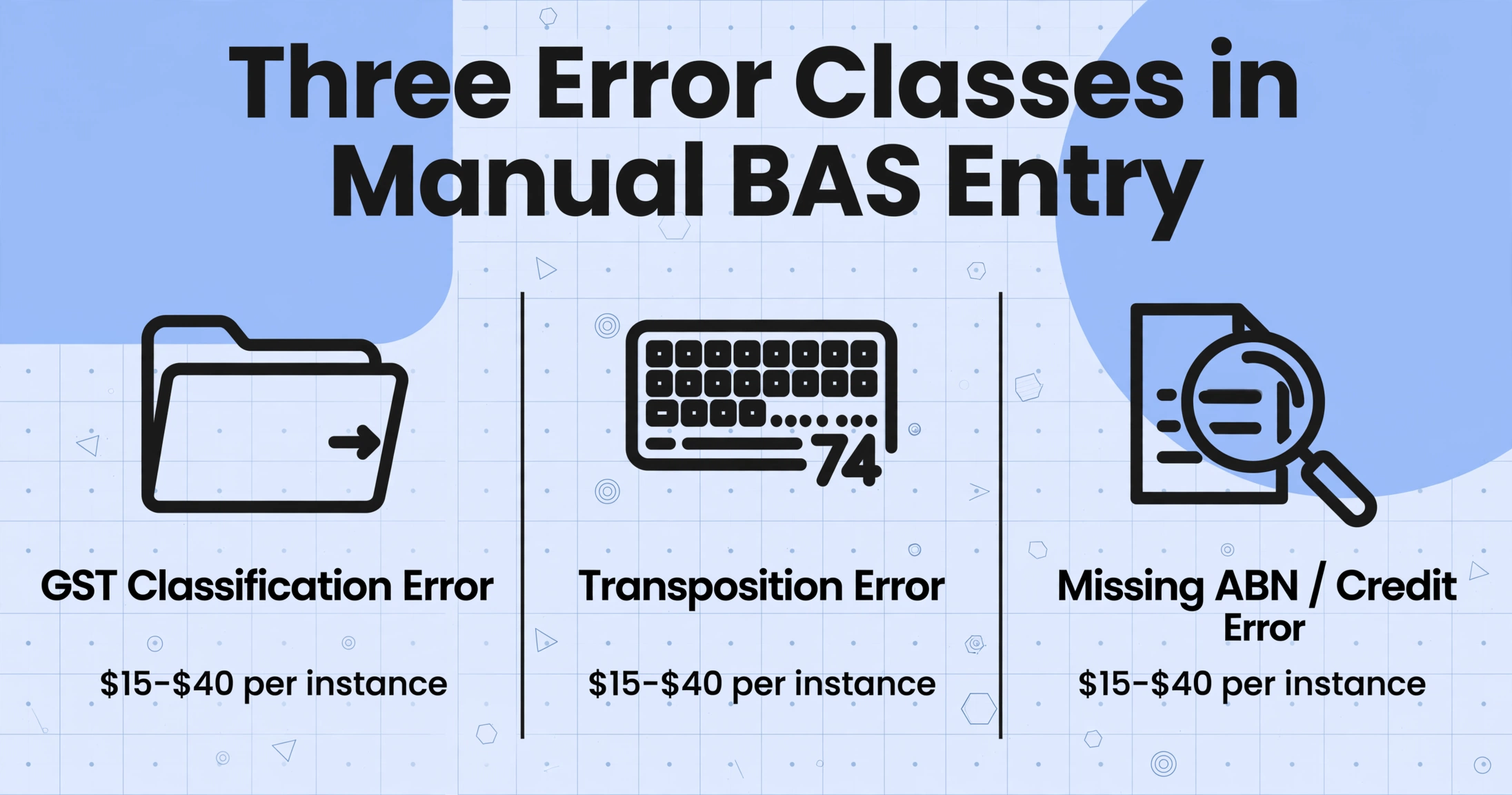
Three classes of error dominate manual BAS entry, and each carries its own correction cost:
1. GST classification error. A GST-free item — plain bread, a medical service, an export — entered as a standard-rated supply means the business overstates GST collected. A taxable purchase where the supplier's invoice is missing a valid ABN means the GST credit is claimed when it shouldn't be. The ATO's $8.7 billion GST gap is in significant part composed of exactly these errors: thousands of small misclassifications made under time pressure. Correcting one classification error discovered during a subsequent quarter requires an amendment to the original BAS, and the correction itself takes time — locating the original document, confirming the correct classification, recalculating the revised label amounts, and either lodging an amended BAS or adjusting in the next period. Estimated correction cost: 15–30 minutes per error, or $15–$40 per instance at an intermediate bookkeeping rate.
2. Transposition and keystroke error. A total sales figure of $87,430 entered as $87,340 — a single transposed digit. The form accepts it. Three weeks later, when the ATO's data-matching engine compares the lodged BAS against the business's income tax return and the Single Touch Payroll data (for W1 and W2), it flags a discrepancy. The ATO sends a query letter. Responding means reconstructing the original calculation from source documents, confirming the correct figure, and explaining the error. For a "please explain" letter triggered by a keystroke mistake: 1–3 hours of owner or bookkeeper time, or $70–$240, to resolve something that started as one mistyped digit.
3. Payroll reconciliation gap. The W1 (total salary and wages) and W2 (amount withheld from payments) labels on the BAS must reconcile against the employer's Single Touch Payroll reports. A final pay run processed after the quarter-end cut-off, a bonus paid in the last week, or a correction to an earlier pay period creates a gap between the payroll system's reported figures and the numbers the business owner manually types from the payroll summary. Tracing that gap — identifying which pay run caused it, confirming the correct figure, and reconciling it across STP, the BAS, and the business's general ledger — routinely takes 30–60 minutes per quarter for an employer with more than three staff.
The common thread across all three error types is that manual entry creates them, and the correction cost per error is typically three to ten times the time it took to enter the number in the first place. A $1,200 annual visible cost can double when error correction enters the equation — and that is before penalties.
The Late Penalty You Pay Even When You Owe Nothing
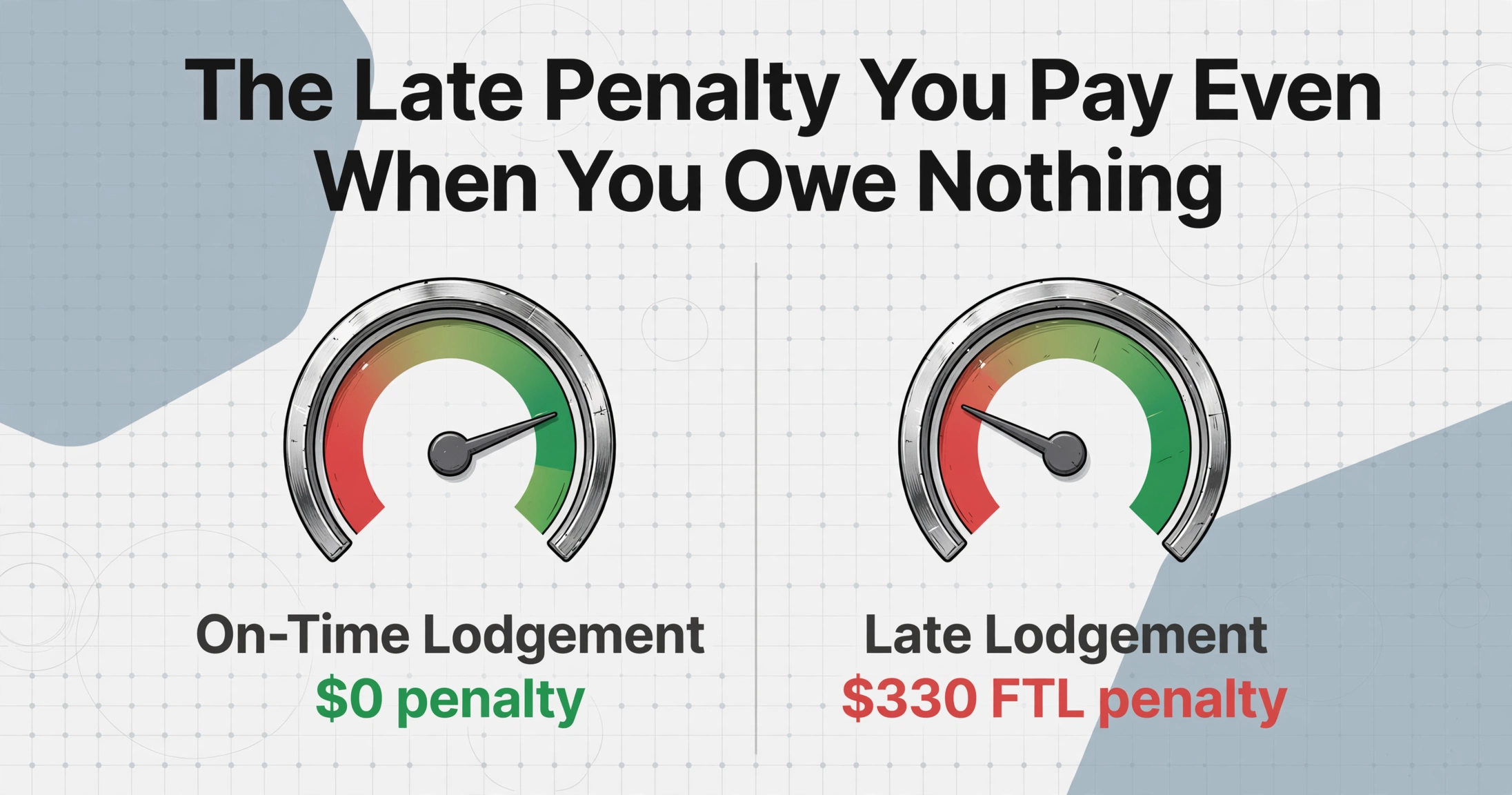
The ATO's failure-to-lodge (FTL) penalty, governed by section 286-75 of Schedule 1 to the Taxation Administration Act 1953, is blind to the reason for the delay. It applies per statement, not per dollar owed. The baseline for a small entity — turnover under $1 million — is one penalty unit for every 28 days (or part thereof) the BAS is overdue, capped at five units. Since 7 November 2024, one penalty unit is $330, making the maximum FTL penalty $1,650 per late BAS.
The practical implication for manual BAS entry: if document assembly takes longer than expected and the lodgement slips past the 28th, a $330 penalty attaches — even if the BAS is nil and the business owes no tax. A Canberra café with $680,000 turnover, as documented in a real case, received a $313 FTL penalty despite being in a refund position. The business had no tax debt — it had a paperwork delay.
When the BAS does reveal a GST liability and the business cannot pay on time, the General Interest Charge (GIC) applies daily from the original due date. In Q4 of 2025–26 (April to June 2026), the ATO's GIC rate is 10.96% per annum, compounding daily. For a business that owes $8,000 in GST and pays 60 days late, the GIC cost is approximately $144 — on top of the $330 FTL penalty, for a total delay cost of $474. And since 1 July 2025, GIC is no longer tax-deductible, meaning the after-tax cost of delaying a payment is now higher than it was in previous years.
The multiplier effect that most business owners miss: manual entry makes errors more likely, errors increase the chance of a late BAS, late BASs attract FTL penalties and GIC, and — since 1 April 2025, under section 27-15 of the GST Act — the ATO can move a business with a history of late or incorrect lodgements from quarterly to monthly BAS reporting for a minimum of twelve months. A manual process that made four BASs per year painful can, through a chain of entirely preventable late lodgements, result in a twelve-BAS year. The penalty for bad manual entry is not just $330 per late quarter. It can be the imposition of a reporting cycle that triples the data-entry burden.
The Year-End Accountant Bill Manual BAS Inflates
Every misclassified GST amount on a quarterly BAS carries forward. When the accountant prepares the annual tax return and financial statements, they compare the four lodged BASs against the business's general ledger and bank records. Discrepancies that originated in manual data entry — a supply coded as GST-free in the books but reported as taxable on the BAS, a purchase where the GST credit was underclaimed because the supplier's invoice was never properly read — must be traced, corrected, and reconciled. The accountant's time on these corrections is billable.
The cost impact is linear in the number of manual-entry errors and compounded by the number of quarters. Four quarterly BASs prepared manually, each containing two or three classification issues, produce eight to twelve items that need year-end adjustment. At an accountant's rate of $150–$300 per hour, and 5–10 minutes per item to investigate, recalculate, and document, the year-end cleanup attributable to manual BAS entry is roughly $100–$600 — money spent to correct mistakes that a machine-extracted, traceable data source would not have produced in the first place.
This cost is distinct from the accountant's standard annual return fee. It is an incremental cost — one that disappears when the source data for each BAS quarter is extracted automatically, stored in a structured format, and independently verifiable without returning to the original paper documents. The batch-processing approach that produces an annual tax ledger from quarterly BAS worksheets eliminates this cost category entirely: with all four quarters in one verified table, the year-end reconciliation is a review, not a reconstruction.
What Business Owners Lose When They Do Their Own BAS
This is the cost category that business owners intuitively understand but rarely calculate: time spent on BAS data entry is time not spent on revenue-generating activity. A sole trader electrician who charges $110 per hour and spends five hours per quarter on BAS — manually typing invoice totals, calculating GST components, reconciling bank lines against supplier documents — forgoes $550 in billable work per quarter, or $2,200 per year.
Even at a lower effective hourly rate — say $70 for a freelance designer or consultant — four quarterly sessions of four hours each add up to $1,120 in forfeited revenue. Over five years, the accumulated opportunity cost of doing BAS manually is $5,600 to $11,000. And that figure only counts the direct earnings forgone — it does not include the compounding effect of evenings and weekends when the business owner, having spent Friday on BAS, is too fatigued to quote the next job or follow up a lead.
The 2025 COSBOA Small Business Perspectives Report found that 32% of small business owners spend six or more hours a week on compliance activities, and 40% spend six or more hours a week on financial management. Quarterly BAS preparation consumes a concentrated share of those hours — an intensive block that competes directly with the final weeks of the quarter, when many businesses are chasing invoices and closing deals. The timing of the BAS — due 28 days after quarter-end — means the compliance work lands precisely when the business's commercial rhythm is at its most demanding.
Putting It Together: Your Total Annual Manual BAS Cost
The framework below is designed to be adapted to any Australian small business. Each component has a default value based on the data points discussed above, and a column for your own numbers. The output is an annual cost — visible and invisible — that can be compared against the cost of automated extraction.
| Cost Component | Per-Quarter Estimate | Annual Total (×4) | Your Number |
|---|---|---|---|
| 1. Direct time (5 hrs × rate) | $300 (@ $60/hr) | $1,200 | |
| 2. Error correction (2 errors × 30 min × $60) | $60 | $240 | |
| 3. FTL penalty risk (assume 1 late per 2 years, averaged) | $41 (annual $330 ÷ 8 quarters × 4) | $165 | |
| 4. Accountant year-end cleanup | N/A (annual) | $200–$600 | |
| 5. Opportunity cost (5 hrs × owner rate minus bookkeeper rate) | $250 (@ $110/hr rate differential) | $1,000 | |
| Total annual cost | $2,805–$3,205 |
For a sole trader doing their own BAS, with moderately complex GST and a few employees, the total annual cost of manual entry — counting direct time, error correction, penalty risk, accountant cleanup, and opportunity cost — falls in the range of $2,800 to $3,200. The visible cost alone — the hours times the rate — was $1,200. The invisible costs more than double it.
For a small business with 10–15 employees, the scale increases. Payroll reconciliation (W1/W2) is more intricate, the number of GST-bearing transactions is higher, and the volume of supplier documents crossing the transcription gap — the PDF invoices and paper dockets that accounting software cannot read — grows with transaction count. The total annual cost pushes past $4,000. For a small business that pays a bookkeeper for BAS-only services at $200–$300 per quarter, the baseline labour cost is lower ($800–$1,200 per year), but the error, penalty, and cleanup components remain — because the bookkeeper is still typing the same numbers from the same documents.
What Automated Extraction Changes in the Calculation
Every cost component above traces back to a single step: a person reading a document and typing a number into a form or spreadsheet. Automated extraction removes that step, and the cost reduction flows through every downstream line item.
The mechanism is Custom Column Extraction: instead of typing values from each supplier invoice, receipt, and payroll report into the BAS form, you define the columns you want — "Supplier", "Date", "GST-Inclusive Amount", "GST Component", "GST Classification" — and the AI reads every document and fills each column by understanding what the data means, not where it sits. Because it is batch-first, a quarter's worth of source documents becomes one structured table in minutes rather than hours. Because the extraction is machine-generated and reproducible, the audit trail is built in — no more reconstructing from paper. A computed column can even run the ÷11 GST calculation during extraction, so the number that lands in your spreadsheet is the GST component, not the raw total you still have to calculate.
The cost comparison for the typical sole trader scenario from the framework above:
| Cost Component | Manual Entry (Annual) | Automated Extraction | Saving |
|---|---|---|---|
| Direct time | $1,200 | $0 (machine time, minutes) | $1,200 |
| Error correction | $240 | $40 (reviewing extraction) | $200 |
| FTL penalty risk | $165 | $0 (no document-assembly delay) | $165 |
| Accountant cleanup | $200–$600 | $50 (verified table, not reconstruction) | $150–$550 |
| Opportunity cost | $1,000 | $100 (review only, not entry) | $900 |
| Total | $2,805–$3,205 | $190 | $2,615–$3,015 |
The pattern is the same one found in PAYG summary cost analysis for Australian employers and in the UK SA100 cost framework for freelancers: the document type and the tax authority change, but the cost structure — visible labour plus error correction plus compliance friction plus opportunity cost — remains remarkably consistent across jurisdiction and form.
For BAS specifically, the fit is particularly close because BAS labels — G1, 1A, G11, 1B, W1, W2 — map directly onto extraction columns. The form is modular; the data sources are documents; the missing link has always been the bridge from document to form, and it has always been manual. The full walkthrough of extracting BAS data for GST and PAYG reporting shows how that bridge works in practice: the same documents, the same labels, the same quarter-end deadline — but the typing step is gone, and with it, the cost components it feeds.
Frequently Asked Questions
How does a small business actually calculate its own manual BAS cost?
Track two numbers across two BAS quarters: the total hours spent from document gathering to lodgement (including chasing missing invoices and reconciling discrepancies), and the number of items your accountant identifies for correction at year-end. Multiply hours by the bookkeeping rate you would pay a professional for the same work — or your own effective hourly rate if you do it yourself. Multiply correction items by 20 minutes at your accountant's hourly rate. Add one late-penalty event for every three to four years of self-lodgement history. The annual total divided by four gives you your per-quarter cost — a number you can compare against the $150–$300 a BAS agent charges for the same period.
Do I need a BAS agent, or can automated extraction help me lodge BAS myself?
Automated extraction does not replace a BAS agent — it addresses the step before lodgement. A BAS agent provides professional oversight, lodgement on your behalf with extended deadlines, and penalty safe harbour. Extraction closes the document-to-data gap: instead of typing supplier invoices and receipts into the form, a tool reads them and produces the numbers that go into G1, G11, 1A, 1B, W1, and W2. You can use the extracted data to lodge yourself through the ATO Business Portal, or hand the verified spreadsheet to your BAS agent for lodgement — either way, the manual transcription step is gone, and with it, the errors it produces.
If I already use Xero or MYOB, why are the errors and costs in this framework still relevant?
Because cloud accounting software automates the ledger and the arithmetic — GST calculation, label population, bank reconciliation — but it cannot read a supplier's PDF invoice, a photographed receipt, or a handwritten docket and enter the transaction for you. Every document that arrives outside a digital feed has to be transcribed by a person before the software can do its work. For most small businesses, the residual pool of these manual-entry documents is small as a percentage of total transactions — which is why the labour cost looks manageable — but large as a source of errors, because each one is a manual classification and keystroke exercise. The correction costs and penalty risks in this framework are driven not by the volume of manual entry but by the error rate on that volume.
What if I'm already using a BAS agent — does this cost framework still apply?
Partially. If your BAS agent handles the full process — including data entry from your source documents, not just lodgement of numbers you provide — the direct labour and error-correction costs are embedded in their fee. However, if you are doing the document-to-data transcription yourself (typing supplier invoices into a spreadsheet or your accounting software) and sending the results to the agent for lodgement, Components 1, 2, and 5 of the framework still apply to you. The agent's fee protects you from Components 3 and 4 (penalty risk and accountant cleanup), but not from the hours spent preparing the data you hand them.
How does the cost framework change if my BAS includes PAYG withholding, FBT instalments, or fuel tax credits?
The additional labels — W1/W2 for PAYG withholding, F1 for FBT instalments, 7C/7D for fuel tax credits — each add a reconciliation step to the manual entry process, because each label pulls from a different source: the payroll system for W1/W2, the FBT return or instalment notice for F1, fuel purchase records for 7C/7D. Each additional reconciliation is a source of both time (10–30 minutes per label per quarter) and potential error (a reconciliation gap that needs tracing). The framework scales with label count: a BAS with four labels (GST only) is a 3–4 hour job; a BAS with eight labels (GST + PAYG + FBT + fuel) is a 5–7 hour job, and the cumulative annual cost moves to the upper end of the range.
A Business Activity Statement looks like a form. It is actually a convergence point — the place where a quarter's worth of supplier invoices, bank statements, payroll records, and cash receipts all have to be turned into numbers that agree with each other. The cost of manual BAS entry is the cost of crossing that convergence point without a bridge. A calculation framework does not change the distance — but it does make the cost visible. Take one quarter's source documents — the invoices, the receipts, the dockets that never made it into your accounting software — and see them turned into a single structured table with all the BAS labels pre-calculated. The cost of doing it manually is not a number you have to guess at anymore. It is a number you can subtract.