The Real Cost of Manual PAYG Summary Processing
for Australian Employers
A mid-size Australian employer with 120 employees processes PAYG payment summaries every July. The finance director knows the payroll administrator spends roughly a week on year-end reconciliation. What the finance director does not see — because the costs never appear on a single line item — is the additional 12 hours spent resolving a TFN mismatch that triggered an ATO query, the three days of auditor follow-up because the manual reconciliation spreadsheet had no verifiable extraction trail, and the 18 employee emails that arrived during the first week of July asking why their tax withheld figure did not match their final payslip. The visible cost of PAYG summary processing is the payroll administrator's hourly rate times the hours spent typing. The real cost is that number plus three others that most Australian employers have never calculated.
Key Takeaways
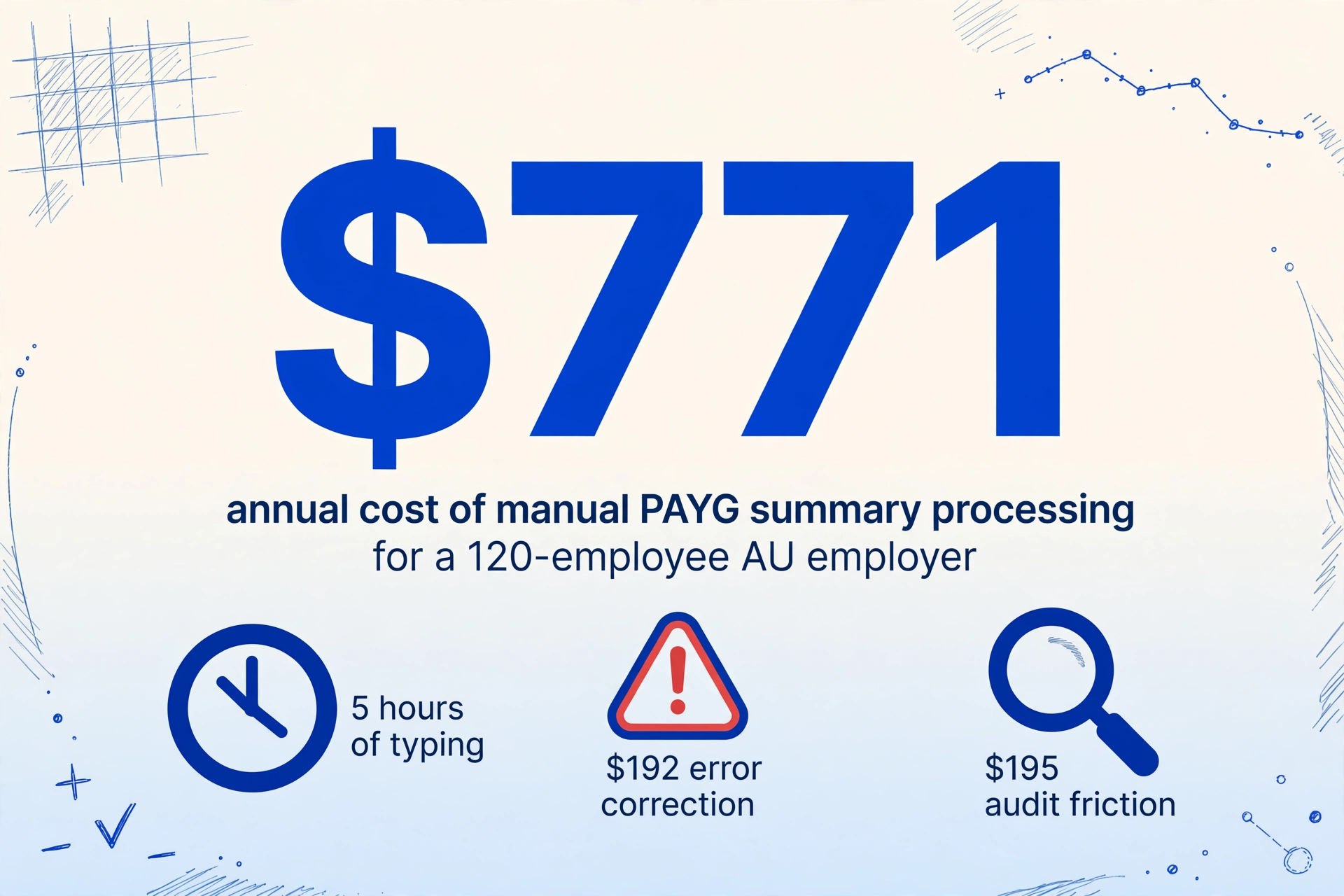
- A 120-employee company spends $771 per tax year on manual PAYG summary processing — but the finance director only sees the $240 labour line because the other $531 hides across error correction, audit compliance, and HR operations budgets.
- At 0.5% digit error rate across 15,360 keystrokes, roughly 8 summary fields are mistyped per year — each one surfaces months later as an ATO query, an auditor re-sampling, or an employee's confused call during tax time.
- Track one number: your fully loaded per-document processing cost. For a 120-employee employer, automated extraction drops it from $6.43 to $1.35 per summary — a 79% reduction that compounds across five years of mandatory record retention.
Four Cost Components Most Payroll Budgets Miss
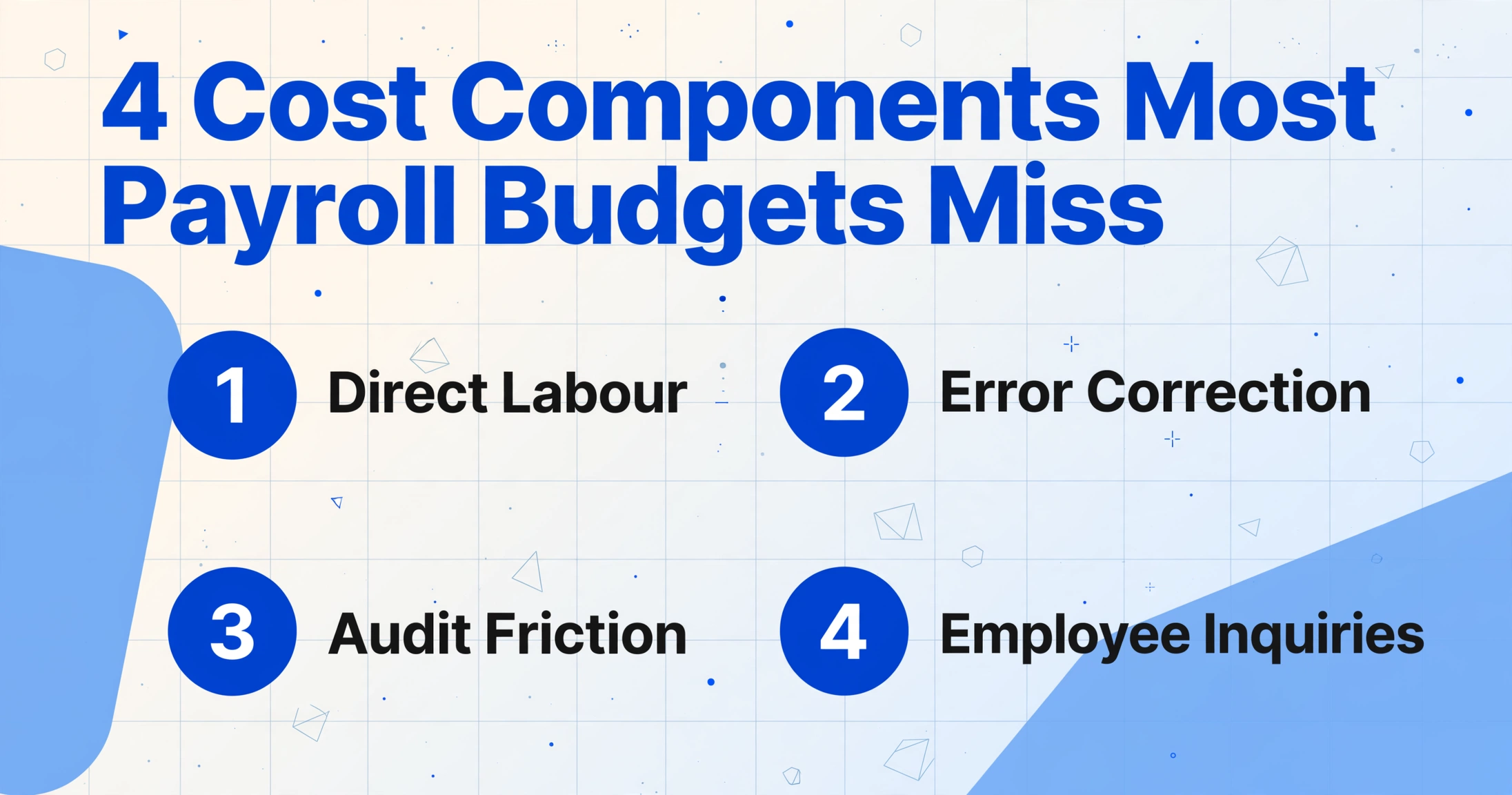
The total cost of manual PAYG summary processing has four components. Only the first — direct labour — appears in payroll department budgets. The other three are dispersed across different cost centres (compliance, audit, HR operations) and almost never aggregated into a single figure. When each component is calculated independently and summed, the total typically exceeds a payroll manager's intuitive estimate by a factor of two to three.
Component 1: Direct Labour
The payroll administrator's time spent typing summary fields into the reconciliation spreadsheet. Measurable as hours × hourly rate. This is the cost most employers already track — but most underestimate the hours by assuming one speed for all summaries when in practice, summaries from different payroll platforms take different amounts of time to retype because field labels vary.
Component 2: Error Correction
The time spent identifying, investigating, and correcting transcription errors — transposed TFN digits, misread gross payment amounts, lump sum amounts entered under the wrong type. Errors detected before distribution cost correction time. Errors detected by the ATO after lodgment cost correction time plus penalty exposure.
Component 3: Audit Friction
The additional hours added to an external audit because the reconciliation spreadsheet was built manually. Auditors must verify extraction accuracy by re-sampling original documents — a step that disappears when extraction is automated and traceable. This cost is shared between the employer (internal staff time) and the auditor (billable hours that may or may not be fixed-fee).
Component 4: Employee Inquiry Handling
The payroll team's time spent responding to employee questions about summary figures during tax time — July through October. Each inquiry requires pulling the original PDF, the payroll register, and the manually entered reconciliation spreadsheet to determine whether the discrepancy is real or a data entry error.
A Calculation Framework: Plug in Your Own Numbers
The framework below is designed to be adapted to any Australian employer's specific circumstances. Replace the default values with your own headcount, hourly rates, and error assumptions. The output is a per-tax-year cost that can be compared against the cost of automated extraction.
Component 1: Direct Labour Cost
| Variable | Default Value | Your Number |
|---|---|---|
| Number of employee PAYG summaries | 120 | |
| Minutes per summary (manual typing of 15-20 fields + cross-check) | 2.5 | |
| Payroll administrator hourly rate (including super and on-costs) | $48 | |
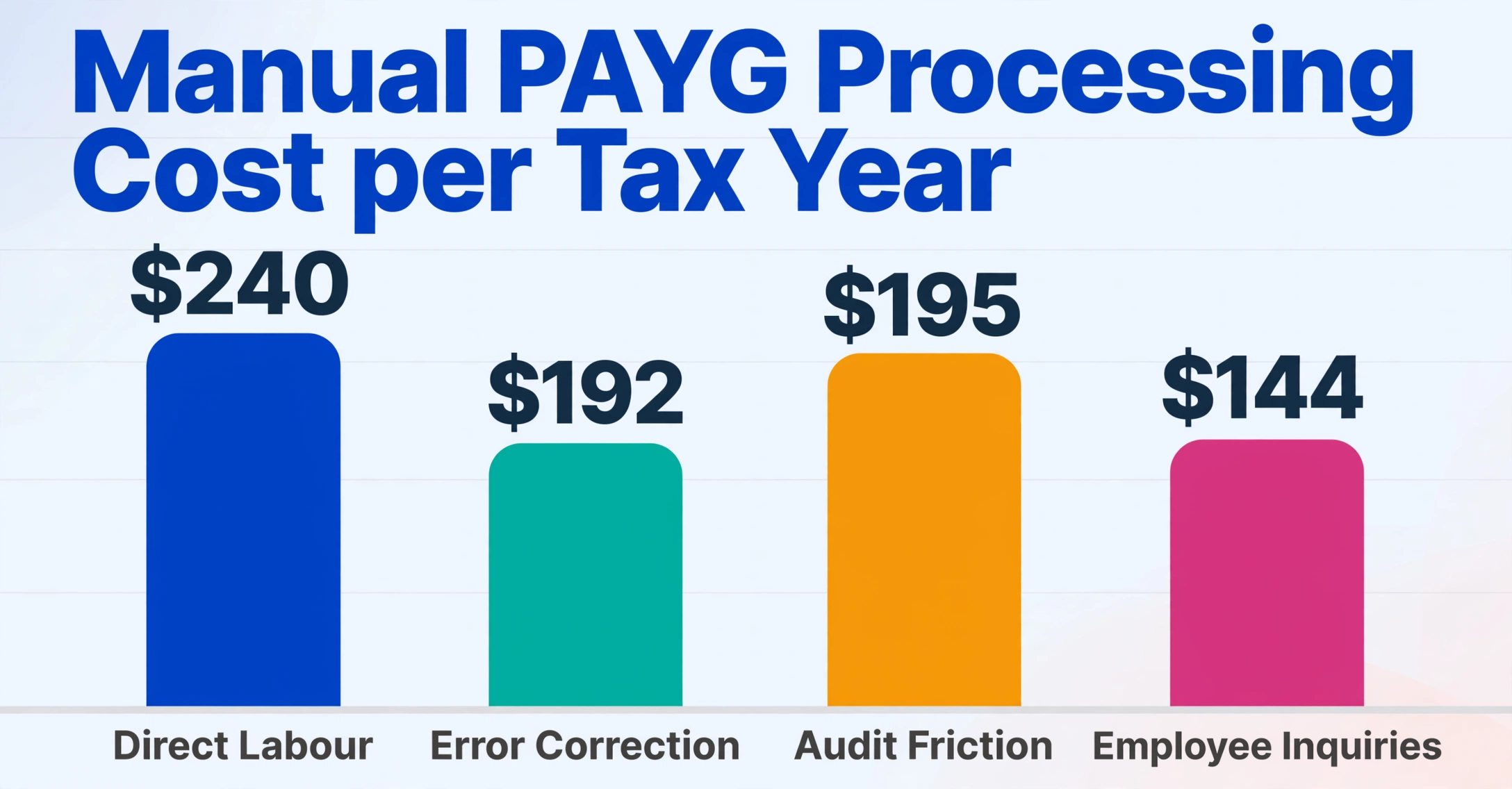
| Direct labour cost per tax year | $240 |
The default hourly rate of $48 is based on the mid-range of a Payroll Officer salary of approximately $75,000-$80,000 plus 12% superannuation and 20% on-costs (leave, workers' compensation, payroll tax on wages), yielding a fully loaded hourly cost of $46-$52. For a senior payroll specialist processing complex summaries with ETP components and multiple lump sum types, use $55-$65 per hour. For an entry-level data entry clerk, use $35-$40 per hour.
At 2.5 minutes per summary, 120 summaries require 300 minutes (5 hours) of direct typing. At $48 per hour: $240. For a company with 500 employees, the direct labour cost scales linearly to $1,000 (500 × 2.5 minutes = 20.8 hours × $48). This is the number most payroll managers already have in their heads — and it is the smallest of the four cost components.
Component 2: Error Correction Cost
| Variable | Default Value | Your Number |
|---|---|---|
| Number of summaries | 120 | |
| Fields typed per summary | 16 | |
| Total digit-level keystrokes (est. 8 chars/field × 16 fields) | 15,360 | |
| Transcription error rate (digits miskeyed) | 0.5% | |
| Errors requiring investigation | ~8 | |
| Minutes per error to identify, investigate, and correct | 30 | |
| Error correction cost (pre-distribution) | $192 |
The 0.5% digit error rate is conservative for an experienced data entry operator working in a focused session. During the July crunch — when the payroll administrator is interrupted by employee calls, urgent pay adjustments, and last-minute corrections — the effective error rate can double. A single transposed TFN digit (123 456 789 typed as 123 456 798) is an error that slips past a visual review because all nine digits are present — they are just in the wrong order. This error surfaces months later when the employee's tax return pre-fill does not match, triggering an ATO query. Resolution: locate the original TFN declaration, confirm the correct number, lodge an amendment through STP, and respond to the employee. Time: 30-120 minutes per instance.
Beyond transcription errors, classification errors carry their own cost. A lump sum payment entered as Type A (unused annual leave) instead of Type D (tax-free redundancy component) changes the employee's assessable income — the A type is taxable, the D type is not. An employee who expected a $5,000 tax-free redundancy payment sees a $5,000 taxable lump sum on their income statement and lodges a complaint. Resolution time for a classification error: 60-90 minutes because it requires recalculating the correct tax treatment and potentially reissuing the summary.
Component 3: Audit Friction Cost
| Variable | Default Value | Your Number |
|---|---|---|
| Auditor sample size for payroll testing | 20 employees | |
| Additional minutes per sampled employee to verify manually entered data against original PDF | 5 | |
| Internal staff time supporting audit queries on manual reconciliation | 3 hours | |
| Internal hourly rate (finance/payroll manager) | $65 | |
| Audit friction cost per year | $195 |
This component is the most variable because it depends on the auditor's methodology. Some audit firms accept a manually built reconciliation spreadsheet without re-verifying extraction accuracy; others — particularly those following AUASB auditing standards for substantive testing — require independent verification of data transcribed from source documents. When the auditor re-samples, both the auditor and the internal team spend time they would not spend if the extraction were automated and the original-to-spreadsheet mapping was machine-generated and therefore independently reproducible.
Component 4: Employee Inquiry Handling Cost
| Variable | Default Value | Your Number |
|---|---|---|
| Number of employees | 120 | |
| Employee inquiry rate during July-October (%) | 15% | |
| Number of inquiries | 18 | |
| Minutes per inquiry (locate documents, compare, respond) | 10 | |
| Payroll administrator hourly rate | $48 | |
| Employee inquiry cost per year | $144 |
The 15% inquiry rate is based on the experience of mid-size payroll teams: approximately 1 in 7 employees will question at least one figure on their payment summary or income statement. The most common triggers are a gross payment figure that does not match the employee's mental calculation of their annual salary (because bonuses, allowances, and back pay are included in gross but not in the employee's base salary mental model), a tax withheld figure that seems too high or too low, and an RFBA amount the employee does not recognise (because they forgot about the company car or the health insurance benefit).
Total Manual Processing Cost Per Tax Year
For a 120-employee employer: $240 (labour) + $192 (errors) + $195 (audit) + $144 (inquiries) = $771 per tax year. For a 500-employee employer, the total scales to approximately $3,200 — labour scales linearly, but errors compound because larger batches are more likely to contain complex summaries (ETP, lump sums, closely held payees). For an employer with 1,000+ employees, the total exceeds $6,500 per tax year. These are the costs of processing one year's summaries. Multiply by five years (the ATO's minimum record retention period) and the accumulated cost for a 120-employee employer is $3,855 — all spent on retyping data that already exists in PDFs, scans, and payroll system exports.
Where Manual Processing Costs Hide Outside July
The per-tax-year cost framework above captures costs that occur in the July-October window. Three additional costs are deferred — sometimes by months or years — and are almost never attributed back to manual PAYG processing:
ATO shortfall penalties on incorrect PAYG withholding reports
If a manual transcription error on the PAYG payment summary annual report (NAT 3447) results in an under-reported withholding amount, the ATO may apply a shortfall penalty of 25% of the shortfall for failure to take reasonable care, 50% for recklessness, or 75% for intentional disregard. For a single transposed digit that causes a $5,000 reporting discrepancy, a 25% penalty is $1,250. The ATO distinguishes between genuine errors and systemic negligence — a payroll team that manually retypes summaries every year with no verification mechanism is harder to defend as having taken "reasonable care" than one that uses automated extraction with a machine-verifiable audit trail. The penalty framework rewards processes that can demonstrate systematic accuracy controls.
Payroll software migration rework
When an employer switches payroll platforms — from MYOB to Xero, or from a legacy desktop system to a cloud platform — historical employee data must be migrated. Prior-year PAYG summary figures (gross earnings, tax withheld, super contributions) form the basis of opening balances in the new system. If the only record of those figures is the manually typed reconciliation spreadsheet from each prior year, the migration team must either trust the manual entries (with no verification against source documents) or re-extract every historical summary into the new system. A migration that could be completed in a day using structured, machine-extracted historical data takes a week when source verification is required — and the cost of that extra week is a deferred cost of manual processing incurred years after the original manual entry was done.
Opportunity cost: what the payroll team is not doing during July
The five hours a payroll administrator spends retyping PAYG summaries is five hours not spent on value-adding July tasks: reviewing the Payday Super transition requirements (effective 1 July 2026, requiring SG contributions to reach employee funds within seven business days of each pay date), reconciling the Q4 BAS before the 28 July lodgment deadline, training new payroll staff on STP Phase 2 reporting codes, or preparing the payroll budget for the new financial year. Manual data entry has an opportunity cost — and in July, when every payroll team is capacity-constrained, that cost is higher than at any other point in the year.
What Automated Extraction Changes in the Cost Equation
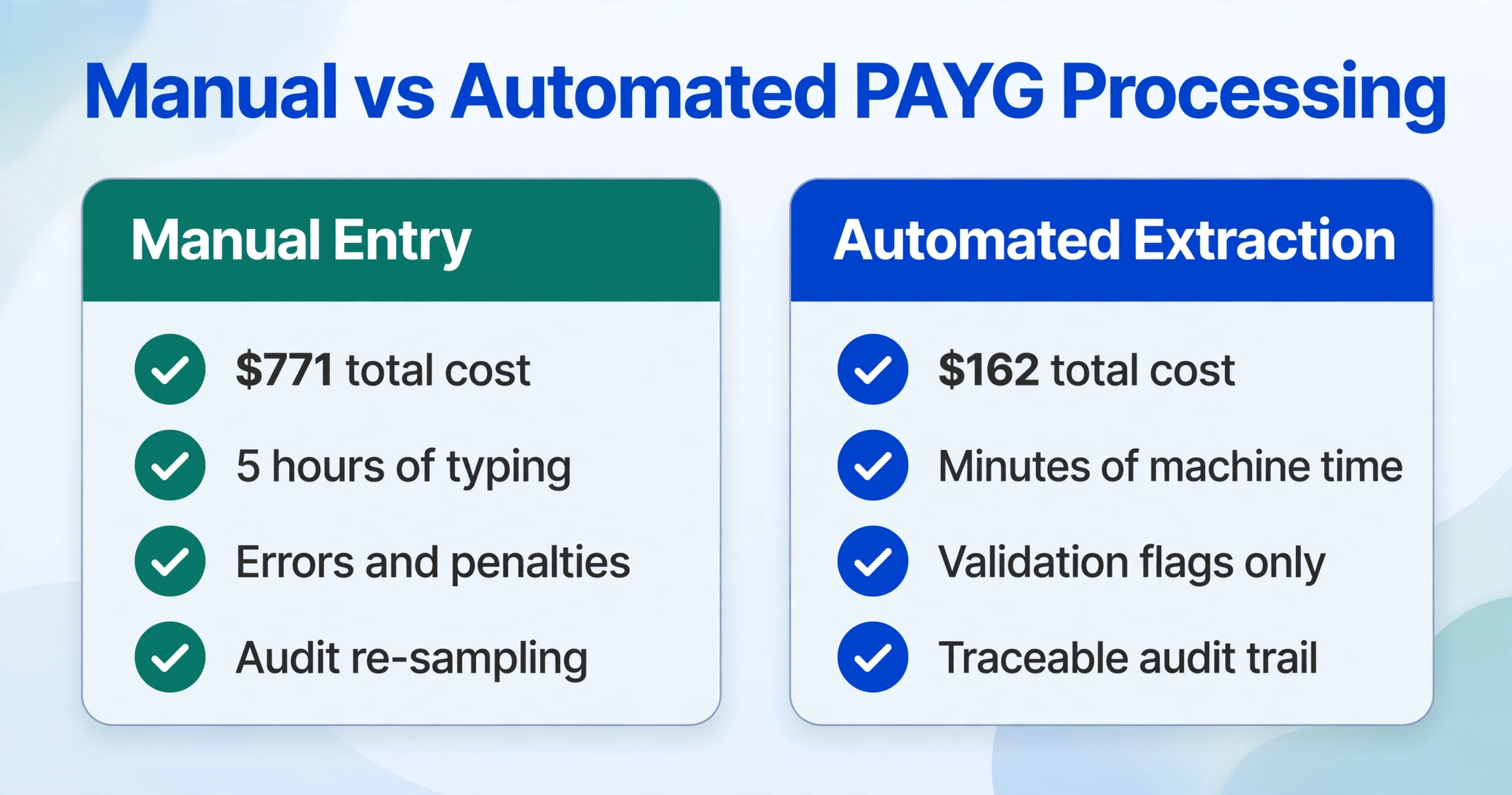
Replacing manual typing with automated PAYG summary extraction eliminates Component 1 (direct labour) almost entirely — the extraction itself takes minutes rather than hours. But the larger financial impact is on Components 2-4, where the cost reduction is multiplied because errors, audit friction, and employee inquiries compound the original data entry cost.
The cost comparison for a 120-employee employer, per tax year:
| Cost Component | Manual Entry | Automated Extraction | Annual Saving |
|---|---|---|---|
| Direct Labour | $240 | $0 (machine time) | $240 |
| Error Correction | $192 | $40 (reviewing validation flags) | $152 |
| Audit Friction | $195 | $50 (reduced verification time) | $145 |
| Employee Inquiries | $144 | $72 (fewer errors = fewer inquiries) | $72 |
| Total | $771 | $162 | $609 |
The per-year saving of $609 for a 120-employee employer scales to approximately $2,500 for a 500-employee employer and $5,000 for a 1,000-employee employer. Over five years — the ATO's minimum record retention period — a 120-employee employer saves about $3,045 in direct and indirect costs, while building a verifiable, auditable extraction archive that reduces the cost of any future ATO review, payroll software migration, or employee dispute that requires accessing historical summary data.
The same cost framework applies to UK employers processing P60 forms and P45 leaver certificates — the document type changes, the tax year and currency change, but the four cost components (labour, errors, audit friction, inquiries) and their relative proportions remain remarkably consistent across jurisdictions.
Frequently Asked Questions
How do I calculate my own payroll team's fully loaded hourly rate?
Start with the base annual salary (e.g., $75,000 for a payroll officer). Divide by 1,976 hours (38 hours × 52 weeks) for the base hourly rate ($37.96). Add superannuation at 12% ($4.56). Add on-costs — workers' compensation insurance (typically 1-3% of salary), payroll tax (varies by state, typically 4-6% in NSW/VIC), and leave loading. A reasonable on-cost estimate is 20-25%, adding approximately $9.50. Fully loaded hourly rate: ~$52. Use this figure for internal cost calculations. For a payroll manager on $120,000, the fully loaded rate is approximately $78 per hour.
What's the most expensive single error in manual PAYG processing?
Misclassification of a lump sum payment. Entering a $20,000 genuine redundancy payment as Lump Sum A (taxable unused annual leave) instead of Lump Sum D (tax-free redundancy component) means the employee's income statement shows $20,000 of additional assessable income. The employee faces tax on that amount, disputes the assessment, and the employer must reissue the payment summary with the correct classification. The cost of correcting one misclassified lump sum: 60-90 minutes of payroll officer time, possible amended BAS lodgment if the error flowed through to activity statement reporting, and — in the worst case — an employee complaint to the Fair Work Ombudsman if the error affected the employee's termination payment entitlements.
Does the cost framework change if my company is fully on STP?
If 100% of your employees are reported through STP and you have zero traditional PAYG payment summaries to issue — no closely held payees, no pre-STP tail, no third-party certificates — the direct labour cost (Component 1) drops to near zero because your year-end reconciliation is done within the payroll system. However, Components 2-4 may still apply if your STP data contains errors that require correction after finalisation, if your auditor samples payroll records and needs to trace STP-reported figures back to source documents, or if employees query their income statement figures. STP eliminates the paper summary but not the reconciliation obligation — and for employers with any of the edge cases (closely held payees, pre-STP records, third-party certificates), Components 1-4 remain fully applicable.
How do I account for the cost of a payroll software migration in the framework?
Add a fifth component: migration rework cost. Estimate the number of prior-year summaries that need to be re-verified during the migration (typically all summaries for the three most recent tax years), multiply by the time per summary to extract the data from PDFs or scans (2.5 minutes if manual, near-zero if already extracted to a spreadsheet), and apply the payroll team's hourly rate. For 120 employees × 3 years × 2.5 minutes at $48/hour: $720. This is a one-time cost triggered by the migration event, but it is a direct consequence of not having machine-extracted historical data — and for employers that change payroll platforms every 5-7 years, it is a recurring cost on that cycle.