How to Read a C79 Certificate
and Reconcile It Line by Line
A C79 certificate records the import VAT declared against one EORI number in one month. A forwarder's invoice records what the forwarder chose to recharge you. The two documents are built from different events, so they disagree in ways you can predict, and most of those disagreements are not errors. This guide shows what each document proves, which charges belong on the C79 and which never will, where the common variances come from, and how to build a ledger that survives an HMRC inspection.
Key Takeaways
- A C79 and a forwarder invoice that agree on the total can still be wrong, because two errors cancel out and each one stays a separate exposure.
- Only the B00 line on a forwarder invoice can ever match a C79, since A00 is customs duty and duty never becomes input tax.
- Six months is how long HMRC keeps the certificate online, not your reclaim window, which can run four years from the return's due date.
A C79 Proves Import VAT, Not the Forwarder's Charges
A C79 certificate is HMRC's monthly record of import VAT declared against your EORI number, and it is the evidence that supports the import VAT element of box 4 on a VAT return. It is not a statement of what your forwarder charged you, and it does not carry the forwarder's invoice number.
The certificate is issued when import VAT is paid at the border rather than postponed, most commonly through a duty deferment account. HMRC usually publishes it online by the 10th working day of the following month, covering the previous month's accounting dates. Online access lasts six months, then the certificate is archived, so the working copy has to be downloaded and kept.
A C79 line is sparse. It identifies the entry and the accounting date and gives a VAT amount. There is no supplier name, no purchase order, no goods description and no forwarder invoice number on it. That is why matching certificates to invoices by recognising the supplier does not work, and why a reconciliation that starts from your purchase ledger usually ends with the conclusion that the certificate is wrong.
The second boundary is duty. A C79 is an import VAT certificate. Customs duty is a cost, not input tax, and it never goes in box 4. A duty deferment statement covers everything deferred through the account, including duty and VAT, so it proves the money left the account, but it does not separate the part HMRC will accept as import VAT. That separation is the C79's job.
The third boundary is who owns the VAT. HMRC's position is that only the owner of the goods at the time of import can recover the import VAT, and the owner's EORI should be the one in box 8 of the declaration. Paying the VAT, arranging the freight or acting as importer of record does not create the right to reclaim it. That is why a forwarder cannot pass you a VAT invoice for the import VAT it paid on your behalf. When the forwarder is acting as your agent, it is not making a taxable supply of that amount, and the certificate in the right entity's name is the normal evidence for the claim.
The C79 is evidence of import VAT only. Duty, freight and clearance fees are costs, and none of them becomes input tax because they appear on the same invoice.
The Invoice Total Is Not a VAT Figure
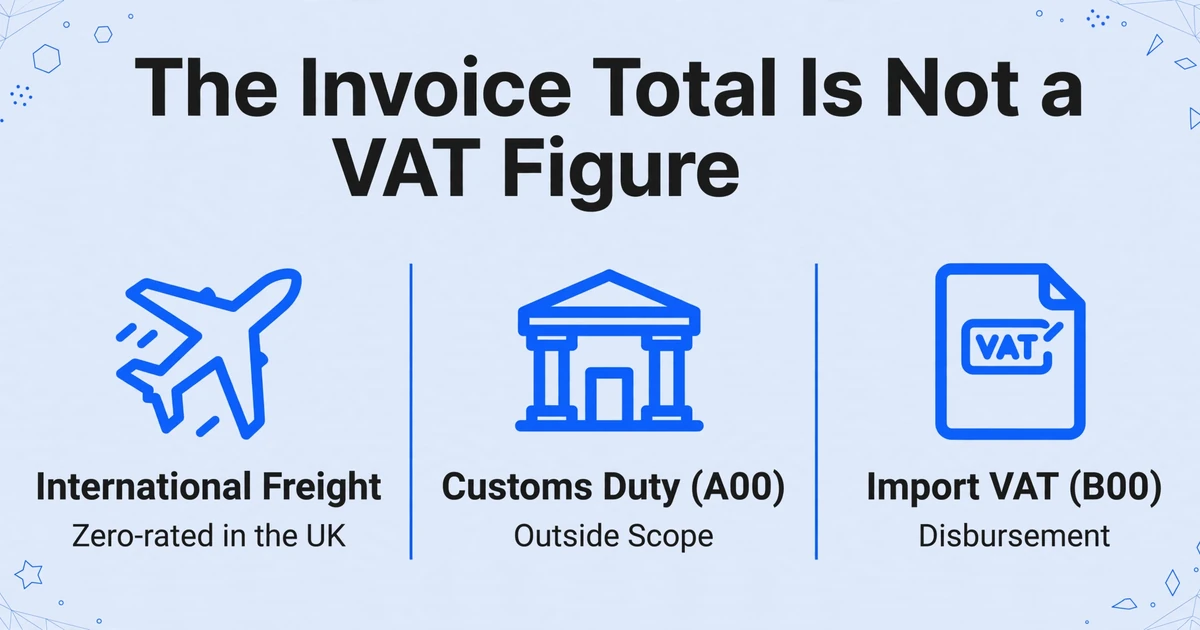
A forwarder invoice mixes charges that carry three different VAT treatments, so its total is a commercial total, not a VAT figure. Checking it against the C79 total is a category error before any numbers are compared.
The customs declaration labels each charge with a tax type code. B00 is import VAT and A00 is customs duty. A forwarder that itemises by tax type is handing you the cleanest possible ledger: the B00 line is the only line that can match the C79, and the A00 line is a cost. A forwarder that bundles everything into "customs charges" or "import fees" is handing you a line that has to be split before it can be checked.
| Charge on the forwarder invoice | What it is | VAT treatment | Evidence for the VAT |
|---|---|---|---|
| International freight and transport to the first UK destination | Moving the goods into the UK | Zero-rated to the extent it is supplied in the UK | Forwarder invoice |
| UK transport after the stated destination | A domestic movement after the import leg | Standard-rated | Forwarder invoice |
| Customs duty (A00) | A tax on the goods, not a service | Outside the scope as a disbursement, and a real cost | Customs declaration |
| Import VAT (B00) | VAT charged on the import | A disbursement, not a supply by the forwarder | C79 or postponed import VAT statement |
| Customs clearance or agency fee | A service, often arranging the entry | Depends on the supply; there are no special rules for forwarders | Forwarder invoice |
| Deferment or administration fee | A service connected with payment or handling | Standard-rated | Forwarder invoice |
The zero-rating is narrower than it looks. Transport connected with an import is zero-rated only to the extent it is supplied in the UK, and transport after the goods reach their stated destination is standard-rated. A forwarder may zero-rate the import leg and standard-rate a later UK movement on the same invoice. The invoice total then contains a mix of 0% and 20% VAT that has nothing to do with the C79.
The import VAT amount is rarely 20% of the goods value. The value for VAT is the customs value plus incidental expenses such as commission, packing, transport and insurance up to the first destination in the UK, plus customs duty and excise duty. Duty sits inside the VAT base even though it is outside the scope as a charge. A quick check of "goods value times 20%" will therefore disagree with the C79 on every consignment that carries duty, and the disagreement is not evidence of an error.
The only defensible comparison is B00 against C79, line by line, after the invoice has been split into its charge types. The rest of the invoice is cost accounting.
A forwarder invoice total is a commercial total. The only line on it that represents import VAT is the B00 recharge, and the invoice is not the evidence for that line.
The Five Variances You Will Actually Find
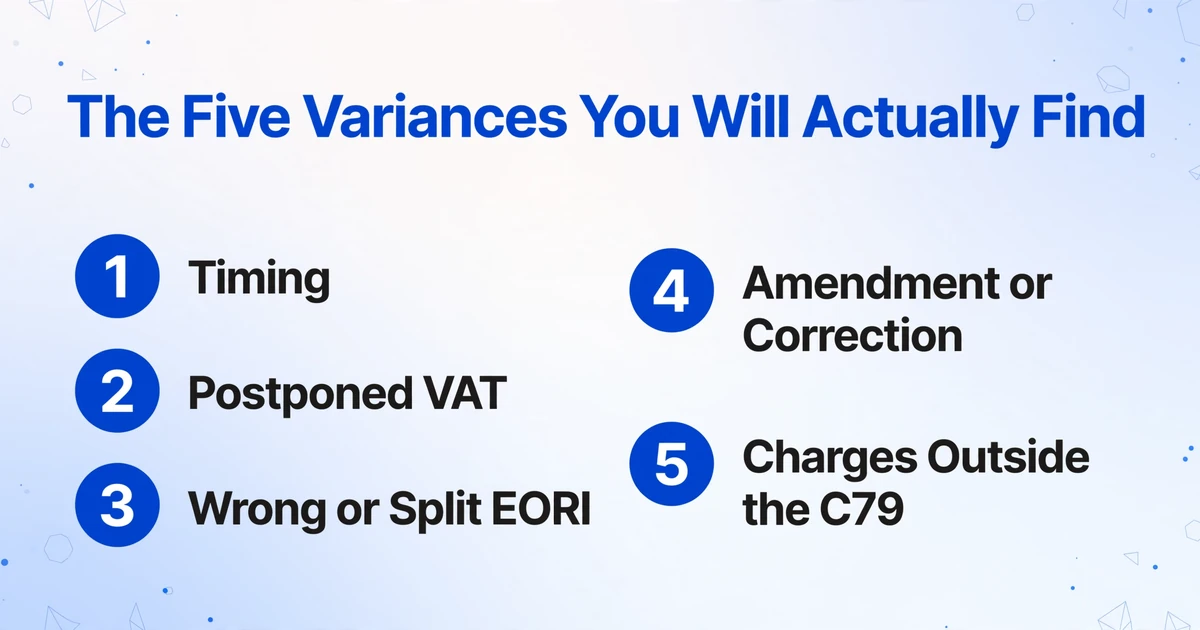
Almost every mismatch is one of five things: a timing difference, a postponed entry, an EORI problem, an amended declaration, or a charge that was never on the C79. Each has a different fix, and only the EORI problem usually requires the forwarder to amend a declaration.
| Variance | How you see it | The fix |
|---|---|---|
| Timing | The invoice is in this month's ledger, the C79 line is on next month's certificate | Match on the accounting date and entry reference, not the invoice date; keep a period column on both sides |
| Postponed VAT | A forwarder invoice shows import VAT, but the C79 has no line for that entry | Check the postponed import VAT statement; reconcile the C79 population and the PVA population separately; never claim both |
| Wrong or split EORI | An invoice line has no C79 line for two months, or one shipment produced two sets of entries | Ask the declarant (usually the customs broker or forwarder) which EORI was used and amend the declaration; match at entry level, not invoice total |
| Amendment or correction | A matched amount changes in a later month, or a negative line appears | Follow the amended entry; a negative amount is a repayment or correction, not a data error |
| Charges outside the C79 | The invoice is higher than the certificate by duty, fees or onward freight | Compare B00 only; treat the rest as cost |
Timing gets logged as an error most often. The C79 follows the accounting date on the declaration, not the invoice date and not the date the goods reached your warehouse. For a deferment entry the accounting date is normally the date of clearance. A container cleared on 29 January and invoiced on 4 February appears on the January certificate while the invoice sits in the February ledger. Nothing is wrong, and forcing the invoice into January creates a variance that reverses itself.
Postponed VAT accounting removes the C79 from the route entirely. The entry appears on the monthly postponed import VAT statement, and the VAT is declared in box 1 and recovered in box 4 on the same return. The importer can choose PVA on some entries and deferment on others, and the forwarder declares it that way, which is how a quarter ends up with both populations. Importers who registered for PVA still report couriers charging import VAT at the border, so the split is real. The failure mode is a double claim: the invoice line is posted as input tax because it says "import VAT", and the monthly statement is also claimed because it is the official record. The entry belongs in one population only.
The EORI problem is usually the first thing to check when an invoice line has no certificate line. HMRC only issues a C79 where a recognised VAT-registered importer's EORI is declared at header level. A forwarder that declares under its own EORI, a superseded entity number or a sister company puts the VAT on the wrong certificate. The same thing happens when one shipment is split across two declarations under two EORIs: the forwarder sends one invoice, but HMRC produces two populations, and the invoice total will not equal either certificate total.
A total that agrees while the lines do not is not reconciled. Two errors can cancel, and each one is a separate exposure.
Build Two Ledgers and Join Them on the Entry Reference
The ledger needs two populations and one join key. The populations are the C79 certificates and the forwarder charge lines. The join key is the entry reference, because it is the one value that appears on the customs entry, on a properly itemised forwarder invoice and on the HMRC record.
The entry reference is not the forwarder's invoice number. The C79 carries the entry reference and accounting date. The postponed import VAT statement goes further and prints the date of import, the entry number, the declarant's reference number, the declarant's EORI and the VAT amount. HMRC describes the declarant's reference as recognisable to you and your intermediary, which makes it the practical bridge when a forwarder prints its own job number. Where neither is printed, ask for the entry documents rather than matching on amount; two consignments in one month can carry identical VAT.
The C79 batch is one row per certificate. The columns are certificate period, EORI, VAT registration number, entry VAT total, printed certificate total and certificate variance. The entry VAT total is a computed column that sums the entry lines on the certificate; the variance returns OK when the two agree and the difference when they do not. That check catches a misread entry before the certificate enters the reconciliation.
The invoice batch is one row per invoice, with a column for each charge type: invoice number, invoice date, entry reference, import VAT (B00), customs duty (A00), freight net, freight VAT, clearance fee net, clearance fee VAT, deferment fee and invoice total. Where a charge type appears more than once, the column sums those lines. Two computed columns do the arithmetic inside the document: a charge total that sums all the lines, and a check that returns OK when the sum matches the printed invoice total, otherwise the difference. A third check divides the VAT charged on the fee lines by their net amount and flags anything that is not 0% or 20%, which is where a misclassified clearance fee shows up.
This is where the product settings matter. Custom Column Extraction means you type the column names you want, such as "Import VAT (B00)" or "Entry reference", and the AI finds the value by understanding what it means, not by its position on the page. A forwarder that prints the entry reference in the footer and one that prints it beside the invoice number both resolve to the same column. Batch processing means the quarter's certificates go in as one upload and the invoices as another, each coming out as one table with a row per document. Computed columns are the row-level and section-level checks described above.
The reconciliation sheet is the third piece, and it is deliberately a spreadsheet step. The period variance is a SUMIFS of B00 recharges by certificate period and EORI, subtracted from the certificate total. The tool can compute the two sides; it cannot decide which side is right, because that decision depends on the entry, the declaration and the commercial agreement. Entry-level rows are added only for exceptions, which keeps the working paper short and makes the exceptions visible.
Review Mode and Bbox are what make the ledger checkable. Hover or click a cell and the original region on the C79 or the invoice is highlighted; click a region on the document and the matching cell is selected. If a field was edited, one click shows the AI's original value and restores it. For an import VAT working paper, this is the difference between "the spreadsheet says £4,218" and "here is the line on the certificate that says £4,218". It can be triggered on demand or set to run after processing.
- Extract the C79s into the certificate ledger and check the entry sum against the printed total.
- Extract the invoices into the charge ledger and check the charge sum against the invoice total.
- Load both into the reconciliation sheet, run the SUMIFS by period and EORI, and work the exception list with Bbox.
The Month-End Routine and the Two Deadlines
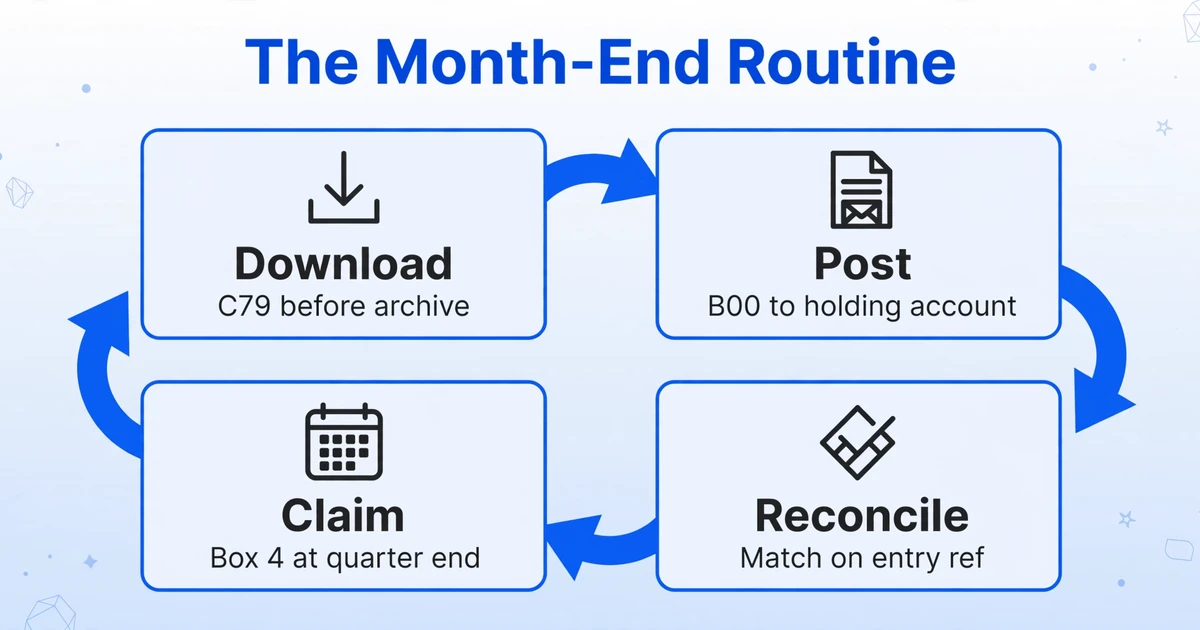
Six months is how long HMRC keeps the certificate available online. Four years is how long you have to correct a return that missed the claim. Those two numbers get mixed up constantly, and the mix-up causes both panic and permanent losses.
The routine is monthly, not quarterly. Download the C79 or the monthly statement in the first half of the following month, before the six-month archive matters. Post forwarder invoices as they arrive, coding the B00 recharge to an import VAT holding account rather than to input tax. When the certificate arrives, reconcile the period and clear the holding account only for the entries that match. Keep the unmatched list and chase the declarant for the entry documents, not the invoice. At quarter end, total the C79 and PVA populations separately and agree each to box 4.
The claim belongs in the return for the period in which the import VAT was accounted for. If it was missed, it becomes an error correction. VAT Notice 700/45 sets the limit at four years from the due date of the return for under-claimed input tax, and the same notice sets the threshold for correcting on a later return: a net error of £10,000 or less, or £50,000 or less and under 1% of box 6. Above that, the correction goes to HMRC as a separate notification rather than on the next return.
Run a twelve-month backstop once a year. Total the import VAT on the last twelve months of C79s and monthly statements and compare it with the import VAT element of the input tax claimed for the same periods. If the certificates and statements are higher, VAT was paid and never reclaimed. If they are lower, input tax has been claimed without a certificate or statement behind it, which is the double-claim pattern and the more urgent of the two. The comparison is crude, but it finds both directions of error in an afternoon.
The VAT return has its own arithmetic checks. If you build the import VAT working paper in a spreadsheet, cross-check the box arithmetic on the return before filing, especially box 4 against the certificate total and box 7 against the goods values. The same discipline applies to the domestic VAT invoices behind the rest of box 4, where the evidence rules are different from the import route.
Do not hold the ledger open waiting for a certificate. Post the invoice, hold the VAT, and release it when the certificate agrees.
What Extraction Can and Cannot Do
Extraction gives you the structured evidence. It does not decide eligibility, file the return or fetch certificates from CDS.
What it does is narrow and useful. It reads the C79 and the forwarder invoice, including scanned PDFs and phone photos, and returns the columns you named. It handles a quarter of each in one batch, so each ledger is built from the same column definitions every month. It computes the section totals and the conditional checks inside each document. It lets you click any cell back to the source region. The output is XLSX, CSV or JSON.
What it does not do is just as important. It does not sign in to the Customs Declaration Service, download certificates or retrieve postponed statements. It does not file a VAT return or submit an error correction. It does not decide whether your business owns the goods, whether the import was for a business purpose, whether partial exemption limits the claim or whether the forwarder's EORI was the right one. It does not adjudicate a variance, and it cannot split a single "customs charges" line into duty and VAT if the forwarder did not itemise it. If the invoice does not print the entry reference, the tool cannot invent one.
That boundary is the point. A structured ledger is evidence. It is not a reclaim decision. The person who signs the return still has to read the entry, confirm the EORI and decide which document needs correcting. The tool makes that review fast enough to do every month instead of every audit.
The same field-level discipline applies to the rest of the evidence file. Domestic VAT invoices behind box 4 need different fields from a C79. A till receipt is not a VAT invoice, and the fields HMRC checks on a UK VAT invoice are a separate list. The import route is unusual only in that the evidence is a certificate keyed to an EORI rather than an invoice keyed to a supplier. The column-first approach is the same one described in the complete guide to invoice data extraction.
The tool structures the evidence. The judgement about what is reclaimable stays with the person who signs the return.
FAQ
Can I reclaim import VAT without a C79?
It depends on the route. If the VAT was postponed, the monthly postponed import VAT statement is the evidence, not a C79. If the import was made through IOSS, no C79 is issued and the VAT cannot be reclaimed through the normal business rules; keep a copy of the declaration as the import evidence. If a C79 should exist but is missing, HMRC can accept alternative evidence, and a copy of the declaration is the first thing to hold while you ask the declarant to trace the entry.
Is the six-month window the deadline to reclaim?
No. Six months is how long HMRC keeps the certificate available online. The claim normally belongs in the return for the period in which the import VAT was accounted for, and a missed claim can be corrected within four years of the due date of that return, subject to the error-correction threshold.
The forwarder charged import VAT but no C79 line appeared. What should I check?
Check the EORI on the declaration first, then whether the entry was put through postponed VAT accounting, then the accounting date. If the EORI was the forwarder's own or a superseded number, the VAT is on another certificate and the declaration needs amending. If the entry was postponed, the line is on the monthly statement. If it is only timing, it will appear on the next certificate. Do not claim the invoice line while you wait.
Can I reclaim the customs duty as well?
No. Customs duty is a cost, not VAT. It does not go in box 4 and there is no input tax to recover on it. Duty is still part of the value for import VAT, which is why the C79 amount is higher than 20% of the goods value.
Two EORIs were used on one shipment. Why do the totals not agree?
Two EORIs mean two declarations and two sets of entries on the HMRC side. The forwarder's single invoice covers the commercial movement, but the certificates split it by EORI. Match at entry level and expect the invoice total to equal the sum of two certificate populations, not either one on its own.
What if the C79 shows a negative amount?
A negative amount is a repayment of import VAT or a correction of an earlier entry. It is not a data error. Match it to the amended entry and keep it in the month it appears rather than forcing it back into the original period.
What is the difference between a C79 and a duty deferment statement?
The deferment statement is an account statement for everything deferred through the account, including duty and VAT. The C79 is the VAT-only certificate built from the declarations. The statement proves the money moved; the C79 is the evidence for the input tax claim.
The Certificate Is the Control, Not the Calculation
A C79 does not tell you what your forwarder charged, and a forwarder invoice does not tell you what HMRC recorded. The reconciliation works when you treat the certificate as the control total, the invoice as the commercial breakdown and the entry reference as the bridge between them. Build that once, and the next quarter is a filter and a short exception list, not a reconstruction.