Best Purchase Order Extraction Software in 2026
7 Tools, Honestly Compared
Procurement automation rarely stalls on the suppliers you'd expect. The big vendors send clean electronic POs that flow straight into your ERP; the part that never automates is the long tail — the small fabricator who emails a scanned PDF, the contractor who still faxes a handwritten order, the supplier who quietly changes their layout every quarter. That's where the rekeying lives, and it's why APQC benchmarking finds organizations spend anywhere from about $14 to more than $54 to process a single purchase order — a gap driven less by volume than by how much of the work is still manual. Before going further, a disclosure: ImageToTable.ai is one of the seven tools reviewed here, and it isn't the right pick for everyone. This review compares seven purchase order extraction tools on the same six dimensions, gives each an honest "best for" and "not ideal for," and ends with a decision guide so you can match a tool to your supplier mix instead of a marketing claim.
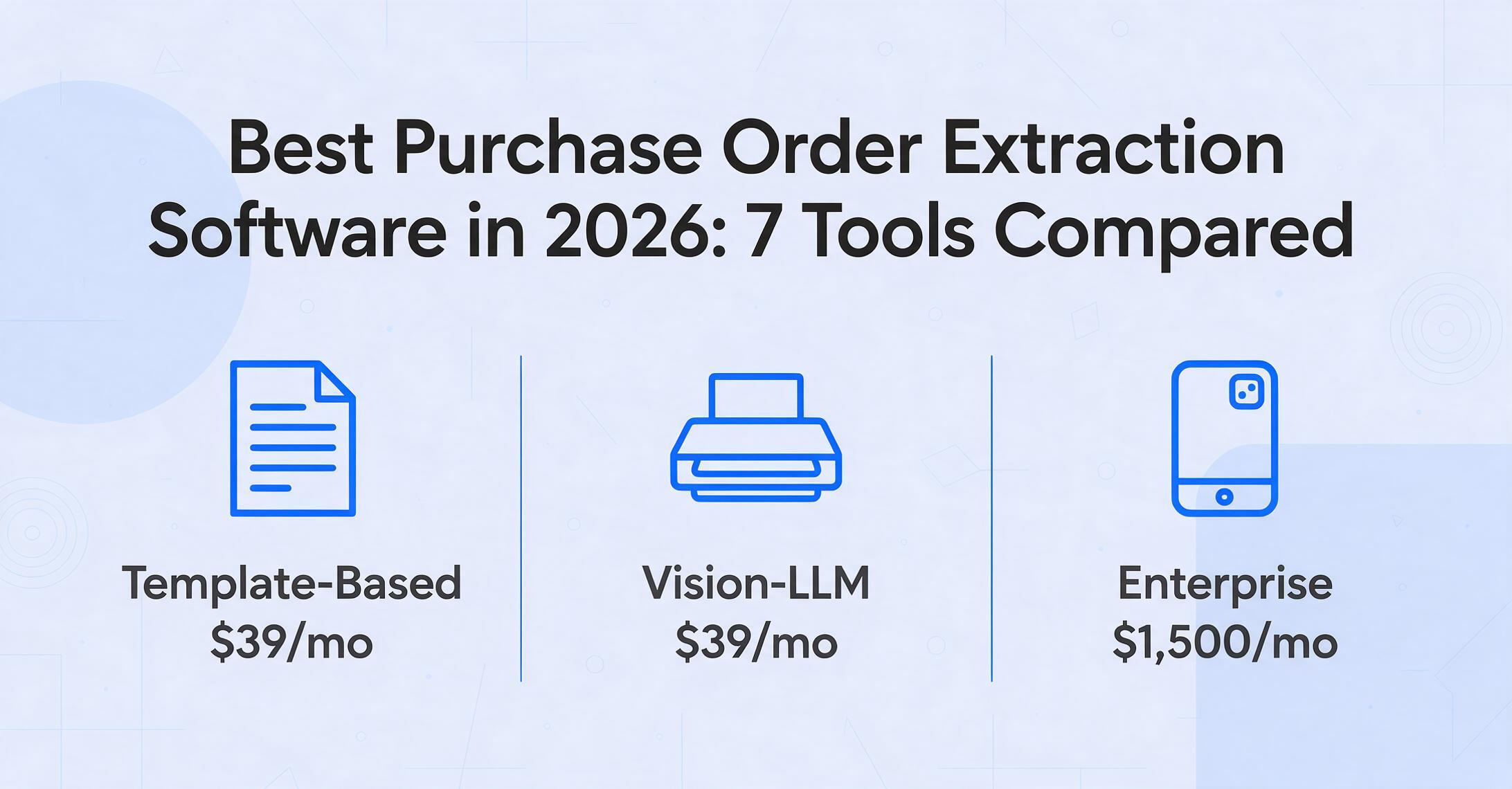
Key Takeaways
- The suppliers you'd expect to be hard aren't the problem — the rekeying lives in the long tail of small shops that email scanned PDFs and fax handwritten orders.
- You can't escape it by asking suppliers to standardize — fifty vendors send fifty different layouts, and not one of them has any reason to reformat their PO for you.
- The single feature that decides whether a tool scales or becomes a second job is whether it reads a PO by meaning instead of by position, so it pulls the right fields off a layout it has never seen with no template to build per supplier.
How We Picked and Tested These Tools
We limited this list to tools that actually read an existing purchase order and pull its data into structured rows — not platforms that create POs. That distinction filters the field hard (more on it in the next section), so the seven tools here are the ones a serious PO-extraction shortlist is genuinely expected to cover: the no-code parsers, the GPT- and vision-based extractors, and the enterprise platforms that read POs as one step in a full procure-to-pay operation. We left out procurement suites with no document-extraction capability, and tools that exist only as a demo behind a sales wall with no public detail.
For each tool we did three things. First, we pulled the lowest publicly listed price from the vendor's own pricing page, with every figure labeled "Pricing checked June 2026" rather than the vague "starting from." Second, we identified each tool's core extraction model — zone/template, trained model, vision-LLM, or raw OCR API — because with purchase orders specifically, that single choice decides whether a new supplier's layout breaks your setup. Third, we wrote a plain "best for" and "not ideal for" for every tool, including our own, based on where its price, setup model, and feature set honestly fit. We did not invent competitor weaknesses; a single factual error would discredit the whole list.
Disclosure
ImageToTable.ai, the tool published on this site, is one of the seven tools reviewed below. We've placed it where it honestly fits — template-free extraction across many supplier PO layouts — and named the tools that beat it for enterprise procure-to-pay, PO-to-invoice three-way matching, and certified ERP posting.
"Purchase Order Software" vs Purchase Order Extraction
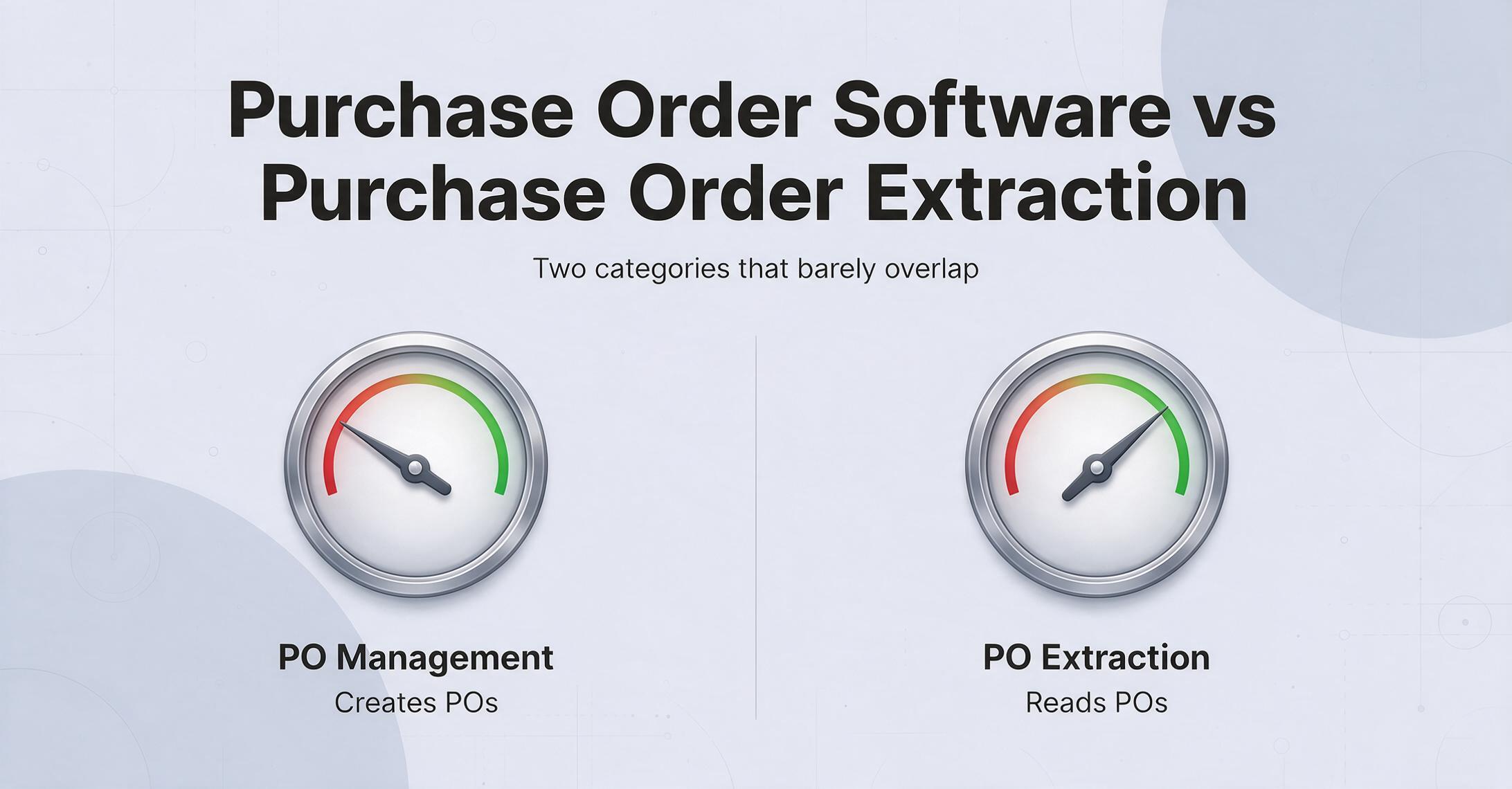
If you searched "purchase order software," most of what you found solves a different problem than this article. The term covers two categories that barely overlap. Procurement / PO management platforms — Coupa, SAP Ariba, Procurify, Precoro, Tradogram — help you create purchase orders: raise a requisition, route it for approval, issue the PO to a supplier, and track it. They generate outbound documents and govern spend.
Purchase order extraction software does the opposite. It reads a PO that already exists — a supplier's order confirmation, a buyer's PO that arrived as a PDF, a scanned or photographed order — and pulls the data off it: PO number, vendor, line items, quantities, unit prices, delivery terms, and totals, into structured rows you can drop into Excel, a database, or an ERP. Extraction sits upstream of your other systems; it turns an unstructured document from an outside party into data your procurement or accounting platform can ingest. The two categories complement each other — a management suite has nothing to read inbound supplier documents with, and an extraction tool doesn't run approvals — but they are bought for different reasons. Everything below is about the extraction side.
Why Purchase Order Extraction Is Harder Than It Looks
The difficulty isn't reading text — it's that every supplier formats a purchase order differently. A PO carries the same handful of fields a buyer needs — PO number, vendor, ship-to, line items, quantities, unit prices, delivery date, terms, and total — but those fields sit in a different place on every supplier's template. One vendor puts the PO number top-right; the next buries it in a footer. One itemizes per line with part numbers; another sends a single free-text block. And unlike high-volume EDI partners, the long-tail suppliers send POs as emailed PDFs, scans, and even handwritten forms.
That's the exact wall procurement teams describe. In one r/procurement thread on messy procurement PDFs, a buyer listed the failure modes plainly: "Same supplier uses a different format every month… Mixed currencies inside the same document… Scanned PDFs that OCR kind of reads… but not reliably." Their sharpest point: "The worst part isn't extraction — it's trust," because even when a tool pulls the numbers out, someone still has to verify totals and catch edge cases. Others are starting from further back — one team described trying to "bring our PO process out of the stone age," with "handwritten POs, physical signatures, and paper files everywhere."
This is why one technical distinction decides whether a tool will actually help with your real workload, and it's the axis the rest of this review turns on:
Template / zonal tools
You map each field to a region of a sample PO — "the PO number lives in this rectangle, line items in this table zone." It's precise and cheap for a fixed set of suppliers whose layout never changes. But the map is layout-specific: when a new vendor sends a differently-shaped PO, the zones miss, and you build a new template. With dozens of suppliers, template maintenance becomes the job.
Template-free AI extraction
A vision-language model reads the PO by meaning, not position. You name the fields you want — "PO Number, Vendor, Item, Qty, Unit Price, Delivery Date" — and the AI finds each value wherever it sits, on a layout it has never seen, with no template to build. The trade-off is less pixel-perfect control on rigidly fixed forms, in exchange for handling many suppliers without setup.
So when a tool claims it "handles any purchase order," the question is which side of that line it sits on. A template tool handles any PO you've already built a template for; a template-free tool handles POs it has never seen. For a business receiving orders from two or three consistent suppliers, the first is fine. For anyone juggling a long tail of supplier formats — including the handwritten and emailed ones — "handle PO variants without templates" is the single feature that separates a tool that scales from one that becomes a second job. (We unpack that mechanism in our comparison of ERP/template-based PO entry versus AI extraction.)
The 7 Tools at a Glance
Here is every tool on the same six dimensions. Prices are the lowest publicly available entry point as of June 2026; "sales-led" means the vendor publishes no self-serve rate card and you have to talk to sales for a quote.
| Tool | Starting Price | Pricing Model | Best For | Key Limitation | Free Trial? |
|---|---|---|---|---|---|
| ImageToTable.ai | Free to try (no sign-up) | Subscription / usage | PO variants from many suppliers, template-free | No ERP posting or PO-to-invoice matching | Yes — instant, no sign-up |
| Docparser | $39/mo (Starter) | Flat subscription | Stable, repeating PO layouts | Zone templates break on new supplier formats | Yes — 14-day + free tier |
| Parseur | $39/mo (Micro) | Flat + volume | Emailed PDF POs flowing into apps | Limited procurement workflow depth | Yes — free 20 pages/mo |
| Airparser | $39/mo (100 credits) | Flat + credits | GPT parsing of irregular / unstructured POs | No confidence scoring; tiny free trial | Yes — 30 credits |
| Nanonets | Usage (~$0.30/doc); Pro $499/mo | Credits / usage | PO automation at scale with ERP posting | Complex for small, simple jobs | Yes — $200 free credits |
| Rossum | ~$18,000/yr (~$1,500/mo) | Annual / sales-led | Enterprise procure-to-pay, PO-to-invoice matching | 30–90 day implementation; overkill for SMB | Demo via sales |
| ABBYY FlexiCapture | Custom (~$0.02–0.08/page at volume) | Page-based / sales-led | Large-scale, regulated, multilingual PO ops | Heavy to configure; long deployment | Yes — Vantage trial |
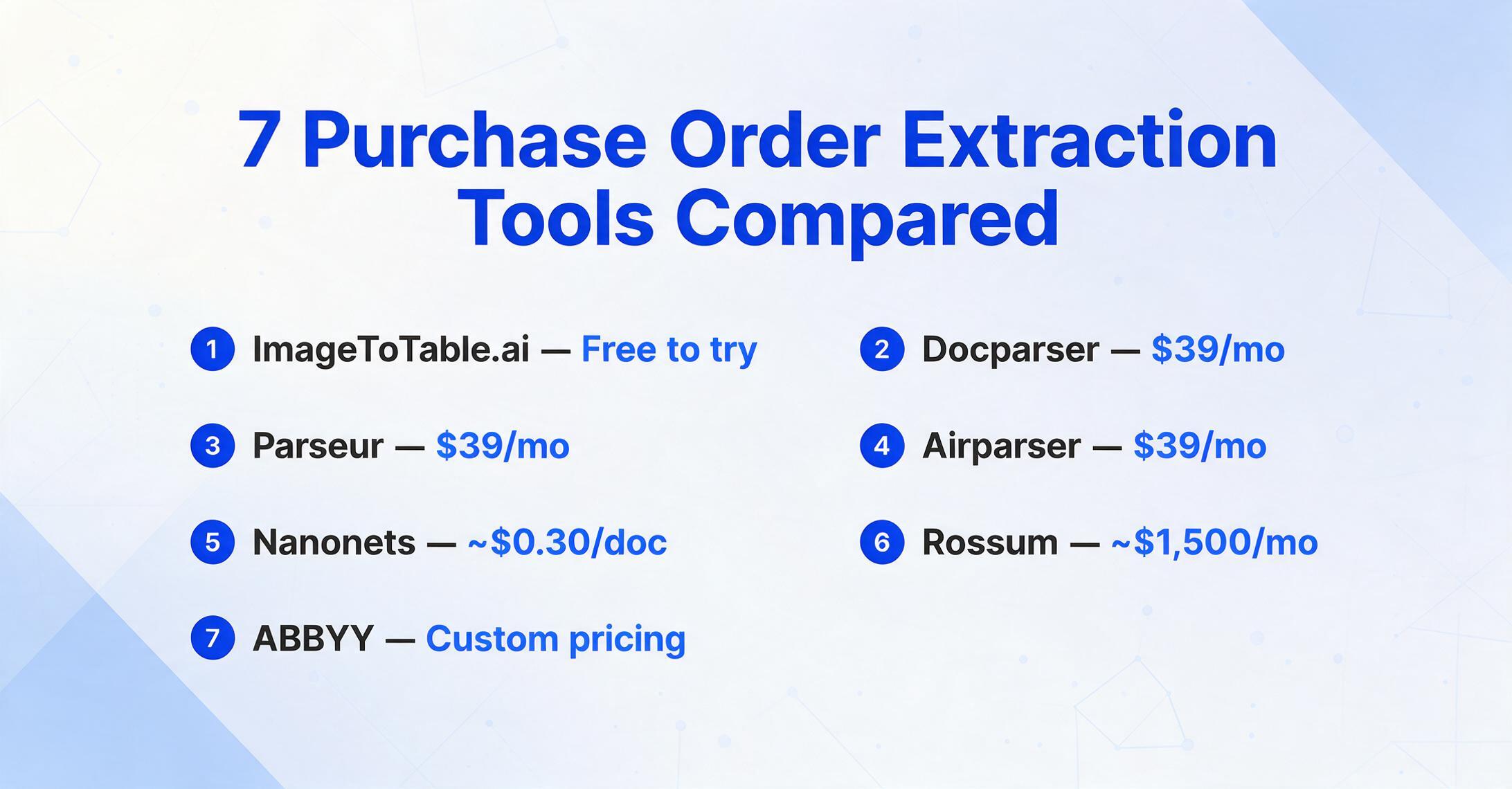
Pricing checked June 2026 from each vendor's public pricing page. Usage-based tools (Nanonets, ABBYY) bill per page or per document, so monthly cost depends on volume. For the full-market view across every document type — not just POs — see our document data extraction tools roundup.
No-Code & Lowest-Cost Tools
These are the tools a small procurement or operations team should start with: everything runs in a browser, with no model to train and no developer to hire. They became viable for purchase orders in the last two years because vision-language models read by meaning rather than coordinates — which is what makes template-free extraction possible at $29–$39/month price points. This is also the band where the template-vs-template-free distinction matters most, because the cheapest tools sit on both sides of that line.
ImageToTable.ai
A no-code, vision-LLM extraction tool built around Custom Column Extraction: instead of drawing zones on a sample PO, you type the columns you want — "PO Number, Vendor, Item, Qty, Unit Price, Delivery Date" — and the AI locates each value anywhere on the page by understanding what the field means. The names you type become your spreadsheet headers. It is batch-first (drop in 50 purchase orders from 50 different suppliers, get one merged Excel file where each PO is a row), supports computed columns (write "Line Total (Qty × Unit Price)" and the math is done during extraction), ships a Google Sheets add-on that writes results into the active sheet, and offers a Collection Link — a shareable URL that lets suppliers or field staff upload POs into your processing queue without creating an account. It reads printed, scanned, and handwritten POs alike.
Best for: Teams receiving purchase orders from many suppliers who want template-free extraction across varied layouts — including handwritten and emailed POs — with the spreadsheet as the destination. Layout variety is exactly what it's built to absorb.
Not ideal for: Organizations that need automatic ERP posting, PO-to-invoice three-way matching, or an approval workflow. It extracts PO data extremely well; it doesn't run the procurement process before or after extraction.
Pricing (checked June 2026): Free to try with no sign-up; affordable monthly plans, with one of the lowest effective per-document costs in this list. You can pull purchase order data into Excel, batch a stack of POs into one spreadsheet, or extract line items and calculate totals in one pass.
If you're weighing whether to buy an extraction tool at all — versus the ongoing cost of manual entry — our automate purchase order data entry guide breaks down the ROI per PO.
Docparser
One of the longest-running parsers in the market, and fundamentally zone-based: you define parsing rules that pull values from specific regions of a PO. For a fixed set of suppliers whose orders never change shape — the same vendors, the same forms, month after month — that approach is precise and dependable.
Best for: High-volume processing of consistent, repeating PO layouts where you can set a template once and trust it.
Not ideal for: Mixed POs from many suppliers. When layouts vary, zone templates need maintenance, and a new vendor format means a new template — the exact failure mode procurement teams describe.
Pricing (checked June 2026): Free tier (limited pages/month), Starter from $39/month, Professional $74/month, with a 14-day free trial.
Docparser pricing → · ImageToTable vs Docparser, feature by feature
Parseur
Strong on email and PDF intake, and it ships a dedicated purchase-order use case. When POs arrive as email attachments and need to flow into downstream systems, Parseur handles the pipeline well, pairing AI extraction with a deep integration layer (1,500+ apps via Zapier, Make, and Power Automate).
Best for: Automating recurring inbound POs that arrive by email and need to land in other apps or a shared spreadsheet automatically.
Not ideal for: Teams wanting a full procurement platform with classification, validation routing, and PO-to-invoice matching out of the box.
Pricing (checked June 2026): Permanent free tier (20 pages/month), Micro from $39/month (annual), scaling to a $399/month tier for 10,000 pages.
Airparser
A GPT-based parser that handles unstructured and human-written documents well, which extends naturally to POs with irregular layouts. Setup is no-code, and it integrates through Zapier and Make for downstream automation.
Best for: No-code users who want GPT-style extraction on variable PO layouts and don't need confidence scoring or table-heavy validation.
Not ideal for: Teams needing per-field confidence scores, advanced multi-line-item table extraction, or a generous trial — the free allowance is small.
Pricing (checked June 2026): Basic from $39/month for 100 credits, with higher tiers at 500, 2,000, and 5,000 credits; free trial of 30 credits.
Enterprise & High-Volume Platforms
These platforms cost more because extraction stops being the product and becomes one module in a full procure-to-pay operation. Alongside reading the PO, they classify it, match it against the invoice and goods receipt, route exceptions to reviewers, post into the ERP, and keep an audit trail. They're built for organizations processing tens of thousands of documents a month with a dedicated team — and the license is rarely the biggest cost; implementation is. If your real bottleneck is PO-to-invoice reconciliation rather than raw data entry, this is the band to look at.
Nanonets
Now positioned as an AI-agent platform for end-to-end AP and procurement automation — reading POs and invoices, applying rules, matching documents, and posting into your ERP. It's substantially more than extraction; it's a workflow engine that scales to enterprise volumes.
Best for: Procurement and AP teams that want extraction plus automated downstream actions — matching, routing, ERP posting — at meaningful volume.
Not ideal for: A small procurement team with a few hundred simple POs a month — the platform's depth is overhead you won't use.
Pricing (checked June 2026): Usage/credit-based — every account starts with $200 in free credits, and you pay per workflow "block," working out to roughly $0.30 per document at common configurations; the Pro subscription is around $499/month.
Rossum
Rossum trains a custom extraction model on each enterprise customer's historical documents, then deploys it into shared-service-center workflows with human-in-the-loop validation and certified ERP integrations (SAP, Coupa, NetSuite). It has strong purchase order and invoice extraction and is built for the PO-to-invoice matching loop. Reviews among enterprise buyers are strong, with a recurring caveat about implementation timelines and post-sales pricing growth.
Best for: Large enterprises running PO and invoice processing through a dedicated team that can absorb a custom-trained, human-in-the-loop deployment with certified ERP connectors.
Not ideal for: SMBs and lean teams processing under ~5,000 documents/month — the 30–90 day implementation and custom-model training are overkill.
Pricing (checked June 2026): Sales-led with no published rate card; third-party listings report a starting plan around $18,000 per year (~$1,500/month), with higher tiers custom-quoted.
ABBYY FlexiCapture
A two-decade market leader, with ABBYY Vantage (cloud-native IDP) and FlexiCapture (on-premise/cloud) anchoring its lineup, and pre-trained "Skills" for documents including purchase orders. ABBYY is recognized for accuracy and multilingual support (180+ languages), and is a common choice for regulated industries processing large, varied document volumes.
Best for: Large-scale, multilingual, and regulated procurement operations that need maximum accuracy and on-premise or hybrid deployment options.
Not ideal for: Small teams or fast pilots — ABBYY is heavy to configure, and deployments typically require internal or external specialists.
Pricing (checked June 2026): Custom quotes; ABBYY doesn't publish a standard rate card. Buyers processing moderate volumes commonly see per-page pricing in the ~$0.02–$0.08 range, plus implementation.
One more class is worth a mention even though it's not on the list: the cloud OCR APIs — Google Document AI (which ships a procurement processor) and AWS Textract. They're not finished products but building blocks: if you have developers and want to assemble a custom PO pipeline that emits predictable JSON, they're the foundation. For a team without engineers, they're not a destination — but they belong in any honest map of the space.
How to Choose by Volume, Vendor Mix, and Where the Data Goes
The right PO tool falls out of three questions, not a feature matrix. Answer these in order and eight options collapse to the two or three worth trialing on your own messiest supplier order.
How many POs a month, and from how many different suppliers?
A few hundred POs from a handful of consistent suppliers: Docparser's zone templates are precise and cheap. A few hundred from many different vendors — including handwritten or emailed ones: a template-free no-code tool (ImageToTable.ai, Airparser) absorbs the layout variety without setup. Tens of thousands across a procurement department: enterprise platforms (Rossum, ABBYY) or Nanonets.
Who operates it — and do you have developers?
No technical staff: stay no-code; everything runs in a browser. One or two developers building PO capture into a product or assembling a custom pipeline: a cloud OCR API (Google Document AI, AWS Textract) fits. A full engineering team plus an existing ERP: Nanonets or Rossum's certified connectors pay off — provided you budget the build and the implementation window.
Where does the PO data go after extraction?
Into a spreadsheet you review and reconcile: a no-code tool is enough, and ImageToTable.ai's Google Sheets add-on removes the export step. Auto-posted to an ERP with PO-to-invoice three-way matching and approval routing: Nanonets or an enterprise platform. Into an emailed-PO automation that fans out to other apps: Parseur.
One honest scoping note: if your real need is three-way matching — PO against invoice against goods receipt, then approval and payment — the enterprise platforms and Nanonets are doing work the no-code tools simply don't attempt. General extraction tools, ours included, give you clean PO data; they don't run the matching and approval process around it. We walk through that exact workflow in our pieces on three-way matching across PO, invoice, and receipt and on matching supplier invoices to POs in a spreadsheet. Because POs and invoices travel together, many teams shortlist tools from both this list and our invoice data extraction software roundup; for the enterprise end specifically, our IDP platforms comparison goes deeper.
Frequently Asked Questions
What is the best purchase order extraction software in 2026?
There's no single best tool — the right one depends on your PO volume, supplier mix, and where the data lands. For a small or mid-size team receiving POs from many suppliers into a spreadsheet, a template-free no-code tool like ImageToTable.ai or Airparser is usually the fastest and cheapest fit. For enterprise procure-to-pay with ERP posting and PO-to-invoice matching, Rossum, Nanonets, or ABBYY are built for that scale. For developers assembling a custom pipeline, the cloud OCR APIs are the foundation.
Is "purchase order software" the same as PO extraction software?
No — and the confusion is common. Most "purchase order software" (Coupa, SAP Ariba, Procurify, Precoro) helps you create, approve, and track outbound POs. Purchase order extraction software does the reverse: it reads an existing supplier PO — a PDF, scan, or emailed document — and pulls its data (PO number, vendor, line items, quantities, prices, delivery terms) into Excel, CSV, JSON, or an ERP. Extraction sits upstream of your procurement system, structuring the inbound documents that a management suite has no way to read on its own.
Can these tools extract PO line items, not just header fields?
Most modern tools extract line items, but quality varies sharply on real POs. Header fields (PO number, vendor, date, total) are easy; multi-line item tables — especially when part numbers wrap, descriptions span lines, or a table breaks across a page — are where tools diverge. Enterprise platforms (Nanonets, Rossum, ABBYY) and template-free vision-LLM tools handle line-item tables better than basic zonal parsers. The only reliable check is running your own messiest multi-line PO through a free trial.
Does any tool handle POs from many different suppliers without setting up a template for each one?
Yes — that's exactly what template-free, vision-LLM tools do. ImageToTable.ai, Airparser, Nanonets, and the cloud APIs' newer processors read a PO by meaning, so they extract the right fields from a layout they've never seen, with no per-supplier template. Template/zonal tools like Docparser are the opposite: precise on fixed layouts, but they need a new template each time a vendor changes the format. If your suppliers send varied or one-off POs, template-free is the feature that matters most.
Can purchase order extraction tools read scanned or handwritten POs?
The better ones can. Vision-LLM tools read printed, scanned, photographed, and handwritten purchase orders because they interpret the image semantically rather than relying on a clean digital text layer. This matters for the long tail of small suppliers who still send handwritten or faxed orders — the segment that traditional OCR and EDI-based procurement intake tend to miss. If handwriting is a real part of your stream, test it directly; accuracy on handwriting still varies more than on print. We cover that case in detail for handwritten POs from small suppliers.
Is ImageToTable.ai included here because it's your product?
Yes — and we've said so plainly. ImageToTable.ai is published by the same team that wrote this article, and it's reviewed alongside six competitors on the same six dimensions. We placed it where it honestly fits — template-free extraction across many supplier PO layouts at a low per-document cost — and named the tools that beat it for enterprise procure-to-pay and PO-to-invoice matching (Rossum, Nanonets, ABBYY).
The Bottom Line
The hardest part of purchase order extraction was never reading the text — it's that no two suppliers format a PO the same way, and the ones that resist automation are exactly the small, irregular, handwritten, and emailed orders in your long tail. That single fact reorders the whole market: a tool's price tells you less than which side of the template line it sits on, and whether it can absorb your supplier variety without turning template maintenance into a job. A $29/month template-free browser tool and a $1,500/month enterprise platform read POs with comparable intelligence; what differs is the procurement layer wrapped around the extraction — matching, posting, approvals — and whether you actually need it.
So shortlist by your situation, not by a ranking. If you receive POs from many suppliers into a spreadsheet, start with a template-free no-code tool and test it on your least cooperative supplier's order — the wrinkled scan, the handwritten one, the PDF that changes shape every month. Five minutes on your own worst purchase order tells you more than any comparison table, including this one.
Disclosure: This article is published by ImageToTable.ai, which is one of the seven tools reviewed above. All competitor pricing was checked against public pricing pages in June 2026; usage-based prices vary with volume. We aim to describe every tool — including our own — accurately, and we welcome corrections.