Why Three-Way Matching Hurts
Manufacturing AP More Than Teams Admit
Ardent Partners' 2025 AP benchmarks report that best-in-class AP teams achieve a 9% exception rate on invoice matching. The rest average 22%. In manufacturing, where CAPS Research data shows procurement spend averages 55.64% of revenue, that 13-point gap isn't just a process metric — it's a structural cost embedded in how the industry buys, receives, and pays for materials. And it's a cost most manufacturing AP teams have quietly accepted as normal.
Key Takeaways
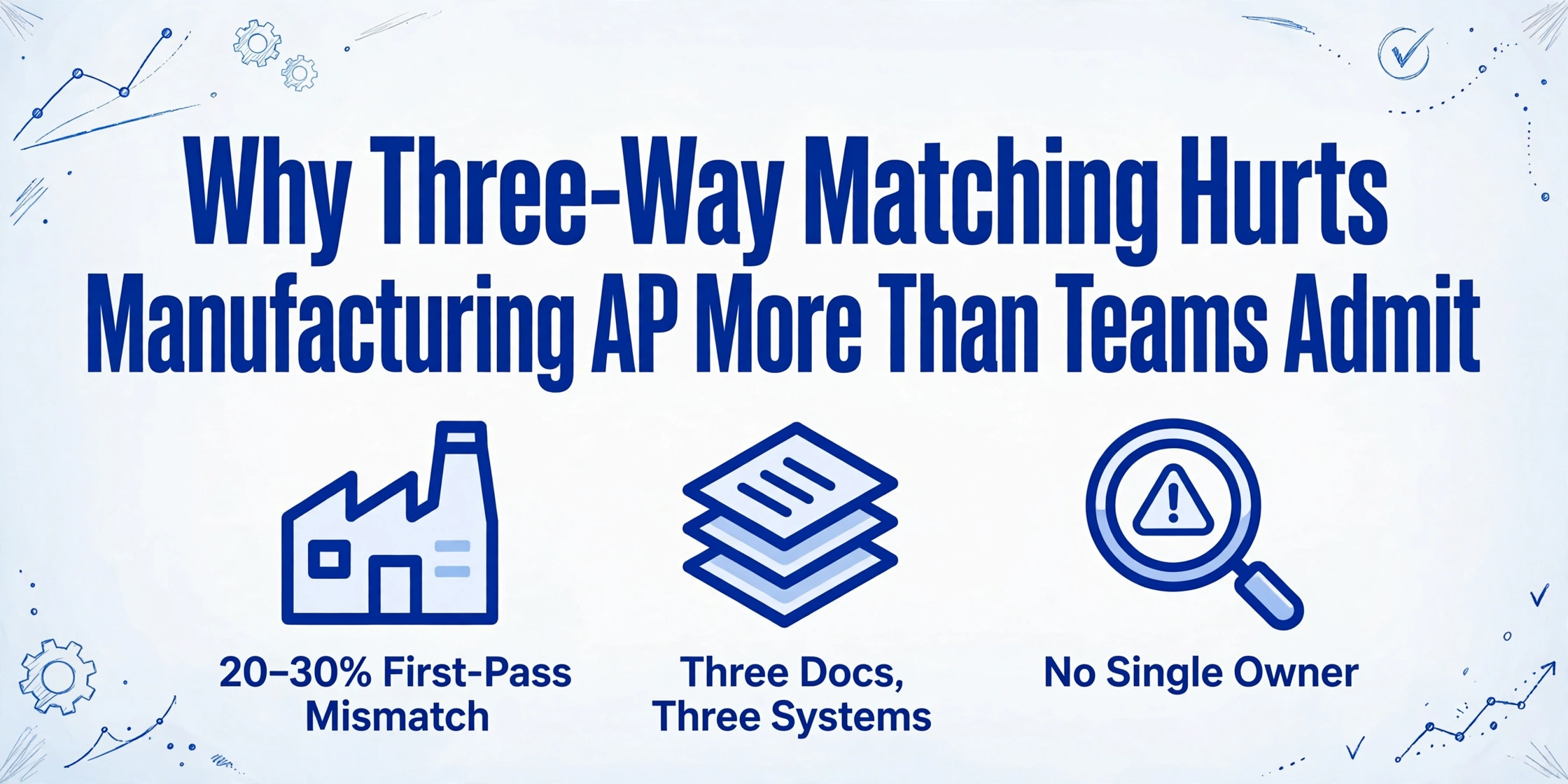
- A 22% first-pass mismatch rate isn't abnormal — it's what Ardent Partners reports as the industry average. In manufacturing, with blanket POs and partial shipments, that number is higher, and every exception costs an AP clerk roughly 30 minutes to investigate across three departments.
- The three documents — PO, goods receipt, and invoice — don't drift apart because anyone made a mistake. They drift because the PO lives in procurement's system, the receipt lives on a paper packing slip at the dock, and the invoice lands as a PDF in AP's inbox. Three departments, three systems, and no one owns the gap between them.
- The fix isn't a better matching algorithm. It's getting all three documents into structured data before matching logic touches them. When invoice data can be extracted from any PDF in seconds — regardless of supplier format — the matching step becomes a spreadsheet exercise, not a three-department investigation.
The Promise of Three-Way Matching vs. the Manufacturing Reality
The textbook model of three-way matching is clean. A purchase order is issued with quantities and agreed prices. Goods arrive. A receiving report confirms what was delivered. An invoice arrives with matching quantities and prices. Three documents, checked, and payment authorized. It's a preventive control so fundamental that the ACFE's 2024 Report to the Nations — which estimates organizations lose 5% of annual revenue to occupational fraud — cites it as a key safeguard against billing schemes. Under SOX Section 404, three-way matching is one of the most heavily tested preventive controls in external audit, categorized under COSO Control Activities. Under ISO 9001:2015 Clause 8.4, the verification that purchased products meet specified requirements is mandatory for every certified manufacturer — and three-way matching is the practical mechanism that most companies use to demonstrate compliance.
The regulatory framework is sound. The operational reality, in manufacturing specifically, renders the textbook model nearly unrecognizable.
In distribution, the flow is linear. A purchase order generates a shipment. A shipment generates an invoice. Quantities are predictable, products are finished goods with standard units, and price agreements hold for the transaction. In manufacturing, the flow is anything but linear. One purchase order covers months of deliveries. Goods arrive in partial shipments — 200 units in week one, 150 in week three, and the remaining 50 held pending the supplier's next production run. Each shipment generates its own packing slip and its own invoice. By the time the third invoice arrives, the PO was issued nine weeks ago, the commodity surcharge has shifted, and the receiving dock's log shows quantities that don't match any single invoice because someone recorded the second shipment in a different unit of measure than what the PO specified.
This isn't incompetence. It's the structure of industrial procurement. And it means that for the average mid-size manufacturer processing 500 to 2,000 invoices a month, the question isn't whether the three documents will match — it's which of the seven ways they won't.
Sievo's 2026 Automotive & Manufacturing Procurement Benchmarks report that the median manufacturer processes 192,000 invoices per $1 billion in spend, with 78% PO coverage. That means 22% of invoices — nearly one in four — arrive without a PO at all, eliminating the first leg of the three-way match before it starts. The matching problem doesn't begin at the comparison step. It begins at the document creation step.
Where the Three Documents Start Drifting
Trace the lifecycle of a single manufacturing purchase and the moments of degradation become visible.
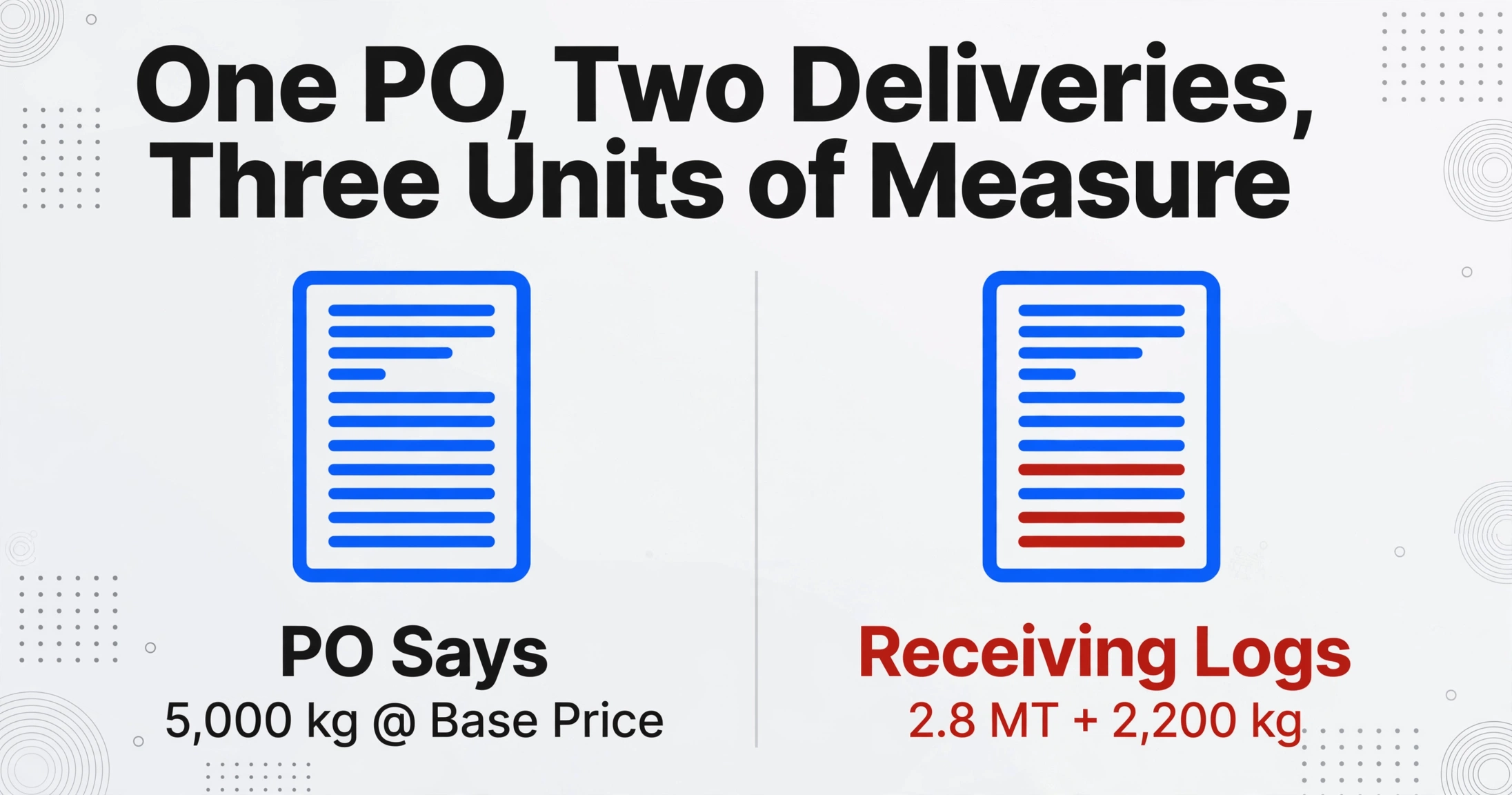
The PO is created. The buyer specifies a commodity-grade raw material — say, 5,000 kg of cold-rolled steel coil — from a mill at an agreed base price plus a monthly surcharge indexed to a published market rate. The PO reflects the base price. The surcharge, by definition, won't be known until the month of shipment. The PO is accurate at the moment of issue. It will be inaccurate by the time the invoice arrives, through no one's fault.
The goods are received. The shipment arrives in two lots. The first truck delivers 2,800 kg. The dock signs the packing slip, which records "2,800 kg" in the carrier's system. But the receiving clerk enters "2.8 MT" into the ERP because the system defaults to metric tonnes for bulk materials. The second delivery arrives two weeks later with 2,200 kg. The clerk enters it correctly. The ERP now shows 2.8 MT + 2,200 kg as two separate receiving lines with different units. The receiving report that AP retrieves for matching shows a total that requires manual conversion before it can be compared to anything.
The invoice arrives. The supplier sends a consolidated invoice covering both shipments — 5,000 kg total at the base price, plus a surcharge line for the month of shipment, plus a freight charge that was not on the PO because freight terms were negotiated separately. The invoice total doesn't match the PO total. The invoice line items don't map cleanly to individual receiving reports. The quantities match on an aggregate basis — 5,000 kg ordered, 5,000 kg delivered, 5,000 kg billed — but the document-by-document comparison that three-way matching logic expects breaks on the surcharge and freight lines that have no counterpart in either the PO or the goods receipt.
One purchase. One supplier. Three documents that have already drifted apart before anyone has typed a single field. This is the structural reality that no tolerance threshold on a matching screen can resolve.
On Reddit, the frustration is palpable. A manufacturing accounting professional posted in r/Accounting: "At my current employer the POs hardly ever align with the purchase invoices. We have many partial receipts and adjustments and the invoice almost never matches." In r/procurement, another user described the core disconnect: "The main issue I'm having is that my accounting department goes by ordered quantity & invoiced quantity, completely ignoring received quantity." The three documents are supposed to cross-reference each other. In practice, each department is referencing only two of the three — and they're not the same two.
The Procurement-to-AP Handoff: Nobody Owns the Gap
The most overlooked dimension of the three-way matching problem isn't technical. It's organizational.
Procurement owns the purchase order. Their incentives are availability and price — getting the right materials to the production line with minimal cost and maximum reliability. They negotiate blanket POs with quarterly price adjustments because it secures supply continuity and volume discounts. Whether the resulting structure creates a matching headache for AP six months later is not a variable in their decision-making — and structurally, it shouldn't be. Procurement's job is to buy, not to match invoices.
Receiving owns the goods receipt. Their incentive is speed — getting the truck unloaded, the material logged, and the dock clear for the next delivery. They record what they see on the packing slip — which may use the supplier's part number, the carrier's unit of measure, or a shorthand description that bears no resemblance to the PO line item. They don't reference the PO at time of receipt because the dock doesn't have live ERP access, or because verifying every shipment against the PO would double the unload time. The receiving data is accurate in isolation. It's incomplete as a matching document.
AP owns the three-way match. Their incentive is accuracy and audit readiness — paying only for goods that were ordered and received, at the agreed price, with complete documentation. But AP controls none of the upstream data. They don't create POs. They don't log receipts. They receive two datasets from two departments — one optimized for purchasing, one optimized for logistics — and an invoice from a third party (the supplier) that follows its own formatting logic. Their job is to make these three datasets agree, in a system where none was designed to talk to the others.
Three departments. Three systems. Three sets of incentives. The three-way matching process sits at the intersection of all three — and nobody owns the pipeline end-to-end. This is why adding another tolerance threshold or another approval workflow rarely solves the problem. The gap isn't in the matching logic. It's in the organizational structure that separates data creation from data verification.
In a r/Netsuite discussion, one user described exactly this dynamic from the practitioner side: "3 way match or invoice validation being done outside the system. Exporting reports to Excel, making changes, and uploading them again." The matching process has been pushed to a side channel — Excel — because the primary system (the ERP) doesn't bridge the organizational gap between the department that creates the data and the department that verifies it. The spreadsheet becomes the de facto integration layer because the organizational integration layer doesn't exist.
Blanket POs and UoM Drift: The Manufacturing Complexities Nobody Talks About
If the organizational gap is the problem most articles miss, two manufacturing-specific complexities compound it to a degree that doesn't exist in any other industry. The first is the blanket purchase order. The second is the unit-of-measure mismatch. Neither is an edge case in industrial procurement — both are the default operating mode.
Blanket POs are the standard structure for raw material and MRO procurement in manufacturing. A single PO covers all purchases of a given material from a given supplier over a period — typically a quarter or a year — with cumulative quantity caps and periodic price adjustments. The PO might authorize up to 100,000 kg of aluminum sheet over twelve months with monthly pricing pegged to the LME index. Each month's delivery triggers its own release, its own packing slip, its own receiving log entry, and its own supplier invoice. By month six, the PO has been matched against six separate invoices, each with its own surcharge line, its own freight allocation, and its own partial-delivery quantities. The matching logic has to handle not just one-to-one comparison, but cumulative tracking across a rolling window of multiple invoices with variable pricing — a scenario that no ERP matching module handles out of the box without significant configuration, and that manual matching in Excel turns into a multi-tab reconciliation workbook.
As one r/Accounting practitioner explained it: "My AP team's job is to get the invoices, verify the goods have been received, verify the invoice matches what procurement put on the PO, enter it — and when they don't match, figure out why." Under a blanket PO with six active releases, "figure out why" might mean tracing a quantity variance back through three partial deliveries, two freight invoices, and a price adjustment that procurement negotiated but never communicated to AP.
Unit-of-measure drift is the other pervasive manufacturing complexity. A PO for fasteners might specify "1 box (500 pieces)" at the line-item level. The receiving dock counts and records "1 box." The supplier invoices "500 EA." The three documents now contain three different representations of the same physical quantity. Scale this across a manufacturer with 200 active raw material SKUs — steel in metric tonnes ordered by the coil, chemicals in litres ordered by the drum, fasteners in pieces ordered by the box — and the matching process requires unit conversion before any comparison can begin.
A Reddit user in r/supplychain put the pain succinctly: "Units of measure not matching between the supplier and us is the biggest pain." That single sentence captures a problem that most three-way matching guides treat as a footnote — "use a UOM conversion table" — but that in practice consumes more AP investigation time than any other mismatch type. Every conversion table needs to be maintained. Every new supplier introduces new conversion factors. Every ERP field has a default unit that may or may not match what the supplier uses. The matching problem isn't that the data is wrong. It's that the data is structurally incompatible before the first comparison runs.
The scale amplifies the cost. When procurement spend exceeds half of revenue — as CAPS Research confirms for industrial manufacturing — a 22% mismatch rate isn't just a process metric. It's a direct cost multiplier applied to the company's largest expense category. See our breakdown of what manual invoice processing actually costs per document for the full quantification. The same structural problem takes a distinct regional form in Japan, where delivery notes rarely share identifiers with the PO or the invoice — see our analysis of the PO-delivery-invoice matching problem in Japanese procurement.
What an "Acceptable" Mismatch Rate Actually Costs
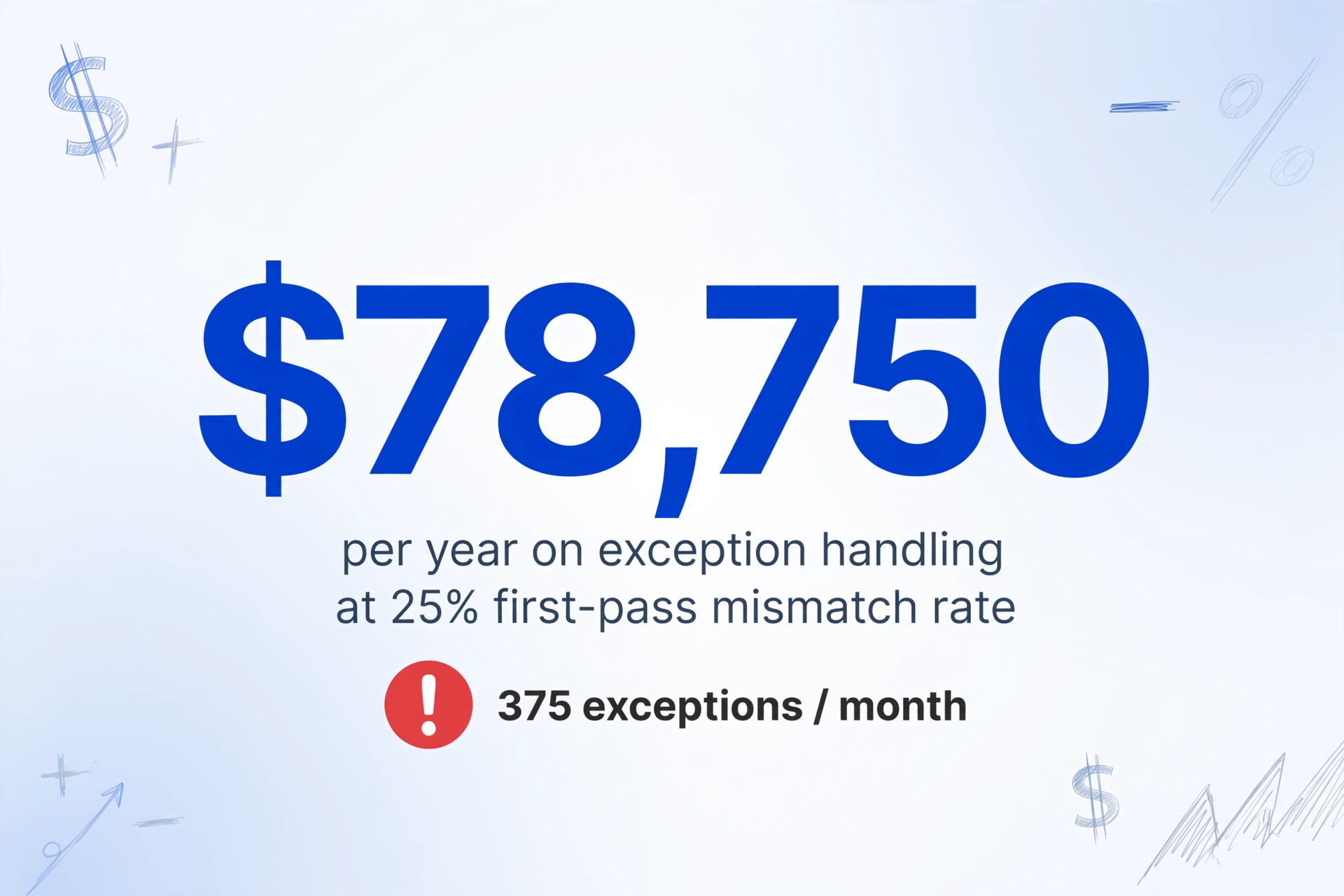
Most manufacturing AP teams have normalized a first-pass mismatch rate of 20–30%. They've built exception-handling workflows around it. They've hired for it. They've budgeted the overtime. What they haven't done — because no one has the time — is quantify what that "acceptable" rate costs in dollars, days, and missed opportunities.
Let's do the arithmetic on a mid-size manufacturer processing 1,500 invoices a month with a 25% first-pass mismatch rate. That's 375 exceptions per month. At 30 minutes per exception — a conservative estimate that includes looking up the PO in procurement's system, calling the receiving dock to verify shipment details, cross-referencing the supplier's online portal for the original order confirmation, and documenting the resolution for audit — that's 187.5 hours per month on exception handling alone. At a fully loaded AP staff cost of $35/hour, that's $6,562 per month, or $78,750 per year, spent on investigating discrepancies that the matching process itself was supposed to prevent.
The labor cost is the visible line item. The invisible ones are larger.
Missed early-payment discounts. Standard supplier terms of 2%/10 net 30 — a 2% discount for payment within 10 days — are common in industrial procurement. For a manufacturer with $30 million in annual material spend, that discount represents $600,000 in potential savings. But when the matching cycle takes 17.4 days on average (Ardent Partners' data for non-best-in-class AP), every invoice that required exception handling misses the 10-day window. As one r/procurement Reddit user summarized: "We miss early-pay discounts constantly and have paid duplicate invoices twice this quarter." A 25% exception rate, applied to that $600,000 discount pool, means approximately $150,000 in early-pay discounts lost per year — not because the company didn't have the cash, but because the matching process couldn't move fast enough.
Duplicate payments. APQC data, as cited by Corcentric, shows that 1.5% of overall payments are duplicates or errors on average — and 2% for laggard organizations. On $30 million in annual spend, that's $450,000 to $600,000 in erroneous payments. A manufacturer with a 25% mismatch rate is far more likely to fall in the laggard category than best-in-class, because every manual exception creates a new opportunity for a duplicate — the same invoice flagged for investigation gets entered twice by two different team members working from two different spreadsheets.
Supplier relationship erosion. This is the cost no P&L line captures. When every other invoice requires a phone call to the supplier to clarify a quantity or confirm a surcharge, the supplier relationship degrades. The supplier's AR team starts treating your AP team as a source of friction rather than a partner. Payment terms tighten. Rush-order prioritization slips. These costs are diffuse and hard to attribute, but every procurement manager with more than five years in manufacturing has watched them accumulate.
The AP team burnout tax. Processing exceptions isn't neutral cognitive work. It's the difference between verifying data and hunting data — between "these three numbers match, approve" and "why doesn't the PO quantity match the invoice, and who do I call to find out?" After 30 hours a week of hunting, the team's accuracy on the remaining 70% of clean-match invoices degrades. The APQC cross-industry benchmark shows that top-performing AP teams process more than three times as many invoices per FTE as bottom performers. The bottom quartile isn't there because of volume — it's there because their FTE hours are consumed by exception investigation, not processing.
Why ERP-Based Matching Alone Isn't Enough
The natural response to a systemic matching problem is to either upgrade the ERP or add an AP automation layer on top of it. SAP, Oracle E-Business Suite, Microsoft Dynamics 365, Epicor, Infor, and Plex all include three-way matching modules. Most allow configurable tolerance thresholds at the company-code or ledger level. SAP's MM module, for example, handles matching through the GR/IR clearing account — goods receipt (MIGO) posts a debit, invoice receipt (MIRO) posts a credit, and the system automatically clears matched line items. The logic is mature.
The logic assumes something that in manufacturing is almost never true: that all three documents exist as structured, comparable data inside the ERP before the matching logic runs.
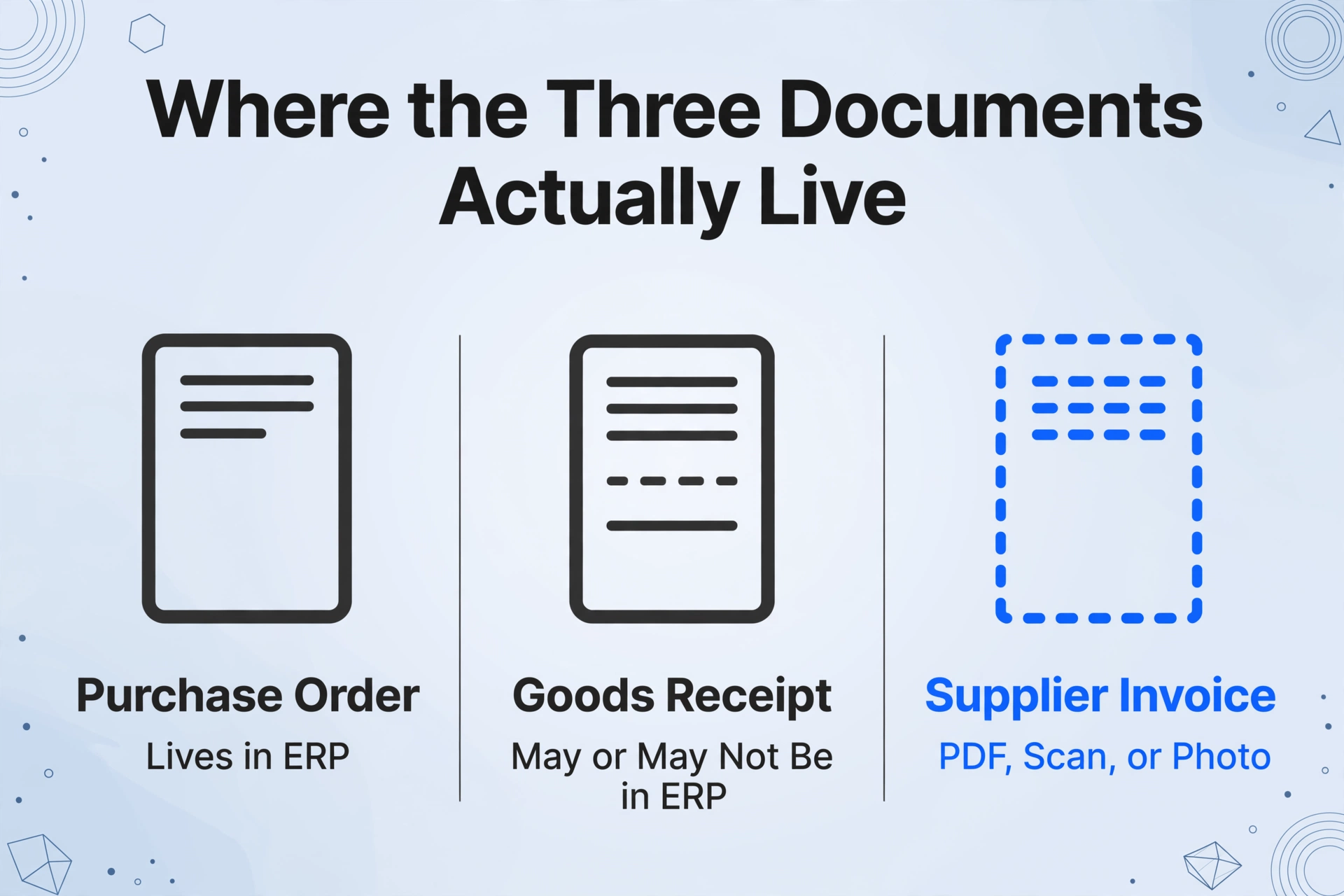
In reality, the PO lives in the ERP — procurement created it there. The goods receipt may or may not live in the ERP — the dock signed a paper packing slip, and whether that data gets entered into the ERP depends on whether receiving has the staffing and access to do it in real time. The invoice, in the overwhelming majority of cases, does not live in the ERP as structured data. It arrives as a PDF in an email inbox, a scanned image from a shared drive, or — in the case of smaller suppliers — a photographed document from a mobile phone. Before any ERP matching logic can touch the invoice, someone has to type its contents into the system line by line.
The IFOL 2025 AP Automation Trends Survey found that 66% of AP teams still manually key invoice data into their ERP. In manufacturing, with its line-item-dense supplier invoices and high transaction volumes, that percentage is likely higher — not because manufacturing AP teams are less sophisticated, but because their invoices are more complex and the ERP's capture tools weren't designed for them.
This is why tolerance thresholds, while operationally necessary, are a fundamentally limited tool. A 5% quantity tolerance tells the ERP to auto-approve an invoice where the billed quantity differs from the PO quantity by 5% or less. It doesn't tell you why the quantities differ. It doesn't catch the invoice where the quantity is correct but the unit price crept up by a surcharge that should have been on a separate line. It doesn't surface the invoice that was matched against the wrong PO release entirely. Tolerance thresholds manage the consequences of bad matches — they don't prevent the underlying data problem that causes the mismatches in the first place.
The real bottleneck is upstream of the matching logic. It's the gap between the unstructured invoice (the PDF in the inbox) and the structured data that the ERP needs to run the match. Until that gap is closed, better matching algorithms, tighter tolerance configurations, and more approval workflows will all produce the same result: a faster version of the same broken process.
An IOFM study found that organizations using three-way matching see up to 70% fewer payment discrepancies. The operative word is using. The ERP has the matching module. The question is whether the data that module needs has been extracted from the documents and entered into the system. In manufacturing AP, the answer — for roughly two-thirds of invoices — is: not yet.
Where the Fix Actually Starts
This article is not a how-to guide. It's a structural diagnosis. But a diagnosis that doesn't point toward a solution is just a complaint. Here is where the fix actually begins.
The core insight is simple, but it inverts how most AP teams approach the matching problem: the bottleneck isn't the matching algorithm — it's the data extraction step that precedes it. You can't match three documents if two of them are still locked inside unstructured formats. The fix isn't to build a smarter matching rule. It's to get all three documents — PO, goods receipt, and supplier invoice — into the same structured data format before any comparison logic runs.
For POs and goods receipts, this is a process discipline problem. The data already exists in your ERP or procurement system — it just needs to be entered completely and consistently. Standardizing the receiving process (requiring PO reference numbers on every packing slip, enforcing real-time or same-day receiving entries) closes the gap on the buyer's side of the equation.
For supplier invoices, the gap is a format problem that process discipline can't solve — because you don't control the format. You receive what your suppliers send. And your suppliers, across a manufacturing supply base of 50 to 500 vendors, send invoices in as many different layouts. This is the step where AI-powered document extraction changes the equation.
Unlike template-based OCR — which requires you to pre-configure a template for every supplier's invoice layout and breaks when a supplier updates their format — AI extraction using visual language models reads an invoice the way a person reads it: by understanding what each value means, not where it sits on the page. You define the columns you need — Invoice Number, PO Number, Vendor Name, Line Item Description, Quantity, Unit Price, Line Total, Invoice Total, Due Date — and the tool extracts those values from any invoice layout, whether it's a structured PDF from a large MRO distributor or a scanned handwritten document from a local machine shop. This approach is called Custom Column Extraction: you type the column names, the AI finds the values, and the output is a structured spreadsheet where every field is normalized for comparison.
The matching step then becomes what it was always supposed to be: a structured comparison. PO data exported from the ERP. Receiving data exported from the WMS or inventory module. Invoice data extracted by AI. Three datasets in the same format. XLOOKUP on PO number. Conditional formatting on variances. One afternoon of setup, and the matching process that used to consume 187 hours a month on exception handling becomes a spreadsheet review.
For the step-by-step workflow — from extraction columns to Excel matching formulas to partial-delivery tracking — see our full guide on matching supplier invoices to POs in manufacturing. For how batch extraction handles high-volume raw material invoices, see the batch processing workflow for raw material invoices.
Files are processed securely and not stored.
The point of the demo above isn't to show you a finished matching workflow. It's to demonstrate the first step that makes every matching workflow possible: turning an unstructured supplier invoice into structured data that you can actually compare to a PO. If this step takes 10 seconds instead of 15 minutes, the rest of the matching problem becomes a question of process design — not a question of staffing.
FAQ
What three-way matching threshold is typical in manufacturing?
Most ERP systems allow configurable tolerance thresholds — commonly 1–5% for quantities and $1–$5 for unit prices, configurable at the company-code or vendor level. In manufacturing specifically, wider quantity tolerances (3–5%) are standard for bulk and raw materials where count precision on partial shipments is low; tighter tolerances (1–2%) apply to high-value components and engineered parts. A tolerance threshold is a practical operational tool that prevents minor variances from flooding the exception queue — but it shouldn't be used to mask a systemic extraction problem. If your tolerance is set at 5% because your team can't keep up with investigation volume, the tolerance is compensating for the wrong problem.
Is 2-way matching sufficient, or do we need 3-way matching?
For manufacturing, 3-way matching (PO + goods receipt + invoice) is the minimum for physical goods. The goods receipt confirms that materials actually arrived — without it, you're paying against the PO and invoice alone, with no confirmation of delivery. The ACFE 2024 report specifically identifies 3-way matching as a key control against billing fraud schemes. 2-way matching (PO + invoice only) is appropriate for service contracts, recurring subscriptions, and digital deliveries where physical receipt isn't relevant. 4-way matching adds an inspection/quality document and is warranted for regulated components (aerospace, pharma) where payment should be conditional on passing quality checks, not just receiving the shipment.
Can AI extraction handle handwritten packing slips and scanned receiving reports?
Yes — modern AI extraction based on visual language models can read handwritten notes, stamped annotations, and scanned documents with varying image quality, up to 99% accuracy on printed text and somewhat lower on heavy handwriting. The difference from traditional OCR is that the model understands the role of the data (this handwritten number next to "Qty Rcvd" is the received quantity) rather than just recognizing characters. For critical receiving documents where handwriting is the primary data source, spot-checking a sample of extractions is recommended before integrating into the matching workflow. The accuracy improvement over manual entry is most significant when the same document type (e.g., a vendor's standard packing slip) is processed repeatedly, because the extraction consistency eliminates the 3–5% manual-entry error rate that compounds over volume.
Do we need an ERP to run three-way matching?
No. Three-way matching requires three documents and a system that compares them. An ERP with a built-in matching module automates the comparison and creates an audit trail — which is essential for SOX compliance and scalable operations. But the functional minimum is: PO data (exportable from any purchasing system, even a shared spreadsheet), receiving data (loggable in any tracking system), and invoice data (extractable by AI into a structured format). These three datasets can be compared in Excel using XLOOKUP, conditional formatting, and tolerance formulas. The practical limit for spreadsheet-based matching is roughly 2,000–3,000 invoices per month, beyond which exceptions overwhelm manual review. The ERP's value is in automation at scale and audit trail integrity — not in making matching possible. For a full Google Sheets implementation of this spreadsheet workflow, see our guide to three-way matching in Google Sheets without an ERP.
What's the single biggest process improvement that reduces three-way matching failures?
Require PO numbers on every supplier invoice as a condition of payment. It sounds trivial, but the data consistently shows that the most common root cause of matching failure isn't a quantity or price discrepancy — it's that the invoice can't be linked to a PO at all because the PO number is missing. When the invoice references the correct PO number, the matching system can at least attempt the comparison. Without it, the AP clerk has to manually cross-reference by vendor name, date, and amount — a 10-minute investigation per invoice that yields an unreliable match. Make PO-on-invoice a supplier onboarding requirement. Most suppliers comply quickly because it speeds up their payment cycle too.
The Bottom Line
Three-way matching in manufacturing fails at a 20–30% first-pass rate not because the matching logic is flawed, or because the ERP is outdated, or because the AP team isn't working hard enough. It fails because the three documents — all three — arrive from different systems, in different formats, through different departments, with no single owner of the pipeline that connects them. Procurement optimizes for availability. Receiving optimizes for speed. AP owns the matching but controls none of the upstream data. The gap between these three functions is not a process failure. It's a structural feature of how manufacturing organizations are built.
The solutions that don't close this gap — tolerance thresholds, additional approval layers, vendor scorecards — make the existing process survivable. They don't fix it. The fix, logically, has to happen at the point where the structural gap is widest: the step where an unstructured supplier invoice becomes structured data that can be compared to a PO. If that step takes seconds instead of minutes, and produces consistent structured output instead of manual variations, the three-way match becomes a spreadsheet exercise instead of a three-department investigation. Not because the organizational gap disappears — it won't — but because the data crossing it no longer carries the accumulated drift of three different input channels.
Try the extraction step yourself below. Upload a supplier invoice and see whether the data you need for matching comes back structured — in seconds, not minutes. If the extraction bottleneck is solved, the matching bottleneck becomes a problem you can build a process around, not a problem you budget overtime for.