A complete deal jacket is
not a fundable deal
A deal jacket is assembled to be complete. The checklist counts the buyer's order, the retail installment contract, the title application, the odometer disclosure, the add-on forms, the insurance evidence and the stipulations, or stips. Funding asks a different question: do those documents describe the same car and the same money?
Two failures look alike in a deal jacket. One is a VIN mismatch that a completeness check cannot see, because the VIN is present and the page is signed. The other is a legitimate $2,590 gap between the order and the contract, created by two add-on products. The first gets the packet returned. The second gets a phone call that should not have happened.
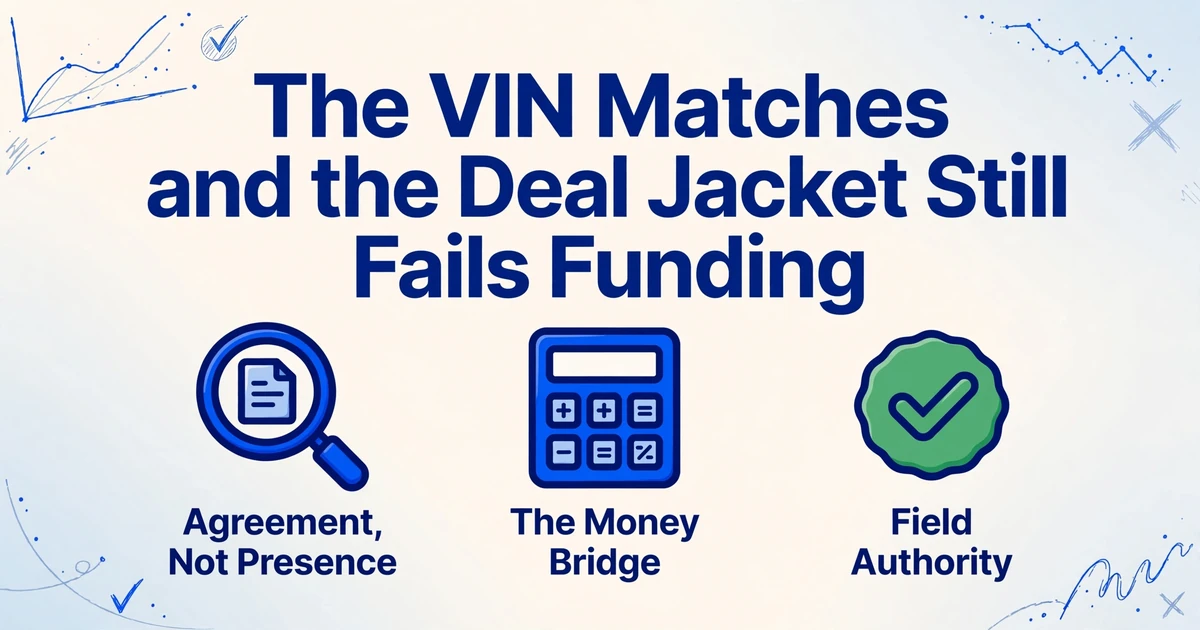
Key Takeaways
- A complete deal jacket can still fail funding, because the checklist never asks whether the documents agree.
- One VIN typed into the dealer system lands on the order, the contract, the title application and the insurance request, so a single typo reads as agreement.
- A $2,590 gap between the order and the contract is fine when a $1,895 service contract and a $695 GAP policy give every dollar a name.
A funder opens the jacket to see whether the documents agree.
An auto finance funding desk is proving that the signed contract is the deal credit approved, that the math and disclosures are right, that the add-ons fit the program, that every stipulation is cleared, and that the deal can be funded, pended or sent to credit. Completeness gets the packet into the queue. Agreement is what the funder decides.
Three roles touch the same facts at different moments, and each one sees only part of the packet.
| Role | What they decide | What they need from the jacket |
|---|---|---|
| Dealer F&I (finance and insurance) manager | Whether the packet is ready to submit | Every document present, every signature in place, the contract reflecting the deal that was approved |
| Funder's verification clerk | Fund, pend, or return | The contract matching the approval, the stips cleared, the collateral and insurance matching the loan |
| Insurance agent or carrier | What the declarations page says | The VIN, the named insured, the loss payee and limits that meet the lender's requirement |
A jacket is a packet of documents written by different parties, each with its own vocabulary. A real estate closing package has the same shape, which is why the comparison problem is familiar to anyone who has assembled one.
The vehicle identity lives in three places: the buyer's order, the retail installment contract, and the insurance declarations page. The title application is a fourth transcription, usually generated from the same dealer management system (DMS) record. The buyer's name lives on the credit application and the contract, which is the name the insurance policy has to match. The money appears on the order and the contract, but the two documents do not carry the same number.
A VIN check has three outcomes, and one of them cannot be settled by looking at the page.
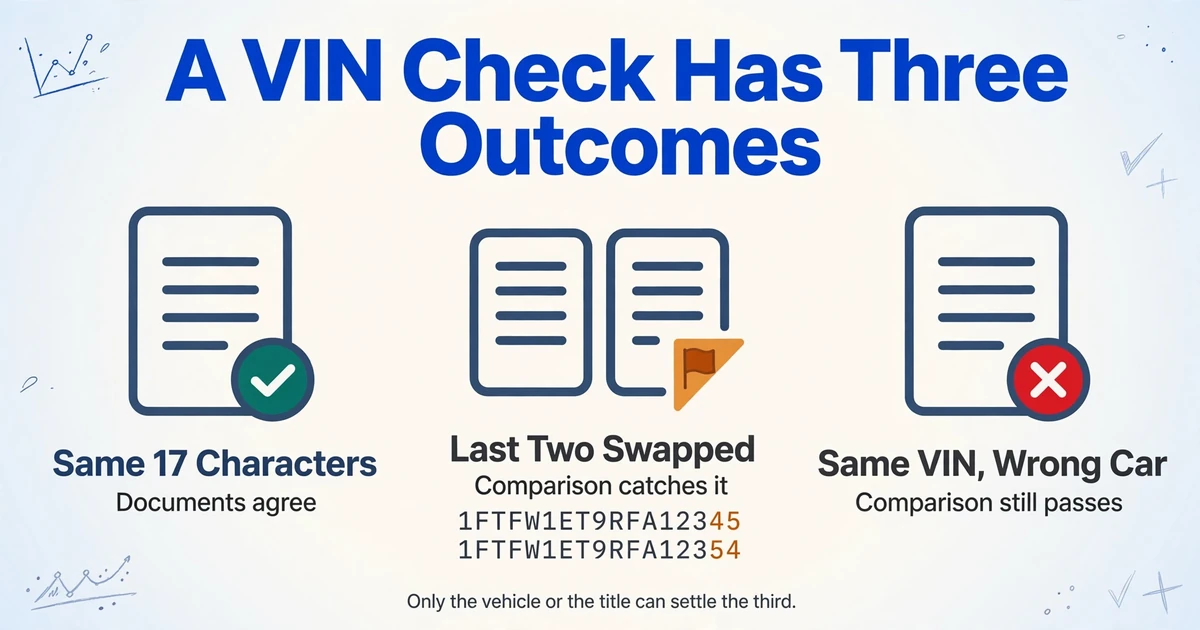
The three outcomes are: the same 17 characters on every document, a different 17 characters on one of them, or the same 17 characters on every document belonging to a different car than the one delivered. The first two can be compared. The third cannot, because every document agrees.
Under 49 CFR 565.13, a VIN has 17 characters. Positions 1 to 3 identify the manufacturer, 4 to 8 describe the vehicle, position 9 is a check digit, position 10 is the model year, position 11 is the plant, and positions 12 to 17 are the serial number. The allowed character set excludes the letters I, O and Q, because they are easy to confuse with 1 and 0.
A format check confirms that a string is 17 characters long and uses only allowed characters. A VIN verification that stops there confirms the shape of the string, not the identity of the car. Take two VINs that differ by a transposition:
| Document | VIN | What a format check sees |
|---|---|---|
| Buyer's order | 1FTFW1ET9RFA12345 | 17 characters, allowed set, passes |
| Retail installment contract | 1FTFW1ET9RFA12354 | 17 characters, allowed set, passes |
The first fifteen characters match. The difference sits in the last two, the part a reviewer skims after the manufacturer and model year line up. A character-by-character comparison catches it. A glance does not.
The ninth character is the check digit, a checksum over the other sixteen. It exists to catch a transcription error, but only if someone calculates it. A visual review does not. The same problem appears when you pull serial numbers out of mixed PDFs: a clean-looking string is not the same as a verified one.
The harder case is the third outcome. One buyer described test-driving two identical cars, choosing the second because it had been on the lot longer and carried a $1,500 discount, and discovering later that the paperwork had been written for the first. Every document carried the same VIN. A cross-document comparison would have passed that jacket, because there was nothing to compare. The only authority for vehicle identity is the VIN on the vehicle or the title, not the packet.
The amount financed is a defined number, and the buyer's order usually shows a different one.
The amount financed on the contract is not the total price on the buyer's order, and the difference is often legitimate. Regulation Z, 12 CFR 1026.18(b), defines it as the cash price minus the down payment, plus any other amounts financed by the creditor, minus any prepaid finance charge. The same regulation defines a separate total sale price in 1026.18(j), which adds the finance charge back in. A buyer's order may show a total price, a balance due, or an amount financed line, and those are three different numbers.
Add-on products are the most common reason the contract is higher. The CFPB's Fall 2024 auto finance supervisory report notes that consumers generally finance GAP, service contracts and similar products at origination, with the premium paid upfront and included in the amount financed. Under 1026.18(c)(1)(iii), the itemization must identify the payee for those optional products. Negative equity is the other legitimate gap: the CFPB's 2024 negative equity report found it in 12% of the transactions it studied, with a mean of $5,073 on new vehicles and $3,284 on used ones.
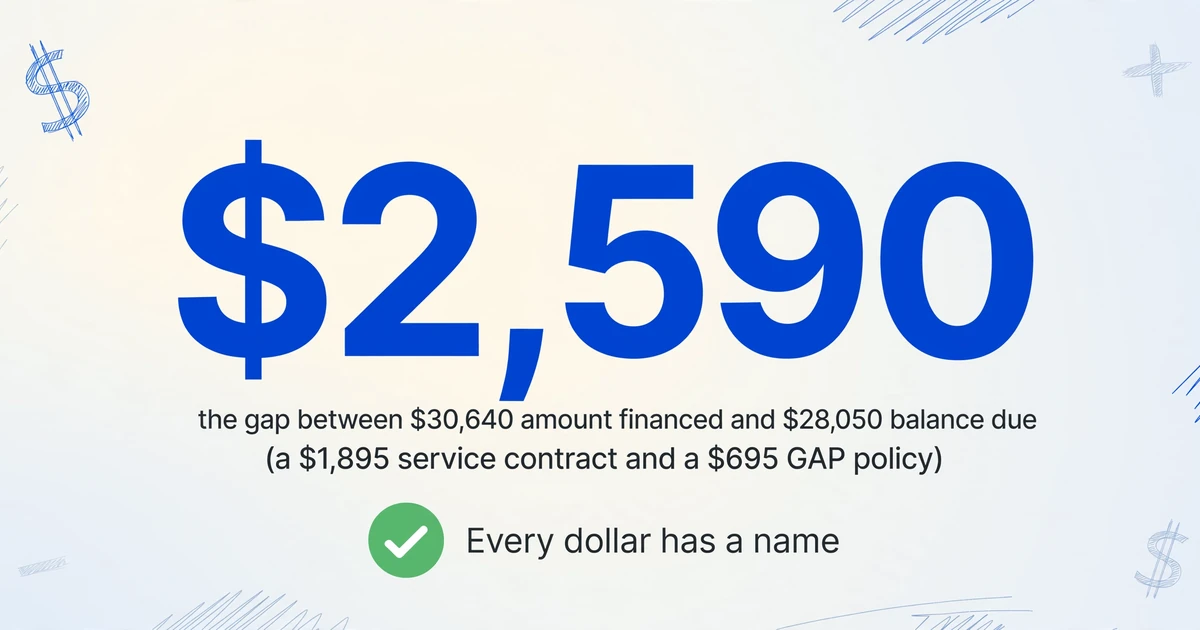
Here is the shape of a bridge that closes. The order shows a $28,900 selling price, a $3,000 down payment and $2,150 in taxes and fees, for a $28,050 balance due. The contract shows an amount financed of $30,640. The $2,590 difference is a $1,895 vehicle service contract and a $695 GAP policy. If the order lists both products, the bridge closes and there is no exception. If the order does not, the $2,590 is the exception.
The money check is not equality. It is whether every dollar of the difference has a name.
The arithmetic inside the contract is a separate check. A contract can be internally wrong even when the bridge to the order closes. That is the same failure pattern as line items that do not multiply out, one level up: the individual numbers look right, and the relationship between them does not.
An insurance declarations page can carry the right VIN and still fail the lender's check.
The declarations page is a summary of the policy, and it carries the named insured, the covered vehicles with their VINs, the coverages and deductibles, and any lienholder or loss payee. The VIN is only one of the fields that matter to funding.
A real credit union's published requirements show the shape: the lender must appear as lienholder or loss payee, the collateral on the policy must match the collateral on the loan document, and the coverage limit should not be less than the loan. Those are three independent tests, and a matching VIN satisfies only the second one.
The named insured is the field that most often looks wrong and is sometimes right. A policy in a spouse's name, a business name, or a maiden name can be legitimate if that person or entity is a buyer or co-buyer on the contract. The test is whether the named insured matches a buyer on the contract, not whether it matches the first name on the first page. What fails is a policy in the name of someone who is not on the contract at all.
The loss payee is the field that gets abbreviated. The lender's exact legal name and address are what the insurer uses to pay a claim. A policy that names the lender as an additional insured but not as a loss payee has the wrong box checked, even when the certificate looks complete. A policy written to a different VIN describes a different car, so the collateral on the policy is not the collateral on the loan.
A matching VIN proves that the policy was written for that VIN. It does not prove that the premium was paid, that the policy is still in force on the date of loss, or that the coverage limits meet the lender's program. Those are separate checks, and the declarations page is evidence of the policy, not of its current status.
The review that catches a missing signature is the wrong review for a field that disagrees.
A funding checklist is a completeness tool. It checks each document against a rule: present, signed, dated, on the right form. A field mismatch is a relationship between two documents, and a rule that looks at one document at a time cannot see it.
- Presence is not equality. The checklist says the contract has a VIN. It does not say the contract's VIN equals the order's VIN.
- The vocabulary differs. Total price, balance due, amount financed and total sale price are four different numbers. A reviewer who treats them as one number either flags legitimate differences or stops checking the field.
- The DMS copies one value onto every form. The system usually prints the VIN onto the order, the contract, the title application and the insurance request from one field. A single typo becomes internal consistency, which is the hardest kind to see.
- The eye anchors on the prefix. The manufacturer and model year match, so the reviewer assumes the serial does too. The last six characters are the ones least likely to be read one by one.
A checklist can tell you the VIN is present. It cannot tell you the VIN is the same one the other two documents carry.
The queue makes this worse. A funding clerk is working a list of jackets, not reading a packet from the first page to the last. A mismatch that is not on the deficiency list survives until the title clerk, the insurer or the customer finds it.
When two documents disagree, the field decides which one wins, and the answer is not the same for every field.
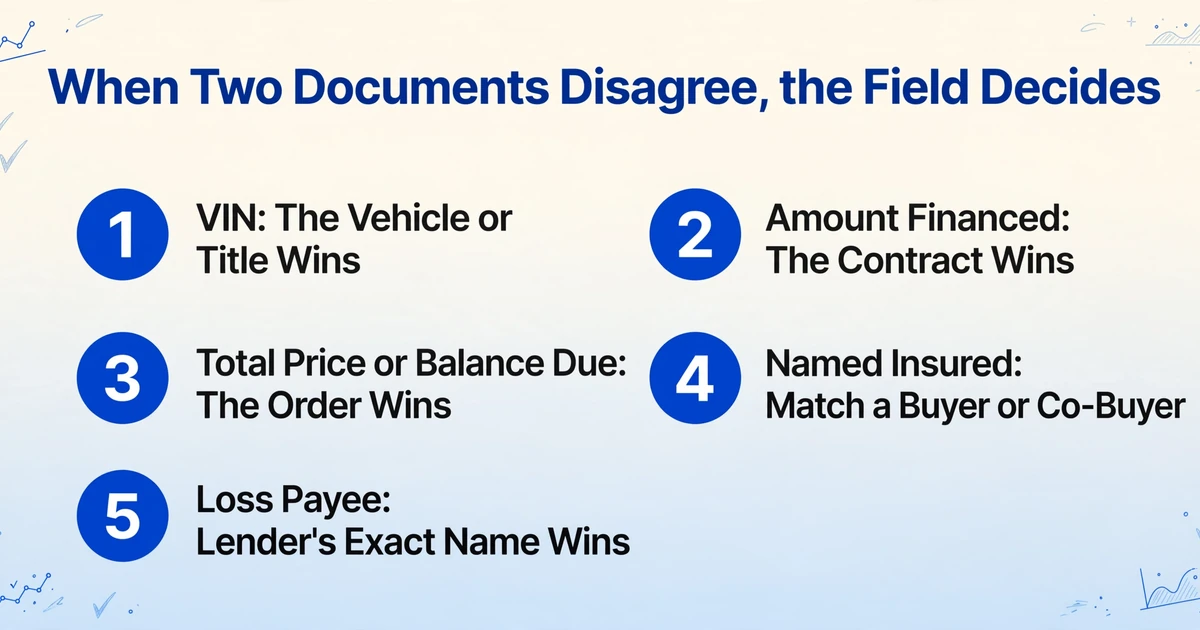
The rule is field-specific, and writing it down before comparing keeps a definition difference from becoming an exception. Without it, every difference looks like an error, and the reviewer starts averaging values instead of resolving them.
| Field | Documents that carry it | Wins when they disagree | Why |
|---|---|---|---|
| VIN | Buyer's order, contract, insurance, title application | The vehicle or title | Every document is a transcription; the car is the object |
| Amount financed | Contract, sometimes the order | Contract | It is the disclosed legal term under Regulation Z |
| Total price or balance due | Buyer's order | Order, for what was agreed | It is a different number from the amount financed |
| Named insured | Insurance declarations; contract for buyer names | Policy for who is insured; contract for who bought | Must match a buyer or co-buyer, not necessarily the first buyer |
| Loss payee | Insurance declarations | Lender's exact legal name and address | Claim payment depends on the named payee |
| Signature | Contract, add-on forms | Presence only | Authenticity lives in the e-signature audit trail |
The extraction unit is the document, because a jacket is a set of them.
One row per jacket hides the disagreement you are trying to find. Pull the same fields from every document into one table, one row per document (or per line item, if a document has a table), and compare after extraction.
ImageToTable.ai's Custom Column Extraction is the part that makes this practical. You type the column names you want, such as VIN, Amount Financed, Total Price or Balance Due, Named Insured and Loss Payee, and the AI locates each value by understanding what the field means rather than where it sits on the page. The column names become the headers of the output table. There is no template per lender and no zone to redraw when a dealer changes forms.
When every row is one document, a single VIN column is enough. The Document Type column tells you which document supplied each value, so the order's VIN, the contract's VIN and the policy's VIN stay distinguishable without three separate columns.
Batch processing handles the volume. A batch of jacket files goes in as one upload and comes back as one Excel table, so the unit of work matches the unit of intake. The output can be XLSX, CSV or JSON.
If the jacket arrives as a single multi-page PDF, add an inferred column such as Document Type (options: Purchase Order / Retail Installment Contract / Insurance Declaration / Title Application / Other). The AI classifies each page from its content, which gives you a way to filter a page index into document groups. Do not turn on Multi-Page Merge for a jacket: that setting is for pages of one logical document, and a jacket is a set of different documents.
A computed column can check the arithmetic inside one document. For example, Contract Math Check (output OK if Amount Financed equals the itemized total, otherwise the difference) compares two values that sit on the same contract. It cannot compare the amount financed on the contract with the balance due on the order, because those values are in different rows. That comparison is a formula in the sheet.
Once the rows are exported, the comparison is ordinary spreadsheet work. Reshape the table by deal number and document type, with a pivot or three lookups, so the three VINs sit side by side, then use =IF(AND(EXACT(B2,C2),EXACT(C2,D2)),"match","check") where B2, C2 and D2 hold the three VINs. For the money, subtract the order balance due and the named add-ons from the contract amount and see whether the remainder is zero. Flag only the rows where the VIN check fails or the bridge does not close.
A three-row extract shows the shape:
| Deal | Document Type | VIN | Amount Financed | Total Price or Balance Due | Named Insured | Loss Payee |
|---|---|---|---|---|---|---|
| 24-1187 | Purchase Order | 1FTFW1ET9RFA12345 | 28,050 | |||
| 24-1187 | Retail Installment Contract | 1FTFW1ET9RFA12354 | 30,640 | Daniel R. Alvarez | ||
| 24-1187 | Insurance Declaration | 1FTFW1ET9RFA12345 | Maria L. Alvarez | Example Credit Union |
The table produces three questions, not one. Two VINs agree and the contract is the outlier, so the contract is the first document to inspect. The named insured differs from the buyer, so the contract needs a co-buyer or the policy needs a correction. The order's balance due and the contract's amount financed differ by $2,590, so the next question is which products account for it.
Review Mode with bounding boxes (bbox) is the check for the VIN rows. Hover or click a flagged cell and the region it came from is highlighted on the original image. Click a region on the image and the matching cell is selected. Turn on auto-annotate after processing when the batch is large, so the boxes are waiting when you open the file. For dense handwriting on F&I forms, the higher Model Tier, the account setting that selects the stronger vision model, is the one to use; the standard tier is built for printed tables.
A four-step check catches the disagreements before the funder does.
The check has to be repeatable across a week of jackets, not a one-time audit. Four decisions, made once and applied to every batch, are enough.
Write the field list and the authority rule
List the fields that matter: VIN, amount financed, total price or balance due, named insured, loss payee and signature presence. For each one, write down which document wins. Do this before opening the first jacket, because the rule is what separates a real exception from a definition difference.
Extract one row per document
Upload the packet as a batch, with a column for the deal number, the document type and each field. If the files arrive separately, upload by document type. If the jacket is one PDF, use the inferred document type column and treat the output as a page index. The goal is a table where every value still has a document attached to it.
Compare the strings and build the money bridge
Pivot so the VINs sit side by side and test them with an exact comparison, not a visual one. For the money, subtract the order balance due and the named add-ons from the contract amount. A remainder of zero is a clean bridge. If the remainder has a name, it is a product, a fee or negative equity. If it has no name, it is the exception.
Review the flags and sample the rest
Open Review Mode on every flagged VIN and read the source region against the image. Record which document was corrected and who corrected it, because the next reviewer will need the reason. For the rows that did not flag, spot-check a sample of the batch; a 100% pass rate on a sample is evidence about the process, not proof about every row.
The cost of skipping this is measured in days. Dealertrack's 2020 contracts-in-transit data put traditional paper packages at an average of five days in transit, and found that one in four paper contracts carried an error such as a missed signature, a missing stip or a contract that did not meet the lender's requirements. A jacket that comes back for a VIN typo re-enters that queue from the beginning.
The method has a hard boundary: it cannot catch an error that every document repeats.
Extraction gives you sourced values. It does not give you a verdict, and the boundary matters because a tool that blurs it creates a new kind of bad record: one that looks authoritative and cannot be defended.
- No VIN decode or vehicle-history lookup. The tool reads the 17 characters on the page. It does not query the National Motor Vehicle Title Information System (NMVTIS), a manufacturer database, a title history or a stolen-vehicle list, and it does not prove that the VIN belongs to the car.
- No check-digit validation. The ninth character can be calculated outside the sheet. The extraction returns the string, not a validation result.
- No cross-document judgment. The comparison is a formula in the spreadsheet. The tool extracts the values; it does not decide that two rows disagree or what the disagreement means.
- No funding decision. It does not approve credit, interpret a stip, release funds or decide whether a deal is fundable.
- No signature authentication. It can tell you whether a signature is present. It does not verify that the person signed, that the e-signature audit trail is intact, or that the form was not signed after the fact.
- No proof of insurance. A declarations page shows what the policy says. It does not prove the premium was paid or the policy is in force on the loss date.
- No title-brand check. Salvage, rebuilt or flood branding lives in the title record, not in the jacket.
- No join without a key. If the documents share no deal number or VIN, the rows cannot be matched automatically, and a person has to match them by date, buyer and vehicle.
The all-documents-agree case is the important one. When the same wrong VIN is printed on every form, the packet is internally consistent and the comparison passes. Only the vehicle, the title or the stock number can settle it. A document check is a check on transcription, not on the car.
FAQ
Can I compare a VIN across a purchase order, contract and insurance record automatically?
You can extract the VIN from each document into a table automatically. The comparison itself is a spreadsheet formula, because the three values sit in three rows. Reshape the table by deal number and document type, then test the three VINs with an exact string comparison. The tool does not make the cross-document judgment for you.
Does the tool check whether a VIN is valid or reported stolen?
No. It reads the VIN as printed. It does not decode the vehicle, validate the check digit, or query NMVTIS, a manufacturer database or a stolen-vehicle list. Those are separate steps against separate data sources, and a VIN can be correct on the page and still fail them.
Why is the amount financed different from the buyer's order total?
Because they are different numbers. The amount financed is defined by Regulation Z as the cash price minus the down payment, plus other financed amounts, minus any prepaid finance charge. The order may show a total price, a balance due or a total sale price. Add-on products such as GAP and service contracts are financed and included in the amount financed, and negative equity from a trade-in is added the same way. The difference is legitimate when every dollar of it can be named.
Is a matching VIN enough to release funding?
No. A matching VIN satisfies the vehicle identity check. The lender also checks that the named insured is a buyer or co-buyer on the contract, that the lender is listed as loss payee under its exact legal name, that the coverage limits meet the program, that the required signatures are present, and that every stipulation is cleared.
Can it read a scanned or photographed deal jacket?
Yes. PDF, JPG, PNG, WebP and AVIF are supported, including scans and phone photos. Handwriting, cursive and checkboxes are supported as well. Dense handwriting on F&I forms is the case for the higher processing tier; the standard tier is built for printed tables.
What if the whole jacket is one 20-page PDF?
Add an inferred document type column and treat the output as a page index, then filter the pages into purchase order, contract, insurance and title groups. Do not use Multi-Page Merge for this, because that setting is designed to fold pages of one logical document into a single row, and a jacket is a set of different documents. If the PDF can be split by document, splitting it gives a cleaner one-row-per-document table.
Does it verify e-signatures?
No, not beyond presence. It can report whether a signature appears on the contract or an add-on form. It does not verify the signer's identity, the integrity of the e-signature audit trail, or whether the document was signed before funding. Those checks belong to the e-signature platform and the lender's own process.
A packet is a set of claims that have to agree, and the claims that matter most are the ones a completeness check never reads. Run one jacket through, compare the three VINs and the money bridge, and see which document disagrees before the funder does. Test it on a deal jacket.