One Wrong Character on a Handwritten Intake Form
Can Become a Denied Claim Weeks Later
Experian Health's State of Claims 2025 survey ranks incomplete or incorrect patient registration data as the third most common trigger of denied claims. The mechanism behind that ranking rarely gets the attention it deserves: a front desk clerk spends thirty seconds keying a patient's name from a handwritten intake form, nobody double-checks it, and a few weeks later the claim comes back because the name on file does not match the payer's records. The person who typed it saw nothing wrong. The person who found it has no idea who to blame.
Key Takeaways
- A handwritten 0 read as an O is enough to send a claim back denied weeks later.
- The clerk who keyed it saw nothing wrong, because the demographics are only compared against the payer's records once the claim reaches the payer.
- The fix is not a more careful front desk, it is making the three fields the payer compares verifiable in the seconds after they are keyed.
Every Claim Travels the Same Route, and One Handoff Feeds It the Wrong Numbers
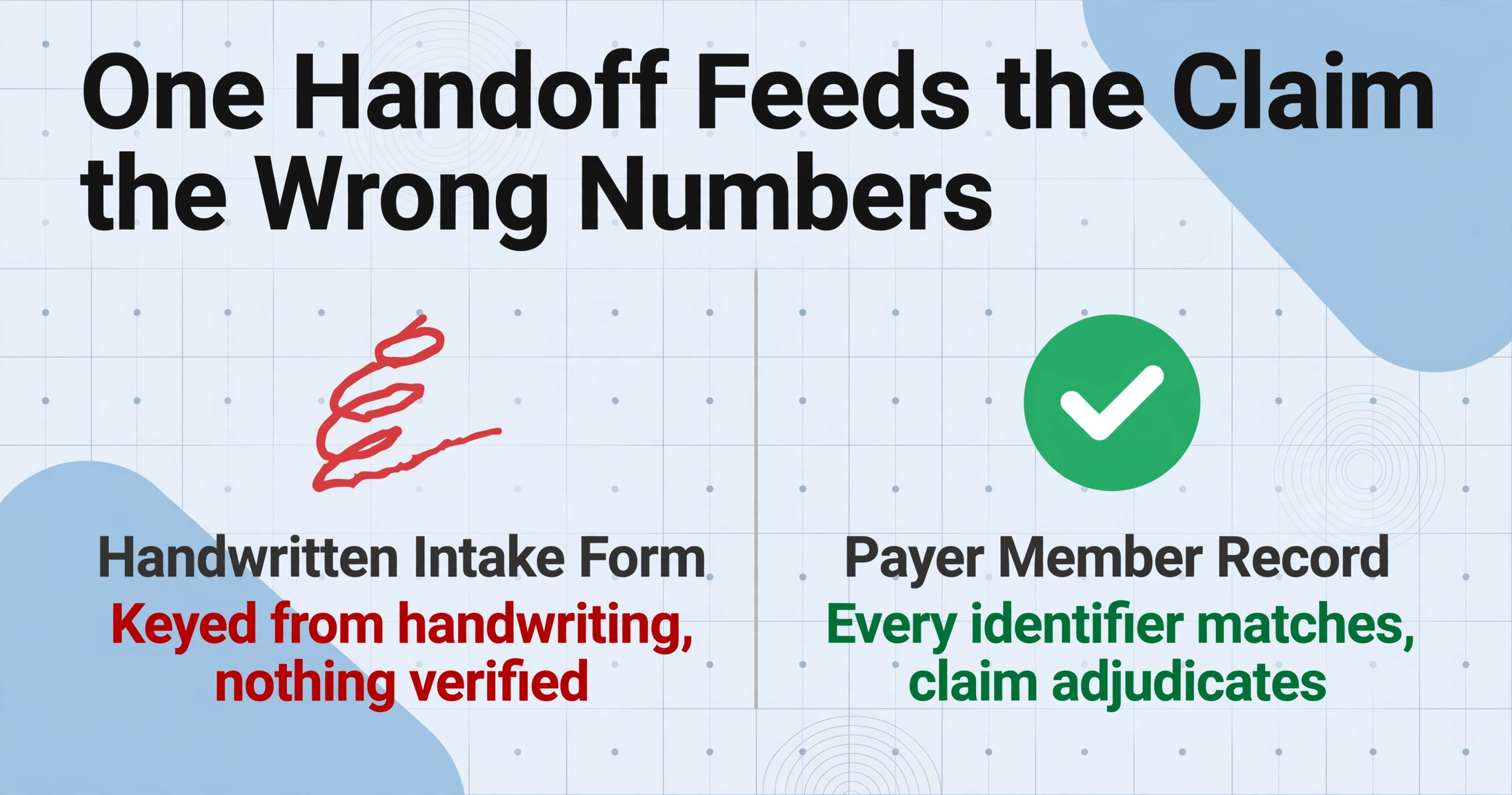
An outpatient claim follows a fixed route with five named players. The patient fills out the intake form, often by hand, ten minutes before the appointment. The front desk types the demographics into the electronic health record or practice management system, which in most US clinics means Epic, athenahealth, Tebra's Kareo, or eClinicalWorks. The biller or coder later assembles the claim itself, the CMS-1500 form for professional services or the UB-04 for facility claims, usually transmitted as an 837 electronic file. A clearinghouse, such as Availity, Waystar, or Change Healthcare, checks the claim's basic completeness and forwards it to the payer, whose claim editing system compares the demographics on the claim against its own member records. When every identifier matches, the claim adjudicates and an EOB (explanation of benefits) returns for posting. When an identifier does not match, the claim comes back rejected or denied before any human at the payer ever looks at it.
The handoff that decides most of these outcomes is not the coding, which goes through build checks before submission. It is the demographics block, typed from handwriting at a moment when nobody is verifying anything against the patient's insurance record. A survey run under the Healthcare Financial Management Association's Pulse Survey program, covering more than 350 hospital CFOs and revenue cycle leaders, found that errors in patient access and registration were the most common reason for initial claim denials, with 47 percent of respondents reporting that denial rates rose year over year.
The step that decides most outcomes is a demographics block typed from handwriting at a moment when nobody is checking it.
The Errors Start Below the Word Level: 0/O, 1/l, 5/S, and a Transposed Birthday
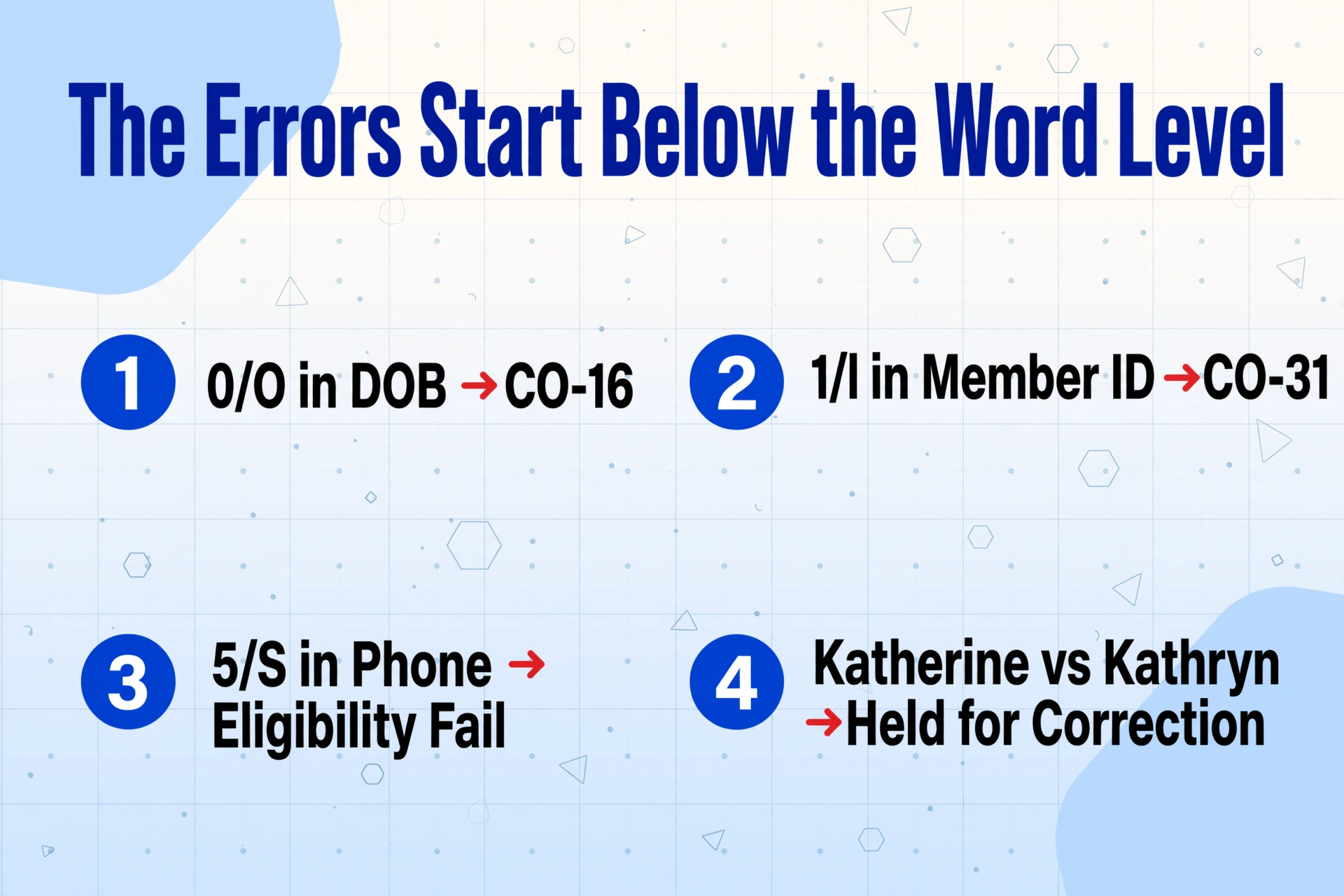
Registration errors are usually described as "typos," which makes them sound random. They are not random. They track the specific ways illegible handwriting gets resolved by a tired employee reading quickly. Each failure mode is tied to a character, a date, or a copied string:
| What the patient wrote | What gets keyed | Where it lands |
|---|---|---|
| 0 in a date of birth | O | Date of birth mismatch, CO-16 rejection |
| 1 inside a member ID | l (lowercase L) | Subscriber ID mismatch, CO-31 |
| 5 at the start of a phone digit | S | Contact data mismatch, eligibility cross-check failure |
| Katherine with a clear "th" | Kathryn | Name mismatch, claim held for correction |
| 03/12 (month/day) | 3/17 | Date of birth mismatch, member lookup fails |
The reason intake form errors survive this long is that nothing in the practice compares the keyed demographics against the payer's member file at the moment of entry; that comparison only happens later, inside the payer's own system. Spelling variants are a whole class of their own. Payer enrollment files hold the version of a name the employer or the insurer recorded, so the correct spelling for the claim is whatever the payer has. A patient who writes Katherine when the policy is under Kathryn creates a mismatch through no mistake on anyone's form, and the clerk who types what the patient wrote cannot see the problem because the handoff that matters happens between the payer database and the claim, not between the form and the keyboard.
The other failure sources predate typing altogether. Carbon copies and second-generation faxes turn the handwriting into grey strokes with missing loops, so the reader fills in the gaps from context and guesses wrong. A patient who forgot their insurance card leaves the front desk copying a member ID from memory, from a sticky note, or from a rewards card that is not the insurance ID. Medicare's MBI runs 11 characters and deliberately excludes the letters S, L, O, I, B, and Z to reduce confusion, yet a handwritten MBI still gets B/8 and I/1 substitutions on a bad copy. None of these require a careless employee. They require a process where the person who reads the paper is not the person who can check it against the payer's records.
What the Payer's System Does With the Mismatch: CO-16 and CO-31
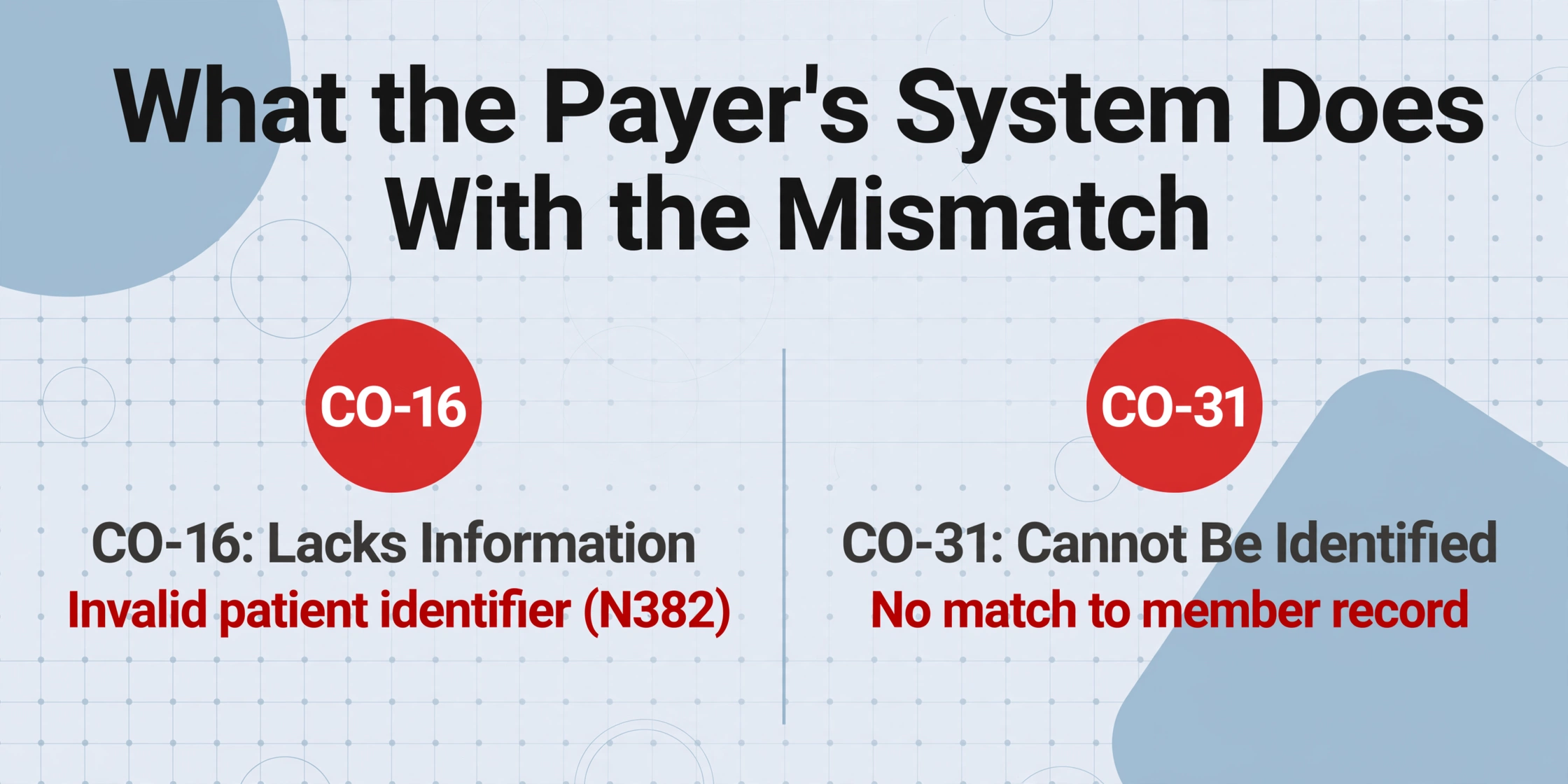
Payer claim editing systems run every submitted claim through an automated comparison of name, date of birth, and member ID against the enrollment database. A single character mismatch triggers a standard HIPAA claim adjustment reason code, which is the fixed wording that comes back with the EOB or the electronic remittance advice. Two codes cover most of the cases that begin at intake. CO-16 means "claim/service lacks information or was submitted incomplete," and when it fires on a demographic mismatch it is typically paired with the remark code N382 for an invalid patient identifier. CO-31 means "patient cannot be identified as our insured," the code used when the submitted identifier cannot be matched to a member record at all.
Both codes set a specific corrective path: a corrected claim, not an appeal. The corrected claim resubmission is cheaper than an appeal, but it burns the one resource that cannot be recovered, the filing window. Medicare's limit runs 12 months from the date of service; commercial plans commonly allow 90 to 180 days. Every cycle of reject, research, correct, and resubmit spends a week to a month of that window, and each round-trip also reassigns a staff member who could have been working a claim that pays. The American Health Information Management Association, whose members run the registration and records side of this process, has put the broader stakes on the record: patient identification errors often begin during the registration process and can initiate a cascade of errors, and by the most recent available data, roughly 35 percent of denied claims have been attributed to inaccurate patient identification, costing the average hospital an estimated $2.5 million annually and the US healthcare system more than $6 billion. The industry's own people find this pattern the same way the rest of us do, by discovering it late. One patient in an r/HealthInsurance thread described catching the same billing failure across four different providers: "Front desk not getting the insurance put in correctly, provider trying to code themselves thinking they are helping patients but actually hurt them."
A single character mismatch on the claim triggers an automated denial before a human at the payer ever sees the claim. The fix has to happen before submission, or it costs a filing window.
Catch It at Entry: Two Settings That Don't Require Replacing Paper
The usual answer to this problem is to eliminate paper with a digital intake platform, and for many practices that is the right long-term move. But paper intake survives in most clinics because the alternative is a system change, and while that change is being considered, every new patient still handwrites a form at check-in. The intercept that works today does not remove the clipboard. It makes the demographics block verifiable at the moment it is keyed, using data extraction that reads the intake packet itself.
The mechanism is Custom Column Extraction: in ImageToTable.ai you type the column names you want in the output spreadsheet, such as "Patient Legal First Name," "Patient Legal Last Name," "Date of Birth," and "Insurance Member ID," and the AI locates each value by understanding what the field label means, not by matching a fixed position or template. That is what makes one set of columns work across intake forms from different clinics, because the field is found by meaning rather than by coordinates. The output is a row per patient where the demographics sit in discrete cells that can be compared against the payer record before a claim is built. This is the same capability described in detail on the patient intake form page, and it is the part that puts the patient's name, DOB, and member ID where the front desk can actually see them.
Handwriting is where Model Tier enters. ImageToTable.ai lets an account run at a processing tier, Standard, Advanced, or Premium, with higher tiers using a stronger vision model tuned for dense handwriting and complex layouts. For the intake packets that come in as pencil-filled scans, third-generation faxes, or forms with handwritten margin notes, the higher tier is the right choice for that batch, and it is worth the extra cost precisely on the batches where character ambiguity is the failure mode. The tier is locked when the batch is submitted, so a practice that runs clean digital forms at Standard and handwritten scans at Premium is billing each batch at the tier it actually needed.
Recognition, even at the strongest tier, is not a guarantee, which is why the second setting is a verification pass aimed at the identifier columns. Review Mode with bbox-assisted verification lets you hover over any extracted cell and see the exact handwriting region on the original image highlighted, or click a region on the image and jump to its cell. For intake forms you would enable auto-annotate so the highlights are generated for every file, and spot-check exactly three columns: legal name, date of birth, and insurance member ID. Those are the three values the payer's system compares, so they are the only three that need a human eye before the claim is built on them. A misread in the medications column is a clinical records problem; a misread in the member ID column is a denied claim. The tool's own billing-side reality is that the EOB data sits on the other end of this chain, manually keyed for decades, so the intake side is not the only manual handoff in this workflow, but it is the one that decides whether the claim is payable at all. Once the identifiers are clean and the EOB returns, the remaining job is confirming which patient record it belongs to, which is the reconciliation workflow covered in matching an EOB back to the right patient.
Try the extractor on your own intake form before setting anything up.
What This Fixes, and What Still Needs a Human or a Payer
The honest boundaries keep this workflow usable. Extraction accuracy on handwriting is high but never 100 percent, which is exactly why the verification pass exists and why the human decision stays where it belongs. Two patients with the same legal name and similar birth years still need a registrar to adjudicate which record is which, because a spreadsheet row is evidence for that decision, not the decision itself. The tool also does not replace eligibility verification: checking coverage against a payer database at check-in, through your clearinghouse's eligibility transaction, remains a separate step that protects against a different failure mode than a transcription error.
Two limitations matter for compliance-sensitive practices. ImageToTable.ai does not integrate with Epic, athenahealth, or any EHR; the output is a spreadsheet your team imports, so the mapping into your system remains your workflow. And the service is not a HIPAA compliance solution: it does not offer a Business Associate Agreement, and practices that handle protected health information should confirm the service meets their own obligations and policies before uploading patient-identifiable forms. The value this workflow adds is a checkable demographics block and a paper trail back to the exact handwriting that produced each value, not a compliance layer.
Finally, catching the error at entry does not automate the downstream half of the chain. When the EOB does come back, verifying that the paid amounts, patient responsibility, and denial codes line up with what was billed is a separate workload with its own failure modes, which is where EOB extraction accuracy and the full EOB extraction workflow come in. The intake fix increases the share of claims that reach that step in the first place.
Frequently Asked Questions
Can the AI actually read rushed handwriting on intake forms, or does it only handle checkboxes and printed text?
ImageToTable.ai's recognition covers printed text, handwriting, cursive, checkboxes, and signatures across a document. For handwriting-dense intake packets, running the batch at the higher processing tier gives noticeably better results on ambiguous characters like 0/O and 1/l. The bbox review pass then lets you confirm the values that matter, patient name, date of birth, and member ID, against the original handwriting before a claim is built on them.
Will this stop all patient registration denials on its own?
No. It fixes the transcription slice: demographics entered from handwritten forms. Eligibility gaps, coverage lapses, missing authorizations, and clinical or coding issues deny claims through separate mechanisms, and eligibility verification at check-in is still required. Front-end accuracy is a widely cited lever, half of the organizations in Experian Health's denial management survey named it a key opportunity, but it is one lever among several.
Does uploading handwritten intake forms mean protected health information leaves my practice?
It can, and that decision is yours. ImageToTable.ai is not a HIPAA-covered entity and does not offer a Business Associate Agreement, so practices subject to HIPAA should evaluate the service against their own compliance requirements and policies before uploading forms with patient identifiers, or work with de-identified documents where that fits the use case. The tool's own position is that it does not claim HIPAA or BAA compliance, and this workflow should be used in whatever form your compliance review supports.
Does this replace the eligibility check my clearinghouse does at registration?
No, and it should not. Eligibility verification queries the payer's coverage database at check-in and answers a different question, whether the patient has active coverage for the service. Extraction and bbox review answer a different question, whether the demographics being keyed are the ones on the form. You still run your clearinghouse eligibility transaction (via Availity, Waystar, or your existing channel) at check-in; this workflow just makes the demographics block it receives more reliable.
When a claim comes back with CO-16 or CO-31, the standard reaction is to treat it as a payer problem and push back. The far cheaper reaction is to look at the demographics block that came off the handwritten form, because that block is the version the payer checked, and it can be made verifiable in the thirty seconds after it is keyed rather than three weeks later. Test the extraction on your own intake packet and see whether the member ID column matches what your payer has on file, before the next new patient fills one out.