5 Japanese Tax Return (確定申告) Data Entry Mistakes That
Cost Japanese Freelancers Their Refund
A Japanese freelance web developer in Tokyo earns ¥5 million a year from three regular clients, maintains a blue return (青色申告) with double-entry books, and claims the standard deductions a sole proprietor (個人事業主, kojin jigyō nushi) typically qualifies for: social insurance, life insurance, spouse deduction, and medical expenses. She files her Japanese tax return (確定申告, kakutei shinkoku) on March 10, five days before the deadline, and assumes the return is correct because the accounting software totalled the columns. Three months later, the tax office sends a notice: the income category was wrong, a ¥650,000 deduction was not claimed, and the tax due is ¥180,000 higher than she paid. None of them was a tax-law error. All were data-entry errors introduced in the step between reading a document and typing the figure, a step that neither accounting software nor a tax accountant's review can fully eliminate because neither reads the source document. The five errors below are the ones that make that step expensive, and each comes with the mechanism that causes it, the consequence of getting it wrong, and the method that prevents it.
Key Takeaways
- Five Japanese tax return (確定申告) mistakes cost freelancers their refund every year, and not one of them is a tax-law error. Every single one is a copy error introduced in the step between reading a figure off a physical document and typing it into Form B.
- A bank passbook entry, a receipt, an insurance certificate, and a withholding slip each use a different format that looks nothing like the fields on the tax form, so the person is doing five incompatible reading-and-typing jobs at once.
- Upload all your documents as one batch, name your columns, and the AI fills each field by meaning. Your job shifts from transcribing numbers to verifying a pre-filled spreadsheet, and the error you are checking for is the one a machine cannot introduce.
How the NTA Finds a Data-Entry Error in a Filed Return
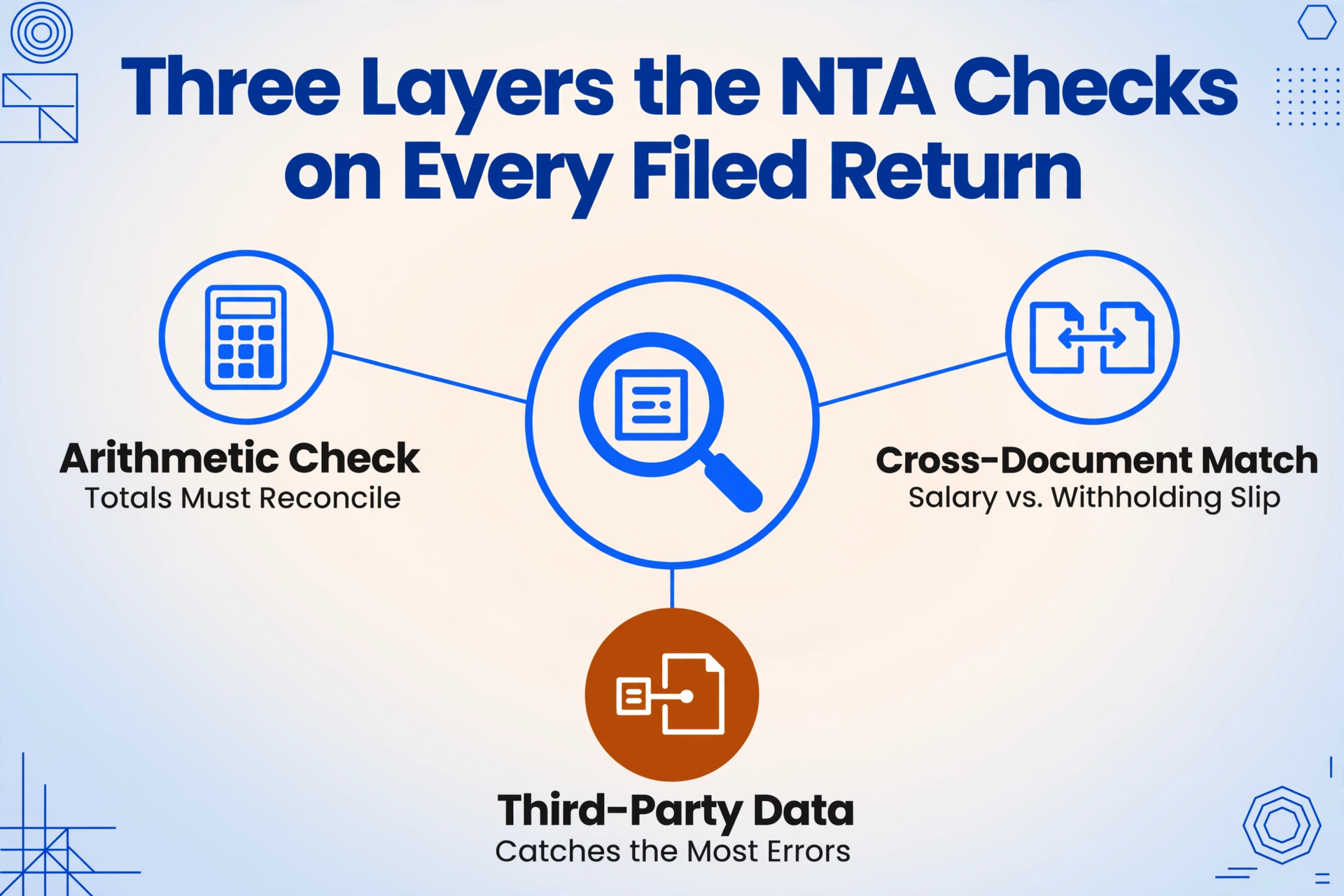
Before looking at individual mistakes, it is worth understanding how a transcription slip on a piece of paper becomes a tax-office letter. The NTA's review process is not random. A filed Japanese tax return (確定申告) passes through three layers of scrutiny, and each layer catches a different class of error.
The first is arithmetic validation: the system checks that totals on Form B reconcile with the attached income statement, that deduction amounts do not exceed statutory limits, and that the tax calculation on Sheet 1 matches the income and deduction figures that feed into it. A medical expense deduction of ¥300,000 on a ¥3 million income is arithmetically unusual (it implies ¥400,000 in medical expenses with no insurance reimbursement, which is rare), and the system flags it for human review.
The second is cross-document matching. When a freelancer also has employment income, the employer submits a withholding slip (源泉徴収票) to the tax office. The NTA's system compares the salary figure reported by the employer with the employment income figure on the freelancer's return. A mismatch triggers a notice. Similarly, a blue return claiming the ¥650,000 deduction without the required e-Tax filing flag is a pair of data points the system checks automatically.
The third layer, and the one that catches the most errors after the fact, is third-party data matching. Insurance companies report payment amounts to the NTA. Banks report interest payments. Municipalities report residence tax payments that feed the social insurance deduction. A figure typed from a certificate that does not match what the issuing institution reported is a mismatch the system will detect. The detection may arrive months later rather than in March, once the matching cycle completes, but it does arrive.
The most common letter a freelancer receives after filing is a discrepancy notice, not an audit notice. The letter says: "The figure you reported for X does not match our records." And in nearly every case, the mismatch was not a tax-law error. It was a data-entry error: a number typed incorrectly from a source document that the issuing institution reported correctly.
Mistake #1: Wrong Income Category — Business vs. Employment vs. Miscellaneous Income (事業所得・給与所得・雑所得)
Income categories (所得区分) are not cosmetic labels: each carries different deduction rules, different tax-rate treatments, and different reporting obligations. The three categories most commonly confused by freelancers:
- Business income (jigyō shotoku). Income from a trade or business operated on your own account. Calculated as revenue minus necessary expenses (必要経費). Qualifies for the blue return deduction (青色申告特別控除) of up to ¥650,000, loss carryforward (純損失の繰越控除) for up to three years, and the special deduction for employing family members (専従者給与). Requires double-entry books for the full deduction.
- Employment income (kyūyo shotoku). Salary and wages from an employer. After the employment income deduction (給与所得控除), which has a minimum of ¥650,000 for 2025 income, the remainder is the taxable amount. Cannot be combined with business income deductions; the employment income deduction is statutory and fixed, not based on actual expenses.
- Miscellaneous income (zatsu shotoku). A residual category covering income that is neither business income, employment income, nor any of the other named categories. Includes freelance work that does not rise to the level of a business: a one-off consulting gig, income from a blog, occasional translation work. No blue return deduction is available. No loss carryforward. Expenses can only be deducted against the specific miscellaneous income they relate to, not aggregated across income types.
How the error happens. A freelancer with a main gig that is clearly business income also does occasional projects, such as a speaking engagement, a training session, or a few hours of consulting, and classifies all of it as business income because "it is all freelance work." The NTA disagrees: the distinguishing factor, per the administrative guidelines, is whether the activity is conducted with the scale, continuity, and profit motive of a business. A single one-day training session for ¥50,000 is miscellaneous income. A monthly retainer for the same training delivered to twelve clients is business income. The distinction matters because miscellaneous income cannot use the blue return deduction, cannot carry forward losses, and cannot deduct expenses that exceed the income from that specific source.
Consequence. A freelancer classifies ¥300,000 of miscellaneous income as business income. The NTA reclassifies it. The business-income-derived blue return deduction does not extend to the reclassified portion, so the effective deduction shrinks. The expense deductions claimed against that income are disallowed if they exceed the miscategorised income. And the understatement penalty (過少申告加算税) of 10% to 15% of the additional tax applies on top.
Prevention. Separate your income sources before you type a single figure. For each source, ask: is this a recurring business activity with continuity and a customer base, or a sporadic engagement? List each source with its correct category on a separate line, and let the categories drive the deductions — not the other way around.
Mistake #2: Missing the Blue Return (青色申告) Special Deduction
The blue return special deduction (青色申告特別控除) is the largest single deduction available to a sole proprietor, and it is the one most commonly forfeited, not because the filer does not qualify, but because the filer never realises the deduction has to be claimed on the return. It is not automatic.
A sole proprietor who meets all three conditions, namely maintaining double-entry books (複式簿記), filing by e-Tax, and submitting the blue return application (青色申告承認申請書) to the tax office by March 15 of the first year of business, is entitled to deduct ¥650,000 from taxable income for 2025 income filed in 2026. The deduction appears on Form B, Sheet 1, as a specific line item, and the filer must enter the amount. Accounting software typically calculates it and pre-fills the field, but if the software was configured incorrectly, say set to simplified bookkeeping (簡易簿記) instead of double-entry, the calculated amount drops to ¥100,000 without any warning dialogue. A filer who trusts the pre-filled figure without verifying it against the conditions forfeits ¥550,000 of deduction.
How the error happens. The filer uses freee or Yayoi (弥生) and the software calculates a deduction of ¥100,000 because the account type was set up as "simplified" at the start of the year. The filer knows they maintain double-entry books and file by e-Tax, and assumes the software "handles" the deduction. It does not: it calculates what it was told to calculate, and if the configuration is wrong, the calculation is wrong. The second variant: a filer switches accounting software mid-year and the new software does not have the blue return flag set, producing a ¥100,000 deduction on a return that qualifies for ¥650,000.
Consequence. ¥550,000 of additional taxable income. At a 20% income tax bracket plus approximately 10% resident tax (住民税), that is roughly ¥165,000 in extra tax, paid unnecessarily and recoverable only through a correction request (更正の請求) within five years. The ¥100,000 deduction is the floor for simplified bookkeeping; a filer claiming ¥100,000 when they could claim ¥650,000 is paying ¥165,000 for a checkbox they never looked at.
Prevention. Before filing, verify two things independently: that your accounting software is set to double-entry bookkeeping rather than simplified, and that the deduction line on Form B Sheet 1 shows ¥650,000, not ¥100,000. These are not the same check: the software can show double-entry in the settings and still calculate ¥100,000 if the blue return application status is not linked. For the transition to the 2027 tiers, the amounts become ¥750,000 for e-Tax with excellent electronic records, ¥650,000 for e-Tax with standard records, and ¥100,000 for paper. The rule is simple: file by e-Tax, or lose the deduction.
Mistake #3: Medical Expense Deduction (医療費控除) — The Wrong Threshold and the Wrong Medical Expenses
The medical expense deduction has two common failure modes: applying the wrong income threshold to the calculation, and including expenses that are not eligible while excluding expenses that are.
Threshold error. If your total income is ¥2,000,000 or above, the formula is: (total medical expenses paid during the year) − (insurance reimbursements, 保険金などで補填される金額) − ¥100,000. If your total income is below ¥2,000,000, the formula is: (total medical expenses) − (insurance reimbursements) − 5% of total income. A freelancer whose total income is ¥1,800,000 and who paid ¥150,000 in medical expenses uses the ¥100,000 formula, producing a deduction of ¥50,000, when the correct formula uses 5% of ¥1,800,000 = ¥90,000, producing a deduction of ¥60,000. The ¥10,000 difference is small, but the same error pattern works in reverse: a filer who assumes "everyone uses ¥100,000" may apply that formula to a ¥2,200,000 income and produce a deduction that is too high, which the NTA can flag as an overstatement.
Expense eligibility error. The NTA distinguishes between expenses that are "for treatment" (治療目的), which are eligible, and expenses that are "for health maintenance or cosmetic purposes", which are not. The boundary is not always obvious. Eligible: hospital treatment, prescribed medication, dental treatment including insurance-excluded ceramic fillings, orthodontic treatment for children, LASIK surgery, public-transport travel to medical appointments, and purchase of medical devices such as crutches. Not eligible: health checkups (人間ドック) unless a disease is discovered and treatment follows, preventive vaccinations, cosmetic surgery, over-the-counter vitamins and herbal supplements not prescribed by a doctor, and private-car travel costs to appointments. Including a ¥50,000 health checkup in the medical expense total overstates the deduction by ¥50,000. Excluding ¥200,000 in dental treatment costs because "insurance did not cover it" understates the deduction; the NTA treats treatment purpose, not insurance coverage, as the eligibility criterion.
Consequence. An overstated medical expense deduction triggers the understatement penalty (過少申告加算税) of 10% to 15% of the additional tax. An understated deduction is penalised less, since the filer simply pays more tax than necessary, but the lost refund on a missed ¥200,000 deduction at a 20% bracket is ¥40,000, and recovering it requires a correction request (更正の請求) with supporting receipts.
Prevention. Before filing, separate medical expenses into three categories: treatment (eligible), prevention/cosmetic (not eligible), and ambiguous (check). For each ambiguous item, ask the single question the NTA uses: "was this for the purpose of treatment?" If the answer is yes, include it. If no, exclude it. If you do not know, call the provider and ask; a two-minute phone call beats a tax-office letter.
Mistake #4: Spouse Deduction (配偶者控除) — The Income Threshold Miscalculation
The spouse deduction and spouse special deduction operate on a set of income thresholds that change with the tax year, and the most common error is applying the wrong threshold to the wrong year, or misreading the difference between employment income (給与収入) and total income (合計所得金額).
For 2025 income filed in 2026, the thresholds are:
- Full spouse deduction, ¥380,000. Your spouse's total income is ¥580,000 or below. For a spouse with only employment income, this corresponds to employment income of ¥1,230,000 or below (¥1,230,000 minus the ¥650,000 minimum employment income deduction = ¥580,000). Your own total income must be ¥10,000,000 or below.
- Spouse special deduction (配偶者特別控除), ¥10,000 to ¥380,000. Your spouse's total income is between ¥580,001 and ¥1,330,000. The deduction stays at the full ¥380,000 until your spouse's total income passes ¥950,000, then phases down as income rises, per the NTA's published table. Your own total income must still be ¥10,000,000 or below.
How the error happens. A freelancer's spouse has employment income of ¥1,950,000 for the year. The freelancer claims the full ¥380,000 spouse deduction, reasoning that a spouse earning under ¥2 million still counts as a dependent. But at ¥1,950,000, the spouse's total income is ¥1,285,000 (¥1,950,000 minus the ¥665,000 employment income deduction for that income level), and the full ¥380,000 deduction stops at ¥950,000 of total income. At ¥1,285,000 the NTA table gives a spouse special deduction of ¥60,000, not ¥380,000. The overclaimed ¥320,000 is a direct understatement of taxable income.
The second variant: the spouse's income included a one-time bonus that pushed the total past a threshold, and the freelancer used the previous year's figure without checking. The employment income deduction changed again for 2025 income, with its minimum rising from ¥550,000 back to ¥650,000, and the spouse thresholds moved with it: the limit for the full deduction rose from ¥480,000 to ¥580,000 of spouse total income. A filer working from a 2024 rulebook subtracts the wrong number and lands on the wrong threshold.
Consequence. An overclaimed ¥320,000 deduction at a 20% bracket produces ¥64,000 in underpaid tax, plus the 10–15% understatement penalty on that amount, plus delinquency interest if the correction is late. The NTA cross-checks spouse income against the spouse's own tax records, and a mismatch between what the filer claims and what the spouse's employer reported is among the easiest discrepancies for the system to flag.
Prevention. Two numbers to check before filing: your spouse's total income for the tax year, not their employment income; and the current-year threshold for each deduction bracket, not last year's. The NTA publishes updated thresholds every year, and the gap between "close enough" and "correct" is exactly what the matching system measures.
Mistake #5: Prepaid Tax (予定納税) — The Credit That Gets Carried Forward Wrong
The prepaid tax system is a mechanism most freelancers encounter for the first time in their second year of filing, and the error it produces is one of the most expensive because it takes a year or more to surface.
Under Income Tax Act Article 107 (所得税法第107条), if your tax liability for the previous year exceeded ¥150,000, the NTA calculates your prepaid tax obligation, typically one-third of the previous year's tax, and sends a payment notice in July (第一期) and November (第二期). You pay these amounts during the year. When you file your return for that year, the prepaid amounts are credited against your total tax liability on Form B, Sheet 1, in the prepaid tax field (予定納税額). If the prepaid amount exceeds the actual tax due, the excess is refunded.
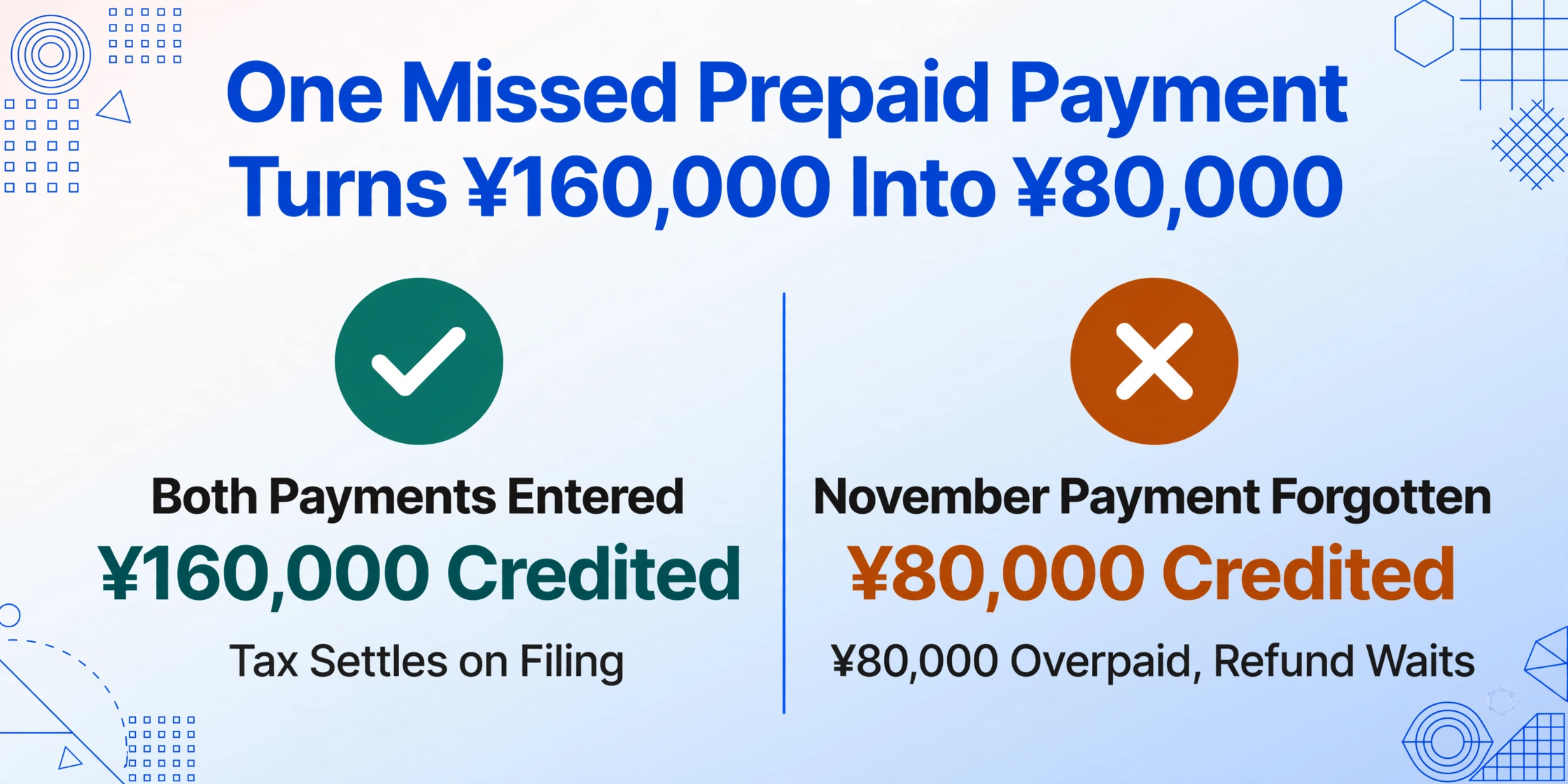
How the error happens. A freelancer's 2024 return showed tax due of ¥240,000. The NTA sent prepaid tax notices for ¥80,000 each in July and November 2025, ¥160,000 in total. The freelancer paid them. When filing the 2025 return in March 2026, the freelancer enters the prepaid amount as ¥80,000, the July payment only, forgetting the November payment. The missing ¥80,000 credit means the return shows ¥80,000 more tax due than is actually owed. The freelancer pays the inflated amount. The error surfaces only when the NTA's records, which show both payments, eventually reconcile and issue a refund, which can take months.
The direction flips when the previous year's return itself was overstated. If the 2024 return incorrectly showed ¥300,000 in tax due (because income was overstated), the prepaid tax notices for 2025 are calculated on the inflated figure, ¥100,000 each in July and November. The freelancer pays ¥200,000 in prepaid tax on a tax liability that, filed correctly, would be ¥180,000. The prepaid amount already exceeds the correct tax by ¥20,000, and the return should show a net refund. But if the 2025 return carries forward last year's error by using the inflated income figure again, the cycle compounds: the 2026 prepaid tax is calculated on an inflated 2025 return, the 2027 prepaid tax on an inflated 2026 return, and each year's overpayment funds the next year's overpayment.
Consequence. A single misentered prepaid tax figure creates either an immediate overpayment (if the credit is too low) or a future underpayment with penalties (if the credit is too high). The compounding variant, where an inflated previous-year return drives inflated prepaid amounts, can cascade across multiple tax years, with each year requiring a correction request (更正の請求) to unwind the overpayment chain. At ¥20,000 to ¥80,000 per year across three years, the cumulative overpayment reaches ¥60,000 to ¥240,000: cash that is gone from the freelancer's account and recoverable only through a multi-year correction filing.
Prevention. Before filing, verify three numbers from the previous year's return: the final tax due (the figure the prepaid amounts are calculated from), the total prepaid tax paid (both instalments), and the income figure that fed the tax calculation. If any of these numbers was wrong on the previous return, the current year's prepaid tax credits are also wrong, and you need to correct the base year before the error compounds.
One Mechanism That Prevents All Five Errors at Once
Read back through the five mistakes and the root operation is the same in every case: a person reads a figure off one document and types it into another. Mistake #1 is reading an income entry from a bank passbook and typing it into the wrong category. Mistake #2 is reading the ¥650,000 deduction line and failing to notice it says ¥100,000. Mistake #3 is reading medical expense receipts and typing the wrong category or the wrong threshold. Mistake #4 is reading a spouse's withholding slip and using the wrong income number. Mistake #5 is reading last year's return and typing the wrong prepaid figure. In each case, the error is a copy error, and copy errors happen because the person doing the copying is working from documents that do not look like the fields they are copying into.
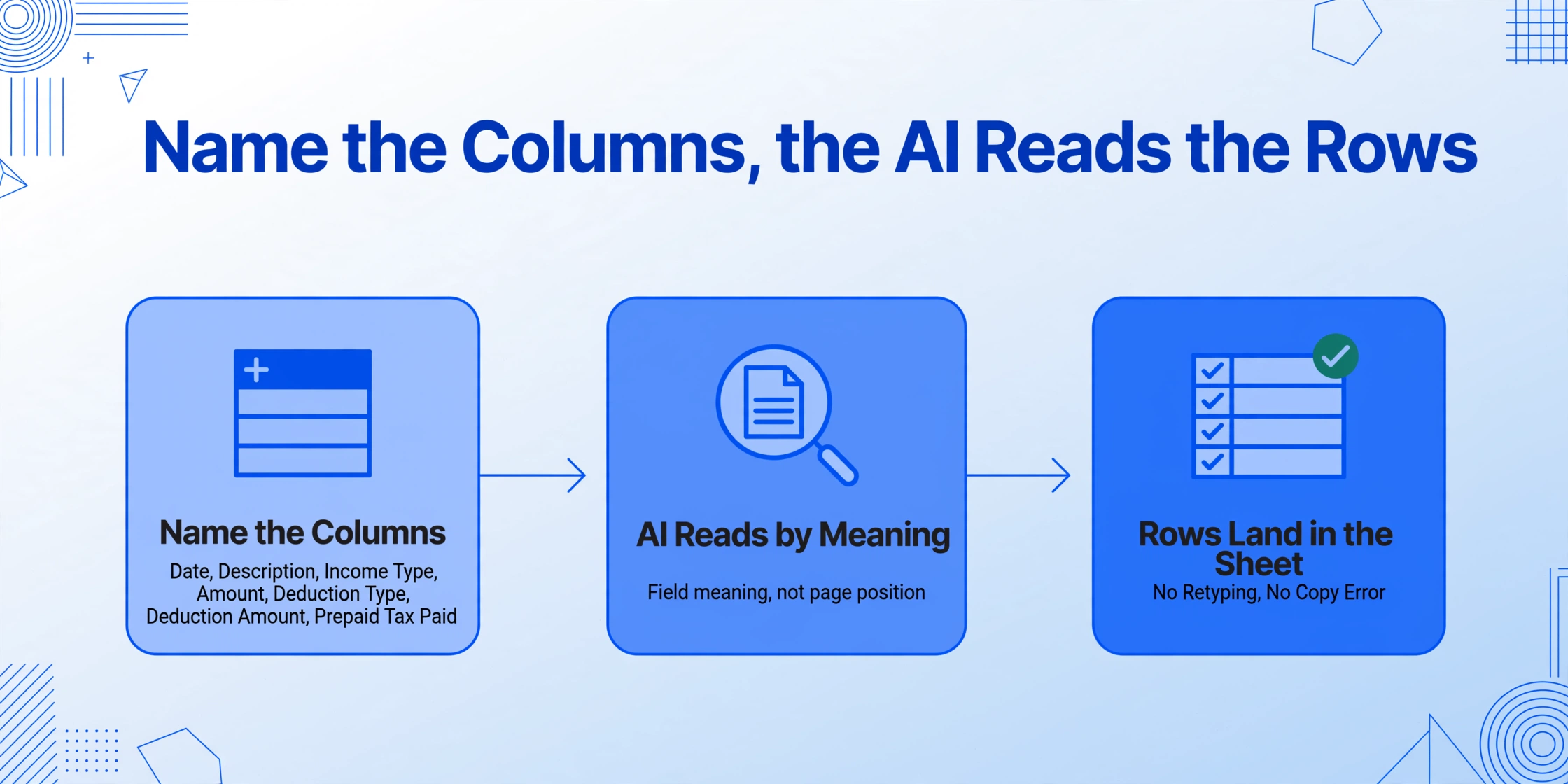
The mechanism that prevents all five is removing the person from the reading-and-typing step. ImageToTable.ai uses Custom Column Extraction: you name the columns you want, such as Date, Description, Income Type (事業所得/給与所得/雑所得), Amount, Deduction Type, Deduction Amount, and Prepaid Tax Paid. The AI reads each document and fills each row by understanding what the field means, not where it sits on the page. A bank passbook entry of ¥50,000 from a client project is read as income with the context "this is from a recurring client", which maps to business income. An insurance certificate showing ¥85,000 in premiums for a life insurance contract is read into the deduction column as a life insurance premium deduction (生命保険料控除), and the correct formula is applied by a computed column that knows the difference between old-contract and new-contract (旧契約/新契約) calculation methods.
Because the tool is batch-first, you do not process documents one at a time. The entire year of passbook pages, receipts, certificates, and last year's return uploads as a single batch, and the output is one spreadsheet where every figure sits in the correct column. An inferred column can categorise income by type as it reads: define a column named Income Category (options: 事業所得/給与所得/雑所得/不動産所得/譲渡所得), and the AI assigns each income entry to the correct income category (所得区分) based on context, so a recurring client payment gets business income and a one-time training fee gets miscellaneous income. A computed column then cross-checks the blue return deduction status: if the filer maintains double-entry books and files by e-Tax, output ¥650,000; if simplified, output ¥100,000; if the books indicate double-entry structure but the e-Tax flag is absent, output "REVIEW", catching Mistake #2 before the return reaches the screen.
None of this replaces the need to review the return; a person should still verify that every figure is correct. The review screen makes that pass cheaper: hovering any extracted cell highlights the exact spot on the original document the value came from, and clicking a region on the document jumps back to the matching row, so checking a figure against its source is a glance rather than a re-read. But extraction replaces the need to type every figure in the first place, and the distinction matters: most data-entry errors are introduced in the step the AI skips, not in the step the person reviews. The full workflow for a single return, from which columns to define to how to export the result, is covered in the guide to extracting Japanese tax return (確定申告) data to Excel. The deeper analysis of why the manual assembly phase produces these errors so reliably for freelancers filing each February is in the piece on why Japanese freelancers still hand-enter tax return data every February. The passbook-specific version of this list is in the article on Japanese bank passbook data entry mistakes. And the matching set of errors in the UK system, such as wrong UTRs, missing SA100 pages, and miscategorised dividend income, is in the article on SA100 data entry mistakes that trigger HMRC enquiries.
Files are processed securely and not stored.
At 5-10 seconds of processing per document against roughly three minutes of manual entry, extraction does not make the return perfect, but it removes the step where all five of these errors are introduced. The freelancer who verifies a pre-filled spreadsheet is doing a different job from the freelancer who types it from scratch, and the residual error rate is the difference between the two.
Frequently Asked Questions
What is the most expensive data-entry error on a Japanese tax return (確定申告)?
Missing the blue return special deduction (青色申告特別控除). A sole proprietor who qualifies for ¥650,000 but claims ¥100,000, typically because the accounting software was misconfigured or the filer assumed the deduction was automatic, loses ¥550,000 of deductible income. At a 20% income tax bracket plus approximately 10% resident tax, that costs roughly ¥165,000 in unnecessary tax. All other common errors, such as an overclaimed ¥320,000 spouse deduction or a ¥50,000 medical expense miscategorisation, are smaller in absolute terms. The ¥550,000 gap is the error class that justifies a verification pass on the deduction line alone.
How does the NTA detect a data-entry error on a Japanese tax return?
Three mechanisms: arithmetic checks (totals must reconcile across Form B and the attached income statement), cross-document matching (the salary on your return must match the employer's withholding slip, the insurance payment on your deduction must match the provider's report to the NTA), and third-party data feeds (banks report interest, insurers report premiums, municipalities report residence tax). The most common trigger is a discrepancy between a figure you typed from a certificate and the figure the issuing institution reported, a mismatch you may not notice when filing but the NTA's system flags when the matching cycle completes.
What is the difference between business, employment, and miscellaneous income?
Business income (事業所得) is income from a trade or business you operate on your own account; it qualifies for the blue return deduction and loss carryforward, and requires double-entry books for the full ¥650,000 deduction. Employment income (給与所得) is salary from an employer, and a statutory employment income deduction applies (minimum ¥650,000 for 2025). Miscellaneous income (雑所得) is a residual category for income that is not business, employment, or any named type, such as one-off consulting, blog income, or occasional translation. Miscellaneous income cannot use the blue return deduction, and expenses are deductible only against the specific miscellaneous income they relate to. Misclassifying miscellaneous income as business income overclaims deductions and triggers the understatement penalty.
How do I calculate the medical expense deduction (医療費控除) correctly?
If your total income is ¥2,000,000 or above: (total medical expenses) − (insurance reimbursements) − ¥100,000. If your total income is under ¥2,000,000: (total medical expenses) − (insurance reimbursements) − (5% of total income). The most common error is applying the ¥100,000 formula when your income is under ¥2,000,000, which understates the deduction, or applying the 5% formula when your income is over ¥2,000,000, which overstates it. Separate your receipts into eligible (treatment purpose) and non-eligible (prevention, cosmetic, health maintenance) before calculating the total.
What happens if I make a mistake on my Japanese tax return that I discover after filing?
If the error means you paid too little tax, file a corrective return (修正申告), the sooner the better, because delinquency interest accrues daily and the understatement penalty (過少申告加算税) of 10–15% applies. If the error means you paid too much, file a correction request (更正の請求) within five years of the original filing deadline. The correction request must include supporting documentation, such as receipts, certificates, and the corrected calculation, and the NTA reviews and processes the refund. Voluntarily filing either correction before the NTA discovers the error generally results in lower penalties than waiting for a tax-office notice.
Can AI extraction prevent data-entry errors on a Japanese tax return?
Yes, by removing the reading-and-typing step where most errors are introduced. The AI reads each document and locates values by understanding what a field means, such as revenue (収入金額), necessary expenses (必要経費), or social insurance premiums (社会保険料控除), rather than reading it off the page and copying it. Computed columns can apply deduction formulas (medical expense threshold, blue return deduction tier) automatically, and inferred columns can categorise income and expenses by type as they read. The output is a spreadsheet where every figure is pre-placed in the correct column: the person's job shifts from transcribing the numbers to verifying them, and the review screen shows where each extracted value came from on the document, which makes that verification faster than a line-by-line re-read.
Of the five errors that cost Japanese freelancers their refund, not one is a tax-law error. Every one is a copy error introduced in the step between reading a document and typing the figure. Take that step out, and the errors go with it. Verify, file, and keep the deduction you earned.
Extract Your Tax Documents