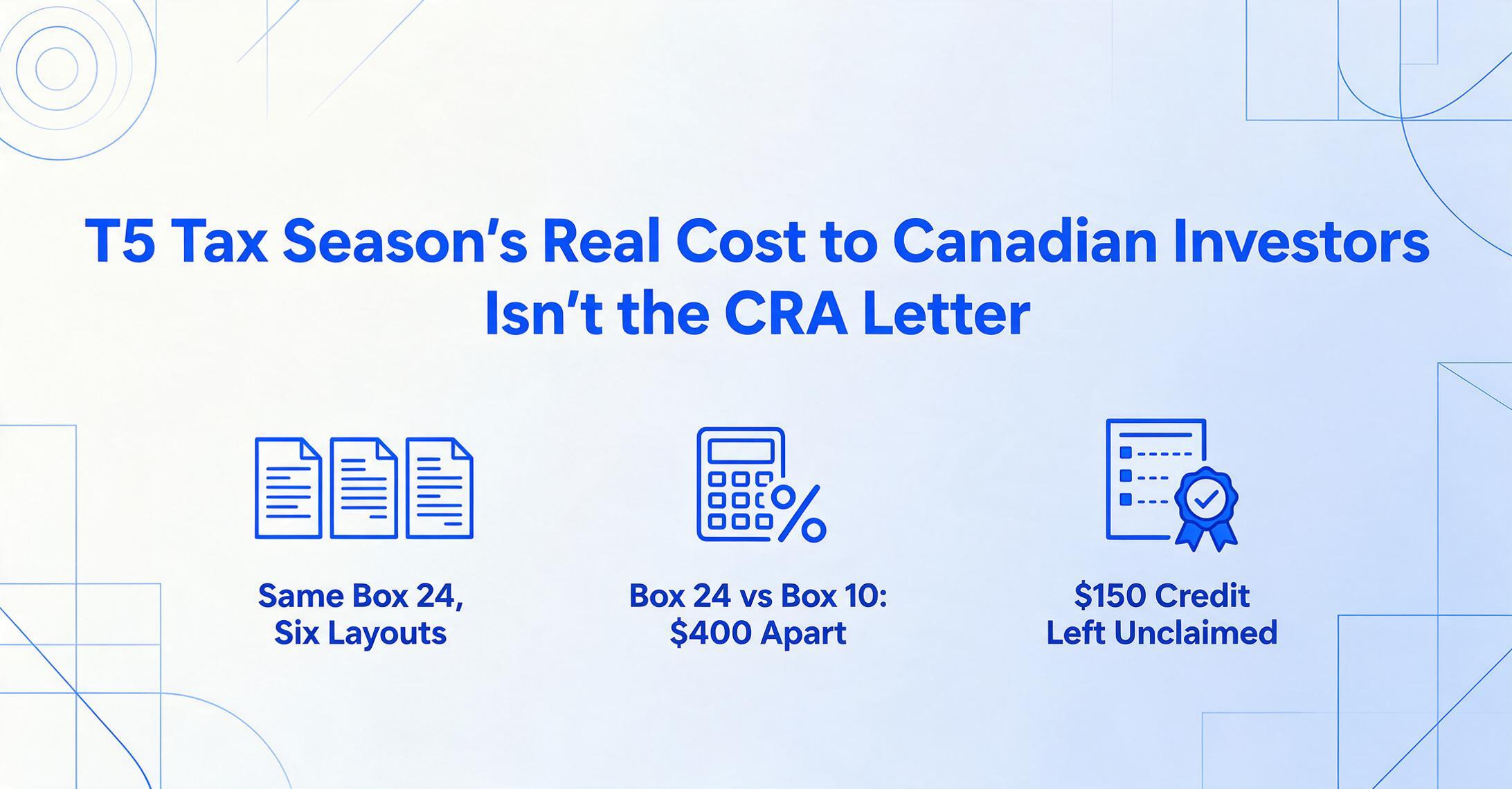
T5 Tax Season's Real Cost to
Canadian Investors Isn't the CRA Letter
The Canada Revenue Agency already has every Box number on every T5 slip you received for the 2025 tax year. Your bank, your brokerage, your credit union — each filed the data electronically, as required under the T5 information return rules (RC4157), by the end of February. The CRA's Matching Program — the automated system that cross-references what institutions reported against what you report on your T1 return — will flag any discrepancy by September. If you missed a slip entirely, the penalty under subsection 163(1) of the Income Tax Act is 10% of the unreported income (federal), matched by another 10% provincially, and if this is your second omission of $500 or more within four years, the penalty escalates to the lesser of 10% of the unreported amount or 50% of the additional tax. A single forgotten T5 showing $900 in interest income from a high-yield savings account at Tangerine — a slip that arrived by mail in late February when you'd already filed — triggers a $180 combined federal-provincial penalty plus interest on the tax owing. But none of that is the real cost of T5 season. The real cost is what happens between the moment you log in to TD Direct Investing to download your first T5 PDF and the moment you click "NETFILE" in TurboTax six weeks later — and it is almost never a CRA penalty. It is the hours that compound before the letter ever arrives, slip by slip, box by box, across a filing window that closes while you are still hunting for Box 16 on a Questrade PDF that puts it in a different position than the RBC PDF you finished ten minutes ago.
Key Takeaways
- Six different brokerages send you T5 slips in six different PDF layouts and your brain resets its visual search pattern with every file — transcription errors are a structural problem, not a sign of carelessness.
- The CRA matching program compares total dividend income but never checks which Box a figure came from, so a Box 24 dividend entered into Box 10 passes silently while you overpay hundreds in tax every year.
- Your role this tax season is not data entry clerk — extract every Box value from the PDFs and become a verifier confirming pre-populated figures instead of transcribing into a safety net that was never designed to catch the classification errors you are most likely to make.
Six Brokerages, Six Layouts, One Form
A T5 slip — formally the Statement of Investment Income — is one of the simplest documents the CRA administers. It has fewer than thirty Box numbers, each carrying a single dollar figure. Box 13 is interest from Canadian sources. Box 10 is the actual amount of dividends other than eligible. Box 24 is the actual amount of eligible dividends. Every financial institution in Canada uses the same Box numbering: a T5 from TD Direct Investing and a T5 from Wealthsimple both report eligible dividends in Box 24. There is no ambiguity about what goes where. The CRA standardized that layer decades ago.
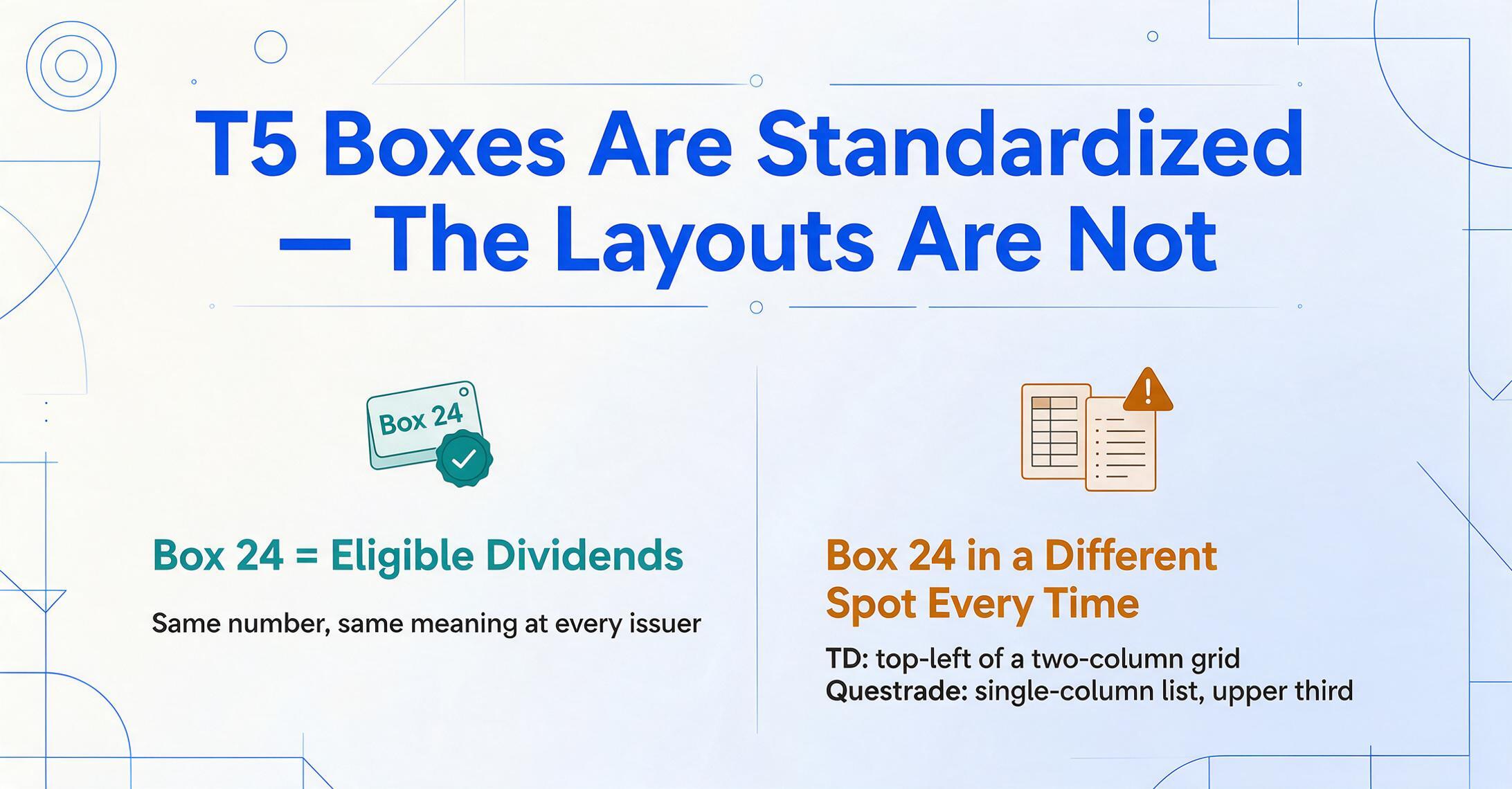
What the CRA never standardized is what the slip looks like.
A TD Direct Investing T5 typically positions the recipient's name and address in a block at the top left, with the payer (TD) information on the right, and the Box values stacked in a two-column grid below a bold "Statement of Investment Income" header. Dividends appear near the top — Box 24 and Box 25 on the left column, Box 10 and Box 11 on the right. Interest income (Box 13) sits halfway down the left column.
A Questrade T5 PDF uses a completely different arrangement. The recipient name sits centered at the top of the page. The Box values are organized in a single-column list — not a grid — with each Box number in bold followed by its dollar amount on the same line. Box 24 appears somewhere in the upper third. Box 13 is somewhere near the bottom. If the Questrade account holds ETFs or mutual funds that paid foreign dividends, Box 15 (foreign income) and Box 16 (foreign tax paid) are inserted between the domestic dividend boxes — a position TD's layout doesn't use.
A Scotiabank T5 shifts the title to a different position again — often embedding the institution's corporate logo and address in the top band, pushing the Box grid lower, changing the visual scan pattern your eyes learned on the TD slip five minutes earlier.
The data is identical in every meaningful sense. Box 13 is still Box 13. But the visual layout changes every time you switch institutions. Your brain has to re-learn where each Box sits on each PDF — and if you process slips sequentially, opening TD's, then Questrade's, then Scotia's, then RBC's, then Wealthsimple's, then BMO's, each layout change resets your visual search pattern. A task that takes 30 seconds per slip when you know exactly where every Box is within a familiar layout takes 90 seconds when you are scanning an unfamiliar arrangement for Box 11 (taxable amount of other-than-eligible dividends) that the previous PDF put in a grid column and this PDF put in a vertical list.
Multiply that by twelve slips. The difference between 30 seconds and 90 seconds across twelve T5s is twelve minutes — but that assumes you never misread a Box number, never double-check a figure because the PDF's font made a "3" look like an "8," never scroll back to the top to confirm which account this slip belongs to because the account number is printed in 7-point type in the footer. In practice, a Canadian investor with accounts at six institutions and twelve T5 slips spends roughly ninety minutes on data entry alone — and that is the best case, before factoring in the T3 slips that arrive in late March and restart the process.
The Box Classification Trap That Changes Your Tax Bill
The cost of T5 manual entry is not just time spent typing. It is time spent correcting.
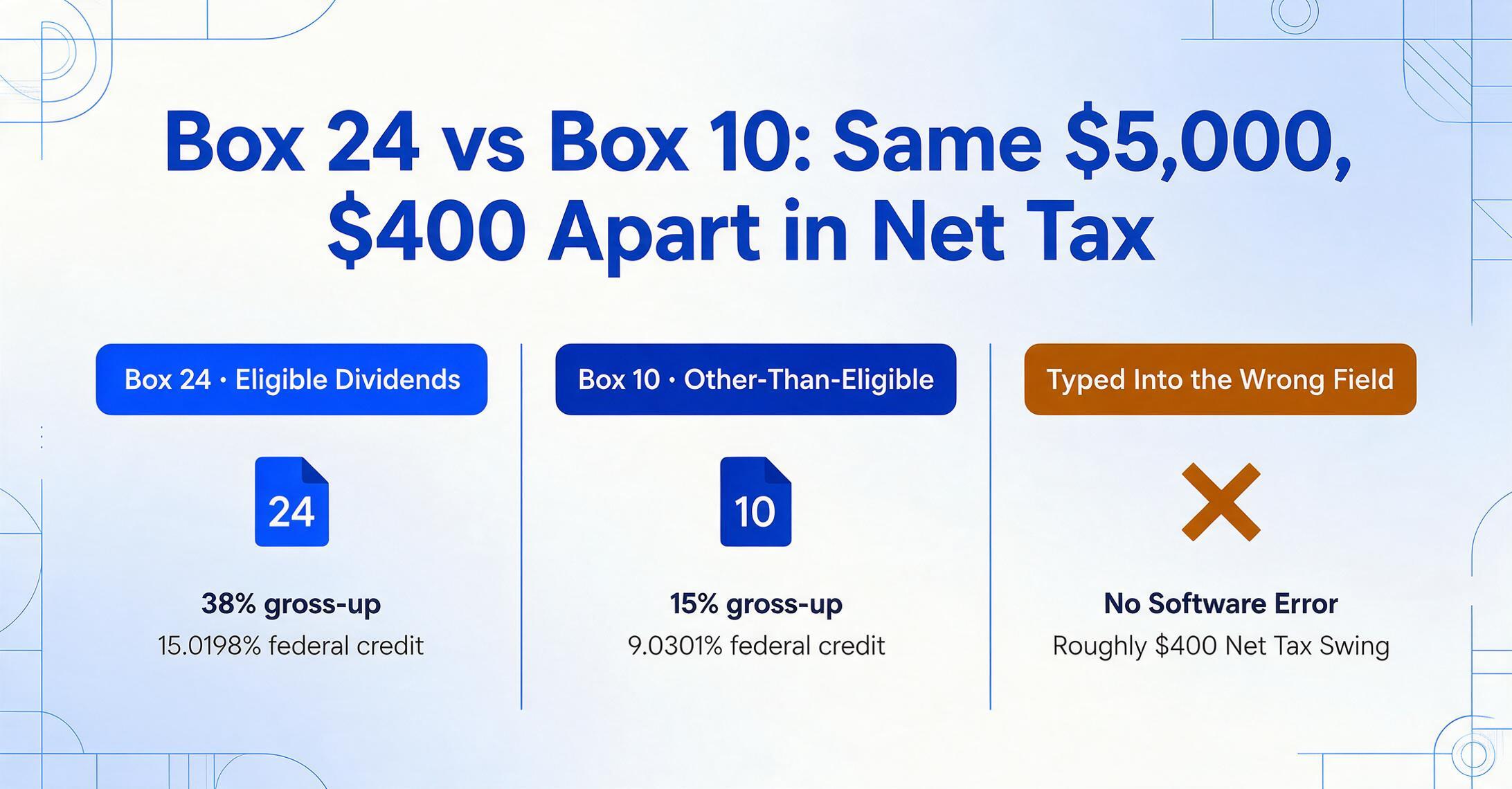
The T5 divides dividends into two tax categories with two different tax treatments: eligible dividends (Box 24–26) and other-than-eligible dividends (Box 10–12). Eligible dividends come from Canadian public corporations that paid corporate income tax at the general rate. They receive a 38% gross-up — the amount in Box 24 is multiplied by 1.38 and the result goes into Box 25 — and generate a federal dividend tax credit of 15.0198% of the grossed-up amount (Box 26). Other-than-eligible dividends come from Canadian-controlled private corporations (CCPCs) that paid at the small business rate. They receive a 15% gross-up and a 9.0301% federal credit.
For a Canadian investor in the 33% federal bracket with $5,000 in eligible dividends versus $5,000 in other-than-eligible dividends, the net tax owing differs by roughly $400 — not because the pre-tax dividend amounts are different, but because the gross-up and credit mechanics work differently. Getting the classification wrong — entering a Box 24 figure into the Box 10 field in your tax software — does not produce an error message from TurboTax or Wealthsimple Tax. Both fields are positive dollar amounts. Both appear on the same T5 slip. The software has no way of knowing which box the number came from. It accepts the entry and applies the wrong gross-up rate, producing the wrong dividend tax credit calculation.
The CRA matching program catches the discrepancy — but not at the Box-number level. The CRA matches the total dividend income you reported against the total the institution reported. If you entered $5,000 in Box 10 instead of Box 24, the total dividend income figure on your T1 return may still match — the dollar amount is the same — but the tax calculation is wrong. The matching program does not catch this kind of classification error. It shows up either if a CRA reviewer notices the anomaly in a broader review, or it never surfaces at all — meaning you overpaid tax by hundreds of dollars and will never get a refund unless you file a T1 adjustment (Form T1-ADJ).
This is not a hypothetical edge case. A single T5 slip from a brokerage can carry both types of dividends — eligible dividends from Canadian bank stocks (Royal Bank, TD, Scotiabank) and other-than-eligible dividends from REITs or income trusts held in the same account. A T5 from RBC Direct Investing with four dividend-paying positions — two eligible, two non-eligible — reports all four distributions on the same slip, with the eligible figures in Box 24/25 and the non-eligible in Box 10/11. The investor has to cross-reference each Box number against the tax software's field labels, field by field, for every slip. At twelve slips, across two types of dividend income, that is twenty-four transcription points where a classification error is possible and no automated check will catch it.
Foreign Tax Paid: The Credit You Lose Without Knowing It's Missing
Box 15 and Box 16 on the T5 report foreign investment income and the foreign tax withheld on that income. If you hold US-listed ETFs, US dividend-paying stocks, or international mutual funds in a non-registered account — as many Canadian investors do, particularly those using Questrade or Scotia iTRADE for USD-denominated trading — these boxes carry figures every year. For a portfolio with $50,000 in US equities yielding 2%, the annual foreign dividends are roughly $1,000 and the foreign tax withheld (typically 15% under the Canada-US tax treaty) is approximately $150.
The $1,000 in Box 15 must be reported as foreign income on your T1 return — the CRA taxes foreign dividends as ordinary income at your full marginal rate, with no gross-up and no dividend tax credit. The $150 in Box 16 is the amount of foreign tax you already paid to the IRS. You can recover it — but only if you claim it on Form T2209 (Federal Foreign Tax Credits). The form asks for the foreign taxes paid and calculates a non-refundable credit against your Canadian tax owing. You do not get a separate slip for this — Box 16 is the only record.
Here is what happens in practice during T5 season: the investor opens a T5 PDF from Questrade, sees Box 15 ($1,000 foreign income) and Box 16 ($150 foreign tax paid), enters Box 15 into the "Foreign non-business income" field in Wealthsimple Tax, and moves to the next slip. Box 16 — the foreign tax paid — sits on the same PDF, often directly below Box 15 in a nearly identical font. It is easy to enter Box 15 and skip Box 16, especially after processing five previous slips that had no foreign income at all. Wealthsimple Tax will not warn you that you entered foreign income without claiming the corresponding credit. The tax return completes and NETFILE files successfully. The $150 foreign tax credit is simply gone — not refunded, not carried forward, not recoverable without filing a T1 adjustment.
Missing Box 16 across four T5 slips with foreign holdings means forfeiting $150 to $600 in foreign tax credits that you have already paid. That is not a CRA matching letter scenario — the CRA does not penalize you for failing to claim a credit you were entitled to. It is a silent loss. The matching program looks for unreported income, not unclaimed credits. And it recurs every year you make the same transcription mistake.
Auto-Fill's Promise and Its Real-World Gaps
The CRA's Auto-Fill My Return (AFR) service — available through all major Canadian tax software including TurboTax, Wealthsimple Tax, UFile, and H&R Block — resolves exactly this problem in theory. AFR pulls T-slip data directly from your CRA My Account into your tax software, populating each Box number automatically. No manual transcription. No hunting for Box 16 on a Questrade PDF. The CRA already holds the data from the institution's electronic filing — and AFR forwards it into your return.
In practice, AFR has three structural gaps that make it insufficient as the sole data source for T5 reporting. None of them are bugs — they are inherent to the filing pipeline.
First: timing. Financial institutions have until the end of February to issue T5 slips to recipients — but they can file with the CRA on a different timeline. The CRA must then receive, validate, and process those filings before the data appears in My Account for AFR retrieval. T5 data typically appears in My Account 1–2 weeks after the institution files, but if an institution files on February 28, the data may not be available for AFR until mid-March — well after many Canadians have already filed their returns. A CRA systems update in January 2025 introduced a new validation process for tax-slip uploads that caused known delays for some issuers, with slips visible to the institution's own portal but absent from CRA My Account for weeks.
Second: coverage. AFR can only import slips the CRA has received and processed. If an institution fails to upload a T5, or uploads it with an error that causes a processing delay, that slip never appears in AFR. The CRA explicitly states that taxpayers are responsible for reporting all income regardless of whether the slip appears in My Account. A Reddit thread on r/PersonalFinanceCanada from March 2025 captures the frustration: the CRA's response to missing-slip complaints was essentially "use the paper slip your institution sent you." AFR is a convenience layer — it is not an authoritative data source.
Third: verification. Even when AFR successfully imports all T5 data, the taxpayer must still verify every figure against the physical or PDF slips. AFR imports numbers into fields — it does not show which slip they came from, does not highlight discrepancies between what the institution reported to CRA and what the institution sent to you, and does not catch the situation noted on r/CanadianInvestor where TD's tax slips aggregate multiple securities into a single T3/T5 while CRA My Account lists each security individually — creating a reconciliation problem between the AFR-imported figures and the actual slip.
AFR reduces the data-entry burden. It does not eliminate it. The verification step — opening each PDF, confirming each Box number, cross-referencing aggregated figures — is the same cognitive task as manual entry, minus the typing. You still sit in front of twelve PDFs, flipping from TD to Questrade to Scotia, matching Box numbers to tax software fields, wondering whether the $1,247.68 in Box 16 on the RBC slip actually made it into Form T2209.
Where the Hours Go: T5 by T5, February Through April
Let us quantify the filing season for a typical Canadian investor who manages their own taxes: non-registered accounts at six institutions — TD Direct Investing, Questrade, Wealthsimple, Scotia iTRADE, RBC Direct Investing, and BMO InvestorLine — plus a high-interest savings account at Tangerine that issued a T5 for $340 in interest. Twelve to fifteen T5 slips arrive between mid-February and late March, delivered through six different online portals, two different email notification systems, and one paper envelope.
The slip retrieval step alone — logging into six portals, navigating to each institution's tax documents section (which is never in the same menu position across platforms), downloading twelve PDFs — takes twenty minutes before data entry begins. Then the actual transcription: 60 to 80 individual Box figures, typed into tax software across an afternoon. The cognitive switching cost — your brain resetting visual search patterns each time you move from one institution's layout to the next — adds approximately 40% overhead above the raw typing speed. If straight transcription of a familiar T5 layout takes 30 seconds per slip, twelve slips across six unfamiliar layouts takes roughly an hour and a half of uninterrupted focus. In practice, interrupted by checking emails, making coffee, and the moment you realize the Scotia T5 shows a Box 15 figure you did not see on the TD slip and need to cross-reference whether you entered Box 15 correctly on all previous slips — two hours is a realistic number for the data-entry session alone.
Then March 31 arrives and the T3 slips start appearing. Trust income — from ETFs, REITs, and mutual funds held in non-registered accounts — is reported on T3 slips (Statement of Trust Income Allocations and Designations), not T5 slips. T3s have a different filing deadline (end of March, not end of February) and a different Box structure with over fifty possible Box numbers. A portfolio holding ETFs across three brokerages generates three to six additional T3 slips that restart the retrieval-transcription-verification cycle, often in the same filing session where you thought you had finished. The T5 season effectively runs from February through mid-April — the April 30 personal tax filing deadline — with a lull in early March and a second wave of slips in late March.
None of this is catastrophic. A two-hour data-entry session plus a one-hour verification pass plus logging into half a dozen portals is not a crisis. It is a recurring tax on attention that compounds every year with no improvement in the process. The CRA receives the same data electronically. The institutions generate the PDFs from databases. The tax software knows where each figure belongs. But at the boundary between the PDF and the software, a person opens a file and starts typing — the same person, the same task, the same February weekend, every year.
Files are processed securely and not stored.
How the Hours Come Back
The data was always there — Box 10, Box 13, Box 16, Box 24 — typed into databases by the institutions that generated the PDFs, filed electronically with the CRA, waiting to be manually transcribed by the investor. The gap was the reading step: the PDF is a visual format optimized for human eyes, and your tax software speaks structured data. The bridge between them was a person with a keyboard.
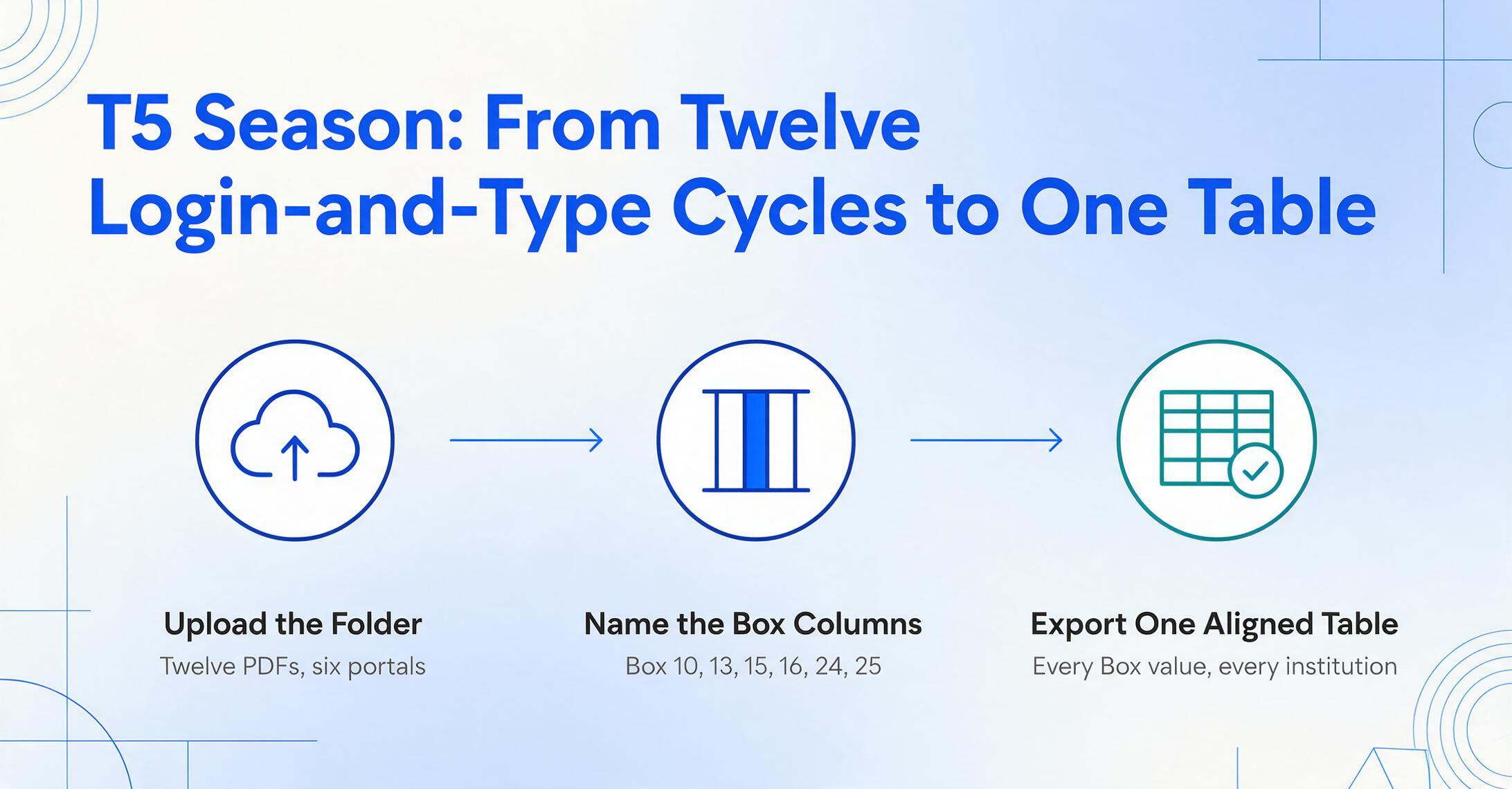
Closing that gap with AI document extraction changes the T5 season workflow from "twelve separate login-and-type cycles" to a single process: upload the folder of PDFs, define six to ten column names matching the Box numbers you need (Box 10, Box 11, Box 13, Box 15, Box 16, Box 24, Box 25, Box 18, Box 26, Box 12), and export a spreadsheet where every Box value from every institution is aligned in a single table. The output tells you, in one view, the total eligible dividends across all institutions, the total foreign tax paid, the total interest income — exactly the consolidated figures your tax software needs.
For the step-by-step extraction workflow with detailed Box mapping, see the T5 extraction guide that walks through column setup for every relevant T5 Box number. For investors with ten or more T5 slips from multiple institutions who want one consolidated spreadsheet output, the T5 batch processing article covers the multi-institution merge workflow.
T5 season is not the only Canadian tax ritual where a person's keyboard bridges the gap between institution-generated PDFs and tax software. The T4 February crunch for payroll teams replicates the same pattern — standardized CRA Box numbers, institution-specific PDF layouts, and a hard filing deadline — at employer scale with higher financial stakes. Quarterly GST/HST filers run into the same data-entry problem across supplier invoice PDFs with province-specific tax rates. And across the Atlantic, UK freelancers filing SA100 self-assessment returns face a near-identical document-scatter dynamic — different forms, different regulator, same human transcription bottleneck. The regulatory framework changes with the border. The hour spent typing numbers out of one system and into another does not.
The two hours of a February filing weekend that belonged to T5 data entry do not come back as a gift from the CRA matching program working faster or from your brokerage adopting a consistent PDF layout. They come back when extraction replaces transcription — when the tool reads the PDF so you can verify instead of type, confirm instead of search, and file your return with the same data the CRA already had, entered correctly the first time.
FAQ
What happens if I forget to report a T5 slip on my tax return?
The CRA's Matching Program automatically compares T5 data filed by financial institutions against what you reported on your T1 return, typically running between September and December. If a T5 slip appears in the CRA's system but not on your return, the CRA issues a Notice of Reassessment adding the missing income and recalculating your tax owing, plus interest. If you failed to report $500 or more in a prior year as well (within a four-year window), the "repeated failure to report income" penalty applies: 10% federal plus 10% provincial of the unreported amount. You can correct an omission before the CRA catches it by filing a T1 adjustment request (T1-ADJ) — doing so proactively may avoid the repeated-failure penalty.
What do I do if I receive a revised or amended T5 after I have already filed my taxes?
Amended T5 slips are not uncommon — brokerages sometimes revise dividends or reclassify distributions after the initial filing deadline. If you have already filed, log into your CRA My Account, compare the revised slip against what you originally reported, and file a T1 adjustment (T1-ADJ) through NETFILE ReFILE (if your tax software supports it and you filed electronically) or by mailing a paper T1-ADJ form. If the revision increases your tax owing, filing the adjustment before the CRA issues a reassessment avoids the repeated-failure penalty. If the revision decreases your tax owing, filing the adjustment gets you a refund of the overpayment.
How do I know whether a dividend is "eligible" (Box 24) or "other than eligible" (Box 10) on my T5?
The financial institution that issued the T5 determines the classification and reports it in the appropriate Box — you do not need to decide. Box 10–12 are "other than eligible" dividends (typically from CCPCs that paid at the small business rate). Box 24–26 are "eligible" dividends (from public corporations that paid at the general corporate rate). The slip itself tells you which box the figure is in. The transcription problem is ensuring the figure from Box 10 goes into the "other than eligible" field in your tax software and the figure from Box 24 goes into the "eligible" field — the labels are similar and the fields are adjacent in most tax software interfaces. A single misclassification on one slip affects the gross-up calculation, the dividend tax credit, and the net tax result.
Can I claim the foreign tax credit from Box 16 without filing T2209?
No. The foreign tax paid in Box 16 of your T5 slip is not automatically credited against your Canadian tax. You must enter the amount on Form T2209 (Federal Foreign Tax Credits), which calculates your non-refundable foreign tax credit based on the foreign income (Box 15) and foreign tax paid (Box 16) reported across all your T5 and T3 slips. Modern tax software — TurboTax, Wealthsimple Tax, UFile — embeds Form T2209 into the interview flow, but you must still enter the Box 15 and Box 16 figures from each slip. If you enter Box 15 (foreign income) without Box 16 (foreign tax paid), the software will calculate your Canadian tax on the foreign income without applying the credit you are entitled to.
Should I rely on CRA Auto-Fill for T5 data instead of manually entering it?
Auto-Fill is a useful starting point but should be treated as a convenience, not a complete data source. Use it to populate what is available, then verify every figure against the original T5 PDFs from your institutions. Pay particular attention to slips from brokerages that aggregate multiple securities — TD and RBC are known to issue combined T5/T3 slips where the totals reported to CRA may not match the per-security breakdown on the PDF. If a slip in your institution's portal does not appear in Auto-Fill after two weeks past the filing deadline, enter it manually from the PDF — the CRA considers the paper or PDF slip authoritative, not the My Account listing.
Why do T3 slips arrive in March when T5 slips arrive in February?
The issuing deadline differs. T5 slips (interest, dividends from corporations) must be issued by the last day of February following the calendar year. T3 slips (trust income from ETFs, REITs, mutual funds) have a deadline 90 days after the trust's year-end — typically March 31 for calendar-year trusts. The trusts need additional time to calculate the breakdown of income types (interest, dividends, capital gains, return of capital, foreign income) allocated to each unitholder. If your portfolio includes ETFs or mutual funds in non-registered accounts, your tax season extends to early April — plan for T3 data entry after the T5 session, not in the same sitting.