Canada's T4 February Crunch
Why Manual Entry Keeps Getting Worse
The Canada Revenue Agency processes over 25 million T4 (Statement of Remuneration Paid) slips every year — one for every employee in the country who received employment income during the calendar year. The filing deadline lands on the last day of February. For 2026, February 28 is a Saturday, pushing the effective deadline to Monday, March 2. Every employer in Canada with at least one employee converges on that same window. The payroll software — Ceridian Dayforce, ADP Workforce Now, QuickBooks Canada Payroll, Wagepoint — generates the slips. That part is automated. What happens after the PDFs are generated is where manual entry begins, and where the problem compounds faster than most payroll teams realize: the data on every T4 must move from the slip into spreadsheets, into the T4 Summary (T4SUM), into general ledger reconciliations, into auditor workpapers. At the handoff point between the payroll software's output and the downstream systems that consume that output, a person opens Excel and starts typing.
Key Takeaways
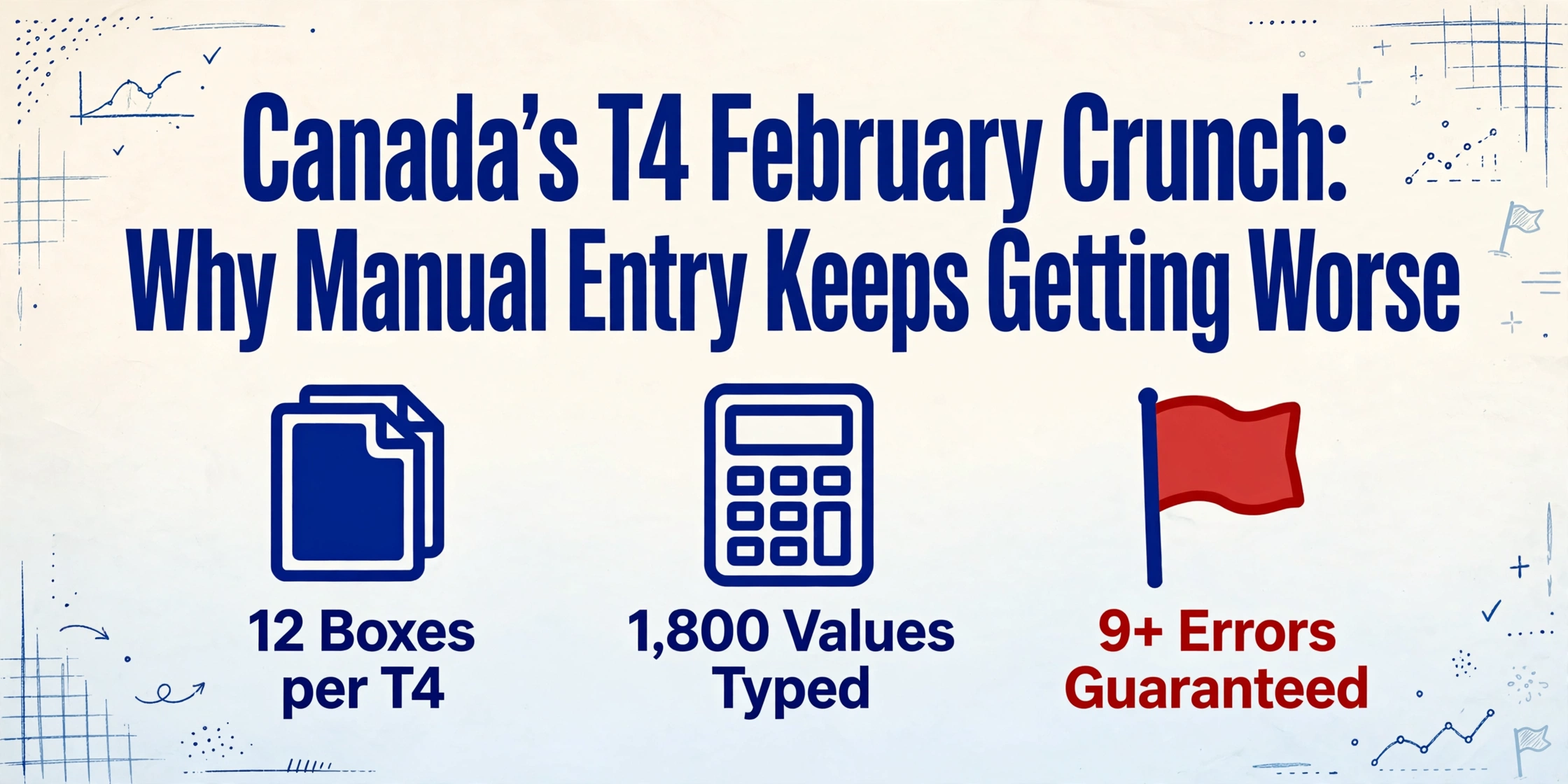
- 150 employees × 12 T4 Box values = 1,800 manual keystrokes every February, and at a 0.5% human error rate, nine values leave the spreadsheet wrong — guaranteed.
- Those nine mistyped digits cost two seconds each in February and up to six hours each in July, because fixing a single wrong Box 16 through a PIER assessment, an amended T4, and an employee explanation splinters across three budget lines where nobody adds it up.
- The payroll system calculated every Box value correctly the first time, so eliminating the transcription step eliminates the entire PIER correspondence cascade without changing a single payroll process.
The Math of February: Why Manual T4 Entry Is Statistically Guaranteed to Produce Errors
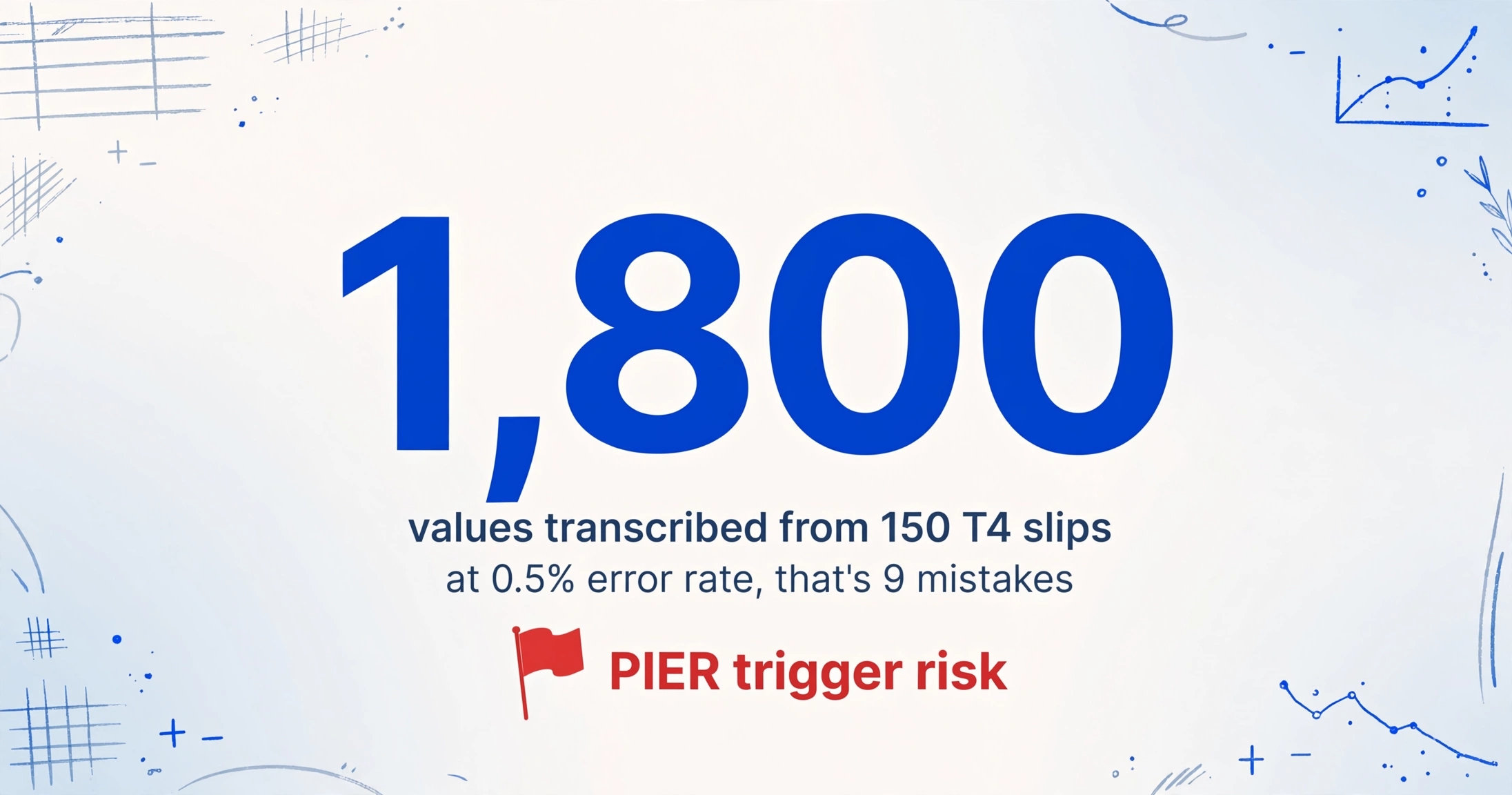
A single T4 slip contains roughly 12 numbered Boxes that matter for payroll reconciliation: Box 14 (Employment Income), Box 16 (Employee's CPP contributions), Box 16A (CPP2 contributions — introduced for the 2024 tax year), Box 18 (Employee's EI premiums), Box 20 (RPP contributions), Box 22 (Income Tax Deducted), Box 24 (EI Insurable Earnings), Box 26 (CPP Pensionable Earnings), Box 40 (Other Taxable Allowances and Benefits), Box 44 (Union Dues), Box 46 (Charitable Donations), Box 52 (Pension Adjustment). For a midsize employer with 150 employees, that is 1,800 individual values to transcribe from T4 slips into a spreadsheet — and into the T4 Summary that aggregates all slips into one CRA filing.
The payroll software has already calculated these values correctly. The data exists inside the system that generated the slips. But the moment someone opens the PDF and begins moving Box 14 values from a Ceridian-rendered layout on screen into a spreadsheet cell, the process transitions from computation to transcription — and transcription introduces a human error rate that no amount of February focus can eliminate. Research on manual data entry across financial and payroll contexts consistently identifies per-field error rates in the 0.3% to 1% range for experienced operators working under deadline pressure. Conservatively, at 0.5% per field, a 1,800-value transcription yields 9 errors. At a more realistic 1% rate under February deadline conditions — split payroll platforms, last-minute corrections, interruptions for employee questions — that is 18 errors embedded in the reconciliation spreadsheet before it reaches the CFO or auditor.
The structural reality of the T4 manual entry problem: the payroll software calculated every Box correctly. The error is introduced during transcription — the act of moving a value that already exists in one system into another system by reading it from a screen and typing it into a cell. The root cause is not carelessness. It is the structural gap between what payroll software generates and what downstream reconciliation requires.
The CRA's PIER Program: Why Every Manual Entry Error Has a Six-Month Fuse
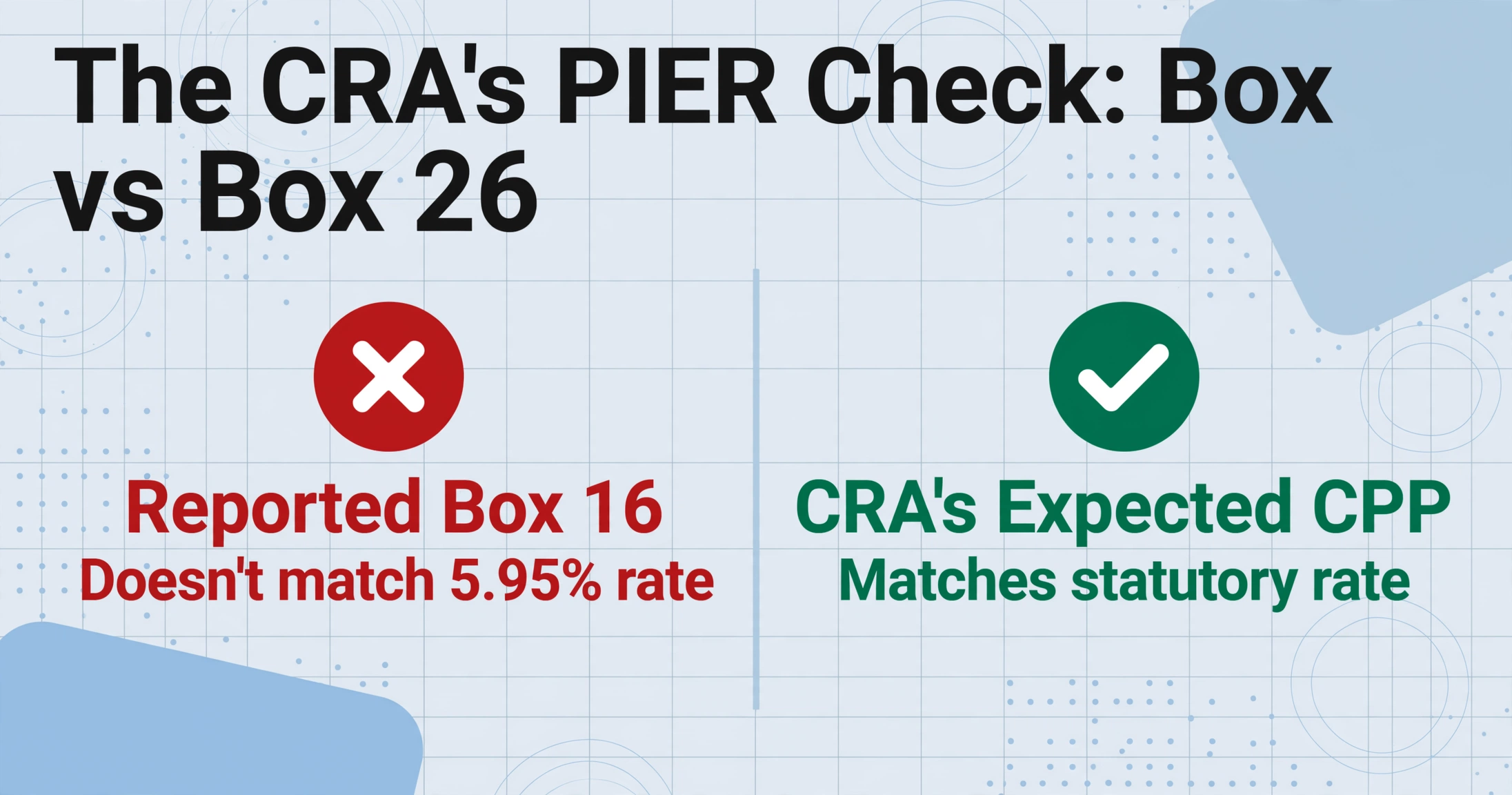
The Pensionable and Insurable Earnings Review (PIER) program is the CRA's automated cross-matching system for T4 data. After all T4 slips and the T4 Summary are filed — typically by late March or April — the CRA's system silently compares every reported CPP contribution (Box 16 on every T4) against the corresponding pensionable earnings figure (Box 26). It runs the same check for EI: Box 18 against Box 24. For every employee on every T4, the CRA computes the statutory CPP rate — 5.95% for the 2025 tax year on pensionable earnings between the $3,500 basic exemption and the Year's Maximum Pensionable Earnings (YMPE) of $68,500 — and compares the result to the Box 16 value the employer reported.
When the CRA's computed CPP contribution for an employee does not match the employer's reported Box 16 — even by a small amount — the system flags that employee. When enough employees at the same employer are flagged, the CRA issues a PIER assessment letter, typically arriving between May and October. The letter lists every flagged employee, the CRA's calculation of what the CPP and EI contributions should have been, and the difference owed — employer share and employee share combined. The employer has a fixed deadline to respond, usually 30 days. If the discrepancy stands, the CRA reassesses the entire calendar year's CPP and EI remittances, with interest calculated from the first pay period where the under-remittance occurred.
The National Payroll Institute, in its guidance on avoiding PIER assessments, notes that employers frequently face PIER notices for discrepancies that trace back to year-end data entry rather than systemic payroll errors. A single miskeyed Box 16 — typing $4,086 as $4,068 — produces a CPP figure that yields a different effective rate when divided by Box 26. The payroll system had the correct value. The slip shows the correct value. The spreadsheet is what introduced the error — and six months later, when the PIER letter arrives, tracing that error back through 150 rows of February transcription is the investigation that costs more than the original data entry.
The most insidious aspect of PIER correspondence is its asymmetry: the employer receives a letter claiming a deficiency, and the burden of proof falls on the employer to demonstrate the error is not a payroll remittance failure but a year-end transcription mistake. That means locating the original T4 PDF for the flagged employee, cross-referencing the Box values on that slip against what was entered in the spreadsheet, and providing a written response to the CRA. For a single employee flagged on a single Box, this might take an hour. For the 9 to 18 employees whose transcription errors trigger flags across a 150-employee batch — a number that is statistically probable at a 0.5%-1% per-field error rate — the PIER response process consumes days of payroll staff time months after the February deadline passed. And every one of those days was avoidable at the point of data entry, not at the point of CRA correspondence.
Why February Manual Entry Keeps Getting Harder — Not Easier
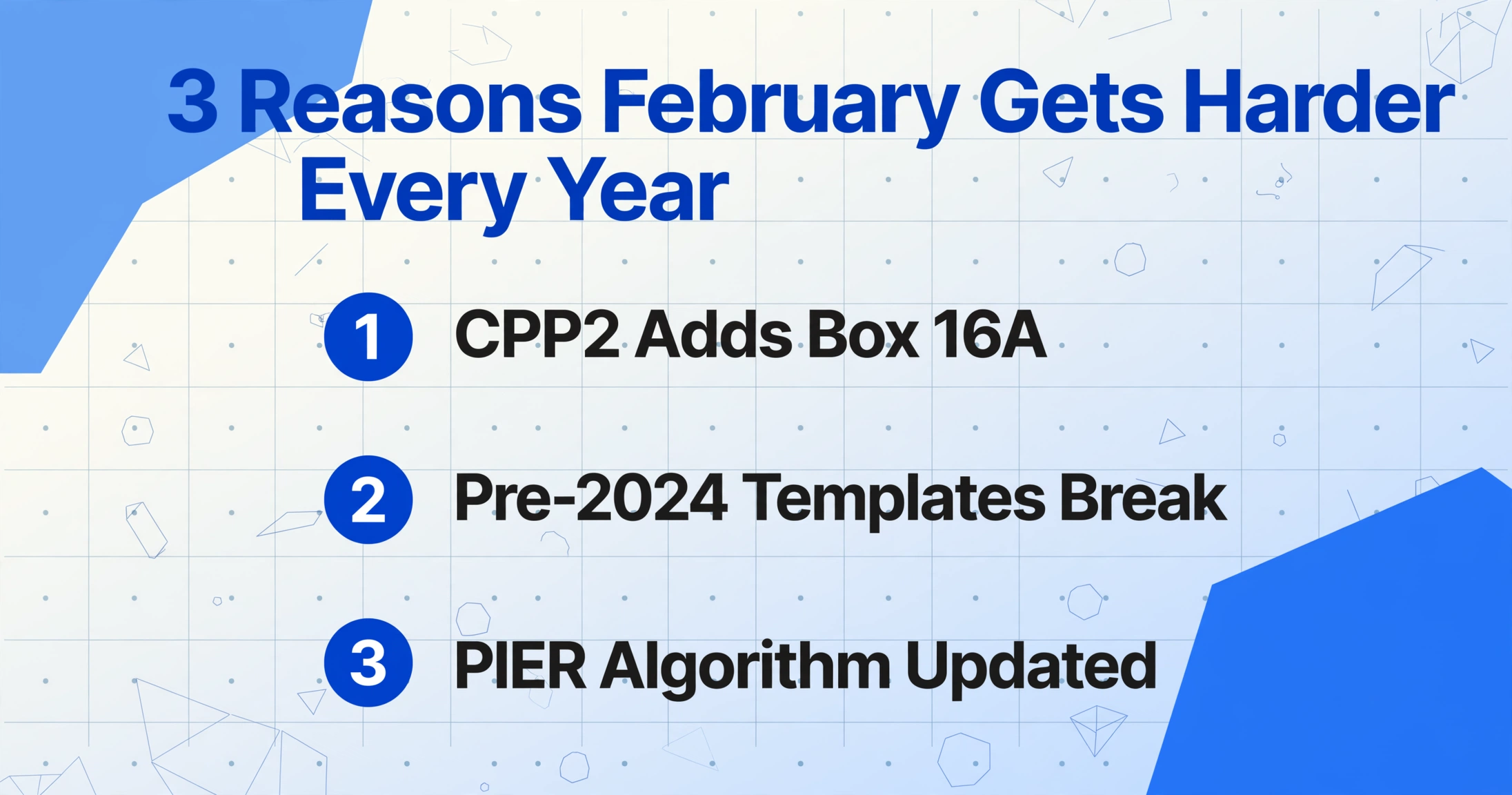
If manual T4 data entry were a problem that technology was steadily solving, the payroll software industry's narrative would be correct: every year, the software gets better, fewer employers need to manually touch T4 data, and the problem recedes. But the evidence points in the opposite direction. Three structural trends are making manual T4 entry more complex and more dangerous with each tax year.
CPP2 and the Expanding T4 Box Landscape
The introduction of CPP2 for the 2024 tax year added a second tier of CPP contributions on earnings between the YMPE ($68,500 for 2025) and the Year's Additional Maximum Pensionable Earnings (YAMPE, $79,400 for 2025). This created a new Box — 16A for employee CPP2 contributions, 17A for employer CPP2 contributions — and a new reconciliation requirement. A T4 for an employee earning $85,000 now carries both Box 16 (on the first $65,000 of pensionable earnings above the basic exemption) and Box 16A (on earnings between $68,500 and $79,400). If the manual entry spreadsheet does not include a separate column for Box 16A — and many spreadsheet templates designed before 2024 do not — the payroll administrator must either add a column mid-process or risk lumping CPP2 into the Box 16 column, creating a contribution figure that does not reconcile against Box 26 at the statutory 5.95% rate. The CRA's PIER comparison algorithm, meanwhile, was updated for CPP2 — so the employer running a pre-2024 spreadsheet template is guaranteed to generate PIER triggers for every employee above the YMPE threshold.
The Multi-Platform Payroll Reality
Mergers and acquisitions are the primary driver of multi-platform payroll in Canada. A company that acquired a competitor in 2023 inherited their ADP payroll data. A division that operates a separate collective agreement runs Ceridian Powerpay while head office has been on QuickBooks Canada Payroll since 2018. The subsidiary doing project-based work in the territories uses Wagepoint. Each payroll platform generates T4 slips that are CRA-compliant but visually distinct — the same Box numbers appear in different positions on the page, with different font sizes, different label formatting, and different grouping logic. The CRA's RC4120 Employers' Guide mandates the data content — every Box must appear, unambiguously numbered — but permits layout variation across software providers.
To a payroll administrator doing manual data entry, this means the Box 14 value on a Ceridian-rendered T4 sits in a different visual location than the Box 14 value on an ADP-rendered T4 and a QuickBooks-rendered T4. Each platform switch requires a visual re-orientation — a 10-to-15-second pause to locate the Box grid on this particular layout before typing begins. Across 150 slips split across three platforms, that re-orientation cost alone consumes 25 to 38 minutes of dead time before a single keystroke — and it increases the cognitive load that drives transcription errors.
Taxable Benefits: The Silently Expanding Error Surface
Every tax year, the CRA's list of reportable taxable benefits grows. Employer-paid group life insurance premiums above the $25,000 threshold. Personal use of a company vehicle — standby charge and operating cost benefit. Employer-paid parking. Gift cards and awards above $500. Remote work allowances. Stock option benefits. Each of these must be captured in Box 40 (Other Taxable Allowances and Benefits) and, in many cases, also reflected in Box 14 (Employment Income), Box 24 (EI Insurable Earnings), and Box 26 (CPP Pensionable Earnings). A single forgotten taxable benefit on one employee's T4 creates four incorrect Box values — and a PIER trigger because the benefit changed the pensionable earnings base against which CPP is calculated.
According to the National Payroll Institute, the cost of employer compliance with T4 and ROE reporting requirements collectively exceeds $900 million annually across Canada, as measured by PwC in the 2020 Cost of Employer Compliance and Public Policy study. Compliance — not payroll processing itself, but the reporting, reconciliation, and audit-response activities performed on top of payroll processing — accounts for over half of payroll professionals' work hours. A significant portion of that compliance cost is generated not by the payroll system's calculations, but by the manual data entry step between the system's output and the year-end filing.
The Cost Nobody Budgets For: PIER Correspondence, Amended T4s, and the Audit Aftermath
The visible cost of manual T4 entry — the payroll administrator's time during February — is the number most employers can estimate: at two minutes per slip for a 150-employee company, roughly five hours of focused transcription work. But five hours is not the problem. The problem is what happens when the transcription errors embedded in those five hours surface months later.
The CRA's matching system is not concerned with how the error was introduced. It detects a discrepancy between the Box 16 amount reported (what was typed into the T4 Summary spreadsheet) and the expected CPP contribution calculated from Box 26. The employer receives a PIER assessment. Responding to that assessment involves:
Locating the source document for each flagged employee
The payroll administrator must retrieve the original T4 PDF — not the spreadsheet entry — and compare the slip's actual Box 16 against what was typed. If the original T4 PDF was not systematically stored with a file naming convention that links it to the employee, this step requires searching through a folder of 150 PDFs for one specific name. Multiply by the number of flagged employees.
Determining whether the error is transcription or a genuine payroll discrepancy
If the original T4 slip shows the correct CPP contribution and the spreadsheet shows a different value, the error is transcription — the payroll system was correct, the manual entry was wrong. The PIER response is a simple correction and an amended T4 filing. If the original T4 slip itself contains an incorrect CPP contribution — which can happen after a mid-year payroll platform migration — the error is systemic and requires recalculating every pay period's CPP contributions for that employee. The employer must decide whether to pursue the employee for their share of under-remitted CPP or absorb it.
Filing amended T4 slips for every affected employee
Under the CRA's amendment procedure, any corrected T4 slip must be clearly identified as "AMENDED" and filed with both the CRA and the employee. An amended T4 for one employee creates downstream consequences: the employee must file an amended T1 personal tax return if the corrected figures affect their tax liability or refund. The employer is now managing not only the CRA correspondence but also employee communications — explaining why a corrected T4 is arriving months after the original and whether it changes their personal tax situation.
Reconciling T4SUM against the corrected data
The T4 Summary aggregates every Box value across all employee T4 slips. If one employee's Box 16 is corrected from $4,086 to $4,068, the T4SUM's Line 16 total changes by $18. The Line 80 total (all deductions) changes. The Line 80-minus-Line 82 reconciliation changes. The employer must file an amended T4 Summary reflecting the corrected aggregate — and if that aggregate now reveals an under-remittance, the employer must remit the difference plus interest.
The time cost of this four-step correction cycle for a single PIER-flagged employee ranges from two to six hours depending on whether the error is pure transcription or a genuine payroll discrepancy. For the 9 to 18 employees flagged across a 150-employee manual transcription batch, the correction cycle consumes 18 to 108 hours of payroll staff time — all of it months after February, none of it budgeted, every hour traceable to a single miskeyed digit during the year-end data entry sprint.
The correction cost is also not captured in any single budget line. The payroll administrator's time sits in the salary budget. The interest on under-remitted CPP and EI sits in a CRA notice of assessment. The amended T4 processing sits in compliance overhead. The employee communication sits in HR. No single accounting entry captures the full cost of a transcription error — which is precisely why the problem persists without organizational pressure to fix it.
One mistyped digit in Box 16 during February triggers a correction cascade that runs through July. The payroll system had the correct value the whole time. The error was introduced at the boundary where the system's output meets the spreadsheet — and the CRA's automated matching catches it at the boundary where the spreadsheet meets the T4 Summary. The months between are the manual entry cost that nobody measures end-to-end.
The Same Structural Problem, Different Tax Jurisdictions
Canadian payroll teams are not alone in this. The problem of extracting year-end payroll data from system-generated certificates into downstream spreadsheets and audit workpapers is consistent across common-law tax jurisdictions — because the structural gap between what payroll software outputs and what reconciliation requires is the same gap everywhere.
In the United Kingdom, payroll departments face an equivalent problem with P60 end-of-year certificates — the deadline is 31 May, the data fields are total pay, total tax deducted, and National Insurance contributions, and the manual entry happens when an accountant processing self-assessment returns needs P60 figures from multiple previous employers for clients who changed jobs mid-year. The full analysis of the UK P60 manual entry problem traces the same cost fragmentation: correction emails, reissued certificates, HMRC compliance queries — each absorbed into a different cost centre, none aggregated to reveal what one mistyped figure costs across its six-year correction window.
In Australia, PAYG payment summaries create a similar bottleneck — the July deadline for STP finalisation and non-STP summary issuance converges with the 14 August annual report deadline, compressing three reconciliation requirements into a six-week window. The Australian PAYG problem analysis identifies the same structural pattern: 85-89% of ATO data-matching flags result in adjustments, and each resolved query traces back to a single transposed digit typed during a compressed deadline window when error rates double under interruption.
The T4, P60, and PAYG summary share a common architecture: a government-mandated year-end employee certificate that a payroll system generates correctly, and a downstream reconciliation process that requires the data to be manually moved from the certificate into a spreadsheet. The document types differ. The tax rates differ. The deadlines differ. But the structural gap — and the manual entry that fills it — is identical across all three jurisdictions.
What Would Actually Change the Problem
The most common proposed solution to manual T4 entry — "use a better payroll system" — misunderstands the nature of the problem. A better payroll system generates T4s more efficiently. It still generates T4s — PDFs or printouts whose data must be consumed by downstream systems. And it still does not automatically reconcile the T4 output against the general ledger, against the auditor's sampling request, or against the T4 Summary that aggregates every employee's figures. The gap is not in the payroll software's generation step. It is in the consumption step that follows.
What actually changes the problem is eliminating the transcription layer between the payroll system's output and the downstream spreadsheet. For a single T4, that means extracting the Box values directly from the slip into a structured row — one row per employee, one column per Box — without typing. For a batch of T4s across multiple payroll platforms, covered in our batch T4 processing guide, it means defining a column schema once — Box 14, Box 16, Box 16A, Box 18, Box 22, Box 24, Box 26, Box 40 — and processing all T4s from all payroll platforms in a single pass. The hub page for extracting Canadian T4 slip data to Excel walks through the single-T4 workflow and the Box structure every T4 extraction must handle.
The extraction step eliminates the transcription error rate not by making people type more carefully, but by removing the typing step entirely. The Box values on the T4 slip are read directly and placed into the corresponding spreadsheet columns. The origin of each value — which payroll platform's T4 PDF it came from — is preserved in a "File Name" column, so the auditor's sample trace is a filter operation, not a folder search. The CPP and EI rate checks that the CRA's PIER program will run in April can be run during extraction itself — flagging the rows where Box 16 ÷ Box 26 deviates from the expected 5.95% rate before the spreadsheet reaches the CFO, not six months later when the PIER letter arrives.
Files are processed securely and not stored.
FAQ: T4 Manual Data Entry and CRA Compliance
How common are manual T4 data entry errors in Canadian payroll?
Manual data entry in payroll and financial contexts carries a documented per-field error rate between 0.3% and 1%, with the higher end occurring under deadline pressure and the lower end in controlled, single-task environments. For a 150-employee employer with roughly 12 Box values per T4 — approximately 1,800 individual values — a 0.5% error rate produces 9 incorrect spreadsheet entries. The problem is not that every payroll administrator makes errors. It is that the transcription volume during the February deadline window is high enough that a non-zero error rate produces a non-zero number of errors — and each one triggers a PIER correspondence cycle that costs hours to resolve. The CRA does not distinguish between transcription errors and payroll calculation errors; both produce the same PIER assessment.
What is the most common T4 box entry error that triggers a PIER review?
The most common trigger is a discrepancy between Box 16 (Employee's CPP contributions) and Box 26 (CPP Pensionable Earnings). The CRA's PIER algorithm divides Box 16 by (Box 26 − $3,500 basic exemption) and compares the result to the statutory CPP rate — 5.95% for 2025. If the effective rate deviates beyond a small tolerance, the employee is flagged. A single miskeyed digit in Box 16 — typing $4,086 as $4,068 — changes the effective rate enough to trigger the flag even though the payroll system calculated the correct contribution. A second common trigger is the omission of Box 16A (CPP2 contributions), introduced for the 2024 tax year. If CPP2 contributions are lumped into the Box 16 column during manual entry, every employee above the YMPE threshold ($68,500 for 2025) will have a Box 16 figure that appears higher than the statutory 5.95% of Box 26 would produce — generating PIER flags for every one of those employees.
Can I correct T4 errors after the February deadline without penalties?
Yes. The CRA permits amended T4 slips to be filed at any time after the original submission. If you discover a transcription error in your T4 filing — a Box value that was typed incorrectly into the spreadsheet and therefore reported incorrectly on the T4 Summary — you can file an amended T4 slip marked "AMENDED" and an amended T4 Summary reflecting the corrected aggregate. The CRA's amendment procedure does not impose additional penalties for voluntary corrections made before a PIER assessment is issued. However, if the correction reveals an under-remittance of CPP or EI, the employer owes the difference plus interest from the original remittance due date — not from the amendment filing date. The earlier the correction is identified and filed, the lower the interest accumulation.
Why doesn't the payroll software just export T4 data directly to Excel?
Most payroll platforms can export T4 data as a CSV or Excel file — but only for the payroll data they contain. The manual entry problem arises when T4 data needs to be consolidated from multiple sources the payroll software cannot access: T4s from a different payroll platform used by a subsidiary or an acquired entity, T4s from a previous employer that an employee needs for a mortgage application or tax planning exercise, or T4 data that must be combined with non-payroll data (general ledger accounts, external audit workpapers, compensation benchmarking datasets). The software exports its own data cleanly. The manual entry fills the gap between that export and the multi-source reconciliation that the business actually needs. The gap is structural — it exists because the reconciliation requirement spans systems, and no single system can populate all the fields the reconciliation demands.
What happens if my T4 Summary totals don't match my PD7A remittance records?
The T4 Summary's core reconciliation is Line 80 (total deductions reported: CPP + CPP2 + EI + income tax) minus Line 82 (total remitted to the CRA during the year, as recorded on your PD7A Statement of Account for Current Source Deductions). A difference of $2 or less is ignored by the CRA. A difference larger than $2 must be explained — either as an overpayment claimed on Line 84 or a balance due on Line 86. If the discrepancy is a manual entry error in the spreadsheet — a Box 22 Income Tax Deducted figure that was miskeyed during transcription — the T4SUM will disagree with the PD7A even though the payroll system remitted the correct amount. The payroll administrator must trace the discrepancy through 150 rows of spreadsheet data to find the single mistyped value. If the discrepancy is not a transcription error but a genuine under-remittance — a late-December payroll remittance that crossed the calendar year boundary and appeared on January's PD7A instead of December's — the employer must explain the timing difference to the CRA and, if necessary, adjust the remittance allocation between payroll accounts.
Does the problem get worse with each additional payroll platform?
Yes — and not linearly. A single payroll platform means every T4 slip in the batch shares the same visual layout. The manual entry process is repetitive but uniform: once the administrator has located the Box grid on a Ceridian-rendered T4, the same eye movement pattern works for all 150 slips. Two payroll platforms break that uniformity: the administrator must re-orient between two different visual layouts, increasing the cognitive load with each platform switch. Three platforms compound the problem further. The error rate increases not just because there are more layouts to mentally process, but because the constant layout-switching interrupts the motor pattern of data entry — the brain is simultaneously locating a Box on a new visual grid while the fingers are typing from the previous slip. This dual-tasking increases per-field error rates measurably, and February's compressed timeline offers no margin to slow down and verify each value.
Canada's T4 filing system was designed for an era when employers ran one payroll platform, printed T4s on pre-printed CRA forms, and filed by mail. Today's reality — multi-platform payroll, CPP2, electronic filing, and automated PIER matching — has moved far beyond that design. The gap between what payroll software generates and what downstream reconciliation requires is not narrowing. It is widening. And every February, the payroll administrators who bridge that gap with manual data entry are holding a structure that was never designed to be held together by human transcription.