Canada's 5-Day ROE Deadline
Structural Problem, Not Speed Problem
Section 19(3) of the Employment Insurance Regulations (SOR/96-332) is only seventeen words long. Every employer shall issue a Record of Employment within five calendar days after the first day of an interruption of earnings. Five calendar days, not business days. The Saturday and Sunday after a Friday layoff belong to the deadline as fully as the Monday. The statutory holiday that falls midweek does not pause the clock. The payroll cycle that runs every other Wednesday does not reset it. The regulation was written with a clear purpose — the faster Service Canada receives a completed ROE, the sooner an Employment Insurance benefit rate is calculated and a displaced worker receives income — and that purpose is irreproachable. But the regulation's architecture assumes a payroll world where separation events are isolated, payroll data is instantly accessible, and the fifty-three data blocks on form INS5153 can be completed and verified in a single sitting by a single person. None of those assumptions is true in Canadian payroll in 2026. Every month, Canadian employers in construction, retail, hospitality, and manufacturing race a deadline that was designed for a scenario that no longer exists — and the gap between the regulation's intent and the payroll department's reality is where the cost lives.
Key Takeaways
- Canada's five-day ROE deadline counts calendar days, not business days — for a Friday layoff the clock starts Saturday morning, consuming 40% of the window before the next payroll run generates the data needed to begin.
- One wrong letter in Block 15C — chosen from sixteen reason codes under a five-day countdown by someone who has never met the employee — determines whether a displaced worker receives income for the next forty-five weeks or nothing at all.
- ROE Web solved the filing half of the deadline with instant electronic transmission — but left the verification half entirely manual: fifty-three blocks, three data sources to cross-reference, and zero tool support for the step that consumes the largest share of the five-day window.
The Five-Day Clock Starts When Earnings Stop — Not When Payroll Is Ready
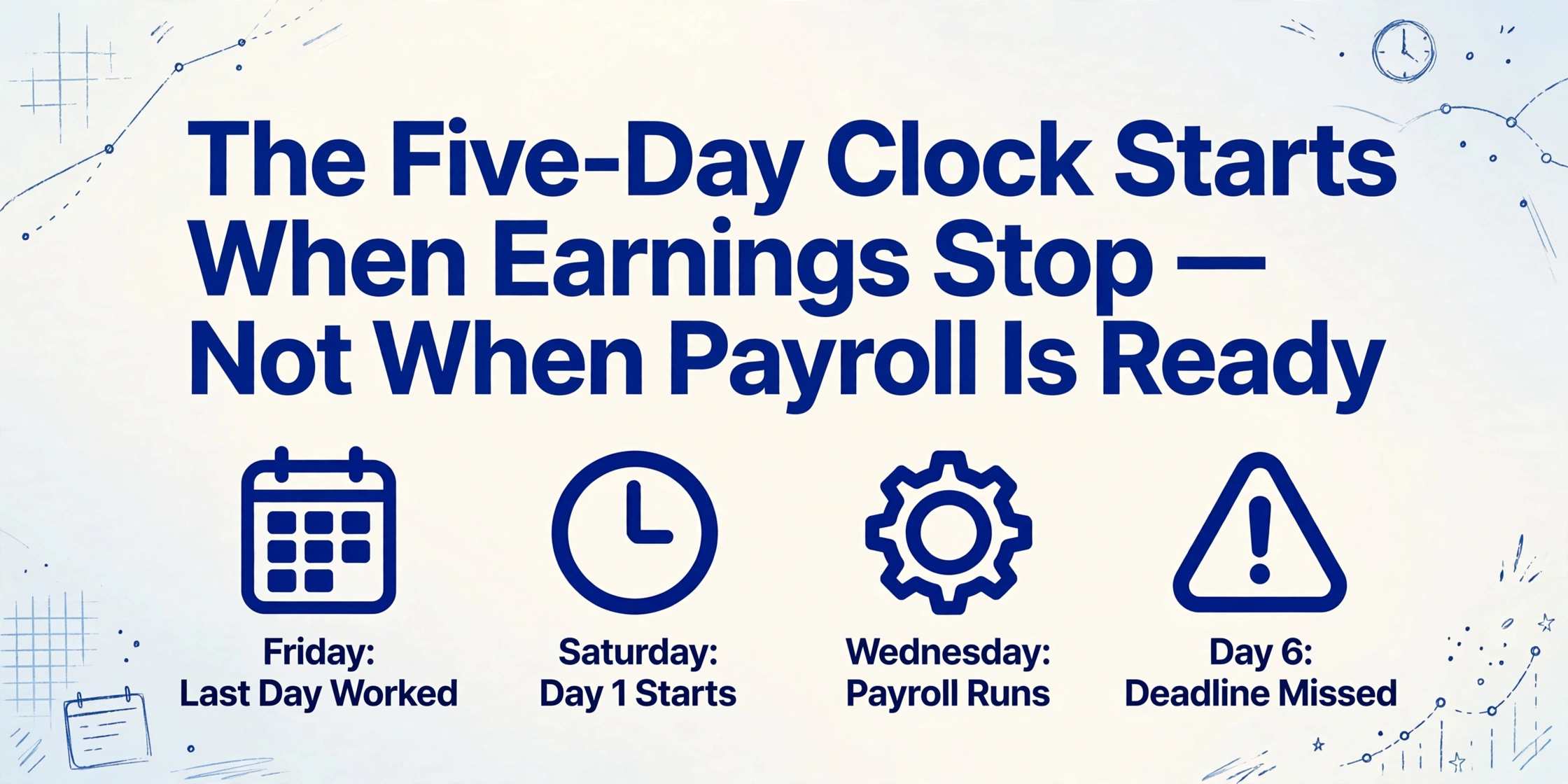
The most overlooked detail of section 19(3) is the trigger: "after the first day of an interruption of earnings." The clock does not begin when payroll processes the separation. It begins when the employee stops receiving insurable earnings.
For a full-time employee whose last day of work is Friday, the five-day countdown begins Saturday morning. Payroll may not run until the next Wednesday. That means two of the five calendar days — Saturday and Sunday — are consumed before anyone in payroll even has the data to begin. The Wednesday payroll run generates the ROE on day three of a five-day window. One remaining business day to verify Block 15A total insurable hours against the payroll register, cross-check Block 15C reason code against the separation documentation, ensure Block 15B total insurable earnings matches the year-to-date record, obtain the sign-off, and transmit to Service Canada. If Wednesday's payroll run has any issues — a missed pay period, an incorrect overtime entry — the correction pushes the ROE into the next run, day six, past the deadline.
The regulation does not account for the payroll processing cycle because it was not written to account for it. It was written for the worker — the person whose EI claim is stalled until the ROE arrives — and a five-day deadline makes sense from that perspective: a displaced worker waiting for income should not wait longer than a workweek. But the employer does not experience five days as a window of time. The employer experiences five days as a constraint imposed by a system that operates on a different clock — payroll cycles measured in weeks, not days — and the collision between the two produces the same result every month: the employer is late before payroll even opens the form.
What Actually Happens Inside the Five-Day Window
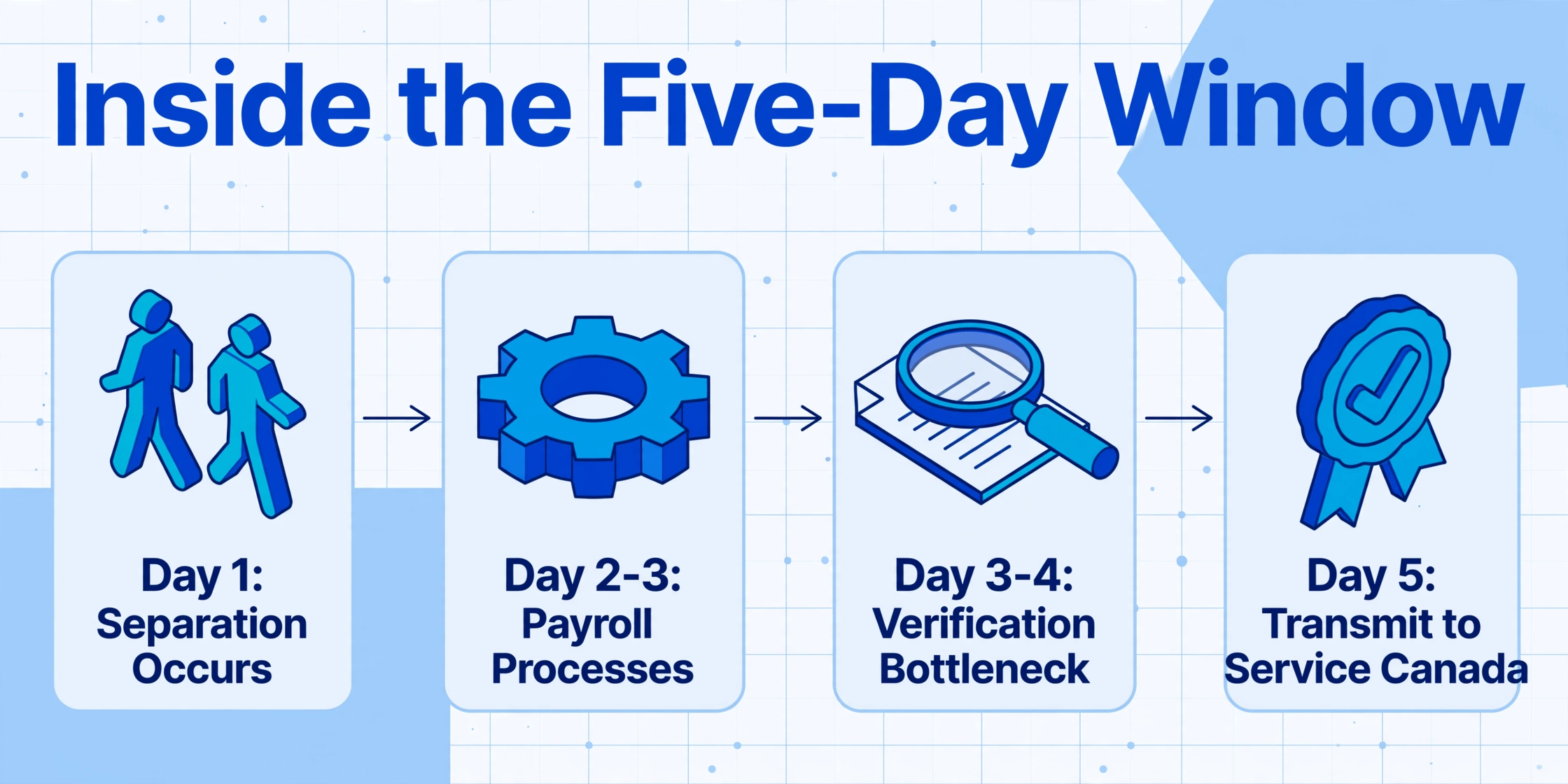
To understand why five days is structurally inadequate, break down what happens between the interruption of earnings and the moment Service Canada receives the ROE. This timeline is not hypothetical. It is the actual sequence experienced monthly by payroll administrators in mid-sized Canadian companies:
Day 1: The separation occurs. Payroll does not yet know.
An employee resigns, is laid off, or is dismissed. The manager notifies HR. HR begins processing the separation internally — updating benefits, collecting equipment, closing systems access. Notifying payroll is typically one item on a checklist that includes a dozen other steps. Payroll learns of the separation hours or even a full day after it occurs. The five-day clock is already running.
Day 2 or 3: Payroll processes the separation. The ROE is generated.
The payroll system — Ceridian Dayforce, ADP Workforce Now, QuickBooks Canada Payroll — runs on its scheduled cycle. The system calculates final pay, generates the ROE form (electronic or printable), and populates all fifty-three blocks. At this point, the ROE exists — but it has not been verified. The data in Block 15A total insurable hours, Block 15B total insurable earnings, and Block 15C reason code was automatically populated by the payroll system. Whether it is correct depends on whether the payroll system's records are complete and accurate.
Day 3 or 4: Verification. The bottleneck.
This is the step that breaks the timeline. The payroll administrator must verify that the automatically generated Block 15A matches the payroll register's year-to-date insurable hours total. That Block 15B reflects all insurable earnings — regular pay, overtime, vacation pay, statutory holiday pay, and any pay in lieu of notice. That Block 15C — a single letter, chosen from sixteen possible codes — correctly describes the reason for separation. Code A (shortage of work) and Code E (quit) look similar in a dropdown but carry entirely different EI waiting periods. The verification requires cross-referencing the payroll register, the separation documentation, and the ROE form — three sources of truth, none of which are designed to be compared side by side in a single interface.
Day 4 or 5: Filing. The final mile.
The verified ROE is filed — through ROE Web (Service Canada's electronic portal), or for the shrinking but still significant minority of employers who do not use ROE Web, printed and mailed. In the electronic case, the deadline is met the moment the submission is transmitted. In the paper case, the Canada Post delivery window — two to five business days in most of the country, longer in rural and remote regions — is layered on top of the statutory five-day deadline. A paper ROE mailed on day five arrives at Service Canada on day seven at best, day ten if it crosses a weekend or hits a processing delay. The employer is late, and the worker's EI claim is stalled — not because anyone was slow, but because the deadline and the delivery mechanism operate on incompatible timelines.
For a single separation, this sequence is manageable — tight, but manageable. A payroll administrator clears the verification on day four, files on day five, and moves on. The structural problem appears when the sequence repeats. Twenty-five separations in a month create twenty-five overlapping five-day countdowns, each one demanding the same three-step sequence — generate, verify, file — overlaid on a payroll cycle that runs on a fixed schedule. The timeline does not stack neatly. It nests, competing with itself for the same payroll processing windows, the same verification hours, the same administrator's attention. One deadline is manageable. Twenty-five are a scheduling impossibility.
Why an ROE Is a Fifty-Three-Block Payroll Reconciliation — Not a Form
If the ROE were a simple document — employee name, date of separation, reason for leaving — the five-day deadline would be generous. A competent payroll administrator could complete one in minutes. But the Record of Employment is not a summary form. It is a regulatory data structure: fifty-three numbered blocks, each one contributing to Service Canada's calculation of EI eligibility, benefit rate, and benefit duration. The form does not just report a separation. It reconstructs the employee's entire insurable employment history.
The blocks that consume the verification window are not the obvious ones. Block 1 (employee name) and Block 2 (SIN) are static — populated once, checked once, rarely problematic. The time sinks are:
| Block | Data | Why It Takes Time |
|---|---|---|
| 15A | Total insurable hours | This is not a single database field. It is the sum of weekly insurable hours across the entire employment period — potentially fifty-three pay periods — minus any non-insurable hours. The payroll system calculates it automatically, but the calculation depends on every pay period in the payroll register being complete and correct. If one pay period in month seven had an incorrect overtime entry, Block 15A is wrong by exactly the amount of that error. Verifying it means confirming the sum against a known-good source — the payroll register or the year-to-date total on the most recent pay stub. This cross-reference is the single largest time investment in the ROE verification process. |
| 15B | Total insurable earnings | Insurable earnings include regular wages, overtime pay, vacation pay, statutory holiday pay, and pay in lieu of notice — but exclude non-insurable items such as severance pay, retiring allowances, and certain expense reimbursements. The payroll system categorizes each payment at the time of processing, and a misclassification at any point in the employee's tenure — a bonus coded as a reimbursement, a vacation payout coded as regular wages — propagates into Block 15B as an error. Spotting it requires tracing the earnings history across the entire employment period. |
| 15C | Reason for issuing ROE | Sixteen legitimate reason codes — A through P, plus Z — each triggering a different rule in the EI determination engine. Code A (shortage of work) allows immediate benefit eligibility once the claimant serves a one-week waiting period. Code E (quit without just cause) triggers disqualification — no benefits payable for the entire benefit period unless the claimant subsequently accumulates enough insurable hours in new employment. Code M (dismissal) triggers an adjudication where Service Canada investigates the circumstances. Selecting the wrong code is not an administrative error — it is a decision that determines whether a former employee receives income or nothing. The payroll administrator, who may have never met the employee, selects a code based on a separation form completed by the manager, who may have chosen a code that minimizes severance exposure. The legal and operational realities encoded in that single letter are the most consequential piece of data on the entire form. |
| 17A–17D | Payment period data | The ROE reports the last fourteen payment periods in detail — pay period start and end dates, insurable hours in each period, insurable earnings in each period. For employees with irregular schedules — construction workers, hospitality staff, seasonal agricultural workers — the period-level data must reconcile with the Block 15A total. A period missing one day of work because a timesheet was submitted late creates a discrepancy between the period-level detail and the summary total. Service Canada detects this discrepancy automatically. The resolution process — amending and resubmitting the ROE — adds days to an already-expired deadline. |
The form's complexity is not a design flaw — Service Canada needs all fifty-three blocks to administer a program that pays billions in benefits annually. But the complexity interacts with the five-day deadline in a way that guarantees bottlenecks. The verification that the regulation implicitly requires is not a quick glance at a form. It is a reconciliation exercise that crosses three data sources — the payroll system, the payroll register, and the separation documentation — none of which were designed to be queried in parallel under time pressure.
The Paper ROE Has Not Disappeared — And Neither Has Canada Post
Service Canada introduced ROE Web — the electronic filing portal — to eliminate the paper form and the postal delay. For large employers and payroll service providers, ROE Web works: the ROE is generated, verified, and transmitted electronically, and Service Canada receives it within minutes of filing. But the transition from paper to electronic is not complete, and it is not evenly distributed across employer sizes.
The employers most likely to still use paper ROEs are small and mid-sized businesses — the construction company with twelve employees, the restaurant with eighteen staff, the dental practice with six hygienists. These employers may issue two or three ROEs a year, not twenty-five a month. ROE Web requires setup, registration, and a learning curve that a three-ROEs-a-year business may never prioritize. When an employee leaves — perhaps the first separation in eighteen months — the employer retrieves the paper ROE form (INS5153), completes it by hand or types it onscreen and prints it, obtains the signature, and mails it to Service Canada. Canada Post delivery adds two to five business days — not two to five calendar days — to a process already governed by a five-calendar-day statutory deadline.
The scenario plays out monthly across the country: a restaurant in Winnipeg lays off a cook on a Thursday. The employer completes the paper ROE on Monday — day four of the deadline — and mails it the same day. Canada Post delivers it to Service Canada's processing centre on Thursday or Friday — day seven or eight. The employer is three days past the statutory deadline through no fault of the payroll administrator's diligence. The ROE is late. The former cook's EI claim is held in pending status. The cook, who was counting on EI to cover rent while looking for the next kitchen job, waits an additional week because the deadline and the delivery mechanism were never designed to work together.
This is not an exceptional case. According to Service Canada's own data, while the majority of ROEs are now filed electronically through ROE Web, paper ROEs remain a permitted alternative — and for the small employers who issue them, the Canada Post delivery window is an unacknowledged extension of the statutory deadline that the regulation does not accommodate.
Files are processed securely and not stored.
Three Payroll Platforms, One Undifferentiated Deadline
The ROE is a federally prescribed form — every payroll software provider must produce the same fifty-three blocks in the same numbered sequence. But the visual arrangement of those blocks — where Block 15A sits on the page, how Block 15C is positioned relative to the identity blocks, whether the payment period grid on page two starts at the top or after a header — is entirely at the discretion of each software provider. Ceridian Dayforce renders Blocks 15A and 15B in a summary panel separate from the identity blocks. ADP Workforce Now flows sequentially in a two-column layout. QuickBooks Canada groups related blocks — income, deductions, hours — in a simplified arrangement. None of these layouts is wrong. Each one reflects the payroll provider's design philosophy.
But a mid-sized Canadian employer running multiple payroll systems — perhaps Ceridian for the main workforce and QuickBooks for a subsidiary, or ADP for one acquired entity — processes ROEs with different visual layouts in the same compliance window. The Block 15A that appeared at the top-right of the Ceridian ROE is in the middle-left of the ADP ROE. The Block 15C that was immediately below the reason field on QuickBooks is on the second page of the ADP form. The payroll administrator does not just verify data across platforms — they re-learn the visual location of each block every time they switch providers. In a similar structural problem with T4 slips, the annual nature of T4 reporting makes the re-calibration a once-a-year cost. ROEs, filed monthly or more frequently, multiply it. The five-day deadline does not distinguish between a Ceridian ROE and an ADP ROE. Both are due in five days. But the payroll administrator processing an ADP ROE immediately after a Ceridian ROE loses seconds — accumulating to minutes — re-orienting to the new layout, and every second lost is a second subtracted from a countdown that was already tight.
Wrong Block 15C: One Letter That Destroys a Person's Income
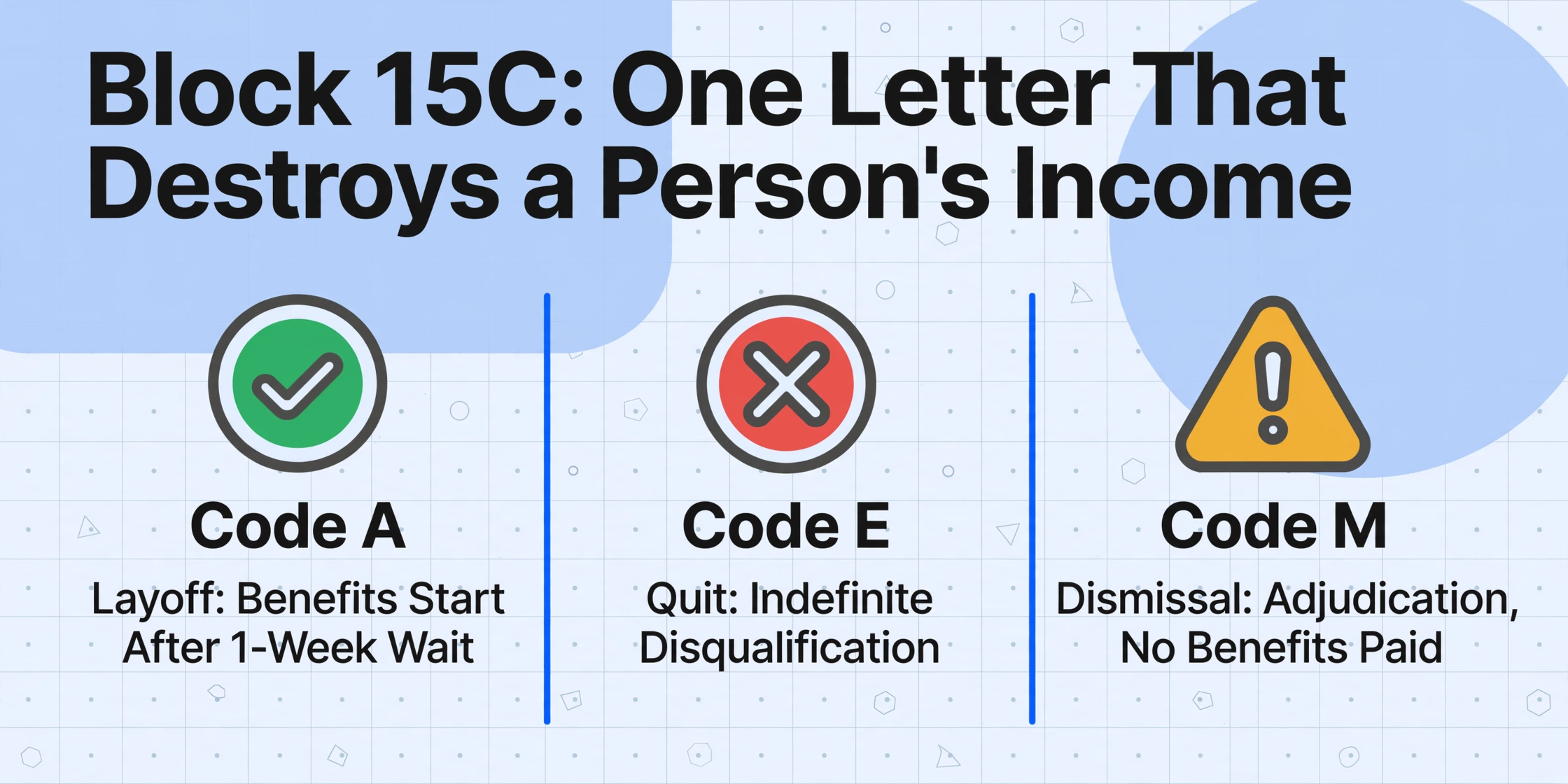
Of the sixteen reason codes in Block 15C, three determine the entire arc of a former employee's EI claim. Get them right, and the system functions as designed. Get one wrong, and a person who is legally entitled to benefits receives nothing.
Code A (shortage of work / layoff), Code E (quit), and Code M (dismissal) are the most frequently used and the most consequential. Code A triggers a one-week waiting period, after which benefits begin. Code E — quit without just cause — results in an indefinite disqualification: the claimant receives no benefits for the entire benefit period, a period that can last up to forty-five weeks, unless they accumulate enough new insurable hours in subsequent employment. Code M — dismissal for misconduct — triggers an adjudication where Service Canada interviews both the employer and the former employee, reviews documentation, and makes a determination. During the adjudication, which can take weeks, no benefits are paid.
The problem is not that payroll administrators are careless with reason codes. It is that the code is selected under time pressure, during the same five-day window that also requires verifying Block 15A and 15B totals, and the code carries legal implications that a payroll administrator — trained in tax deductions, remittance schedules, and earnings calculations — may not be fully equipped to assess. A manager reports that an employee "left." Left how? Resigned voluntarily? Left after being told they would be laid off at the end of the month? Was told "we won't need you next week" — a statement that could be a layoff (Code A) or a dismissal (Code M) depending on the context? The payroll administrator enters Code E because "left" sounds like a quit. The former employee files for EI and is told they are disqualified — the ROE says they quit. The employee appeals. Service Canada investigates, contacts the employer, reviews the separation documentation, and determines the correct code is Code A. The ROE is amended. The employee receives benefits — three weeks later than they should have. The error was not malice. It was a one-letter misclassification produced by a system that asks a payroll administrator to make a legal determination in a data entry field, under a five-day deadline.
This is the same structural challenge described in the UK P45 processing context — a leaver document whose deadline and classification logic create a compliance bottleneck for payroll teams — though the Canadian EI system adds a layer of adjudication complexity that the HMRC process does not.
The Block 15A total creates a different category of harm. If Block 15A understates insurable hours by two hundred — because a pay period was missed or an overtime entry was incorrect — and the correct total would have put the employee at 430 hours in an EI economic region with a 420-hour entrance requirement, the employee's EI claim is denied because the ROE says they have 230 hours. Service Canada does not cross-check the ROE against the payroll register. It takes the insurable hours total at face value. The employer catches the error three months later during a payroll audit and issues an amended ROE. The employee — who was entitled to benefits the entire time — receives back payments. But they went three months without income because of a data error that would have been caught if the verification process had any margin for cross-reference inside the five-day window.
ROE Web Solved the Filing. It Did Not Solve the Verification.
ROE Web is Service Canada's electronic filing portal — the recommended method for submitting Records of Employment. It eliminates the paper form, the Canada Post delay, and the manual data entry into Service Canada's intake system. For large employers and payroll service providers, ROE Web is the mechanism that makes the five-day deadline achievable: an ROE generated at 4:00 PM on day five and transmitted through ROE Web at 4:05 PM meets the deadline. The filing side of the equation has been solved.
What ROE Web does not do is verify the data before it is transmitted. The portal receives the ROE, validates the basic structure — the SIN format, the date ranges, the block numbering — and forwards it to Service Canada's adjudication system. It does not cross-check Block 15A total insurable hours against the payroll register. It does not compare Block 15B total insurable earnings against the year-to-date record. It does not flag a Code E ROE issued three days after a Code A ROE for the same employee, which may indicate a correction or an error. The verification step — the step that consumes the largest share of the five-day window — remains entirely in the employer's hands, with no tool support from the filing system.
This creates a structural asymmetry: the deadline is enforced by the same agency that provides the filing portal, but the data integrity that the deadline hopes to protect — the correctness of the ROE that determines a worker's eligibility — is the employer's responsibility alone. An employer who rushes the verification to meet the deadline may file an incorrect ROE on time. An employer who takes the time to verify thoroughly may file a correct ROE late. The deadline does not distinguish between these two outcomes. It treats an incorrect-but-on-time ROE and a correct-but-late ROE as two different failures — each triggering its own category of consequence — and asks the employer to pick which one to optimize for.
This is the same structural gap explored in the comprehensive ROE extraction guide: the data lives in the payroll system, the deadline lives at Service Canada, and the bridge between them is a manual verification step that no regulation mandates and no tool supports. For a detailed walkthrough of how to bridge this gap at scale, the ROE batch processing guide covers the end-to-end workflow for processing monthly ROE volumes into a single compliance spreadsheet with validation checks embedded in the extraction itself.
Frequently Asked Questions
What happens if an employer misses the five-day ROE deadline?
Service Canada may impose administrative monetary penalties under the Employment Insurance Act for late filing. The penalty structure considers the frequency of late filings and the employer's history. More immediately, a late ROE delays the former employee's EI claim — the claim cannot be fully adjudicated until Service Canada receives the ROE — meaning the worker bears the financial consequence of the employer's missed deadline, at least until the ROE arrives and the claim can be processed retroactively.
Does the five-day deadline apply to weekends and statutory holidays?
Yes. The regulation specifies five calendar days, not five business days. Weekends, statutory holidays, and any other non-business days count fully toward the deadline. An interruption of earnings that occurs on a Friday gives the employer until Wednesday to file — Saturday and Sunday are days one and two. An interruption on the Wednesday before a statutory holiday Thursday gives the employer until Monday — the holiday Thursday is day two, and the weekend that follows brings the deadline to Monday.
Can an employer issue an amended ROE after the five-day deadline if Block 15A or 15C was wrong?
Yes. Service Canada accepts amended ROEs at any time. The employer issues a new ROE with the "Amended" indicator checked and the corrected block values. The amendment replaces the original in Service Canada's system. However, the amendment process does not undo the delay caused by the original error — the former employee's EI claim was stalled or denied based on the incorrect original, and the correction only restores the claim prospectively, with retroactive payments if applicable. The amendment fixes the data; it does not fix the weeks the claimant spent without income.
Why hasn't the five-day deadline been updated to reflect modern payroll realities?
The five-day deadline reflects a policy choice — prioritizing the worker's access to EI benefits — that remains valid. A longer deadline, even if more realistic for employers, would mean displaced workers wait longer for income. The regulation balances employer compliance burden against worker income continuity, and the current balance has remained stable because any adjustment in the employer's direction directly harms the worker's timeline. The more relevant question is not whether the deadline should change, but whether the tools available to employers for meeting it — verification, cross-referencing, data reconciliation — have kept pace with the deadline's demands. In most Canadian payroll departments, they have not.
Does ROE Web eliminate the deadline pressure for small employers?
ROE Web eliminates the postal delay — the largest single source of involuntary late filing — but it does not eliminate the verification bottleneck. A small employer who registers for ROE Web can transmit the ROE electronically the moment it is complete, avoiding the Canada Post delivery window entirely. But the data verification — confirming Block 15A totals, verifying Block 15C codes, cross-checking Block 15B earnings — still consumes the same time regardless of how the ROE is transmitted. ROE Web removes the delivery problem; it does not remove the accuracy problem.
Are there any exceptions to the five-day deadline for seasonal or high-volume employers?
No. The five-calendar-day deadline applies to all employers equally, regardless of size, industry, separation volume, or seasonality. A construction company issuing forty-two layoff ROEs at the end of November has the same per-employee five-day deadline as a dental practice issuing one ROE in July. The regulation does not include a volume-based exemption. The practical consequence is that seasonal employers — construction, tourism, agriculture, fishing — who experience concentrated separation events at predictable times of year must process large volumes within the same statutory window that governs individual separations. The accessing EI benefits page at Service Canada provides current information on employer obligations, but the deadline itself has no volume adjustment provision.
If payroll software generates ROEs automatically, why is verification still manual?
The payroll system generates the ROE from its own records. If those records are correct, the ROE is correct. But the payroll system does not know whether its own records are correct — it trusts the data it was given. A pay period with incorrectly entered overtime hours, a vacation payout categorized under the wrong earnings code, a separation date entered one day off — all are faithfully reproduced in the ROE because the payroll system has no mechanism to question its own data. The verification step is the employer's quality control: checking that the payroll system's output matches the payroll register's year-to-date totals and the separation documentation's facts. Until payroll systems incorporate cross-source verification — comparing their internal totals against external reference points — the verification step remains manual, and the five-day window remains largely consumed by a step that should be automatable.
The Problem Is Not Speed. It Is Structure.
The Canadian payroll industry has interpreted the five-day ROE deadline as a speed problem for decades. The solution, implicitly, was to go faster: process payroll more frequently, type more quickly, skip lunch, stay late. But speed does not solve a structural problem. An employer who types faster still needs to verify the same fifty-three blocks, reconcile the same three data sources, and make the same legal determination about a reason code that will determine whether a former employee receives income. Going faster at the data entry step does not shorten the verification step. And the verification step — the one that catches the errors that would otherwise become amended ROEs, EI delays, and disqualified claims — is the one that cannot be accelerated by effort alone.
The monthly ROE batch processing workflow addresses this at the structural level: instead of verifying twenty-five ROEs one at a time, define a column schema once — Block 15A, Block 15B, Block 15C, Block 11 last day paid, payment period detail — and extract all twenty-five in a single pass. Verification rules — Computed Columns that cross-check Block 15A against period-level totals, validate reason codes against the valid code set, and flag ROEs approaching or past their deadline — run during extraction, not afterwards. The verification step that consumes the five-day window shifts from a manual cross-reference to an automated check that surfaces discrepancies before the data reaches the spreadsheet.
The five-day deadline is not going to change. It exists to protect workers, and it serves that purpose. But meeting it — meeting it consistently, meeting it accurately, meeting it month after month without burning payroll administrators to the ground — requires tools that address the structure of the problem, not the speed of the person solving it. The Canadian payroll system has spent decades building faster horses. What the deadline actually needs is a different vehicle entirely.