March Kessan PO Checklist:
What Procurement Needs Before the Fiscal Close
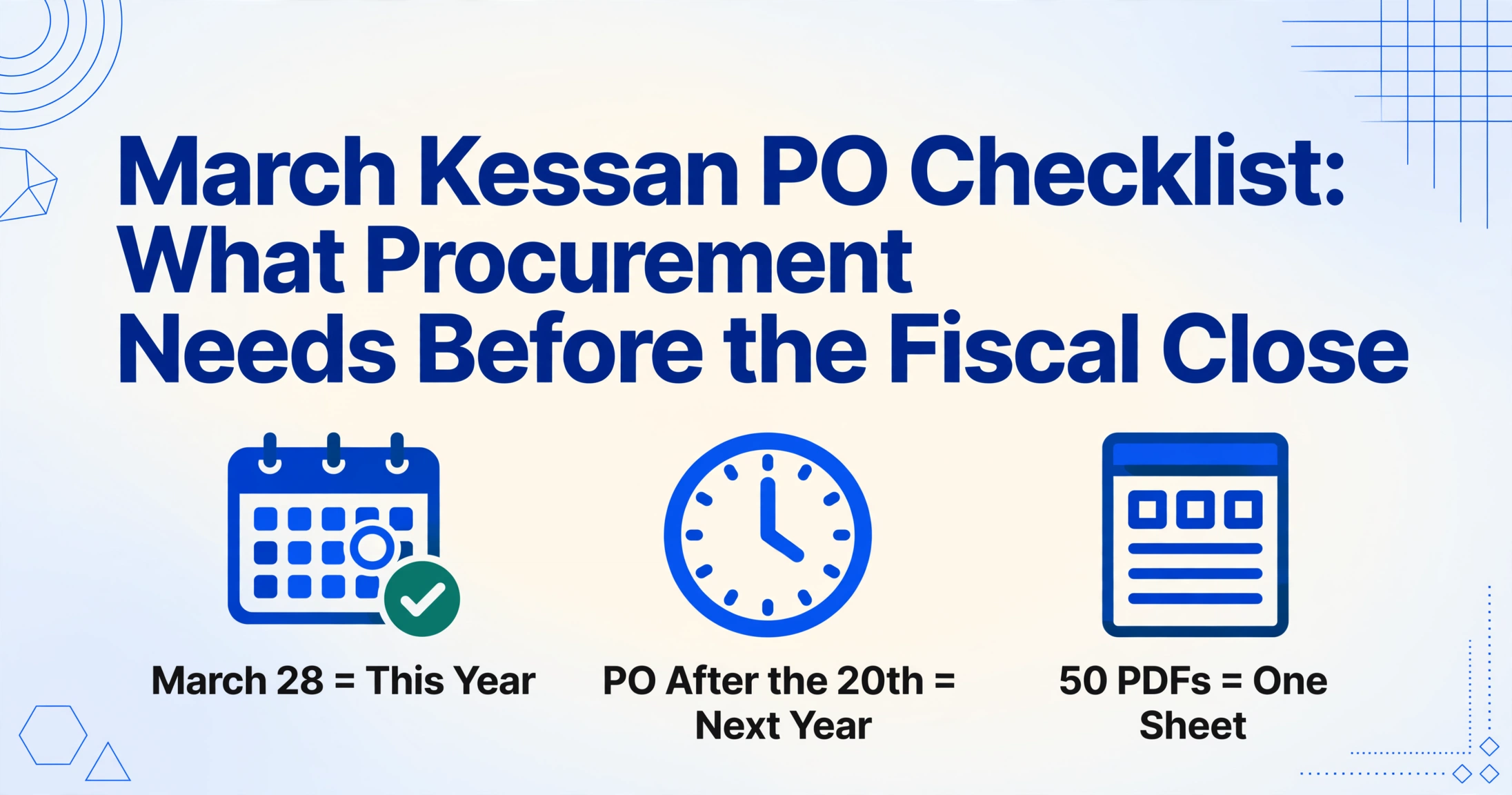
By mid-February, a Japanese company that closes its books on March 31 has roughly six weeks to reconcile every outstanding purchase order (発注書, hatchūsho), match them against the corresponding delivery notes (納品書, nōhinsho) and invoices (請求書, seikyūsho), classify consumption tax (消費税) by rate bracket, and apply purchase cutoff (仕入の期間帰属) to determine which fiscal year each transaction belongs to. The workload is the same every March — what changes is how much of the six-week window goes into finding the documents versus acting on them. This checklist covers the five tasks that must be done before the fiscal books close, in the order that matters, with the specific Japanese procurement conventions that determine whether a number lands in this year's P&L or next year's.
Key Takeaways
- May 31 — two months after the March 31 fiscal close — is the corporate tax filing deadline, and every open PO left unclassified by then is a misstatement in the current year's financial report.
- Three of the six weeks before the deadline go into finding and retyping PO data from PDFs scattered across email — and the spreadsheet you finally build runs out of time before you can verify which fiscal year each PO actually belongs to.
- Process each month's POs into a structured spreadsheet as they close — when March arrives, the five-task kessan checklist runs against data that's already assembled rather than files you must first hunt down and retype.
The Six-Week Window That Every March Kessan Creates
The Japanese fiscal year runs April 1 to March 31, and over 60% of listed Japanese companies use this calendar — it aligns with the government fiscal year and with the budget cycles of schools, public agencies, and most trading partners. For the procurement and accounting departments of a March-kessan company, the final six weeks before closing are not a normal period. Every open PO, every goods-in-transit shipment, and every unpaid invoice becomes a classification judgement: does this cost belong to the fiscal year ending March 31, or to the one beginning April 1?
The decisions made in February and March determine whether the company's financial statements show the correct purchase obligations and accounts payable — and a misclassification that pushes a ¥5 million procurement into the wrong fiscal year is not just a journal adjustment next quarter. It is a misstatement in the current year's financial report.
The Corporate Tax Law (法人税法) requires Japanese companies to retain purchase orders and related procurement documents for seven years from the filing deadline of the relevant tax return, per NTA Article 5930. Under the Companies Act (会社法), accounting books — including purchase ledgers — must be retained for ten years. The retention requirement is not the problem. The problem is that in the six weeks before kessan, every PO that is still open represents a decision that has not been made: is the delivery complete, has the invoice arrived, what tax rate applies, and does the settlement day (締日, shimebi) push the expense into the next fiscal year. When forty or fifty outstanding POs need these four decisions each, the window shrinks fast.
The FujiCore Japan analysis of common year-end risks for Japanese companies identifies incomplete documentation and reconciliation difficulties as two of the most frequent causes of delayed closing — problems that compound when procurement data is scattered across supplier PDFs, fax printouts, and email attachments rather than assembled into one structured ledger. Gathering the data is the task that eats the first three weeks of the window. The checklist that follows assumes you want to shrink those three weeks into one sitting.
The Five-Task Kessan PO Checklist
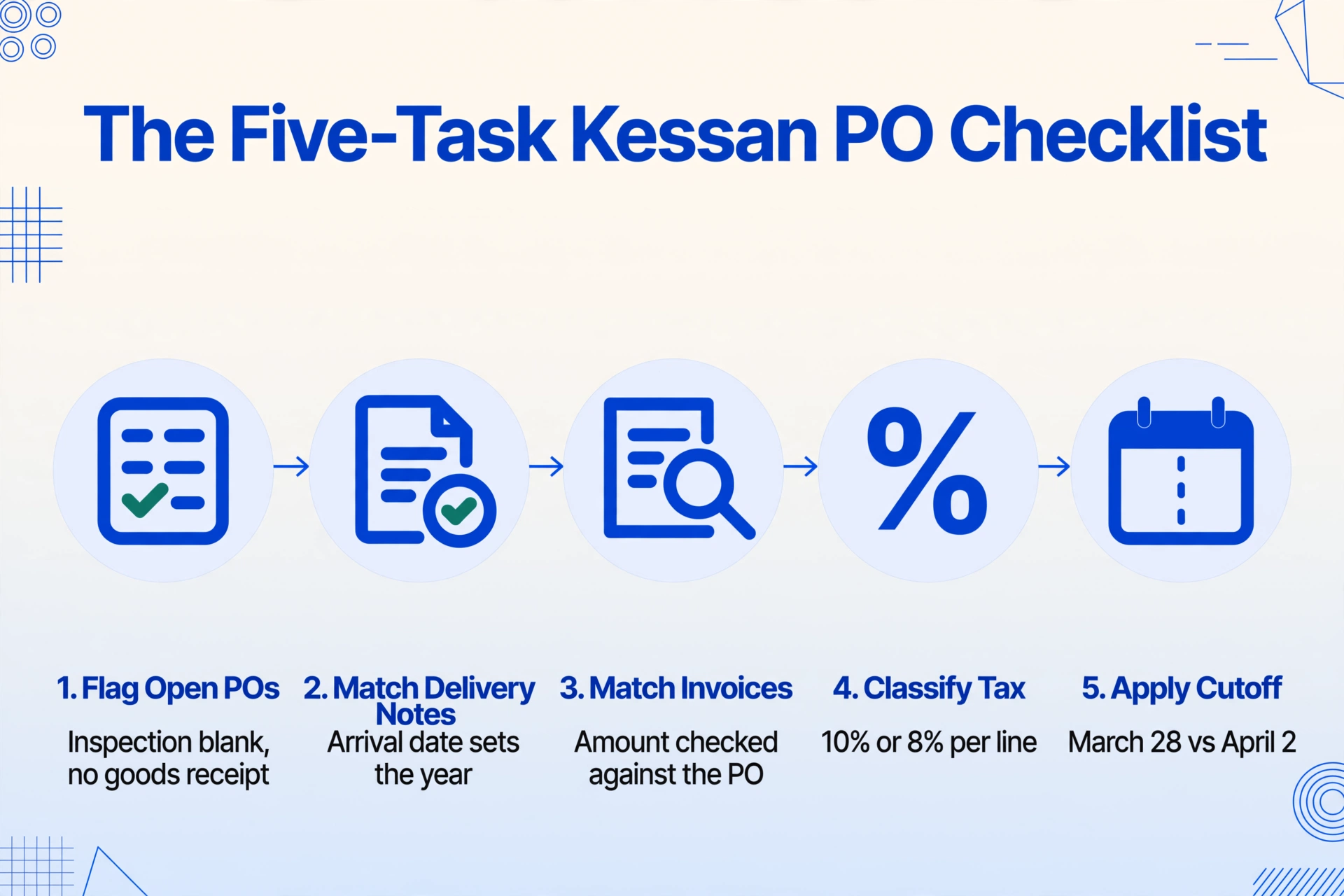
Each task below is a reconciliation judgement. It is ordered so that each step produces data the next step needs — if you reorder them, you will find yourself reopening earlier spreadsheets to retrieve information you did not capture the first time.
1. Identify Every Open PO With Outstanding Delivery
The first scan is the simplest but the most easily skipped: go through every PO issued during the fiscal year and flag those where delivery is not yet complete or the inspection (検収, kenshū) has not been signed off. The Subcontract Act (下請代金支払遅延等防止法) requires that every PO issued to a subcontractor carry a unique PO number (発注番号), an order date (発注日), a delivery date (納期), a delivery location (納入場所), and an inspection completion date (検収完了日), among other mandatory fields — the JFTC's mandatory field requirements define the full set. If the inspection date field is blank or the delivery date has passed without a corresponding goods receipt, the PO is open. Open POs with delivery dates in March are the subset that matters most — goods arriving in the final week of the fiscal year are a cutoff question.
A PO issued in September for delivery scheduled in April of the following year is straightforward: the procurement obligation belongs to the next fiscal year. A PO issued in February for delivery scheduled March 25 is the one that requires attention — if goods arrive on March 28, the expense is this fiscal year's; if they arrive April 3, it belongs to next year's. The classification hinges on the actual delivery date, not the scheduled one, which means the March 25 PO cannot be closed in the kessan spreadsheet until someone confirms whether the delivery occurred.
2. Match Delivery Notes (納品書) Against Each Open PO
Once open POs are identified, the next step is the first leg of the three-way match (三点照合): verifying that the delivery note — the supplier's confirmation of what was actually shipped — agrees with what the PO ordered. A delivery note in a Japanese procurement workflow carries the PO number, item names (品名), delivered quantities, and delivery date. The fields to compare:
- Item name match: a PO may list "SUS304 M8×30 bolt" and the delivery note may abbreviate it to "SUSボルト M8." These refer to the same item, but a VLOOKUP on raw text returns #N/A. The match must be verified by someone who knows the supplier's naming conventions — or by an extraction step that reads item identity by meaning rather than string equality.
- Quantity match: a PO may order in lots (1式) and the delivery note itemizes the lot into individual pieces (5個). The quantities are different numbers representing the same delivery. The comparison must account for the unit-of-measure mapping — a human or an AI that can resolve "1 lot = 5 pieces" from context.
- Delivery date vs PO date: the delivery note date confirms when goods arrived, which is the event that determines fiscal-year classification for the expense.
Delivery notes that match the PO in item, quantity, and date become the foundation for the invoice comparison in the next step. Delivery notes that show short shipments (数量不足) or discrepant items create the exceptions list — the subset of POs that require supplier communication before kessan can close.
3. Match Invoices (請求書) Against Each Matched PO-Delivery-Note Pair
With PO and delivery note matched, the invoice is the third document in the three-way match and the one that determines the accounts payable (買掛金) balance at fiscal year-end. The Japanese invoice carries fields that do not appear on Western invoices: the supplier's bank transfer details (振込先 — bank name, branch name, account number), the payment terms expressed as a settlement-day compound (20日締翌月末払い), and, since October 2023, the Qualified Invoice registration number (インボイス登録番号) required for input tax credit claims.
The invoice comparison checks three things against the matched PO-delivery-note pair:
- Billed amount vs PO amount: the invoice line amounts (金額) should match the PO line amounts for the delivered quantities. A discrepancy at this stage — the invoice charges ¥520 per unit when the PO specified ¥480 — is a pricing error or an unapproved price change that must be resolved before payment approval.
- Consumption tax breakdown: the invoice must itemize the consumption tax by rate category — 10% standard rate (standard goods and services), 8% reduced rate (food, non-alcoholic beverages, subscription newspapers), and tax-exempt (非課税 — exports, certain medical and educational services). This breakdown is required for the input tax credit claim on the consumption tax return (消費税申告), and it must align with the tax classification applied to each PO line item.
- Payment due date: derived from the payment terms (支払条件) on the PO. If the PO says 20日締翌月末払い and the invoice is dated February 25 with a billing period closing on the 20th, the payment is due by the end of March — making it a current-fiscal-year obligation. If the PO says 月末締翌々月末払い and the billing closes on March 31, payment is due by the end of May — a next-fiscal-year cash outflow but a current-fiscal-year expense. The distinction between cash timing and expense recognition is the cutoff decision discussed in the next section.
The three-way match is the control point that prevents overpayment, duplicate payment, and the recording of expenses against the wrong fiscal year. Every matched PO-delivery-note-invoice triple produces one clean accounts-payable entry. Every unmatched pair — where one of the three documents is missing or disagrees — is a reconciliation item that must be tracked to resolution before kessan can close.
The underlying matching problem — why the same transaction is described differently across the three documents and why template-based OCR fails to resolve it — is covered in detail in our piece on the 発注書-納品書-請求書 matching problem in Japanese procurement.
4. Classify Every PO Line Item by Consumption Tax Rate
Japan's dual-rate consumption tax system, combined with the Qualified Invoice System (インボイス制度) that took effect in October 2023, means the procurement-side input tax credit (仕入税額控除) requires every purchase to be categorized by tax rate. This is not a year-end-only task — but year-end is when the categorization gets audited, because the consumption tax return for the fiscal year aggregates twelve months of procurement data and any misclassification that went unnoticed in a single month can distort the annual total.
A single PO can carry line items at three different tax treatments: standard goods at 10%, food or beverage items at 8% reduced rate, and export-related items as tax-exempt. The invoice must separately state the consumption tax for each rate bracket, and the PO data must match. If a supplier's invoice claims 10% consumption tax on a food-item line that should be 8%, the discrepancy is caught at this step — not months later when the tax office (税務署) raises it during an audit.
The classification rule per line item is straightforward, but the volume is the friction. A procurement department with fifty POs per month and an average of four line items per PO has 200 classifications to assign. Spread across twelve months, the annual total is 2,400 classifications — and if a single staff member is verifying these by opening each PO PDF and checking each line item description against the tax rate rules, the task consumes days. The tax classification is an Inferred Column in an extraction workflow: the AI reads the item description, applies the dual-rate rule, and populates a Tax Classification column during extraction — so the annual batch of PO data arrives with tax classes already assigned, and the verification step becomes a spot-check of outliers rather than a line-by-line review.
5. Apply Purchase Cutoff — Which Fiscal Year Does This Expense Belong To
The purchase cutoff (仕入の期間帰属) is the accounting judgement that determines whether a procurement transaction is recorded in the fiscal year ending March 31 or the one beginning April 1. The rule under Japanese GAAP is accrual basis (発生主義): the expense is recorded in the period when the goods or services are received, not when the payment is made. The practical question in the six-week window is: for every open PO, has the delivery occurred by March 31?
Three scenarios cover most cases. Goods delivered and inspected by March 31: the expense belongs to the current fiscal year — the invoice may arrive in April, but the obligation was incurred in March, and the accounts-payable entry is booked as a March liability (未払金). Goods ordered but not yet shipped: the PO is open but no obligation exists yet — nothing is booked, and the PO simply rolls into the next fiscal year's procurement plan. Goods in transit (未着品): the goods left the supplier before March 31 but arrived at the buyer's location after April 1. The cutoff treatment depends on the shipping terms — if the contract specifies the buyer's location as the delivery point, the expense belongs to the next fiscal year; if the supplier's location, it is this fiscal year's. The PO's delivery location (納入場所) field tells you which, because it specifies where delivery is deemed to occur.
The purchase cutoff decision for each open PO is not a formula — it is a case-by-case judgement that requires the PO data, the delivery note, the shipping terms, and the actual delivery date. Having all of that data in one structured spreadsheet, with one row per PO and columns for each decision input, is the difference between a cutoff review that takes an afternoon and one that drags into the final week of March with documents still being located.
When Settlement Day (締日) Determines Which Fiscal Year Gets the Bill
Japanese payment terms introduce a wrinkle that most Western accounting teams never encounter: the settlement day (締日) embedded in the payment terms expression does not just determine when payment is due — it determines which month's billing period the transaction belongs to, and by extension which fiscal year's accounts payable it lands in.
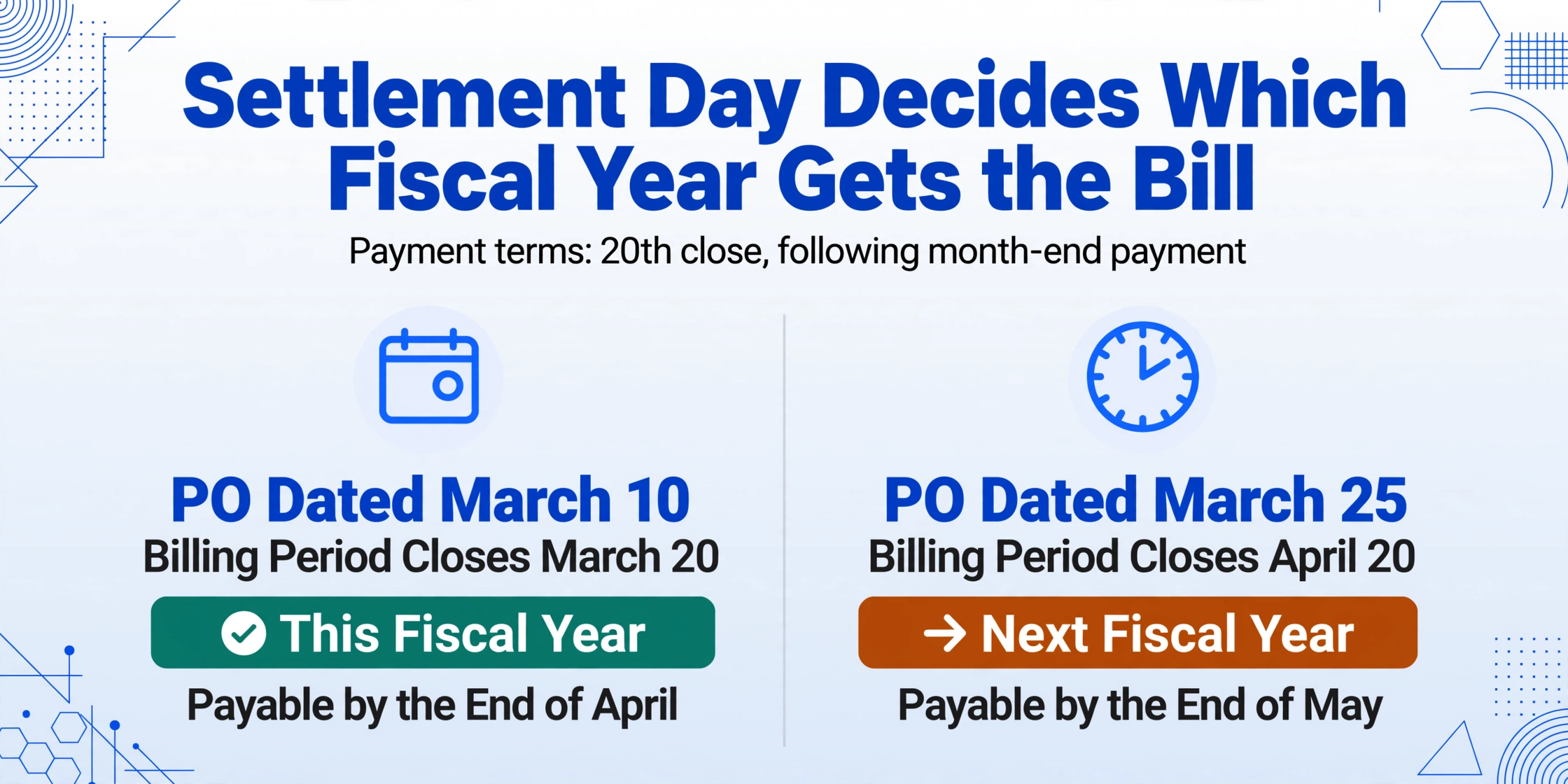
A payment term written as "20日締翌月末払い" means the billing period closes on the 20th of each month and payment is due by the end of the following month. A PO issued on March 10 under these terms means the transaction falls into the billing period that closes on March 20 — making it a March expense, payable by the end of April. A PO issued on March 25 under the same terms falls into the billing period that closes on April 20 — making it an April expense, payable by the end of May, and belonging to the next fiscal year. The difference is the PO date relative to the settlement day: before the 20th means this fiscal year; after the 20th means next fiscal year.
For "月末締翌月末払い" (end-of-month close, payment by end of following month), the cutoff is the calendar month boundary. Any PO with a delivery date in March is a March expense — payable by the end of April. For "月末締翌々月末払い" (end-of-month close, payment by end of month after next), the cash moves two months later, but the expense recognition remains in the delivery month. A March delivery under 翌々月払い terms means payment in May, but the expense is recorded in March — the payment lag affects cash flow, not expense recognition.
The practical implication for the kessan checklist: the settlement day extracted from the PO's payment terms field determines which billing period the transaction belongs to, which in turn determines whether the accounts-payable entry lands in this fiscal year's balance sheet. If the settlement day on a PO with a March delivery date is the 20th and the delivery occurred on March 18, the expense is a current-year liability. If the settlement day is the 20th and the delivery occurred on March 22, it is next year's. The extraction must capture not just the raw payment terms string but the settlement day as a structured value — so the cutoff decision can be made by comparing the delivery date to the settlement day, not by reading each PO's payment terms text afresh.
The batch-processing guide for Japanese procurement covers how a monthly PO dashboard groups payment obligations by settlement day — the same dashboard structure, applied to the full fiscal year's POs, produces the settlement-day view that makes the cutoff review systematic rather than document-by-document.
Compressing the Gather: From Fifty PDFs to One Kessan-Ready Spreadsheet
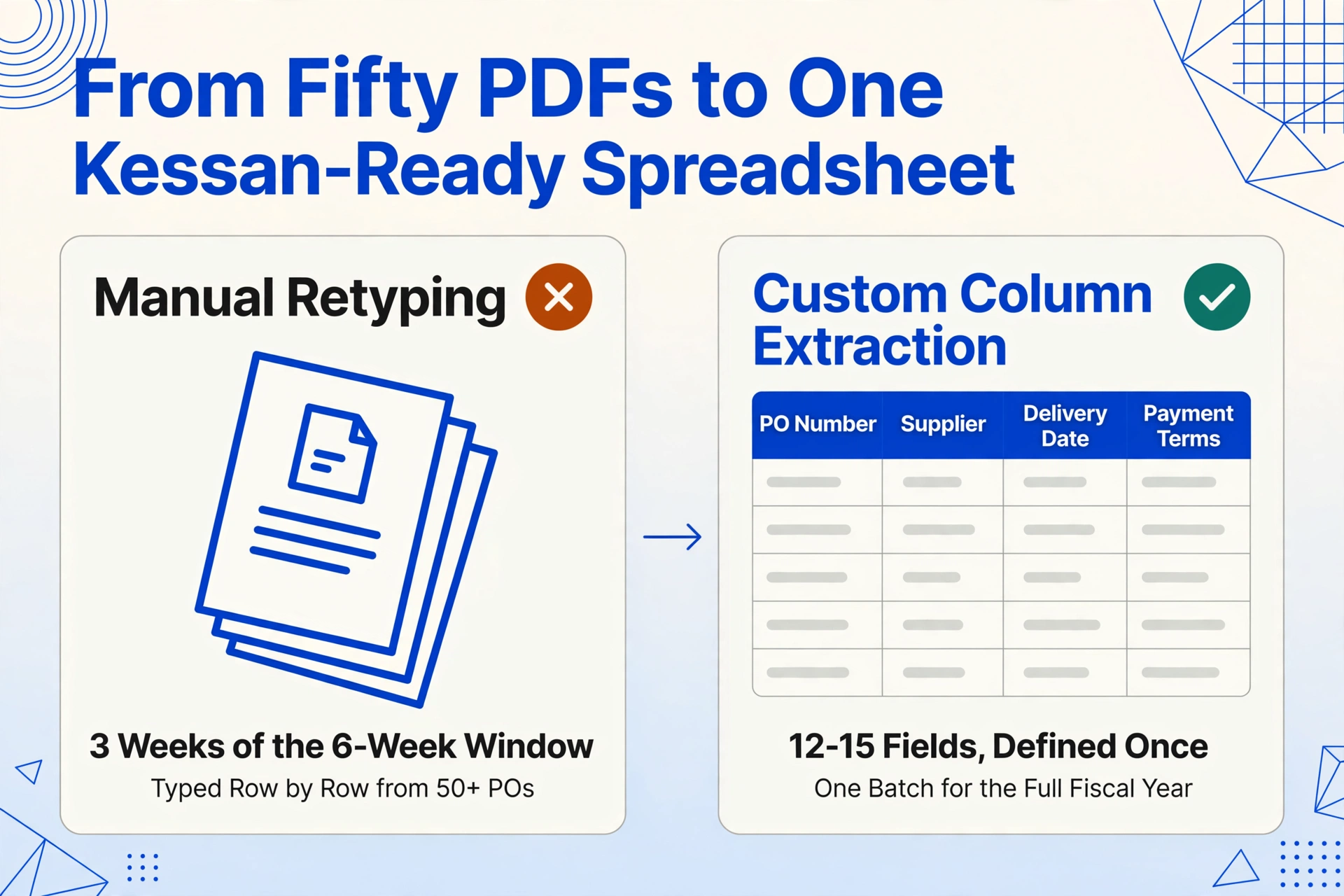
The checklist above — five tasks across fifty or more POs — assumes the PO data is already in a spreadsheet. In most procurement departments, it is not. It lives in the original PDFs, fax printouts, and email attachments from suppliers, and the first three weeks of the six-week window are spent extracting it — typing PO numbers, item names, quantities, amounts, payment terms, and delivery dates from each document into a spreadsheet row by row. By the time the spreadsheet is ready, there are three weeks left to run the five-task checklist.
A different approach starts with the extraction rather than the checklist. Instead of opening each PDF and retyping it, you define the column schema once — the twelve to fifteen fields every PO carries — and process the full fiscal year's worth of POs in one batch. Custom Column Extraction means you type the field names you want as column headers (PO Number, Supplier, Item Name, Quantity, Unit Price, Line Amount, Delivery Date, Delivery Location, Payment Terms, Consumption Tax Classification, Total Amount) and the AI locates each value on every document by understanding what it means, not where it sits. A PO number is still a PO number whether it is printed top-right on a Mitsubishi Chemical PDF or handwritten in the margin of a subcontractor's fax form. The semantic approach does not care about the layout — it cares about the field identity.
Three extraction features matter specifically for the kessan deadline. Batch processing means you upload all fifty POs at once and the results merge into a single spreadsheet — the extraction time for fifty documents is approximately the same as for one. Computed Columns let the AI parse Japanese payment terms conventions during extraction: a column defined as Settlement Day (extract the day number from Payment Terms; if "20日締" then 20, if "月末締" then 31) outputs the structured settlement day that the purchase cutoff decision needs. Inferred Columns assign the consumption tax classification per line item — 10% Standard, 8% Reduced, or Tax-Exempt — based on the item description, so the tax-breakdown view is populated without a separate classification pass. The full extraction workflow for Japanese POs is covered step by step in the guide to extracting Japanese purchase order data to Excel.
Files are processed securely and not stored.
Getting PO Data Into Accounting Software Before the Deadline
Once the fiscal year's PO data is structured in a spreadsheet, importing it into the accounting or procurement software is the last step before the kessan reports can be generated. Japanese accounting platforms universally support structured data imports — the bottleneck has always been getting the PO data into structured form, not the import step itself.
Yayoi (弥生会計), the market leader in Japanese SME accounting, accepts CSV imports for purchase ledger data. Extracted PO columns map directly to Yayoi's field names: PO Number → 伝票番号, Supplier → 仕入先, Amount → 金額. Yayoi Sales (弥生販売), the companion purchase-and-inventory module, imports PO data into its purchasing module — a dedicated pipeline that reduces the extraction-to-import step to a file upload, with automatic linking to the corresponding general ledger entries in 弥生会計. The purchase cutoff date — derived from the delivery date rather than the PO date — determines the fiscal year classification in Yayoi's period-close function.
freee, the cloud accounting platform used by over 70,000 Japanese SMEs, supports CSV import with automatic journal entry generation (自動仕訳). PO data extracted with consumption tax classification per line item feeds directly into freee's dual-rate tax reporting — the 10% standard rate and 8% reduced rate totals are computed as the import runs, and the output populates the consumption tax return calculation that freee generates automatically. For the Qualified Invoice System (インボイス制度) compliance check, the supplier's invoice registration number — if extracted alongside the PO data — is carried through to the purchase journal entry, satisfying the documentation requirement for input tax credit claims.
MoneyForward Cloud Accounting (マネーフォワード クラウド会計), freee's primary competitor with the largest number of financial institution API connections in Japan, accepts batch CSV imports into its purchase management module. Kanjo Bugyo (勘定奉行), OBC's suite for mid-size Japanese companies, imports PO data with department-level cost allocation (部門別原価管理) preserved — the cost center from the PO flows through to segmented P&L reporting automatically.
The common thread across all four platforms is that the import capability exists. What does not exist — what the six-week window before kessan makes painfully visible — is an automated way to get fifty POs from PDF form into import-ready CSV form without manual retyping. Closing that gap is the difference between a kessan close that runs to the deadline and one that finishes with time to review the numbers before they are filed.
Prepping for the 2027 Kessan While the 2026 One Closes
The kessan deadline is annual, but the procurement data that feeds it is generated monthly. A company that runs the five-task checklist in February-March 2026 and then resumes processing POs one at a time through April, May, and June will find itself in the same position in February-March 2027: a six-week window, fifty or more POs to gather, and the same retyping workload. The structural fix is to run the extraction monthly rather than annually — process each month's PO batch as it closes, so the fiscal-year-end checklist starts with twelve monthly spreadsheets already assembled rather than fifty individual PDFs.
A monthly batch extraction with a twelve-column PO schema — the same columns every month — produces twelve structured spreadsheets by the time March arrives. Stacking them into one annual ledger is a copy-paste operation because the columns align. The five-task checklist — identify open POs, match delivery notes, match invoices, classify tax, apply cutoff — runs against data that is already structured rather than data that must first be extracted. The time saved moves from the extraction step to the analysis step: more time to review the purchase cutoff decisions, more time to verify the consumption tax classification, more time to catch the outlier POs where an extraction result needs to be checked against the source document.
The same annual consolidation benefit applies retroactively. The Corporate Tax Law requires PO and related document retention for seven years, and a tax office audit (税務調査) can request purchase records from any year within that window. If each fiscal year's POs were batch-processed at year-end into one structured ledger — indexed by PO number, supplier, month, and tax classification — an auditor's request for "all POs above ¥1 million from Fiscal Year 2023" is answered by filtering the dashboard, not by opening a storage box of physical files. The time saved is in the audit response, not in the extraction step.
The same seasonal-deadline pattern repeats across tax jurisdictions with their own cutoff dates and their own document conventions. The UK Self Assessment crunch, covered in the SA100 January checklist for freelancers racing the HMRC deadline, faces the identical structural problem: a fixed deadline, a year's worth of scattered documents, and a gathering step that consumes the available window. The tax fields differ per jurisdiction; the checklist principle — identify the documents, extract the data once, run the verification before the deadline — does not.
Frequently Asked Questions
What is the Japanese fiscal year-end (kessan) deadline for companies?
The fiscal year-end date is set in the company's articles of incorporation. The most common date for Japanese companies is March 31 (3月決算), which aligns with the government fiscal year (April 1 to March 31). The corporate tax return filing deadline is two months after the fiscal year-end — May 31 for a March-kessan company. The accounts-payable balance as of March 31 must reflect all purchase obligations incurred during the fiscal year, which is why the February-March period becomes a procurement reconciliation crunch.
What is a purchase cutoff (仕入の期間帰属) and why does it matter for kessan?
Purchase cutoff is the accounting judgement that assigns each procurement transaction to the correct fiscal year. Under Japanese GAAP's accrual basis (発生主義), an expense is recorded in the period when the goods or services are received, not when payment is made. For a March 31 kessan, a delivery that arrives on March 28 belongs to the current fiscal year; a delivery on April 2 belongs to the next one. Every open PO with a delivery date near the March 31 boundary requires a cutoff decision, and the decision depends on the actual delivery date, the shipping terms, and the settlement day (締日) in the payment terms — data that must be collected from the PO, the delivery note, and often a communication with the supplier.
How does the settlement day (締日) in Japanese payment terms affect the fiscal year classification?
The settlement day embedded in a payment term like "20日締翌月末払い" determines which monthly billing period the transaction belongs to. Transactions before the 20th of the month are settled together; transactions after the 20th roll into the next month's billing period. For a March kessan, a PO with a delivery on March 18 under 20日締 terms falls into the March billing period (current fiscal year). The same PO with a delivery on March 22 under the same terms falls into the April billing period (next fiscal year). The cutoff is the delivery date relative to the settlement day, not relative to March 31 — which means the settlement day must be extracted as a structured value, not treated as an undifferentiated text string.
Can I process a full fiscal year's POs at once instead of one at a time?
Yes. Batch extraction processes all POs for the fiscal year — or for any subset — in one upload, and results are merged into a single spreadsheet. The column schema is defined once and applied to every document: PO Number, Supplier, Item Name, Quantity, Unit Price, Line Amount, Delivery Date, Delivery Location, Payment Terms, Consumption Tax Classification, Total Amount. Because the AI reads each field by semantic meaning rather than position on the page, the same schema works across POs from every supplier regardless of format — the Mitsubishi Chemical PO and the local subcontractor's handwritten fax produce identically structured rows in the same spreadsheet.
How does the Qualified Invoice System (インボイス制度) affect kessan PO data?
Since October 2023, input tax credits for consumption tax on purchases require a Qualified Invoice from a registered Qualified Invoice Issuer. For kessan, this means the procurement department must verify that every supplier invoice used for input tax credit claims carries a valid registration number (インボイス登録番号, starting with "T"). Purchases from unregistered suppliers still receive transitional input tax credits — 80% deductible through September 2026, 50% through September 2029, 30% through September 2031 (per 2026 tax reform), then zero — but the reduced credit must be calculated separately. The PO data with consumption tax classification per line item provides the base for computing the correct input tax credit under the transitional rules.
Can the same extraction handle delivery notes (納品書) and invoices (請求書) for the three-way match?
The extraction engine handles all procurement document types. For delivery notes, define columns for PO Number (the join key), Item Name, Delivered Quantity, Delivery Date. For invoices, define columns for Invoice Number, PO Number, Billed Amount, Consumption Tax, Bank Transfer Details (振込先). Batch-process each document type separately into its own structured spreadsheet, and the three-way match becomes a column-comparison exercise across three spreadsheets — PO spreadsheet vs delivery note spreadsheet vs invoice spreadsheet — rather than a manual read-each-document-and-compare process. The single-PO extraction guide covers the column schema for each document type.
How long must Japanese companies keep purchase order records?
Under the Corporate Tax Law (法人税法施行規則第59条), purchase orders and related procurement documents must be retained for seven years from the day after the filing deadline of the relevant tax return. Under the Companies Act (会社法第432条), accounting books including purchase ledgers must be retained for ten years. If the company has a tax loss carryforward (欠損金の繰越控除), the retention period extends to ten years under tax law as well. The longer of the two applies — so the practical retention period for purchase records is ten years.