Japan's Electronic Bookkeeping Act After
the Grace Period Ended: What Compliance Requires in 2026
If your business receives or issues invoices, receipts, purchase orders, or contracts in Japan — whether you are a sole proprietor or a multinational subsidiary — the 電子帳簿保存法 (Electronic Bookkeeping Act, Act No. 36 of 1998) has required you to preserve electronic transaction data in its original digital form since January 1, 2024. The two-year grace period (宥恕措置) that let businesses fall back on paper storage expired more than two years ago. This article lays out what the law actually demands, where businesses still get it wrong, and how to build a compliant document workflow without over-engineering.
Key Takeaways
- 40% of Japanese businesses are still printing PDF invoices and stacking them in binders — two full years after the Electronic Bookkeeping Act grace period ended, and the NTA's postponement measure is explicitly not a permanent alternative.
- Keeping every PDF in a folder is not compliance. The law requires retrieval, not storage: when a tax auditor asks for a transaction from 2024, you must find it by date, amount, and counterparty (3要素) within minutes — not hours spent scrolling through filenames.
- One AI extraction pass that reads your documents and outputs date, amount, and counterparty into structured columns creates the 3要素 searchable index the NTA accepts as Alternative 1 compliance — no file renaming discipline, no manual spreadsheet, no JIIMA-certified system required.
What the Electronic Bookkeeping Act Actually Requires
The Electronic Bookkeeping Act (電子帳簿保存法, denshi chobo hozon ho) is administered by Japan's National Tax Agency (国税庁, NTA) and governs how tax-related books, documents, and electronic transaction data must be preserved. The law was significantly amended in the 2021 and 2022 tax reforms, with the final mandatory provisions taking effect on January 1, 2024. Understanding the law starts with recognizing its three distinct categories — because the requirements are not the same for each.
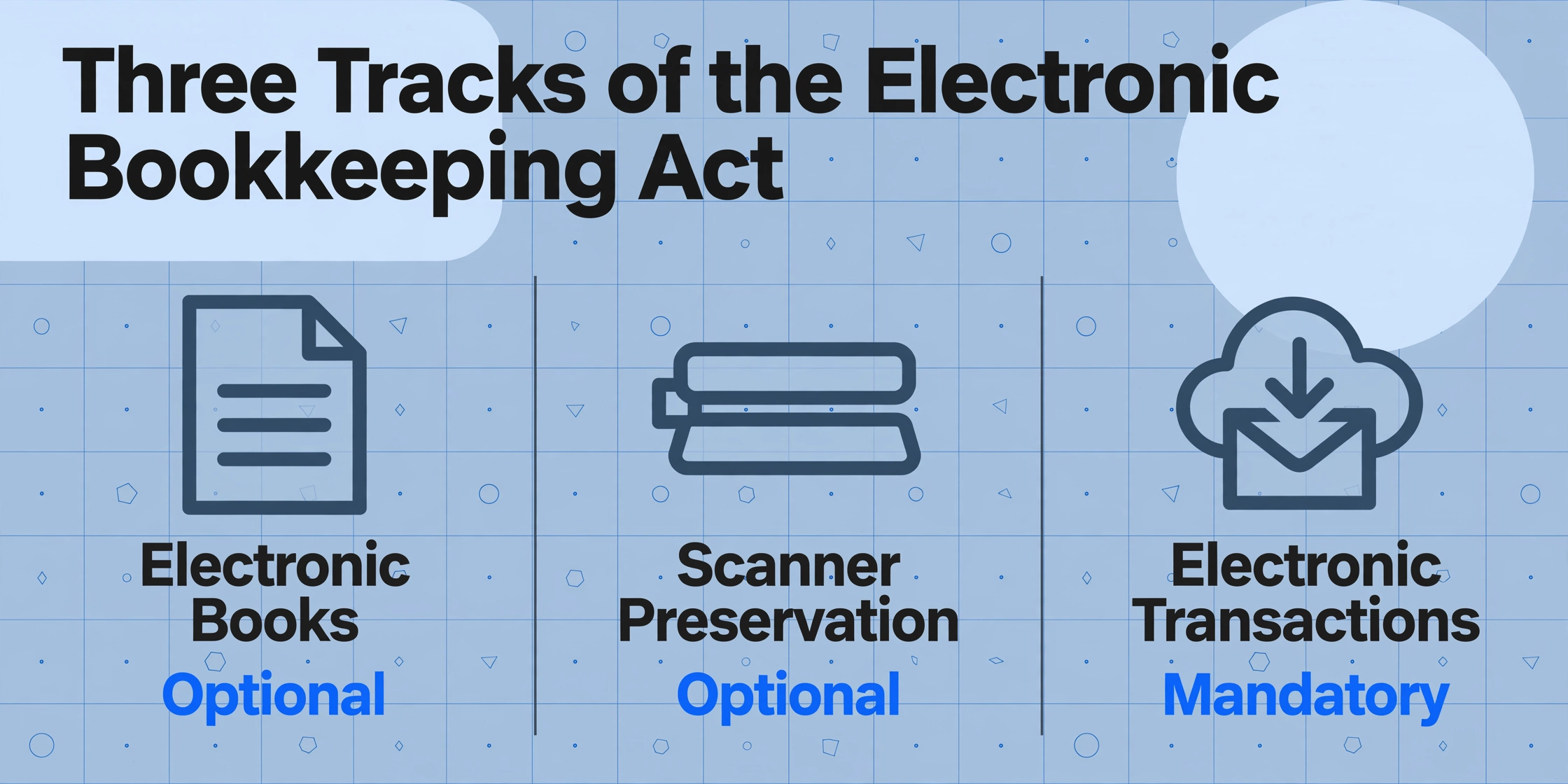
The Act divides preservation into three tracks: electronic books and documents (電子帳簿等保存), which is optional and applies when a business chooses to keep its accounting ledgers in digital-only form; scanner preservation (スキャナ保存), also optional, governing the digitization of paper receipts and invoices; and electronic transaction data (電子取引), which is mandatory for every business that receives or issues transaction documents electronically — email-attached PDF invoices, receipts downloaded from web portals, EDI transactions, and cloud-based document exchanges. According to the NTA's official guidance, the law applies to all corporations and sole proprietorships regardless of size or industry.
| Category | Mandatory? | Key Requirements |
|---|---|---|
| 電子帳簿等保存 Electronic books & documents | Optional | Tamper-proof system, searchability (3要素), system documentation, output equipment |
| スキャナ保存 Scanner preservation | Optional (if digitizing paper) | ≥200dpi, 24-bit color, timestamp within input period, tamper-proofing, searchability |
| 電子取引 Electronic transactions | Mandatory since Jan 1, 2024 | Truthfulness (真実性) + Visibility (可視性), searchable by 3要素, tamper-proof or timestamped |
Of these three, electronic transaction data preservation is the category that demands the most urgent attention. It is the only one that is mandatory for all businesses, and it captures the widest range of everyday documents: invoices received by email, Amazon order receipts downloaded as PDFs, payment notifications from cloud services, contracts exchanged via EDI platforms — any transaction document that arrives in digital form must stay in digital form.
What Changed on January 1, 2024 — and What Hasn't
Two years before the 2024 deadline, the 2022 tax reform introduced a transitional measure known as the 宥恕措置 (yujo sochi, forbearance measure). From January 1, 2022 through December 31, 2023, businesses that could not yet meet the electronic preservation requirements were permitted to print electronic transaction data to paper and store it in paper form — provided they could explain why they were unable to comply and present the paper records during a tax audit. No application to the tax office was needed.
That forbearance period expired on December 31, 2023. As of January 1, 2024, the mandate is in full force. However, a new 猶予措置 (yuyo sochi, postponement measure) replaced the forbearance. Under this measure, businesses that still cannot fully meet the electronic preservation requirements may be allowed to retain paper output, but only if they meet all of the following conditions: (1) the paper output is organized in a consistent, searchable manner; (2) the printed text is clearly legible; (3) the documents can be presented promptly during a tax audit; and (4) the business can demonstrate ongoing efforts toward digital compliance. This is not a return to the old rules — it is a tighter, more conditional bridge, and the NTA has made clear it is not a permanent alternative.
In practice, this means that any business still printing PDF invoices and stacking them in binders as of mid-2026 is operating outside the law's intended framework. The NTA's 2025 administrative guidance and the 2025 tax reform's introduction of the Digital Seamless Software certification (a new JIIMA certification category) signal that the agency expects continued movement toward fully digital, audit-ready preservation systems — not indefinite reliance on transitional measures.
The Three Searchability Requirements — Why "Just Saving the PDF" Does Not Work
The single most common misunderstanding about the Electronic Bookkeeping Act is that simply keeping PDF files in a folder meets the requirement. It does not. The law imposes specific searchability requirements (検索機能の確保) that a folder of filename PDFs cannot satisfy on its own.
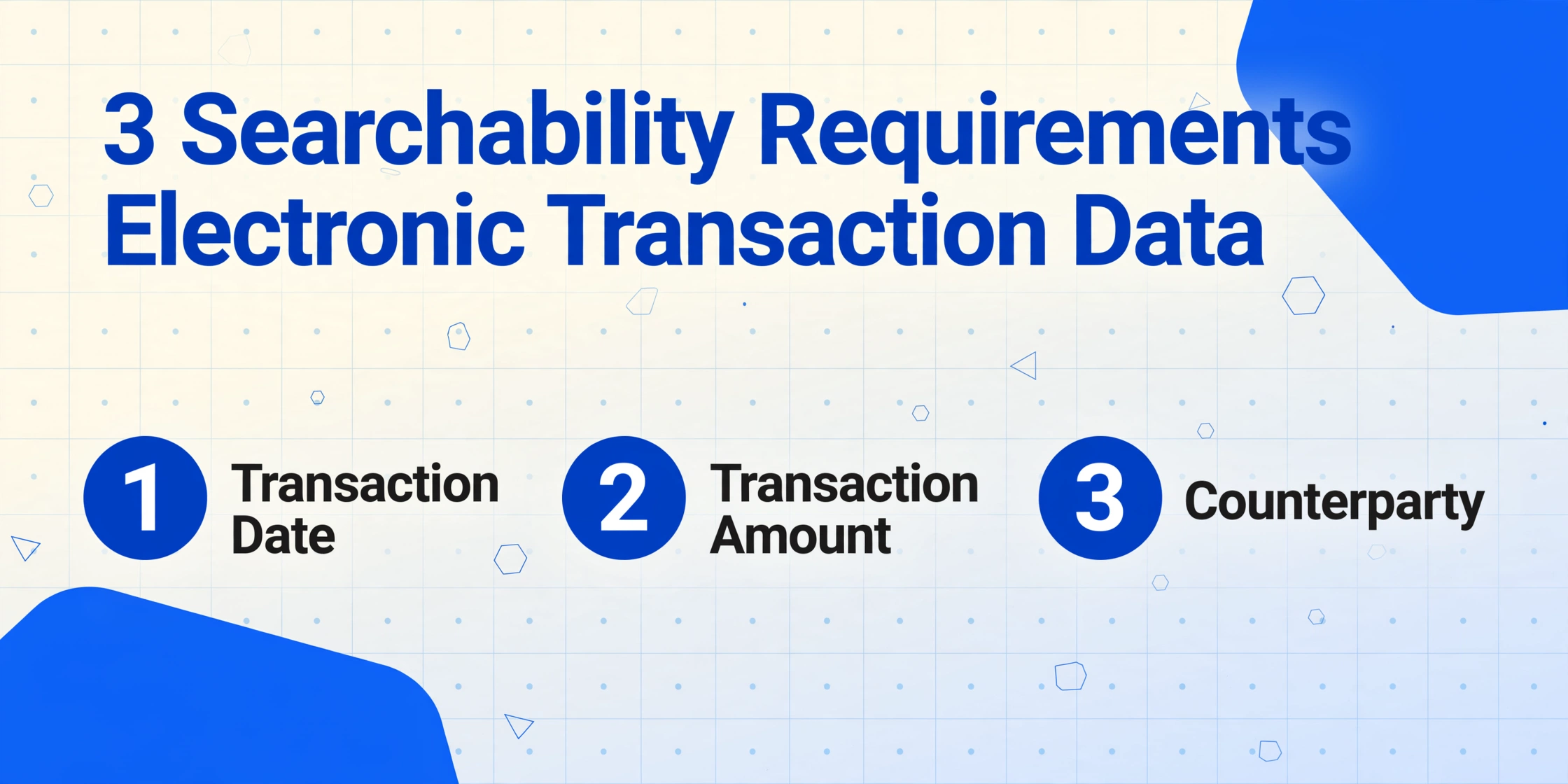
For electronic transaction data, the preservation system must enable searches by three mandatory criteria — known as the 3要素 (three elements):
- Transaction date (取引年月日) — the date the transaction occurred
- Transaction amount (取引金額) — the monetary value of the transaction
- Counterparty (取引先) — the name of the other party involved
In addition, the system must support: (A) searches by date or amount range, (B) combined searches using two or more criteria simultaneously, and (C) the ability to download digital records when requested by a tax auditor. For businesses with base-period sales of ¥50 million or less, requirements (A) and (B) are partially relaxed — but the core 3要素 searchability and audit download obligation remain.
Many businesses attempt to satisfy these requirements through file naming conventions: a PDF named 2026-04-15_Inv#12345_K-Corporation.pdf that includes the date, amount indicator, and counterparty name. While this approach is technically permitted under NTA guidance as Alternative 2 in the official Q&A, it has three serious weaknesses. First, it depends entirely on manual discipline — every file must be renamed correctly, every time, by every employee. Second, it does not support range searches or combined queries unless the file names follow a rigid, queryable convention. Third, it provides no audit trail: if a file is accidentally deleted or renamed, there is no record of what changed or when.
The practical consequence: A business with 5,000 electronic invoices stored in a shared folder with inconsistent naming will fail a searchability test during a tax audit. The NTA expects systems that make records findable by design, not by individual diligence.
Truthfulness: Timestamps, Tamper-Proofing, and What Qualifies
The second pillar of compliance — alongside searchability — is truthfulness (真実性の確保). The law requires that electronic records remain demonstrably unaltered throughout their retention period. This can be achieved through any of three approaches:
Approach 1 — Timestamping. A timestamp must be applied to the electronic record within a defined input period. For scanner preservation, the input period is either "promptly after receipt, generally within approximately 7 business days" (早期入力方式) or within the "normal business processing cycle, up to a maximum of 2 months, plus approximately 7 business days" (業務処理サイクル方式), depending on whether formal administrative procedures have been established. The timestamp must be issued by a provider certified by the Japan Data Communications Association (JDC) and must remain verifiable for the entire statutory retention period.
Approach 2 — Tamper-proof system. If the storage system itself logs all corrections, deletions, and modifications with traceable records (who made the change, what was changed, and when), the system may substitute for individual timestamps. Most JIIMA-certified cloud services use this approach.
Approach 3 — Administrative procedures. The least technically demanding path involves establishing written internal rules that govern how electronic records are handled, who has access, and what procedures must be followed to prevent unauthorized modifications. The NTA publishes a sample administrative procedures document that businesses can adapt. This approach is the most common among small businesses using spreadsheet-and-folder setups, though it places a heavier burden on audit readiness.
For electronic transaction data specifically, the law is somewhat more flexible on timestamps than on searchability: if the storage system can verifiably demonstrate tamper-proof integrity, individual timestamp history is not required for each record. However, this still requires a system-level guarantee — a managed cloud service or JIIMA-certified preservation tool — not a standard cloud drive with shared editing permissions.
JIIMA Certification: What It Certifies, and When You Need It
The Japan Information Management Association (JIIMA, 公益社団法人日本文書情報マネジメント協会) operates a certification program that evaluates commercial software and cloud services against the functional requirements of the Electronic Bookkeeping Act. JIIMA certification is not mandated by law — the NTA does not require certified software — but in practice, using a JIIMA-certified product is the simplest way for most businesses to demonstrate that their preservation system meets the statutory requirements.
As of 2026, JIIMA offers five certification categories:
| Certification | Covers | Relevant To |
|---|---|---|
| Scanner preservation software | Digitizing paper documents | Businesses scanning receipts/invoices |
| Electronic book software | Accounting ledgers kept digitally | Companies using digital accounting |
| Electronic transaction software | Preserving received e-documents | All businesses with e-transactions |
| Electronic document software | Paper-issued document copies kept digitally | Businesses creating paper but keeping digital copies |
| Digital Seamless Software | End-to-end digital preservation + accounting linkage | Full digital workflow (new in FY2025 reform) |
Products that carry JIIMA certification are listed on both the JIIMA official website and the NTA's website. Certified services include cloud platforms such as freee, Money Forward Cloud, TOKIUM, Hubble (契約管理), and various scanner preservation tools. When selecting a preservation solution, the presence of the relevant JIIMA certification mark is a reliable shortcut — it means the software has been independently audited against the law's functional requirements, so your business does not need to interpret the statute on its own.
What OCR and AI Extraction Have to Do with Compliance
The connection between document extraction and the Electronic Bookkeeping Act is not immediately obvious — the law is about preservation, not data entry. But the searchability requirement (3要素検索) creates a direct link. A preservation system must make transaction date, amount, and counterparty searchable. If your documents are scanned images or PDFs that lack embedded, queryable data, you need a way to populate those three fields.
Traditional OCR — optical character recognition — can extract text from an image, but it outputs raw characters without understanding what they mean. A traditional OCR tool cannot reliably distinguish an invoice date from a due date, or a subtotal from a grand total. To build a compliant 3要素 search index from OCR output, you typically need manual validation for each field, which defeats the efficiency purpose of digital preservation.
This is where modern AI-powered extraction changes the compliance equation. Tools like ImageToTable.ai that use vision-language models (VLMs) can read a document, locate the transaction date, amount, and counterparty name based on what the data means rather than where it sits on the page, and output the extracted values into a structured table. That structured table — date, amount, counterparty in separate columns — is a compliant 3要素 search index. Export it to Excel, Google Sheets, or a database, and you have a system that satisfies the searchability requirement through Alternative 1 permitted by the NTA: a list or spreadsheet showing transaction date, transaction amount, and counterparty name for every document.
ImageToTable.ai's Custom Column Extraction capability — where you define the fields you want (e.g., "Transaction Date," "Amount," "Vendor Name") and the AI locates the corresponding values anywhere in the document — is particularly well-suited to this task. Because the tool is template-free and format-independent, it works across the full variety of document formats Japanese businesses encounter: invoice PDFs from large suppliers, Amazon receipt downloads, handwritten delivery notes from small vendors, and payment confirmation screenshots — no template setup required for any of them.
The batch processing workflow is equally relevant: upload multiple documents, run extraction on the batch, and export a consolidated spreadsheet. That spreadsheet becomes your 3要素 searchable index, and the original PDFs or images remain stored as the underlying records. The combination — searchable index + preserved originals — meets both the truthfulness and visibility requirements of the law.
Practical Compliance Checklist for 2026
If you are responsible for document compliance at a Japan-based business — or for the Japan operations of a multinational — here is a concrete checklist to assess where you stand under the Electronic Bookkeeping Act as of mid-2026.
Identify every channel through which your business receives electronic transaction documents: email attachments, web portal downloads, EDI, cloud-based exchanges. List them all. If you are unsure whether a channel counts, assume it does — the NTA's definition of electronic transactions is broad.
Are the incoming PDFs being stored as-is? Are they printed and filed? Are they uploaded to a cloud system with audit trails? Map the current process — honest assessment beats optimistic assumptions.
This is the most common compliance gap. Ensure every preserved electronic record can be found by transaction date, amount, and counterparty. Use either (a) a JIIMA-certified preservation system with built-in search, (b) a structured spreadsheet index built via AI extraction, or (c) a rigorously enforced file-naming convention with folder-level organization — understanding that (c) carries the highest operational risk.
Choose your approach: timestamping via a JDC-certified provider, a tamper-proof storage system with modification logs, or formal administrative procedures adapted from the NTA sample. Document your choice and maintain the supporting records.
Tax auditors have the right to request digital records in downloadable form. Your system must be capable of producing the requested records promptly — with the searchable index intact. Test this capability at least once per fiscal year.
The Electronic Bookkeeping Act interacts with Japan's Qualified Invoice System (適格請求書保存方式). Under the invoice system, every input tax credit claim depends on preserving a qualified invoice with all six mandatory elements — including the issuer's T-number and rate-separated amounts. Preservation without those elements is incomplete. See our guide on the real cost of Japan's Qualified Invoice System for finance teams for the cost side of this equation.
For businesses with base-period sales of ¥50 million or less, steps 3 and 4 have some flexibility — the range-search and combined-search sub-requirements are waived — but the core 3要素 searchability and truthfulness obligations still apply. Do not assume small business status means no compliance work is needed.
Three Mistakes That Show Up in Practice
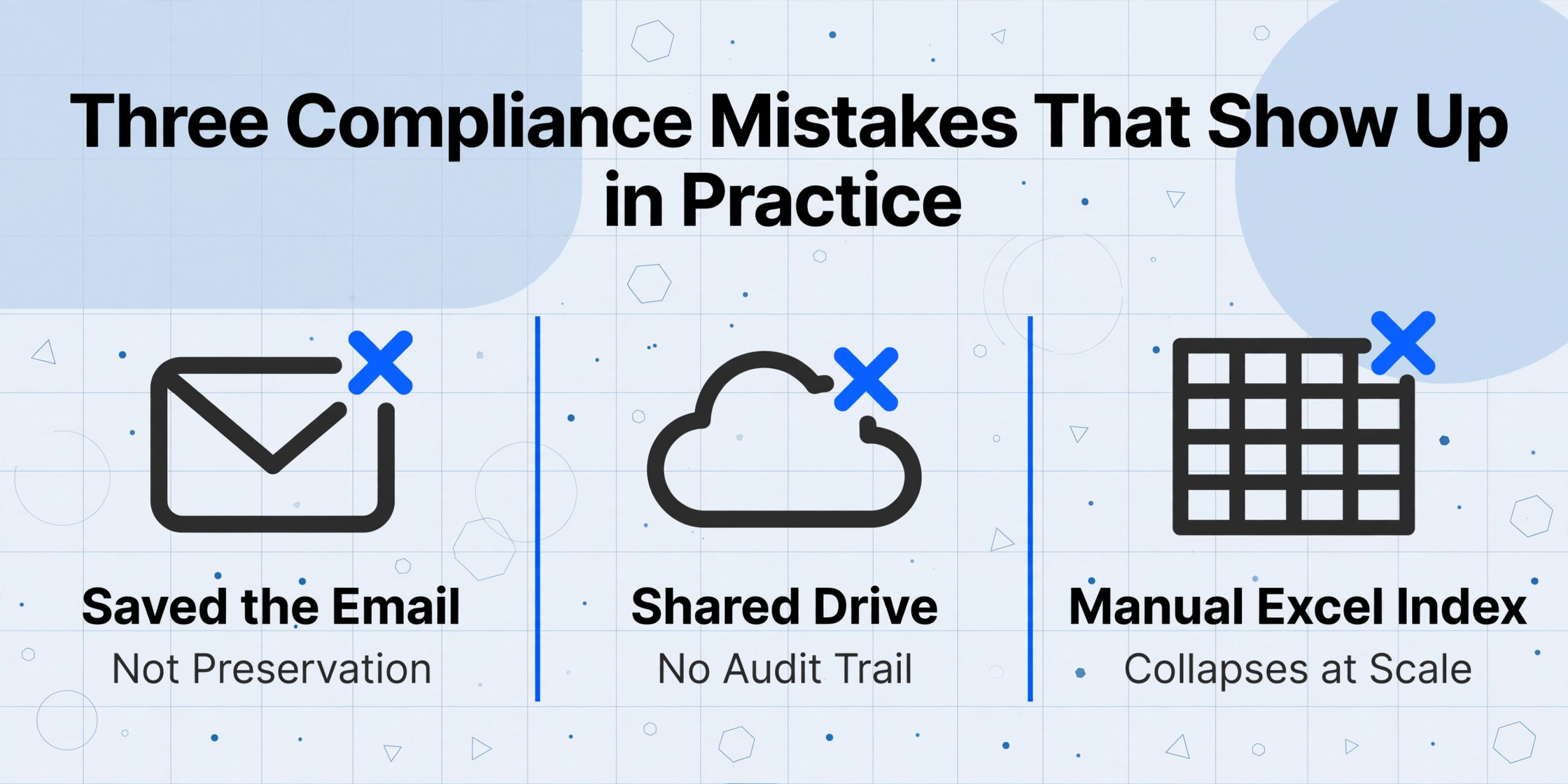
Based on the compliance patterns that tax advisors and JIIMA auditors most frequently encounter, three errors consistently surface across Japanese businesses of all sizes.
Mistake 1: Treating "saved the email" as preservation. Keeping PDF attachments inside an email inbox does not satisfy the Electronic Bookkeeping Act. Emails are mutable (users can delete or modify attachments), lack structured searchability by the 3要素, and do not provide an audit trail. The records must be moved to a dedicated preservation environment.
Mistake 2: Using a shared cloud drive without access controls. Google Drive, Dropbox, and OneDrive are widely used, but the standard plan lacks tamper-proof logging and granular search capabilities. If multiple employees have edit access and the system does not track who changed what and when, the truthfulness requirement is not met. Some enterprise-tier plans add audit logging — verify before assuming compliance.
Mistake 3: Building a 3要素 index manually in Excel. This works in theory — create a spreadsheet with columns for date, amount, and counterparty, link each row to the file path of the preserved document — but it collapses under scale. Manual data entry errors, missed entries, and inconsistent formatting compound over hundreds of transactions. The moment the index diverges from the actual document, the searchability requirement fails in practice even if it passes on paper.
AI extraction solves the third mistake directly: instead of typing data into a spreadsheet by hand, the AI reads each document and populates the index automatically. ImageToTable.ai processes a batch of documents in seconds and outputs a structured table that doubles as your 3要素 search index — accurate, consistent, and audit-ready.
How This Law Interacts with the Qualified Invoice System
The Electronic Bookkeeping Act and the Qualified Invoice System are separate legal frameworks that overlap in practice. The invoice system (in effect since October 2023) governs what must appear on a qualified invoice — the six mandatory elements including the T-number registration, rate-separated taxable amounts, and consumption tax per rate. The Electronic Bookkeeping Act governs how that invoice must be preserved.
The practical interaction is straightforward but often overlooked: a qualified invoice that is stored in a non-compliant preservation system (no searchability, no truthfulness) effectively loses its evidentiary value for input tax credit purposes. If the NTA determines during an audit that the preservation system does not meet the Electronic Bookkeeping Act's requirements, the input tax credit claimed against those invoices can be disallowed — even if the invoices themselves are perfectly formatted.
This is why comprehensive compliance requires addressing both frameworks simultaneously. The preservation system must be able to store, index, and retrieve invoices with all six qualified invoice elements intact and searchable. AI extraction that captures the T-number, gross amounts, tax amounts, and vendor details into a searchable index serves both the invoice system's data requirements and the Electronic Bookkeeping Act's searchability requirement in a single process. For a deeper analysis of the cost implications specifically tied to the invoice system, see our breakdown of Japan's Qualified Invoice System compliance costs.
For a broader perspective on how electronic document compliance is evolving across markets, our e-invoicing compliance guide for 2026 covers the global regulatory landscape and where Japan fits within it.
Frequently Asked Questions
Does the Electronic Bookkeeping Act apply to sole proprietors?
Yes. The law applies to all businesses operating in Japan, including sole proprietors and freelancers. There is no exemption based on business structure — the only relief is the partial search-requirement relaxation for businesses with base-period sales of ¥50 million or less.
Can I still print electronic invoices and file them as paper?
Not as a permanent solution. The 猶予措置 (postponement measure) permits paper output under strict conditions — legible, organized, promptly presentable — but only as a transitional bridge while working toward full digital compliance. The NTA has stated that this measure is not intended as a permanent alternative to electronic preservation.
Do I need JIIMA-certified software to be compliant?
No. JIIMA certification is not legally required. However, using a JIIMA-certified product is the most reliable way to demonstrate that your preservation system meets the functional requirements. If you build a custom system, you should consult with the NTA's pre-consultation desk or a licensed tax accountant (税理士) to confirm compliance.
What happens if I fail a compliance check during a tax audit?
Non-compliance with the Electronic Bookkeeping Act can result in heavier surcharges — the 重加算税 (heavy surtax) is increased by 10 percentage points if concealment or disguise is involved. More practically, the tax auditor may disallow input tax credits claimed against non-compliant records, and in serious cases, the blue return status (青色申告承認) may be revoked. This means losing access to the ¥650,000 blue return deduction and other benefits.
Can AI extraction help me meet the searchability requirement?
Yes. AI-powered extraction that reads documents and outputs the transaction date, amount, and counterparty into a structured table creates exactly the kind of searchable index the NTA recognizes as compliant under Alternative 1. This is one of the most practical approaches for businesses handling high volumes of diverse document formats — provided the underlying records are also preserved in a tamper-proof environment.
Are Amazon invoice PDFs and web-downloaded receipts covered?
Yes. Any transaction document that is delivered or received in electronic form — including Amazon order receipts, SaaS billing PDFs, and airline e-ticket invoices — falls under electronic transaction data (電子取引) and must be preserved in compliance with the law. The NTA's guidance explicitly includes web-downloaded documents and cloud-service-generated invoices.
The Bottom Line: Preservation Is About Retrieval, Not Storage
The Electronic Bookkeeping Act asks one question that cuts through all the technical requirements: when a tax auditor asks for a specific transaction record from two years ago, can you find it, prove it has not been altered, and produce it within minutes? Everything in the law — the 3要素 searchability, the timestamp rules, the tamper-proof logging — is designed to make the answer to that question "yes."
Businesses that treat the law as a checklist of features to bolt onto their existing workflow will end up with a patchwork that passes neither a compliance review nor a stress test at scale. Businesses that instead start from the retrieval question and build backward — what data do I need to index, where do I store the originals, how do I prove integrity — will find that modern AI extraction collapses most of the complexity into a single step: read the document, extract the three fields, populate the index. The preservation follows naturally.
Test your own documents. See if the extraction tools you have been using can reliably pull transaction date, amount, and counterparty from the mix of Japanese invoices, receipts, and delivery notes that land in your inbox every day. If they cannot, your compliance risk is higher than you think.