Global E-Invoicing Compliance 2026:
What Finance Teams Need to Know Before the Deadlines
This article tells you what the 2026 e-invoicing mandates actually require, who they affect, and what you need to do before the deadlines — without the "or else" panic that fills most compliance content.
Key Takeaways
- 16 European countries with active or incoming e-invoicing mandates, and no two of them use the same format — Poland demands FA_VAT XML, France accepts three schemas, Germany splits across XRechnung and ZUGFeRD.
- The hidden trap: a Factur-X or ZUGFeRD file at the MINIMUM or BASIC WL profile carries only header data in its XML — every line item still lives in the PDF layer, invisible to XML-only parsers.
- The fix isn't a template per country: a semantic extraction approach that understands what a field means — not where it sits on a page — reads Polish FA_VAT, French Factur-X, and German XRechnung through the same column definition.
By the end of 2026, sixteen countries will have active or incoming e-invoicing mandates across Europe alone. Poland's KSeF went live in February. Belgium's Peppol mandate started in January. France begins its B2B rollout in September. Germany's receiving mandate has been in effect since January 2025, with the sending side approaching fast. Each country has chosen a different format, a different transmission model, and a different enforcement timeline.
If your AP team receives invoices from multiple European suppliers — or if you are a mid-market finance leader whose ERP and extraction tools need to adapt — the question is not whether these mandates affect you. It is which ones, when, and what to do about the invoices that arrive in formats no single tool can handle consistently.
This guide covers the seven mandate systems that matter most for businesses receiving invoices across Europe in 2026: the EU's ViDA framework (setting the long-term trajectory), Poland's KSeF (now active), Belgium's Peppol mandate (now active), France's B2B reform (September 2026), Germany's phased E-Rechnung rollout, Spain's Crea y Crece law (coming into force), and Italy's mature FatturaPA system (already operational). Each is treated from the perspective of a finance team that needs to extract usable data from incoming invoices — not just ensure their own outgoing invoices are compliant.
What the 2026 Mandates Actually Require
Every e-invoicing mandate in Europe shares a common DNA: the requirement to exchange invoices as structured data rather than as unstructured PDFs or paper. Beyond that, each country's implementation differs in three key dimensions: the transmission model, the required format, and the scope of transactions covered.
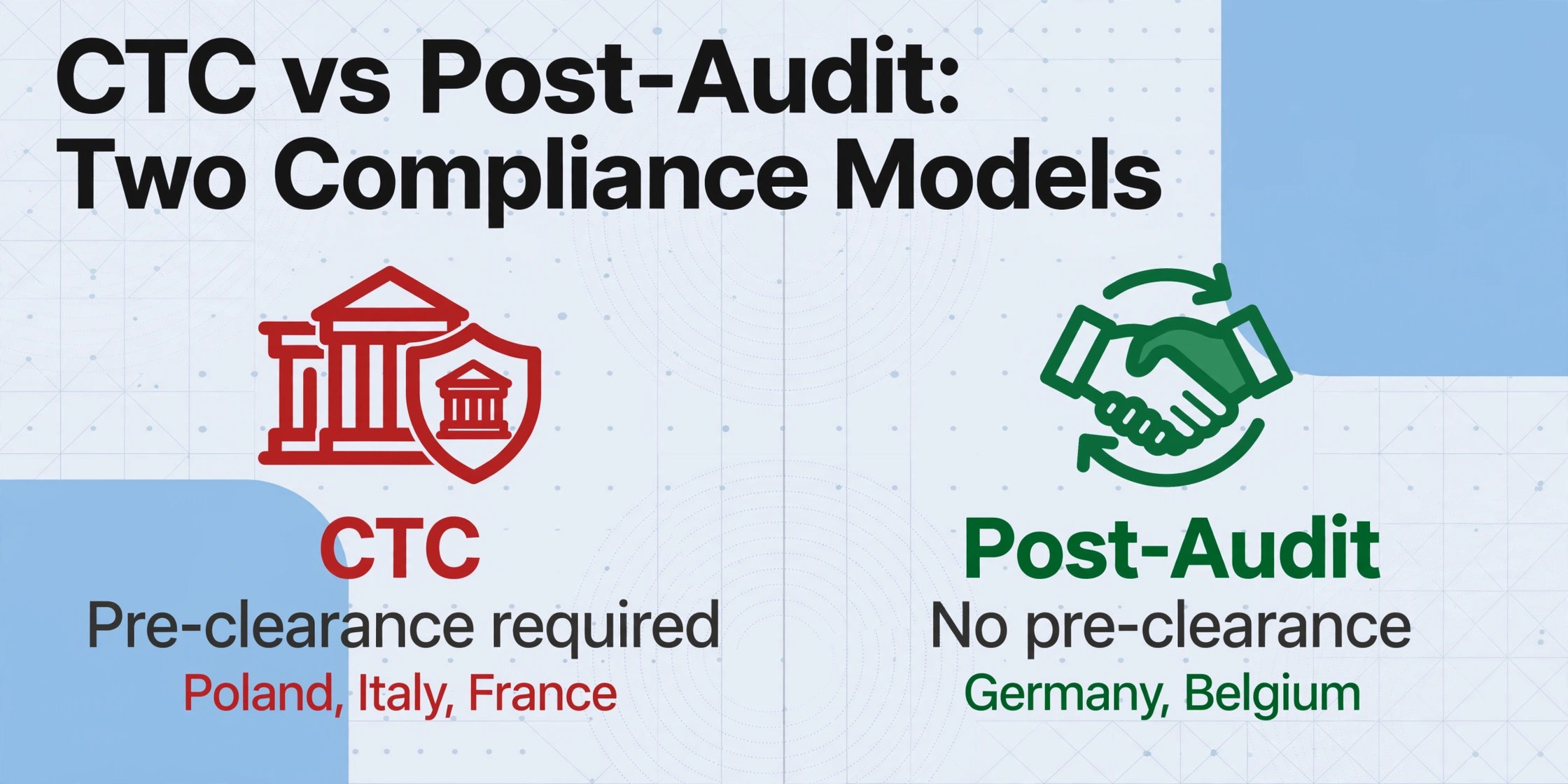
The transmission model falls into two camps. Continuous Transaction Controls (CTC) — used by Poland, Italy, and soon France — require invoices to pass through a government platform for clearance before they become legally valid. Post-audit models — used by Germany and Belgium — require structured invoices to be exchanged between businesses but do not require pre-clearance from a tax authority. The distinction matters operationally: CTC mandates demand real-time platform integration, while post-audit mandates focus on format compliance.
The format requirement is where compliance gets complicated for receivers. Poland mandates the FA_VAT XML schema. France accepts three formats — UBL 2.1, CII, and Factur-X — but Factur-X wraps XML inside a PDF/A-3 container. Germany accepts XRechnung (pure XML) or ZUGFeRD (hybrid PDF+XML). Belgium requires Peppol BIS Billing 3.0 (UBL). Italy uses FatturaPA XML. Spain, once its Royal Decree 238/2026 takes effect, will require UBL syntax.
The legal framework for these mandates is anchored in specific legislation:
- EU level — The VAT in the Digital Age (ViDA) package was adopted by the Council on 11 March 2025, published in the Official Journal on 25 March 2025, and entered into force on 14 April 2025. The European Commission published its ViDA 2026 Work Programme in May 2026 to support phased implementation through 2035. The updated semantic standard EN 16931-1:2026 was formally released by CEN on 18 March 2026, superseding previous versions with new fields for Digital Reporting Requirements.
- France — Law No. 2022-1157 (Finance Law for 2023), amended by the Finance Law for 2024 (published 30 December 2023).
- Germany — The Wachstumschancengesetz (Growth Opportunities Act), passed by the Bundesrat on 22 March 2024.
- Poland — VAT Act amendment signed 27 August 2025, establishing the KSeF as the mandatory e-invoicing system.
- Belgium — Federal law modifying the VAT code, published 6 February 2024. Implementing Royal Decree published July 2025.
- Spain — Ley Crea y Crece (Law 18/2022), with implementing Royal Decree 238/2026 approved by the Council of Ministers on 24 March 2026 and published in the BOE on 31 March 2026.
- Italy — Law No. 205 of 2017 (Legge di Bilancio 2018), mandating FatturaPA via SDI from 1 January 2019.
Who Is Affected — and When
Not every business is swept up in every mandate on day one. Most countries phase obligations by company size, starting with large enterprises before cascading to SMEs and micro-entities. The following breakdown shows who is in scope for each active or incoming 2026 mandate.
Poland — KSeF (Active February 2026)
Poland launched the first phase of mandatory KSeF on 1 February 2026 for large taxpayers with annual turnover exceeding PLN 200 million (approximately €46 million). All other VAT-registered businesses followed on 1 April 2026. Micro-entrepreneurs with monthly invoiced sales up to PLN 10,000 gross have until 1 January 2027. A full-year grace period applies throughout 2026 — no financial penalties are imposed until 1 January 2027, after which non-compliance carries penalties of up to 100% of the VAT amount on the invoice.
Critically, once KSeF is fully in force, PDF and paper invoices lose their legal validity for domestic B2B transactions. All invoices must conform to the FA_VAT XML schema, be submitted to KSeF, and receive a unique KSeF identification number before becoming legally effective.
Belgium — Peppol Mandate (Active January 2026)
Since 1 January 2026, all Belgian VAT-registered businesses have been required to issue and receive structured electronic invoices for domestic B2B transactions via the Peppol network using EN 16931-compliant formats (Peppol BIS Billing 3.0, based on UBL 2.1). Unlike Poland's CTC system, Belgium uses a post-audit model — invoices do not require tax authority clearance before transmission. Non-compliance carries administrative fines starting at €1,500. Belgium also plans to introduce real-time reporting via the Peppol 5-corner model from January 2028.
France — B2B Mandate (September 2026)
France's mandate is built on a two-wave structure. From 1 September 2026, all companies must be capable of receiving e-invoices, and large enterprises (GE) and intermediate-sized enterprises (ETI) must issue them. SMEs and micro-enterprises join the issuing obligation from 1 September 2027. The French model uses the "Y-model": invoices are transmitted through certified private platforms (Plateformes Agréées, or PAs) that connect to the Public Invoicing Portal (PPF). The three accepted formats are UBL 2.1, CII, and Factur-X, all of which must comply with the EN 16931 standard. A voluntary pilot phase in the production environment began on 23 February 2026 to validate B2B invoice exchanges and e-reporting flows ahead of the September go-live.
Germany — E-Rechnung (Receive Mandatory Since 2025, Send Phased)
Germany's B2B e-invoicing rollout started early. Since 1 January 2025, all businesses have been required to accept structured e-invoices (E-Rechnung) conforming to EN 16931. Sending obligations are phased: from 1 January 2027, businesses with annual turnover exceeding €800,000 must issue structured e-invoices for domestic B2B transactions. All remaining businesses follow from 1 January 2028. The two accepted formats are XRechnung (pure XML) and ZUGFeRD (hybrid PDF/A-3 with embedded XML), both based on EN 16931. Germany uses a post-audit model — no government clearance is required before transmitting invoices.
Spain — Crea y Crece (Pending Ministerial Order)
Spain's B2B e-invoicing mandate, established by Royal Decree 238/2026, entered into force on 20 April 2026 (20 days after BOE publication). The compliance countdown begins when the Treasury Ministerial Order (expected before 1 July 2026) is published. Once triggered, companies with annual turnover exceeding €8 million have one year to comply (expected around July 2027), and all other businesses have two years (expected around July 2028). All e-invoices must use UBL syntax. Separately, Spain's Veri*factu anti-fraud regulation — requiring certified invoicing software that reports transactions in near-real-time — is expected to take effect from January 2027 for corporate income tax payers. Businesses already on the SII (Suministro Inmediato de Información) real-time reporting system are exempt from Veri*factu.
Italy — FatturaPA (Already Mature)
Italy is the most mature e-invoicing system in Europe. Since 1 January 2019, all domestic B2B and B2C invoices must pass through the Sistema di Interscambio (SDI) platform in FatturaPA XML format. Cross-border transactions were added in July 2022. Italy's model is the global benchmark for CTC clearance: an invoice has no legal validity until SDI validates and delivers it. For businesses receiving invoices from Italian suppliers, this means every invoice has already been cleared by the tax authority before it reaches your inbox.
Timeline: E-Invoicing Mandates at a Glance
The table below consolidates every major e-invoicing mandate affecting businesses in 2026, organized by country with the applicable date, transaction scope, required format, and transmission model.
| Country | Effective Date | Scope | Format | Model |
|---|---|---|---|---|
| Belgium | 1 Jan 2026 | Domestic B2B (all VAT-registered) | Peppol BIS Billing 3.0 (UBL 2.1 / CII) | Post-audit |
| Poland | 1 Feb 2026 (large) 1 Apr 2026 (all others) | Domestic B2B (VAT-registered) | FA_VAT XML (KSeF) | CTC |
| France | 1 Sep 2026 (receive all + issue large/mid) 1 Sep 2027 (SME/micro issue) | Domestic B2B | UBL 2.1 / CII / Factur-X | CTC (Y-model) |
| Germany | 1 Jan 2025 (receive) 1 Jan 2027 (send, >€800k) 1 Jan 2028 (send, all) | Domestic B2B | XRechnung (XML) / ZUGFeRD (PDF/A-3+XML) | Post-audit |
| Spain | Apr 2026 (RD in force) ~Jul 2027 (>€8M) ~Jul 2028 (all others) | Domestic B2B | UBL (EN 16931) | Post-audit (CTC pending) |
| Italy | 1 Jan 2019 (B2B/B2C) Jul 2022 (cross-border) | All domestic + cross-border | FatturaPA XML (EN 16931) | CTC (SDI) |
| EU ViDA | 14 Apr 2025 (in force) 1 Jul 2028 (platform rules) 1 Jul 2030 (cross-border DRR) 1 Jan 2035 (harmonisation) | Cross-border B2B → domestic alignment | EN 16931-1:2026 | Harmonised framework |
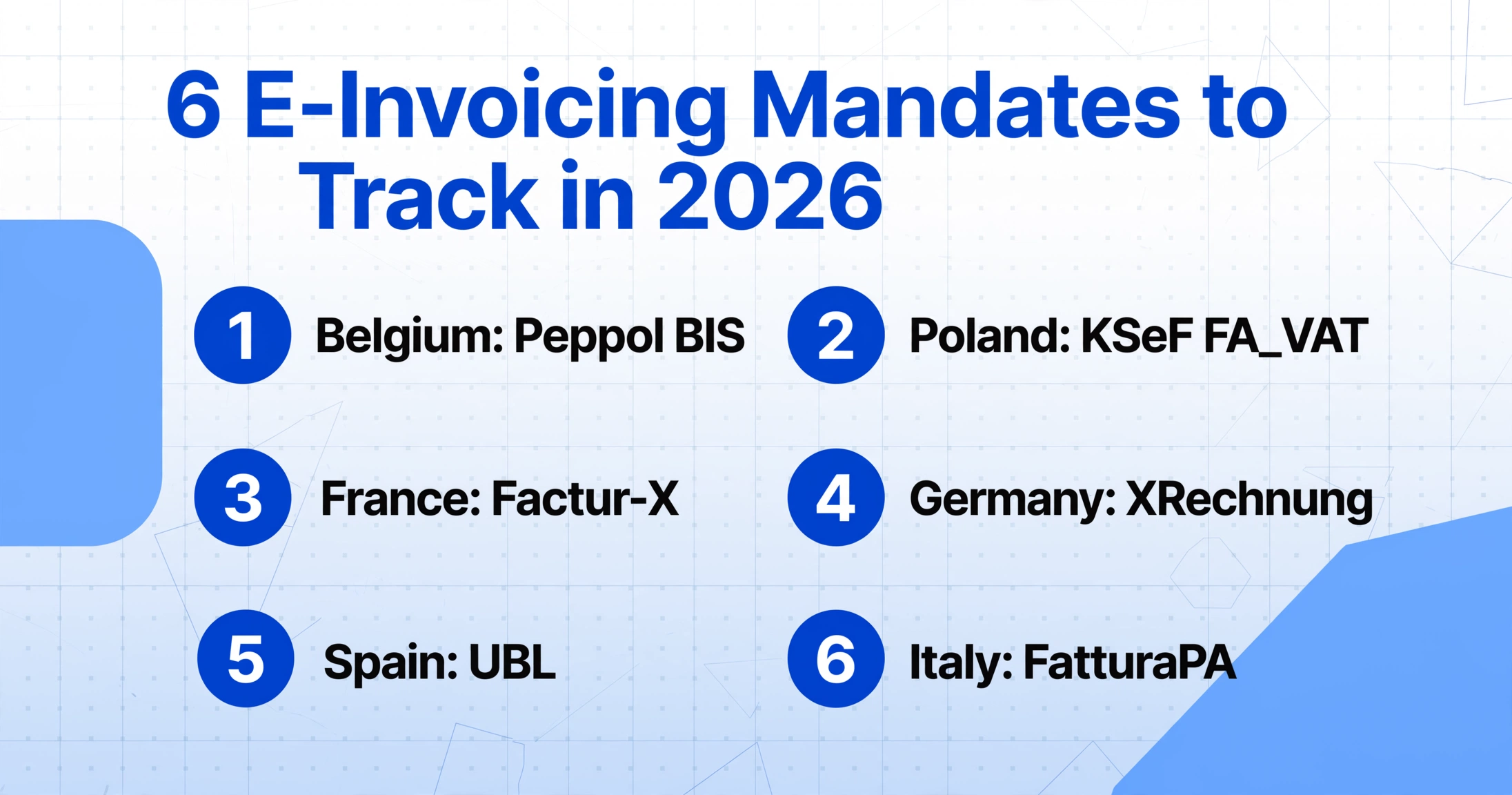
What the table makes clear: there is no single European e-invoicing format. A business receiving invoices from suppliers in Poland, France, Germany, and Belgium must handle four different XML schemas, two hybrid PDF+XML standards, and two different transmission networks (KSeF and Peppol). The common denominator across all of them is EN 16931-1:2026 — each country's required format implements this European semantic standard to varying degrees. Understanding which fields each mandate requires beyond the core EN 16931 set is the practical starting point for configuring your extraction and ERP workflows.
Beyond Europe, Saudi Arabia (ZATCA phase 2 from late 2025), United Arab Emirates, Singapore, Malaysia, and several Latin American countries also introduced or expanded e-invoicing mandates in 2025–2026. The global trajectory is unmistakable: unstructured invoice processing is being phased out on a regulatory level. The businesses that prepare their receiving infrastructure now — rather than reactively after a mandate deadline has passed — will have a significant operational advantage over those that wait.
Practical Compliance Checklist
If your business receives invoices from any of the countries listed above, compliance starts with understanding what lands in your inbox — not just what leaves your billing system. The following four steps apply whether you are in the scope of one mandate or a dozen.
1. Map Your Incoming Invoice Flows by Country and Format
You cannot comply with a mandate you do not know applies to you. List every country from which you receive B2B invoices, identify the relevant mandate and effective date, and check whether your suppliers are required to issue structured e-invoices. A French supplier sending Factur-X invoices from September 2026 is a very different operational challenge from a German supplier sending XRechnung from January 2027.
2. Verify Your Receiving Infrastructure
A business that can only process PDF and paper invoices cannot receive a valid e-invoice from Poland, Belgium, or France. You may need a Peppol Access Point (for Belgium, and increasingly for cross-border flows), a connection to the KSeF platform (for Polish invoices), a relationship with a certified PA (for France), or an ERP that accepts EN 16931 XML. For smaller businesses without an ERP upgrade budget, an AI extraction tool that reads both the XML data and the visual PDF layer of hybrid formats can serve as a bridge solution.
3. Decide on Your Hybrid-Format Strategy
Factur-X and ZUGFeRD — the formats used in France and Germany — are hybrid documents: a PDF/A-3 file with an XML payload embedded inside. The XML may carry the full structured invoice data (at the EN 16931 or EXTENDED profile level), or it may contain only minimal header information (at the MINIMUM or BASIC WL profile level). This variability means you cannot assume the XML will be complete enough for fully automated processing. A robust extraction strategy handles both: reads the XML when it is rich enough, and falls back to AI-based visual extraction from the PDF when it is not.
The image below shows how this dual-layer architecture works in practice.
4. Communicate with Your Suppliers
Mandates may be new to your suppliers too — especially if they are in the SME waves of France (2027) or Poland (2027 for micro-entrepreneurs). Establish a communication process: confirm which format each supplier will use, provide your Peppol ID or platform details, and agree on a fallback method for edge cases. A structured onboarding process in the months before a mandate goes live prevents last-minute invoice rejections.
For a detailed week-by-week plan that turns these four steps into a 90-day execution calendar — including entity registration, ERP XML readiness, and a supplier communication template — see our AP readiness checklist. That article is the operational companion to this landscape guide.
How AI Extraction Fits Into Your Compliance Workflow
Most compliance content treats e-invoicing purely as a transmission and platform problem: get your ERP to output XRechnung, connect to KSeF, register with a PA. But for the businesses receiving invoices from multiple jurisdictions, the harder problem is data extraction. A Polish FA_VAT XML, a Belgian Peppol UBL, a French Factur-X at the BASIC profile level, and a German PDF-only invoice from a small supplier who still qualifies for the transition exemption — these arrive in different structures, different data depths, and different formats.
This is where the distinction between structured extraction and visual extraction matters.
What Factur-X Profiles Mean for Data Extraction
Factur-X and its German counterpart ZUGFeRD define five compliance profiles that determine how much machine-readable data is available in the embedded XML:
| Profile | Data in XML | Line Items? | How Receiver Gets Full Data |
|---|---|---|---|
| MINIMUM | Invoice ID, date, tax IDs, totals only | No | Must extract from PDF visual layer (OCR/AI) |
| BASIC WL | + Addresses, payment terms, tax breakdown | No | Header data available; line items need PDF extraction |
| BASIC | + Line descriptions, quantities, unit prices | Yes | XML sufficient for most AP automation |
| EN 16931 (Comfort) | + Classification codes, delivery info, allowances | Yes | Full automation; XML covers all core fields |
| EXTENDED | + Complex business scenarios, multi-currency | Yes | Suitable for enterprise supply chains |
The key insight for receivers: a Factur-X or ZUGFeRD file at the MINIMUM or BASIC WL profile is not fully self-service for data extraction. The XML gives you header-level data, but the line-item detail — quantities, unit prices, product codes — lives only in the human-readable PDF layer. Your extraction tool needs to handle both: parse the XML for whatever structured data it carries, then use AI-based visual extraction on the PDF/A-3 rendering to fill in what the XML omits.
ImageToTable.ai's vision-language model is designed for exactly this dual-format reality. Because it reads documents by understanding their visual layout — not by relying on template positions or XML schema — it can extract line-item data from the PDF layer of a Factur-X invoice even when the embedded XML profile is MINIMUM or BASIC WL. The tool requires no pre-configuration for each profile or country format: you upload the hybrid PDF, name the columns you need, and the AI locates matching values across both the visual and (where accessible) the structured content.
Structured Data When You Get Pure XML — And a Fallback When You Do Not
For invoices that arrive as pure XML (XRechnung, FA_VAT, FatturaPA), the extraction path is straightforward: the data is already structured and can be consumed by an ERP or accounting system. The challenge arises when the XML is incomplete (a Factur-X at MINIMUM profile) or when a supplier sends a PDF-only invoice during a transition period. In these scenarios, a single extraction workflow that can ingest both pure XML and hybrid PDF+XML — and fall back to AI visual extraction when structured data is insufficient — eliminates the need to maintain separate processes for each format.
For example, a German logistics company receiving invoices from a Polish warehouse operator (KSeF FA_VAT), a French carrier (Factur-X at BASIC profile), and a Belgian port authority (Peppol UBL) currently needs three separate onboarding processes and potentially three extraction tools. With a semantic extraction approach, you define your output columns once — "Invoice Number", "Supplier Name", "Line Items", "VAT Amount", "Total" — and the AI locates the corresponding data regardless of which format each invoice arrives in. The same column definition works whether the data comes from pure XML, a hybrid PDF/A-3, or a scanned paper invoice.
For a deeper look at handling format variability in practice — including edge cases like corrupt PDF/A-3 files, missing XMP metadata, and suppliers who send unstructured attachments alongside structured invoices — see our document extraction troubleshooting guide.
Frequently Asked Questions
Which of these mandates apply if my business is not based in the EU?
It depends on where your customers are based. If you send invoices to a VAT-registered business in Poland, France, Belgium, Germany, Italy, or Spain, the receiving mandate applies to you in the sense that your customer must receive a compliant e-invoice — and in CTC countries like Poland and Italy, you must issue through the government platform. If you only receive invoices from EU suppliers, your compliance burden is on the receiving side: having the infrastructure to accept structured e-invoices and extract usable data from them.
What happens if we are not ready by the deadline?
Consequences vary by country. Poland has a full-year grace period through 2026 with zero financial penalties — but from 1 January 2027, non-compliance carries penalties up to 100% of the invoice's VAT amount. Belgium imposes administrative fines starting at €1,500. France has announced tolerance measures for the transition period. Germany does not impose transaction-level fines but a non-compliant invoice may be rejected by the recipient, creating operational disruption. In Italy, an invoice not transmitted through SDI is legally considered not issued. The most immediate consequence in every country is operational: if you cannot receive structured e-invoices, your suppliers cannot send you valid invoices, which interrupts your AP workflow.
If an invoice arrives as Factur-X, can I just extract the XML and ignore the PDF?
Only if the sender uses the BASIC, EN 16931, or EXTENDED profile. At MINIMUM or BASIC WL, the XML contains header-level data only — no line items. You will need to extract the line-item detail from the PDF visual layer. Always check the profile before deciding whether the XML is sufficient for your use case.
Do I need a different extraction tool for each country's format?
Not necessarily, but this depends on the tool's approach. Template-based extraction tools require separate configurations for each format variant, which becomes unmanageable when you receive invoices from multiple mandate countries simultaneously. Semantic extraction tools — which locate data by understanding what each field means rather than where it sits on a page — work across formats without per-country templates. The same column name definition you use for a Polish FA_VAT invoice can extract matching data from a French Factur-X PDF or a German XRechnung XML.
Does ViDA replace the national mandates?
No. ViDA establishes a harmonised EU framework rather than replacing national systems. Under the current timeline, by 1 July 2030, cross-border B2B digital reporting requirements (DRR) become mandatory. By 1 January 2035, member states with existing domestic digital reporting systems must align with the EU-wide standard. Until then, each country's mandate operates within its own legal framework — so you must comply with both the national mandate and the emerging ViDA requirements. The closest thing to a unified standard across all these mandates is EN 16931-1:2026, which all accepted formats implement to varying degrees.