How to Calculate a
Revenue Guarantee Shortfall
Which number is wrong when a guarantee shortfall looks obvious and the counterparty disagrees? Usually neither. The settlement statement's royalty line is computed on the base the counterparty's system was built around, and the guarantee is read over the period the contract names. Subtract those two readings before you reconcile them and you get an answer that is arithmetically correct and commercially meaningless.
This is a working method for the finance or partner-finance analyst who has to put a shortfall number in front of a controller, a counterparty or an auditor and defend it. It covers what each document supplies, the four places the subtraction usually goes wrong, and how to build one file that carries the contract term, the statement figure and the page each number came from. The subtraction is the last step, not the first.
Key Takeaways
- The shortfall that looks obvious is usually two documents disagreeing about the royalty base.
- A 12% cap on deductions turns 420,000 of reported deductions into 288,000 and moves the apparent shortfall from 140,000 to 132,080.
- The same statement can show a shortfall, an overage or nothing at all depending on whether the contract tests the year or the quarter.
A Guarantee Shortfall Is a Contract Calculation, Not a Statement Field
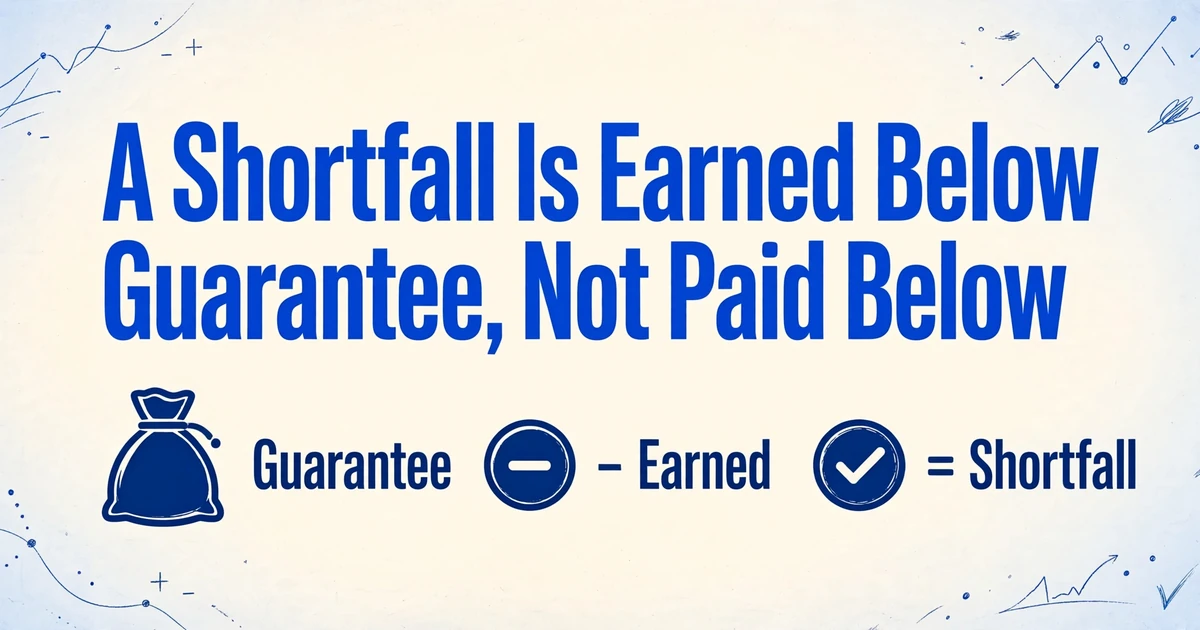
A revenue guarantee shortfall is the amount by which royalties earned in a defined measurement period fall below the minimum the counterparty promised for that period. The definition is contractual, not accounting-derived: a licensee, distributor or concessionaire promises to pay at least a stated amount over a term or a contract year, and if the royalty earned on actual sales is lower, it pays the difference.
A minimum guarantee is a floor, not a forecast. It is also not the same thing as an advance, even though the two are routinely bundled in one clause. The advance is the part paid upfront and recouped against future royalties. The guarantee is the total commitment, which may be paid in installments or settled at the end of the term. Contract language reflects that distinction in different ways: one definition in a public contract file describes the payment as the "dollar for dollar difference between this guarantee and the actualized program revenue," while another tests the guarantee monthly and invoices the shortfall at the end of each calendar quarter (Law Insider).
Three inputs decide the number: the guarantee for the period, the qualifying royalty base, and the rate that applies to it. The statement gives you a fourth number, the amount paid, which is not the same as the amount earned. A file that treats earned, paid and due as one figure will produce a wrong claim even when every number on the statement is accurate.
Earned, paid and due are three different numbers. The shortfall is a comparison of earned royalty to the guarantee; the cash still owed is that shortfall minus whatever has already been paid against it.
The term also collides with unrelated uses. This is the licensing, media and concession sense of a revenue guarantee, not the crop-insurance revenue assurance program, Australia's super guarantee charge, or the expected-shortfall risk measure. If a search result is talking about payroll contributions or portfolio risk, it is answering a different question.
The Contract and the Statement Answer Different Questions
The contract defines the calculation and the statement reports one party's execution of it, so the two documents cannot be compared field to field until the definitions are lined up. The contract says what counts, what rate applies and when the test happens. The statement says what the counterparty sold, what it deducted, what it calculated and what it paid.
| Document | Supplies | What goes wrong if you skip it |
|---|---|---|
| Contract, rate schedule and amendments | Guarantee amount and guarantee period; royalty rate and any tiers; the definition of net or qualifying sales; allowed deductions and any cap; territory, product or channel scope; whether pools may be cross-collateralized; payment schedule; audit rights | You apply the headline rate to the statement's net sales and inherit the counterparty's definition of the base |
| Settlement or royalty statement | Statement period; gross sales or units; deductions and their detail; reported net sales; rate applied; royalty earned for the period; cumulative royalty earned; advance recouped; amount paid | You treat a reported subtotal as if it were a contract term, or treat a monthly figure as the measurement period |
Four roles touch this number. Deal or partner finance owns the claim and the working file, and usually reads the contract more closely than anyone else. The counterparty's reporting team prepares the statement, often from a royalty system configured around its own product and deduction taxonomy. Accounting and revenue recognition decide how the guarantee and any overage are recognized under ASC 606 or IFRS 15. Legal or contract management handles the reading when the two sides disagree about what a clause means.
The reporting team is a common source of the mismatch, and usually without bad faith. The auditors behind a twenty-year royalty audit dataset put the role problem plainly in a 2018 book chapter: "Often the people who negotiated and wrote the license agreement are not the people put into the position to interpret it... sometimes the people reporting royalties under the terms of a license agreement have never even seen the agreement."
That sentence explains a pattern finance teams see constantly. The statement is internally consistent. Its gross-to-net bridge adds up. Its rate matches the rate the counterparty's system holds. It is still not the contract's calculation, because the person who built the report never read the definition of net sales or the cap on deductions.
Accounting adds a second split. Under ASC 606, the minimum guarantee is fixed consideration, while royalties above it are variable and recognized as subsequent sales occur (PwC Viewpoint, ASC 606-10-55-65). The working file does not make that judgment, but it has to keep the guarantee and the overage in separate columns so accounting can apply it.
The Rate Applies to the Contract's Base, Not the Statement's
Most shortfall errors start in the royalty base, because the statement's "net sales" is a system output and the contract's net sales is a negotiated definition. The rate is rarely the problem. The number the rate is multiplied by is.
A licensing agreement normally defines the base by listing what comes off gross sales and what does not. Returns, trade discounts, sales tax and credits for damaged goods are common allowances. Selling, shipping, warehousing and administrative costs usually fall outside the allowance, because they are the licensee's cost of doing business rather than money given back to a customer. A 2019 Licensing Executives Society International article on licensing financial terms recommends capping total deductions as a percentage of gross sales, with typical caps between 5 and 15 percent (LESI).
The audit data shows where this breaks. In the InvotexIP dataset behind that chapter, disallowed deductions had a 26 percent error rate, math errors 13 percent and misapplied royalty rates 11 percent. Underreported sales was the largest category at 60 percent. None of those are failures of subtraction. They are failures of applying the contract's base.
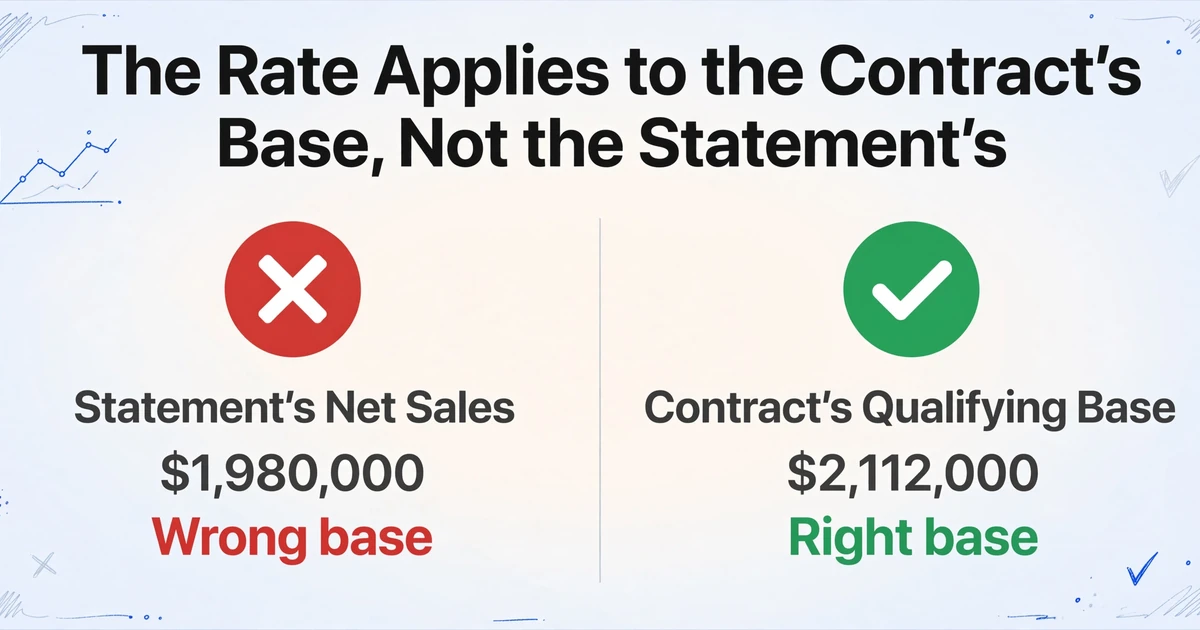
An illustrative quarter makes the size of the gap concrete. Assume a contract with a 600,000 annual guarantee, a 6 percent rate, and a 12 percent cap on deductions as a share of gross sales. The statement reports 2,400,000 in gross sales, 420,000 in deductions and 1,980,000 in net sales.
| Line | As reported | After applying the contract |
|---|---|---|
| Gross sales | 2,400,000 | 2,400,000 |
| Deductions | 420,000 (17.5% of gross) | 288,000 (12% cap) |
| Net qualifying sales | 1,980,000 | 2,112,000 |
| Royalty at 6% | 118,800 | 126,720 |
| Cumulative royalty through Q3 | 310,000 | 317,920 |
| Pro-rata guarantee for 9 months | 450,000 | 450,000 |
| Apparent shortfall | 140,000 | 132,080 |
The 132,000 of disallowed deductions adds 7,920 back to the quarter's royalty. That is a small number against a 600,000 guarantee, which is exactly why it gets missed. Across four quarters at this run rate, the same definitional gap compounds into a five-figure understatement of earned royalty, and the corrected shortfall is smaller than the first subtraction suggested.
The 132,080 is the pro-rata figure. If the contract tests the guarantee only at the contract year, neither number is payable yet. The table corrects the base; it does not settle the period question, which comes next.
A deduction cap reduces the royalty base. It does not cap the shortfall. Applying the 12 percent cap to the shortfall payment instead of to the deductions produces a smaller claim than the contract supports.
The same structure appears outside licensing. A retail concession lease often sets base rent plus a percentage of gross sales above a breakpoint, and the lease defines which sales count and which are excluded. The formula is simple; the gross-sales definition and the reporting period are the work. A property accountant writing on Reddit put the arithmetic plainly: percentage rent is the rate times gross sales minus the breakpoint, "but only once Gross Sales exceeds breakpoint" (r/PropertyManagement). The rest of the job is deciding what belongs in gross sales.
The Guarantee Is Tested Over a Period, and Offsets Are Not Automatic
A shortfall only exists at the measurement boundary the contract names, which is often the contract year rather than the reporting month. Running the test every month against one-twelfth of an annual guarantee invents an obligation in weak months and a credit in strong ones. The same statement can show a shortfall, no shortfall, or an overage depending on the period you test.
Read the clause for three things before you compute anything. First, the measurement period: contract year, calendar year, season, or a defined term that does not match either. Second, whether interim tests are cumulative, meaning year-to-date earned royalty is compared with a year-to-date guarantee and trued up at the end. Third, whether a shortfall paid in an earlier period is credited against the cumulative test later. Without that credit, a quarterly claim can bill the same gap twice.
Offsets between pools are a separate question. Many agreements create separate guarantees by territory, product line, channel or property, and expressly prohibit cross-collateralization. A public clause sample states the rule directly: "any shortfall in a given Contract Year or payment in excess of the minimum guaranteed payment may not be off-set or credited against royalty payments for any other Contract Year" (Law Insider). Strong sales in one pool do not cure a shortfall in another unless the contract says they can.
Advances create the last separation. If the guarantee was prepaid at signing, a shortfall can exist while no cash is still due, because the money already changed hands. Track paid-to-date separately from earned-to-date. The claim is the guarantee minus earned royalty; the amount to invoice is that number minus the advance already applied and any shortfall already settled.
Two smaller adjustments cause disproportionate arguments. Currency: if the guarantee is in one currency and the statement in another, the contract should name the conversion date and rate, and a statement that converts at month-end average is not automatically wrong or right. Timing: returns and credits often land in a later statement than the sale they reverse, so a period that looked closed can move after the fact. Both belong in the working file as explicit columns, not as footnotes.
One month's shortfall is a data point. The claim exists only at the boundary the contract names, after prior payments and any permitted offsets are applied.
Build One Working File From Both Documents
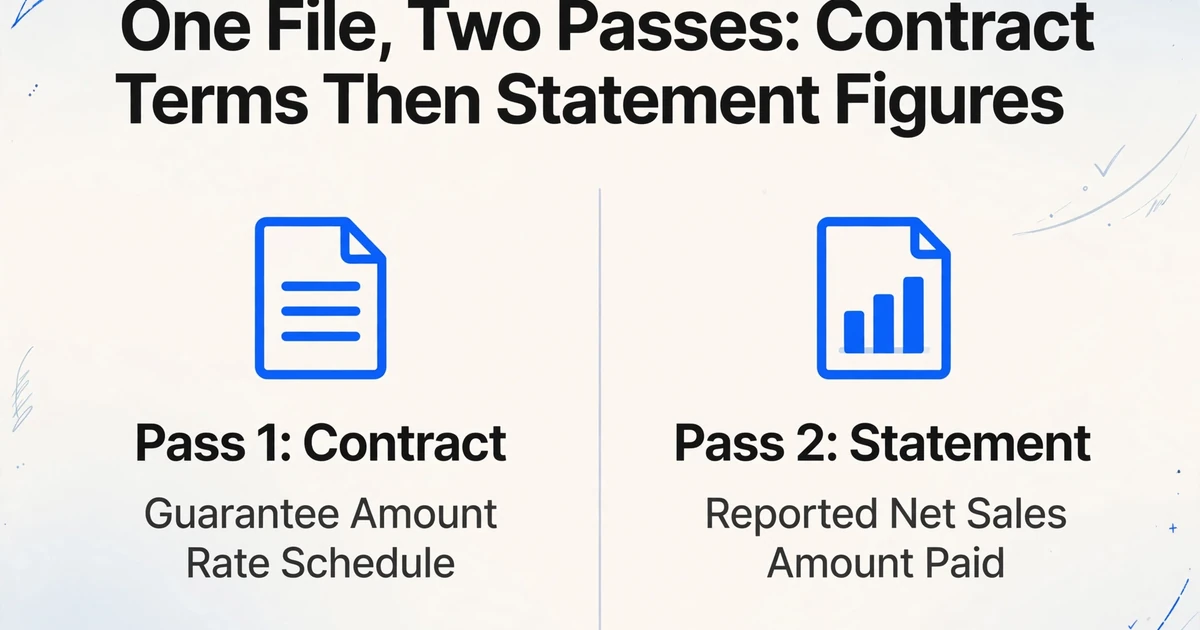
The working file needs one row per measurement period per agreement, with contract terms in named columns and statement figures beside them. Building it in two passes is cleaner than trying to extract both document types into one sparse table, because a contract usually has no "amount paid" field and a statement rarely restates the "deduction cap" clause.
ImageToTable.ai is built around Custom Column Extraction: you type the column names you want, and the AI locates the matching value anywhere on the page by meaning, not by a fixed coordinate or a template per counterparty. That matters here because a guarantee clause, a rate schedule and a settlement statement never share a layout across counterparties. The column name is the instruction, and the column names you type become the headers of the output table.
Extract the contract terms, including the definition text
Run the contract, its rate schedule and any amendments as one batch. Useful columns: Agreement ID, Counterparty, Guarantee Amount, Guarantee Period, Measurement Boundary, Royalty Rate, Rate Tiers, Royalty Base Definition, Allowed Deductions, Deduction Cap, Territory or Product Scope, Cross-Collateralization, Payment Schedule. Extract the clause language for the definition columns, not just a number, because "net sales" is a sentence and the sentence is what decides the base.
Extract every statement into the same column set
Batch all statements for the period so each one becomes a row. Columns: Agreement ID, Statement Period, Gross Sales, Deductions Reported, Net Sales Reported, Units, Rate Applied, Royalty Earned, Cumulative Royalty Earned, Advance Recouped, Amount Paid. If a contract was scanned page by page, Multi-Page Merge can group the pages by a tracked value such as the agreement number, so the rate on Schedule A and the cap in Section 4.2 land in the same row instead of two rows.
Add the arithmetic as computed columns
A computed column can multiply the net sales column on the statement by the contract rate you type into the rule, and subtract the result from a guarantee you also supply as a fixed parameter. For example, Royalty at Contract Rate (Net Sales Reported × 0.06) and Shortfall vs Guarantee (Annual Guarantee − Cumulative Royalty Earned). You take the rate and guarantee from the contract pass and enter them as fixed parameters. The column does the arithmetic on values already in the row; it does not decide which deductions qualify or which period test applies.
Join the two passes and run the contract test
Bring both outputs into one workbook, keyed on Agreement ID and period. Apply the deduction cap, rebuild the gross-to-net bridge, run the period test, and credit prior shortfall payments. This join is a spreadsheet step, not an automatic cross-document judgment. The extraction removes the retyping; the comparison is still yours.
Verify every decision-bearing number against its page
Use Review Mode with bbox highlighting: hover any extracted cell and the original page highlights the region the value came from; click a region on the page and it jumps back to the matching cell. Edited fields can be reverted to the AI's original value. Use this to attach a page reference to the rate, the cap, the deduction total and the amount paid. A shortfall claim that cannot point to the clause page and the statement page is a number, not a finding.
Files are processed securely and not stored.
The column set is not arbitrary. It follows the order of the calculation: define the base, resolve the rate, establish the period, then compare. A broader field list for contract extraction is covered in the complete guide to contract data extraction, and the arithmetic side is covered in what computed columns can and cannot do. If the immediate job is a portfolio of agreements rather than one settlement, summing contract values during extraction is the closer starting point. For leases with breakpoints and sales-reporting obligations, the field list in lease agreement key fields maps to the same columns. The extraction step itself works the same way whether the documents are contracts, statements or both, which is the point of contract data extraction as a document workflow rather than a one-off conversion.
What the Working File Cannot Decide
The file can make the arithmetic traceable; it cannot decide the accounting, the eligibility or the legal reading. Those boundaries are worth stating plainly, because a shortfall number that overclaims is worse than a number with a documented open question.
Revenue recognition is an accounting judgment. Whether the guarantee is fixed consideration recognized over time, and when royalties above it become recognizable, depends on the contract and the applicable standard. The file separates the components and supplies the evidence; accounting decides the treatment.
Eligibility is a contract reading. Whether a deduction is allowed, whether a channel is in scope, and whether one pool may offset another are questions about the clause. The tool can extract the clause and the reported deduction, but it does not adjudicate whether the deduction qualifies. That comparison and that judgment remain with the reviewer.
The file does not post, true up or invoice. It does not create a journal entry, issue a credit note, or trigger payment. It produces the support for a claim or an accrual, and a person decides what to do with it.
It is not a legal conclusion. A shortfall letter is a commercial claim. Whether the amount is owed, and how much, depends on the contract, the relationship and sometimes the governing law. The file makes the claim explainable; it does not make it collectible.
Accuracy has the same practical caveat as any document extraction. The product publishes up to 99 percent recognition on printed tabular data at 5 to 10 seconds per page, which covers most printed statements well. Contracts arrive as scans, with handwriting, amendments and exhibits, so sample the batch and verify the fields that carry the decision. Review the rate, the cap and the deduction total closely; a typo in a description column rarely changes the claim, while a misread cap changes all of it.
FAQ
What is a revenue guarantee shortfall?
It is the difference between the minimum royalty or revenue a counterparty guaranteed for a measurement period and the royalty actually earned on the contract's qualifying base, when the earned amount is lower. It becomes payable at the settlement point the contract names, not automatically every month.
How do you calculate a minimum guarantee shortfall?
Apply the contract's base definition to the statement's sales, apply the correct rate, compare cumulative earned royalty to the guarantee at the contract's measurement boundary, then subtract anything already paid. The subtraction is the last step, and it only means something after the first three.
Is the guarantee tested monthly or annually?
Whatever the contract says, and the two produce different answers from the same statement. Many agreements test cumulatively at the contract year and true up at the end. Testing a monthly statement against one-twelfth of an annual guarantee invents a shortfall in weak months and a credit in strong ones, so check for interim cumulative tests and prior shortfall credits before you send a claim.
Can a shortfall in one territory be offset by overperformance in another?
Only if the contract allows cross-collateralization. Many agreements create separate guarantees by territory, category, channel or property and expressly prohibit offsets between them. Read the clause before netting anything, and keep each pool as its own row in the working file.
What if the statement's net sales do not match the contract's definition?
Treat it as a base exception, not a rounding difference. Rebuild the gross-to-net bridge from the statement's deduction detail, disallow items outside the contract's list, apply any deduction cap, and document each adjustment with a page reference. That bridge is usually where the whole disagreement lives.
Can AI calculate the shortfall automatically?
It can extract the contract terms and statement figures into one table and run the arithmetic in a computed column when the rate and guarantee are supplied as fixed parameters. It cannot decide which deductions qualify, whether a period test applies, or how the guarantee should be recognized. Those remain review decisions, and the working file should show them as such.
The useful output is a number with a contract clause behind it, a statement line behind that, and a page reference for both. Once the file carries those three things, the shortfall conversation stops being a disagreement about arithmetic and becomes what it always was: a disagreement about definitions, which is a conversation finance can actually settle. Put one contract and one statement through the column workflow and see which definitions your current spreadsheet was assuming.