6 CT-e ICMS Calculation Errors
That Trigger SEFAZ Audits
A freight analyst in São Paulo issues a CT-e for a shipment of auto parts destined for a buyer in Bahia. She applies the 12% ICMS rate — the rate she always uses for interstate freight — and the document is authorized by SEFAZ without incident. Three months later, during a routine SPED EFD ICMS/IPI filing, the state's cross-validation system flags a discrepancy: the origin-destination pair (SP → BA) requires the 7% interstate rate, not 12%. The company has been claiming ICMS credits at the wrong rate across 87 CT-e documents issued to the same region over the quarter. The tax adjustment, including interest at the SELIC rate and penalties calculated at 75% of the underpaid difference, reaches R$23,000 for what began as a single wrong digit in a rate field on the first document.
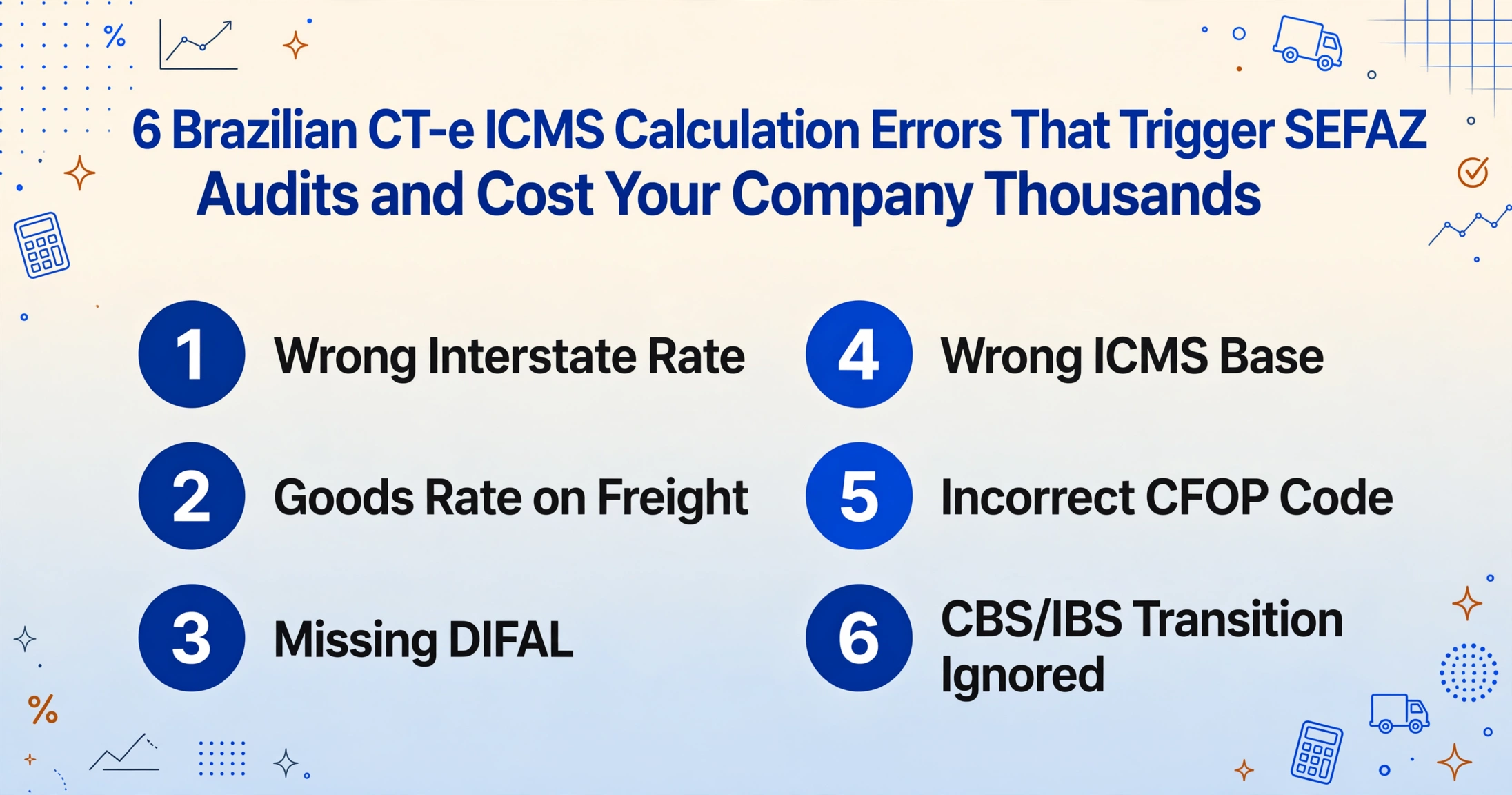
Key Takeaways
- A single wrong ICMS rate digit on one CT-e — 12% instead of 7% — can cascade across 87 documents and trigger R$23,000 in penalties, interest, and audit costs.
- Transport ICMS follows a different rate logic than goods ICMS. Teams familiar with one systemically misapply the other across hundreds of documents per quarter.
- A computed column that compares the declared rate against the expected interstate rate cuts a 300-document audit from 'review every row' to 'spot-check flagged exceptions only.'
Why CT-e ICMS Errors Have Real Consequences
The ICMS on transport services follows a different set of rules than the ICMS on goods. The rate is not determined by what is being shipped — it is determined by the carrier's location (origin state) and the service destination. A freight analyst who handles thousands of CT-e documents per year and understands goods ICMS well may still make systematic errors on transport ICMS because the two tax frameworks, despite sharing the same name, operate on different logics.
The consequences of those errors compound in three ways. First, each error affects every CT-e issued under the same wrong rate across the entire period until it is caught. Second, SEFAZ cross-validation systems automatically flag ICMS credits that do not match the origin-destination rate table — and once flagged, the burden of proof shifts to the taxpayer. Third, the penalty framework under Brazilian tax law starts at 75% of the underpaid amount for simple errors and reaches 150% if the tax authority determines inadequate controls, plus SELIC interest from the date the tax was originally due.
This article catalogues the six most common ICMS calculation errors specific to CT-e freight documents, with the exact rate rules, the scenarios in which each error occurs, and the corrective action required. It assumes working knowledge of what a CT-e contains — for a full field-by-field breakdown, the CT-e extraction guide covers every data point on the document.
The risk profile: ICMS on transport is governed by a different rate framework than ICMS on goods. A team that applies goods-ICMS logic to freight documents will make systematic errors that compound across every shipment in a quarter.
Mistake 1: Applying the Wrong Interstate Rate (7% vs 12%)
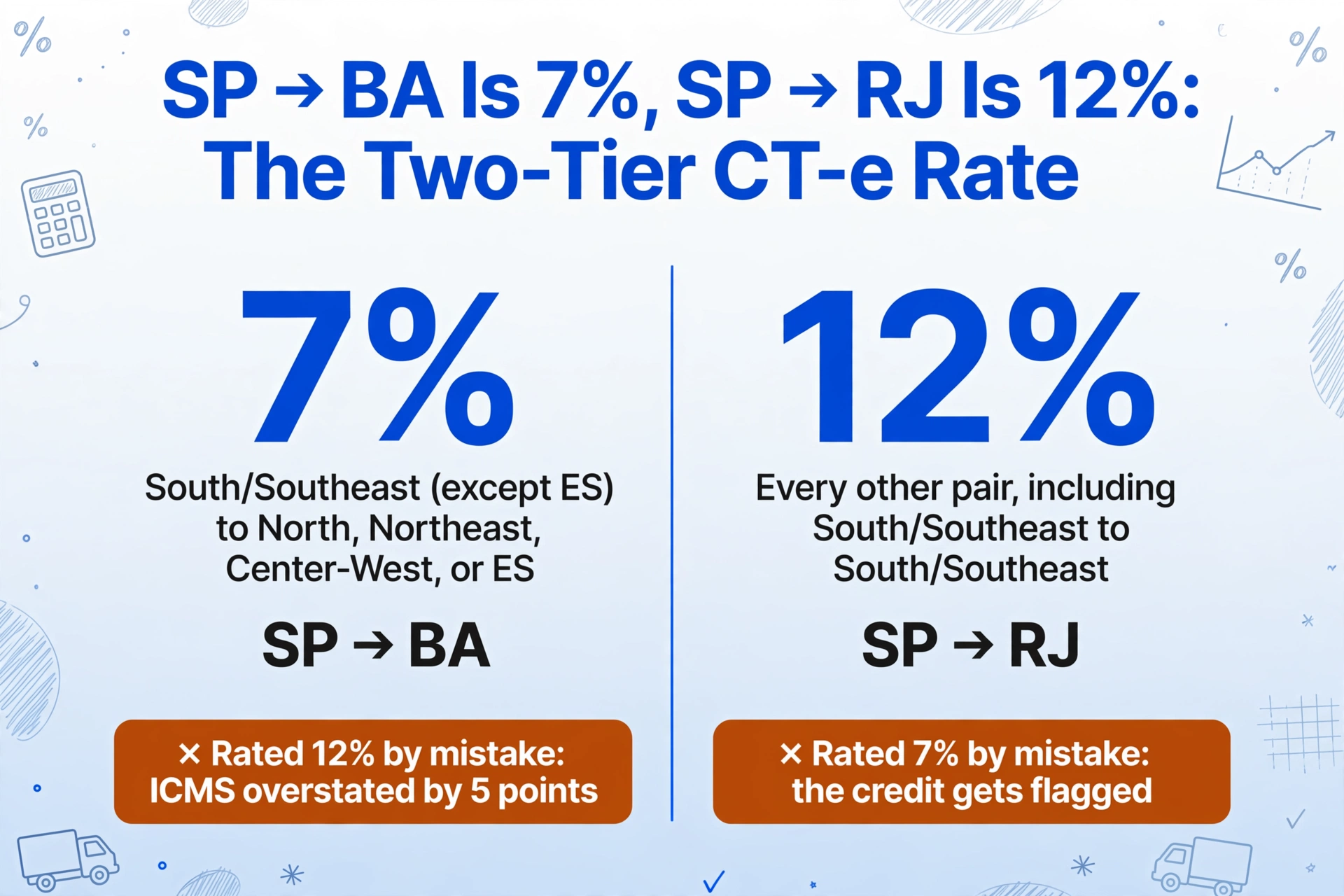
The interstate ICMS rate for transport services follows the same two-tier structure as goods transactions, defined by Resolução do Senado Federal. The rate is determined by the destination state relative to the origin state:
| Origin Region | Destination Region | Interstate ICMS Rate |
|---|---|---|
| South and Southeast (exc. Espírito Santo) | North, Northeast, Center-West, and Espírito Santo | 7% |
| Any state (including North/Northeast/Center-West) | Any state not covered by the 7% rule | 12% |
| Any state | Any state (goods with imported content >40%) | 4% |
The most frequent error scenario: a carrier located in São Paulo (Southeast) transports cargo to a consignee in Bahia (Northeast). The rate should be 7% — because the origin is in the South/Southeast and the destination is in the Northeast. An analyst unfamiliar with the two-tier rule applies 12% (the "default" interstate rate for most South-to-South shipments), overstating the ICMS by 5 percentage points and creating an ICMS credit claim that exceeds what the law allows.
The reverse error is equally common: a carrier in São Paulo ships to Rio de Janeiro (also South/Southeast), and the analyst applies 7% (because she has been told "Northeast = 7%" and confuses the rule). The correct rate for SP → RJ is 12%, since both states are in the South/Southeast region and RJ is not in the exempted list (ES is the only Southeast state that receives the 7% rate).
How to check: For every CT-e, confirm the origin UF against the destination UF using the two-tier table above. The key memorization rule: 7% applies only when the cargo is traveling from the richer South/Southeast to the poorer North/Northeast/Center-West (plus ES). Everything else is 12%.
Mistake 2: Confusing Goods ICMS Rate with Transport Service ICMS Rate
A manufacturer ships electronic equipment (NCM 8471) from São Paulo to a buyer in Minas Gerais. The goods themselves may benefit from a reduced ICMS rate under a state-specific protocol or tax benefit program (such as 12% instead of the standard 18% internal rate). The freight analyst, seeing the reduced goods rate on the NF-e, applies the same reduced rate to the CT-e transport service.
This is incorrect. The ICMS on the transport service is calculated independently of the ICMS on the goods. The transport service rate follows the interstate rate table (7% or 12% for SP → MG, which is 12% since both are in the Southeast), regardless of what tax benefit applies to the goods being carried. Applying a 7% or reduced rate that was meant for the goods to the freight service creates an underpayment of ICMS on the transport, which SEFAZ detects through cross-validation because the CT-e's rate field does not match the rate expected for the origin-destination pair.
How to check: The CT-e's ICMS rate field must be determined independently of the NF-e's ICMS rate for the same shipment. Compare the CT-e rate against the interstate table using only origin and destination — not against the goods invoice rate.
Mistake 3: Missing DIFAL on Transport Services to Non-Contributing Consumers
DIFAL (Diferencial de Alíquota) applies when a transport service is provided to a non-ICMS taxpayer consumer (consumidor final não contribuinte) located in a different state from the carrier. The most common real-world scenario: an individual or a company not registered as an ICMS taxpayer receives goods carried by a transportadora from another state. The transport service crosses state lines, and the recipient is not an ICMS taxpayer — therefore DIFAL is due to the destination state.
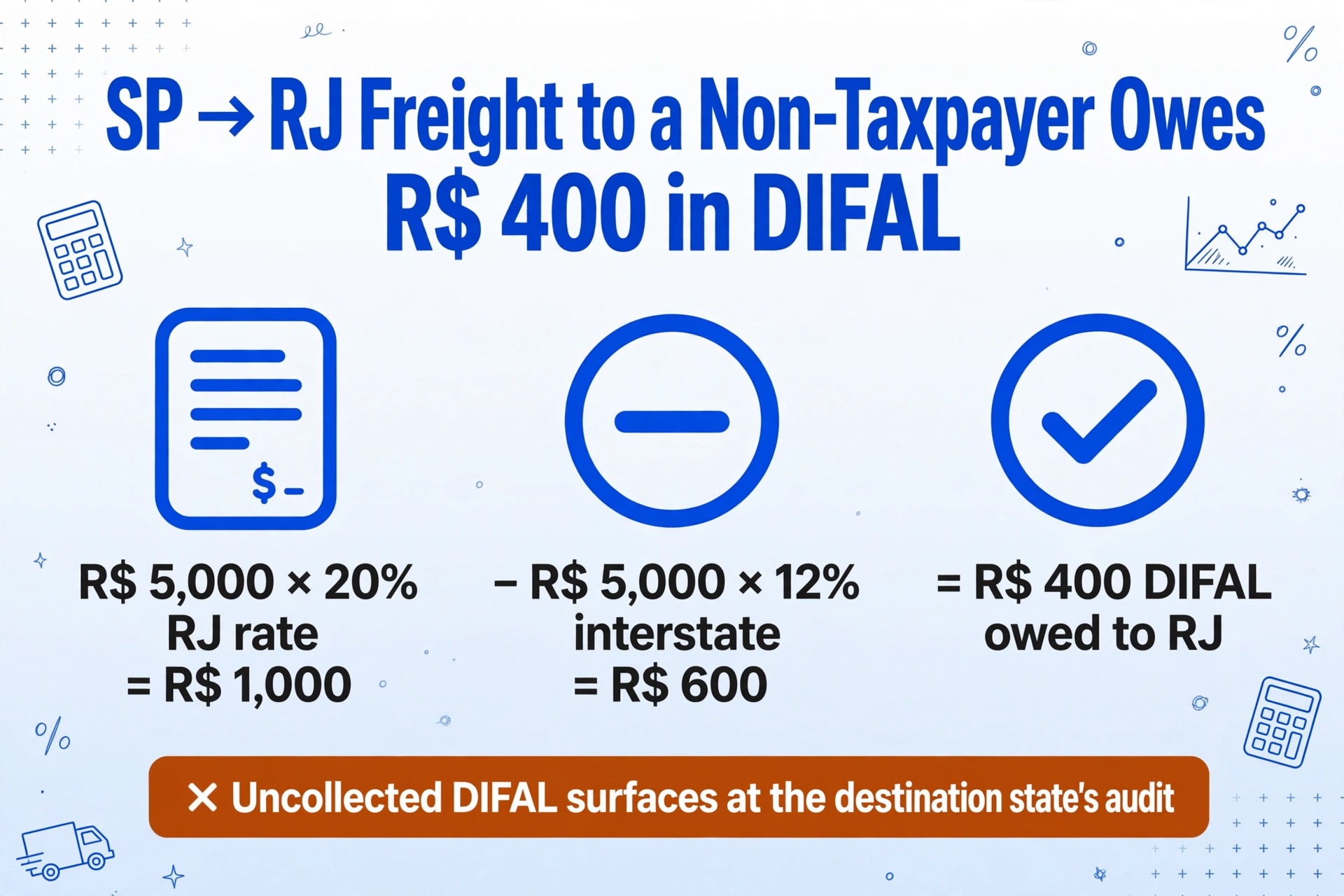
DIFAL on transport services is governed by the same LC 190/2022 framework that applies to goods. The calculation is:
DIFAL = (Valor da Prestação × Alíquota Interna do Destino) − (Valor da Prestação × Alíquota Interestadual)
For example: a transport service valued at R$ 5,000 from SP (origin) to a non-contributing consumer in RJ (destination). SP → RJ interstate rate = 12%. RJ internal rate = 20%.
DIFAL = (5,000 × 20%) − (5,000 × 12%) = 1,000 − 600 = R$ 400 due to RJ
The error occurs when the carrier or the consignee's fiscal team does not recognize that the recipient is a non-contributing consumer — often because the recipient's CNPJ status is not checked before issuing the CT-e. The DIFAL goes uncollected, and the destination state's tax authority discovers the gap during audit or through SEFAZ cross-system data sharing.
Since 2024, the responsibility for DIFAL collection on transport services rests with the destination state, per the regulations implementing LC 190/2022. But the carrier who issued the CT-e without the correct DIFAL treatment remains exposed, because the tax authority can assess the deficiency against either party. The carrier's safest practice is to determine the recipient's ICMS taxpayer status before issuing the CT-e and to apply DIFAL whenever the recipient is a non-contributing consumer in another state.
Internal ICMS rates by destination state for DIFAL calculation in 2026 (source: SEFAZ / CONFAZ):
| Destination State | Internal ICMS Rate (2026) |
|---|---|
| São Paulo (SP) | 18% |
| Minas Gerais (MG) | 18% |
| Rio de Janeiro (RJ) | 20% |
| Paraná (PR) | 19% |
| Rio Grande do Sul (RS) | 17% |
| Santa Catarina (SC) | 17% |
| Bahia (BA) | 20.5% |
| Pernambuco (PE) | 20.5% |
| Maranhão (MA) | 22% |
| Alagoas (AL) | 19% → 20.5% (from Apr 2026) |
Full tables are maintained on the Portal Nacional da DIFAL and published by each state's SEFAZ. Internal rates vary from 17% to 22% across the 27 states and the Federal District, with some states applying higher rates on specific product or service categories.
Mistake 4: Wrong ICMS Calculation Base (What Does and Does Not Count)
The ICMS taxable base on a CT-e is not simply "the freight service value." It includes certain charges and excludes others, and the rules vary by state and by the nature of the transport service. The most common base-calculation errors on CT-e documents:
Including IPI in the ICMS base on freight. Unlike the NF-e (where ICMS base can include IPI in certain configurations under Lei Complementar 87/96), the ICMS base on transport services should generally not include IPI — because IPI is a federal tax on industrialized products, not a component of the freight service value. Some carriers incorrectly carry over the IPI-inclusive logic from NF-e processing into their CT-e issuance, inflating the ICMS base.
Including or excluding toll charges inconsistently. Toll charges (pedágio) that are passed through to the consignee as part of the freight service may or may not be included in the ICMS base, depending on whether they are classified as an integral part of the service value or as a reimbursable disbursement. The distinction is not always clear on the DACTE, and different carriers treat it differently — leading to inconsistent base calculations across CT-e documents in the same batch.
Excluding discounts that should reduce the base. Unconditional discounts (descontos incondicionais) on the freight service reduce the ICMS taxable base. If a carrier applies a volume discount or a loyalty discount that is documented as an unconditional reduction, the ICMS base must be reduced accordingly. Errors occur when the discount is applied to the service value but not reflected in the ICMS base field, or vice versa.
How to check during extraction: Include a computed column named Expected ICMS (Base × Alíquota ÷ 100) in your extraction template. This column calculates what the ICMS amount should be given the base and rate printed on the DACTE. Compare it against the actual ICMS amount (vICMS) extracted from the same document. Any row where the two values diverge flags a potential base-calculation issue that warrants further investigation.
Mistake 5: Incorrect CFOP Code Leading to Wrong ICMS Treatment
CFOP (Código Fiscal de Operações e Prestações) is the four-digit fiscal operation code that determines how the transaction is classified for tax purposes. On CT-e documents, the most common CFOP codes are:
| CFOP | Description | ICMS Treatment Implication |
|---|---|---|
| 5.902 | Freight on purchase (frete na compra) | Inbound freight — ICMS may be creditable by the buyer under non-cumulative ICMS regime |
| 6.902 | Freight on inter-company transfer (frete em transferência) | Internal transfer — ICMS credit treatment differs; may not be creditable depending on state |
| 7.902 | Freight on sale (frete na venda) | Outbound freight — ICMS is part of the seller's cost; credit rules vary by regime |
The error: a freight analyst processing inbound freight costs selects CFOP 7.902 (freight on sale) instead of 5.902 (freight on purchase) because she is looking at the carrier's CT-e and assumes any "freight" code is the same. The wrong CFOP changes how the ICMS credit is treated in the company's SPED EFD ICMS/IPI filing — a 5.902 ICMS credit on inbound raw materials is generally recoverable under the non-cumulative regime; a 7.902 ICMS credit on what is actually inbound freight may be flagged as an incorrect classification during audit, because the fiscal code does not match the transaction type.
How to check: The CFOP code should be determined by the nature of the transport service in relation to the goods being carried — not copied from a similar transaction or assumed from the carrier's default. For each CT-e batch, extract the CFOP field and verify that the codes match the transaction types recorded in the purchase or sales orders.
Mistake 6: Ignoring the CBS/IBS Transition Impact on ICMS Calculation
Brazil's tax reform (EC 132/2023 and its implementing legislation) introduces a transition period from 2026 to 2032 during which the legacy ICMS, PIS, and COFINS coexist alongside the new CBS (Contribuição sobre Bens e Serviços, federal) and IBS (Imposto sobre Bens e Serviços, state/municipal). For CT-e freight documents, this transition creates a new source of ICMS calculation errors: the same shipment may need to be partially taxed under the old regime and partially under the new regime, depending on the nature of the goods, the transport service, and the profile of the parties involved.
In practical terms, during the transition, some CT-e documents will carry legacy ICMS fields only, some will carry both legacy and new IBS/CBS fields, and some (later in the transition) will carry only the new taxes. An analyst who processes a CT-e in 2027 and sees that the ICMS field is populated may assume the legacy rules apply in full — missing the fact that a portion of the transport service's tax liability has shifted to the new regime and that the ICMS amount shown is only part of the total tax burden. The resulting ICMS credit claimed on inbound freight may be overstated or understated depending on whether the transition rules have been correctly interpreted.
The practical strategy: For the 2026–2032 transition period, every CT-e batch should include a computed column that calculates the expected total tax (ICMS + IBS/CBS where applicable) and compares it against the declared ICMS amount. A substantial gap between expected and declared values indicates a transition-era classification issue that requires review by a tax specialist.
The reform reality: Tax reform does not reduce complexity during transition — it doubles it. CT-e documents processed between 2026 and 2032 may carry both legacy and new tax fields, and the ICMS calculation logic must account for both.
How to Catch These Errors Before They Reach SEFAZ
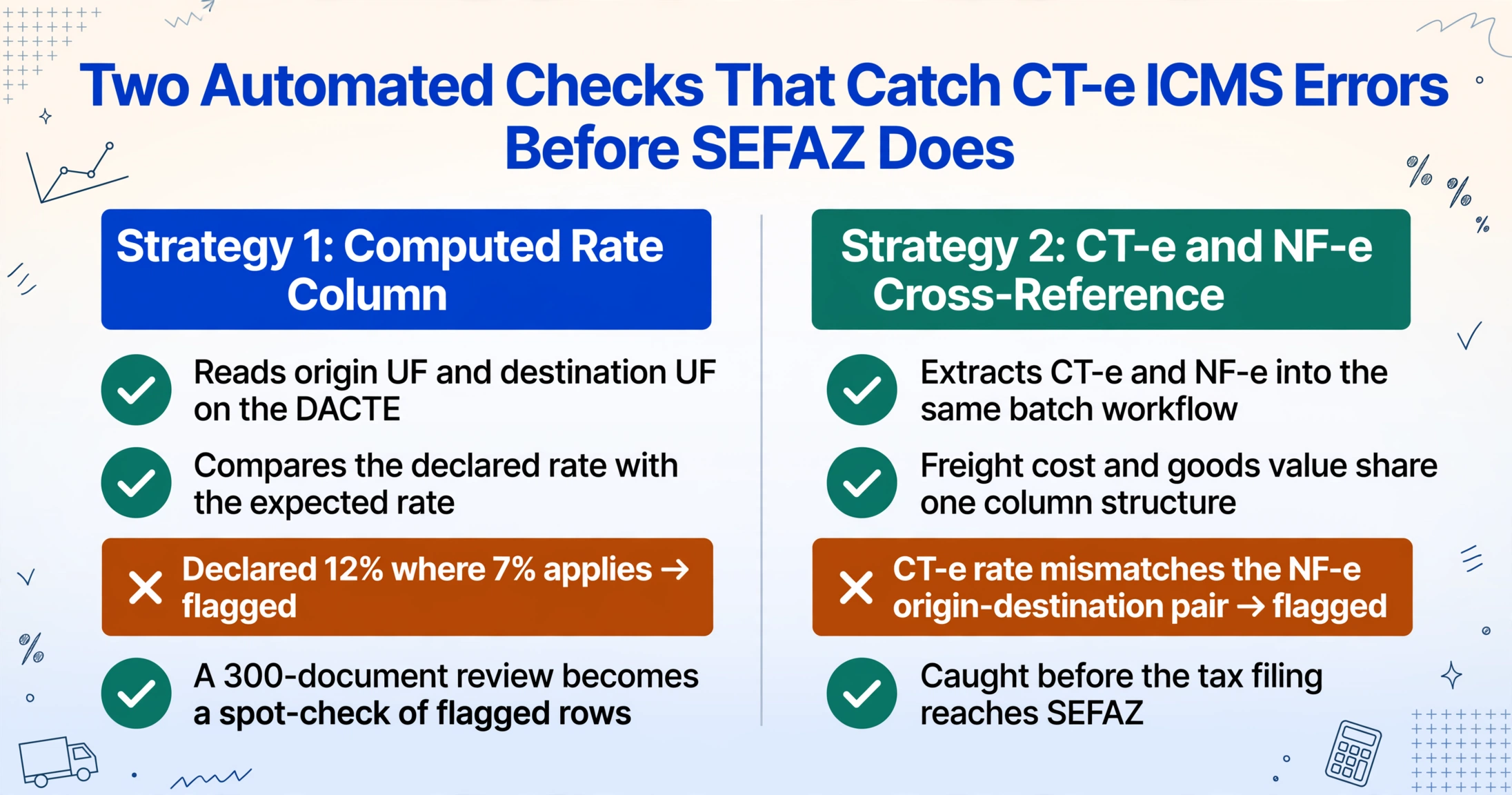
Manual spot-checking of ICMS calculations across hundreds of CT-e documents per month is not realistic — the error rate of the checker eventually matches the error rate of the original data entry. But there are two automation strategies that can catch these errors at the extraction stage, before they propagate into the ERP and the SPED filing.
Strategy 1: Computed columns as rate validators. When extracting CT-e data from DACTE printouts, include computed columns that calculate the expected ICMS rate and compare it against the declared rate. The column Expected Rate Validation (Interstate 7% if SP→BA, 12% if SP→RJ) can be implemented as an inferred column — the AI evaluates the origin and destination UFs printed on the DACTE and applies the rate rule automatically. Any document where the declared rate differs from the expected rate is flagged in the output spreadsheet, turning a 300-document review into a spot-check of flagged rows.
Strategy 2: Cross-reference batch extraction with NF-e data. By extracting both CT-e and NF-e data into the same batch processing workflow, you create a dataset where freight costs and goods values coexist in the same column structure. An ICMS rate on a CT-e that does not match the expected rate for the origin-destination pair shown on the corresponding NF-e is a red flag that can be caught before the tax filing reaches SEFAZ. The batch processing guide for CT-e freight cost ledgers covers how to set up this cross-reference workflow.
For a comprehensive view of how the CT-e fits into Brazil's electronic document ecosystem — alongside the NF-e (goods), NFS-e (services), and MDF-e (freight consolidation) — see the Brazilian electronic document hub, which covers the SEFAZ authorization framework common to all DF-e documents.
Frequently Asked Questions
How do I know whether to apply 7% or 12% to a specific interstate CT-e?
Check the carrier's origin state and the consignee's destination state. If the carrier is in the South or Southeast region (except Espírito Santo) AND the destination is in the North, Northeast, Center-West, or Espírito Santo, the rate is 7%. For all other interstate combinations — including South/Southeast to South/Southeast (excluding ES-destination, which is 7%), and any transport originating from the North/Northeast/Center-West — the rate is 12%. A rate of 4% applies when the goods being transported have imported content exceeding 40%, per Resolução do Senado Federal n° 13/2012. Remember: the transport ICMS rate is independent of the goods ICMS rate written on the NF-e.
Who is responsible for collecting and paying DIFAL on a CT-e?
Under LC 190/2022, the DIFAL on transport services to a non-ICMS taxpayer consumer in another state is due to the destination state. Since 2024, the collection responsibility has shifted to the destination state's tax authority. However, the carrier who issued the CT-e remains exposed to assessment if the DIFAL was not correctly declared. In practice, the carrier should determine the recipient's ICMS taxpayer status at issuance and include the DIFAL calculation when applicable. Many carriers rely on their ERP's Brazilian localization module (SAP TDF, TOTVS Protheus Fiscal) to automate this check.
What happens when a CT-e ICMS error is found during a SPED filing?
SPED EFD ICMS/IPI cross-validates every CT-e entry against SEFAZ records. A rate mismatch — where the ICMS rate declared in your SPED filing differs from the rate on the authorized CT-e — generates a discrepancy that the Receita Estadual's audit system flags. The taxpayer receives a notice (notificação fiscal) to explain the discrepancy. If the error is confirmed, the penalty is 75% of the underpaid tax difference, plus SELIC interest from the date the tax was originally due. If the tax authority determines that the error resulted from inadequate internal controls rather than a clerical mistake, the penalty may be increased to 150%. Systematic errors — the same rate applied incorrectly across multiple CT-e documents — attract higher scrutiny and higher aggregate penalties.
Can computed column validation replace a tax specialist's review?
No. Computed column validation flags anomalies for review — it does not resolve them. A row flagged as "expected rate 7%, declared rate 12%" may be a data entry error, a legitimate exception under a specific state protocol, or a transition-period classification issue. The computed column identifies which documents need attention; the tax specialist evaluates the context and determines the correct treatment. The value of the automation is in reducing the search space from 300 documents to the 5–10 that have anomalies, not in replacing the specialist's judgment.
Can I correct a CT-e after issuance if I discover an ICMS error?
Yes — a CT-e can be corrected through the Carta de Correção Eletrônica (CC-e) process, which allows the issuer to amend certain fields without cancelling the original document. However, ICMS rate and base-of-calculation corrections typically require cancelling the original CT-e and issuing a new one (CT-e de substituição), because the tax amount is part of the fiscal record that SEFAZ has already authorized. The cancellation process has a deadline (generally within the same calendar month or before the SPED filing deadline for the period) and must be documented with the correct justification code. A cancelled CT-e that has already been used by the consignee for ICMS credit requires a matching adjustment in the consignee's SPED EFD filing, creating a cascading correction that is significantly more expensive than getting the rate right at issuance.
Where can I find the most current CT-e ICMS rate table for 2026?
The authoritative source is each state's SEFAZ published rate table, consolidated through CONFAZ (Conselho Nacional de Política Fazendária). The Portal Nacional da DIFAL provides a centralized reference for interstate and internal rates. For taxpayers using ERP systems with Brazilian localization, the rate tables are built into the fiscal module (SAP TDF, TOTVS Protheus) and updated through each vendor's legal change management process. For manual processing, the table in this article reflects the rates as of mid-2026, but state legislation changes — Alagoas moved from 19% to 20.5% effective April 2026 — so the responsible fiscal team should verify rates against the most recent state legislation before each SPED filing period.