Why Boleto Reconciliation
Costs More Than Most Finance Teams Realize
Over 10 million Boletos are paid every business day in Brazil. Each one follows the same FEBRABAN standard, carries a machine-readable 44-digit barcode, and encodes its amount, due date, and beneficiary in precisely defined positions. The payment infrastructure that processes these 10 million daily transactions is among the most automated in the world — banks settle Boleto payments through the Central Bank's clearing system with no human touch. But the finance teams on the receiving end of those payments still reconcile them one by one, by hand, using a process that has not fundamentally changed in the 33 years since the Boleto was introduced.
Key Takeaways
- Most AR teams blame themselves for slow Boleto reconciliation — but the bottleneck is a process that inserts human touch at five independent failure points.
- Data entry alone consumes 25 hours per month at 500 Boletos — before any matching or investigation begins.
- When extraction removes the typing step, reconciliation shifts from 'who reads and types each field' to 'who reviews the exceptions' — the role finance teams were actually hired for.
The Boleto Reconciliation Problem in Numbers
Before diagnosing the failure points, the scale is worth stating plainly. Brazil processes an estimated 3.7 billion Boleto transactions annually — roughly 10 million per business day. For the businesses on the receiving end, each of those payments must be matched against the corresponding issued Boleto, the amount must be verified, the settlement date must be recorded, and any discrepancy must be investigated.
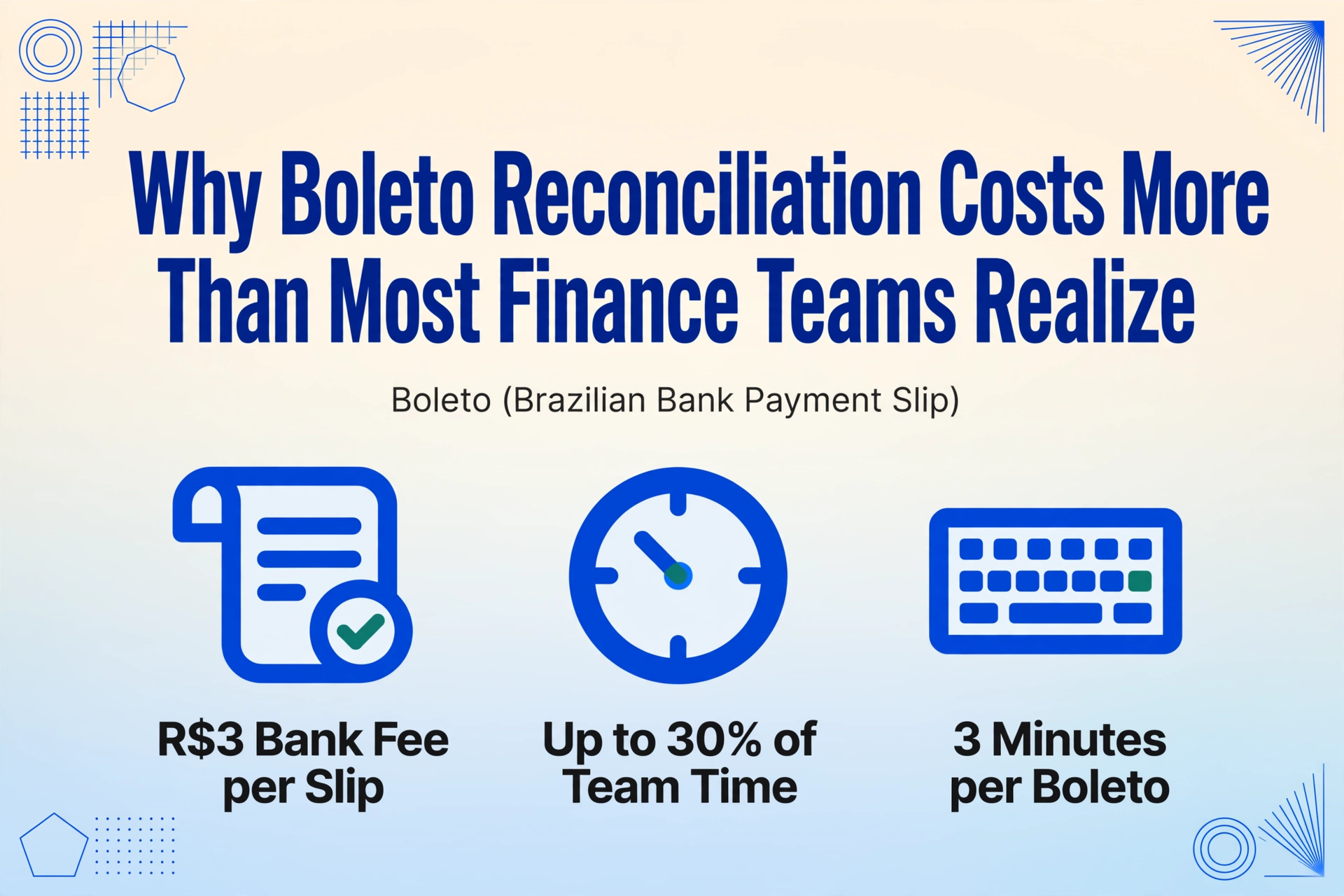
According to data from payments consultancy GMattos, Boleto payments average approximately R$3 per processed slip in bank fees alone — and that is just the cost the bank charges. The labor cost of manually extracting data from each slip, entering it into a spreadsheet, and reconciling it against the bank's settlement report is not included in that figure. A PwC benchmark across finance teams found that manual reconciliation consumes up to 30% of a finance team's time. For a mid-size Brazilian company processing 500 Boletos per month, that translates to roughly one full-time equivalent spent entirely on Boleto-related reconciliation.
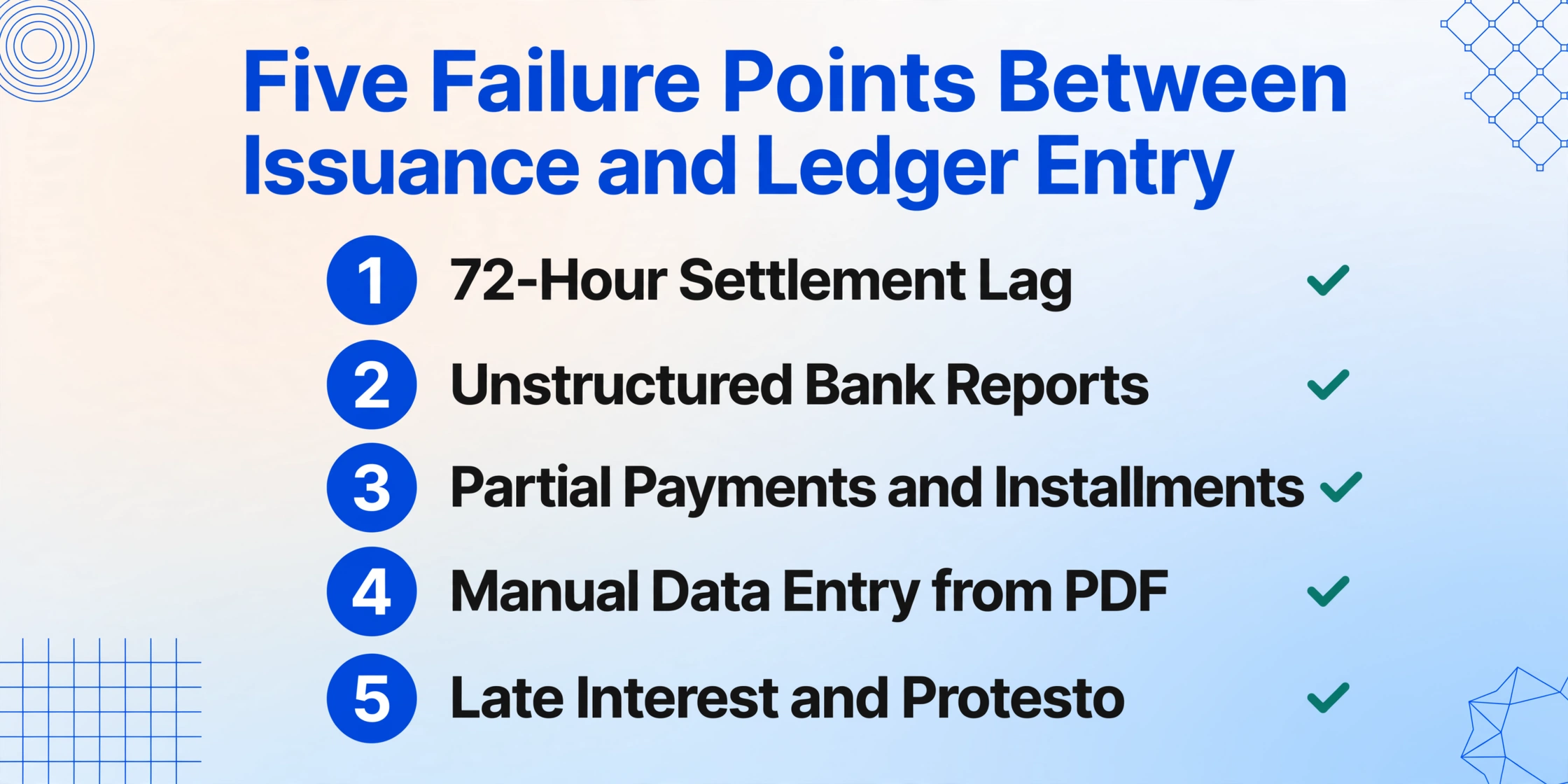
The core problem: Boleto reconciliation is not hard because each individual task is difficult. It is hard because the process has five distinct failure points between issuance and final ledger entry, and each one generates its own type of operational cost.
Failure Point 1: The 72-Hour Settlement Lag Between Payment and Confirmation
When a consumer pays a Boleto at a lottery agency or supermarket, the money leaves their hands immediately. But the confirmation reaching the merchant's bank account is not instant. Until March 2024, standard Boleto settlement took one to three business days. FEBRABAN's March 2024 rule change accelerated this — payments made by 1:30 PM now settle the same business day, while later payments clear the next business day. This is a meaningful improvement, but it still lags far behind Pix's instant settlement, which processes payments in seconds.
The gap creates a tracking problem. An AR team issuing 100 Boletos on the 1st of the month will see payments trickle in over the next week — not as a single batch but as a daily stream of partial, overlapping, and sometimes-unlabeled deposits. Without real-time confirmation, the team cannot know which specific Boleto a given deposit corresponds to until the bank's settlement report arrives. In the meantime, the aging report shows items as "unpaid" that may already have been settled, or worse, as "paid" when the settlement has not yet cleared.
This is not a failure of the Boleto system itself — it is a mismatch between the payment's speed at the front end (immediate, at the point of payment) and its confirmation at the back end (one to three days, in the bank's settlement cycle). And that mismatch forces teams to build buffers, estimates, and manual checkpoints into their reconciliation workflow that would be unnecessary if confirmation were instantaneous.
Failure Point 2: The Unstructured Bank Settlement Report
Every bank in Brazil that processes Boleto payments provides a daily settlement report to its merchant clients. But "report" is a generous term — what arrives is a file in the bank's own preferred format, often a CNAB 240 or CNAB 400 text layout, sometimes a semi-structured spreadsheet, sometimes a PDF with a table of transactions.
The CNAB (Centro Nacional de Automação Bancária) standards define fields like Nosso Número, valor (amount), data de pagamento (payment date), and código de compensação (clearing code). But the field positions, the way the data is encoded, and the supplementary information included vary by bank. One bank might include the payer's CPF in the file. Another might omit it. One might put the payment date in position 120. Another might put it in position 210.
An AR team that receives Boletos from clients using multiple Brazilian banks must therefore reconcile against multiple report formats. The data from Bradesco's settlement report arrives structured differently from Itaú's, which is different from Santander's. Each one requires its own parsing logic or, more commonly, its own manual interpretation by a finance team member who knows "how that bank's file works."
When the bank report cannot be directly matched against the issued-Boleto list because the formats don't align, the reconciliation step becomes a manual cross-reference exercise. The AR analyst prints or opens the bank report on one screen and the Boleto tracking spreadsheet on another, and visually matches rows by amount and date — hoping no two payments have the same value on the same day.
Failure Point 3: Partial Payments and Installments Break the One-to-One Match
The simplest reconciliation case — one Boleto issued, one payment received for the full amount — is also the most common. But a significant minority of Boleto transactions break this clean model, and when they do, the manual matching work multiplies.
Partial payments. A Boleto of R$ 1,500 may be paid in two installments — R$ 750 on the 5th and R$ 750 on the 20th — or the payer may simply remit R$ 1,200 because they are disputing a portion of the invoice. In either case, the bank's settlement report shows two entries (or one entry for a different amount) against a single Boleto. The AR team must decide: mark the Boleto as partially paid and track the remainder? Or apply the full payment and create a credit note? Either way, the clean row-per-Boleto structure of the tracking spreadsheet is broken — and someone has to add a manual note, a separate row, or a journal entry.
Instalments (parcelas). In B2B transactions, it is common for a single invoice to be split into multiple Boletos with different due dates — especially in sectors like education (monthly tuition) or equipment leasing. The payer may settle the March installment but not the February one. The AR team must track each installment as a separate Boleto while maintaining the link to the original invoice. When the bank settlement report shows a payment, the analyst must know which installment it applies to — information that is not always clear from the settlement data alone.
Failure Point 4: The Excel Bottleneck — Manual Data Entry of Each Boleto's Fields
Before any matching can happen, the data from each issued Boleto must exist in the tracking spreadsheet. The source document — the Boleto PDF — carries all the necessary information: barcode, amount, due date, beneficiary, payer, Nosso Número. But in the standard manual workflow, someone must read those fields from the PDF and type them into the spreadsheet.
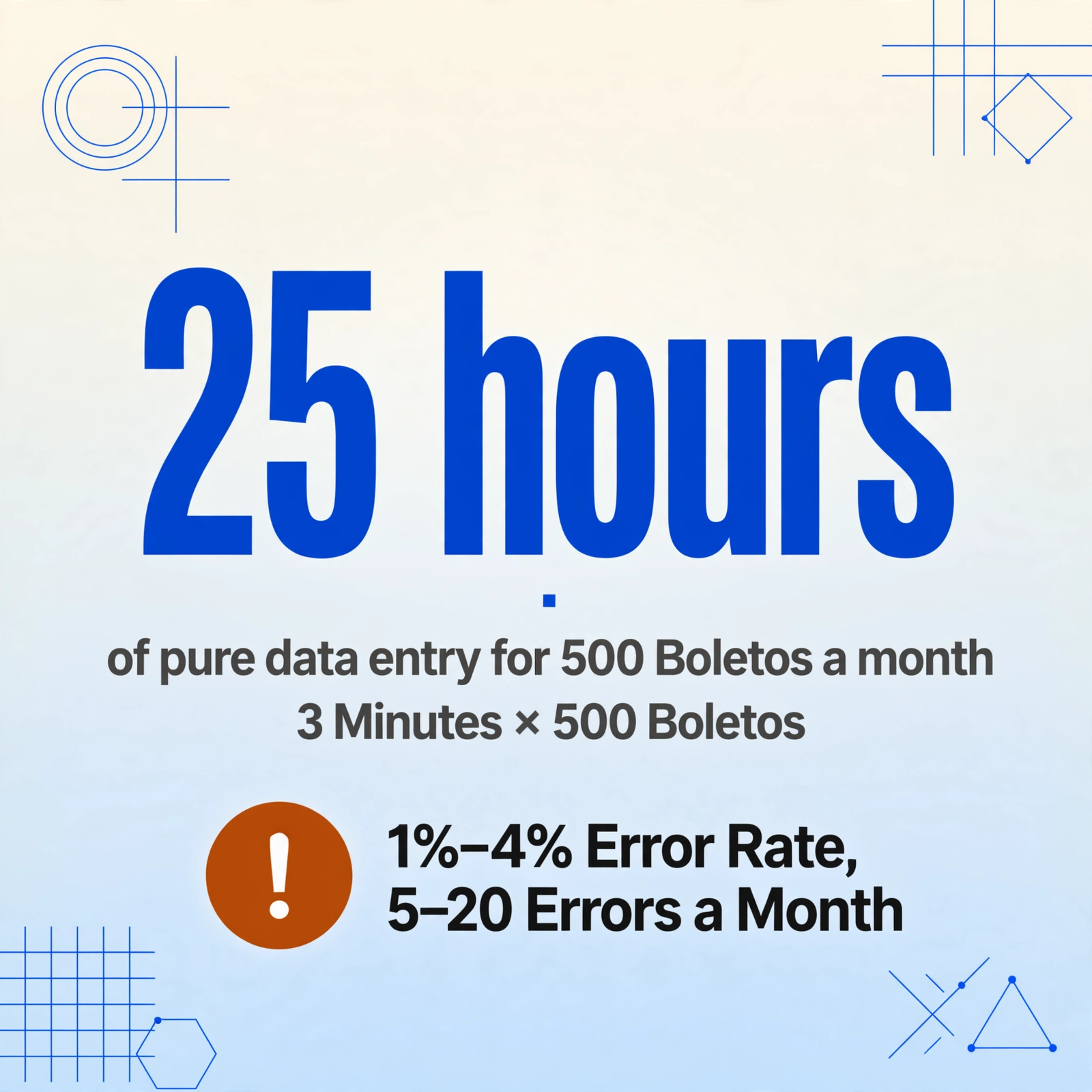
The average time to locate, read, and type six fields from a Boleto is approximately 3 minutes per document. For 500 Boletos per month, that is 25 hours of pure data entry. PwC's finding that reconciliation consumes up to 30% of finance team time aligns closely with this — data entry alone accounts for a large portion of that benchmark before the actual matching work begins.
And data entry carries its own error rate. Industry benchmarks for manual financial data entry place the typical error rate between 1% and 4%. For a portfolio of 500 Boletos, that means 5 to 20 errors per month — a transposed barcode digit, a misread decimal separator (R$ 1.234,56 vs R$ 1,234.56), a due date entered as MM/DD/YYYY instead of DD/MM/YYYY. Each error must be caught and corrected during reconciliation, adding to the time cost.
The irony is that the Boleto's 44-digit barcode contains the same data in a machine-readable format. The same fields typed from the visual slip are already encoded in the barcode — but most teams do not have a tool that reads the barcode directly.
Failure Point 5: Late Payments, Interest Calculations, and Protesto Escalation
When a Boleto is paid after its due date, Brazilian law allows the beneficiary to charge up to 1% monthly interest (juros de mora) plus a one-time penalty of approximately 2% (multa). The actual amount received may therefore differ from the valor nominal printed on the Boleto — and the reconciliation spreadsheet must reflect both.
If the AR team does not track late payment interest separately, the extracted amount from the Boleto PDF (the valor nominal) will not match the settled amount in the bank report (which includes Juros and multa). The analyst sees a discrepancy of a few reais and must investigate whether it is an error or a legitimate late payment fee. For a handful of late payments per month, this is manageable. For a portfolio with a high proportion of after-due-date payments — common in consumer-facing segments — the investigation effort per incident quickly exceeds the value of the discrepancy being investigated.
More seriously, a Boleto that goes unpaid past its due date enters a timeline that can escalate to protesto (protest) — the formal registration of the unpaid debt at a Cartório de Protesto (notary office). Once protested, the debt becomes a public record visible to credit bureaus Serasa and SPC. The debtor has three business days to pay or contest after receiving the protesto notice. If the Boleto was not properly tracked — if the data entry error caused a false overdue flag, or the partial payment was not recorded — the protesto process may be triggered incorrectly, creating a dispute that costs more to resolve than the original Boleto value.
Where Automation Changes the Reconciliation Equation
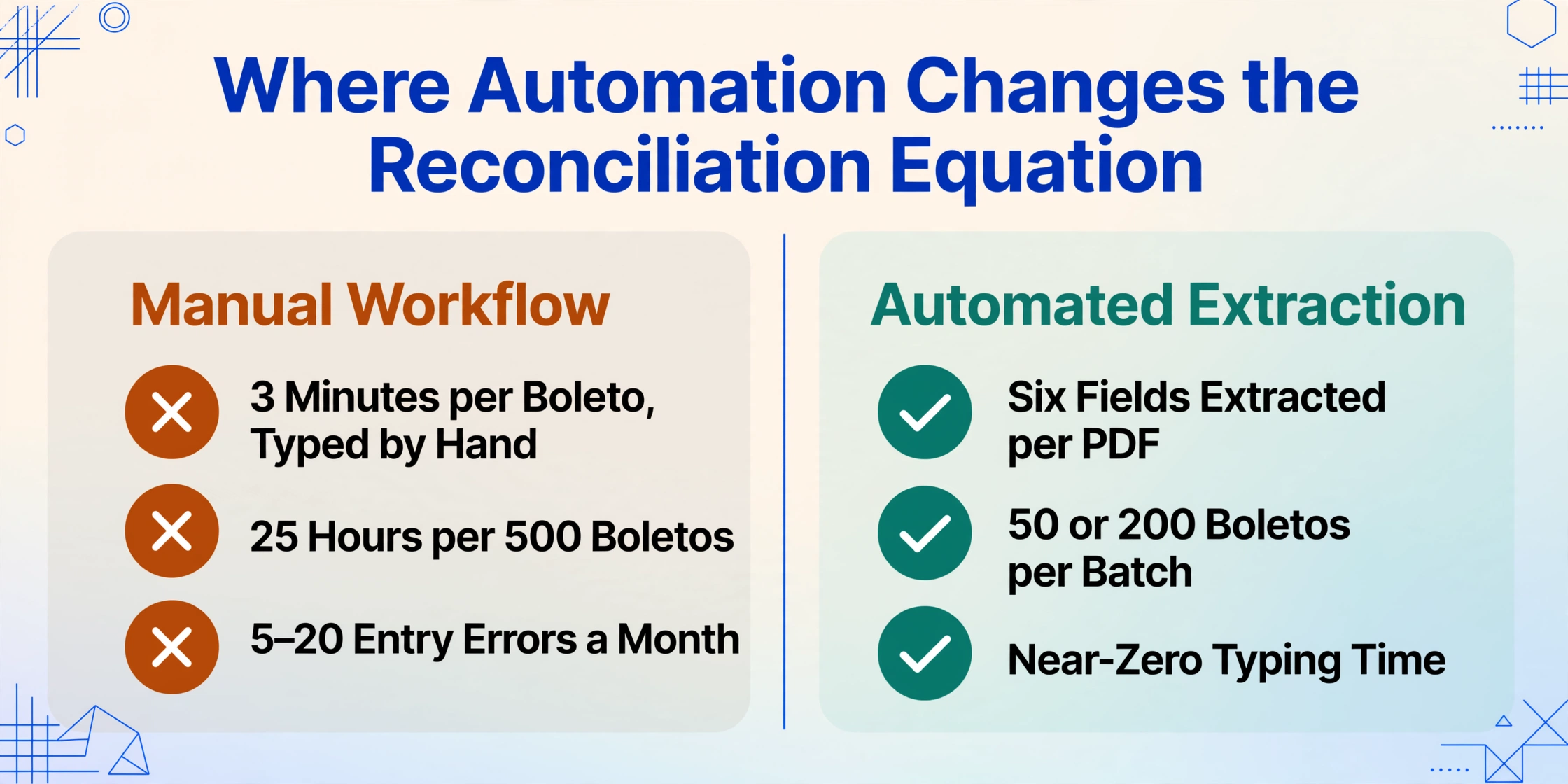
The five failure points share a common cause: human touch is required at every step between the Boleto PDF and the reconciled ledger entry. Each touch point — reading, typing, matching, investigating — adds time and introduces error risk. Automation changes the equation by removing the touch points, not by making each one faster.
When a Boleto's data is extracted automatically from the PDF or screenshot — barcode, amount, due date, beneficiary, Nosso Número — the data entry failure point (Point 4) is eliminated entirely. The extracted data lands in the spreadsheet without a keystroke. When the same extraction handles 50 or 200 Boletos in a single batch, the time cost per document drops from 3 minutes to near zero for data entry.
With structured data on both sides — extracted Boleto fields in Column A through F, bank settlement report imported in Column G — the matching step shifts from "visually compare two screens" to "run a VLOOKUP or merge query." Discrepancies caused by late payment interest become visible as systematic differences (e.g., settled amount consistently equals extracted amount + ~2%) rather than mysterious one-off mismatches.
For teams processing significant Boleto volumes, the combination of batch data extraction and structured reconciliation is the difference between reconciliation being a full-time role and being a Monday morning review. The R$3 per slip bank fee does not change. But the labor cost per slip — which, at 3 minutes per document and R$20 per hour, adds roughly R$1 per Boleto — drops to near zero for the data entry portion. On 500 Boletos per month, that is R$500 in direct labor savings on data entry alone, before accounting for error reduction and faster month-end close.
Frequently Asked Questions
Is Boleto usage declining in Brazil? Does that make this problem less urgent?
Boleto's share of overall payment transactions has declined — from double digits before Pix launched to roughly 4% in 2025. However, Boleto remains dominant in specific segments: 68% of cross-border e-commerce purchases from Brazil use Boleto, and approximately 50 million unbanked Brazilians rely on it as their primary online payment method. The volume has stabilized rather than collapsed. For companies serving these segments, the reconciliation problem is not going away.
Does Pix eliminate the need for Boleto reconciliation?
No. Businesses that offer both payment methods end up reconciling two separate flows — instant Pix payments (which settle immediately but in a different format) and Boleto payments (which settle over 1-3 days in the traditional format). Reconciliation tools must handle both. Pix resolves the settlement-lag problem (Failure Point 1) but does not change the data entry problem for Boletos that customers still choose to pay that way.
How do Brazilian ERPs like Totvs or SAP handle Boleto reconciliation?
Most Brazilian ERPs can import CNAB files directly for automatic matching — but only if the issued Boleto data is already in the system. The bottleneck is getting the data from each Boleto PDF into the ERP in the first place. The extraction step bridges that gap, converting the PDF data into a format the ERP can consume. For a step-by-step guide on extracting Boleto data from PDF to spreadsheet, see this walkthrough.
What happens if a Boleto goes to protesto due to a reconciliation error?
If an incorrect data entry — such as a duplicated Nosso Número or wrong due date — causes a Boleto to appear unpaid when it actually was paid, the issuer may wrongly send it to protesto. Reversing a protesto requires going to the cartório with proof of payment, paying administrative fees, and updating the credit bureau records. The process typically takes weeks and costs R$50-R$150 in cartório fees plus internal administrative time. This is one of the highest-cost consequences of manual Boleto data entry.
Can Boleto data extraction handle CNAB files too, or only the visual PDFs?
Extraction tools that read visual documents (PDFs, images, screenshots) handle the issued Boleto side. The bank's CNAB file is a separate structured format that is best handled by an ERP's existing import functionality or a custom parser. The value of visual extraction is to get the Boleto data into a structured format that can then be matched against the CNAB — it replaces the manual data entry step, not the bank interface.
Reconciliation Is Not the Problem — Data Entry Is
The five failure points outlined here share a single root cause: the data on each Boleto must be read by a human before it can be processed by a system. Every other inefficiency — the settlement lag, the bank report mismatch, the partial payment tracking — is amplified by the fact that the starting point is unstructured data on a PDF that must be manually entered. Fix that one step, and the downstream costs shrink proportionally.
The Boleto Bancário was designed as a payment instrument, not a reconciliation challenge. But 33 years into its existence, the reconciliation workflow around it has accumulated layers of manual process that the document's own structure was built to eliminate. Moving from "read and type each field" to "extract all fields at once" is the single highest-leverage change an AR team processing Brazilian payments can make.
See the difference on your own Boleto files.
Upload a Boleto Bancário PDF or screenshot and get structured data back in seconds.
Try It Now