The Real Cost of Manual Boleto Processing:
A Calculation Framework for Finance Teams
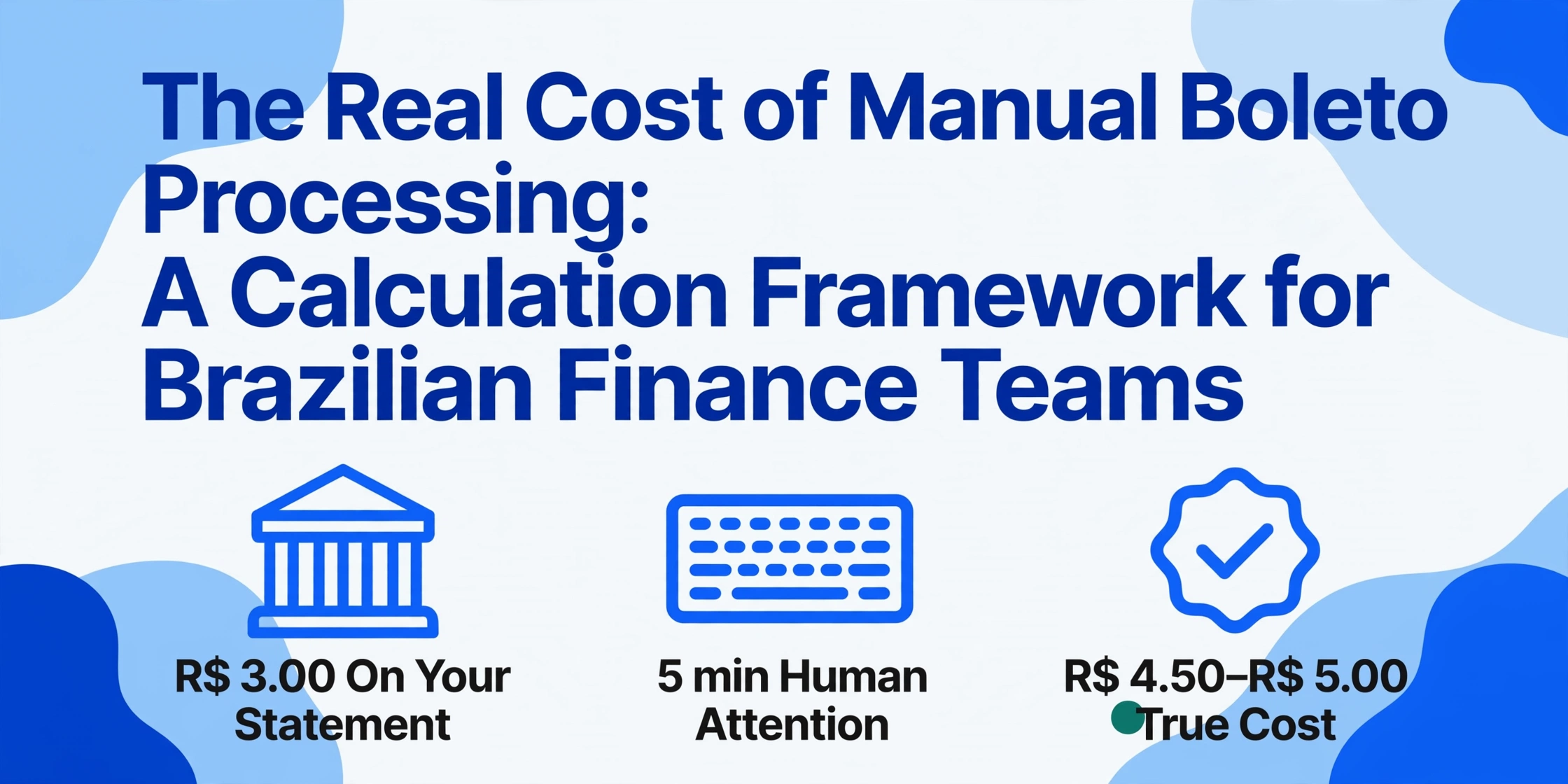
If you ask a finance manager what it costs to process a Boleto payment, the answer is usually the bank fee: somewhere between R$ 1.00 and R$ 12.00 per slip, with an average around R$ 3.00 according to recent market data. That answer is not wrong. But it is incomplete — because the bank fee covers only what the bank charges to clear the payment. It does not cover the cost of the person who opens each Boleto PDF, reads the amount, types it into a spreadsheet, matches it against a bank settlement file, and investigates the inevitable discrepancies. Those costs are real, recurring, and almost never tracked.
Key Takeaways
- That R$3 bank fee per Boleto is only one layer — labor and error-correction costs hidden in payroll add another R$1.50 to R$2.00 per slip.
- A company processing 500 Boletos per month spends R$6,000 per year on data entry labor alone — a cost that appears on no invoice.
- Track a single number — total per-Boleto cost including labor and corrections — and the business case for automation writes itself before the first batch.
The Three Layers of Boleto Processing Cost
Every Boleto that passes through a finance operation incurs costs in three distinct layers. Only the first is visible on a bank statement. The second and third are hidden in payroll hours and error-correction cycles that most teams accept as "the way it is."
| Layer | Type | Typical Cost (Per Boleto) | Who Pays |
|---|---|---|---|
| Layer 1 | Bank processing fee | R$ 1.00 – R$ 12.00 | Merchant (visible in bank charges) |
| Layer 2 | Data entry labor | R$ 1.00 – R$ 2.00 | Finance department (hidden in salary cost) |
| Layer 3 | Reconciliation + error correction | R$ 0.50 – R$ 3.00 | Finance department (hidden in overtime and delays) |
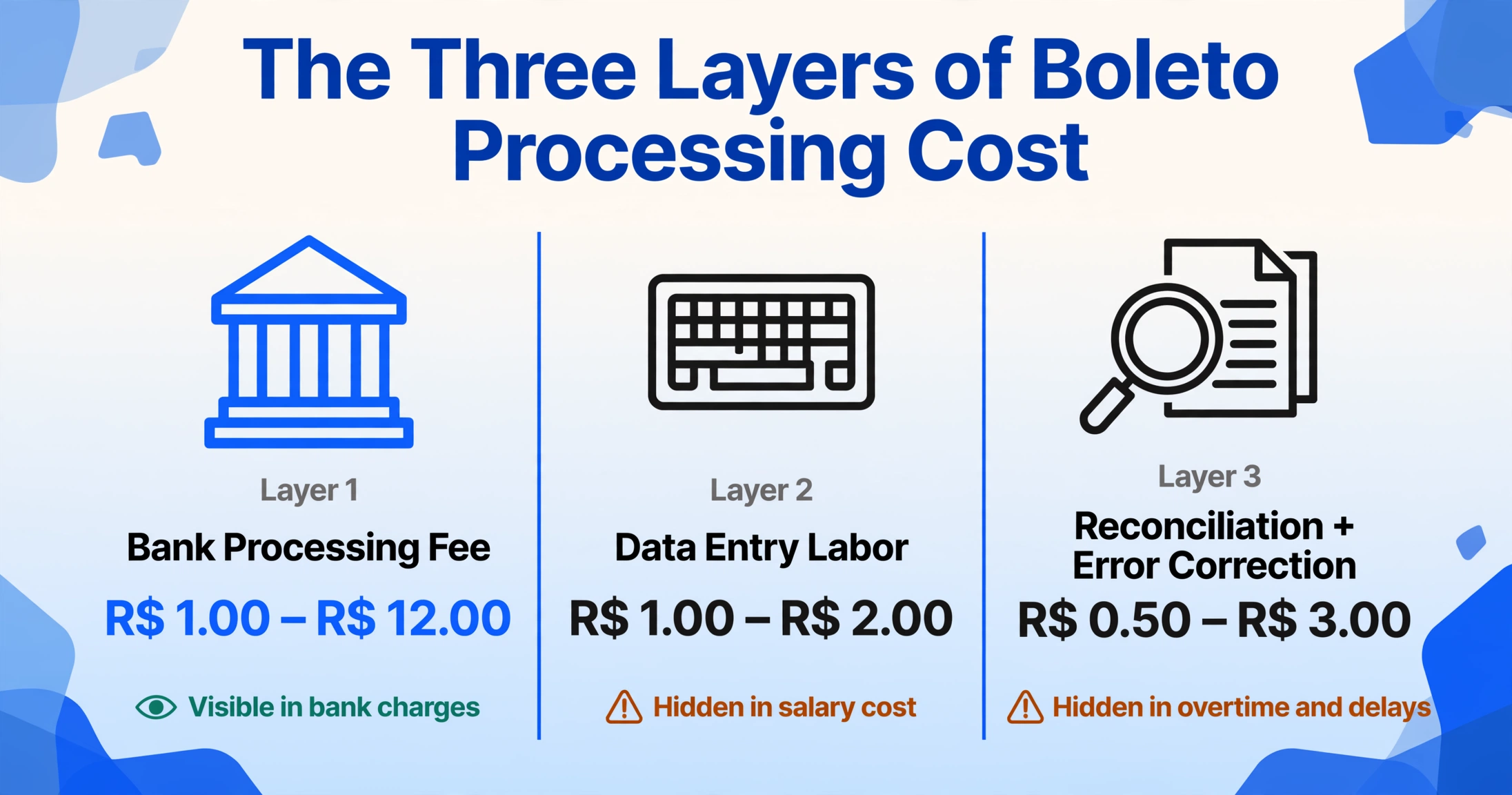
The total per-Boleto cost — combining all three layers — typically falls between R$ 2.50 and R$ 17.00, depending on volume, labor rates, and the complexity of the payment portfolio. For a company processing 500 Boletos per month, the difference between the low end and the high end of that range is R$ 7,250 per month in unaccounted operational cost.
Layer 1: What the Bank Charges Per Boleto
The bank fee is the easiest to quantify because it appears on your bank statement. Brazilian banks charge a processing fee for each Boleto that goes through their clearing system. The fee structure depends on several factors:
- Boleto Registrado (registered): Since the FEBRABAN mandate requiring registration took full effect in 2017, most Boletos are registered. Banks can charge fees for issuance, payment processing, and cancellation or change — even if the Boleto is never paid. The per-slip fee for registered Boletos tends to be higher than the unregistered version.
- Boleto sem Registro (unregistered): The bank charges only for paid slips. No issuance or cancellation fee. This structure is less common now but still used by some smaller merchants.
- Volume tiering: Larger clients negotiate lower per-slip fees. A company issuing 10,000 Boletos per month may pay R$ 1.00–R$ 2.00 per slip, while a small business issuing 50 per month may pay R$ 8.00–R$ 12.00.
The average of R$ 3.00 per slip, cited in recent market analysis by GMattos, reflects the blended rate across registered Boletos in the current market. Pix, by comparison, costs merchants approximately 0.30% per transaction — significantly cheaper for low-value payments, though the comparison is not entirely fair since the two instruments serve different settlement timelines and user bases.
Layer 2: The Labor Cost of Opening Each Boleto Individually
This is the cost that most teams do not track, because it is spread across the regular payroll in the form of "AR analyst time" rather than a line item on a bill.
To calculate the labor cost per Boleto, you need three numbers:
- Time per Boleto: How long does it take an AR analyst to locate the PDF, open it, read the key fields (barcode, amount, due date, beneficiary, Nosso Número), and type each one into the tracking spreadsheet? Industry benchmarks for financial document data entry suggest approximately 3 minutes per document. In practice, interruptions, context-switching between multiple bank portals, and the need to re-verify unclear values extend this.
- Fully loaded hourly cost: At a typical Brazilian accounting or AR clerk salary of roughly R$ 2,500–R$ 3,500 per month, plus benefits, taxes (FGTS, INSS), and overhead, the fully loaded hourly cost is approximately R$ 20–R$ 25 per hour.
- Monthly Boleto volume: 50, 200, 500, or more.
The math: 3 minutes × R$ 20/hour = R$ 1.00 per Boleto in data entry labor alone. At 500 Boletos per month, that is R$ 500 per month — R$ 6,000 per year — in labor that contributes zero analytical value. The analyst is typing, not analyzing.
This R$ 1.00 per Boleto is the minimum. If your team uses a more senior analyst (higher hourly rate), or if the PDFs require additional steps (downloading from a banking portal, renaming files, organizing by bank), the per-slip labor cost increases proportionally.
Layer 3: The Reconciliation Tax — Matching, Investigating, Correcting
Once the data is in the spreadsheet, the reconciliation work begins. This is where the cost gets harder to measure because it is not a single predictable activity — it is a category of work that includes matching, discrepancy investigation, error correction, and escalation.
A PwC benchmark across finance teams found that manual reconciliation consumes up to 30% of a finance team's time. For a team of three AR analysts handling Boleto reconciliation, that is roughly one full-time equivalent (R$ 2,500–R$ 3,500/month in salary cost) spent entirely on matching and investigation work that would not exist if the data on both sides were structured and automatically comparable.
The reconciliation cost per Boleto scales with portfolio complexity:
- Simple portfolio (all B2B, same-day payments, minimal partial payments): R$ 0.50 per Boleto. The match is straightforward — issued amount matches settled amount in most cases.
- Mixed portfolio (B2B + B2C, regular late payments, some partial payments): R$ 1.00–R$ 1.50 per Boleto. Each batch requires investigating 5-10% of payments for amount discrepancies, late fee application, or missing payer identification.
- Complex portfolio (installments, cross-border, multiple banks, high after-due-date rate): R$ 2.00–R$ 3.00 per Boleto. Each mismatch investigation takes 10-15 minutes, and a significant portion of payments require manual adjustment.
On top of the investigation cost sits the error correction cost. Manual data entry has a typical error rate of 1-4%. Each error — a transposed barcode digit, a wrong date — creates a discrepancy that must be found and fixed. For 500 Boletos per month at a 2% error rate, that is 10 errors requiring correction. Each one takes roughly 10 minutes to trace, correct, and verify. That adds another R$ 33 per month in error-correction labor alone.
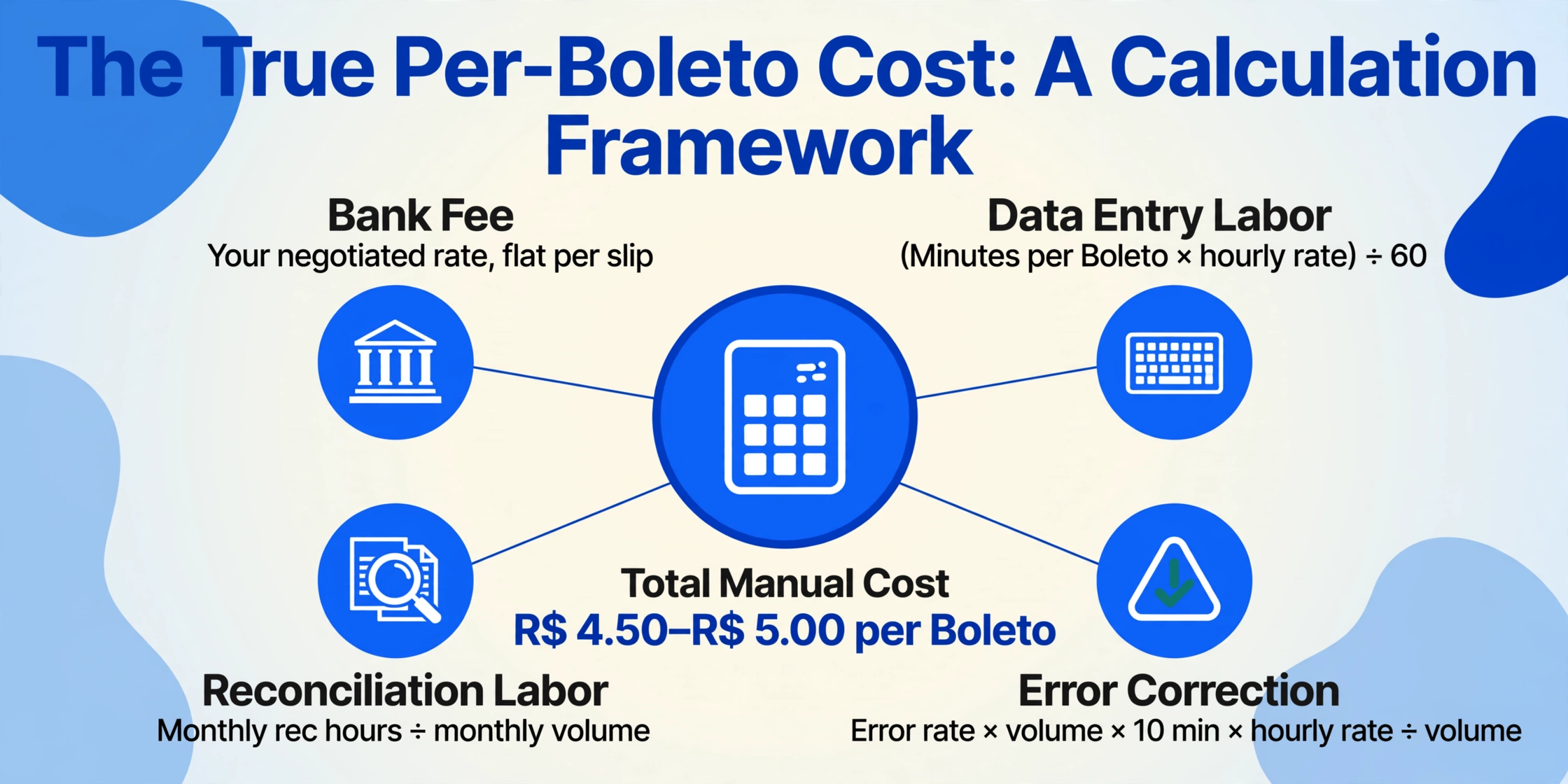
The True Per-Boleto Cost: A Calculation Framework
Rather than give you a single number that may or may not match your operation, here is a framework you can populate with your own numbers.
| Cost Component | Your Input | Calculation | Per-Boleto Cost |
|---|---|---|---|
| Bank fee | Your negotiated rate | Flat per slip | R$ ___ |
| Data entry labor | (Minutes per Boleto × hourly rate) ÷ 60 | 3 min × R$ 20/hr ÷ 60 = R$ 1.00 | R$ ___ |
| Reconciliation labor | (Monthly hours on Boleto rec) ÷ monthly volume | Estimate your team's dedicated rec hours | R$ ___ |
| Error correction | (Error rate × volume × 10 min × hourly rate) ÷ volume | 2% × 500 × 10 min × R$ 20/hr ÷ 500 = R$ 0.07 | R$ ___ |
| Total manual cost | R$ ___ |
For a typical operation (R$ 3.00 bank fee, 3 min data entry, R$ 20/hr labor, moderate portfolio complexity), the total comes to approximately R$ 4.50–R$ 5.00 per Boleto — roughly R$ 1.50–R$ 2.00 more than the visible bank fee alone.
Where Automation Changes the Equation
Automating Boleto data extraction does not eliminate the bank fee — that is a cost of the payment infrastructure. But it can eliminate or significantly reduce the labor and error-correction layers.
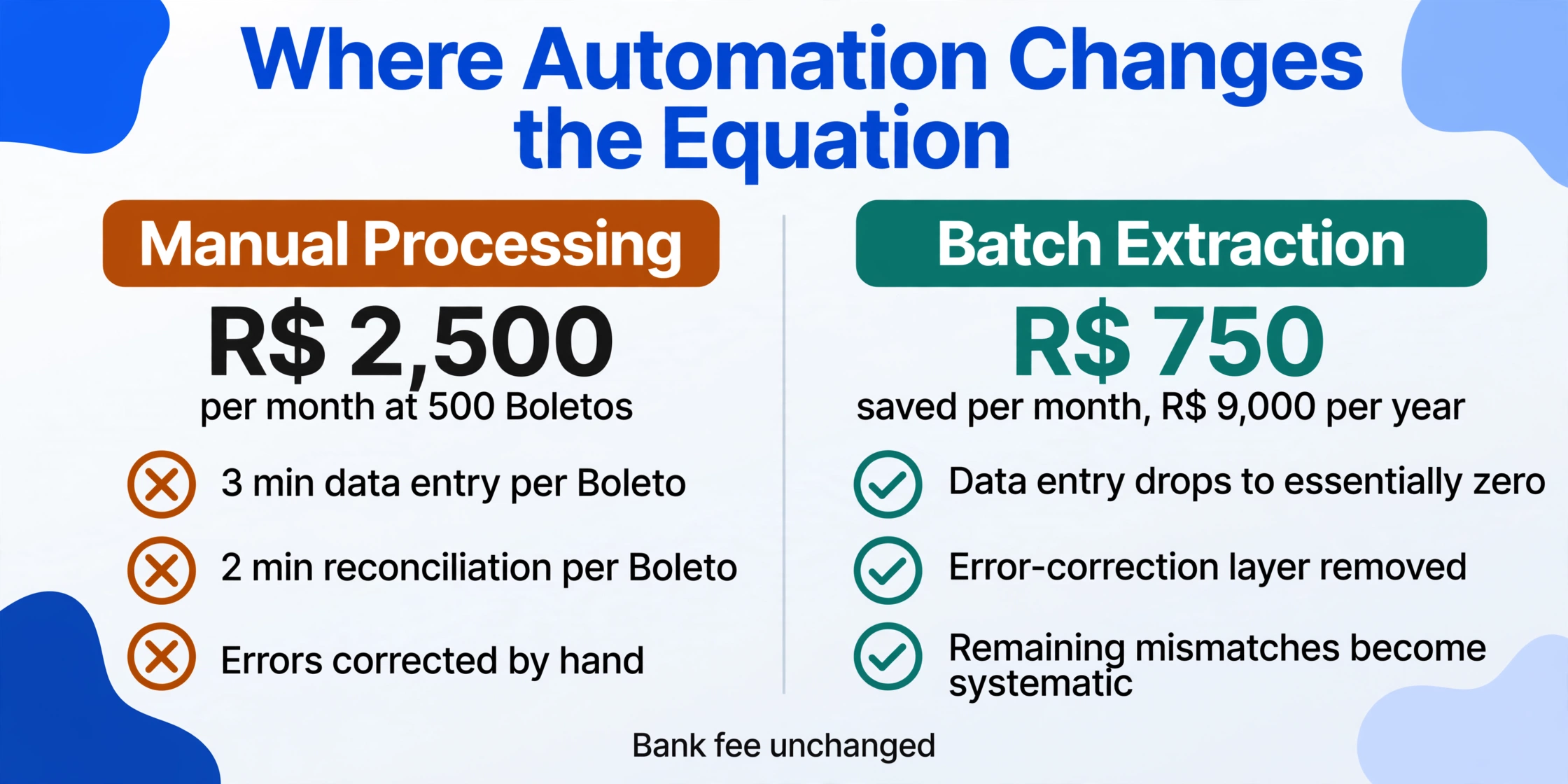
With automated batch extraction, the data entry step (Layer 2) drops from 3 minutes per Boleto to essentially zero — the AI reads all fields from all documents in the batch simultaneously. The reconciliation step (Layer 3) is reduced because discrepancies caused by data entry errors disappear, and the remaining mismatches (late fees, partial payments) become systematic and predictable rather than requiring case-by-case investigation.
Using the framework above, a company processing 500 Boletos per month at R$ 5.00 total cost per slip would spend R$ 2,500 per month on Boleto processing. If extraction automation removes the labor and error-correction layers (roughly R$ 1.50 per Boleto), the monthly savings are R$ 750 — R$ 9,000 per year — from a single process improvement in a single document type.
The Google Sheets add-on extends this further for teams that work primarily in spreadsheets. Rather than exporting extracted data to a file and then importing it, the extraction writes directly into the active sheet — eliminating the export/import step entirely.
Files are processed securely and not stored.
Frequently Asked Questions
Does the bank fee differ between Boleto Registrado and Boleto sem Registro?
Yes. For registered Boletos, banks can charge fees at three points: issuance, payment, and cancellation. For unregistered Boletos, fees apply only when the slip is paid. Registered Boletos are now the standard — since 2017, FEBRABAN's mandate has required that all Boletos be registered, with phased implementation across banks throughout that year. Most businesses today pay only the registered structure.
How does the per-Boleto cost compare to Pix?
Pix transactions cost merchants approximately 0.30% per transaction. For a R$ 200 payment, that is R$ 0.60 — significantly less than the R$ 3.00 average Boleto bank fee. However, Pix does not replace Boleto entirely; many customers, especially in B2B and cross-border contexts, still prefer or require Boleto. For a detailed guide on extracting Boleto data to automate reconciliation, see this walkthrough.
Are there cost savings in switching to digital-only Boleto issuance (paperless)?
Yes. Paper Boletos cost more to process — there is the physical printing and postage cost on top of the bank fee. Digital Boletos, sent via email or made available through a payment link, eliminate those costs. However, the data entry and reconciliation costs remain the same whether the Boleto is digital or printed, since the AR team must still extract the data from the digital PDF.
Do Boleto costs decrease at higher volumes?
Bank fees can be negotiated downward at higher volumes — a company issuing 10,000 Boletos per month can negotiate rates closer to R$ 1.00 per slip. However, the labor cost per Boleto does not automatically decrease at higher volumes; without automation, more Boletos require more people or more overtime. The labor cost is linear. Automation is what breaks that linearity.
How do protesto costs factor into the total?
Protesto (protest) adds a separate cost layer: cartório fees of R$ 50–R$ 150 per protested Boleto, potential legal costs (sucumbência fees of 10-20% in escalated cases), and the operational cost of managing the protesto process. While not every unpaid Boleto goes to protesto, the cost of improperly handled payments — including those caused by data entry errors — can be substantial. This is covered in more detail in our article on Boleto data entry mistakes that trigger protesto.
The Cost You Can Measure vs. The Cost You Can Reduce
The bank fee is the cost you see. The labor and reconciliation costs are the costs you do not see — but they are no less real. Every Boleto that requires 3 minutes of data entry and 2 minutes of reconciliation time is consuming roughly R$ 1.50–R$ 2.00 in payroll cost that does not appear on any invoice.
For teams processing significant volumes, the question is not "can we reduce the bank fee?" — the bank fee is a pass-through cost set by the financial system. The question is "can we reduce the 5 minutes of human attention per Boleto that happens after the bank fee is paid?"
Calculate your own savings.
Upload a Boleto PDF and see how fast extraction works — then apply the framework to your monthly volume.
Try the Calculator