Why Medical Supply PO Reconciliation
Costs More Than Most Hospitals Realize
Ask a hospital supply chain director how many PO line items their team processed last month and they can give you a number. Ask how many failed three-way matching on the first pass — they probably have that figure too. But ask why medical supply invoices fail matching at a fundamentally different rate than invoices in any other industry, and the answers converge on the same surface-level causes: supplier errors, data entry mistakes, tight tolerance thresholds. The structural answer is more specific, more pervasive, and has almost nothing to do with AP process quality. It starts with the fact that a single medical supply item routinely carries three different identification numbers — and none of them are guaranteed to match.
Key Takeaways
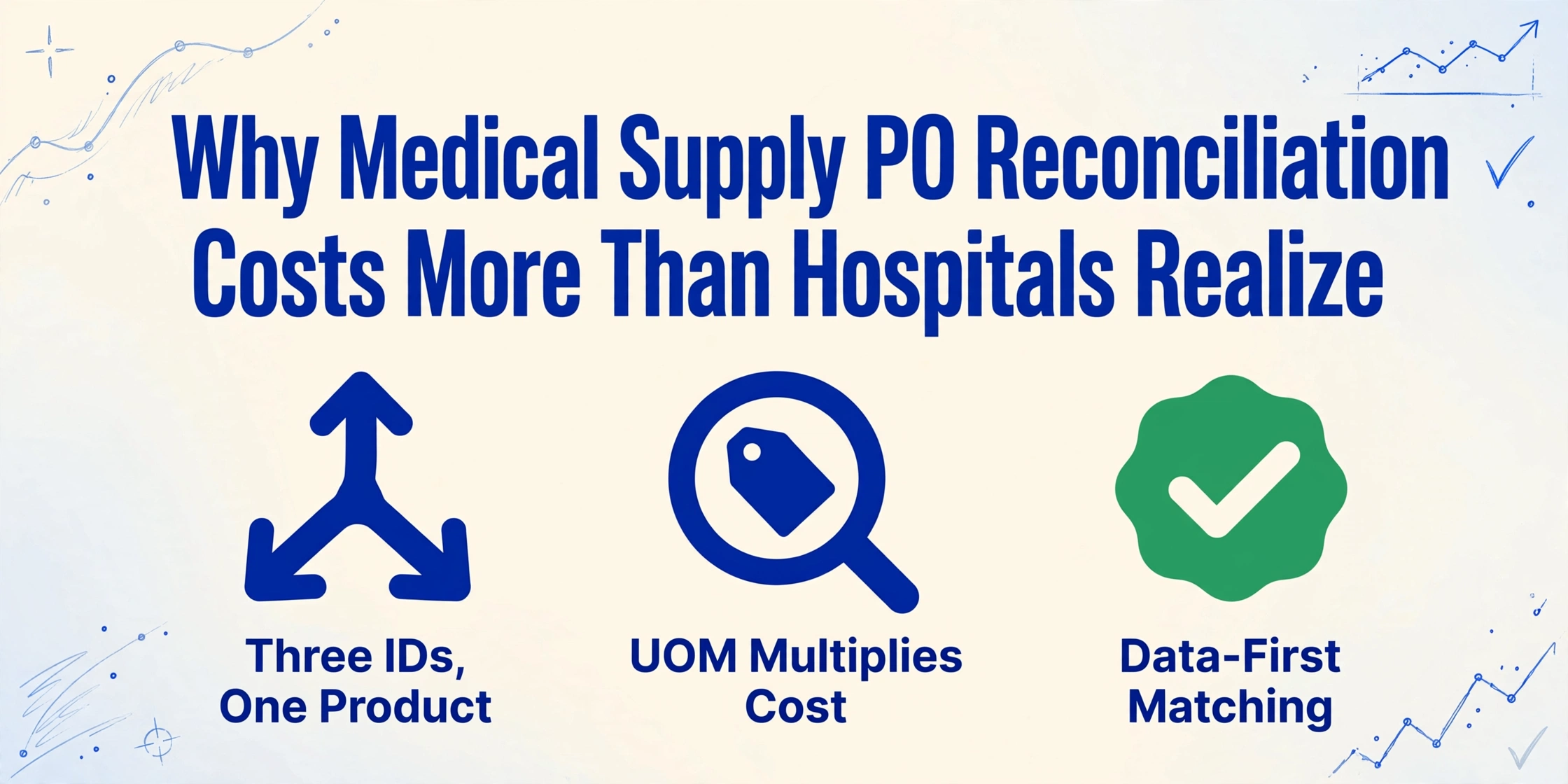
- Your AP team isn't slow — every medical supply item carries three different identification numbers from three different systems and none of them were designed to match each other
- A hospital processing 50,000 invoices annually with a 10% exception rate spends $265,000 per year on manual investigation alone without ever measuring the invisible cost of missed GPO tier savings
- ImageToTable.ai reads the invoice itself instead of reconciling identifiers so the NDC on the invoice and the catalog number on the PO appear in the same record making matching a spreadsheet comparison
A Problem Buried in Routine
In most industries, purchase order reconciliation is difficult. In healthcare, it is structurally different — and most hospitals have never measured the gap. Premier Inc. estimates that up to 70% of healthcare invoices still move through paper-based workflows, and 5–15% contain match exception errors on any given processing cycle. That is not a rounding error. At a mid-size hospital processing 40,000 invoice lines per month, a 10% exception rate means 4,000 lines require manual investigation — each one demanding someone open a purchase order in the ERP, pull up a receiving report, and compare line-item details against a vendor invoice that arrived as a PDF.
The AHRMM Perfect Order KPI defines the standard: a purchase order achieves "perfect order" status only when it is delivered to the correct location, on time, undamaged, at the correct price, in the correct quantity, on the first attempt, and through an electronic process that required no human correction. It is a composite metric that, in practice, very few hospital supply chains consistently hit. Every failure in any one dimension — wrong price, wrong quantity, wrong unit of measure — creates a reconciliation exception that someone, somewhere in the hospital's AP or supply chain department, has to resolve by hand.
What makes healthcare different is not the volume. It is the collision of data systems that manufacturing, retail, and distribution simply do not have to contend with. A box of latex gloves in a hospital supply chain does not have one identification number. It has three — and they live in three different systems maintained by three different organizations. When an invoice arrives, the number printed on it may or may not match the number on the purchase order. And the number in the hospital's item master may match neither.
The reconciliation problem in healthcare procurement does not begin at the matching step. It begins at the product identification step — before the three documents ever reach the same desk.
Three Identifiers, One Product
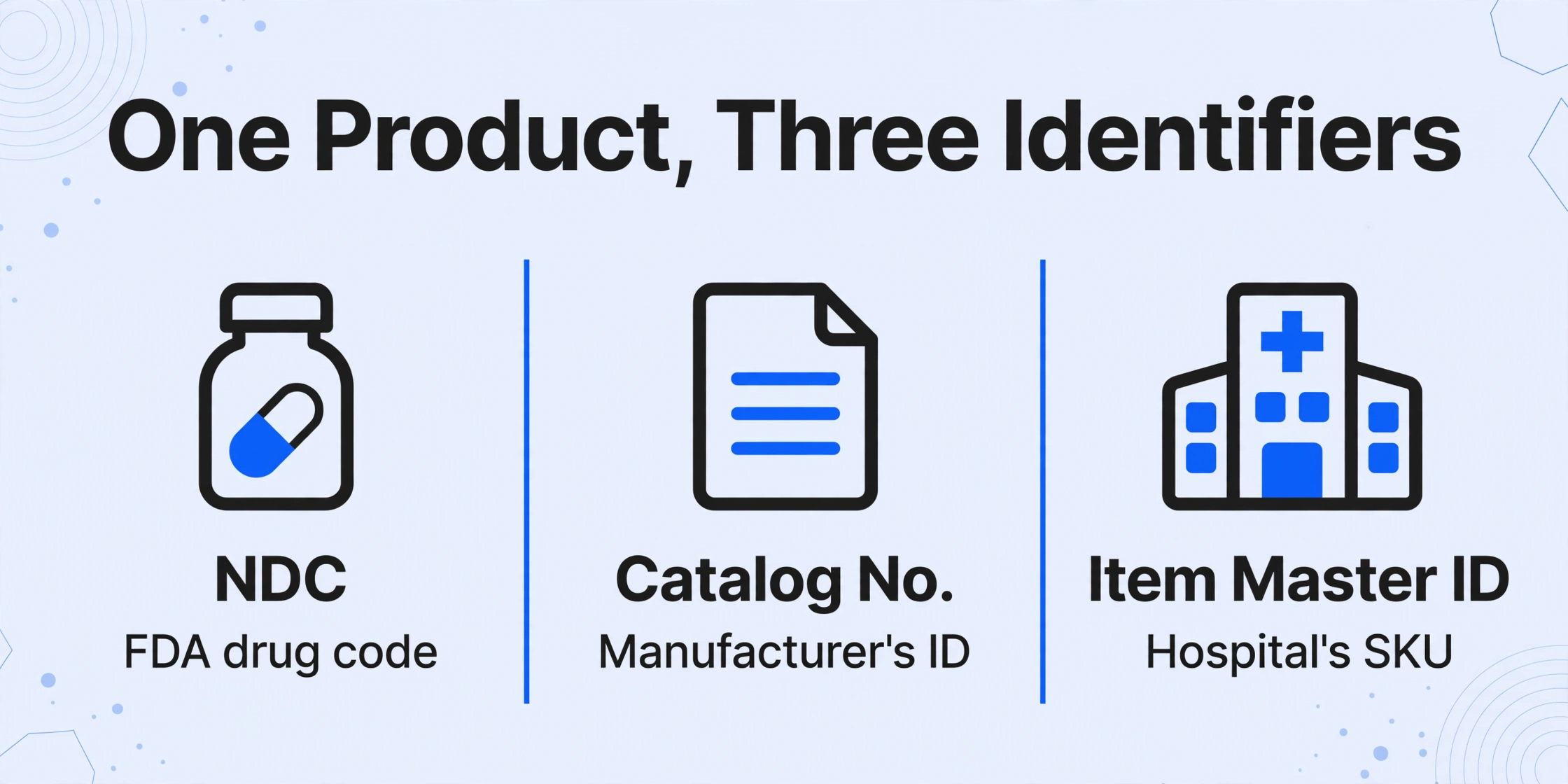
Walk through the procurement chain of a single medical supply item — a box of surgical gloves, a vial of contrast dye, a tray of syringes — and the numbering problem becomes visible.
The manufacturer assigns a catalog number. This is the identifier the supplier uses internally: in their ERP, on their packing slips, on their invoices. For a pharmaceutical or device product, the manufacturer may also assign a National Drug Code (NDC) — a 10-digit number established by the FDA under Section 510 of the Federal Food, Drug and Cosmetic Act — that identifies the labeler, product, and package configuration. For medical devices regulated under the FDA's UDI rule, there is yet another identifier: the Unique Device Identifier, consisting of a Device Identifier (DI) and Production Identifier (PI) that together uniquely identify the device model, lot, and expiration date.
The hospital assigns an item master ID — the internal SKU that the hospital's ERP (Infor, Oracle, Workday, Epic) uses to track inventory, issue purchase orders, and route payments. This number is created and maintained by the hospital's supply chain or materials management department. It is the hospital's own internal taxonomy, and it bears no systematic relationship to either the manufacturer's catalog number or the NDC.
The distributor sits between the manufacturer and the hospital, and may use yet another identifier — the distributor's own SKU, or the GS1 Global Trade Item Number (GTIN), or in some cases the NDC that the manufacturer registered with the FDA. The Drug Supply Chain Security Act (DSCSA) adds another layer: serialized GTINs (SGTINs) that are distinct from NDCs in both character count and format, meaning the serialization identifier on a case of pharmaceuticals is structurally incompatible with the NDC that the hospital's pharmacy system uses for billing and inventory.
Now consider what happens when a purchase order is created. The hospital's procurement system pulls the item master ID. The PO is sent to the distributor. The distributor translates that item master ID into their own SKU or the manufacturer's catalog number. The product is shipped. The packing slip carries the distributor's SKU. The invoice carries — depending on the supplier's billing system — either the manufacturer's catalog number, the NDC, the UDI-DI, or a combination. The receiving dock logs the shipment against the PO, which references the item master ID. Three documents. Three different numbering systems. One product.
The matching process — the step where a human being or an automated system is supposed to verify that the invoice matches the PO matches the receiving report — has to reconcile these three identifiers before any price or quantity comparison can begin. But the identifiers were never designed to reconcile. They were designed by three different organizations operating in three different regulatory frameworks, and they map to each other only through manual cross-reference tables that someone in the supply chain department has to maintain by hand.
A GHX analysis of Perfect Order rates identified product data misalignment — not pricing errors, not quantity discrepancies — as the root cause of most failed PO-to-payment processes. Owens & Minor, one of the largest healthcare distributors in the US, presented at the 2023 GHX Summit on the "negative impacts of product data misalignment on Perfect Order rates." The problem is not that hospitals process POs poorly. The problem is that the data was never aligned to begin with.
A single field relocation by one supplier — updating a catalog number or switching from an NDC to a GTIN — silently breaks the cross-reference table. The matching system flags a mismatch. An AP clerk opens the exception, sees that the PO lists item master ID 84721, the invoice lists NDC 12345-6789-01, and the packing slip lists catalog number SG-400-L. None of them match. The investigation begins.
The United States Pharmacopeia (USP) and FDA are currently transitioning the NDC from a 10-digit to a 12-digit format, with a hybrid period spanning 2033–2036 during which both formats will coexist. Every hospital pharmacy and procurement system will need to handle two NDC formats simultaneously — on top of the catalog number, item master ID, GTIN, and UDI-DI that already circulate. The numbering collision is about to get worse before it gets better.
Where the Unit of Measure Multiplies the Problem
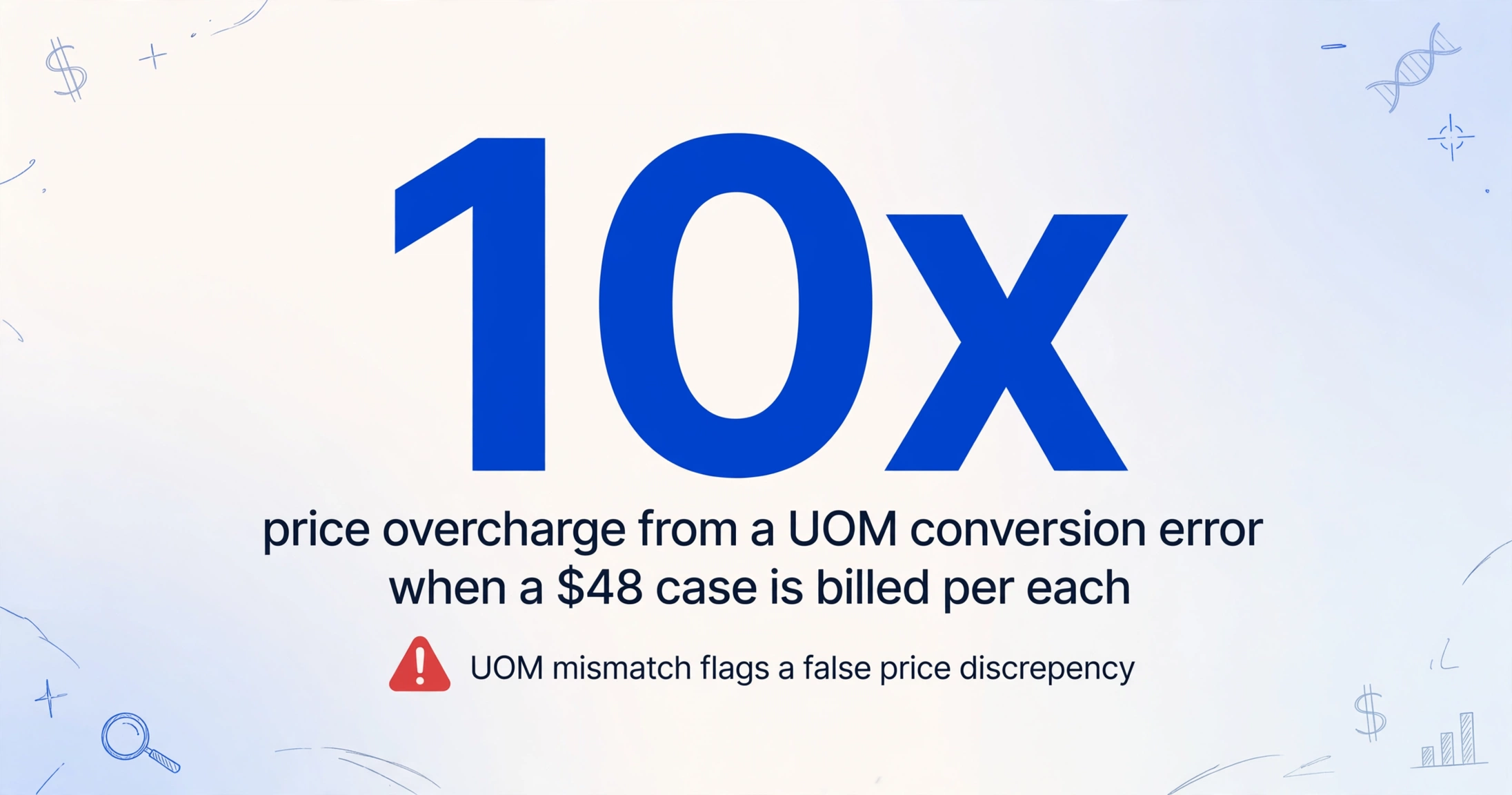
If the three-identifier collision is the structural problem that makes healthcare PO reconciliation uniquely hard, the unit-of-measure mismatch is the force multiplier that turns a data alignment problem into a financial one.
Medical supplies are sold, shipped, stored, and billed in units that rarely stay consistent across the supply chain. A manufacturer packages surgical gloves in boxes of 100. The distributor sells them in cases of 10 boxes. The hospital's central supply stocks them by the each — pulling individual gloves for procedure carts. The PO might specify "1 case (10 boxes of 100)." The packing slip might record "1 case." The invoice might charge "$48 per case" — but if the supplier's billing system prices per each and the conversion factor is wrong, a $48 case price becomes a $48 per-unit charge. A correctly priced line item suddenly reflects a 10x or 100x overcharge, and the three-way match flags a price discrepancy that looks like a supplier error but is actually a unit conversion failure buried in the cross-reference table.
A Definian analysis of healthcare supply chain data found that unit-of-measure inconsistencies across functional areas create cascading exceptions in procurement, inventory, and accounts payable — and that incorrect UOM relationship data can cause supply chain failures as fundamental as ordering 10 boxes when you actually need 100. This is not a niche problem. A hospital that stocks 2,000 unique SKUs across its supply chain — a modest number for a mid-size facility — is maintaining thousands of unit conversion factors. Every new product added to the formulary introduces new conversion factors. Every supplier that changes packaging configuration introduces new conversion factors. Every ERP system upgrade that resets default units introduces new conversion factors.
On Reddit's r/supplychain, healthcare procurement professionals consistently rank UoM mismatches as their most persistent reconciliation headache. One supply chain manager described the dynamic bluntly: when the PO says "case," the invoice says "each," and the receiving record says "box," the three-way match was never going to work — regardless of how carefully the AP team checks the numbers.
The Identimedical analysis of hospital supply chain failures identified vendor SKU changes as a chronic source of item master mismatches. Suppliers change catalog numbers, packaging configurations, and units of measure routinely — and the hospital's item master, maintained by an understaffed supply chain team, lags behind. When the scanned SKU on a delivery doesn't match the item master, the receiving process breaks. When the receiving process breaks, the three-way match breaks. The reconciliation exception that lands on an AP clerk's desk two weeks later is the downstream symptom of a data maintenance failure that happened months earlier in a different department.
GPO Tier Pricing: The Contract That Silently Changes
Most industries have negotiated supplier pricing. Healthcare has Group Purchasing Organization (GPO) tier pricing — a multi-layered contracting structure that adds another dimension of complexity to PO reconciliation.
A GPO negotiates volume-based discounts on behalf of thousands of member hospitals. A hospital commits to a certain purchasing volume tier — say, Tier 3 pricing on surgical implants, which requires $500,000 in annual spend with a given manufacturer. The GPO contract specifies the tier price. The distributor's pricing file should reflect that tier price. The vendor's invoice should charge that tier price. But the tier is not a static field. It changes when the hospital's actual purchasing volume crosses a threshold, when the manufacturer renegotiates the GPO contract, or when a hospital converts from one GPO to another mid-year.
The Healthcare Industry Distributors Association (HIDA) has documented a taxonomy of chargeback and pricing discrepancy scenarios that arise specifically from GPO tier structures. When a hospital converts from one GPO to another, the manufacturer continues honoring the former GPO's pricing while the new tier assignments are negotiated — generating thousands of credits and chargebacks during the conversion period, each one requiring manual reconciliation. When a hospital's purchasing manager is on vacation and forgets to send a GPO Letter of Commitment (LOC) for a tier upgrade, the distributor continues billing at the old tier while the hospital operates at the new tier's volume, creating a pricing gap that compounds with every order. When a distributor qualifies for a manufacturer chargeback but only applies for it above a certain dollar threshold, the omitted chargebacks go unacknowledged by both parties, quietly distorting the hospital's actual supply costs.
The chargeback reconciliation process itself is a structural friction point. A manufacturer sells to a distributor at wholesale price. The distributor sells to the hospital at the GPO-negotiated contract price. The manufacturer then issues a chargeback to the distributor to cover the difference between wholesale and contract price. The chargeback claim has to match across four entities: the manufacturer's contract records, the distributor's sales data, the GPO's membership roster, and the hospital's purchase order. The ProfitOptics analysis of healthcare chargeback administration calls this a "4x4 match" — four players, four data sources — and notes that thousands or even millions of dollars move back and forth unsubstantiated when any one of the four data sets is out of alignment.
For the hospital AP team reconciling a single invoice, this means the price on the supplier's invoice might be correct for Tier 3 but wrong for Tier 4, correct for GPO A but wrong for GPO B, correct for the contract date but wrong for the shipment date. The invoice looks normal. The price is a valid contract price. It is just the wrong contract price for that hospital at that moment — and catching it requires cross-referencing the invoice against GPO contract schedules, tier assignment letters, and chargeback records that live in systems the AP team may not even have access to.
A hospital processing 50,000 invoices annually with a 10% exception rate and an average $53 rework cost per exception — the figure commonly cited in APQC AP benchmarks for manual exception resolution — spends $265,000 per year on reconciliation rework alone. That is the visible cost. The invisible cost — GPO savings that never materialize because tier pricing was never validated — is almost certainly higher.
Why ERP Matching Modules Leave the Gap
The natural assumption is that enterprise software should handle this. Infor, Oracle PeopleSoft, Workday, and SAP all include three-way matching modules designed to compare PO line items against receiving records and invoices automatically. PeopleSoft's Matching Workbench, for example, checks a list of matching conditions that an invoice must fulfill before it can be matched and paid — establishing a three-way match between the invoice, purchase order, and receipt. The logic is mature and well-documented.
But ERP matching modules were built for a world where one product has one identifier, and that identifier is consistent across the PO, the packing slip, and the invoice. They were built for manufacturing procurement — where a raw material SKU means the same thing to the buyer, the supplier, and the receiving dock. They were not built for an environment where the same product is identified by an NDC in the pharmacy system, a catalog number in the distributor's billing system, a GTIN on the case label, and an item master ID in the hospital's ERP — with no automated cross-reference between any of them.
Clarium Health's analysis of healthcare ERP matching found that even after implementing intelligent four-way matching — adding contract validation to the traditional three-way comparison — hospitals still needed manual intervention for a significant share of exceptions because the root cause was not a matching logic failure. It was a data alignment failure upstream. The contract data lived in one system. The PO data in another. The receiving data in a third. The matching module could compare them, but only after a human being had already aligned the identifiers — which is precisely the step that consumes the most time.
In a Reddit discussion among hospital supply chain professionals, the frustration with ERP matching modules was consistent: the system flags an exception but provides none of the context needed to resolve it. An AP clerk sees "Quantity mismatch — PO: 10, Invoice: 1000" and has to independently determine whether the discrepancy is a real shortage or a unit-of-measure conversion that the system failed to apply. The ERP knows that the numbers don't match. It does not know why they don't match. And the "why" — the NDC versus catalog number, the each versus case, the Tier 3 versus Tier 4 — is what determines whether the exception takes five minutes or five days to resolve.
Nobody Owns the Gap
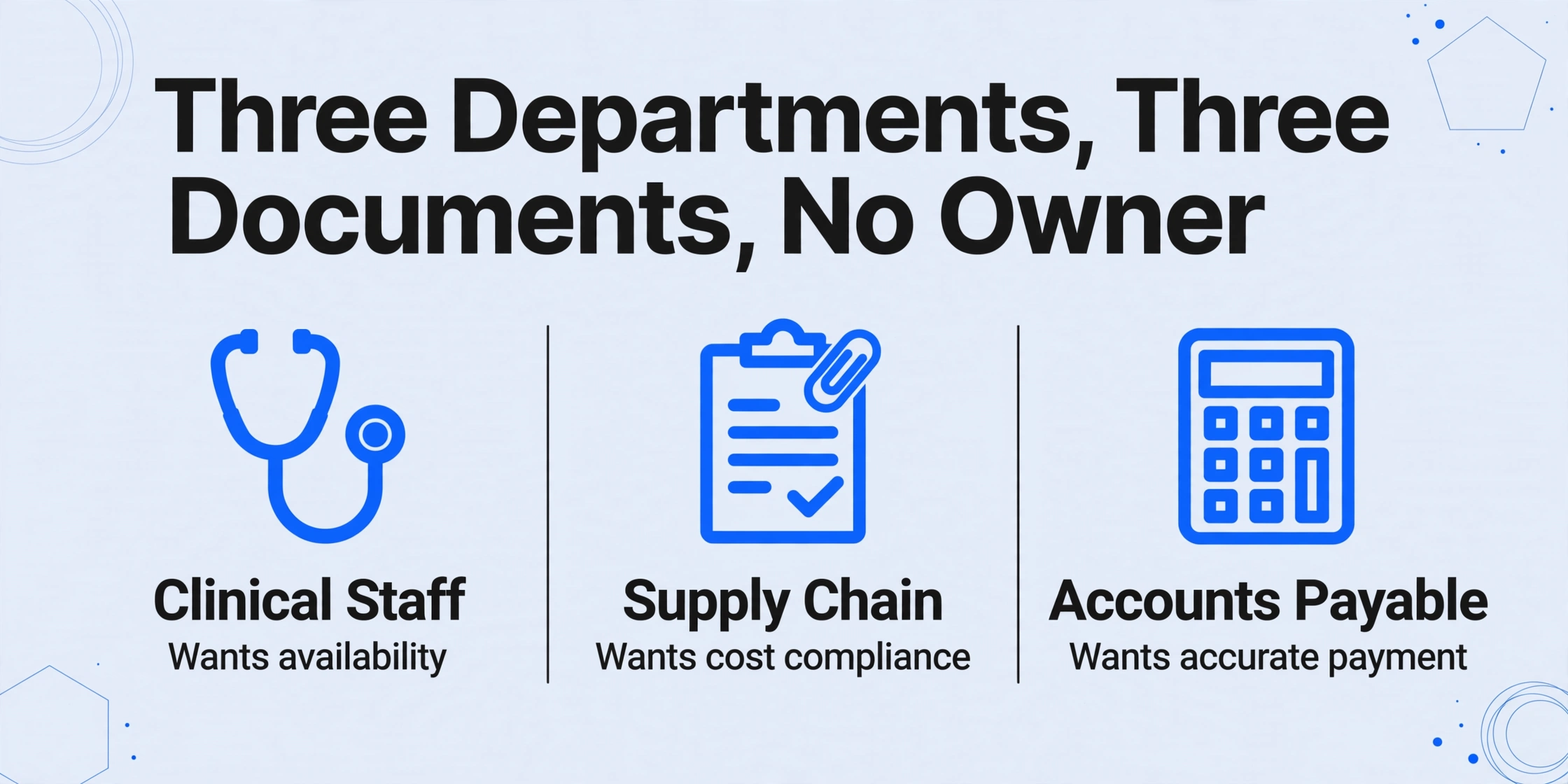
The most overlooked dimension of medical supply PO reconciliation is organizational. Three departments handle the three documents, and each has incentives that are structurally misaligned with accurate matching.
Clinical staff and department managers initiate the requisition. Their incentive is availability — making sure the supplies needed for tomorrow's procedures are on the shelf. They specify the product by its clinical name or by the item they have used before. They rarely reference an item master ID, and they almost never reference a manufacturer catalog number. Their requisition is functionally accurate — "the same surgical gloves we always order" — but structurally incomplete as a matching document.
Supply chain and procurement convert the requisition into a purchase order. Their incentive is cost and contract compliance — buying from approved vendors at GPO-negotiated prices. They translate the clinical description into an item master ID, select the GPO contract, and issue the PO. They do not see the invoice. They do not log the receipt. Their job ends when the PO is issued.
Accounts Payable receives the invoice — a PDF from a distributor they did not select, referencing a product identifier they did not assign, at a GPO tier price they did not negotiate. Their job is to verify that the hospital pays only for what was ordered and received, at the correct price. But the data they need to perform that verification — the item master cross-reference, the GPO contract schedule, the tier assignment letter — lives in systems they may not have access to, maintained by departments with different reporting structures and different priorities.
The AHRMM Keys for Supply Chain Excellence explicitly recognize this organizational gap. The Perfect Order KPI is defined as a composite metric specifically because it "cuts across functional silos" — procurement, receiving, AP, and clinical departments — and "helps galvanize collaboration across the internal/external organizations collectively responsible for supply chain performance." The fact that AHRMM had to build a KPI to measure cross-silo collaboration is itself an acknowledgment that, in most hospitals, the silos are the default.
The result is a reconciliation process where no single person has access to all three data sources, and no single department is accountable for the outcome. The AP clerk who catches a price discrepancy has to call procurement to verify the contract, call the receiving dock to verify the delivery, and call the distributor to verify the invoice — three phone calls, across three departments, to resolve one exception on one line item. Multiply by 4,000 exceptions a month.
The Costs Nobody Measures
The financial cost of manual PO reconciliation in healthcare — the $53 per exception, the missed early-payment discounts, the duplicate payments — is concrete and quantifiable. The operational and clinical costs are harder to measure but arguably larger.
When a hospital's accounts payable ages past 60 days because exceptions are piling up, the suppliers respond predictably: credit holds. A hospital on credit hold with its primary medical-surgical distributor cannot receive supplies. A procedure scheduled for Thursday gets postponed to Friday — or cancelled — because the specific implant or consumable that was supposed to arrive on Wednesday is sitting on a truck that the distributor will not release until the outstanding balance is cleared. The delay traces directly back to a reconciliation exception that was opened three weeks ago and never resolved — not because the invoice was wrong, but because the NDC on the invoice did not match the catalog number on the PO, and the AP clerk who opened the exception did not have access to the cross-reference table that would have confirmed they were the same product.
This is the domino effect that Premier's Remitra team has documented: a price discrepancy between a provider's PO and a supplier's invoice creates an exception. The invoice is set aside. The provider does not pay. The account ages. A credit hold is placed. The provider cannot get products. The problem started in the supply chain — specifically, in the data layer that was supposed to align the PO, the invoice, and the contract — and it ends at the patient's bedside.
The staffing cost is equally diffuse. AP clerks and supply chain specialists who spend 60% of their week investigating reconciliation exceptions are not available for the work that actually improves procurement outcomes: analyzing spend patterns, renegotiating contracts, optimizing inventory levels. A hospital supply chain professional on Reddit described the cumulative effect: "Healthcare purchasing is pretty brutal." The brutality is not the volume of work. It is the nature of the work — reconciling identifiers that were never designed to reconcile, in systems that were never integrated, across departments that were never aligned.
A Navigant survey found that US hospitals lose an estimated $25.7 billion annually from unnecessary spending on supply chain products and related operations. A portion of that — impossible to isolate but impossible to ignore — is the accumulated cost of reconciliation exceptions that were never designed out of the process because the process was built on incompatible data systems from the start.
What Changes the Equation
The healthcare supply chain has spent two decades layering technology onto a reconciliation problem that is fundamentally a data problem. ERP matching modules, GPO contract management platforms, chargeback automation tools — all of them assume that the identifiers on the three documents already agree, or can be made to agree through better cross-reference maintenance. The assumption is wrong. The identifiers were never designed to agree, and maintaining cross-reference tables manually is an infinite game with no winning condition.
What changes the equation is not a better matching algorithm. It is removing the identifier dependency from the matching step entirely. If an invoice arrives as a PDF — from any distributor, in any format, carrying any product identifier — and the data it contains can be extracted into structured form in seconds, then the matching logic operates on the data itself, not on the identifiers. The NDC on the invoice, the catalog number on the PO, and the item master ID in the ERP become three attributes of the same extracted record rather than three incompatible keys that must be reconciled before any comparison can begin.
This is not a hypothetical workflow. Tools built on vision-language models can read a purchase order or vendor invoice the way a human AP clerk reads it — by understanding what each field means, not by locating it at a fixed coordinate. When you define extraction columns like "NDC," "Catalog Number," "Item Description," "Quantity Ordered," and "Unit Price," the AI reads the document, identifies each field by its semantic content, and populates the corresponding column — regardless of where the field appears on the page, which supplier sent the document, or which numbering system the supplier used. The output is a structured record where all three identifiers sit side by side, and the matching step becomes a spreadsheet comparison — not a three-department investigation.
When hospital supply chain teams can extract data from medical supply purchase orders into a single spreadsheet, the reconciliation bottleneck shifts from data alignment to data verification — a fundamentally different task that takes seconds instead of hours. When procurement departments can batch-process purchase orders across multiple vendors into consolidated spend reports, the cross-reference table maintenance that currently consumes supply chain FTEs becomes optional — because the extraction engine reads the identifiers directly from each document and presents them together, rather than requiring a human to align them first.
The hospital supply chain that achieves this does not eliminate reconciliation exceptions. It eliminates the structural cause of the exceptions — the three-identifier collision — by collapsing three incompatible data sources into one structured record before the matching logic ever runs. That is not an incremental improvement. It is a category change in how healthcare procurement data flows.
Files are processed securely and not stored.
Frequently Asked Questions
Why does medical supply PO reconciliation fail more often than in other industries?
Healthcare procurement carries a structural complexity that manufacturing and retail do not face: a single product item routinely carries three different identification numbers — an NDC (or UDI-DI for devices), a manufacturer catalog number, and a hospital item master ID — none of which are systematically cross-referenced. Add unit-of-measure mismatches (each vs. case vs. pack) and GPO tier pricing that shifts without notice, and the reconciliation step has to resolve data incompatibility before it can even begin matching quantities and prices.
Can a hospital's ERP system handle PO matching automatically?
ERP matching modules (Infor, Oracle PeopleSoft, SAP) can compare PO lines against receiving records and invoices — but only when the product identifiers on all three documents are consistent. In healthcare, where the invoice may carry an NDC, the PO may reference an item master ID, and the packing slip may use a distributor SKU, the ERP flags a mismatch before any comparison can run. The matching logic works. The data alignment does not. Until the identifiers are reconciled — typically through manual cross-reference tables — the matching module cannot function as designed.
What is the most common type of PO-invoice mismatch in healthcare procurement?
Unit-of-measure mismatches are consistently cited as the most persistent source of reconciliation exceptions. Medical supplies are sold, shipped, stored, and billed in different units (each, box, case, pack, pallet), and conversion factors are not reliably maintained across supplier systems, distributor pricing files, and hospital ERPs. A price discrepancy that looks like a supplier error is frequently a unit conversion failure — the invoice charged per each when the contract priced per case, or vice versa.
How does GPO contract pricing affect PO reconciliation?
GPO tier pricing adds a verification step that does not exist in standard three-way matching. An invoice may show a valid contract price — but for the wrong tier, the wrong GPO, or the wrong contract period. Catching this requires cross-referencing the invoice against GPO contract schedules, tier assignment letters, and chargeback records that often live in systems separate from the AP workflow. The hospital may be paying the negotiated price for Tier 3 when it has actually qualified for Tier 4 — and without systematic reconciliation, the overpayment can persist for months before anyone notices.
What is the financial impact of unresolved PO reconciliation exceptions in a hospital?
The direct cost is measurable: at an average $53 in rework per exception and a 10% exception rate across 50,000 annual invoices, that is roughly $265,000 per year in manual investigation labor. The indirect costs — missed early-payment discounts, duplicate payments, credit holds that delay supply deliveries, and GPO savings that never materialize because tier pricing was never validated — are almost certainly higher but rarely attributed to reconciliation failures in hospital financial reporting.
Does AI document extraction work with medical supply invoices that use NDC codes or UDI identifiers?
Yes — and this is where the approach differs fundamentally from template-based extraction. A vision-language model reads a document by understanding what each field means semantically, not by locating it at a fixed coordinate. When you define a column called "NDC" or "Catalog Number," the AI identifies that field on the document regardless of where it appears, which supplier sent it, or which numbering system they used. This means a single extraction configuration works across invoices from multiple distributors — without building or maintaining per-supplier templates. The output is a structured record where the NDC, catalog number, and item master ID appear side by side, and the matching step becomes a straightforward comparison rather than a multi-system investigation.
The reconciliation problem in healthcare procurement is not going to be solved by better matching logic. It will be solved by collapsing three incompatible data sources into one — before the matching step begins.
Extract Your First Purchase OrderNo sign-up required. Free to try.