Why Freight Invoice Reconciliation
Costs More Than Logistics Teams Think
A typical product invoice has four charge lines on it. A freight invoice — even a straightforward LTL shipment — lands with eight to twelve. Base freight. Fuel surcharge calculated off an index that changed since the quote was issued. Three to five accessorials (liftgate, residential delivery, inside delivery, detention, appointment fee), each billed under a code unique to that carrier. A freight class that may have been re-classed between pickup and billing. By the time you've finished reading the invoice, you're not just verifying a payment — you're auditing a compound document against a contract spreadsheet, a rate confirmation email, a fuel surcharge table updated last Tuesday, and an NMFC classification lookup. Most logistics teams are doing this cross-reference work manually, in Excel, against a month-end clock. And industry data suggests 5-10% of those invoices contain at least one overcharge nobody catches.
Key Takeaways
- Your AP team spends 15 to 20 hours a week on freight invoice reconciliation — but almost none of that time is actually spent verifying charges against contracts.
- Five to 10 percent of freight invoices contain an overcharge, and those errors survive month after month because line-level verification across thousands of charge lines is structurally impossible under a three-day close window.
- ImageToTable.ai extracts freight invoice data in 10 seconds — what used to take 10 minutes — and when the time budget flips, your team stops triaging by dollar amount and starts line-checking by default, catching the $30,000 to $80,000 in recoverable overcharges that used to slip through.
A freight invoice isn't a longer product invoice — it's a fundamentally different document
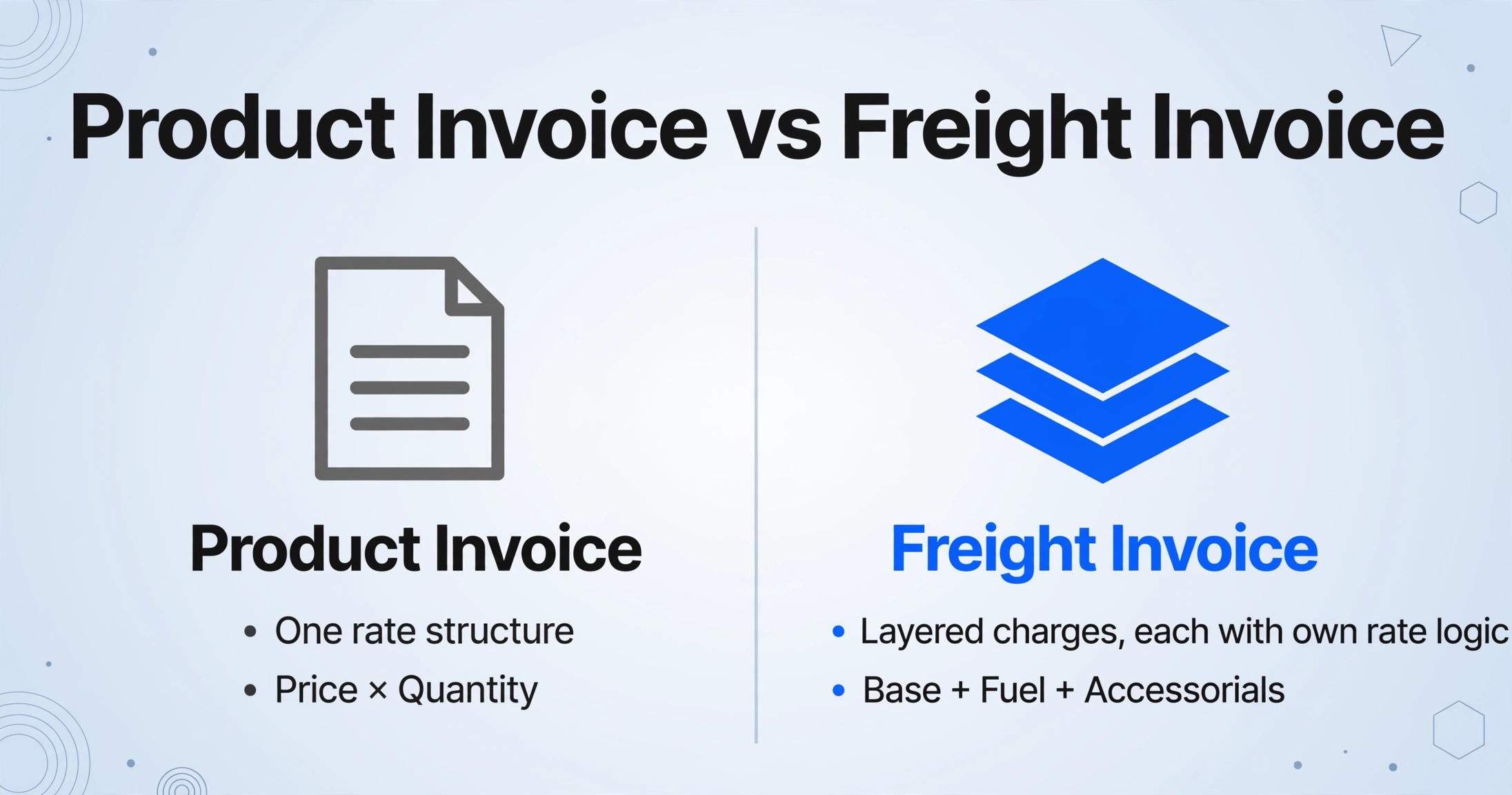
The simplest way to understand why freight invoice reconciliation consumes so much more time than standard AP work is to count what you're actually reconciling. A product invoice follows a predictable structure: item description, unit price, quantity, line total, subtotal, tax, grand total. The invoice has one rate structure (the agreed unit price), one discount tier, and one tax rate per jurisdiction. Even a multi-page product invoice with fifty line items is reconciling one thing — price × quantity — across fifty rows.
A freight invoice has layered charges, each operating under its own rate logic. The base freight charge is calculated from a contract rate table keyed to origin-destination lane, weight break, and freight class — three variables before you get to a single dollar figure. The fuel surcharge is a percentage of that base, but the percentage itself is a function of the U.S. Energy Information Administration's weekly diesel price index applied through a carrier-specific surcharge table that may have different breakpoints at $3.00, $3.50, and $4.00 per gallon. The accessorial charges — detention, liftgate, residential delivery, limited access, re-delivery — each has its own trigger condition, its own rate, and in many cases its own dispute window. An NMFC class correction applied after pickup but before billing changes every calculation upstream.
In a product invoice reconciliation, you're verifying one calculation across multiple rows. In a freight invoice, you're verifying three to five different calculation types across a single row — and each type references a different source document. The verification workload doesn't scale linearly with the number of line items. It scales with the number of rate regimes you're cross-referencing per line item.
Accessorial charges alone illustrate the structural asymmetry. According to industry data from Nuvocargo's freight cost analysis, accessorials add 8-15% to a typical freight invoice, and 25-40% of invoices include at least one accessorial charge beyond the fuel surcharge. In LTL programs — where shipments consolidate goods from multiple shippers — that rate climbs to 40-60% of invoices. The same carriers that bill these accessorials use internal codes that differ from one another for the same service. One carrier calls a truck-waiting fee "detention." Another calls it "per diem." A third absorbs it into an "appointment fee" that may or may not include waiting time. Your AP clerk sees three different line-item labels for the same underlying event and has to recognize they are comparable before any audit logic can apply.
This is the structural gap that product-invoice AP automation was never designed to bridge. A standard invoice OCR tool that matches "Unit Price" against a PO line item doesn't know what to do with a fuel surcharge that references the EIA diesel index for Week 23 of the current quarter. The tool was built for one rate regime. Freight invoices operate under five.
Why carrier portals don't solve the problem — they fragment it
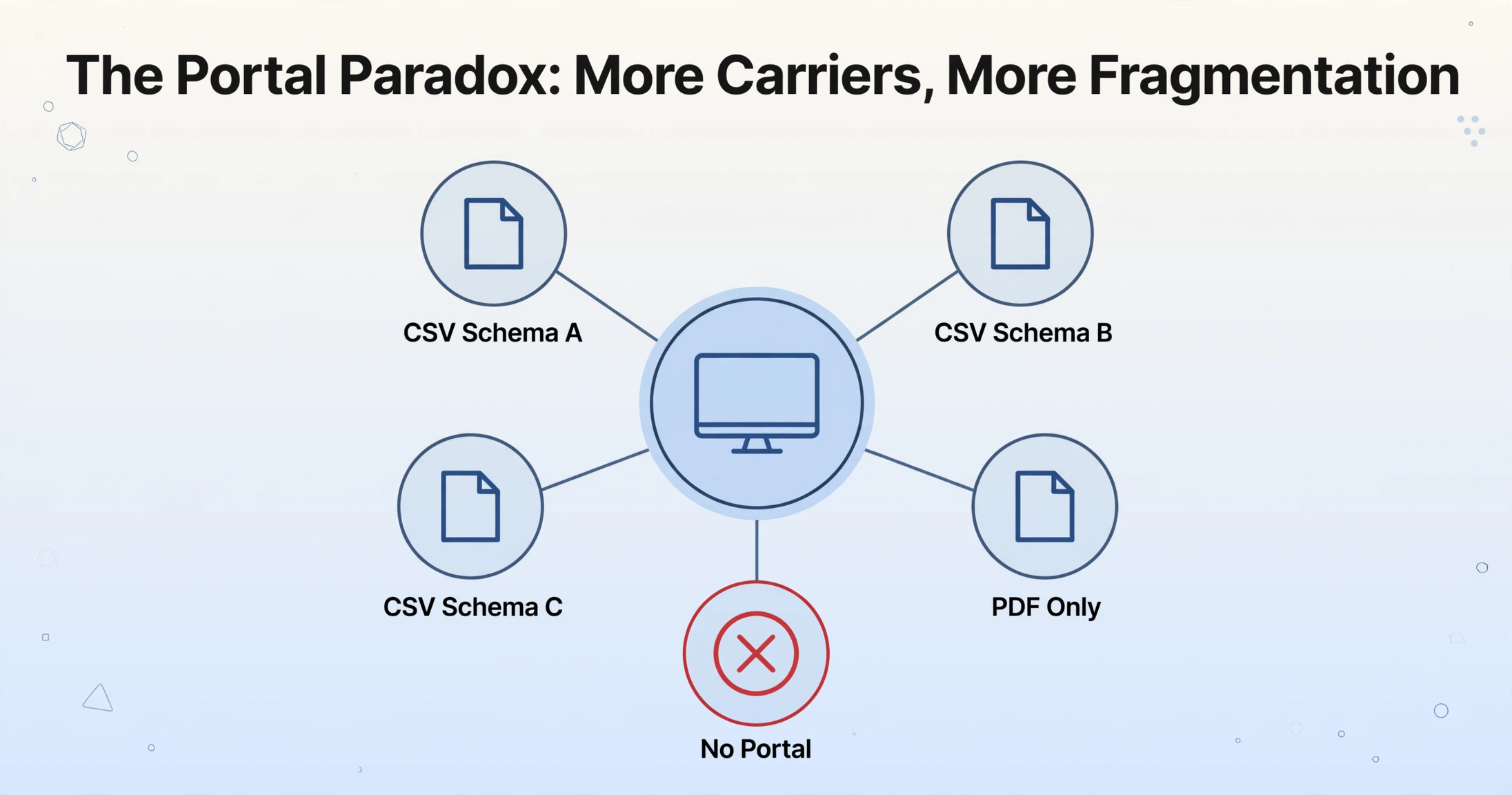
The standard advice — "use the carrier's portal to download invoice data" — sounds like a reasonable intermediate step between full manual entry and full automation. In practice, it replaces one bottleneck with eight.
A mid-market shipper working with 5-10 carriers faces 5-10 different billing portals, each with its own login, its own data export format, and its own definition of what constitutes a "downloadable report." FedEx Freight's billing portal exports one CSV schema. Old Dominion's exports another. SAIA's portal groups accessorials under a different column hierarchy than Estes. A regional carrier serving one of your lanes may have no portal at all — they email a PDF. By the time your AP team has logged into six portals, downloaded six CSV files with six different column structures, and re-keyed the data from two PDF-only carriers, they've spent thirty minutes preparing to reconcile — before any actual comparison against your rate cards has begun.
The fragmentation isn't theoretical. Carriers label identical services under different names — one carrier's "inside delivery" is another's "white glove service," and a third bills it as "threshold delivery — non-residential." Until someone in your AP department manually maps each carrier's terminology to your internal chart of accounts, there is no unified view of freight spend across carriers. The portal gives you data. It does not give you reconciliation.
This is the portal paradox: the more carriers you work with, the more "free" invoice data portals are available to you — and the more time you spend aggregating data from those portals into a single spreadsheet where reconciliation can actually happen. The bottleneck moves from "I can't get the data" to "I have the data in eight different shapes and need to make them comparable before I can use them." For many logistics AP teams, the spreadsheet is where the portal downloads go to become usable — and building that spreadsheet is manual work that no carrier portal was designed to eliminate.
5-10% error rate: the line-level audit that can't happen in a PDF viewer
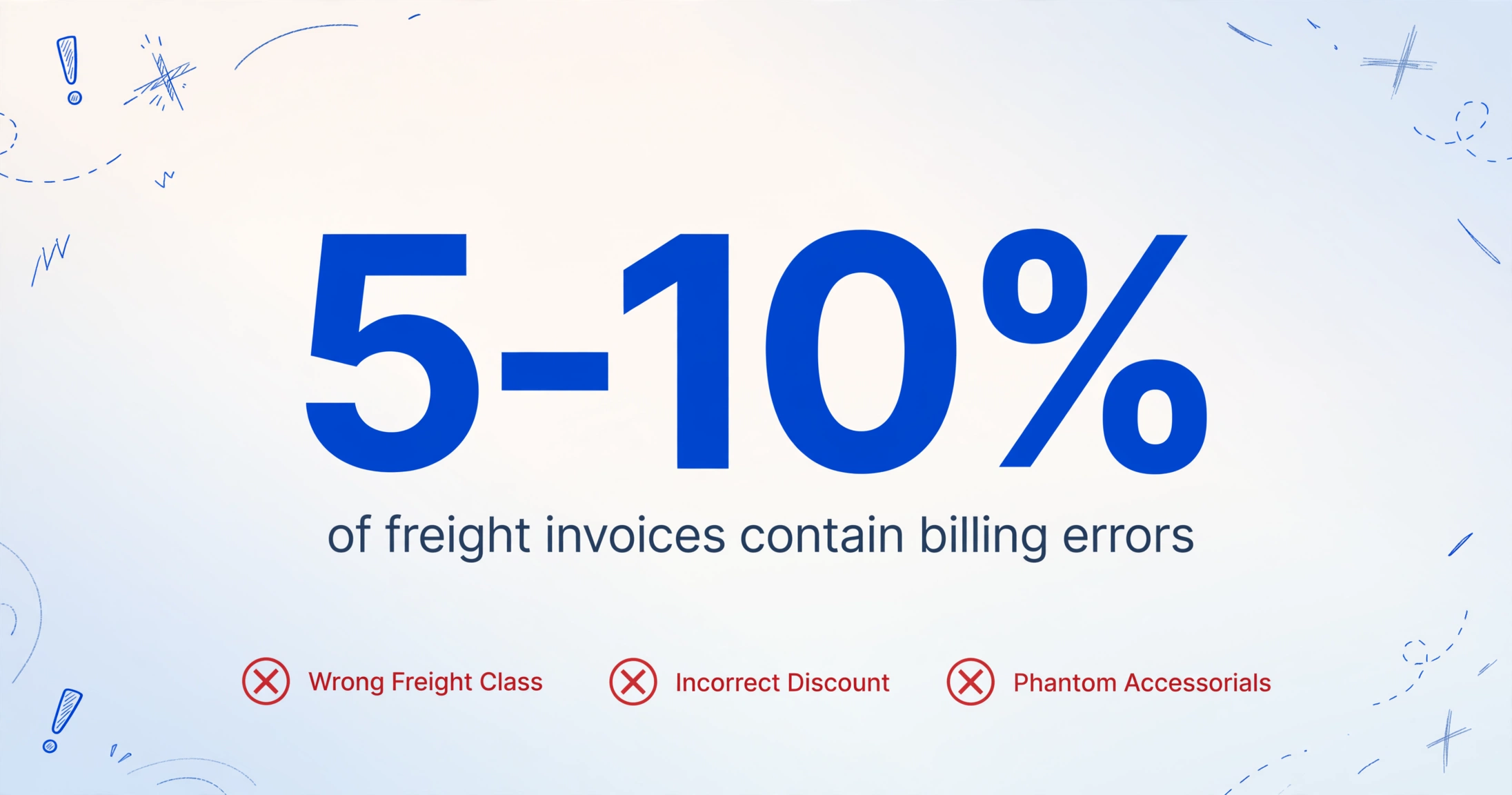
Industry estimates converge on a range that should concern any logistics finance leader. Warp's freight audit analysis puts the error rate at 5-10% of invoices. Shipware's data suggests roughly 25% of freight invoices contain some form of error. Transportation Insight found that 3-6% of invoices studied in a typical audit contain errors — and that the majority of those errors stem from accessorial charges or misapplied discounts. The variation in these numbers reflects different methodologies (spot audits vs. systematic reviews, LTL vs. truckload, small parcel vs. freight), but the consistent finding across all sources is that carrier billing errors are systematically under-detected in manual processes.
The errors fall into predictable categories — which also means they're predictable enough that a systematic review should catch them, if that review were practical at scale:
- Wrong freight class. A commodity that shipped at NMFC class 70 (density 15-22.5 lbs/cu ft) gets re-classed to class 85 (12-15 lbs/cu ft) between pickup and billing. The per-hundredweight rate increases, and unless someone checks the BOL against the invoice, the overcharge stands. The National Motor Freight Traffic Association's 18-class system — from class 50 (dense, cheap to ship) to class 500 (light, expensive) — means a two-class shift can change the rate by 15-25% on a single shipment.
- Incorrect discount application. The contract specifies a 72% discount off the carrier's tariff rate for lanes under 500 miles, but the discount tier applied on the invoice is 68% — either because the billing system defaulted to a lower tier or because the shipment crossed a mileage threshold the AP clerk doesn't have visibility into without pulling the rate confirmation.
- Accessorials billed without service rendered. A liftgate charge appears on an invoice for a delivery to a loading dock. A residential surcharge is applied to a commercial address. Detention is billed at two hours when the driver was on-site for 45 minutes. These errors are impossible to verify from the invoice alone — they require cross-referencing the delivery receipt, the BOL, and sometimes the carrier's own tracking data.
- Fuel surcharge calculated off the wrong index or week. The carrier's billing system applies last week's surcharge rate instead of the rate in effect on the shipment date. The difference is typically 0.5-1.5% of the base — small enough to escape a total-amount check, large enough to accumulate across hundreds of shipments.
- Duplicate invoices. Carriers resubmit. System glitches create copies. Without checking invoice numbers against payment history, some invoices get paid twice. STB Freight's audit analysis notes this is more common than most shippers assume.
Every one of these errors lives at the line-item level. A total-amount comparison — "the invoice says $847.32 and the quote said $820, but that's close enough" — misses the accessorial that shouldn't be there, the freight class that was overridden, and the fuel surcharge that used the wrong week's index. The only way to catch these is line-level verification: every charge on the invoice compared against its corresponding source document. For a shipper processing 500 freight invoices per month, each with 8-12 charge lines, that's 4,000 to 6,000 individual line-level comparisons — a volume that manual audit processes absorb by not doing them, and automated ones handle by doing them instantly.
STB Freight estimates that companies typically discover they're overpaying 3-8% of total freight spend once they implement systematic audit processes. For a company spending $1 million annually on freight, that's $30,000 to $80,000 in recoverable overcharges — charges that manual reconciliation had been approving for months or years without detection.
Verifying one charge means consulting four documents
The word "rate" in freight is a category, not a number. When you reconcile a freight invoice, you are not checking one rate against one contract. You are checking multiple rate dimensions, each with its own source of truth, each of which can change independently of the others:
Contract rates by lane, weight, and class. Your carrier agreement specifies rates per hundredweight (CWT) for origin-destination pairs, segmented by weight breaks — 0-500 lbs, 501-1,000 lbs, 1,001-2,000 lbs, and so on — and further segmented by NMFC freight class. A single lane can have dozens of valid rate combinations. Verifying that the invoice applied the correct combination means consulting the contract rate table and matching three variables (lane, weight, class) to the invoice — a lookup that takes 30 seconds on paper but consumes the bulk of reconciliation time when repeated across hundreds of line items.
Spot quotes and mini-bids. Not every shipment moves under contract rates. Spot quotes — one-time prices offered for a specific lane on a specific day — change daily based on market supply and demand. Mini-bids and quarterly RFPs produce rate tables that overlay or replace portions of the annual contract. A shipment moved under a spot quote needs to be verified against a rate confirmation email, not the master contract. If that email is buried in an inbox or saved as a PDF in a shared drive, the verification step becomes a document retrieval exercise before it becomes a math check.
Fuel surcharge tables that change weekly. The U.S. Energy Information Administration publishes a national diesel price every Monday. Carriers update their fuel surcharge percentage accordingly — typically adding one cent per mile for every six-cent increase in diesel above their baseline, per the Owner-Operator Independent Drivers Association's standard formula. A shipment picked up on Thursday is subject to a different surcharge than one picked up the following Tuesday. The AP clerk reconciling invoices at month-end has to know which week's surcharge rate applies to each shipment date — and whether the carrier's billing system applied the correct one. At scale, this is not a verification task; it's a forensic exercise.
Deficit rating and minimum charges. Many LTL contracts include deficit weight provisions — minimum chargeable weights regardless of actual shipment weight. Ship 75 pounds but the contract includes a 200-pound minimum, and you're paying for 200 pounds. The invoice won't flag this as a separate line item; it'll just show a higher-than-expected charge at the contracted CWT rate. Without knowing the specific minimum-weight clause for that lane and that carrier, the overcharge is invisible.
Accessorial schedules with carrier-specific codes. Each carrier publishes an accessorial tariff — a list of services and their fees — that exists as a separate document from the rate contract. The same service (residential delivery) may cost $85 with Carrier A and $110 with Carrier B, and Carrier C may call it "non-commercial delivery" and charge $95. Verifying a single accessorial means consulting a document that may not be in the same folder as the rate contract — if your team has an organized digital copy of that carrier's accessorial tariff at all.
This is not a process failure. It's the natural consequence of an industry in which no single document contains all the information needed to verify a freight invoice. The rate confirmation lives in an email. The fuel surcharge table lives on the EIA website. The accessorial tariff lives in a PDF on the carrier's portal. The BOL — which confirms the actual weight, class, and service performed — lives in your TMS or in a shared inbox. Reconciling a freight invoice is, at its core, a document aggregation problem. The arithmetic is trivial. Finding the numbers to do the arithmetic with is the work.
Why your best auditor stops looking at 4:30 PM on the 30th
There is a specific sequence that plays out in logistics finance departments at the end of every month. The AP team reconciles product invoices first — those are straightforward, the PO system handles most of the matching, and the exceptions are manageable. Then come operating expenses: rent, utilities, subscription services, all verified against contracts that change once a year if at all. Then the bank reconciliation closes the cash position. By the time freight invoices reach the top of the queue, the team is in the final 48 to 72 hours of the close cycle. The general ledger needs to be locked. The financial reports are due. Every hour spent verifying a fuel surcharge is an hour not spent closing the books.
In this environment, freight reconciliation becomes a triage exercise, not an audit. The AP clerk sorts invoices by dollar amount and checks the largest ones. Invoices under a mental threshold — $500, $300, whatever feels small in the context of a $2 million monthly freight spend — get a total-amount glance and approval. The overcharges on those "small" invoices — a $45 accessorial that shouldn't exist, a $28 fuel surcharge miscalculation — go undetected. Individually they're negligible. In aggregate, across 500 invoices, they are not.
The psychology is important here, because it's not about competence. The same AP clerk who catches a $0.02 rounding error on a product invoice reconciliation will approve a freight invoice with an $85 phantom accessorial — not because they're less careful, but because the freight invoice demands a different kind of verification work than the product invoice, and the month-end calendar does not grant extra hours for freight-specific diligence. The task arrives last in the queue. The time budget is already spent. HighRadius's 2026 month-end close analysis found that 88% of close errors originate from manual data entry — not from human incompetence, but from a process design that concentrates the highest-complexity manual work into the narrowest window of available time.
This sequencing isn't arbitrary. Freight reconciliation comes last because it's the step most dependent on data that arrives late — carrier invoices trickle in throughout the month, with a surge in the final week as carriers batch their billing. You can't reconcile what you haven't received. But the structural result is that the invoices demanding the most careful line-level scrutiny arrive at the moment when scrutiny is least available.
A freight invoice approved at 4:30 PM on the last day of the month isn't approved because someone verified all twelve line items. It's approved because delaying the close costs more than the overcharge you might be missing — and everyone in the room knows it.
What changes when data extraction stops being the bottleneck
If the core problem is that freight invoice data lives in too many places — carrier portals with incompatible CSVs, emailed PDFs, paper bills from regional carriers — and the month-end calendar doesn't allow time to aggregate it all into a single verification spreadsheet, then the bottleneck is not the audit logic. It is the step before the audit: getting structured, comparable data out of every freight invoice, regardless of format or carrier.
This is where the conventional automation path — EDI integration, carrier API connections, TMS-based auto-matching — runs into its scaling limitation. EDI connections cost money per trading partner. A shipper working with 10 carriers needs 10 EDI setups, and at least two of those carriers won't support EDI at all. The TMS that could auto-match invoice lines against contract rates needs clean, structured invoice data to begin with — data that, for many shippers, still originates as a PDF attachment in an inbox.
Decoupling extraction from integration changes the economics. Instead of requiring a carrier-to-system connection for each carrier — an integration project that can take months and cost tens of thousands of dollars — the extraction happens at the document level. The freight invoice arrives as a PDF or carrier portal screenshot. An AI extraction engine reads it the way a human AP clerk would: by understanding what each charge line means rather than where it sits on the page. Base freight, fuel surcharge, liftgate, detention, inside delivery — each extracted into its own column in a spreadsheet, regardless of which carrier sent the invoice or what code that carrier used for a given accessorial.
This is the mechanism behind what ImageToTable.ai calls Custom Column Extraction: you define the columns you need — Invoice Number, Carrier Name, Ship Date, Base Freight, Fuel Surcharge, Liftgate, Detention, Residential, Other Accessorials, Invoice Total — and the AI locates each value on each invoice by understanding the semantic meaning of the charge, not its position on a template. A fuel surcharge is still a fuel surcharge whether the carrier labels it "FSC," "Fuel," "Diesel Surcharge," or "Energy Recovery Fee." The extraction engine recognizes the concept, not the label, and places the value in your predefined column.
The output is a single spreadsheet where every carrier's invoice sits in the same column structure — your rate tables, your fuel surcharge references, and your accessorial validation rules applied to a consistent dataset instead of eight different CSV schemas. The same approach scales to batch invoice data extraction across hundreds of invoices in a single processing session — every charge from every carrier in one place before the audit begins. This doesn't eliminate the need to audit. It eliminates the need to type. And that distinction matters because it shifts how the AP team spends its 15-20 weekly reconciliation hours: from data entry to actual verification. From transcribing numbers to comparing them against contracts. From fighting formats to finding overcharges.
The 5-10% error rate in freight invoices doesn't exist because audits are hard. It exists because getting the data into a format where an audit is possible consumes all the available time. When extraction becomes a software step — 5-10 seconds per invoice instead of 10-15 minutes of manual keying — the time budget shifts. The AP team that used to triage by dollar amount can now line-check by default. The overcharge that slipped through because it was on a $300 invoice gets caught because the invoice was checked.
This is not an argument against TMS integration or EDI where those are viable — a carrier with a reliable API feed is always preferable to a PDF. It is an argument for covering the gap between the carriers who integrate and the carriers who email. For most mid-market shippers, that gap is the majority of their carrier base. Closing it doesn't require carrier cooperation. It requires extraction that works on the documents carriers already send — in whatever format they choose to send them.
Frequently asked questions
How long does manual freight invoice reconciliation actually take per invoice?
Mid-market AP teams report spending 15-20 hours per week on freight invoice reconciliation, per Nuvocargo's 2025 logistics AP analysis. At a typical processing rate of 4-6 invoices per hour — accounting for portal logins, data extraction, rate cross-referencing, and dispute follow-up — each invoice consumes 10-15 minutes of staff time. For a shipper processing 500 invoices per month, that's 83-125 hours of labor devoted to a process whose value is largely in the verification, not the transcription.
Why can't my TMS auto-match freight invoices?
Most TMS platforms — Oracle Transportation Management, SAP TM, MercuryGate, BluJay — include invoice matching modules, but they require the invoice data to arrive in a structured format the TMS can ingest. If your carrier invoices arrive as PDFs, the TMS can't read them natively. The matching logic also depends on accurate, complete shipment data in the TMS — if shipments booked outside the TMS (spot moves, intercompany transfers, inbound freight managed by suppliers) don't have corresponding records, the matching engine has nothing to match against. The data quality problem precedes the automation problem.
What's the most commonly missed overcharge on a freight invoice?
Accessorial charges billed without the service being performed — liftgate fees on dock deliveries, residential surcharges on commercial addresses, detention billed at inaccurate durations. These errors are the hardest to detect in a manual process because they require cross-referencing the delivery receipt or carrier tracking data against the invoice, not just the rate contract. Without that cross-reference, the charge looks legitimate. With it, the overcharge is unambiguous.
Are freight invoice errors intentional?
Most are not. Carrier billing systems contain outdated rate tables, misapplied discount tiers, and data entry errors at scale — the same challenges any high-volume billing operation faces. The asymmetry is that carrier billing errors disproportionately favor the carrier (overcharges are more common than undercharges), and the shipper bears the burden of detection. The incentive structure rewards carriers for accurate billing only to the extent that inaccuracies get caught. When manual processes catch a fraction of errors, the feedback loop that would drive billing accuracy weakens.
How much can AI extraction actually save on freight reconciliation?
The direct savings come from two sources: labor hours recovered (replacing 10-15 minutes of manual data entry per invoice with 5-10 seconds of AI extraction) and overcharges recovered (catching the 3-8% of freight spend that systematic audits typically identify). For a company spending $1 million annually on freight, the overcharge recovery alone represents $30,000-$80,000 per year — before accounting for the AP hours freed for higher-value work. The labor savings depend on volume: a shipper processing 500 invoices per month saves roughly 80-120 hours of AP time monthly, which at a BLS-median cargo agent wage of $23.24/hour translates to $1,860-$2,790 per month in direct labor cost recovery.
Does ImageToTable.ai integrate with my TMS or ERP?
ImageToTable.ai extracts freight invoice data into structured spreadsheets (Excel, CSV) that can be imported into any TMS or ERP that accepts file-based data uploads. It does not offer direct API-to-API TMS integration — the output is a file you import into your system, not a live data feed. For teams whose TMS or ERP supports CSV/XLSX import for invoice data, this provides a practical bridge between carrier PDFs and system matching without requiring carrier-by-carrier EDI setup.
Upload a freight invoice. Define the columns. Watch the line items fill themselves in.