Why Freight Forwarders Still
Key In BOL Data by Hand in 2026
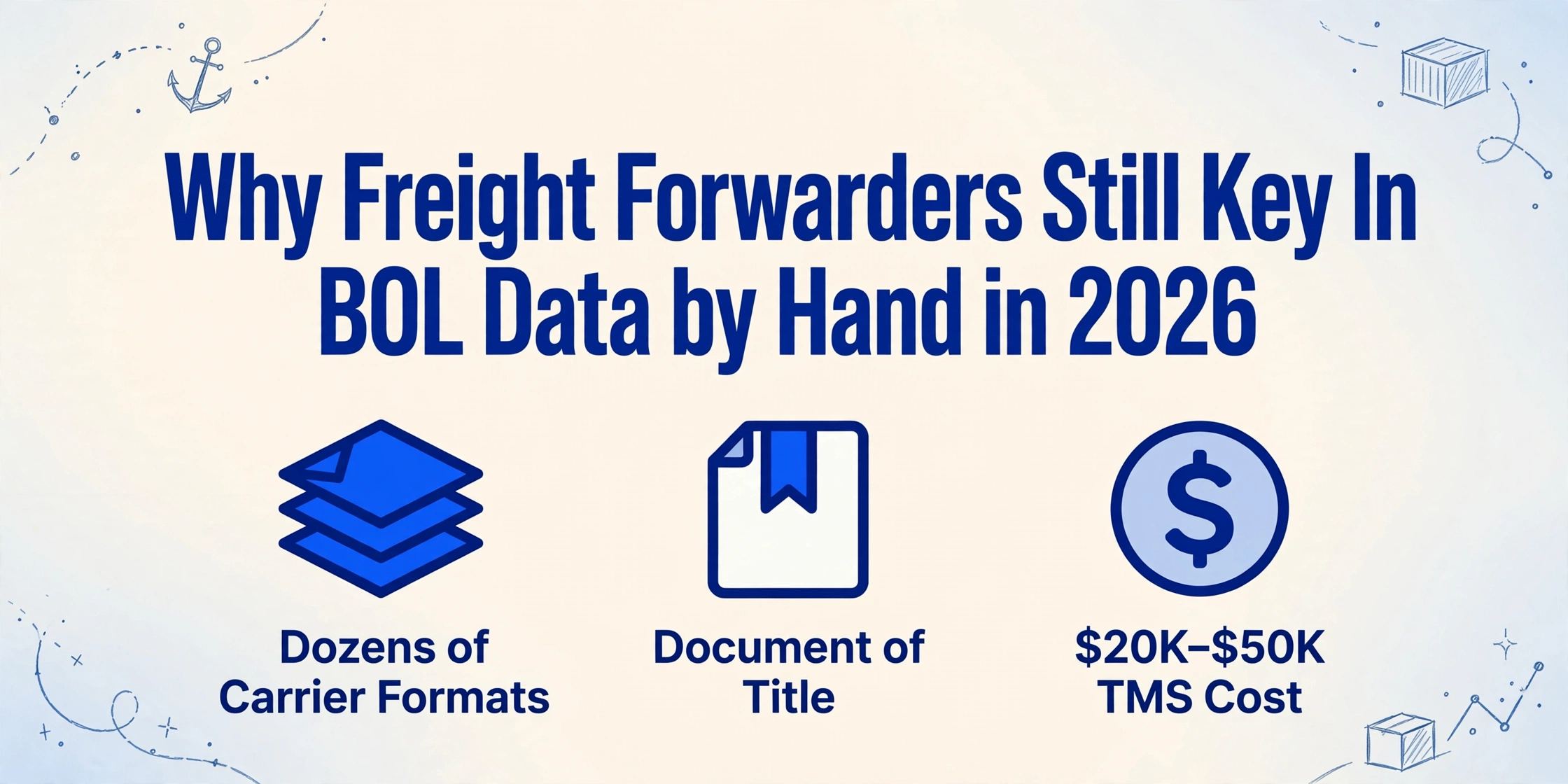
In 2024, roughly 9,300 freight forwarding firms globally had adopted electronic bill of lading platforms, processing 15.2 million paperless transactions. That sounds like progress — until you realize there are an estimated 80,000 to 100,000 freight forwarders operating worldwide. The overwhelming majority still receive BOLs as PDF attachments, carrier portal screenshots, and paper scans — and key the data into their TMS field by field. This isn't a story about resistance to technology. It's a story about structural lock-in at three layers, each reinforcing the one below it.
Key Takeaways
- 15.2 million electronic bill of lading transactions were processed in 2024 by 9,300 forwarders — a headline number that conceals a starker reality: over 70% of the world's 80,000 forwarders still open carrier PDFs and type shipping fields into their system by hand, field by field, every day.
- A bill of lading is a negotiable document of title under centuries of maritime law, not a data form — six major trading nations including the US, Japan, and Canada don't recognize electronic versions, so paper isn't a technology gap waiting to close; it's a legal requirement locking manual entry into the workflow regardless of what software exists.
- ImageToTable.ai reads any carrier's bill of lading by understanding what each field means — Container Number, Vessel Name, Gross Weight — rather than where it sits on a template, so a forwarder gets structured data into one spreadsheet without building carrier-specific templates, without waiting for EDI (electronic data interchange) connections, and without needing the law to change first.
The BOL isn't one document — it's dozens
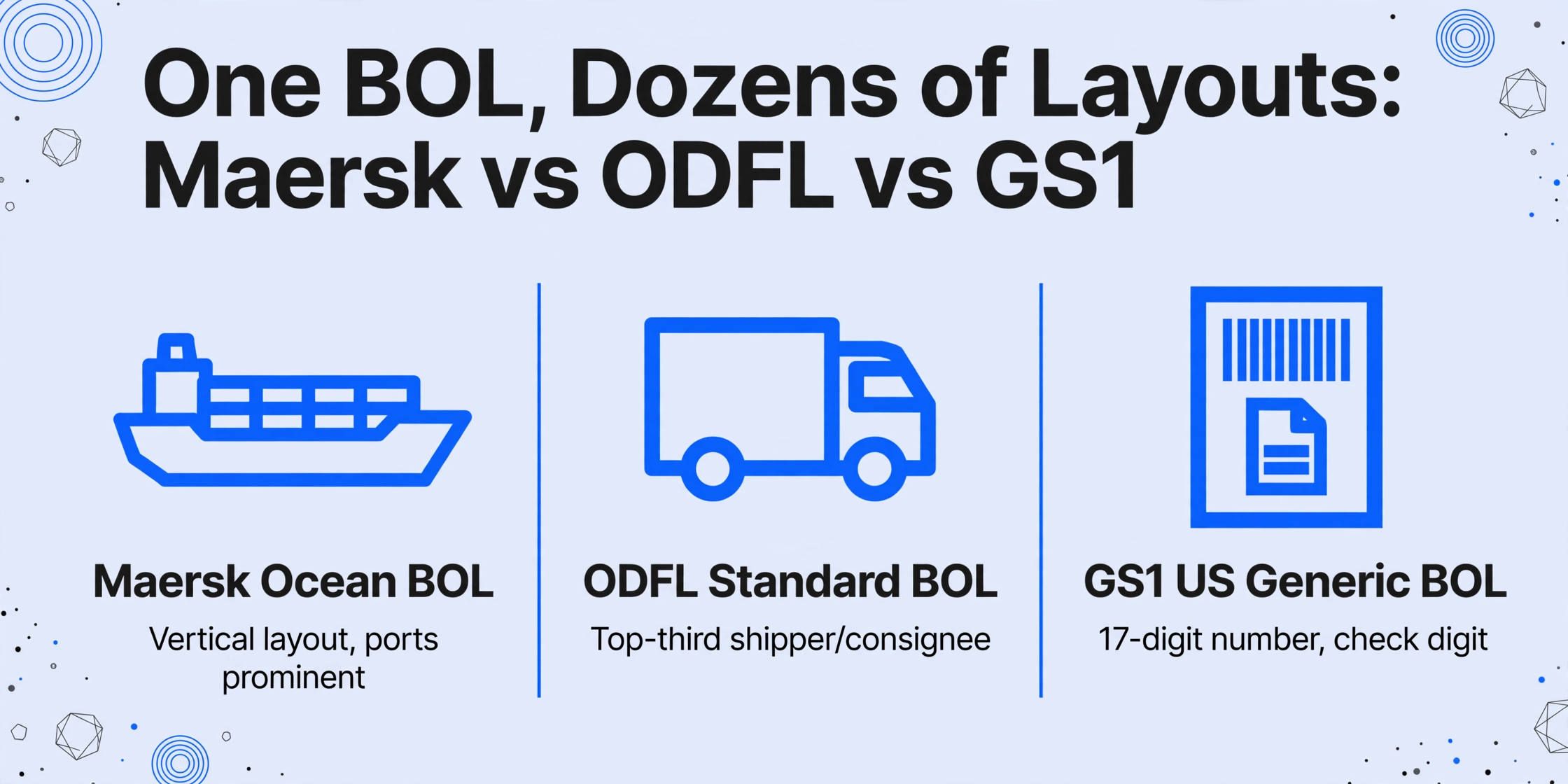
Ask a mid-size freight forwarder how many carrier BOL formats they handle in a typical month. The answer is rarely below a dozen. Each carrier — Maersk, MSC, CMA CGM, Hapag-Lloyd, ODFL, Estes, SAIA and the hundreds of regional trucking companies that fill the gaps — generates BOLs on its own template, with its own field naming conventions, its own layout logic, and its own placement of critical data points. A container number appears in the top-right on one carrier's BOL, inline with the vessel name on another, and in a barcode-only section on a third.
Public BOL templates illustrate the scope of the problem. ODFL's standard BOL groups shipper and consignee information across the top third of the page with handling-unit rows below. Maersk's ocean BOL arranges the same data vertically, with port of loading and discharge prominent in a dedicated section. Generic carrier BOLs from the GS1 US standard use a 17-digit BOL number with a modulo-10 check digit — a numbering scheme that regional trucking carriers may completely ignore. A freight forwarder receiving BOLs from five carriers on a single consolidation is looking at five structurally different documents, none of which share a common data model.
This fragmentation is not the result of negligence. It is the natural consequence of a carrier ecosystem in which each operator designs its BOL to serve its own operational workflow — warehouse receiving, dock scheduling, driver check-in — not the downstream data needs of the freight forwarder who must aggregate shipment data for customers, customs filings, and invoicing. The BOL was never designed as a data-transfer format. It was designed as a receipt and a contract. The fact that forwarders need to extract data from it is a secondary use case that the designers of each carrier's BOL had no incentive to accommodate.
The practical result: a freight forwarder handling 200 shipments per month across 20 carriers is effectively running a manual data translation operation. Every BOL that lands in their inbox presents the same 20 or so data fields — shipper name, consignee address, container number, seal number, vessel name, voyage number, port of loading, port of discharge, gross weight, number of packages, commodity description, freight class, charges — arranged in a different spatial order, with different labels, sometimes abbreviated, sometimes in the carrier's internal codes. The human brain translates this variability instinctively. A software system, unless explicitly configured to recognize each carrier's format, does not.
UNCTAD's Q1 2025 data put a number on the cost of this variability: approximately 20% of global maritime shipping delays are caused by errors in bill of lading data, at an average loss of $1,450 per incident — up 20.8% from 2024 figures. That is not the cost of hardware failure or weather disruption. That is the cost of a mistyped container number, a transposed digit in a weight field, a comma that should have been a period.
A document of title isn't the same as a data field
The BOL occupies a unique position in global trade that most documents — invoices, purchase orders, inspection reports — do not. It is a negotiable document of title. The entity holding the original BOL has constructive possession of the goods. This legal function is the reason paper BOLs are couriered across continents at considerable expense even when the cargo itself moves electronically through customs pre-clearance. The paper matters because, under centuries of maritime law, possession of the original BOL is what gives a bank the right to release payment under a letter of credit, what gives a consignee the right to claim cargo at the destination port, and what gives a claimant standing in cargo-loss litigation.
This legal architecture creates a structural barrier to digitization that is qualitatively different from, say, automating invoice processing. An invoice is an accounting artifact. A BOL is a title instrument. And the distinction matters because title instruments require a system of trusted transfer — a mechanism by which one party can pass exclusive, verifiable control to another party without the originating issuer or a platform operator retaining a residual copy that could undermine title integrity.
The Kentucky Law Journal published a detailed analysis of this problem in January 2026 that exposes the gap between eBL technology and legal reality. While blockchain-based eBL systems like IQAX (used by Hapag-Lloyd) can guarantee cryptographic authenticity, they fail the classical test of a negotiable instrument on a more fundamental ground: free circulation. A paper BOL circulates independently — possession is binary, transfer requires no permission or intermediary, and the rights attach to the physical document itself. An eBL on a platform like IQAX requires platform membership, user authentication, and compatible systems at every link in the chain. If one party — a consignee's bank in a jurisdiction that has not adopted UNCITRAL's MLETR framework, for instance — cannot access the platform or does not recognize the legal validity of an eBL, the chain breaks and the shipment reverts to paper.
The data bears this out. A December 2024 survey by the FIT Alliance found that just 21% of bank representatives said their institution had adopted eBLs, and only 28% planned to start within two years — despite near-universal awareness of the technology. The United States, Canada, Japan, Mexico, South Korea, and Russia have not adopted MLETR or equivalent laws. For a freight forwarder handling shipments to or from any of these jurisdictions, the paper BOL is not an option — it is a regulatory necessity. And where a paper BOL exists, manual data entry exists by definition, because paper cannot self-populate a TMS.
The nine-party chain that a typical maritime shipment travels through makes this dependency compound: shipper → freight forwarder → carrier → consignee → customs broker → terminal operator → notify party → inland carrier → financing bank. Each party consumes BOL data in a different system, for a different purpose, on a different timeline. The forwarder needs shipment data for booking reconciliation and customer updates. The customs broker needs commodity descriptions and HS codes for entry filing. The consignee needs delivery confirmation. The bank needs proof of shipment before releasing payment. A single mistyped field — an incorrect weight triggering a carrier reweigh surcharge, a wrong consignee address causing a failed delivery — cascades through this chain in ways that a simple OCR accuracy percentage cannot capture. The downstream cost of a data error at the BOL stage is orders of magnitude larger than the keystroke that created it.
The paper BOL isn't a data problem that technology hasn't solved. It's a title problem that law hasn't solved. And until every jurisdiction in a freight forwarder's trade lanes recognizes eBLs as legally equivalent to paper, manual data entry will remain a structural feature of the forwarding business, not a temporary inefficiency awaiting automation.
The TMS bridge most mid-size forwarders can't afford
If you are a mid-size freight forwarder — 15 to 50 employees, moving 200 to 1,000 shipments per month — you occupy a particularly difficult position in the automation landscape. You are too large for spreadsheets to remain manageable (the pivot-table approach breaks down somewhere around 100 shipments per month, when cross-referencing carrier BOLs against customer quotes and vendor invoices becomes a full-time reconciliation job). But you are too small to absorb the total cost of ownership of enterprise-grade integration infrastructure.
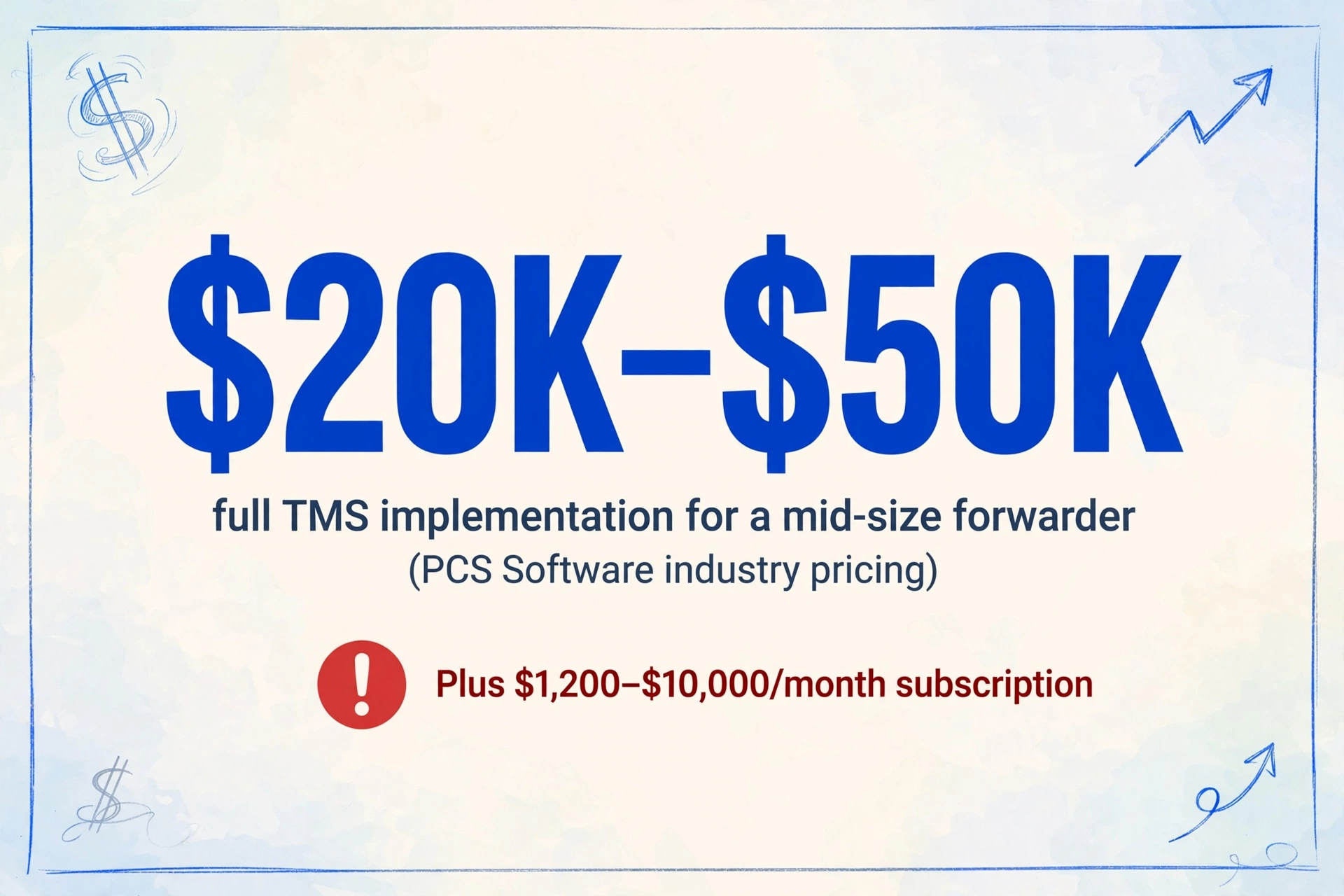
The numbers tell the story. A full TMS implementation for a mid-size operation — including software licensing, EDI carrier connections, data migration, training, and the first year of support — runs between $20,000 and $50,000 according to industry pricing analysis from PCS Software and other TMS vendors. That figure covers setup; ongoing subscription costs for platforms like CargoWise, which moved to per-shipment value pack pricing at $6 to $10 per shipment in 2025, add $1,200 to $10,000 per month depending on volume. The EDI connections that make BOL data flow automatically from carriers into the TMS are a separate line item, typically billed as one-time setup plus annual maintenance per trading partner — meaning a forwarder that works with 20 carriers pays for 20 EDI connections, not one.
And EDI is not one standard. It is a family of message formats — ANSI X12 204 (motor carrier load tender), 210 (freight invoice), 214 (shipment status), 211 (BOL) — each with carrier-specific variants and implementation guides that require a dedicated integration specialist to configure and maintain. The TMS market itself acknowledges the friction: MarketsandMarkets' 2025 industry report identifies "fragmented standards across freight documentation" as the primary obstacle to TMS adoption, noting that carriers use proprietary EDI message variants while regions increasingly prefer XML declarations or API-first JSON schemas — forcing TMS vendors to continuously maintain adapter libraries that are never complete.
For a 25-person forwarder with no in-house IT staff, this is not a purchase decision. It is a capability gap — a threshold below which the economics of integration do not close. The result is that the forwarder's employees open carrier PDFs, read the fields, and type them into whatever system they have, whether that is a lightweight TMS, a shared Excel workbook, or a QuickBooks entry screen. This workflow is genuinely faster and cheaper than attempting to automate it through EDI — when you factor in the implementation cost, the ongoing maintenance, and the fact that even fully-integrated carriers still send exceptions (amended BOLs, split shipments, carrier substitutions) that require manual intervention anyway.
This is not a failure of technology. It is a reflection of the fact that EDI and TMS integration were built for enterprise logistics — for the Kuehne + Nagels and the C.H. Robinsons, which move enough volume to amortize six-figure integration budgets across millions of transactions. The mid-market forwarder was never the design target. And manual data entry, for this segment, is not a choice that a more tech-forward competitor would avoid. It is the default operating model of an industry whose integration infrastructure was built for a different scale.
What changes when extraction decouples from integration
If there is a way out of this three-layer lock-in — carrier format diversity, document-of-title constraints, and TMS integration cost thresholds — it does not come from solving all three at once. It comes from decoupling data extraction from system integration.
The conventional automation path assumes that the only way to eliminate manual BOL entry is to connect the carrier's system directly to the forwarder's TMS — an EDI link or API that populates shipment fields automatically. That path is effective when it works, but it is barrier-gated: you need carrier cooperation, compatible systems on both sides, and sufficient volume to justify the integration cost. For the mid-size forwarder working with 20 carriers, only a fraction of which support reliable API or EDI — and even fewer that the forwarder's lightweight TMS can connect to natively — the conventional path covers perhaps 30% of BOL volume. The rest remains manual.
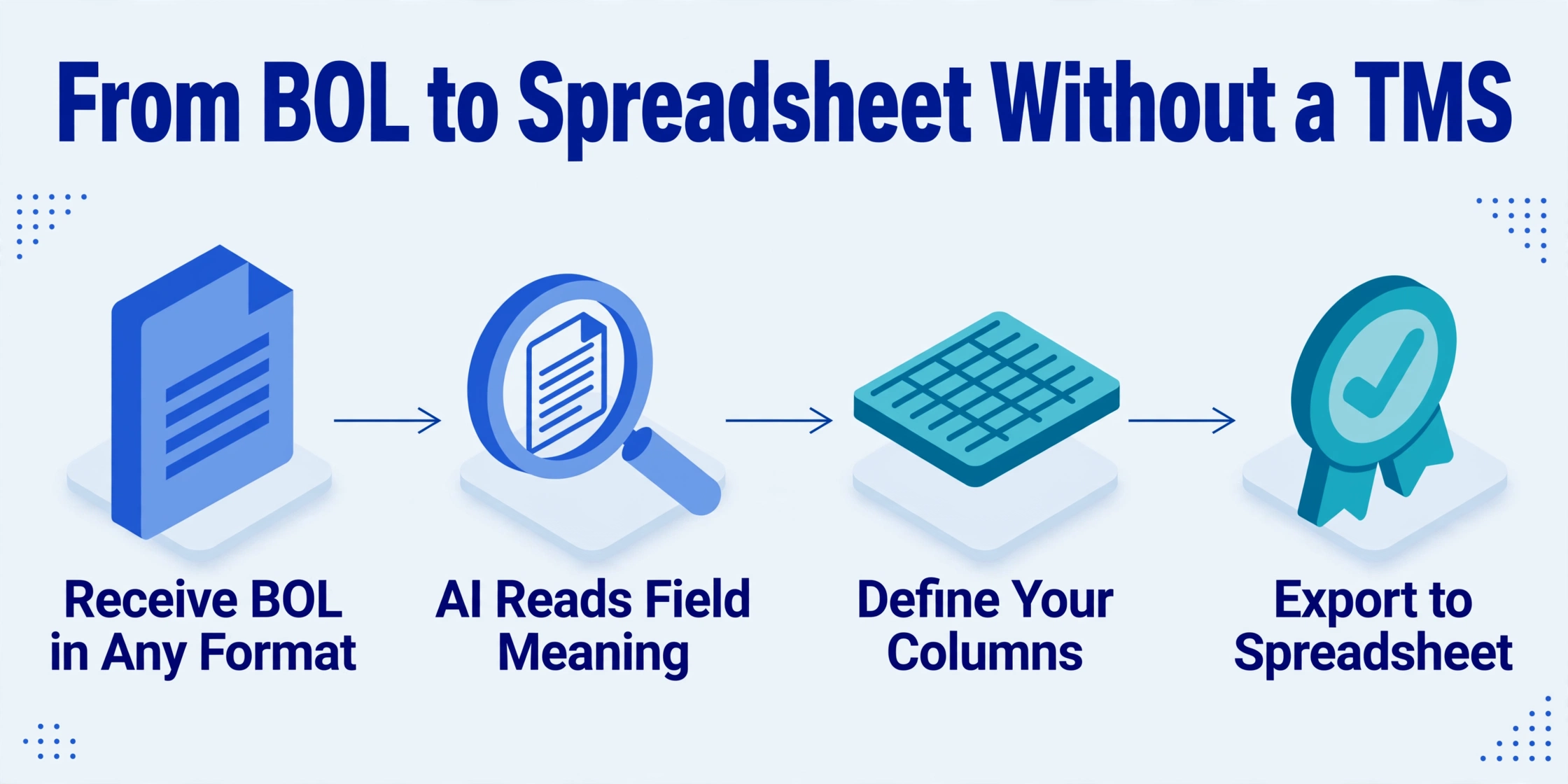
What if the extraction step were decoupled from the integration step? Instead of requiring a carrier-to-TMS connection for each carrier, the forwarder receives the BOL in whatever format it arrives — PDF, scanned image, carrier portal screenshot — and extracts the data at the document level using AI that reads the BOL the way a human does: by understanding what each field means, not where it sits on a template. The forwarder defines the columns they need — Container Number, Seal Number, Vessel/Voyage, Gross Weight, Shipper, Consignee, Port of Discharge — and the extraction engine locates each value across any carrier's BOL layout. The output is a spreadsheet that feeds the TMS or accounting system on the forwarder's terms, without requiring the carrier to change formats, adopt an API, or participate at all.
This approach — extraction at the document layer rather than integration at the system layer — changes the economic calculus. It doesn't require carrier-by-carrier setup. It doesn't require EDI. It doesn't require a full TMS implementation to begin saving time. A forwarder handling 200 BOLs per month, each taking 10 to 15 minutes to enter manually, spends approximately 35 to 50 hours per month on BOL data entry alone. At a cargo and freight agent's BLS median hourly wage of $23.24, that is $800 to $1,160 in labor cost per month — not counting the cost of data errors, which UNCTAD's data suggests adds an average of $1,450 per incident when an error causes a delay. Extraction at the document level addresses that cost without requiring the forwarder to cross the TMS integration threshold first.
This is not a replacement for EDI or TMS integration where those are viable. It is a coverage extension — a way to handle the 70% of BOL volume that comes from carriers without a reliable digital feed, from customers who email PDFs, from consolidation shipments where the forwarder's own system generates the master BOL but the underlying house BOLs from sub-carriers still arrive as scanned documents. For the mid-size forwarder, covering that 70% without manual typing — without hiring another data entry clerk as volume grows — is the difference between a business that can scale without headcount and one that cannot.
And once extracted, the data is structured. Once structured, it can be merged across carriers into one spreadsheet — a batch view that gives the forwarder a single pane of glass across all shipments regardless of which carrier generated which BOL. For a forwarder whose daily reality is flipping between carrier portals, email attachments, and a shared spreadsheet, this single-pane consolidation is the operational unlock — and it does not require any carrier to change a thing.
Frequently asked questions
Why don't freight forwarders just require carriers to send BOLs in a standard format?
Because the freight forwarder is not the carrier's customer in most lane relationships — the shipper is. The forwarder arranges transport on the shipper's behalf, but the BOL is a contract between the shipper and the carrier. The forwarder's data needs are downstream of that contract. Carriers have no commercial incentive to reformat their BOLs for a party that is an intermediary in the transaction chain. Even large forwarders with significant volume leverage — the top 20 global forwarders — rarely succeed in getting carriers to adopt a standard BOL data format. For mid-size forwarders, the ask is not even on the table.
How much does manual BOL data entry actually cost per month?
At the industry-benchmarked rate of 10 to 15 minutes of manual entry per BOL and the BLS median hourly wage of $23.24 for cargo and freight agents, a forwarder processing 200 BOLs per month spends $800 to $1,160 on pure data entry labor — not counting error correction, which UNCTAD's 2025 data puts at an average loss of $1,450 per BOL-data-related shipping delay. For a more detailed breakdown, see our analysis of what manual BOL data entry costs freight forwarding per shipment and per month.
Can OCR software read bill of lading data automatically?
Traditional OCR can read printed text on a BOL but faces two limitations: it lacks the semantic understanding to distinguish a "container number" from a "booking number" when both appear as alphanumeric strings on the same page, and it requires template training for each carrier's layout — which defeats the purpose for forwarders handling BOLs across dozens of carriers. AI-based extraction that reads fields by understanding their meaning rather than their position on the page avoids the template problem, but accuracy still depends on document quality — a crumpled or heavily watermarked BOL scan presents the same challenge to AI that it presents to a human reader.
How do multi-carrier BOL batches work in practice?
A forwarder receives BOLs from multiple carriers — say, Maersk for the ocean leg, a regional trucking line for the inland drayage, and a rail carrier for the intermodal segment — all relating to different shipments or to different segments of the same consolidation. Instead of opening each PDF, manually keying the fields into the TMS, and cross-referencing shipment IDs, the forwarder uploads all BOLs into a single processing session and specifies the column names they want extracted. The output is one spreadsheet with all shipments across all carriers in consistent columns. We cover this workflow in detail in our guide on how freight forwarders batch-process BOLs from multiple carriers into one control spreadsheet.
Is electronic bill of lading adoption actually accelerating?
Yes, but unevenly. The nine largest container carriers — who collectively move the majority of global containerized cargo — have committed through DCSA to 100% eBL by 2030, and BIMCO's "25 by 25" pledge targets 25% of seaborne trade volume on eBL for at least one commodity. FIATA's digital negotiable eFBL is now available on over 50 TMS platforms. But execution remains concentrated at the top of the market. The mid-size and regional carriers that form the backbone of domestic and short-sea forwarding in most countries have no equivalent commitment, and the banking sector's adoption rate — 21% of banks, per the FIT Alliance's 2024 survey — is the binding constraint. eBL adoption will accelerate, but the paper BOL will remain a significant portion of forwarding documentation through the end of the decade.
Upload a carrier PDF. See how many seconds your next BOL entry takes.