Why SPED Manual Review Costs Brazilian Accountants
More Time Than Most Realize
Every year, in the weeks leading up to the June 30 Digital Accounting Bookkeeping (Escrituração Contábil Digital, or ECD) deadline and the July 31 Digital Tax Bookkeeping (Escrituração Contábil Fiscal, or ECF) deadline, accounting teams across Brazil settle into the same rhythm: open the ECD file in the official validation program (Programa Validador e Assinador, or PVA), export a .txt copy, import it into Excel with pipe delimiters, and begin the manual review. The goal is not analysis. It is confirmation — checking that the data the system is about to submit has no material inconsistencies that could trigger a tax audit, a penalty, or a last-minute correction that delays the filing.
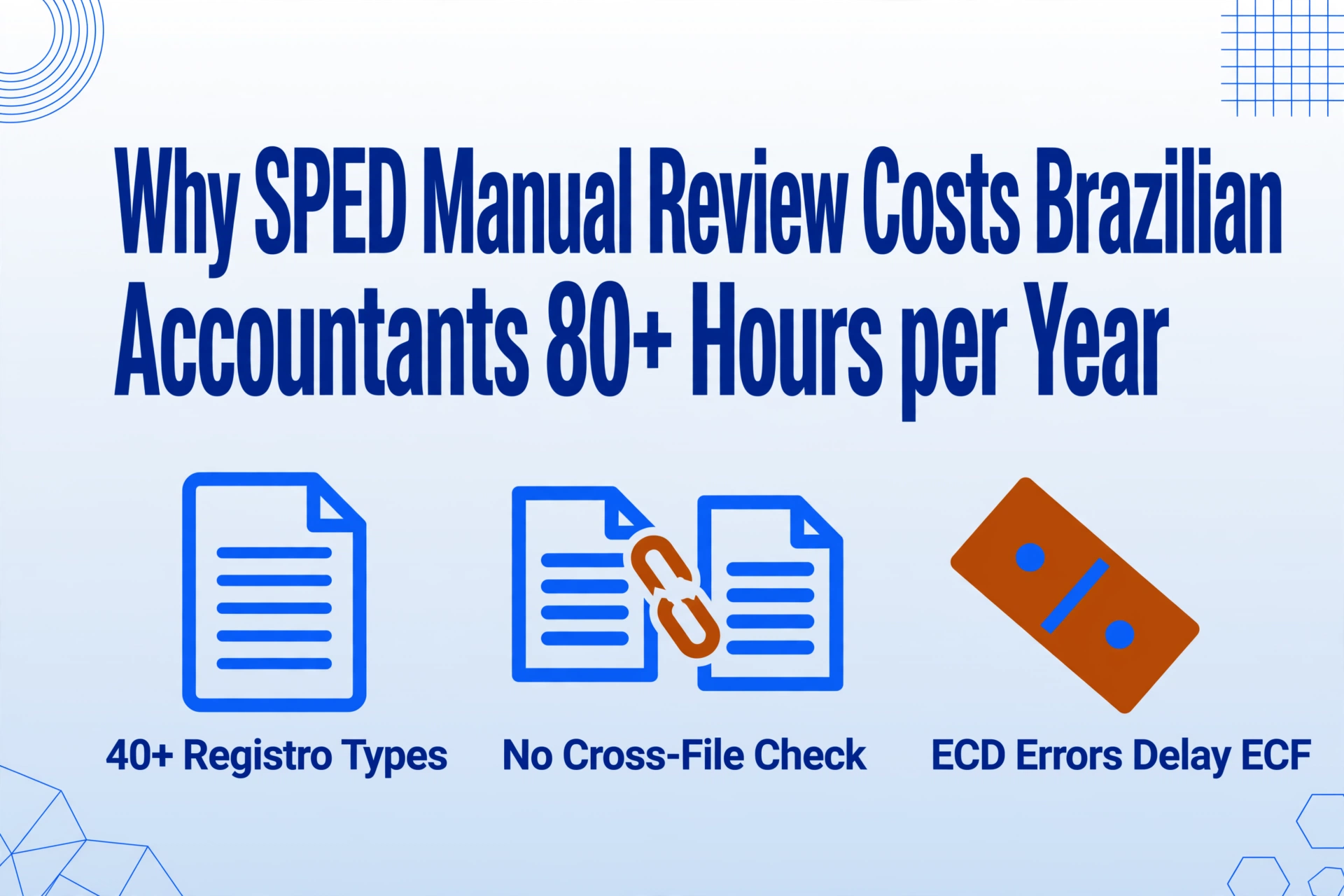
This article is not about how to file the SPED. It is about why the manual review step — the one that takes 40 to 80 hours every year for a mid-sized company — exists in the first place, what structural features of the SPED format make it unavoidable with standard tools, and why "just start earlier" is not a complete answer.
The Clock That Keeps Ticking: SPED's Annual Countdown
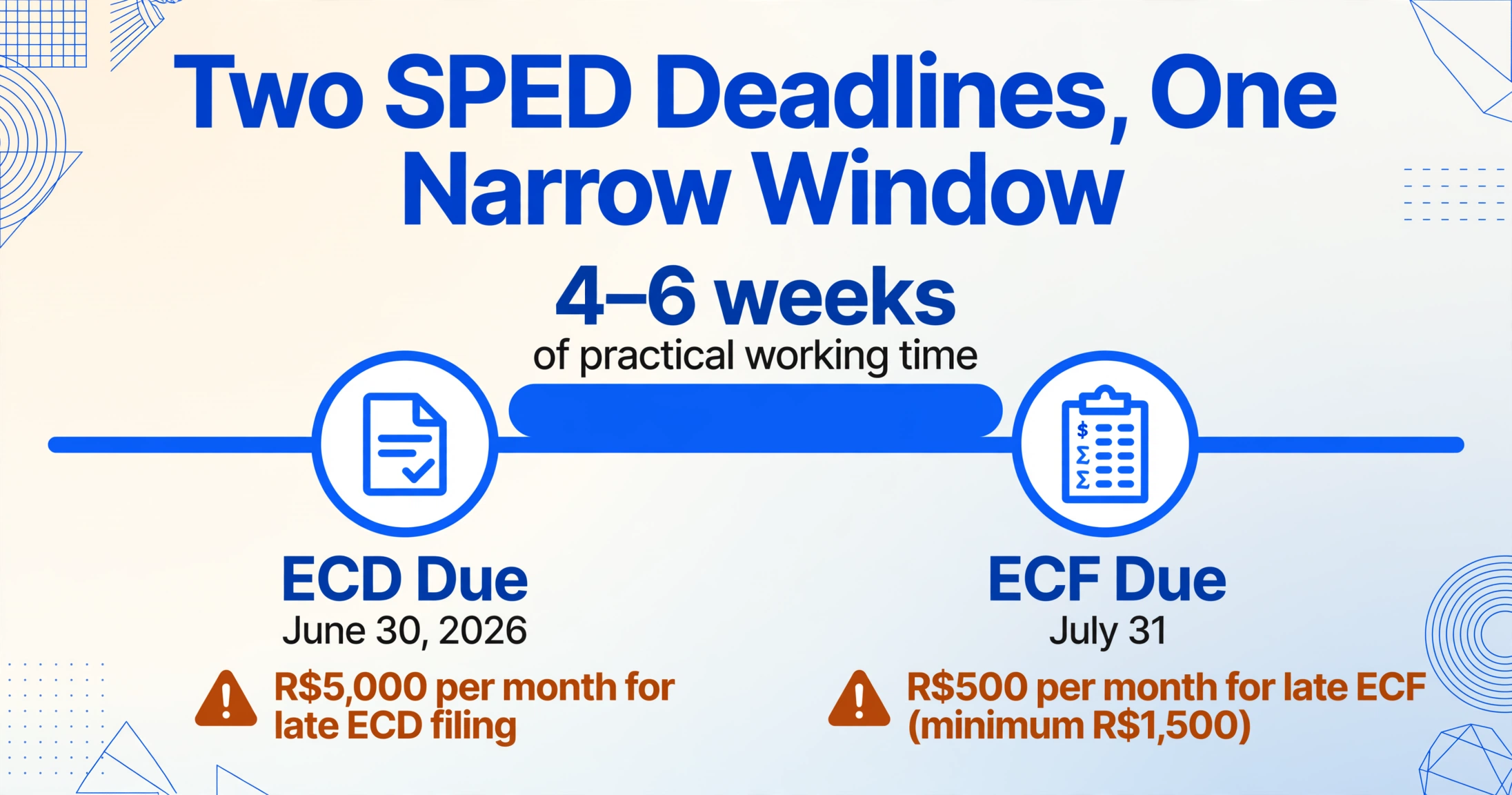
The timeline is tight by design. The ECD is due by the last business day of June for the prior calendar year — June 30, 2026, for calendar year 2025 data. The ECF follows one month later, on July 31. Between the two deadlines, a company's accounting team must close the books for the prior year, generate and validate the ECD file, submit it, and then use the ECD's output as the foundation for the ECF's tax calculation. This leaves roughly four to six weeks of practical working time between the ECD submission and the ECF deadline — and during those weeks, the team is also running the manual review that confirms the ECD data is consistent and that the ECF adjustments are correctly derived from it.
The consequence of missing either deadline is automatic: R$5,000 per month for late ECD filing, plus R$500 per month (minimum R$1,500) for late ECF filing under Lei nº 10.426/2002. But penalties tell only part of the story. A late or inconsistent submission increases the likelihood of being flagged for a fiscal audit — an outcome whose cost far exceeds the monthly fine, in both direct professional fees and indirect management distraction.
The pressure, then, is not artificial. It is structural: the deadlines leave little margin, the penalties are real, and the manual review is the only safeguard between the data as it sits in the file and the data as the Receita Federal will see it.
Why "The Data Is Correct" Takes 40 to 80 Hours to Confirm
To understand why manual SPED review absorbs this much time, you need to look at what a mid-sized company's ECD file actually contains. The file is a plain text document structured according to the Public Digital Bookkeeping System (Sistema Público de Escrituração Digital, or SPED) layout specification — currently Leiaute 9 for ECD and Leiaute 12 for ECF. Every line begins with a Registro code that identifies the type of record it carries. A typical file runs 80,000 to 150,000 lines.
A manual reviewer's job is not to read every line. It is to verify that the key Registro groups — the trial balance (C155), the chart of accounts (C050), the closing balances (C157), the journal entry summaries (I200/I250) — are internally consistent and that the ECF's tax adjustments (M300 for e-Lalur, M350 for e-Lacs) match the underlying ECD data. In practice, this means extracting subsets of data from the file, cross-referencing totals, and tracing specific account balances from one section to another.
Three structural features of the SPED format make this work far more time-consuming than it should be.
Structural Problem 1: Fixed-Width Text That Excel Cannot Read as Structured Data
An ECD file is not a spreadsheet. It is a fixed-width text file where each Registro type has its own field layout at specific character positions, delimited by pipe characters. When you open it in Excel using the text import wizard with pipe delimiter, every line becomes a row — but the meaning of each column depends entirely on which Registro code appears in the first column.
A C155 Registro (trial balance detail) has fields for account code, opening balance, debit movement, credit movement, and closing balance at specific positions within its 390-character structure. An I200 Registro (journal entry) has fields for entry date, entry number, and total amount — an entirely different layout. In the raw Excel import, both sit in the same spreadsheet, and column G might mean "opening balance" for a C155 row and "journal total" for an I200 row. The spreadsheet has no way of treating them differently.
To extract just the trial balance, the reviewer filters the spreadsheet for rows where column A equals "C155." This reduces the visible data to trial balance records, but the column headers are still generic — the reviewer must remember or look up that column H in a C155 row corresponds to the opening balance, while column I corresponds to the debit movement. A single typo in the filter or a misplaced column during the import produces a dataset that looks plausible but is structurally wrong. The time cost is not just the filtering. It is the mental overhead of keeping the field layout in your head while you scan thousands of rows.
Structural Problem 2: 40+ Registro Types in a Single File
The ECD layout defines over 40 distinct Registro types across six Blocos (0, C, I, J, K, and 9). Each Registro type has a different field layout. A reviewer who needs to cross-reference the trial balance (C155) against the journal entries (I200) and the cost center allocations (C100) must extract three different subsets from the same file, each with its own column mapping, and then manually reconcile the totals across them.
The ECF adds another layer of complexity. Its Registro structure includes Bloco E (recovered ECD data), Bloco M (e-Lalur and e-Lacs adjustments), and Bloco Y (related-party and transfer pricing information). The ECF's M300 Registro (e-Lalur Part A adjustments) references specific account codes from the ECD's C050 chart of accounts — a cross-file dependency that requires the reviewer to open two independent .txt files, extract matching subsets from each, and verify consistency manually.
No validation done by the PVA checks this cross-file consistency. The PVA validates that each individual file meets the layout specification. It does not verify that the ECD's closing balance for account 4.01.01 matches the opening balance brought into the ECF's E010 recovery record. That verification is left entirely to the human reviewer.
Structural Problem 3: No Cross-File Validation Built into the PVA
This is the single most consequential gap in the SPED ecosystem. The Programas Validadores e Assinadores (PVAs) for ECD and ECF are independent. They validate syntax, field ranges, and Registro sequence within each file. They do not cross-reference data between the two files. They do not flag an inconsistency where the ECD's closing balance for a given account differs from the opening balance the ECF recovered in Bloco E. They do not check that the M300 adjustments in the ECF correspond to accounting provisions in the ECD.
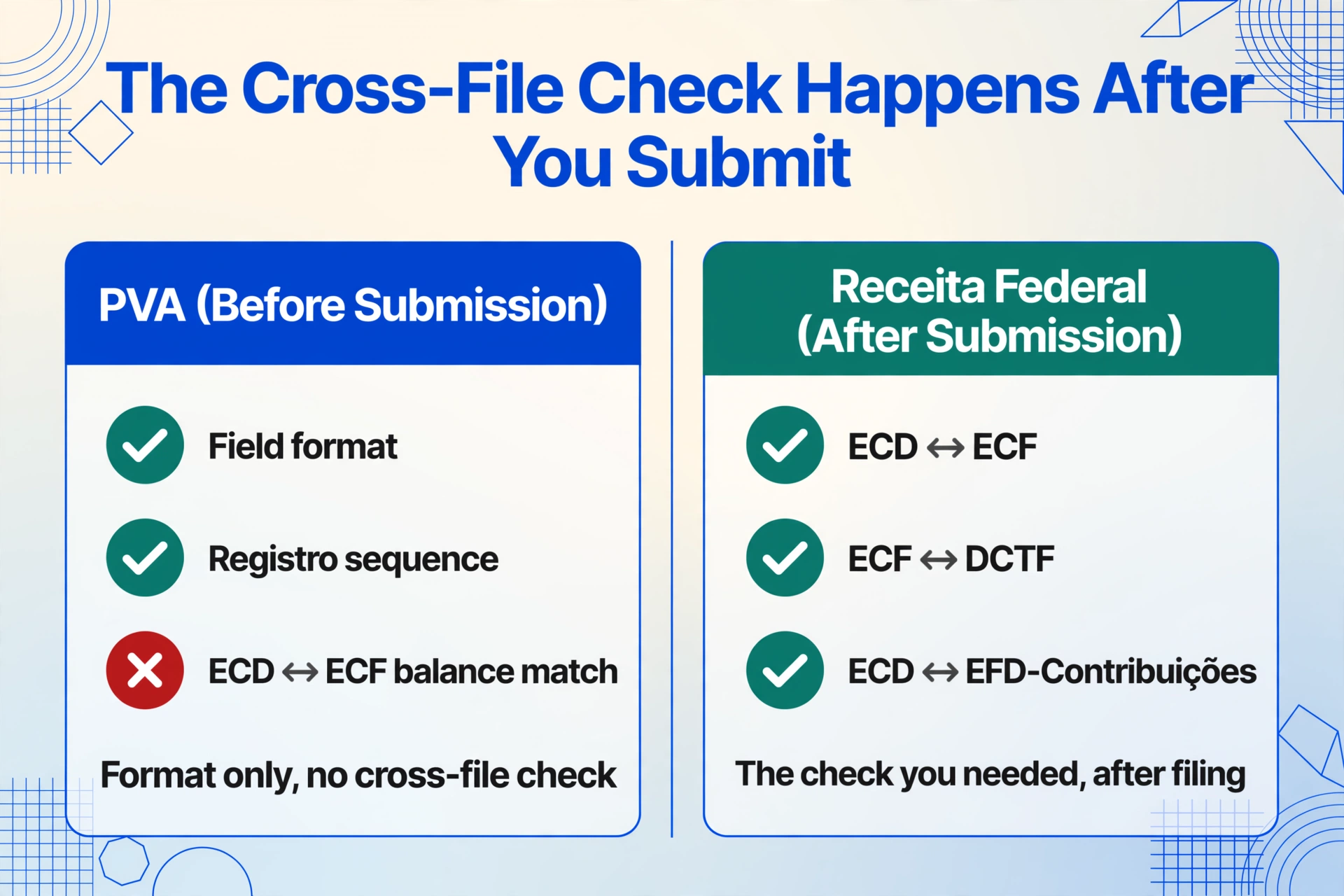
The Receita Federal, of course, does perform this cross-reference — after submission. The RFB's own systems compare ECD data against ECF data, ECF against DCTF, and ECD against EFD-Contribuições, using increasingly sophisticated automated cross-checking that has been enhanced with artificial intelligence capabilities since 2026. When a discrepancy is found after submission, the company receives a notice, the adjustment is recorded, and the audit risk increases. The manual review is the only opportunity to catch and fix these discrepancies before they become part of the permanent record.
The result: a process where the accountant spends hours doing work that an automated cross-reference engine could do in seconds — and the RFB already has that engine on their side of the submission boundary.
The Cascade Effect: When ECD Review Delays ECF Filing
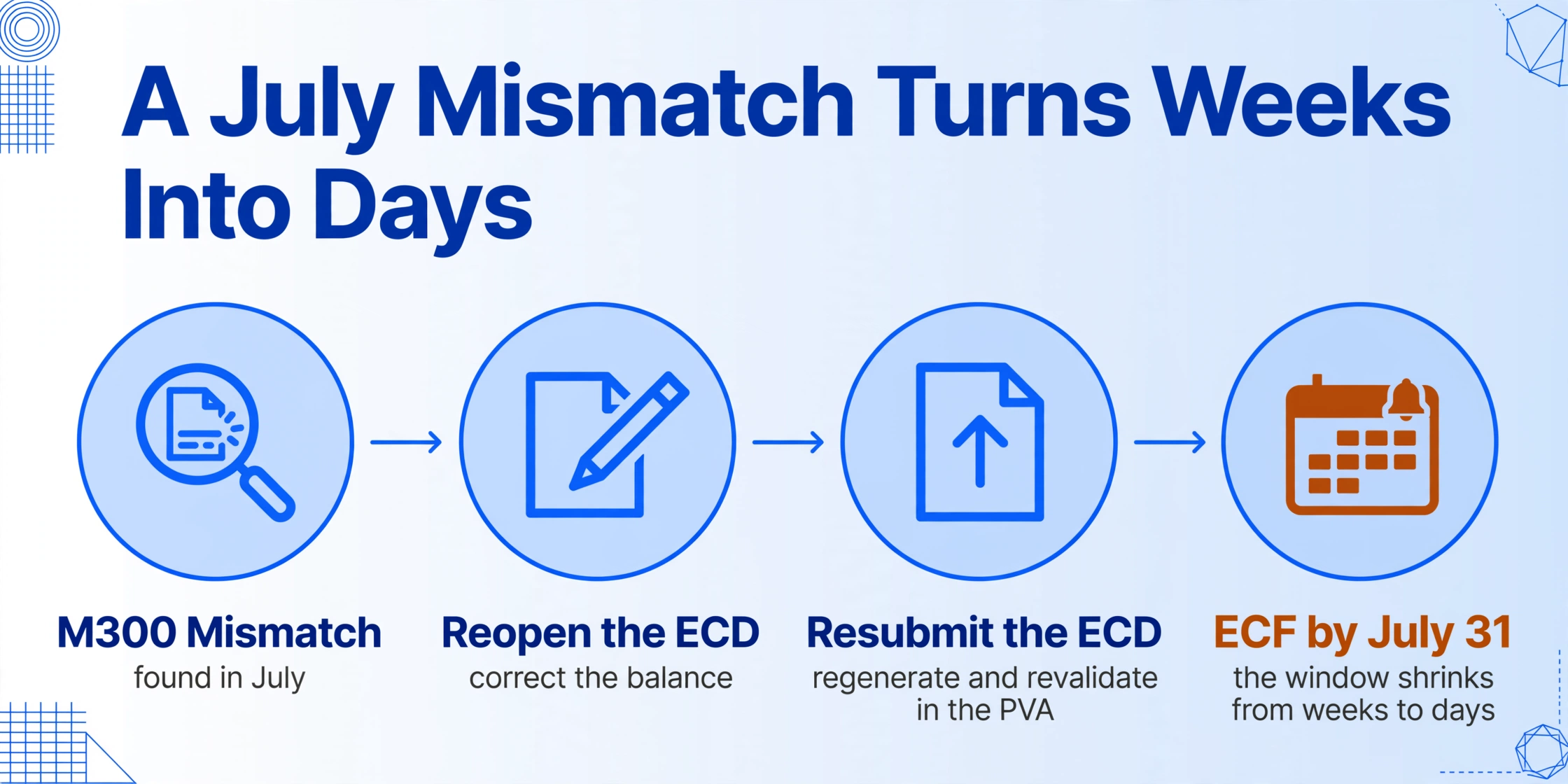
Because the ECF depends on the ECD for its accounting basis (Bloco E recovers the ECD's final balances and mapped accounts), any delay or error in the ECD review propagates directly to the ECF timeline. A correction found during the ECF preparation — "this M300 adjustment does not match the corresponding ECD account" — requires reopening the ECD file, making the correction, generating a substitute ECD file, revalidating it in the PVA, and resubmitting before the ECF can proceed. This cascading rework is the single biggest source of last-minute stress in the SPED cycle.
In practice, a company that discovers an ECD↔ECF inconsistency in the second week of July faces a compressed timeline where the fix to the ECD must be processed before the ECF can be finalized, and both must be submitted by July 31. The working window shrinks from weeks to days, and every correction carries the risk of introducing a new inconsistency somewhere else in the file.
Where the Industry Is Headed (and Why Manual Review Persists)
The Receita Federal is investing in its cross-file analysis capabilities. The 2026 introduction of AI-enhanced data cross-checking (reported by multiple Brazilian advisory firms) signals that the gap between what submission-side tools can do and what the RFB's post-submission analysis can do is widening. On the taxpayer's side, however, the tools available for pre-submission review have not kept pace. The PVA validates format. Excel filters by Registro code. Everything in between — the actual verification that the data is consistent, complete, and matchable from one file to the next — remains manual.
This asymmetry is the fundamental reason accountants spend weeks on SPED review. Not because they are slow or underprepared, but because the format distributes a company's most important financial data across multiple text files with divergent structures, and the available tooling expects the reader to hold the field layouts and cross-file relationships in their head while scanning tens of thousands of lines. It is a format problem that looks like a preparation problem from the outside — and the difference matters because the solution is structural, not motivational.
Key insight: The SPED manual review problem is not a problem of "too little time before the deadline." It is a problem of too many Registro types, too few cross-file references, and zero analytical tooling between the PVA's format validation and the human reviewer's eyes. A tool that can read multiple Registro types by meaning — not by byte offset — and produce structured tables from any SPED file in the same session is not a convenience. It is a structural answer to a structural problem.
Frequently Asked Questions
Q: How long does a full ECD manual review typically take for a mid-sized company?
Based on reported accounting firm workflows, a complete ECD↔ECF cross-reference review for a company with 80,000 to 150,000 lines of ECD data takes 8 to 12 hours per year. For a three-year comparison window, the total review time exceeds 30 hours just for the cross-reference step, not including the initial data extraction and formatting work.
Q: Does the PVA detect data inconsistencies?
The PVA validates syntax and format compliance — field types, required Registros, sequence ordering. It does not perform semantic cross-checks between different Registro types or between ECD and ECF files. A C155 record with an opening balance that does not match the prior year's closing balance will pass PVA validation as long as the field format is correct.
Q: What are the most common inconsistencies found during manual review?
The most frequent issues are mismatches between the ECD's closing balances and the ECF's recovered balances in Bloco E (E010), errors in the M300 adjustment amounts relative to the underlying accounting provision, and missing cross-references in the E015 mapped account table. These are all cross-file inconsistencies that the PVA does not catch.
Q: Is manual review still required if the company uses a major ERP with SPED modules?
Yes. ERP modules (SAP TDF, Oracle NetSuite Brazil Localization, Senior, Domínio) generate the ECD and ECF files from the company's transactional data. They do not perform cross-file consistency checks between the generated ECD and ECF outputs. The file generation is automated; the data verification is not. The manual review step is not a function of the generation tool but a function of the SPED format itself.
Q: What happens if an inconsistency is found after the ECF is filed?
The company files a substitute ECF (ECF retificadora) with the corrected data. The Receita Federal compares the original and corrected filings as part of its risk-scoring process. Frequent corrections or corrections that involve large value changes increase the company's audit risk score. The RFB's cross-reference engine automatically flags discrepancies between filed ECD, ECF, DCTF, and EFD-Contribuições data.
Q: Can AI extraction tools help reduce SPED manual review time?
Tools like ImageToTable.ai that use Custom Column Extraction can reduce the data preparation portion of the review — extracting the trial balance, the e-Lalur adjustments, and the cross-reference tables from ECD and ECF files into structured Excel tables — from hours to minutes. The reviewer still applies professional judgment, but they do so on clean data rather than raw pipe-delimited text with mixed Registro types. The time savings come from eliminating the filtering, column remapping, and structural cleanup steps that currently consume the majority of the review cycle.
Beyond the Deadline — A Process That Deserves Better Tooling
The annual SPED review cycle reveals a basic mismatch: the format your data lives in and the tool you use to verify it were designed for different purposes. The SPED format was designed for machine validation — fixed-width fields, Registro codes, pipe delimiters, all optimized for a parser. The tool most accountants use to review it is a general-purpose spreadsheet, which treats every row the same regardless of Registro type. The reviewer has to bridge the gap between the two — and that bridging work is what takes 40 to 80 hours every year.
Bridging this gap is not difficult in a technical sense. It is mechanically repetitive: filter, check, map, verify, re-filter with a different Registro code, repeat. The work disappears when the extraction step understands Registro types by meaning rather than by filter. For Brazilian accounting teams facing the June-July deadline cycle, the question is not whether the manual review is necessary — it is whether the data preparation that precedes it needs to take the majority of the available time.