Why German Contract Clause Review Burns More Associate Hours
Than Legal Teams Budget For
A legal due diligence team reviewing a portfolio of 30 Werkverträge (contracts to produce a work, governed by BGB §631) does not budget a week of associate time for contract review. It budgets three days — a comfortable margin, by the team's estimate, for contracts that average 35 pages each. Three days is what the calendar allows before the preliminary findings memo is due. But three days into the review, the team has extracted the key clauses from 18 contracts. Twelve remain, and the memo is due tomorrow. The hours did not go to legal analysis — the team barely started that. They went to locating the five clauses that matter among hundreds of pages of boilerplate, recitals, and cross-references. The clauses are all there, in every contract. Finding them is what consumed the week.
Key Takeaways
- Reviewing 30 Werkverträge manually consumes 25–28 billable hours — a full person-week — and 80% of that time is not reading clauses or analysing what they mean, but locating them across 35-page PDFs.
- Scanning fatigue is not a training deficit — the brain's template-building mechanism that accelerates clause review is the same mechanism that causes a Gewährleistungsfrist placed in §12 to escape detection because the reviewer expects it in §9, and this effect compounds with every contract added to the queue.
- Separate reading from classifying — let the AI locate all five target clauses across all 30 contracts simultaneously, so the reviewer verifies a populated spreadsheet instead of building one from scratch.
Anatomy of a Manual Clause Review: Where the Hours Actually Vanish
A legal associate reviewing one Werkvertrag for due diligence performs a sequence that looks efficient on paper. Open the contract PDF. Locate the parties — Auftraggeber (client) and Auftragnehmer (contractor) — typically on page 1. Find the Leistungsbeschreibung (scope of work description), usually in §3 or §4 but occasionally in an appendix (Anlage) referenced from §1. Locate the Vergütung (remuneration, governed by BGB §632) in §5 or §6. Find the Abnahme (acceptance, the milestone that triggers the warranty clock under BGB §640) and the Gewährleistungsfrist (warranty period under BGB §634a) in §8 through §10. Identify the Haftungsbeschränkung (liability limitation) in §11 or §12. Type each finding into the review spreadsheet — one row per contract, each of the five clauses as a column. Close the contract. Open the next one.
The sequence works. Contract one takes 45 minutes — 35 of which is finding the clauses, 10 of which is reading them to confirm they say what the heading implies. Contract five takes 30 minutes — the reviewer has internalised that the parties are on page 1 and the Vergütung is near §6. By contract ten, the review is running at 25 minutes per contract. The associate is getting faster — and precisely here, the mechanism that makes her faster starts making her less accurate.
The associate's job is to find deviations from standard. But the process of getting faster at finding clauses is the process of learning to expect them in the same place — which means the mechanism that improves speed is the same mechanism that causes her to miss the clauses that aren't where she expects them. This is not a training issue. It is a structural property of the manual review method.
The Locating Problem vs the Reading Problem
If you ask a legal associate what takes the most time in contract review, the instinctive answer is "reading." It is wrong — but it is wrong for an instructive reason. The brain registers the activity it is performing at any given moment, and "reading" is the activity that fills the screen of consciousness for most of the review. The associate reads the heading of §3, reads the first sentence, scrolls past the definitions, finds the operative paragraph, reads it carefully. But between reading §2 and reading §3, there is an invisible step: locating §3. The PDF must be scrolled. The table of contents may or may not exist. The section numbering might be decimal (3.1, 3.1.1) or paragraph-based (§3, Abs. 1, Satz 2). The section might be on the same page as the end of §2 or two pages later because §2 contained a lengthy definition block. Every one of these navigation decisions consumes seconds — and across 15 sections of a 35-page contract, seconds accumulate into minutes, and across 30 contracts, minutes accumulate into days.
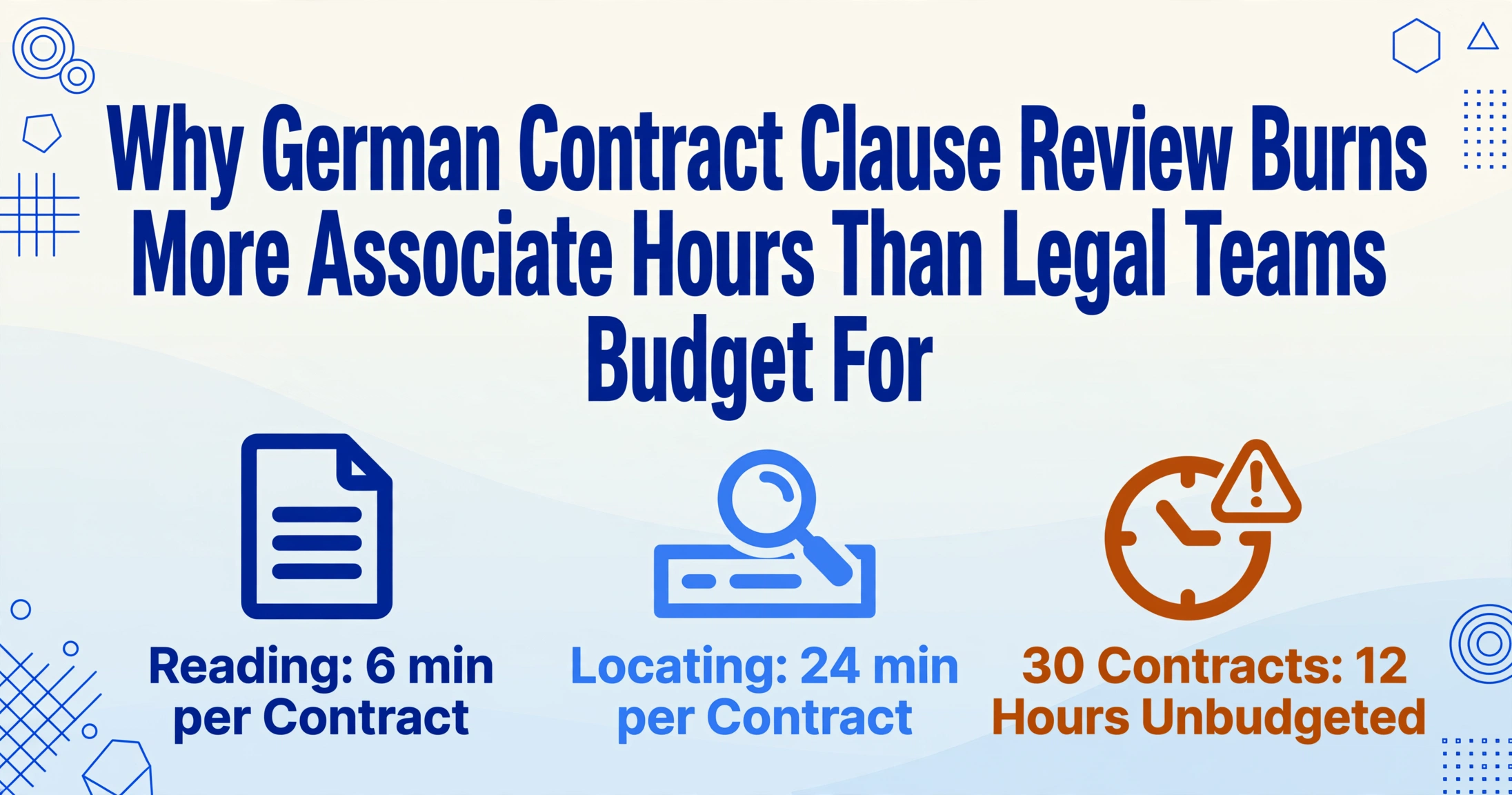
A precise breakdown of a 30-minute contract review reveals the asymmetry. Reading the five target clauses — the actual legal content that matters — takes roughly 6 minutes. The remaining 24 minutes go to locating those clauses within the document: scrolling, checking the table of contents, backtracking because the Vergütung section was not where §6 should have been, re-reading the heading to confirm this is actually the Haftungsbeschränkung and not a general liability disclaimer in the preamble. The reading-to-locating ratio is roughly 1:4 — meaning 80% of manual review time is spent on an activity that requires zero legal expertise. A first-year trainee and a 20-year partner navigate a PDF at the same speed, because PDF pagination does not respect legal seniority.
This asymmetry also explains why legal teams consistently underestimate how long contract review takes. When a partner estimates "three days for 30 contracts," the mental model is three days of reading — which, at 6 minutes of reading per contract, would take just over three hours, easily fitting a single day. The estimate misses the locating overhead because the partner, like the associate, doesn't consciously register it as a separate activity. The locating is invisible to the planner; it only becomes visible when the deadline approaches and the hours don't add up.
Scanning Fatigue: Why Contract 17 Gets Less Attention Than Contract 1
The locating problem has a second-order effect that compounds with volume: scanning fatigue. After reviewing 10 Werkverträge from the same data room — all drafted by German law firms following broadly similar structures — the associate's brain has built a template. §3 = Leistungsbeschreibung. §6 = Vergütung. §9 = Gewährleistung. The brain uses this template to accelerate scanning: instead of reading every section heading, it pattern-matches the visual structure of the page to jump to the expected location. This is not laziness — it is a well-documented cognitive adaptation called selective attention habituation, and it is the brain doing exactly what evolution designed it to do: conserve mental energy by treating repeated patterns as predictable.
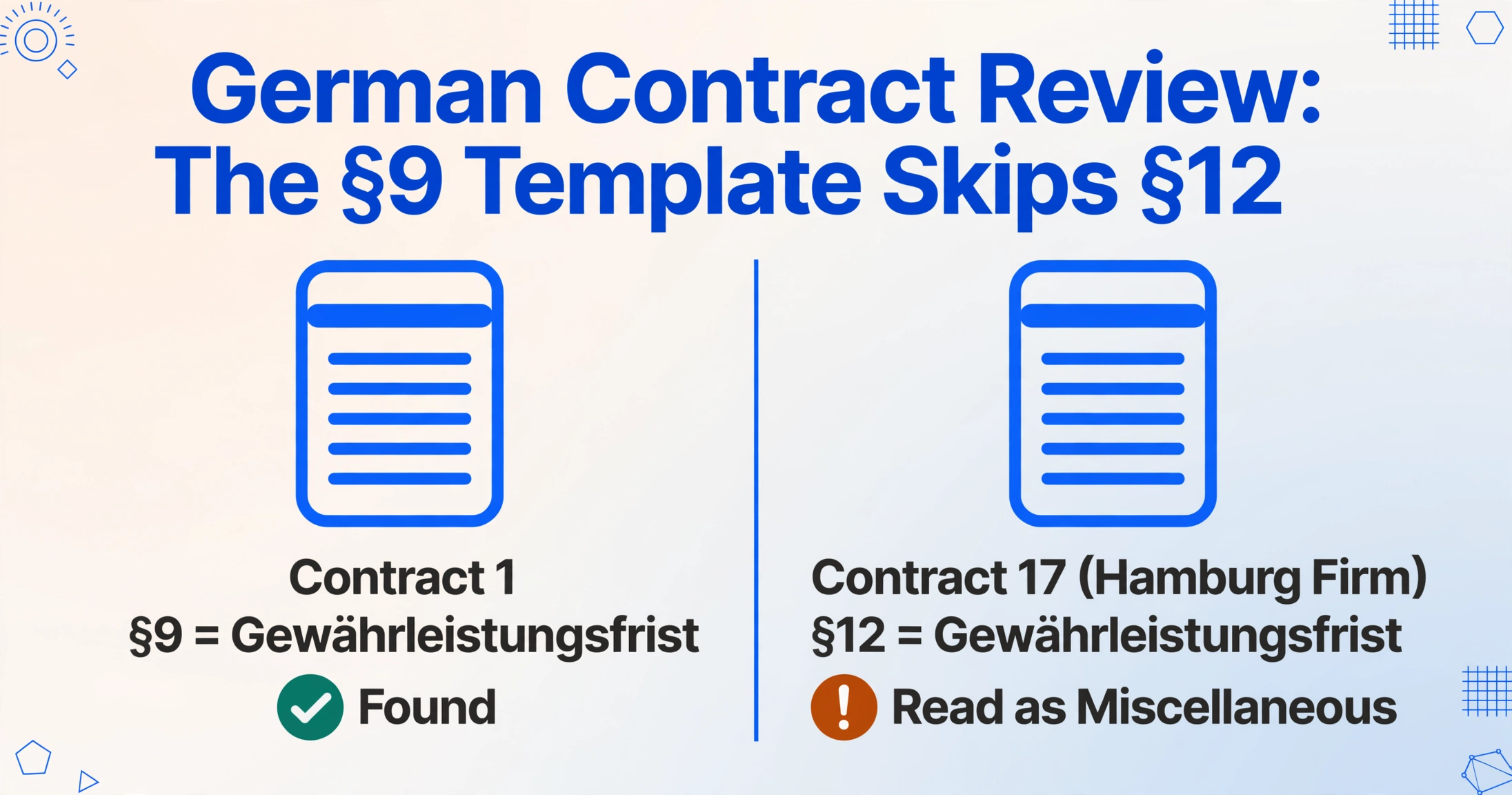
The problem is that the brain was not designed for contract review. When contract 17 places the Gewährleistungsfrist in §12 instead of §9 — because it was drafted by a Hamburg firm that uses a different section ordering convention — the associate's eyes scan past §12, register the heading as "probably the miscellaneous provisions," and continue scrolling forward looking for §9. The deviation exists in the document; the reviewer's brain has filtered it out. This is not a mistake an untrained reviewer makes and an experienced one avoids. Experienced reviewers build stronger templates, which means they skip over deviations more efficiently, not less. The 20-year partner who has reviewed 2,000 contracts has a template so robust that a Gewährleistung clause in an unexpected section location may be genuinely invisible to her — not because she is careless, but because her expertise has optimised for speed over anomaly detection.
This is also why the first five contracts in a review receive the most thorough scrutiny, and the last five receive the least — regardless of the reviewer's conscientiousness. The attentional budget is finite, and it is spent early. A due diligence report based on 30 manually reviewed contracts is structurally biased toward the risks visible in the first half of the review and blind to the risks buried in the second half. The bias is invisible — the report does not come with a confidence interval per contract — but it is real, and it means the contracts most likely to harbour undetected deviations are the ones reviewed last.
Classification Overhead: Two Cognitive Tasks Competing for One Brain
There is a second structural problem operating in parallel with scanning fatigue, and it is even less visible: classification overhead. When the associate reads the Vergütung clause and types the value into the spreadsheet, she is performing two cognitively distinct tasks simultaneously. The first is reading — extracting the remuneration figure from a paragraph of German legal prose. The second is classifying — mapping that figure to the correct column in the spreadsheet, ensuring the format is consistent (EUR 120,000, not "€120k" or "120.000,00 EUR"), and mentally confirming that this value belongs in the Vergütung column and not in a separate "Nebenkosten" (ancillary costs) column she hasn't created yet.
Dual-task interference is one of the most robust findings in cognitive psychology: when the brain performs two tasks that compete for the same cognitive resource — in this case, verbal working memory — both tasks degrade. The degradation is not dramatic in any single instance — a 2–3% error rate per task — but across 150 extraction operations (five clauses × 30 contracts), a 2% error rate produces three errors that should not exist. The associate typed "EUR 120,000" into the Vergütung column when the contract actually said "EUR 120,000 zuzüglich der gesetzlichen Mehrwertsteuer" (plus statutory VAT) — and the VAT treatment matters for the buyer's financial model. Or she typed "5 Jahre" into the Gewährleistungsfrist column because the contract used the statutory default language, but missed the sentence three paragraphs later that said "abweichend von Satz 1 beträgt die Gewährleistungsfrist 3 Jahre" (deviating from sentence 1, the warranty period is 3 years). The error is in the spreadsheet; the truth is in the contract; and by the time the error is discovered — if it ever is — the due diligence report has already been delivered to the client.
This is the same cognitive mechanism described in the analysis of the UK SA100 Self Assessment preparation problem, where freelancers translate bank statements, payment platform exports, and receipts into HMRC's form boxes. The document type changes — German legal contracts instead of UK tax forms — but the structural failure is identical: reading and classifying simultaneously degrades both tasks, and the degradation is invisible to the person performing them because the brain does not flag its own dual-task interference. It just produces the wrong result and moves on.
Neither scanning fatigue nor classification overhead can be solved with better training, more careful associates, or stricter review protocols. They are not failures of diligence — they are structural properties of a workflow that asks one person to perform two incompatible cognitive tasks (reading and classifying) across a volume of material that exceeds the brain's sustained-attention budget. The manual review method has no defense against its own failure modes.
The Cost Nobody Calculates: 1 Person-Week for 30 Contracts
Let the numbers make the structural point concrete. A single Werkvertrag in a German mid-market M&A data room averages 35 pages. A legal associate reviewing it manually spends 30 to 45 minutes per contract — the variance depends on how consistently the contract's section numbering matches the reviewer's mental template. At the midpoint of 37 minutes per contract, 30 contracts consume 18.5 hours of associate time — roughly 2.5 working days at 7.5 chargeable hours each. That is the locating-and-reading time.
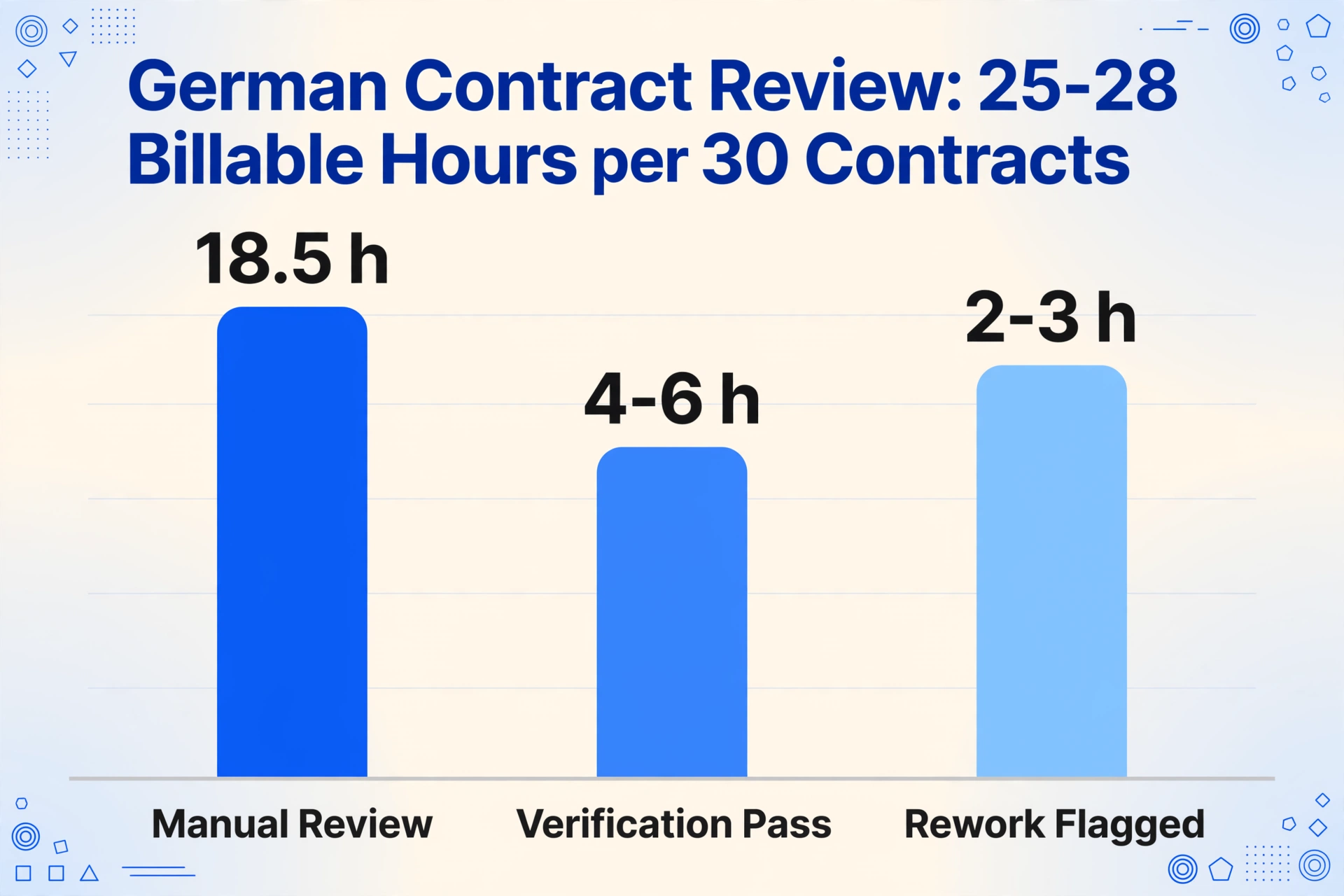
But the number that matters for the law firm's economics is not 18.5 hours. It is what happens after the 18.5 hours: the verification step. A senior associate or partner must spot-check the junior's spreadsheet against a sample of the original contracts to confirm the extracted values are correct. This verification pass — reading 5–8 contracts and cross-referencing every extracted value against the source — takes another 4 to 6 hours. And because the verification will inevitably find errors (a transposed Vergütung figure, a missed Gewährleistungsfrist deviation, a Haftungsbeschränkung typed as text instead of a number), the junior must go back and re-check the flagged contracts, consuming another 2 to 3 hours.
Total: roughly 25 to 28 hours of billable time to review 30 contracts and produce a clause spreadsheet — a full person-week of associate and senior time. The legal analysis — the part clients actually pay for, the judgment about which warranty expiries create negotiation leverage and which liability caps are commercially unreasonable — has not even started. The person-week purchased a spreadsheet of contract data. The legal advice starts from there, in the remaining days before the findings memo is due.
And this calculation assumes the most favourable scenario: contracts in searchable PDF format, drafted in German by German law firms using consistent section numbering, with no handwritten amendments, no scanned exhibits, no multi-language contracts where the Vergütung clause is in German but the Leistungsbeschreibung appendix is in English. In a real M&A data room — especially one involving a Mittelstand company with a 15-year operating history and contracts accumulated from multiple legal advisers — the variance is far wider. A scanned PDF of a 2009 contract with a handwritten Gewährleistungsfrist amendment in the margin adds 15 minutes to the review just for the legibility challenge, and the associate's spreadsheet has no column to capture "good luck reading this."
Why This Is Not a Skill Problem
The law firm's instinct, when a review takes longer than budgeted, is to ask whether the associate was inefficient. Could a faster associate have done it in two days? Could a more experienced reviewer have spotted the Gewährleistung in §12 of the Hamburg-firm contract without the scrolling delay? The instinct is reasonable — law firms optimise for billable-hour efficiency, and associate speed is a legitimate performance metric — but it misdiagnoses the problem.
The locating overhead is not reducible by skill. A faster reader reads faster; a faster scroller scrolls faster, but the PDF renders at the same speed for everyone, and the section headings don't change position to accommodate expertise. The 1:4 reading-to-locating ratio is not a function of the reviewer's ability — it is a function of the medium. A contract stored as a flat PDF is structurally resistant to rapid clause extraction, because PDF was designed for faithful visual reproduction, not for structured data access. Asking a reviewer to extract five data points from a 35-page PDF is equivalent to asking someone to find five sentences in a printed book and type them into Excel — the bottleneck is not reading speed, it is the physical act of navigating a linear document to find non-linear targets.
The cross-market evidence confirms the structural nature of this problem. The UK SA100 Self Assessment analysis shows the identical locating-and-translating bottleneck in a completely different professional context — UK sole traders collating source documents for their tax return. The professional role (freelancer vs. legal associate), the document type (tax form vs. contract), the legal system (UK vs. Germany), and the skill level (no legal training vs. law degree) are all different. The structural problem — extracting discrete data points from documents not designed to yield them — is the same. When the same failure mode appears across roles, documents, and jurisdictions, the failure is in the method, not in the people using it.
What Changes When You Separate Reading from Classifying
The alternative to reading-then-typing is not "read faster" or "focus harder." It is to separate the two cognitive tasks — reading and classifying — and assign them to different agents. The AI reads the contract; the lawyer classifies the output. This is the paradigm shift behind the Werkvertrag clause extraction method: the reviewer defines the five columns (Auftraggeber, Leistungsbeschreibung, Vergütung, Gewährleistungsfrist, Haftungsbeschränkung), uploads all 30 contracts in one batch, and receives a populated spreadsheet. The AI has done the locating — the scrolling, the section-heading matching, the synonym resolution between "Vergütung" and "Honorar." The reviewer has done none of it. What arrives is a spreadsheet where every row is a contract and every cell is a clause value — the same output the associate would have produced after 18.5 hours of manual work, generated in the time it takes to read one contract.
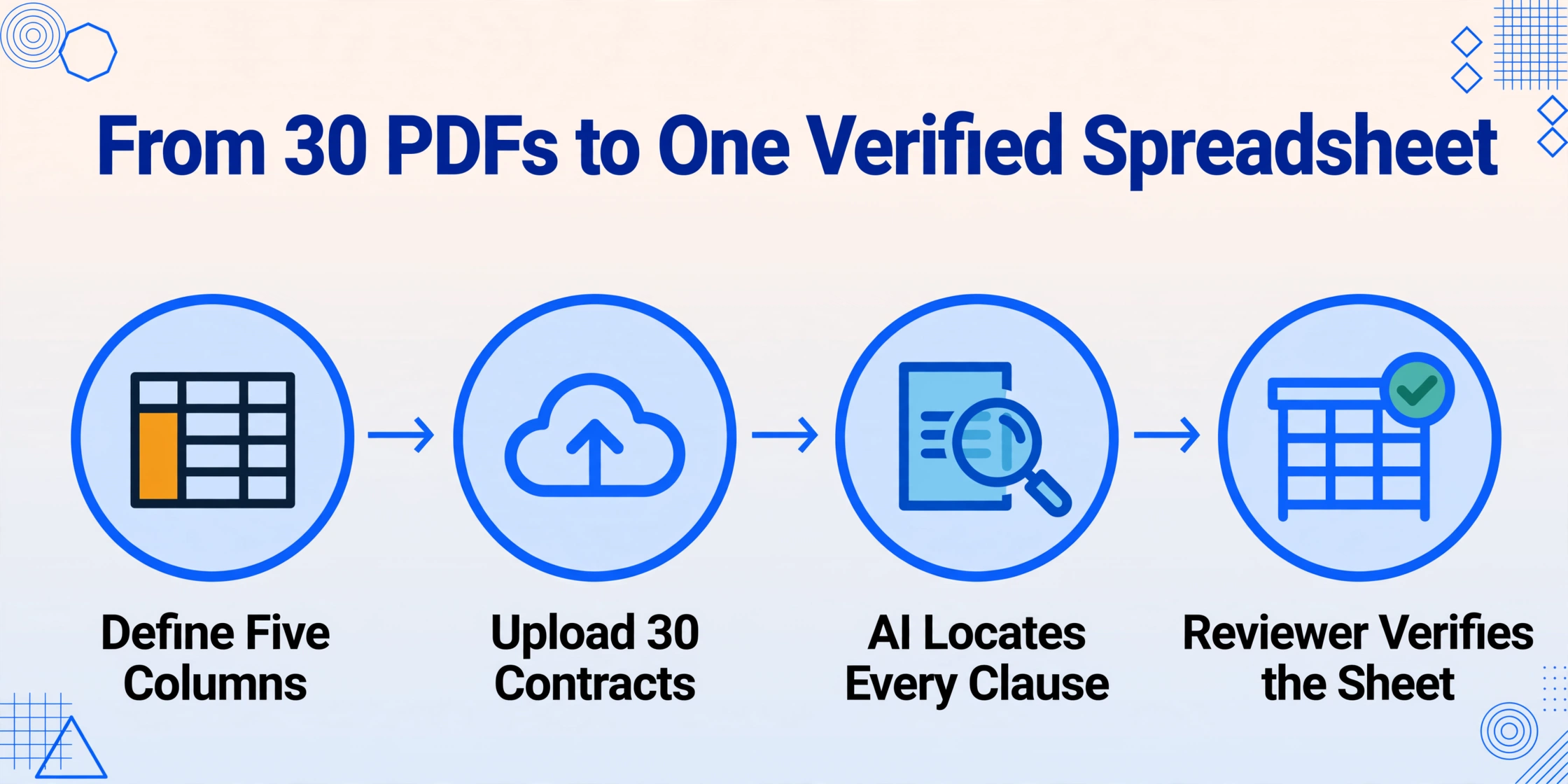
The reviewer's job shifts from transcription to verification. Instead of reading 30 contracts sequentially, the reviewer reads the spreadsheet: sorts the Gewährleistungsfrist column ascending to see which warranties are closest to expiry, compares Vergütung against Haftungsbeschränkung to flag disproportionate liability caps, filters the Vertragstyp column to isolate ambiguous contract classifications. These are the analytical passes described in the batch contract clause registry guide — and they are only possible because every contract's data arrived in the same format at the same time, ready for cross-contract comparison.
This does not eliminate the need for a lawyer to read contracts. The verification step still requires opening the contracts that the spreadsheet flags as anomalous — the Gewährleistung that deviates from the 5-year Bauwerk default, the liability cap of €30,000 on a €400,000 contract, the contract classified as "Vertragstyp: Unclear." But the reviewer now opens 5 contracts instead of 30 — and opens them with a specific question in mind, not to discover what is in them from scratch. The 18.5 hours of locating overhead have been removed from the workflow. The remaining hours go to the work that requires legal expertise: interpreting what the deviations mean in the context of the transaction.
Files are processed securely and not stored.
FAQ — German Contract Clause Review Bottleneck
Why does manual Werkvertrag review take longer than most legal teams estimate?
Because the mental estimate counts reading time, not locating time. Reading the five target clauses — Auftraggeber, Leistungsbeschreibung, Vergütung, Abnahme/Gewährleistungsfrist, Haftungsbeschränkung — takes roughly 6 minutes per contract. But locating those clauses within a 35-page PDF — scrolling, checking section headings, backtracking when the numbering doesn't match expectations — takes 24 minutes per contract. The 1:4 reading-to-locating ratio is invisible to the planner, so the estimate covers the reading and leaves the locating unbudgeted. Across 30 contracts, that unaccounted locating overhead alone consumes roughly 12 associate hours.
What is scanning fatigue and why does it hit the last contracts hardest?
Scanning fatigue is a cognitive adaptation where the brain builds a template of expected clause positions after reviewing several similarly-structured contracts. The template accelerates navigation — the reviewer stops reading every section heading and jumps to the expected location by visual pattern. But when a contract deviates from the template — for example, placing the Gewährleistungsfrist in §12 instead of §9 because a different law firm drafted it — the reviewer's brain skips past it, having already registered the heading as irrelevant. The fatigue is cumulative: contracts reviewed later in the sequence receive less thorough scrutiny than those reviewed earlier, regardless of the reviewer's conscientiousness. This means the contracts most likely to harbour undetected deviations are systematically the ones reviewed last.
How many hours does a 30-contract Werkvertrag portfolio actually consume?
At 30–45 minutes per contract for manual clause location and extraction, 30 contracts consume roughly 18.5 hours of associate time — about 2.5 working days. Adding the senior review verification pass (4–6 hours) and re-checking flagged discrepancies (2–3 hours), the total is approximately 25–28 billable hours — a full person-week. This covers only the data extraction and spreadsheet population. The legal analysis — interpreting which warranty expiries create negotiation leverage, which liability caps are commercially unreasonable, which contract type classifications are legally significant — begins after this week is spent. In a typical M&A timeline with a 10-business-day due diligence window, spending a full week on data entry before the legal work starts is a structural constraint on the quality of the final report.
Does using searchable PDFs or Ctrl+F solve the locating problem?
Partially — and the limits illustrate why the problem is structural, not technological. Keyword search (Ctrl+F) finds the string "Vergütung" in the document — but it also finds every cross-reference to it ("wie in §5 Vergütung geregelt"), every definition that mentions it, and every boilerplate clause that uses the word. The reviewer still has to read through the search results to identify which instance is the actual Vergütung clause. More critically, keyword search fails when contracts use different terminology: one contract's "Vergütung" is another contract's "Honorar" and a third's "Auftragssumme." Ctrl+F for "Vergütung" returns zero hits on the second and third contracts, even though both contain a remuneration clause — the information exists, but the search term doesn't match. A flat-text search tool cannot resolve synonyms, which means it systematically misses clauses that are present but labelled differently.
Is this problem specific to German contracts or does it apply to contract review generally?
The locating problem exists in any jurisdiction where contracts are reviewed as flat documents — which is all of them. What makes it particularly acute for German Werkverträge is the combination of BGB-specific legal terminology (the difference between a Werkvertrag under §631 and a Dienstleistungsvertrag under §611 has material consequences for warranty periods), the widespread use of statutory cross-references within the contract text (§634a, §640, §307), and the structural inconsistency across law firms (Munich firms typically use a different section ordering than Hamburg firms). But the same problem has been documented in other contexts — the UK SA100 Self Assessment preparation bottleneck shows the identical locating-and-translating failure mode in a tax-filing context, confirming that the problem is the method, not the jurisdiction.
What changes when AI reads the contracts instead of an associate?
The associate stops being the reading agent and becomes the verifying agent. Instead of spending 18.5 hours locating five clauses across 30 contracts and typing them into a spreadsheet, the associate receives a populated spreadsheet — every contract's key clauses, extracted and formatted — and spends 4–6 hours verifying the values against the source documents. The reduction is not in the verification step (which still requires legal expertise) but in the locating step (which never did). The associate's time shifts from a 1:4 reading-to-locating ratio to a 1:0 ratio — all of the reading is done by the AI, and all of the associate's time goes to the legal judgment the client is paying for. The full extraction-to-verification workflow is detailed in the Werkvertrag clause extraction guide.
The person-week a legal team spends finding clauses across 30 contracts is a budget line nobody planned for — and one that can be compressed to an afternoon without changing anything about how the legal analysis is done. The contracts stay the same; who reads them doesn't have to.
Find Clauses in Your Contracts