How Lawyers Extract German Service Contract Clauses
Without Reading Every Page
A German legal associate reviewing 20 Werkverträge (contracts to produce a work, governed by BGB §631) for a client's vendor portfolio does not need to understand every sentence in every contract. She needs five specific data points from each one: who the parties are (Auftraggeber/Auftragnehmer — client and contractor), what was promised (Leistungsbeschreibung — scope of work), what was paid (Vergütung — remuneration), whether it was accepted (Abnahme — acceptance, the event that triggers the warranty clock under BGB §640), and when the warranty expires (Gewährleistungsfrist — warranty period under BGB §634a). The rest of the contract — the boilerplate, the recitals, the definitions section — is relevant only if one of those five clauses deviates from standard. But finding those five clauses across 20 contracts means reading every page to locate them — until extraction separates the reading from the classifying.
Key Takeaways
- The five clauses a legal reviewer needs from every Werkvertrag — Auftraggeber, Leistungsbeschreibung, Vergütung, Gewährleistungsfrist, Haftungsbeschränkung — all sit somewhere in the contract, and locating them across 20+ contracts consumes 80% of review time before a single legal judgment is made.
- Scanning fatigue is not a discipline problem — by the 15th contract, the brain treats repetitive clause structures as a pattern and skips the exact deviations the review was supposed to catch, and the manual method has no structural defense against this.
- Extraction separates the reading from the classifying — the AI locates the five clauses across all contracts and fills the spreadsheet, the lawyer verifies the extracted values and puts their time into the legal analysis only a qualified reviewer (Rechtsanwalt) can do.
What German Service Contracts Actually Define
Germany's civil code (Bürgerliches Gesetzbuch, BGB) defines two fundamentally different types of service agreements — and confusing them produces the wrong review checklist. A Werkvertrag (contract to produce a work, BGB §§631–650v) obliges the contractor (Auftragnehmer) to deliver a specific result. A construction company promising to build a warehouse by a deadline is a Werkvertrag — the outcome, not the effort, is what matters. A Dienstleistungsvertrag (service contract, BGB §§611–630h) obliges the provider to perform a service with diligent effort, without guaranteeing a specific outcome. A management consultant advising on strategy for six months is a Dienstleistungsvertrag — the obligation is to work competently, not to guarantee the strategy succeeds. In legal practice the contract type may be explicitly labelled in the heading, or it may be ambiguous and require interpretation. Either way, the contract type determines which BGB provisions apply — and which warranty rules (Mängelrechte under §634) govern the relationship.
The distinction has practical bite. A Werkvertrag carries Abnahme (acceptance, §640 BGB) as a defining milestone: the client inspects the work, declares it conforming (or not), and the warranty clock starts ticking from that date. A Dienstleistungsvertrag has no Abnahme concept. The remedies for a defective Werkvertrag — Nacherfüllung (cure), Rücktritt (rescission), Minderung (price reduction), Schadensersatz (damages) under §634 — follow a statute of limitations (Verjährung) that runs from the Abnahme date: two years for standard works, five years for construction works (Bauwerke) under §634a Abs. 1 Nr. 2 BGB. A Dienstleistungsvertrag follows the three-year regular limitation period (§195 BGB), starting at the end of the year the claim arose — a completely different calculation.
The contract type is not academic. It determines what clauses are legally mandatory, when the warranty expires, and which field a legal reviewer must check first. A contract review that treats all service agreements identically misses the structural difference between "I owe you a roof" (Werkvertrag) and "I owe you my best effort to design a roof" (Dienstleistungsvertrag).
The Five Clauses Every Legal Review Must Check
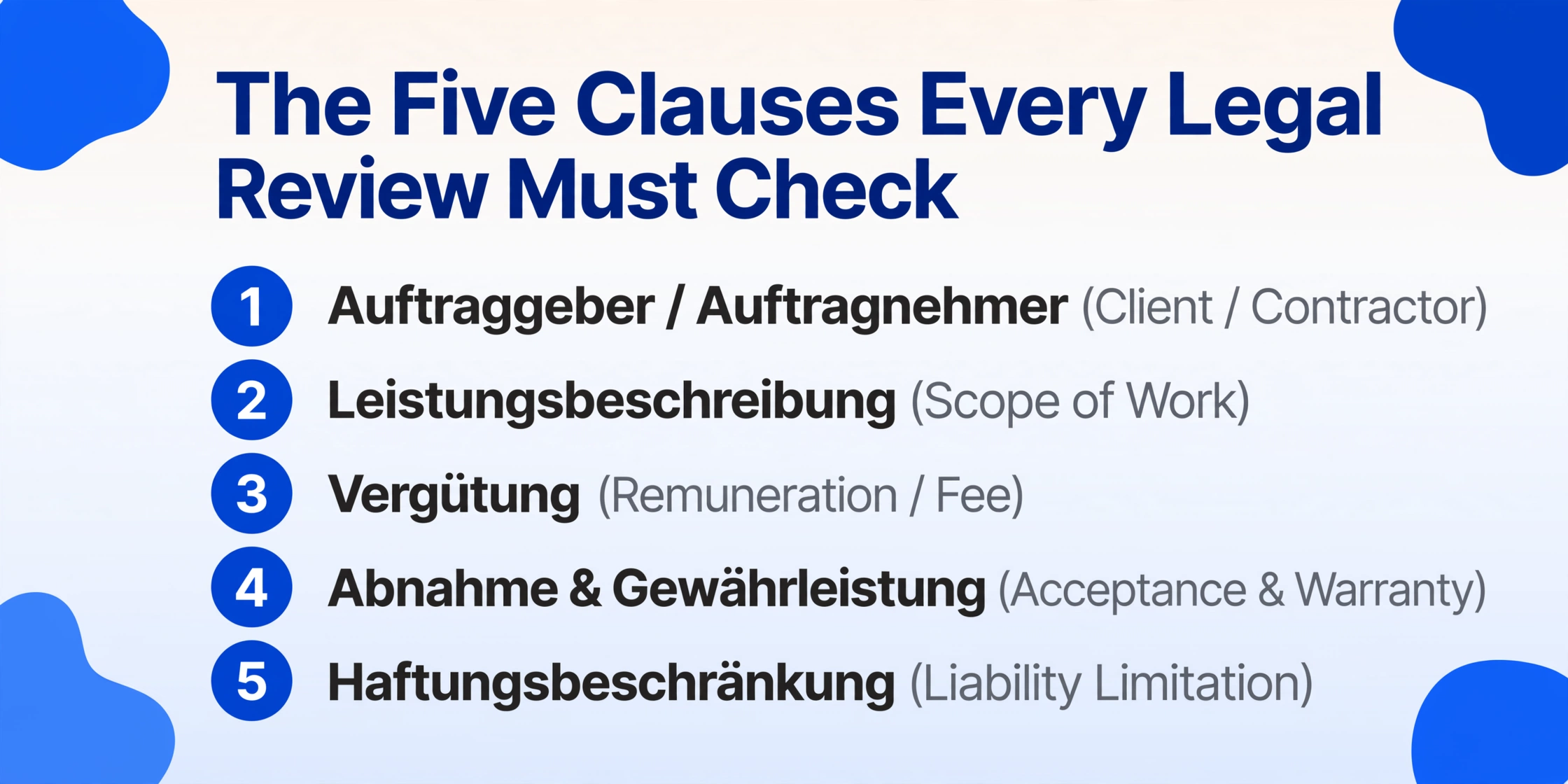
Not every clause in a 15-page Werkvertrag requires the same scrutiny. The legal reviewer's job is to identify the provisions that create financial or legal exposure — and the five that matter most are the ones that govern obligations, payment, liability, and expiry. Here they are, in the order a reviewer reads them off the contract:
The identity of the parties — sometimes obvious from the first page, sometimes buried in a "Vertragsparteien" section with subsidiary designations, registered office addresses, and Handelsregister (commercial register) numbers. Getting this wrong means reviewing the wrong contract against the wrong counterparty.
The description of what the contractor must deliver. This is the clause that determines whether the contract is a Werkvertrag (result-oriented: "build a 200m² warehouse") or a Dienstleistungsvertrag (effort-oriented: "provide project management support"). It also determines whether the five-year Gewährleistungsfrist under §634a Abs. 1 Nr. 2 applies — that requires a Bauwerk (construction work), and Bauwerk status depends on what the Leistungsbeschreibung says will be built.
The agreed payment under §632 BGB — whether fixed price (Festpreis), time-and-materials (Aufwand), or milestone-based (Abschlagszahlungen under §632a). This clause also determines whether the payment schedule creates advance-payment exposure (the client paying before work is complete) or deferred-payment leverage (the contractor working on credit).
The Abnahme date is the single most important date in a Werkvertrag — it starts the warranty clock under §634a Abs. 2 BGB. The Gewährleistungsfrist (warranty period) may follow the statutory defaults (2 or 5 years) or be contractually modified. A contract with a Gewährleistungsfrist expiring in three months is a materially different risk profile from one with four years remaining — and the reviewer cannot know this without extracting the Abnahme date and warranty clause from every contract.
The clause that caps damages — often stated as a multiple of the contract value (e.g. "haftet bis zur Höhe des dreifachen Auftragswerts," liable up to three times the contract value) or a fixed sum. Under German law, liability for intent (Vorsatz) cannot be excluded, and gross negligence (grobe Fahrlässigkeit) is heavily restricted under AGB (standard terms) control (§§307–309 BGB). But the cap for simple negligence — where most disputes land — is defined by this clause. A Werkvertrag with a €50,000 liability cap is not the same risk as one with a €500,000 cap, even if both contracts describe the same type of work.
These five clauses are not optional. They are the structural answer to "what risk does this contract create?" — and the legal reviewer who does not extract them into a comparable format cannot answer that question across a portfolio of contracts.
How Manual Review Works — and Where It Breaks
The traditional workflow looks like this. The reviewer receives a stack of Werkverträge — PDFs from a data room, emailed attachments from a client, or printouts from a physical contract archive. She opens the first contract, skims the first page for the parties, locates §3 or §4 for the Leistungsbeschreibung, flips to the Vergütung section (often §5 or §6), finds the Abnahme and Gewährleistung provisions (typically §8–§10), and locates the Haftungsbeschränkung (usually §11 or §12). She types each value into an Excel spreadsheet — one row per contract, the five clauses as columns. Then she opens the next contract and repeats. If the contracts come from different law firms — as they almost always do in M&A due diligence — the clause numbering, section headings, and even the terminology vary: one contract calls it "Vergütung," another "Honorar," a third "Auftragssumme." The reviewer must mentally map each variant to the correct column in her spreadsheet. We've broken down exactly where these hours go — and how a 30-contract portfolio can silently consume a full person-week — in our analysis of why German contract clause review burns more associate hours than teams budget for.
This method has two failure modes. The first is scanning fatigue: contract four is read with less attention than contract one, because the brain interprets the repetitive structure as a pattern and skips over deviations — the very deviations the reviewer is supposed to catch. The second is classification overhead: the reviewer is simultaneously performing two cognitive tasks — reading a value off a page and classifying it into a spreadsheet column — and performing both at once produces errors after roughly 20 minutes of sustained work, as documented in the analysis of the German ELSTER manual data entry problem. The ELSTER article describes a tax-filing context, but the mechanism is identical: reading and classifying simultaneously degrades accuracy with repetition, regardless of the document type.
The manual method has no structural defense against these failure modes. If a reviewer misses a Gewährleistungsfrist variation in contract 17 of 20, the spreadsheet says the contract carries the standard 5-year warranty. A due diligence report based on that spreadsheet will be wrong — and by the time the error surfaces in a post-closing dispute, the M&A deal has already closed.
How AI Clause Extraction Works on German Contracts
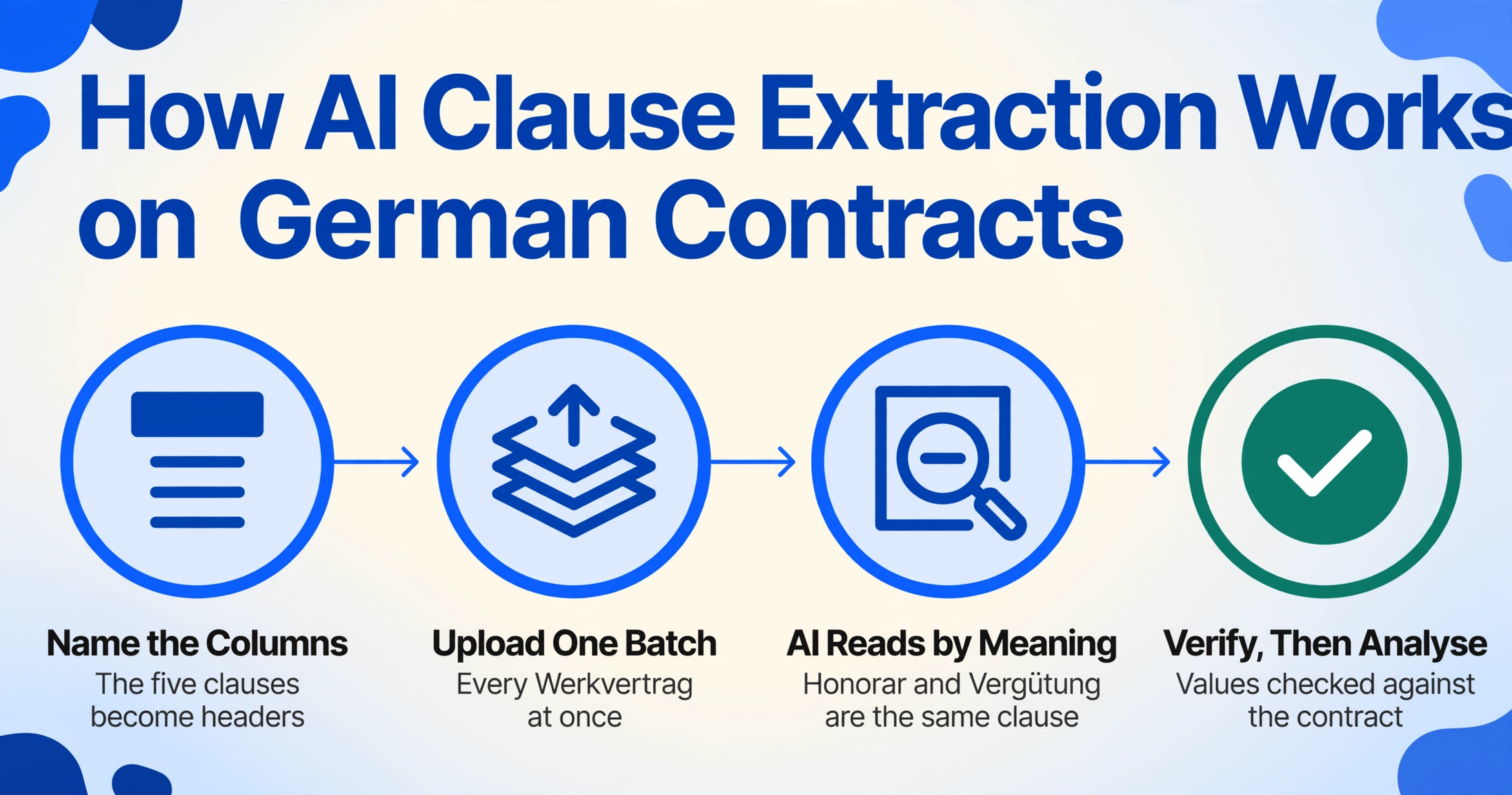
The alternative to reading-then-typing is Custom Column Extraction — a method where you define the columns you want (the five clauses above), upload all the contracts in one batch, and the AI locates each value by understanding what the clause means, not where it sits on the page. This is the core paradigm shift described in the Japanese purchase order extraction guide: a column named "Vergütung (EUR)" has the AI read the contract, find the remuneration clause — whether it is labelled "Vergütung," "Honorar," "Auftragssumme," or "Preis" — and extract the amount. The identical column-based principle works for tax documents — the ELSTER tax form extraction guide shows how column-name extraction handles Anlage assignments and tax categories via the same mechanism. The column name IS the instruction. The AI does the reading; you do the classifying — verifying the extracted values against the contract, not transcribing them from scratch.
Here is the step-by-step procedure for extracting Werkvertrag clauses:
Type the column names exactly as you want them to appear in your output: "Auftraggeber," "Auftragnehmer," "Leistungsbeschreibung (Scope of Work Summary)," "Vergütung (EUR)," "Abnahmedatum," "Gewährleistungsfrist (Years)," "Haftungsbeschränkung (EUR or Multiple of Contract Value)." The AI reads each contract and fills the corresponding row by locating the provision that matches each column's semantic intent — regardless of whether the contract labels the remuneration section "Vergütung" or "Honorar."
Drop all your Werkverträge into the upload area. The AI handles PDFs (even scanned), Word documents (.docx), and images. No need to pre-process, OCR separately, or standardize formats — the AI reads each document visually, understanding text in context rather than extracting character-by-character.
Add a column: "Vertragstyp (options: Werkvertrag/Dienstleistungsvertrag/Unclear)." This is an Inferred Column — the AI reads the Leistungsbeschreibung and classifies the contract type based on whether the obligation is result-oriented (Werkvertrag) or effort-oriented (Dienstleistungsvertrag). This classification feeds into your risk assessment: a Werkvertrag classified as a Dienstleistungsvertrag means the legal reviewer may have misapplied the wrong BGB provisions to the contract during the initial review.
Add a computed column: "Gewährleistungsablauf (Abnahmedatum + Gewährleistungsfrist Years)." This Computed Column performs the date arithmetic automatically: if the Abnahme was 15 March 2021 and the Gewährleistungsfrist is 5 years, the output is 15 March 2026. The AI does the math at extraction time, so you don't manually calculate expiry dates for each contract. Sort this column ascending to see which warranties are closest to expiry — the contracts at the top are your highest-priority review targets.
The spreadsheet lands with all five clauses extracted across all contracts. Your job now is verification: spot-check a few contracts against the extracted values, confirm the contract type classification is correct for each, and note any discrepancies. This is where the reviewer's legal expertise enters — not in the transcription, but in the judgment. A Gewährleistungsfrist of 2 years on a Werkvertrag that describes construction of a "Lagerhalle" (warehouse) is a red flag: Bauwerk status under §634a Abs. 1 Nr. 2 triggers a 5-year statutory minimum, and a contractual reduction may be invalid under AGB control (§307 BGB). The AI extracts the number; you interpret its legal significance.
Files are processed securely and not stored.
Why Semantic Extraction Works Where Keyword Search Fails
A traditional contract review tool that relies on keyword search looks for the string "Vergütung" in the document. It finds it — and also finds every cross-reference to it ("wie in §5 Vergütung geregelt," as regulated in §5 Remuneration), every definition that mentions it, and every boilerplate clause that uses the word. The reviewer then reads through the search results to find the actual clause. The AI method works differently: it reads the entire document once, understands that §5 is the remuneration section (even if it is labelled "Honorar" instead of "Vergütung"), and extracts the value — a number in euros, or a description of the fee structure. It does not search for a string; it searches for a meaning.
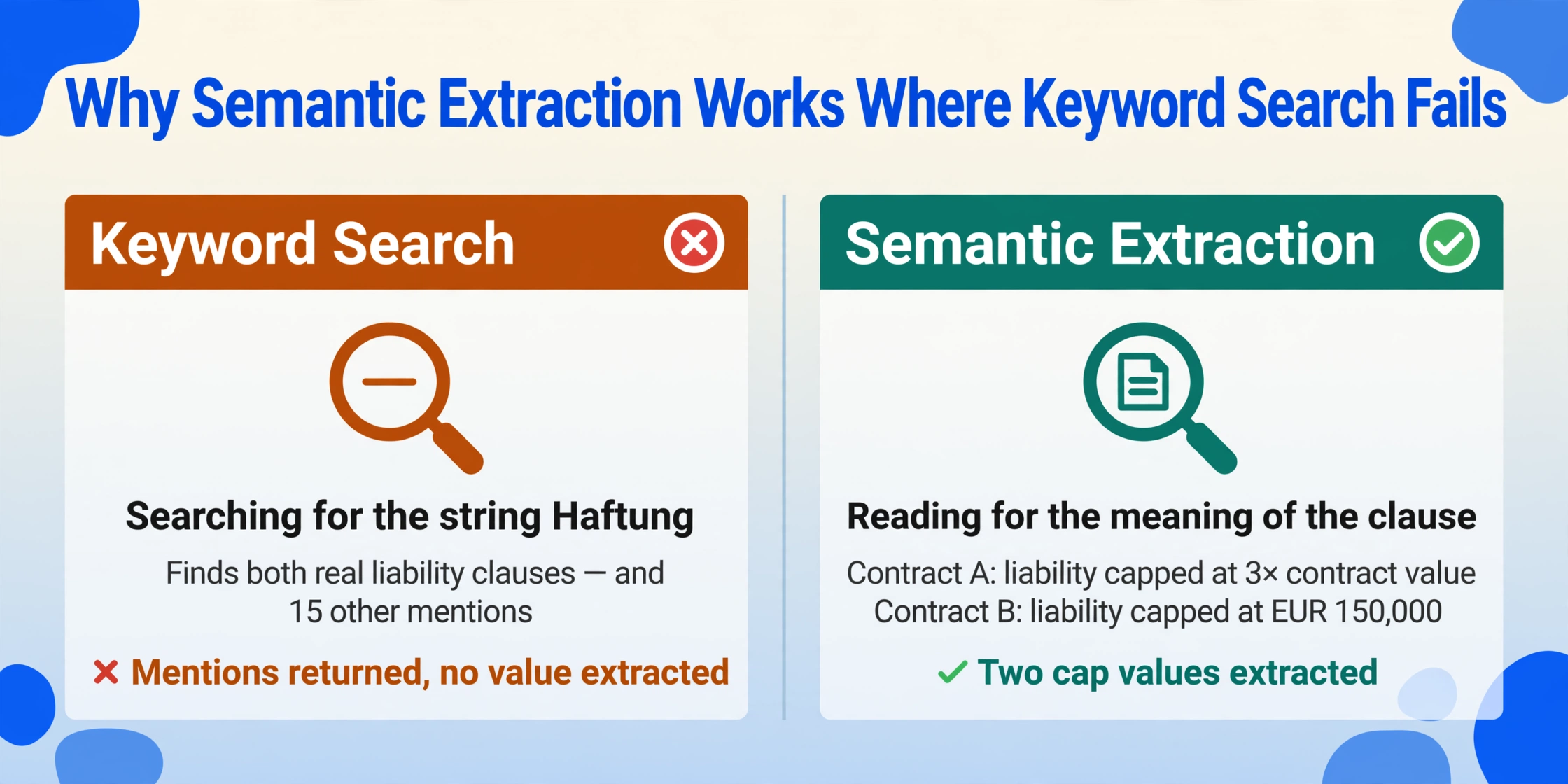
This difference matters especially for clause types that rarely use identical phrasing across contracts. A Haftungsbeschränkung (liability limitation) clause in one contract might read "Die Haftung ist auf den dreifachen Auftragswert begrenzt" (liability is limited to three times the contract value). In another contract, the same concept might be expressed as "Der Auftragnehmer haftet für einfache Fahrlässigkeit bis maximal EUR 150.000" (the contractor is liable for simple negligence up to a maximum of EUR 150,000). A keyword search for "Haftung" finds both — along with 15 other mentions of the word. A semantic extraction understands that both clauses express the same concept and extracts the cap value — 3× contract value from the first, EUR 150,000 from the second — into the same column.
This semantic approach also handles a structural peculiarity of German legal documents: the numbering system. German contracts use § (Paragraph) references extensively, including cross-references to BGB provisions within the contract text. A sentence like "Die Gewährleistungsfrist beträgt abweichend von §634a Abs. 1 Nr. 2 BGB drei Jahre" (the warranty period is three years, deviating from §634a Abs. 1 Nr. 2 BGB) contains two different statutory references — one to the BGB provision being deviated from, and an effective statement that the warranty is 3 years instead of 5. A keyword search for "§634a" returns every contract that mentions it. The AI returns the actual warranty period — "3 years" — into the Gewährleistungsfrist column, because it understands the sentence, not just the characters.
What Extraction Doesn't Do — and Why That's the Point
Document data extraction is a data capture tool — it reads contracts and outputs structured data. It does not perform legal analysis. It does not tell you whether a 2-year Gewährleistungsfrist in a Bauwerk contract violates AGB law under §307 BGB. It does not flag that a liability cap of €50,000 on a contract worth €2 million is commercially unreasonable. It does not advise on whether a Leistungsbeschreibung is specific enough to satisfy the Bestimmtheitsgrundsatz (the principle of definiteness) required for a Werkvertrag.
These judgments remain the lawyer's responsibility — and that is the point. Extraction removes the reading-and-typing step that consumes the first pass through every contract, leaving the lawyer with more time and cognitive bandwidth for the analysis step. The extracted spreadsheet is the input to legal judgment, not the output that replaces it. A reviewer who spends four hours reading contracts and one hour analysing them, and a reviewer who spends one hour verifying extracted data and four hours analysing it, may start from the same stack of Werkverträge — but the second reviewer's output will identify risks the first reviewer's fatigue prevented them from seeing.
The honest boundary: extraction reads the contract. It does not interpret the BGB, assess commercial reasonableness, or advise on legal risk. What it does — replacing manual transcription with AI-assisted verification — gives the lawyer back the hours they would have spent on the part of contract review that requires no legal expertise at all.
FAQ — German Werkvertrag Clause Extraction for Legal Review
What is the difference between a Werkvertrag and a Dienstleistungsvertrag under German law?
A Werkvertrag (BGB §§631–650v) obliges the contractor to deliver a specific result — building a warehouse, repairing a machine, producing a report with defined content. A Dienstleistungsvertrag (BGB §§611–630h) obliges the provider to perform a service with diligent effort — management consulting, legal advice, medical treatment. The distinction matters for warranty: a Werkvertrag carries Abnahme (acceptance) under §640 BGB, after which the Gewährleistungsfrist runs (2 years for standard works, 5 years for Bauwerke under §634a Abs. 1 Nr. 2). A Dienstleistungsvertrag has no Abnahme concept and follows the regular 3-year limitation period under §§195, 199 BGB. The contract type also determines which remedies apply if the work is deficient (§634 BGB for Werkvertrag vs general law of obligations for Dienstleistungsvertrag).
Can AI extraction handle German legal terminology and BGB cross-references?
Yes. The AI reads the contract by understanding meaning, not by matching strings. A clause that reads "abweichend von §634a Abs. 1 Nr. 2 BGB beträgt die Gewährleistungsfrist drei Jahre" is parsed as "the warranty period is 3 years" — the statutory cross-reference is understood as context, not as the answer. The AI also handles the linguistic variation common in legal documents: "Vergütung," "Honorar," "Auftragssumme," and "Preis" are all recognized as referring to the same concept (remuneration) when the column is named "Vergütung (EUR)." The AI does not need a glossary — it understands synonyms from context.
How many contracts can I process in one batch?
There is no hard limit on the number of contracts. The batch processing engine handles multiple files simultaneously and merges all extracted data into a single spreadsheet — one row per contract, one column per clause you defined. In practice, a review of 20–50 Werkverträge — the typical volume for a mid-market M&A due diligence — processes in the time it takes to read one contract manually. For larger portfolios (100+ contracts), the batch still completes, but the verification step naturally takes longer because there are more rows to spot-check. The output spreadsheet can be exported as Excel (XLSX) or CSV for further analysis in your existing review workflow.
Does extraction work with scanned contracts and handwritten amendments?
Yes. The AI reads documents visually — it does not rely on a text layer, so scanned PDFs and even photographed printouts are processed the same way as born-digital documents. Handwritten amendments in the margin (e.g., a manually corrected Gewährleistungsfrist) are read by the AI as part of the document image. However, if the handwriting is illegible to a human reader, it will also be problematic for the AI — extraction quality follows input quality.
What happens if a clause is missing from a particular contract?
The AI leaves the cell blank for that contract. A blank cell is itself a finding: it means the contract does not contain a provision matching the column name. For example, if the "Haftungsbeschränkung (EUR)" column returns blank for contract #7, the reviewer knows that contract has no liability cap — which means the statutory default applies (unlimited liability for simple negligence unless excluded by AGB). Blank cells should be the reviewer's first verification targets, because a missing clause is often more legally significant than a present one.
Can extraction classify whether a contract is a Werkvertrag or Dienstleistungsvertrag?
Yes, using an Inferred Column (Inferred Column — a column where the AI classifies the document based on its content rather than extracting an explicit value). Define a column: "Vertragstyp (options: Werkvertrag/Dienstleistungsvertrag/Unclear)." The AI reads the Leistungsbeschreibung and determines whether the obligation is result-oriented (Werkvertrag) or effort-oriented (Dienstleistungsvertrag). This classification is not legal advice — it is a data point for the reviewer to verify. If the AI classifies a contract as "Unclear," the reviewer should examine the scope clause directly, because ambiguous contract type classification is itself a risk factor in German contract law.
The five clauses that determine a Werkvertrag's risk profile are the same five clauses you read from every contract. Extraction separates the reading from the classifying — and the hours you save on transcription become hours you spend on the analysis that only a lawyer can do.
Extract Werkvertrag Clauses Now