Batch-Processing German Service Contracts
for M&A Legal Due Diligence
A mid-market M&A transaction involving a German Mittelstand company — a manufacturing firm with 200 employees and 15 years of operating history — will have roughly 30 Werkverträge (contracts to produce a work, BGB §631) in its data room. These are the contracts with the company's subcontractors, maintenance providers, facility managers, and IT vendors. Each one carries a Gewährleistungsfrist (warranty period under BGB §634a) that started ticking on the Abnahme date — and in a portfolio that spans 15 years, some warranties expired years ago while others have four years remaining. The legal due diligence team has one week to review all 30 contracts, extract the five clauses that determine financial exposure, and produce a risk-ranked issue list for the buyer. Reading 30 contracts one by one — finding the Leistungsbeschreibung (scope of work) in §3 of one and §4 of another, locating the Haftungsbeschränkung (liability limitation) in §11 of a contract drafted by a Munich firm and §9 of one drafted by a Hamburg firm — consumes four days of associate time before the first risk assessment even begins. Batch extraction turns those four days of reading into one afternoon of verification.
Key Takeaways
- A data room with 30 Werkverträge looks like it needs 30 individual reviews — but reviewing contracts in isolation means you cannot see that four contracts share the same Haftungsbeschränkung template and a fifth has a materially different liability cap: the risk is a pattern, not a sentence.
- The comparison IS the risk assessment — and comparison requires extracting every contract's key clauses into the same spreadsheet before the analysis starts, not reading 30 documents sequentially across four days and holding 30 mental models in your head.
- One clause registry, built in one batch, sorted in three passes — warranty expiry sort surfaces the contracts closest to expiry, liability cap comparison flags disproportionate caps, contract type filter isolates the ambiguous cases — replaces four days of individual reading with one afternoon of verification.
Why Single-Contract Review Breaks at Scale
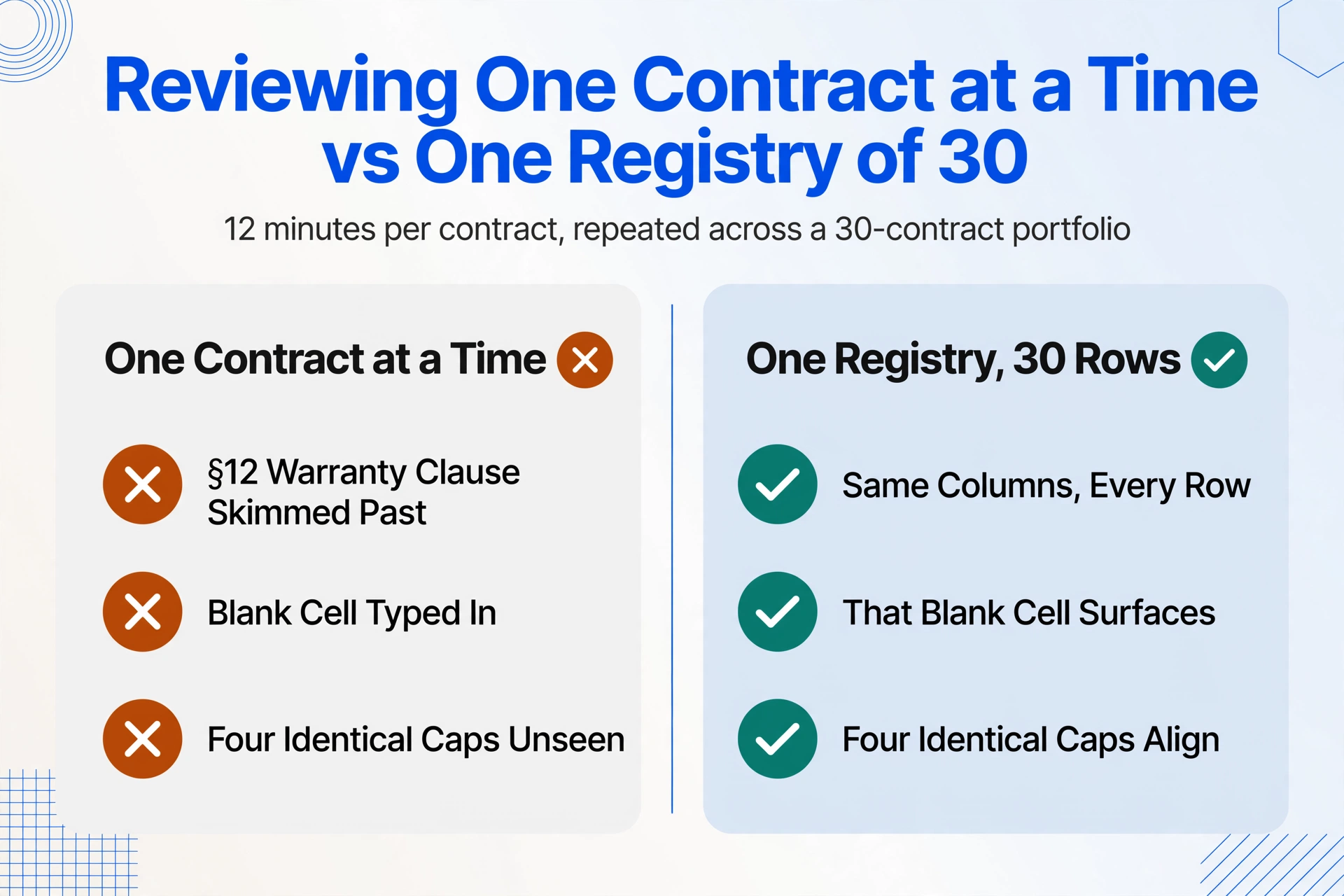
A legal associate reviewing one Werkvertrag performs a specific sequence: locate the parties (usually page 1), find the Leistungsbeschreibung (typically §3 or §4), locate the Vergütung (remuneration, §5 or §6), find the Abnahme and Gewährleistung provisions (§8–§10), identify the Haftungsbeschränkung (§11 or §12). She types each finding into a row of her review spreadsheet. This sequence takes roughly 12 minutes per contract — not because reading 15 pages of German legalese takes 12 minutes, but because locating the relevant clauses within the document structure consumes most of the time. The reading itself is fast; the navigation between sections is slow. We've mapped exactly where those hours go — and why they balloon across a 30-contract portfolio — in our breakdown of why German contract clause review burns more associate hours than teams budget for.
Now multiply by 30. The same sequence, performed 30 times, triggers two structural problems that do not exist at the single-contract level. The first is column drift: by contract 15, the reviewer has mentally internalised that the Gewährleistungsfrist is "usually §9" — and when contract 17 places it in §12 instead, the reviewer skims past it, types a blank or a default value into the spreadsheet, and moves on. The second is comparison blindness: with each contract reviewed in isolation, the reviewer cannot see that four contracts share an identical Haftungsbeschränkung clause — a pattern that suggests the counterparty used a template — and that a fifth contract has a materially different liability cap. That fifth contract is the risk, but without cross-contract visibility, it reads as just another row in the spreadsheet.
Single-contract review is a reading problem. Batch contract review is a comparison problem — and comparison requires all the data in one place before the analysis begins. Reading every contract sequentially and only then comparing the extracted data means the comparison happens at the end of the process, when fatigue is highest and the transaction deadline is closest.
What a Contract Clause Registry Actually Looks Like
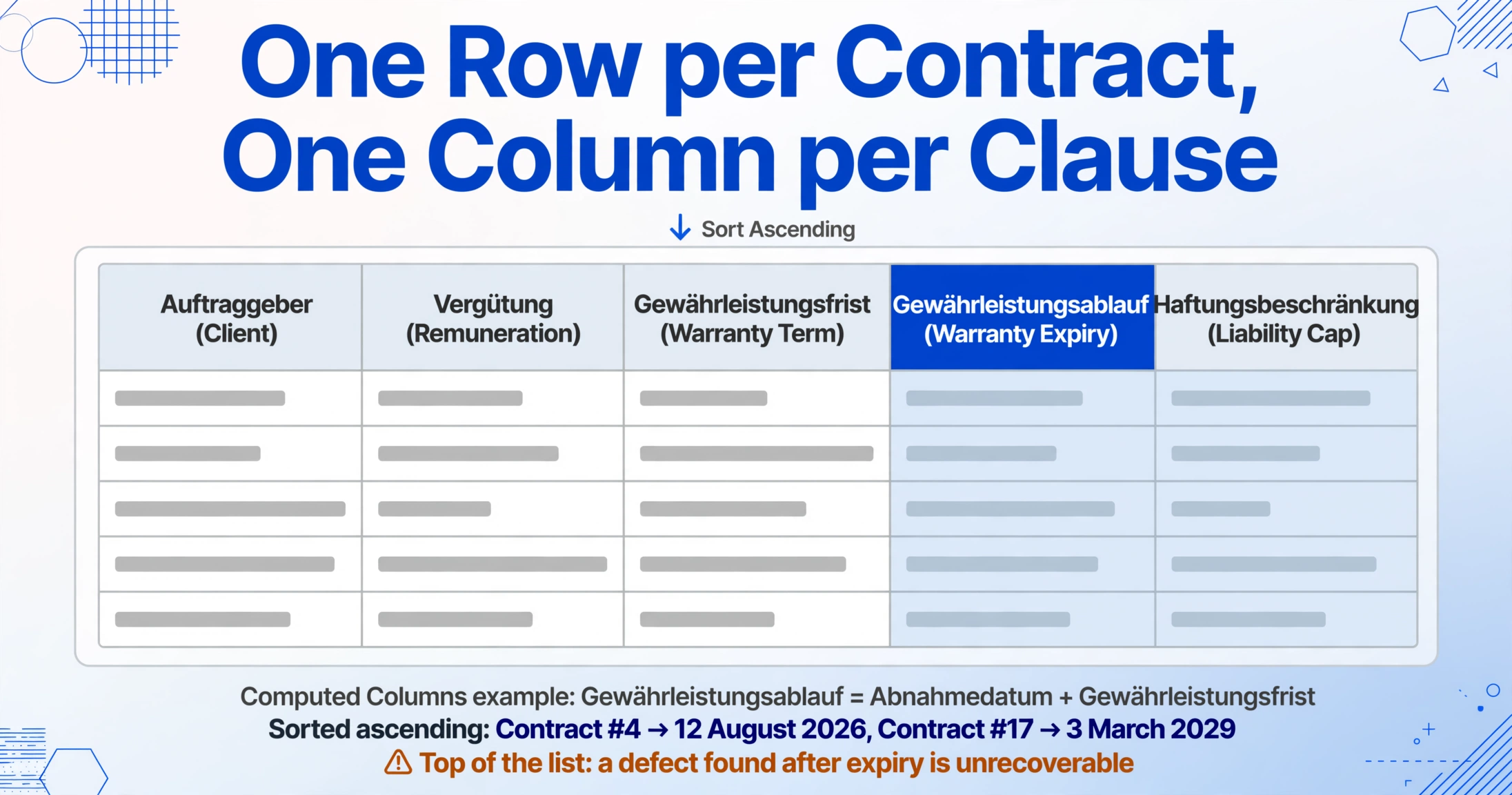
A clause registry is a spreadsheet where each row is one contract and each column is one clause. The columns are the same five fields defined in the Werkvertrag extraction guide: Auftraggeber, Auftragnehmer, Leistungsbeschreibung, Vergütung, Abnahmedatum, Gewährleistungsfrist, and Haftungsbeschränkung. But the registry adds two dimensions that single-contract review cannot produce:
- Row-wise comparison: Sort the registry by Gewährleistungsfrist (warranty period, ascending) to see which contracts' warranties are closest to expiry. Add a computed column — "Gewährleistungsablauf" (Abnahmedatum + Gewährleistungsfrist) — and sort by that, and you see the expiry calendar: contract #4's warranty ends 12 August 2026, contract #17's ends 3 March 2029. The contracts at the top of this sorted list are the ones where a defect discovered after expiry creates unrecoverable exposure — the buyer's negotiation leverage depends on knowing this before signing.
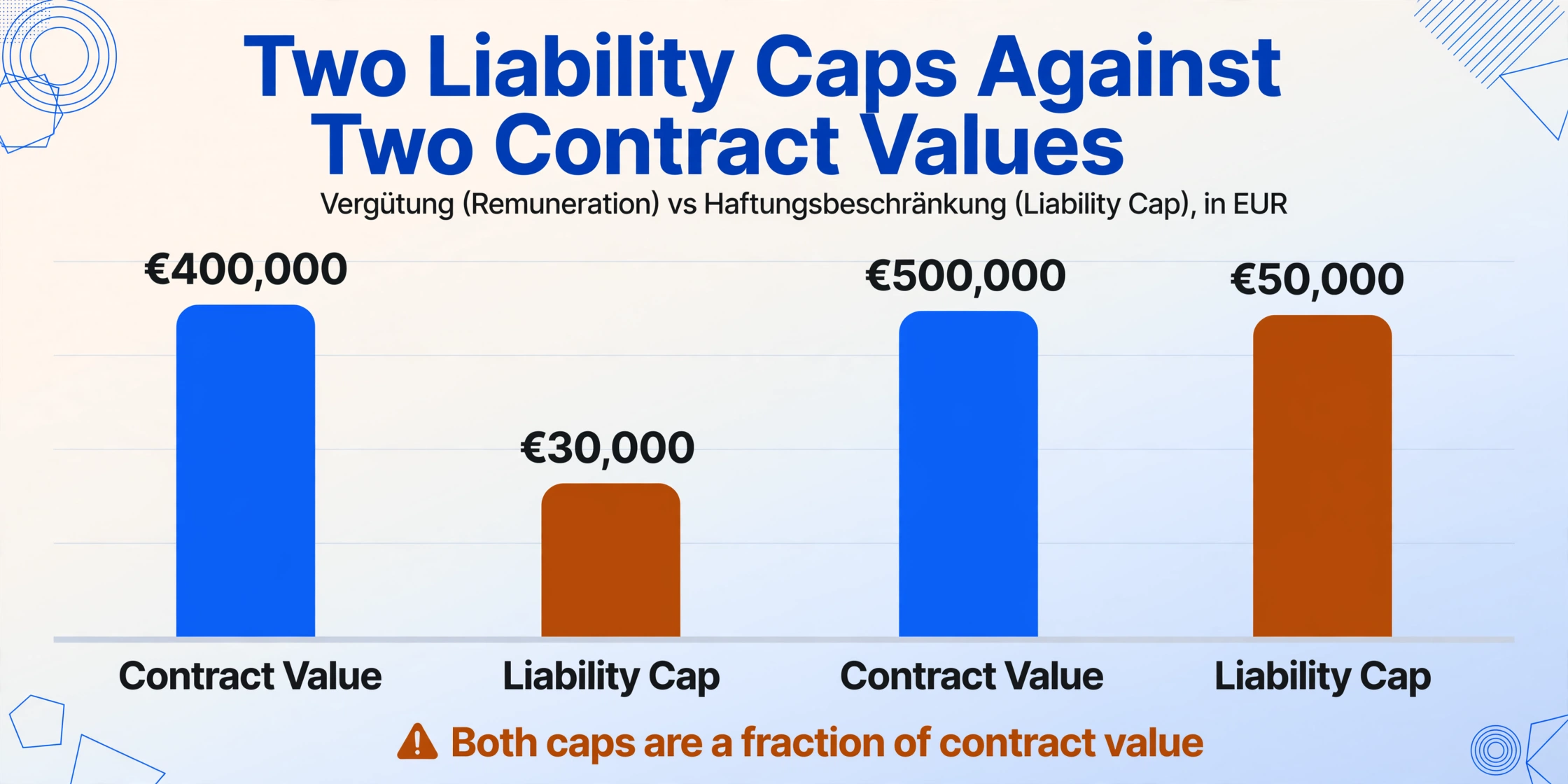
- Column-wise aggregation: Sum the Vergütung column to see the total outstanding contract value. Filter by Haftungsbeschränkung values below a threshold — say, liability caps under €100,000 — to identify contracts where the limitation of liability is disproportionate to the contract value. A €500,000 Werkvertrag for facility maintenance with a €50,000 liability cap is a risk signal, but you can only see it when the Vergütung and Haftungsbeschränkung columns are side by side for every contract.
This is not a new concept — contract registries have been standard practice in corporate legal departments for decades. What is new is that building the registry no longer requires reading every contract. The AI reads the contracts; the reviewer reads the registry.
How to Configure Batch Extraction for Werkvertrag Clause Extraction
The batch extraction workflow differs from single-contract processing in one critical respect: the columns must be designed for cross-contract comparability. A column named "Vergütung" extracted from one contract as "EUR 120.000 zzgl. MwSt" (plus VAT) and from another as "€85,000 netto" produces a column that cannot be summed, sorted, or filtered — the values are text strings, not numbers. The batch configuration requires standardisation at the column-definition stage.
Name your Vergütung column "Vergütung (EUR, numeric only)" — the parenthetical instruction tells the AI to extract only the number, stripping currency symbols, VAT notes, and text qualifiers. Similarly, "Haftungsbeschränkung (EUR, numeric only — if multiple of contract value, output as '3x' format)" captures both absolute caps (EUR 150,000) and relative caps (3× contract value). The format instruction ensures every cell in the column is comparable: 150000 and 3x are different data types but both are parseable for review.
The Gewährleistungsfrist (warranty period) by itself tells you the duration. The Computed Column "Gewährleistungsablauf (Abnahmedatum + Gewährleistungsfrist Years)" gives you the date the warranty actually expires. Sort this column ascending and the top rows are the contracts whose warranties are closest to expiry. In an M&A context, these are the contracts the buyer should negotiate specific indemnities for — because a post-expiry defect is unrecoverable under §634a Abs. 1 BGB, and the seller will not volunteer which warranties are about to lapse.
Define "Vertragstyp (options: Werkvertrag/Dienstleistungsvertrag/Unclear)" as an Inferred Column. In a batch of 30 contracts, some will be explicitly labelled as Werkverträge, some will describe a result-oriented obligation without using the word, and some will be ambiguous. The AI reads the Leistungsbeschreibung and classifies each contract. Filter this column to "Unclear" to identify the contracts that require immediate legal interpretation — a contract whose type is ambiguous may have the wrong BGB provisions applied to it by the counterparty, creating exposure the due diligence report must flag.
Drop every Werkvertrag, Dienstleistungsvertrag, and ancillary service agreement from the data room into the upload. The batch engine processes all files simultaneously — the output is one spreadsheet with 30+ rows, one per contract. No file-naming convention is required; the AI reads the contract content, not the filename, to populate the correct columns. The data room folder structure is irrelevant — extraction operates on document content, not file paths.
Files are processed securely and not stored.
Reading the Registry: Risk Assessment from Sorted Columns
The power of a clause registry is not that it contains data — it is that sorting one column rearranges every other column in lockstep. Here is how a legal due diligence team reads a 30-contract Werkvertrag registry in three passes:
Pass 1 — Warranty expiry sort. Sort by "Gewährleistungsablauf" ascending. The top three rows are contracts whose warranties expire within the next 6 months. These are the contracts where the buyer's post-closing window to assert a defect claim is shortest — and where the seller's disclosure schedule must be most specific about known defects. A contract for roof repair with a Gewährleistungsfrist expiring in 4 months and a Vergütung of €180,000 is a different negotiation problem from a contract for IT maintenance with a warranty expiring in 4 years and a Vergütung of €12,000. The sorted column makes the difference immediately visible.
Pass 2 — Liability cap vs contract value. For each row, compare the "Haftungsbeschränkung (EUR)" column against the "Vergütung (EUR)" column. A liability cap that is a fraction of the contract value — €30,000 cap on a €400,000 contract — means the contractor's exposure for defective work is capped well below the contract's financial significance. If the contractor is critical to the target company's operations (the sole provider of facility maintenance across three sites), that cap is a material risk: the buyer inherits a service relationship where the contractor has limited financial incentive to perform. Flag these rows for the issue list.
Pass 3 — Contract type classification. Filter the "Vertragstyp" column to "Unclear." These are the contracts where the Leistungsbeschreibung does not clearly establish whether the obligation is result-oriented (Werkvertrag) or effort-oriented (Dienstleistungsvertrag). An ambiguous contract type in German law means the warranty regime is also ambiguous — and the counterparty will argue for whichever interpretation limits their liability. Each "Unclear" contract should be flagged for legal interpretation by a qualified reviewer (Rechtsanwalt) before the due diligence report is finalised.
Three passes through a sorted spreadsheet, each pass answering one question for all 30 contracts simultaneously. The same analysis on 30 unconnected contract reviews — each read in isolation, each typed into a separate spreadsheet entry — would take days and still miss cross-contract patterns. The time saving is not from faster reading; it is from eliminating the need to hold 30 mental models of 30 contracts in your head at the same time.
Why Batch Extraction Is Not Just Single Extraction Repeated
Processing 30 contracts individually — uploading one, running extraction, downloading the result, uploading the next — produces 30 separate spreadsheets. Merging them into one registry requires manual copy-paste across 30 files. The single-contract workflow is designed for the end-user who processes one document at a time — a lawyer reviewing one client contract, a procurement manager entering one purchase order. The batch workflow is designed for the due diligence team that needs one output from many inputs. The difference is not just speed; it is that the merged output enables the cross-contract comparisons that the single-contract workflow structurally prevents.
This batch-first architecture — processing all files simultaneously and outputting one merged spreadsheet — is the same engine described in the Japanese purchase order batch processing guide. The document type changes — Werkverträge instead of Japanese 発注書 (hatchusho, purchase orders) — but the principle is identical: when the output is one table, the reviewer's job shifts from data entry to data analysis. The comparison logic (sort by warranty expiry, filter by liability cap, aggregate by contract type) works regardless of whether the rows are German service contracts, Japanese purchase orders, or UK employment agreements. The batch engine does not care what document created the row — it only cares that every row has the same columns.
FAQ — Batch German Service Contract Processing for Legal Due Diligence
How many Werkverträge can I batch-process at once?
There is no hard limit. The batch engine processes all uploaded files simultaneously and merges the results into one spreadsheet. For a typical mid-market M&A data room — 20 to 50 service contracts — the extraction completes in minutes. For larger portfolios (100+ contracts), the engine still processes them in one batch, but the verification step takes proportionally longer because the reviewer must spot-check more rows. The practical limit is the reviewer's capacity to verify, not the engine's capacity to extract.
What happens if contracts in the same batch use different languages or formats?
The AI processes each document independently — language, format, and clause numbering do not need to be consistent across the batch. A Werkvertrag drafted in German by a Munich firm and a service agreement drafted in English by a London firm (but governed by German law) can both be in the same batch. The column names — written in English — tell the AI what to find, and the AI reads each document in its own language to locate the matching provision. A column named "Vergütung (EUR)" extracts the remuneration from the German contract's "§5 Vergütung" section and the English contract's "Clause 5 — Remuneration" section equally.
Can I extract clauses from scanned contracts and handwritten amendments in the same batch?
Yes. The AI reads documents visually, not via a text layer, so scanned PDFs and photographed printouts are processed identically to born-digital documents. Handwritten margin notes — such as a pen-corrected Gewährleistungsfrist — are read as part of the document image. However, extraction accuracy depends on input legibility. A contract photographed in low light at an angle will produce less reliable extraction than a flatbed-scanned PDF. If legibility varies across the batch, focus the verification step on the lowest-quality source documents first.
How is the clause registry different from a contract management system (CLM)?
A CLM (Contract Lifecycle Management system) stores contracts and tracks metadata — party names, dates, renewal triggers — often entered manually during contract intake. The clause registry described here is an extraction output, not a storage system. It pulls the actual clause content from the contract text at review time, not from previously entered metadata. You can export the registry as Excel (XLSX) or CSV and import it into your existing CLM or due diligence platform. The registry is the bridge between the document and the database — extraction builds it in one batch; the reviewer verifies it; the CLM stores it.
Can the AI identify change-of-control clauses or assignment restrictions relevant to M&A?
Yes. Add a column named "Change-of-Control Clause (yes/no, extract relevant text if yes)" to the batch configuration. The AI reads each contract and identifies whether it contains a provision triggered by a change in the client's ownership — a standard concern in M&A due diligence, since the buyer needs to know which contracts require counterparty consent to transfer. Similarly, add an "Assignment/Übertragbarkeit (freely assignable/consent required/prohibited)" column. These are not among the standard five clauses, but the column-based extraction model means you define whatever clauses matter to your specific due diligence scope — the engine extracts what you ask for, not what a pre-built template includes.
A data room with 30 Werkverträge does not need 30 individual contract reviews. It needs one clause registry — built in one batch, sorted in three passes, verified by the people who understand what the numbers mean.
Build Your Clause Registry