Why Re-Keying DARF Codes Every Month
Costs Brazilian Finance Teams More Than They Realize
When a mid-sized Brazilian company processes ten supplier invoices in a month, those invoices can generate anywhere from four to six separate tax payment vouchers each — a DARF for IRRF, another for PIS, another for COFINS, another for CSLL, and, if the service involves labor, a GPS for INSS. In total, ten invoices produce between 40 and 60 individual payment documents. The finance team's process for tracking them is almost always the same: someone opens each PDF, reads the código da receita — a four-digit number that tells the Receita Federal which tax is being paid — and types it into a spreadsheet cell alongside the CNPJ, the period, and the amount. The work is repetitive, error-prone, and accepted as routine because "that is how it has always been done." What is less visible is the compliance chain that a single mistyped digit sets in motion.
Key Takeaways
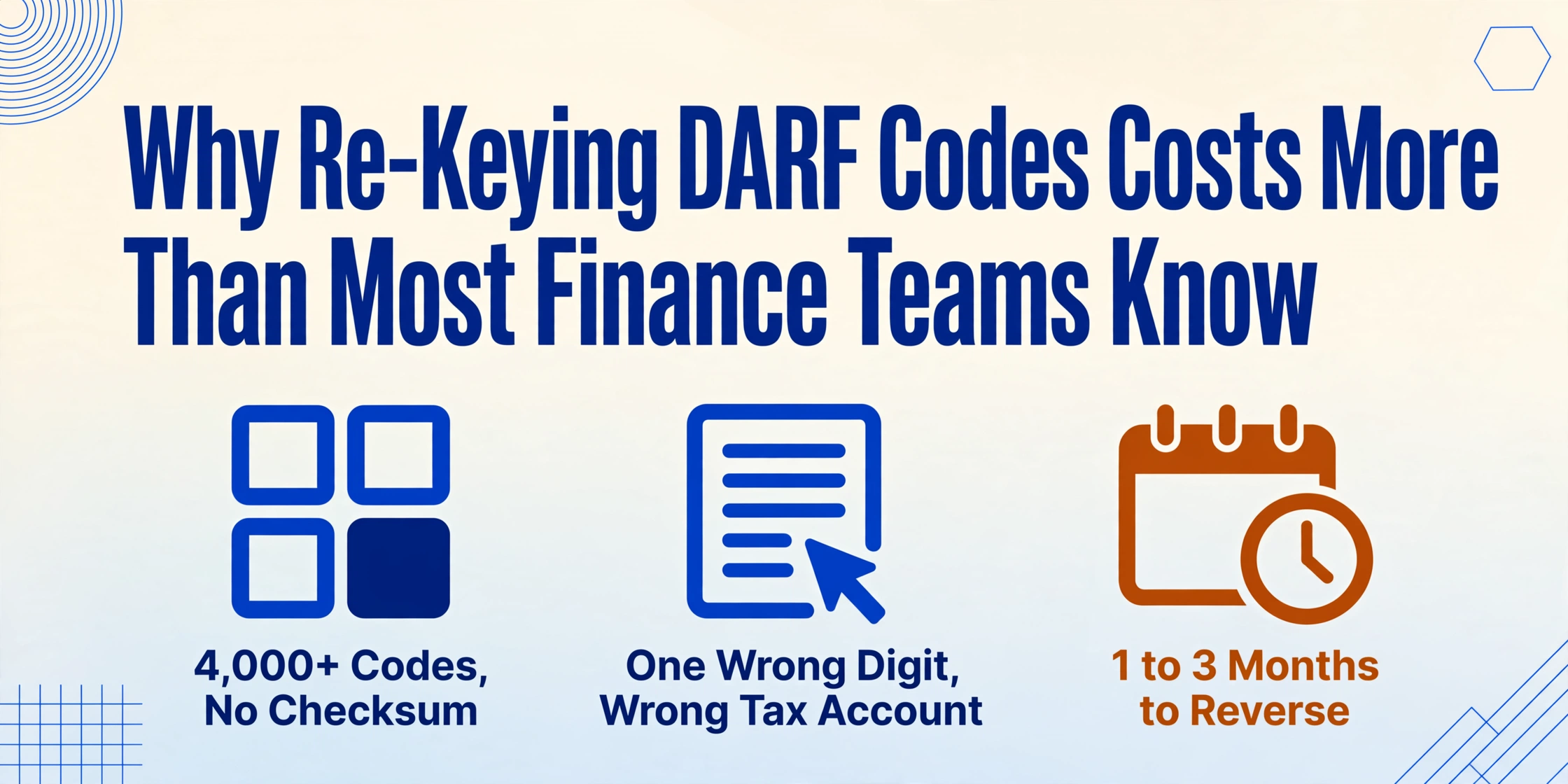
- A single mistyped digit in a four-digit DARF revenue code — 2362 typed as 2632 — triggers a REDARF correction that takes one to three months to resolve.
- Over 4,000 active revenue codes with zero validation mean the system silently credits your payment to the wrong tax account.
- Extracting the code directly from the DARF eliminates the transcription step — and with it the cycle of errors that surface months later through Malha Fiscal notices.
The Three-Voucher System: Three Formats, Three Code Schemes, One Person Typing
Brazil's tax collection is split across federal, social security, and state levels, and each level uses a different payment voucher format with its own identifier system. The finance professional processing these documents does not get to specialise in one format — they must handle all three, frequently within the same payment run.
DARF (Documento de Arrecadação de Receitas Federais) covers federal taxes. The key identifier is the código da receita — a four-digit number with over 4,000 active codes. Code 1708 means IRRF withheld on services. Code 2362 means the monthly IRPJ estimate. Code 0190 covers Carnê-Leão for individuals. Code 2909 is the INSS-on-payroll DARF generated by DCTFWeb. The code determines which tax account the payment is credited to. There is no autocomplete in manual data entry. The person typing it must look at the printed code on the DARF, read it correctly, and type it exactly into the spreadsheet — 2362 typed as 2361 is not a minor discrepancy; it is a payment credited to the wrong tax type.
GPS (Guia da Previdência Social) covers social security contributions — employer INSS (flat 20% of payroll), employee withholdings (7.5% to 14% progressive), and third-party entity levies. Its identifier is the payment code (e.g., 2003 for employer INSS, 2100 for individual contributors, 1007 for domestic employers), but unlike the DARF, the GPS also carries a CEI number (Cadastro Específico do INSS — the establishment-level registration at the social security authority) that differs from the company's main CNPJ, adding another identifier that must be transcribed correctly.
DAE (Documento de Arrecadação Estadual) covers state taxes — primarily ICMS. The name and format change by state: São Paulo issues DARE (formerly GARE), Rio de Janeiro issues DARJ, other states use DUA or state-specific names. There is no unified code directory across states. Each DAE carries its own reference code system, with no standardisation between, say, a São Paulo ICMS payment and a Minas Gerais one.
For a detailed breakdown of the individual fields on each voucher type, the extraction guide for Brazilian DARF and GPS documents includes the complete field map covering all three formats. The guide focuses on how to extract those fields using AI; this article focuses on what happens when the extraction is not automated and the fields must be transcribed by hand.
The Revenue Code Problem: 4,000+ Four-Digit Combinations With Zero Error Tolerance
The coding system for DARF payments has a surface-level simplicity that masks its danger: each code is only four digits. It seems easy enough. Look at the printed code, type four digits. The problem is not the length of the code; it is the density of the code space. With over 4,000 active codes distributed across dozens of tax types, rates, and calculation methods, the distinction between 1708 (IRRF on services) and 2362 (IRPJ monthly estimate) is not visually obvious — both are four digits that start with two different numbers. A person processing 40 DARF vouchers in a sitting will encounter dozens of different codes. Fatigue sets in. Digits get transposed. A 2362 becomes a 2632. A 0190 becomes a 0910.
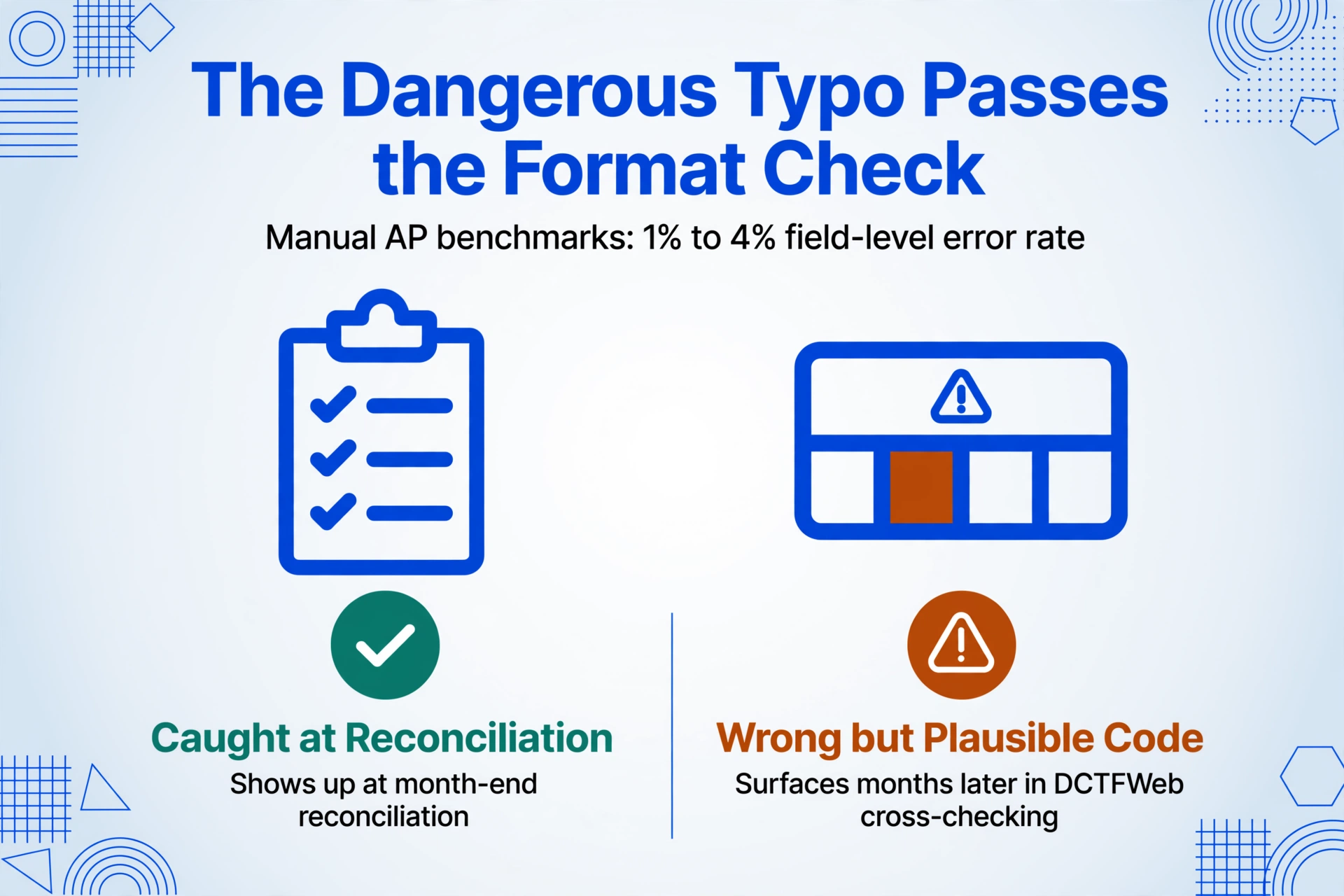
Industry benchmarks for manual data entry in AP environments typically show field-level error rates of 1% to 4%. Applied to a monthly load of 50 payment vouchers with 5–7 fields each (CNPJ, revenue code, period, due date, principal amount, total amount), that means roughly 2 to 12 transcription errors per month. Most are caught during reconciliation. The ones that are not caught — the revenue code typed incorrectly but within a plausible range — produce errors in the payment register that surface months later during DCTFWeb cross-checking or, worse, during a Malha Fiscal exercise.
The four-digit revenue code has no built-in checksum or validation. If the code is valid (it passes the format check — four digits that exist in the Receita Federal's table), the payment is credited to the wrong tax account. There is no automatic rejection, no "are you sure?" prompt. The system accepts the code, assigns the payment, and posts the error to the taxpayer's register.
One Wrong Digit, Months of Red Tape
When a DARF payment lands in the wrong tax account — because the revenue code was typed with a single wrong digit — the correction process is not a quick fix in a spreadsheet. The Receita Federal's system operates on the principle of pagamento vinculado à declaração: the payment is automatically linked to the tax declaration (DCTF, DCTFWeb, or DIRF) on the Receita Federal's side. A payment credited to the wrong code means the declared tax for the correct code appears unpaid in the system, while the wrong code's account shows an overpayment.
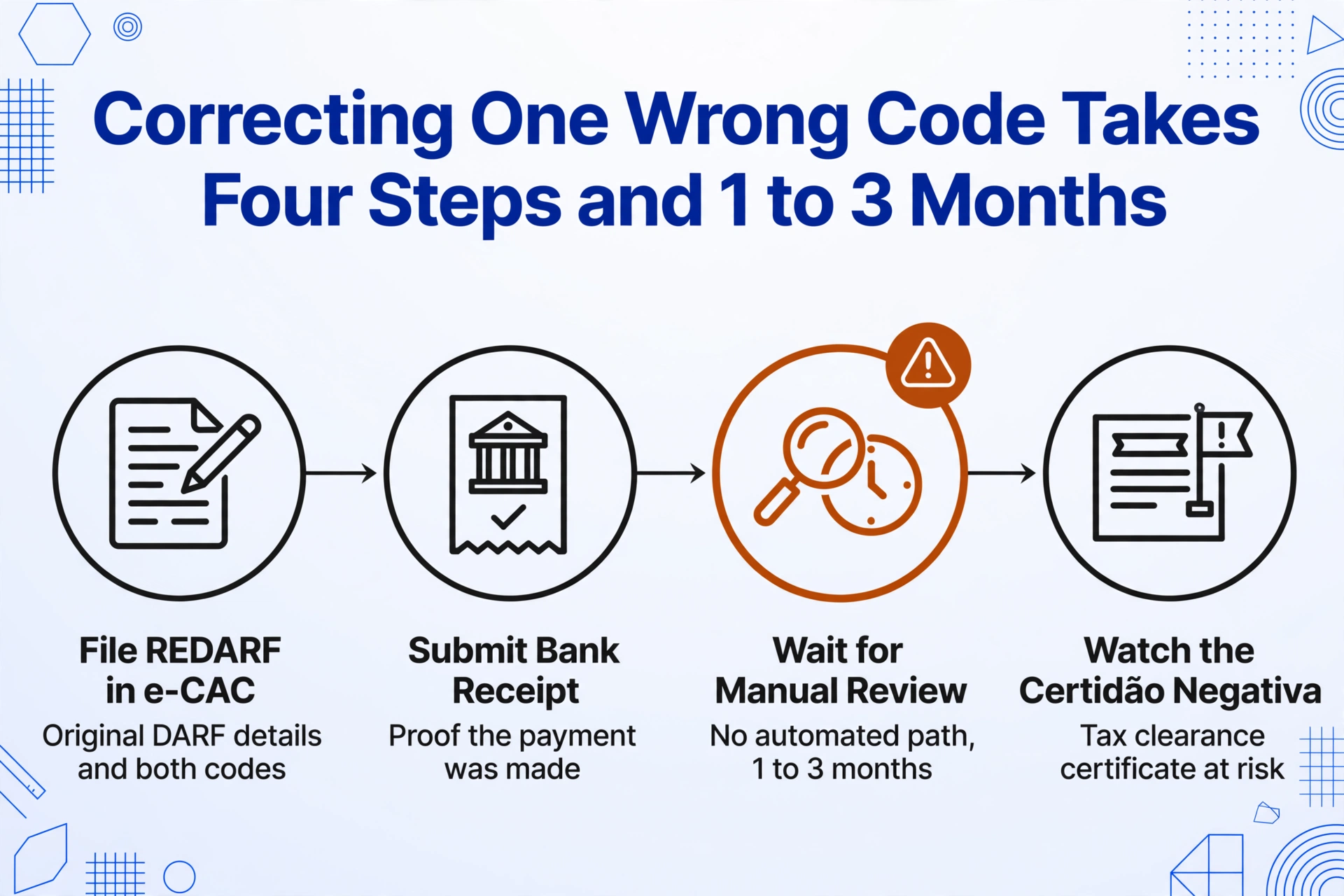
Correcting this requires a formal REDARF (Retificação do Documento de Arrecadação de Receitas Federais) — a correction request submitted through the e-CAC portal. The process involves:
- Filing the rectification request through e-CAC with the original DARF details, the incorrect code entered, and the correct code that should have been applied
- Providing proof of payment — the bank-authenticated receipt showing the payment was made, including the correct amount and date
- Waiting for manual review by the Receita Federal — the correction is not automated. Depending on the complexity and the current workload at the Receita, this can take 1 to 3 months
- Monitoring the tax clearance certificate (Certidão Negativa de Débitos) throughout the process — while a REDARF is pending, the original tax may still show as unpaid in the system, which can affect the company's ability to obtain financing, renew government contracts, or participate in public bids
During those months, the company's Malha Fiscal notice — the Receita's automated cross-reference alert — may flag the discrepancy between the DCTF declaration (which reports the tax at the correct code) and the payment register (which shows the payment at the wrong code). Each Malha notice requires a response, typically through an administrative appeal or a formal clarification submitted via e-CAC. A single keystroke error, detected months later, can generate hours of tax consultant time to unwind.
The risk is not hypothetical. In Brazil, the tax authority's cross-referencing systems operate continuously — matching every declared tax against every paid DARF, every filed GPS against every processed payment. A 1% error rate on 50 monthly payment documents means roughly one REDARF-worthy error every two months. Each one consumes hours of compliance staff time to identify, document, and correct. The manual data entry is not generating the error deliberately — but it is generating it systematically, and the cost of each individual error, when it surfaces through the Malha Fiscal, outweighs the cost of the data entry that introduced it.
The Spreadsheet Gap: Why the Shared Spreadsheet Is the Weakest Control
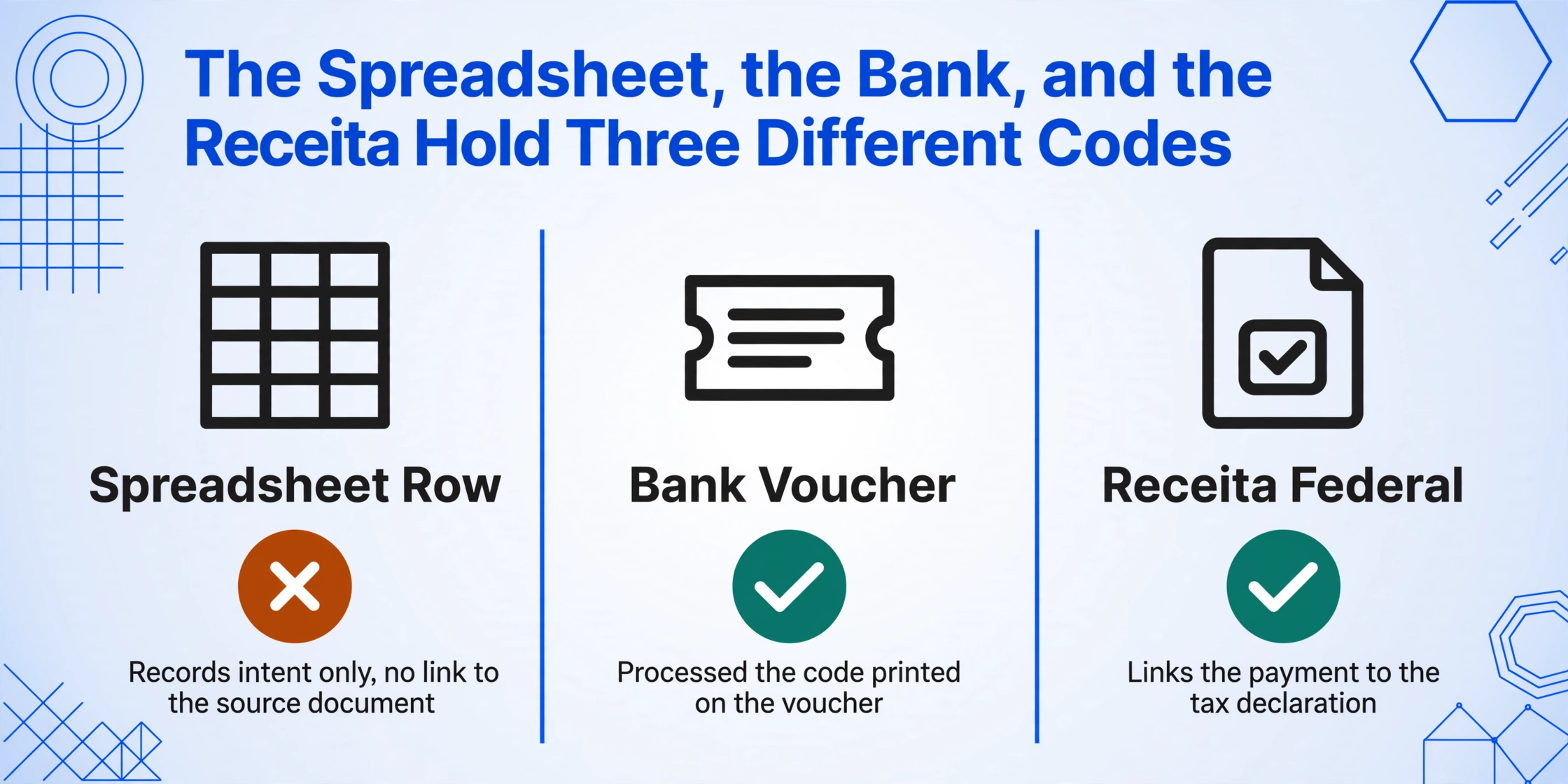
The most common solution to DARF/GPS/DAE tracking is the shared spreadsheet — a Google Sheet or Excel file with columns for CNPJ, code, period, amount, and a "notes" field for free-text observations. It is everywhere in Brazilian finance departments. And it has a fundamental structural weakness: the spreadsheet is disconnected from the source documents.
When a DARF is paid and the code is typed into the spreadsheet correctly, the spreadsheet row is evidence that the AP clerk intended to record that payment. But it is not evidence that the payment was actually made to the correct code. The bank processed the DARF based on the code printed on the voucher — not the code typed in the spreadsheet. If those two diverge, the spreadsheet is wrong, and the bank is correct. But the spreadsheet has no way of detecting that divergence. It cannot check its own entries against the source documents because it is not linked to them.
This disconnect produces a specific class of reconciliation problems: the spreadsheet looks complete, every row is filled in, and the totals balance. But the individual rows — the revenue codes, the CNPJ numbers, the contribution periods — contain transcription errors that are invisible until the Receita's cross-reference system flags them. At that point, the spreadsheet is not a helpful diagnostic tool. It is a record of the same workflow that introduced the error.
Why Manual Still Feels "Good Enough" — Until It Isn't
The persistence of manual DARF/GPS/DAE data entry is not because finance teams are unaware of automation tools. It reflects a more specific structural condition: the work is distributed across the month, the volume per person per day is low enough to feel manageable, and the errors do not surface immediately.
A senior AP analyst processing ten payment vouchers per day spends roughly 30 minutes on data entry. The work feels routine — open a DARF, read the code, type it, move on. The 1% to 4% error rate is invisible at the daily level because most errors are not detected until the month-end reconciliation, and even then, the reconciliation process itself relies on the same spreadsheet, making it hard to distinguish between input errors and genuine payment discrepancies. The cost of the errors does not appear on a P&L line — it shows up as tax consultant hours, REDARF filing fees, and, in some cases, late-payment penalties on taxes that were actually paid on time but credited to the wrong code.
The volume threshold at which manual data entry becomes unsustainable is surprisingly low. At 40 payment documents per month — a realistic figure for a mid-sized company with 10–15 supplier invoices — the monthly error exposure is roughly one to two transcription errors. At 100 documents per month, it is three to five errors. At 300 documents — not unusual for a São Paulo-based accounting firm handling payroll and AP for multiple clients — the expected error count reaches 8 to 12 per month, more than enough to trigger repeated Malha Fiscal notices that consume the same compliance staff's time, creating a cycle where fixing the errors prevents the team from implementing the automation that would prevent them.
Frequently Asked Questions
How does extracting DARF data using AI eliminate the revenue code transcription error?
The extraction reads the revenue code directly from the source document — the DARF PDF, the GPS slip, or the DAE receipt — and writes it into the spreadsheet column without a human transcription step. The AI identifies the código da receita field on the document by understanding that a four-digit number next to the label "Código da Receita" is the revenue code, and copies that value into the output table. The error vector of "I misread the 3 as an 8" or "I typed 2362 as 2632" is eliminated because the value is transferred from document to spreadsheet by the same process that reads it. The full workflow for extracting DARF and GPS data covers the implementation in detail.
Does this apply only to DARF, or does it work for DAE state payments too?
It applies to all three formats — DARF, GPS, and DAE — because the extraction is Format-Independent. The underlying vision model reads the document's content semantically rather than matching a template. A DARE from São Paulo, a DARJ from Rio de Janeiro, and a DUA from another state are processed the same way: the AI identifies the taxpayer CNPJ, the reference period, the state tax amount, and the payment identifier regardless of where those fields appear on each state's form. The revenue code problem exists in all three formats, and the same extraction approach addresses it across all of them.
What about DARF payments made via PIX where the only receipt is a banking app screenshot?
Screenshots from banking apps — Caixa, Banco do Brasil, Itaú, Santander, Nubank, and others — are processed as image files the same way as original DARF documents. The AI reads the payment details, including the revenue code if it is displayed on the screenshot. The limitation is that some banking apps truncate or abbreviate the revenue code display — if the app shows only the last three digits or masks part of the code, the extracted value may be incomplete. When possible, supplement the bank screenshot with the original DARF slip generated by SicalcWeb or e-CAC, which contains the complete set of fields in a standardised layout.
Does the tool automatically flag DARF vouchers where the revenue code looks suspicious?
The extraction tool itself does not validate revenue codes against the Receita Federal's code table — its function is to read the field and transfer it to the output. However, once the data is in a structured spreadsheet, you can build a validation layer that cross-references extracted codes against a known code list. A simple conditional formatting rule in Excel — "if the revenue code column contains a value not in the approved list, highlight it yellow" — converts the extraction output into a self-checking register. The key point is that the extraction eliminates the transcription error at the input stage; any validation you add at the spreadsheet stage is catching mismatches between the extracted code and your expectations, rather than mismatches between the source document and what someone typed.
How long does a REDARF correction typically take?
The formal REDARF process through e-CAC averages 1 to 3 months for resolution, depending on the complexity of the correction and the current processing volume at the Receita Federal. During this period, the original tax may remain flagged as unpaid in the system, which can cause complications if the company needs a Certidão Negativa de Débitos (negative debt certificate) for a government contract, bank financing, or participation in public bids. Some companies opt to pay the tax again at the correct code and seek a refund for the miscredited payment through a separate process — a faster route to resolving the immediate compliance issue, but one that ties up additional cash. The most cost-effective intervention is preventing the error from occurring in the first place, because the cost of a REDARF — in consultant time, monitoring effort, and potential bid qualification delays — far exceeds the labour cost of the manual data entry that introduced the error.
Manual DARF/GPS/DAE data entry does not fail often. It fails often enough. At 40 payment documents per month, a 2% field-level error rate produces roughly one coding error every month — and each one triggers a REDARF correction cycle that can consume more compliance time than the data entry itself. The manual process feels like it works because most of the time, it does. The cost is not in the routine days. It is in the error that surfaces three months later, after the Malha Fiscal notice arrives, when the compliance team must trace back through a spreadsheet that has no connection to the source documents that produced it. The four-digit revenue code is simple to read. It is not always simple to type correctly every single time.
If your team processes Brazilian DARF, GPS, or DAE payment vouchers and tracks them in a manually maintained spreadsheet, the threshold question is not whether automation is faster — it is whether the current error rate is acceptable for tax compliance. For an overview of how the Brazilian tax document ecosystem fits together — including the relationship between payment vouchers, electronic invoices, and the SPED reporting system — the complete guide to Brazilian tax documents provides the broader context. For a practical, step-by-step implementation of an automated DARF/GPS extraction workflow, the extraction guide covers the exact process.