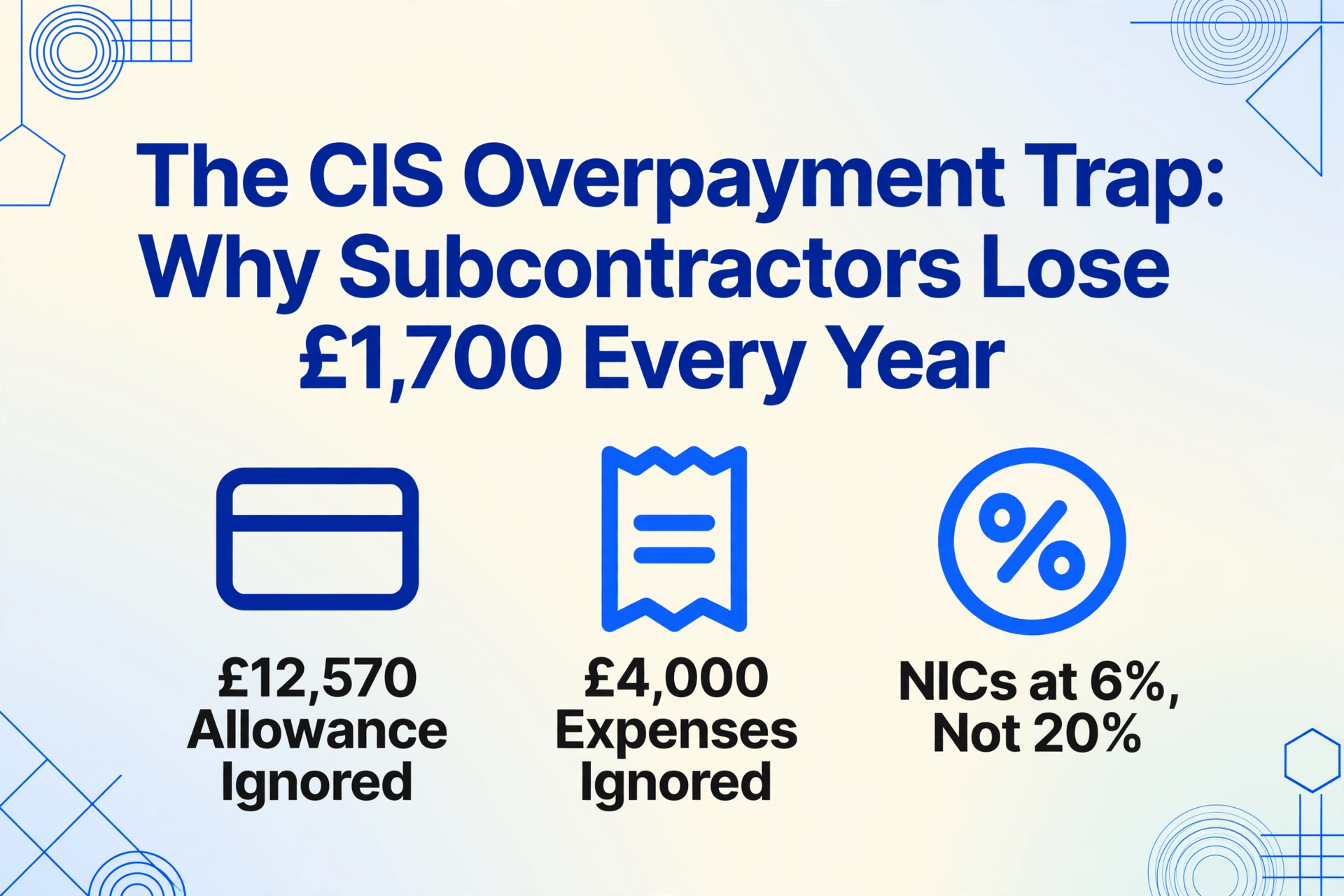
The CIS Overpayment Trap
Why Subcontractors Lose £1,700 Every Year
The Construction Industry Scheme withholds 20% of your labour income at source — or 30% if you are not registered. For a subcontractor billing £35,000 across three contractors in a year, that is £7,000 sent directly to HMRC before a single expense is deducted, before the £12,570 personal allowance is applied, before National Insurance contributions are calculated at their actual rate. The system is designed to collect tax upfront, not to get the amount right. And it succeeds at that: RIFT Tax Refunds data shows that 95% of CIS subcontractors who file a claim receive a tax refund, with the average rebate around £1,700. At Dearne Accountancy in South Yorkshire, first-time claimants typically see £1,500 to £2,000 come back — money that was theirs all along. The problem is not that the tax gets taken. The problem is what happens between the deduction and the refund: a gap that swallows the money for thousands of subcontractors every year, not because the tax law is wrong, but because the tracking system that connects one to the other is held together by paper, email attachments, and memory.
Key Takeaways
- CIS withholds 20% of your labour income at source without accounting for your personal allowance or expenses — the system was designed in 1971 to collect tax upfront, not to get the amount right.
- That design means 95% of subcontractors are owed a refund averaging £1,700 — and a single missing monthly statement can cascade into a full compliance check that disallows an entire contractor's deductions.
- Track every deduction statement into a running ledger from day one and SA103 Box 21 is a column sum — not a January detective project against contractors who are on holiday.
The Flaw in the Flat Rate: Why 20% Over-Collects by Design
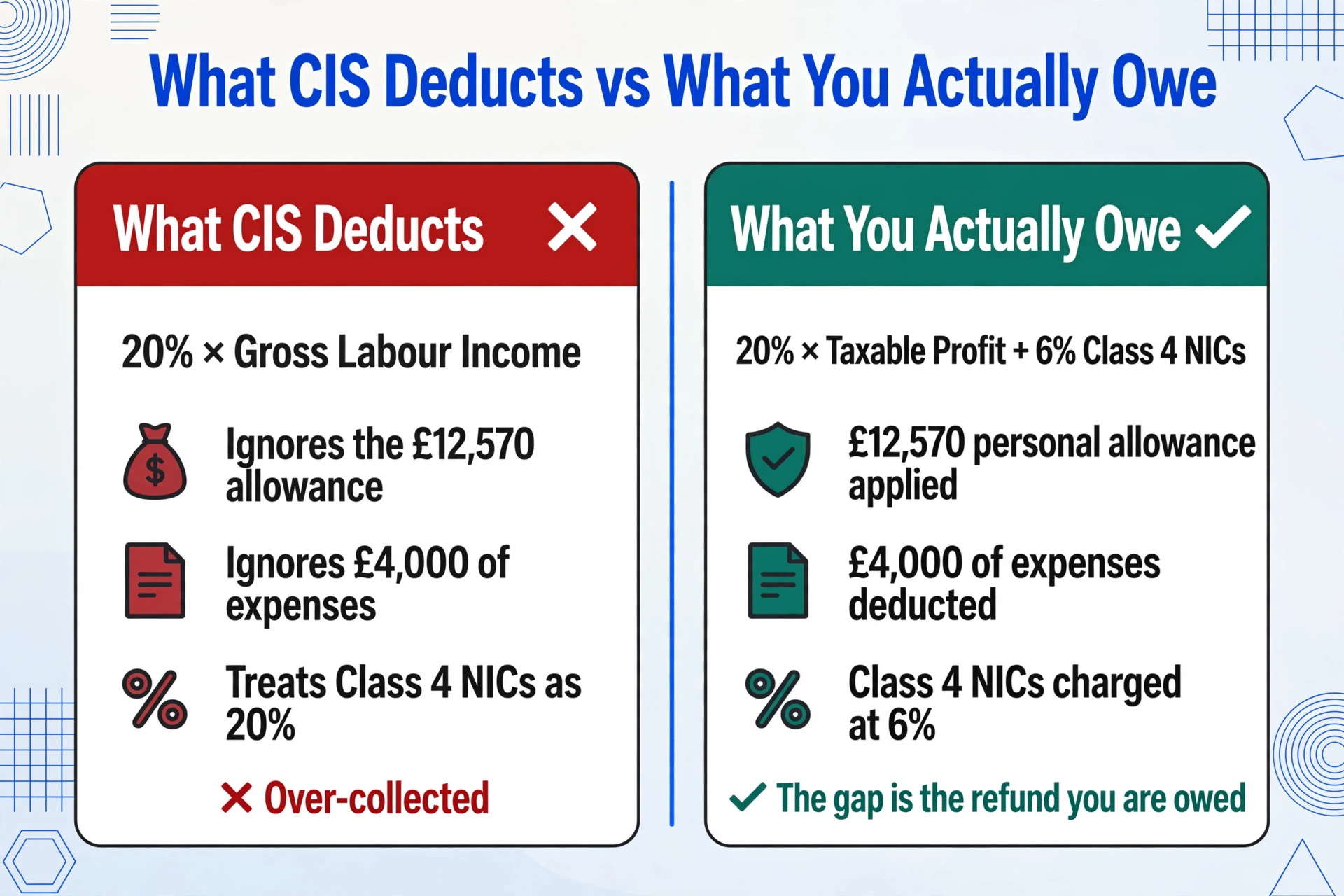
The CIS deduction system applies a flat percentage to your labour income, but your actual tax liability is calculated through Self Assessment on a completely different basis. The two numbers rarely converge — and the gap between them is the refund you are owed.
Here is the structural mismatch at its simplest. HMRC calculates your real tax bill by taking your taxable profit — gross income minus all allowable business expenses — applying your personal allowance of £12,570 (2025/26), then charging 20% basic-rate Income Tax on what remains, plus Class 4 National Insurance contributions at 6% on profits above the threshold. The CIS system, in contrast, takes your gross labour income and deducts 20% — full stop. It ignores your £12,570 tax-free allowance. It ignores the £4,000 you spent on copper pipe, a new cordless drill, public liability insurance, and 8,000 miles of van travel. It ignores that Class 4 NICs are charged at 6%, not 20%. Every mechanism that reduces your real tax bill is invisible to the flat-rate deduction engine.
The Low Incomes Tax Reform Group describes the CIS deduction as "an advance payment towards your income tax and National Insurance contributions." The word "advance" is doing heavy lifting. An advance implies you will get back what you overpaid — but getting it back requires filing a complete, accurate Self Assessment with every CIS deduction substantiated by a paper trail. And that is where the system, which over-collects by design, hands the problem to you.
A subcontractor earns £35,000 gross with £7,000 in expenses. Their actual tax liability — Income Tax at 20% on £15,430 (profit minus allowance) plus Class 4 NICs — is roughly £4,000. Their contractors deducted £7,000 in CIS (20% of £35,000). HMRC is holding £3,000 of their money — but only if they can prove every deduction with a properly tracked statement.
The Format Problem: Why a Simple Spreadsheet Breaks Under CIS Reality
To a first-time subcontractor, the tracking problem looks manageable. You work for a building firm, they give you a monthly statement, you type the numbers into a spreadsheet. Simple. The spreadsheet breaks the day you start working for a second contractor.
A groundworks contractor might hand you a printed CISOL1 form — HMRC's official template — on site at the end of the week. A housebuilder might email a branded PDF where the deduction figure sits in bold at the bottom of a payment letter, nowhere near where the CISOL1 form places it. A small builder who runs Sage CIS might give you a printout that looks like a mini-payslip, with the gross and deduction figures in a table that runs horizontally instead of vertically. The data is the same in all three: gross amount, materials, deduction, net, UTR. But the visual layout is different every time. When you have been transcribing numbers from the CISOL1 layout for six months, the housebuilder's PDF format requires you to stop, visually re-scan the page to find each field, and recalibrate where your eyes go before typing anything.
Now multiply that by three contractors, twelve tax months each — 36 statements — and add the reality that one contractor emails statements late, another hands you paper on site that you lose between the van and the kitchen table, and a third issues a statement with the wrong deduction rate that you do not notice until the following March. The spreadsheet that started clean in April is by November a document with three different column layout experiments, two months where you are guessing the deduction figure from your bank balance, and a column called "ACME??" that you cannot remember creating.
This is not a hypothetical. It is the predictable outcome of asking a manual spreadsheet to absorb unstructured data from multiple sources in multiple formats that arrive unpredictably over twelve months — a job that data engineers spend their careers solving with ETL pipelines and validation rules.
The Cost of a Missing Statement: More Than the Deduction Itself
A single missing monthly statement has a cascade effect that most subcontractors only discover during their first Self Assessment audit. The immediate loss is the deduction itself — £400 to £800 for a typical month that you cannot substantiate with a document. But that is not where the real damage happens.
Loss 1: The deduction credit that disappears. HMRC credits CIS deductions against your tax bill only if you can prove the contractor actually deducted them and paid them over to HMRC. The proof is the statement. Without it, HMRC has your contractor's CIS300 return showing a deduction was made, but no matching claim from your side to connect it to your Self Assessment. The credit sits orphaned in HMRC's system — you paid the tax, but you get no offset for it. For a subcontractor with one missing statement per year, that is £400 to £800 lost. For a subcontractor with three missing statements — a common scenario when working for a disorganised small builder — it is £1,200 to £2,400.
Loss 2: The refund you were counting on. Most subcontractors file their Self Assessment expecting a specific refund. They have done the rough maths: £7,000 deducted, maybe £4,000 in actual tax, £3,000 coming back. That refund funds their January cash flow — it pays for materials for the new year's first jobs, or covers the quiet December-January period. When HMRC disallows one contractor's deductions because the statements do not add up, the refund shrinks. If the refund was paying for something you already spent, the shortfall is debt.
Loss 3: The compliance check cascade. A mismatch between the deductions you claim and what HMRC expects triggers a compliance check. This is not a penalty — yet — but it is an investigation. HMRC requests the original statements for the period in question. If you cannot produce them, the investigation widens. The contractor whose statement you lost is now under scrutiny. The other two contractors on your return are now under scrutiny. A single missing statement from March has turned into an audit of your entire tax year — and the accountant you hire to handle the audit charges by the hour.
The January Scramble: Why Filing Season Exposes Every Tracking Weakness
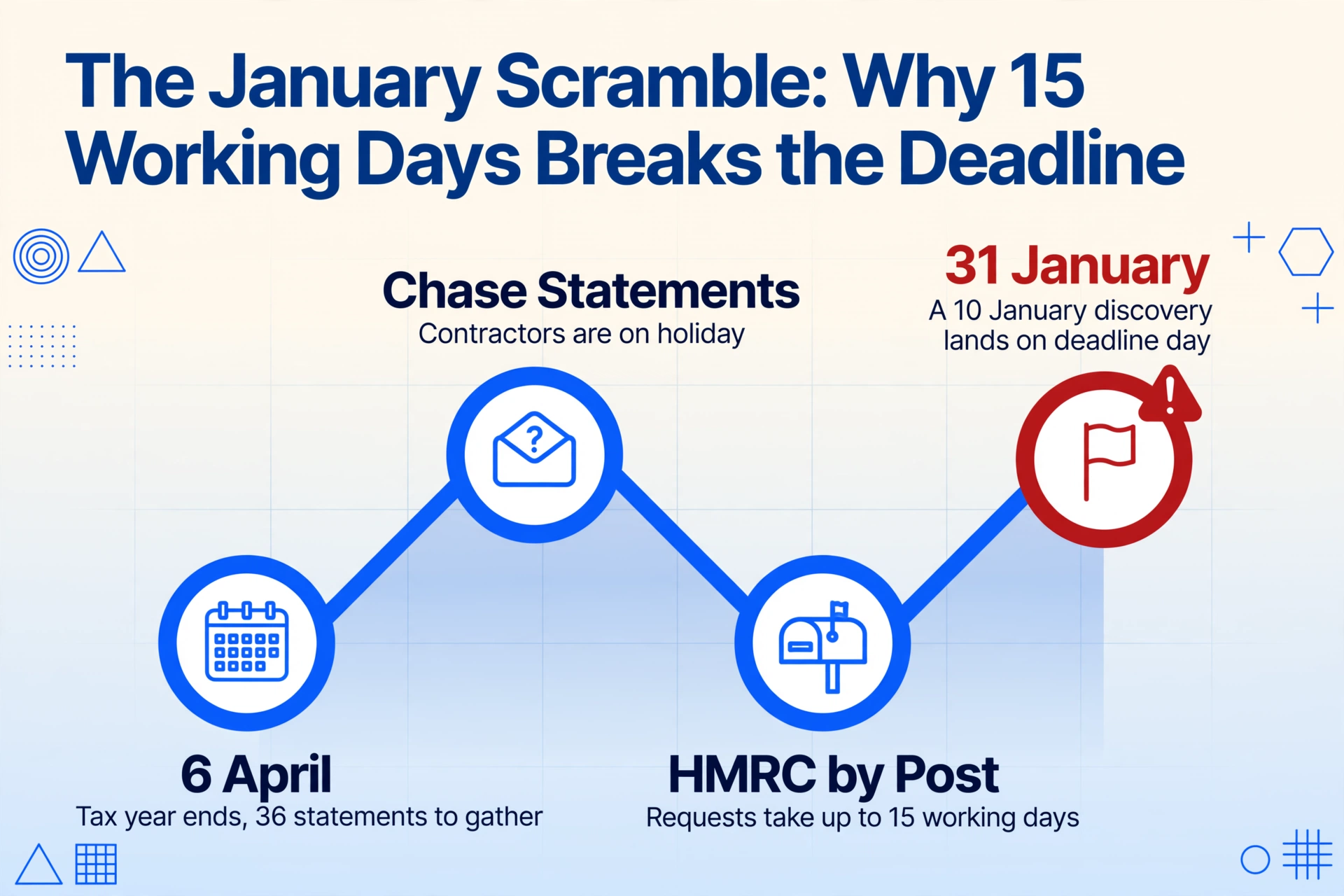
The Self Assessment filing deadline of 31 January creates a time-pressure event that the CIS statement tracking system was never designed to survive. Between 6 April, when the tax year ends, and 31 January, when the online return is due, a subcontractor needs to:
- Gather all 36 monthly statements from the tax year
- Identify which months are missing
- Chase missing statements from contractors — many of whom are on holiday in late December and early January
- Reconcile each statement's deduction against their bank statements and the contractor's UTR
- Verify that no contractor deducted at 30% when the rate should have been 20%
- Sum total gross income and total CIS deductions for SA103
- Compile expenses — materials, tools, van costs, insurance, protective equipment, training — separately from the CIS ledger
- File the return
If the tracking system throughout the year was a manual spreadsheet, step 3 alone can consume weeks. A contractor who issued statements by post may not respond to a January email. A contractor who left the industry may no longer exist as an entity. HMRC can provide missing statement data — but only by post, to written requests sent to PT Operations, BX9 1BX, with an aim to respond within 15 working days. If you discover the missing statement on 10 January, HMRC's best-case response arrives on 31 January — the day of the deadline.
This is the structural weakness that the CIS system imposes on subcontractors: the filing deadline is rigid, the document retrieval process is not, and the burden of closing the gap between the two falls entirely on the subcontractor. Nobody else in the chain — not the contractor, not HMRC — operates on your January timeline. For a deeper look at how this scramble plays out across the full Self Assessment, the SA100 document collation problem follows the same pattern across bank statements, invoices, and payment platform exports — all needing to be translated into HMRC's form boxes against the same unmoving deadline. On the CIS side, the fix is to extract every statement into a ledger the week it arrives — here's the step-by-step extraction workflow, and the batch approach for processing a full year of statements in one session.
The Multiple Contractor Math: Why Two Contractors Is Four Times Harder Than One
The complexity of CIS statement tracking does not scale linearly with the number of contractors — it compounds. One contractor means 12 statements, one format, one UTR to verify, one deduction rate to confirm. Two contractors means 24 statements, two formats, two UTRs, and two deduction rates — but also the need to reconcile each contractor's totals against each other, cross-reference HMRC's online record separately for each, and maintain a ledger structure that keeps the two contractors' data distinct while still summing to a single SA103 total.
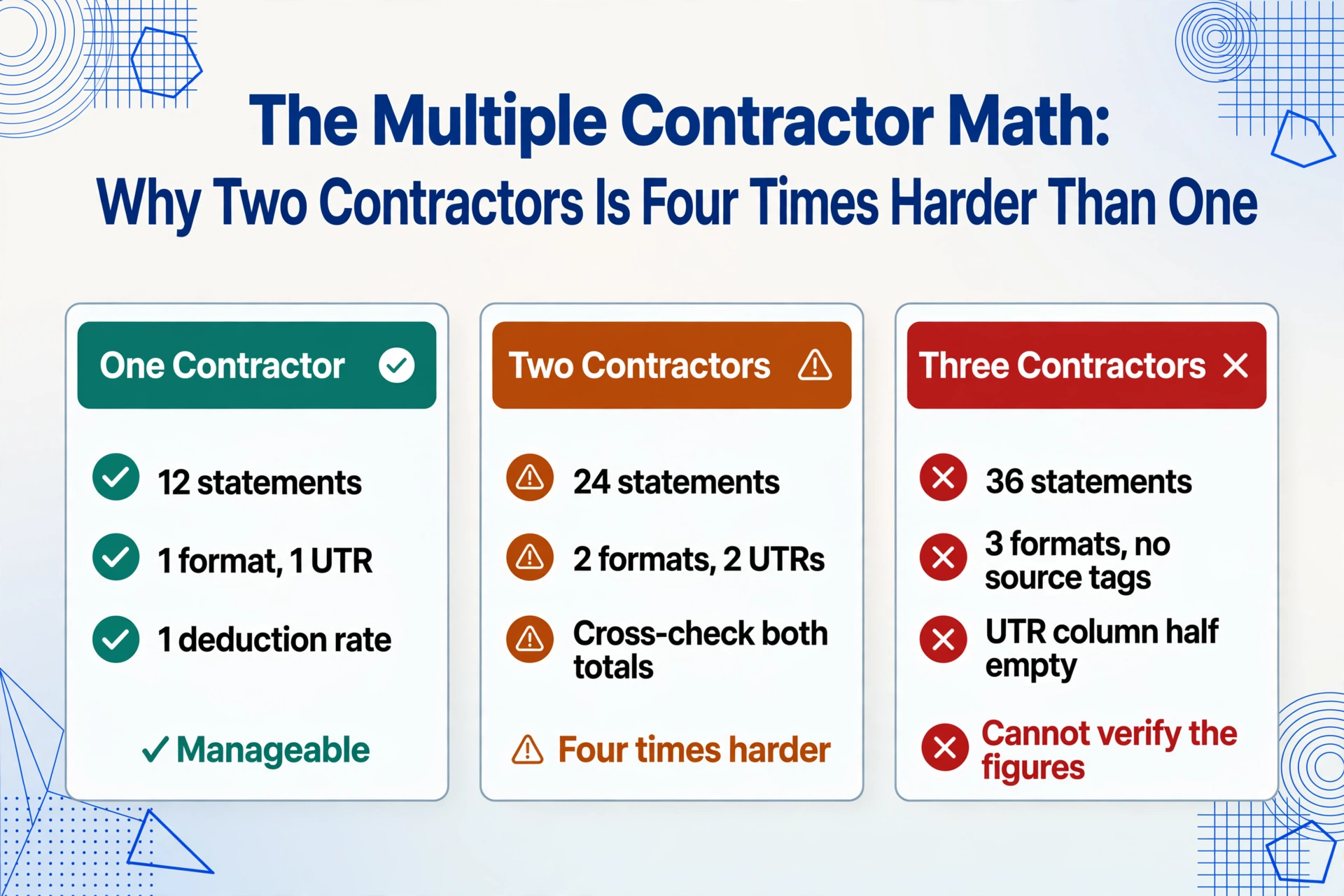
Three contractors — a common scenario for a multi-skilled subcontractor doing groundwork for one firm, bricklaying for another, and general labour for a third — means 36 statements. The tracking spreadsheet that worked passably for one contractor has by now become a document only its creator can interpret. The column for "CIS Deduction" contains figures from three different sources with no source tag attached. The "Tax Month" column has three different interpretations of which month is which, because not every contractor labels the tax month correctly. The "Contractor UTR" column is empty for half the rows because the small builder never printed their UTR on the statement and you never chased it.
At this scale, the failure mode shifts from "I made a typo" to "I cannot determine whether my numbers are right." The difference between these two failure modes is the difference between a correctable error and a systemic gap in your tax record — and HMRC treats them differently. A typo is an honest mistake. A systemic gap — claiming deductions you cannot substantiate — is grounds for a penalty.
The Paper-vs-PDF Divide: When Your Filing System Has Two Incompatible Halves
A subcontractor's CIS statement collection, by the end of a tax year, lives in two places: a physical shoebox or folder containing paper statements handed over on site, and a digital inbox or downloads folder containing PDFs emailed by contractors who file electronically. The two halves do not talk to each other. The paper statements require manual transcription — you cannot Ctrl+F a paper document. The PDF statements require a device to open — you cannot flip through them while you are on the phone to your accountant.
This dual-format reality creates a specific kind of error that compounds at scale: when you are transcribing paper statements into a spreadsheet, you copy the figures in the order the statements sit in the pile — not in chronological order, not grouped by contractor. The PDF statements, opened one at a time, get entered in whatever order you happen to click through your downloads folder. The result is a spreadsheet where Row 1 is a March statement from Contractor A, Row 2 is an April statement from Contractor C, and Row 3 is an April statement from Contractor A — making it impossible to verify at a glance whether a given month is present for a given contractor. The only way to validate completeness is to re-sort the entire spreadsheet after entering every figure — a step that most subcontractors skip because they have already spent two hours entering numbers and the January deadline is not getting further away. The alternative to transcription — having each statement read straight into a structured ledger — is covered in how to turn CIS statements into a subcontractor tax ledger.
For HR and payroll professionals dealing with similar multi-format tracking problems across employee benefits documents, the P11D manual reporting problem follows the same pattern: multiple formats, multiple employees, one deadline, and a spreadsheet that breaks under the weight of paper-to-digital translation.
Making Tax Digital Turns an Annual Problem into a Quarterly One
From April 2026, HMRC's Making Tax Digital for Income Tax Self Assessment (MTD for ITSA) begins rolling out to sole traders and landlords. The threshold starts at £50,000 of qualifying income — and as noted by Emilia Accountancy, qualifying income for CIS subcontractors is gross turnover, not the net amount received after deductions. A subcontractor invoicing £55,000 but receiving £44,000 after 20% CIS is above the threshold. They enter MTD from that quarter and must keep digital records and submit quarterly updates.
If CIS statement tracking was a once-a-year scramble, MTD makes it a four-times-a-year scramble. Every quarter, a subcontractor must report their income and expenses digitally to HMRC. Every quarter, they need their CIS deduction figures organized and accessible. The shoebox-and-memory method — which barely survived a once-a-year filing rhythm — is incompatible with quarterly reporting. Each quarterly update that contains incomplete or estimated CIS deductions creates a data point that must be reconciled at year end, turning the SA100 from a standalone return into a reconciliation of four previous partial returns.
The subcontractors who feel this hardest are those working for multiple contractors. Contractor A issues statements on time. Contractor B issues statements two months late. The quarterly update deadline arrives and Contractor B's figures are missing. The subcontractor estimates — and the estimate is wrong. When Contractor B's statement finally arrives, the subcontractor has already filed a quarterly update with a number that does not match. The correction process is not automatic. It is another interaction with HMRC, another potential compliance flag, another piece of administrative work that subtracts from billable hours on site.
Frequently Asked Questions
How many CIS subcontractors actually overpay tax?
RIFT Tax Refunds reports that 95% of CIS subcontractors who file a claim receive a tax refund. The figure is high because the flat-rate CIS deduction system ignores the personal allowance (£12,570 in 2025/26), business expenses, and the actual structure of National Insurance contributions — all of which reduce the real tax bill below what the 20% flat rate collects. The average refund across claimants is approximately £1,700 per year, with first-time claimants at some accounting firms averaging £1,500 to £2,000.
Can I claim a CIS refund without having all my statements?
You can file a Self Assessment claiming CIS deductions based on what you believe was deducted, but HMRC may request the original statements as evidence. If you cannot produce them, HMRC can disallow the deduction credit — meaning the tax you paid is not refunded because you cannot prove it was paid. For missing statements, you can write to HMRC at PT Operations, HM Revenue and Customs, BX9 1BX, requesting the data from the contractor's CIS300 returns. As a last resort, you can reconstruct figures from your bank statements — net payment ÷ 0.8 = gross payment if the contractor applied 20% — but this reconstruction may not be accepted by HMRC without corroboration from the contractor's side.
Why does the flat-rate deduction ignore my expenses?
The CIS system was designed in 1971 to combat tax evasion in construction — a cash-heavy industry where subcontractors historically under-reported income. The flat-rate deduction was chosen because it is administratively simple for contractors to apply and HMRC to verify. Asking every contractor to calculate a personalised tax rate for every subcontractor based on their individual expenses would collapse under its own complexity. The trade-off — and it is a deliberate one — is that subcontractors systematically overpay during the year and claim the difference back through Self Assessment. The system works for HMRC. Whether it works for the subcontractor depends entirely on whether they can produce the paper trail to claim what is theirs.
What happens if my contractor deducted at 30% but I am CIS-registered?
The over-deduction still counts as tax paid on your behalf — HMRC credits the full amount against your Self Assessment bill. However, your cash flow takes an immediate hit for the extra 10% of every payment, and that money sits with HMRC until you file your return and claim it back. Contact the contractor immediately and ask them to verify your CIS status with HMRC. If they refuse or are unresponsive, contact the CIS helpline. The problem should be fixed before the next payment cycle — living with a 30% deduction for a full tax year means the amount of overpayment you need to reclaim at year end is 50% larger than it should be.