The Prescription Re-Type:
Paper Rx and Pharmacy's Data Entry Burden
In 2025, American pharmacies filled an estimated 5 billion prescriptions. Of those, approximately 2.64 billion arrived electronically through the Surescripts network. The remainder — more than 2 billion prescriptions — arrived at pharmacy counters by paper, phone, or fax. Every single one of them had to be manually typed into a pharmacy management system, field by field, keystroke by keystroke, by one of 490,000 pharmacy technicians across the country. It is a volume of manual data entry with no parallel in any other sector of healthcare — and almost nobody outside the pharmacy has ever seen it happen.
Key Takeaways
- Roughly 2 billion prescriptions arrive at U.S. pharmacies on paper or by phone each year — and every single one is manually re-typed into pharmacy software, field by field, by a technician at a keyboard.
- E-prescribing's 92% adoption hits a permanent ceiling — controlled substances, dentist practices, veterinary clinics, and price-shopping patients create a structural floor of paper volume no network expansion can eliminate.
- AI that reads handwriting by semantic meaning rather than template position can turn a 30-second manual transcription into a 5-second verification step — the pharmacist's safety check stays, the re-typing disappears.
The Paper Prescription's Journey Starts Where E-Prescribing Stops
The first thing to understand is how a paper prescription actually moves. A physician in a small private practice — perhaps one of the roughly 8% of prescribers who, according to ONC data, still have not adopted e-prescribing — writes a prescription on a pad. The patient takes it to a pharmacy. A technician at the intake counter scans it into the pharmacy management system (PMS). And that scan, that image of a piece of paper with a doctor's handwriting on it, is where the manual labor begins.
The pharmacy management system does not understand the image. It cannot parse the handwriting. It has no semantic model of what a prescription means. The image sits there as a reference image — and the technician's job is to extract everything on it, translate it into structured data, and type it into the system's data entry screen. Refill counters read those fields back off the bottle — the medication name, dosage, and frequency on a prescription label photo.
That screen, depending on which PMS the pharmacy runs — PioneerRx, QS/1 NRx, Computer-Rx, Rx30, or any of the dozens of others maintained by companies like RedSail Technologies and Outcomes — will present somewhere between 15 and 20 discrete fields. Each one must be filled. Each one is a decision point. Each one is an opportunity for error.
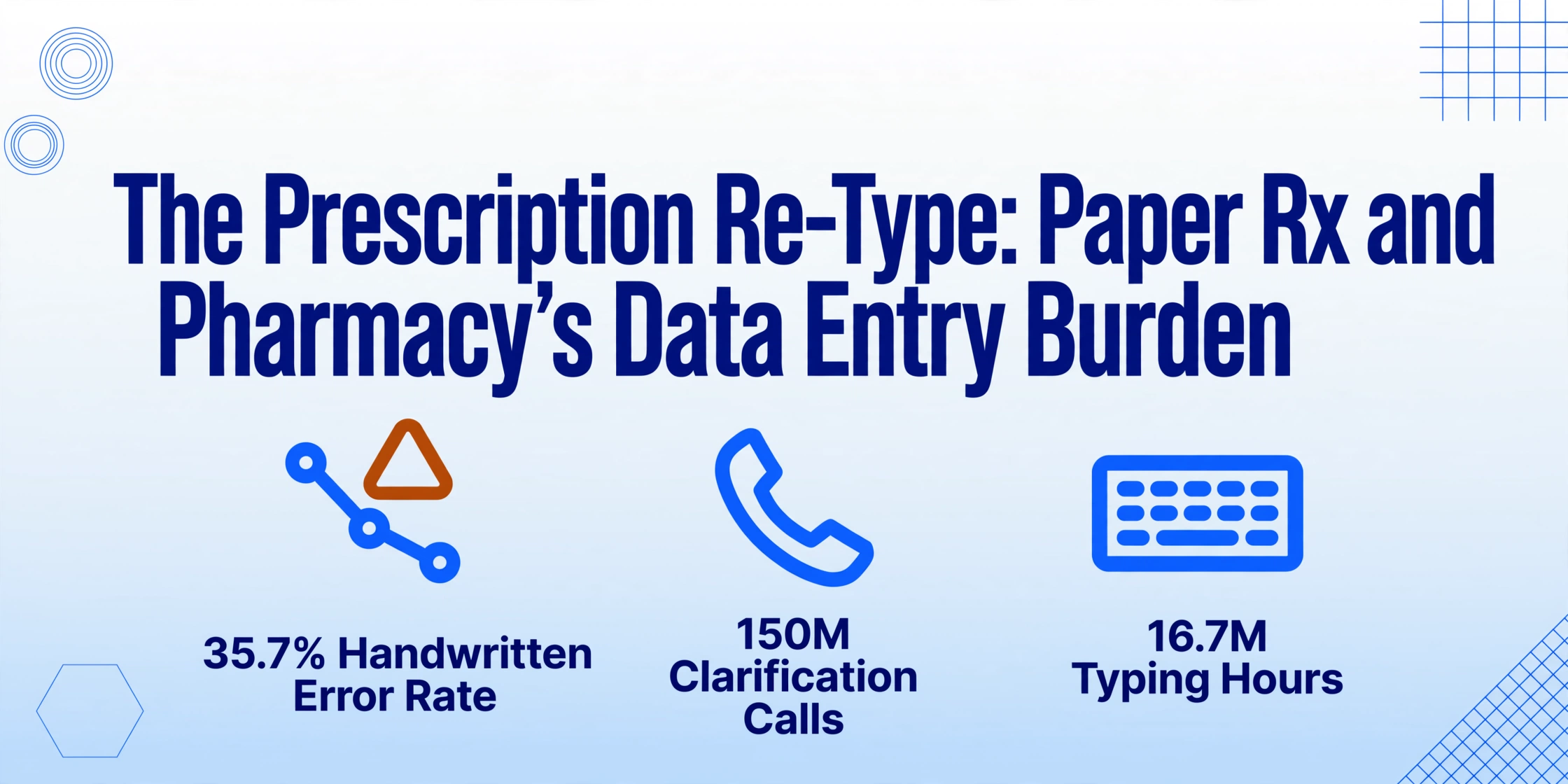
The sheer scale of this workflow defies easy visualization. At 2 billion non-electronic prescriptions per year and an average data entry time of roughly 30 seconds per prescription — a figure frequently cited by technicians on forums like r/pharmacy — the aggregate labor cost is staggering: approximately 16.7 million hours of manual data entry work annually, performed almost exclusively by pharmacy technicians earning a Bureau of Labor Statistics median of $43,460 per year (May 2024).
The 15-Field Gauntlet: What Actually Happens at the Keyboard
To grasp why this isn't just "typing" — why it's a cognitive gauntlet, not a clerical task — you have to see the fields. Here is what a technician encounters on a typical data entry screen for a single prescription, based on the standard field layout taught in pharmacy technician training curricula and visible in the Pharmacy Skills Lab's data entry queue simulator:
| Field Category | Individual Fields | Source of Data |
|---|---|---|
| Patient | Name, Date of Birth, Address, Phone | Paper Rx + verbal from patient |
| Prescriber | Name, NPI (10-digit), DEA Number, Office Address, Phone | Paper Rx (often scribbled) |
| Medication | Drug Name, Strength, Dosage Form, NDC (11-digit) | Paper Rx — handwritten drug name decoded |
| Dispensing | Quantity, Days Supply, Refills Authorized, DAW Code | Paper Rx + technician calculation |
| Directions | SIG (verb + dose + route + frequency + auxiliary info) | Paper Rx — often abbreviated, cursive, ambiguous |
| Administrative | Date Written, Do-Not-Fill-Before Date, Rx Origin Code | Paper Rx + state regulatory requirements |
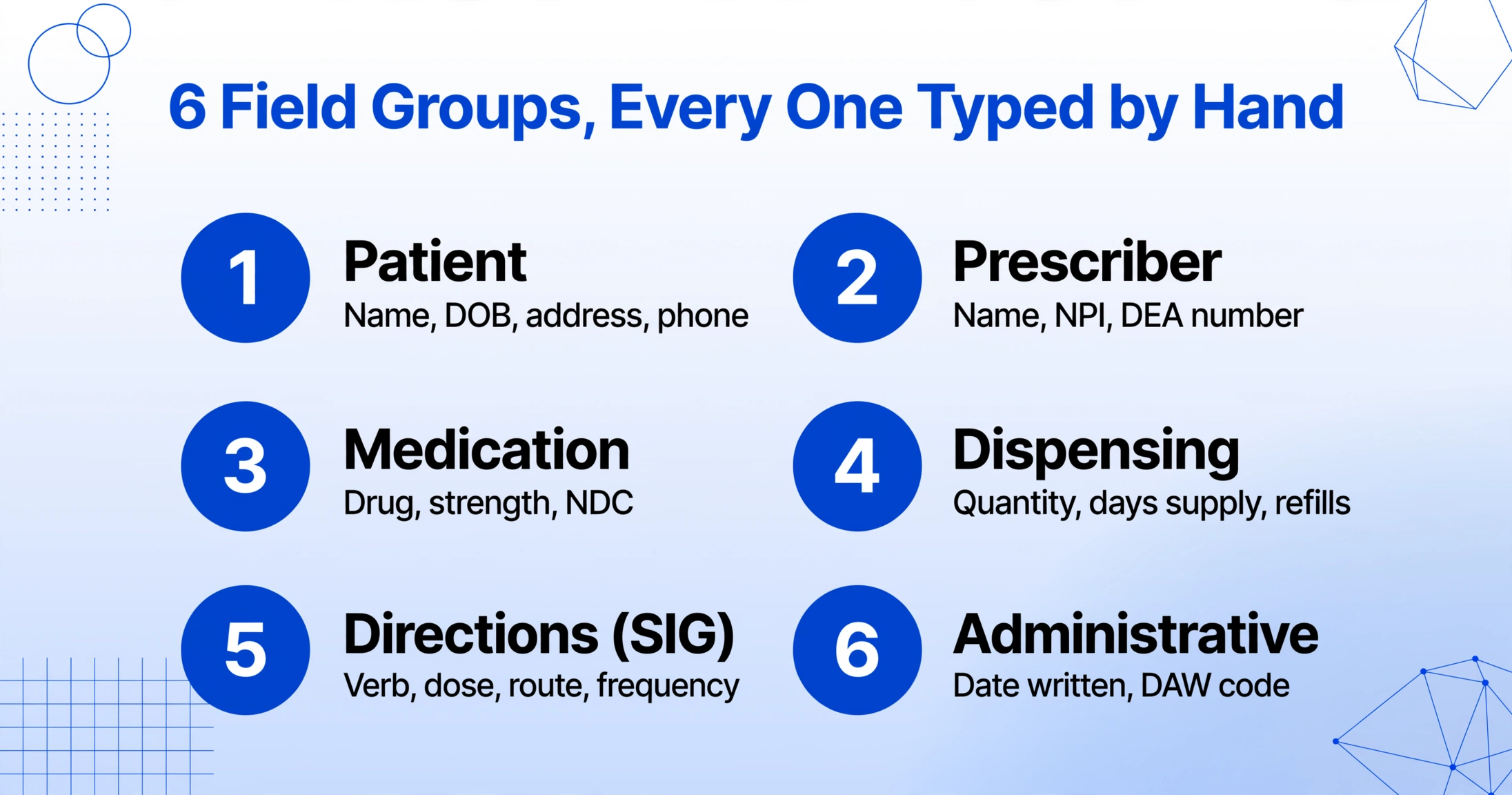
That's roughly 18 to 20 individual pieces of information per prescription, each requiring verification against the paper original. And the paper original — the piece of evidence the technician is supposed to be matching — is the problem's core. It is handwritten. Often in cursive. Frequently rushed. Sometimes by a prescriber whose handwriting the technician has never seen before.
On Reddit's r/PharmacyTechnician, one trainee described the experience bluntly: "I swear, half of them were unintelligible! Are we really supposed to know what the providers want, when they can't even write correctly?"
That question isn't just venting. It captures a structural mismatch: the prescribing system is designed for one human to read another human's handwriting, at a pace dictated by the prescriber's pen. But the dispensing system demands structured, machine-readable data, at a pace dictated by a queue of waiting patients. The technician is the translation layer between these two incompatible systems — and the translation is error-prone by design.
What Handwriting Actually Costs: Errors, Calls, and Lives
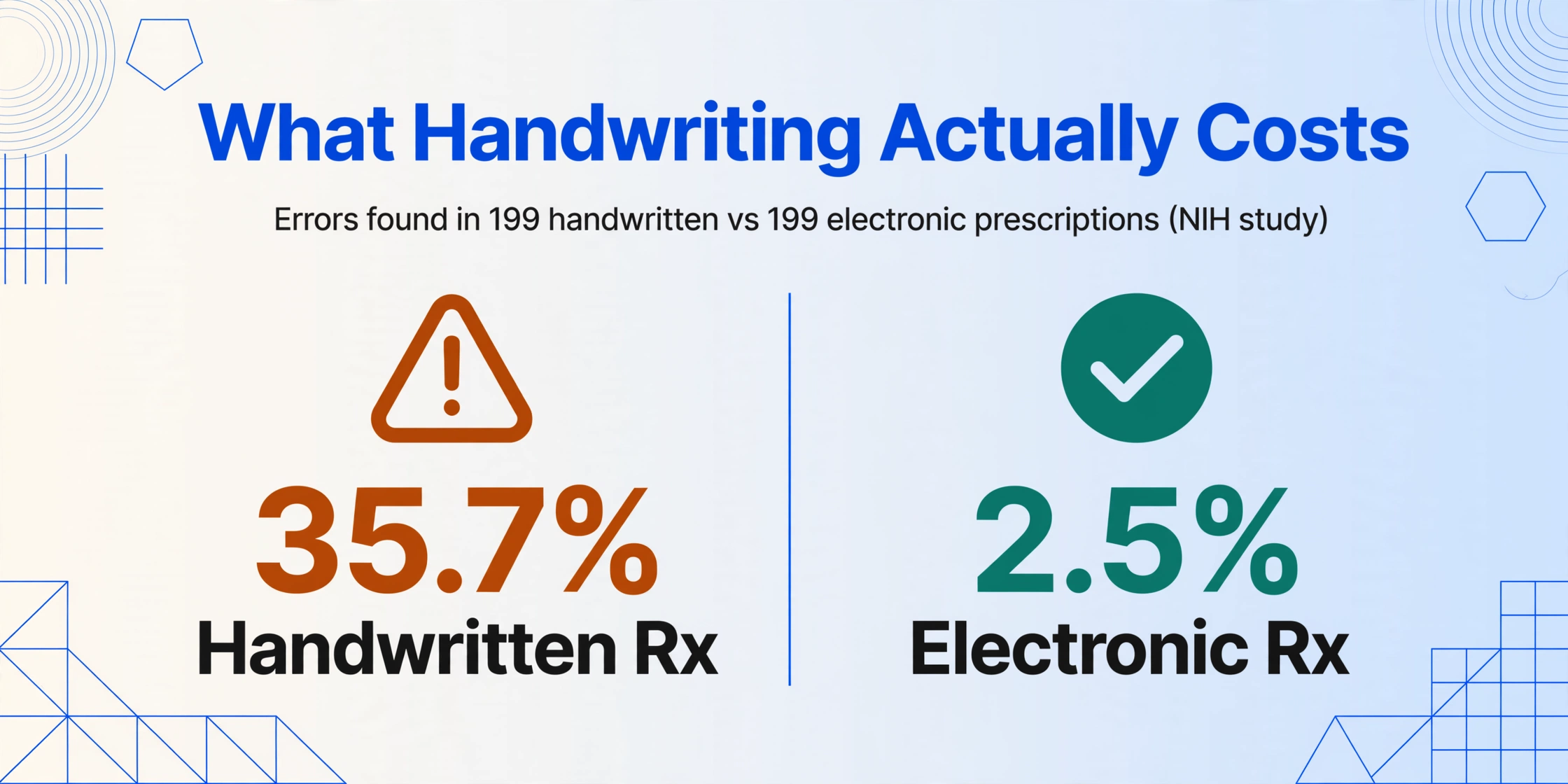
The error rates are not marginal. A study from the National Institutes of Health reviewed 398 prescriptions — 199 handwritten, 199 electronic — and found errors in 35.7% of the handwritten prescriptions versus only 2.5% of the electronic ones. A separate body of research, compiled in a 2023 systematic review in the Annals of Medicine & Surgery, estimated that between 1.7% and 24% of all prescriptions are erroneously delivered, with 1.5% to 4% of those errors resulting in patient injury. The Institute of Medicine has linked more than 7,000 deaths annually to medication errors traceable to poor handwriting and prescription filing mistakes.
But the error numbers only measure what gets caught. They don't measure the friction — the system-wide cost of uncertainty that eats into every paper prescription.
When a technician can't read a drug name, or can't tell if the SIG says "QD" (once daily) or "QID" (four times daily), or isn't sure whether the handwritten number is a 7 or a 9 in a quantity field, the prescription stops. The technician flags it. The pharmacist calls the prescriber's office. The office staff checks the chart. The prescriber calls back. The pharmacist verifies. The data entry resumes.
An estimated 150 million such clarification calls are made from pharmacies to prescribers each year in the United States, according to industry data. That's 150 million interruptions in the medication supply chain, each one triggered by the gap between a scribbled piece of paper and a database that demands precision.
The most dangerous errors cluster around what pharmacists call "LASA" drugs — Look-Alike, Sound-Alike pairs. Prednisone and prednisolone. Clonidine and Klonopin. Celebrex and Celexa. When a prescriber's handwriting turns "Celebrex 200 mg" into a scrawl that could be either drug, the difference between an anti-inflammatory and an antidepressant — or the difference between 1 mg and 10 mg of warfarin, as Pharmacy Times documented in a detailed analysis of data entry accuracy — is a keystroke-level decision that falls on the technician.
Why E-Prescribing Didn't Finish the Job
Given the magnitude of the problem, the obvious question is: why isn't everything electronic by now? The Surescripts network processed 2.64 billion e-prescriptions in 2025. According to the ONC, 92% of prescribers have adopted e-prescribing capability. The infrastructure exists. The error reduction is proven. What's holding back universal adoption?
The answer isn't one thing. It's a stack of structural reasons that each carve out a category of paper prescriptions that e-prescribing can't reach:
Controlled substances. The DEA's rules under 21 CFR Part 1311 permit electronic prescribing for controlled substances (EPCS), and 35 states now mandate it. But Schedule II drugs — the opioids, stimulants, and other high-abuse-potential medications — still arrive on paper in significant volumes. The DEA requires two-factor authentication, identity-proofing, and third-party audited software for EPCS. According to the DEA's own FAQ on EPCS, participation remains voluntary at the federal level. Many small prescribers choose paper because the compliance overhead of EPCS-certified software isn't worth it for their practice. For Schedule II narcotics, a handwritten signature on a tamper-resistant prescription pad remains, in 2026, the legal fallback.
The small-practice gap. While 92% of prescribers have e-prescribing capability, actual consistent usage is another matter. Independent physicians, solo practitioners, dentists, veterinarians, and specialists in rural areas are disproportionately represented among the 8% without capability — and among those who have it but don't use it consistently. A dentist writing for post-operative pain medication doesn't have an EHR. A veterinarian treating a dog has no NCPDP SCRIPT standard interface to the local pharmacy. These are not edge cases. Added together — dentistry alone accounts for approximately 155,000 practitioners in the U.S. — they represent a permanent reservoir of paper prescriptions.
State law patchwork. While 35 states mandate EPCS, the mandates vary in scope. Some cover all controlled substances; others cover only opioids; some cover all prescriptions, period (New York since 2016, under New York Education Law). The remaining states have no mandate. A prescription written in a non-mandate state and filled in a mandate state — or vice versa — operates in a legal gray zone that often defaults to paper.
Patient preference and portability. Not every patient wants their prescription locked to a specific pharmacy before they've compared prices. A paper prescription gives the patient freedom to shop. For uninsured patients paying cash, this matters. For anyone who has experienced sticker shock at a pharmacy counter — and Surescripts data shows 28% of paper prescriptions never make it to any pharmacy, a phenomenon researchers call "primary non-adherence" or "prescription leakage" — the paper in hand at least gives the patient agency over where and when to fill.
The result: a structural floor under paper prescription volume that no amount of network expansion can eliminate. Paper isn't a residual problem that will phase out naturally. It's a permanent feature of the prescription ecosystem — and permanent paper means permanent manual data entry.
The Human Behind the Keyboard
The costs so far have been measured in errors, calls, and system inefficiency. But there's another ledger entirely — the one that tracks what manual data entry does to the people who perform it.
The 490,400 pharmacy technicians counted by the BLS in 2024 are overwhelmingly women (77.7%, per Data USA). Their median wage of $43,460 places them below the national median for all occupations, despite performing a task that directly affects patient safety with every keystroke. The job combines the cognitive demands of clinical data verification with the throughput pressure of a retail queue — and the manual data entry component sits squarely at the intersection of both.
"Data entry has become a hidden bottleneck in pharmacy operations, especially first thing in the morning, after weekends, or following holiday backlogs," notes a 2024 analysis from Outcomes, the company behind the Rx30 and Computer-Rx pharmacy platforms. "Technicians and pharmacists often start their day buried in queues of prescriptions that require manual typing before anything else can move forward."
That bottleneck is felt in every pharmacy in America every Monday morning. A retail pharmacy processing 300 prescriptions per day might have 60 to 90 of them arrive on paper, depending on the local prescriber mix and controlled-substance volume. At 30 seconds per entry, that's 30 to 45 minutes of uninterrupted typing per day — before any interruptions from patient questions, insurance rejections, phone calls, or the pharmacist's verification check. In busier stores filling 500+ scripts per day — the threshold at which pharmacies like those running on PioneerRx or QS/1 NRx typically reorganize their workflow into specialized stations — data entry can consume several technician-hours per day.
On r/PharmacyTechnician, the physical and cognitive toll is a recurring theme. One veteran technician observed: "My pharmacy uses the rule of thumb of typing one prescription between every patient." That rhythm — type a script, serve a patient, type a script, answer a phone — is the daily cadence of a profession that has no off-ramp from manual data entry for the prescriptions that arrive on paper. The industry's projected 6.4% job growth through 2034, per the BLS, means the workforce will expand — but the fundamental workflow that burns technicians out will not change unless the data entry paradigm itself changes.
A Different Way to Type
This is the point in the analysis where the question shifts from "how bad is it" to "what can be done." And the answer, in 2026, is not speculative. It's operational.
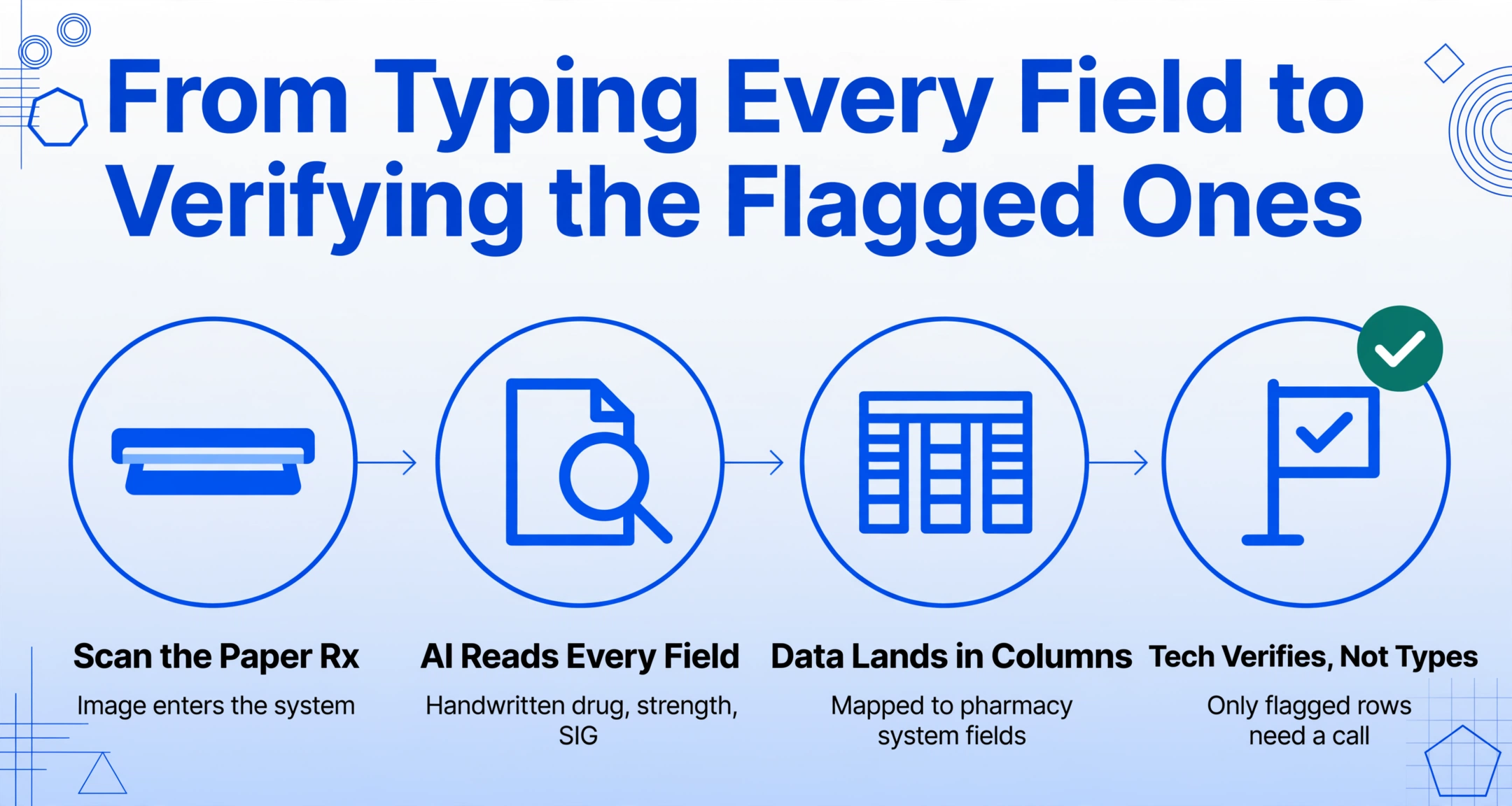
The underlying technology that makes it possible to read a scanned prescription image and extract structured data from it — drug name, dosage, NDC, SIG, quantity, prescriber DEA — is the same class of visual AI that powers modern document extraction across industries. It works not by matching templates (the prescription pad from Dr. Smith looks different from the one from Dr. Patel) but by understanding the semantic content of the document. It reads the handwriting. It identifies the fields. It maps them to the target data structure — in this case, the pharmacy management system's entry screen.
This approach — known as Custom Column Extraction — reverses the traditional workflow. Instead of the document dictating what data is present and where, the user defines what output columns they need: Drug Name, Strength, NDC, Quantity, Days Supply, SIG, Prescriber NPI. The AI locates each value on the prescription by understanding what it means, not by matching where it sits on the page. A handwritten "Amoxicillin 500 mg" is recognized as a drug name and strength pair regardless of how slanted the cursive is, which line it's on, or whether it's the top or bottom of the pad.
For the pharmacy context, this means the technician's job changes from transcribing (reading the paper Rx and typing every field) to verifying (checking that the AI's extraction matches the original). That verification step already exists in the pharmacy workflow — the pharmacist must perform a final check on every prescription before dispensing, per state board regulations, whether the data was entered by human hands or by AI. The AI doesn't bypass the safety check. It eliminates the part of the workflow that adds no clinical value: the mechanical re-typing.
The regulatory dimension is worth addressing directly. Under HIPAA, any system processing prescription data — which contains protected health information (PHI) including patient names, dates of birth, and medication histories — must maintain appropriate safeguards. This is the same compliance framework that governs pharmacy management systems, e-prescribing networks, and insurance adjudication platforms. Data extraction tools that process prescription images operate within this framework; the key selection criterion is whether the vendor provides a HIPAA-compliant processing environment and a Business Associate Agreement (BAA). For a deeper dive into how AI extraction intersects with HIPAA requirements, we've covered this in our HIPAA compliance guide for medical document extraction.
This is not hypothetical infrastructure. The same visual AI that can extract 15+ fields from a menu-style restaurant receipt, or parse a multi-page insurance Explanation of Benefits with nested table structures, can handle a single-page handwritten prescription. The prescription is, in many ways, the simpler document — it has fewer data points, a more standardized layout, and a constrained vocabulary of drug names, strengths, and SIG codes. The challenge has never been technological feasibility. It has been that the pharmacy software market — dominated by legacy systems with deep incumbency — has been slow to integrate extraction capabilities into the data entry workflow. But that is changing. Outcomes, the company behind Rx30 and Computer-Rx, launched automated data entry for e-scripts on its platform in 2024. The logical next step — automated extraction from paper prescription images — is where the technology is already capable and the demand is waiting.
For pharmacy technicians, the impact would be immediate and measurable. A prescription that currently takes 30 seconds to type might take 5 to 10 seconds to verify against an AI extraction. The difference compounds across the volume: 60 paper prescriptions per day drops from 30 minutes of typing to 5 to 10 minutes of verification. The technician's cognitive load shifts from decoding handwriting to spot-checking output — a task closer to the clinical verification they were trained for than the data entry they were conscripted into.
If you're interested in the step-by-step workflow for extracting prescription fields — drug name, dosage, NDC, quantity, refills, prescriber DEA/NPI — to a structured spreadsheet, we've detailed the full process in our guide to prescription data extraction for pharmacy inventory and insurance claims. For a field-by-field analysis of what affects extraction accuracy in the prescription context — including NDC format complexity, LASA drug confusion, and state PMP requirements — see our prescription extraction accuracy guide.
This problem — manual data entry as the invisible tax on paper-based workflows — isn't unique to pharmacy. The same dynamic plays out in medical billing, where EOB forms arrive by mail and must be re-keyed into practice management systems. We've analyzed the parallel costs in our deep dive on manual EOB data entry costs in medical billing. The pattern is the same across healthcare: paper enters, humans type, errors accumulate, costs compound. The technology to break that pattern now exists.
Frequently Asked Questions
How many prescriptions are still written on paper?
While 92% of prescribers have adopted e-prescribing and approximately 2.64 billion e-prescriptions were filled through the Surescripts network in 2025, a significant volume still arrives on paper, by phone, or by fax. With total retail prescriptions estimated at approximately 5 billion annually, roughly 2 billion non-electronic prescriptions entered the pharmacy workflow — though not all of these are "paper" in the literal sense. Phone orders, faxes, and controlled-substance paper prescriptions all require manual data entry into the pharmacy management system. The exact split between e-prescriptions and manual-entry prescriptions varies by state, pharmacy type, and prescriber mix.
Why can't pharmacies just scan prescriptions and have the computer read them?
Traditional pharmacy management systems like PioneerRx, QS/1 NRx, Computer-Rx, and Rx30 were not built with handwriting recognition or semantic document understanding. They are transaction-processing and dispensing-workflow platforms. The scan creates an image — a reference file — but the system has no capacity to extract structured data from that image. The technician must read the image and type the fields. Newer AI-based document extraction tools can fill this gap by reading the scanned image, understanding the fields semantically, and outputting structured data — but integration with legacy PMS platforms is not yet standard.
What are the most common errors in manual prescription data entry?
The most frequent errors cluster around three areas: drug name confusion (especially LASA pairs like prednisone/prednisolone or clonidine/Klonopin), SIG misinterpretation (QD vs. QID, "once daily" vs. "four times daily" — one letter apart in handwriting but a 4x dosing difference), and numeric quantity errors (misreading handwritten 7 as 9, 1 as 7, especially in refill and days-supply fields). A 2023 systematic review in the Annals of Medicine & Surgery documented that 1.7% to 24% of prescriptions are erroneously delivered, with handwriting illegibility as a primary contributor.
Does AI prescription extraction work with controlled substance prescriptions?
Yes — the visual AI can read and extract data from Schedule II-V prescriptions the same way it reads non-controlled prescriptions. The handwriting, fields, and data structure are identical. What differs is the regulatory handling of the extracted data: controlled substance prescriptions have additional legal requirements around DEA number verification, Prescription Monitoring Program (PMP) checks, and record retention. AI extraction tools do not replace these compliance steps — they handle the data entry component, and the existing pharmacy workflow for controlled-substance verification remains intact. The key requirement is that the extraction tool operates within a HIPAA-compliant environment with a signed Business Associate Agreement.
Does this replace the pharmacist's verification step?
No. In every state, the pharmacist is legally required to perform a final verification check on every prescription before dispensing — reviewing the original prescription against the data entered, checking for drug interactions, verifying clinical appropriateness, and ensuring labeling accuracy. AI extraction handles the data entry step that precedes verification: reading the handwritten prescription and populating the PMS fields. The pharmacist's clinical judgment, the Drug Utilization Review (DUR), and the final accuracy check remain unchanged. What changes is that the pharmacist and technician spend less time on transcription and more time on the clinical tasks that their licenses exist to perform.
The data entry bottleneck in pharmacy isn't going to solve itself — paper prescriptions aren't disappearing. But the technology to read them, extract their contents, and populate the PMS fields already exists.
Upload a PrescriptionFiles are processed securely and not stored.