Is Medical Document Extraction
HIPAA Compliant? A Guide for Healthcare Organizations
If your AI document extraction tool processes medical records, insurance EOBs, or any document containing protected health information (PHI), you are making a disclosure under HIPAA — whether you work in a hospital revenue cycle team or a three-provider clinic. Here is what the Privacy Rule (45 CFR §164.514), the Security Rule (45 CFR §164.306), the Business Associate Agreement requirement (45 CFR §164.504(e)), and the Minimum Necessary Rule (45 CFR §164.502(b)) require, and how to verify your extraction provider is compliant.
Key Takeaways
- Removing patient names before uploading a medical document to a cloud extraction tool does not make it HIPAA-safe — §164.514 defines 18 identifiers, and leaving any one of them in the document means it is still PHI requiring a BAA.
- The moment you transmit a medical document to a third-party AI tool, you have made a disclosure under the Privacy Rule — and without a signed BAA covering all six §164.504(e) provisions, that disclosure is a reportable breach regardless of the tool's encryption.
- Custom column extraction — where you define which fields to pull and the AI locates only those by semantic understanding — satisfies the Minimum Necessary Rule (§164.502(b)) at the architecture level, without needing to extract everything and hope an auditor accepts your post-filtering.
What HIPAA Requires for Document Extraction
HIPAA does not mention "AI document extraction" by name. But three components of the regulation — the Privacy Rule (45 CFR Part 164, Subpart E), the Security Rule (45 CFR Part 164, Subpart C), and the Breach Notification Rule (45 CFR Part 164, Subpart D) — directly govern how you can use an extraction tool to process medical documents.
The starting point is simple: if a document contains PHI, uploading it to a cloud AI tool constitutes a disclosure under the Privacy Rule. That disclosure is permitted only if the tool provider is a business associate with a signed Business Associate Agreement (BAA) under §164.504(e), and only if the amount of information disclosed is limited to the minimum necessary under §164.502(b). Understanding each requirement — and how they interact — is the difference between a compliant workflow and a reportable breach.
The Privacy Rule (45 CFR Part 164, Subpart E): What Counts as PHI
The Privacy Rule defines PHI as individually identifiable health information held or transmitted by a covered entity or its business associate in any form — electronic, paper, or oral (45 CFR §160.103). A document does not need to be a full medical record to contain PHI. An insurance EOB with a patient name, procedure date, and plan ID qualifies. A clinic intake form with name, date of birth, and diagnosis codes qualifies. A lab results PDF with patient name and test results qualifies.
The rule that most directly affects document extraction is the de-identification standard at 45 CFR §164.514(b)(2). It defines 18 categories of identifiers whose presence makes health information individually identifiable — and therefore PHI.
The Security Rule (45 CFR §164.306): Safeguards for ePHI
While the Privacy Rule governs who can access PHI and why, the Security Rule governs how electronic PHI (ePHI) must be protected during processing, transmission, and storage. Under §164.306(a), covered entities and business associates must ensure the confidentiality, integrity, and availability of all ePHI (§164.306(a)(1)); protect against reasonably anticipated threats (§164.306(a)(2)); protect against reasonably anticipated impermissible disclosures (§164.306(a)(3)); and ensure workforce compliance (§164.306(a)(4)).
For document extraction, this translates to encryption in transit (TLS 1.2 or higher), encryption at rest, access controls, audit logging of every document access, and independently verified security certifications. The Security Rule's administrative safeguards (§164.308) also require a risk analysis — which means you need documented evidence that your extraction provider has assessed the risks specific to handling ePHI.
The Minimum Necessary Rule (45 CFR §164.502(b))
The Minimum Necessary Rule requires that when using or disclosing PHI, a covered entity or business associate must "make reasonable efforts to limit protected health information to the minimum necessary to accomplish the intended purpose" (§164.502(b)(1)). For document extraction, this is the provision that separates purpose-built tools from general-purpose document processors. A tool that extracts specific fields — patient name, date of service, CPT code, billed amount — and discards the rest naturally satisfies minimum necessary. A tool that uploads an entire medical record, processes all content indiscriminately, and retains everything creates a §164.502(b) exposure.
The 18 PHI Identifiers Under §164.514
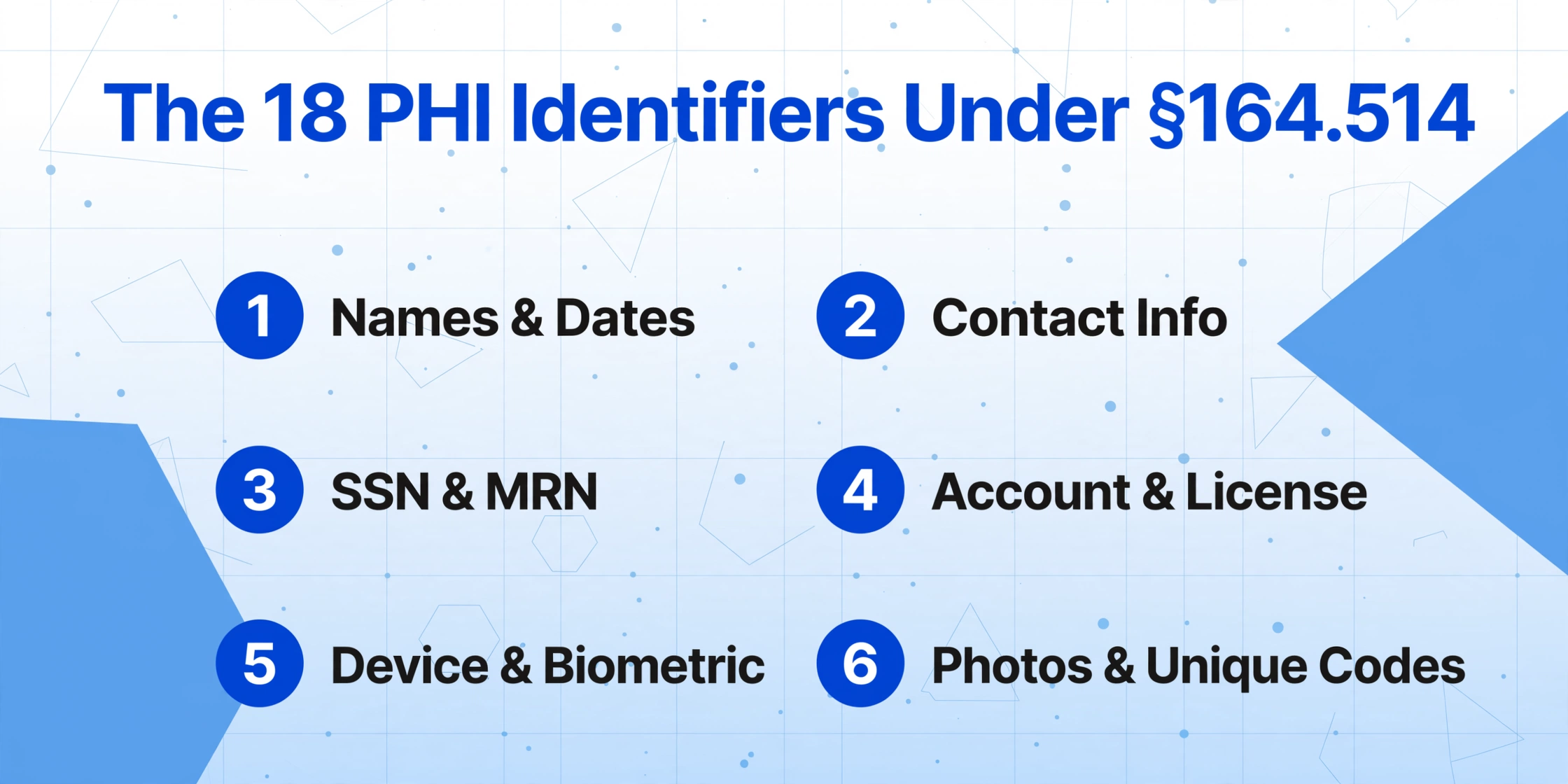
If any of the following 18 identifiers is present in a document alongside health information, the document is PHI and falls under HIPAA's full protections (45 CFR §164.514(b)(2)(i)).
| Category | Identifier | Example in Medical Documents |
|---|---|---|
| (A) | Names | Patient name on a lab report |
| (B) | Geographic subdivisions smaller than a state (street address, city, county, ZIP) | Patient address on an intake form |
| (C) | All elements of dates (except year) — birth date, admission, discharge, death; ages over 89 | Date of service on a claim |
| (D) | Telephone numbers | Patient contact on a referral |
| (E) | Fax numbers | Provider fax on a prescription |
| (F) | Email addresses | Patient email on a consent form |
| (G) | Social Security numbers | SSN on a billing statement |
| (H) | Medical record numbers | MRN on every clinical page |
| (I) | Health plan beneficiary numbers | Insurance ID on a claim form |
| (J) | Account numbers | Patient account on a hospital bill |
| (K) | Certificate or license numbers | Provider license on credentialing docs |
| (L) | Vehicle identifiers and serial numbers, including license plates | License plate on an accident report |
| (M) | Device identifiers and serial numbers | Implant serial on a surgical record |
| (N) | Web URLs | Patient portal URL in communications |
| (O) | IP address numbers | IP logged during portal access |
| (P) | Biometric identifiers (finger and voice prints) | Fingerprint on auth record |
| (Q) | Full face photographic images and comparable images | Patient photo on intake docs |
| (R) | Any other unique identifying number, characteristic, or code | Electronic signature; facility-specific patient ID |
Most medical documents contain multiple identifiers from this list. A single EOB typically contains the patient's name (A), address (B), date of service (C), insurance ID (I), account number (J), MRN (H), and sometimes an SSN (G). Uploading that EOB to an extraction tool is a disclosure of all those identifiers — which is why the BAA and minimum necessary requirements are non-negotiable.
When You Upload a Medical Document: Why §164.504(e) Matters
Here is the critical regulatory question: Is uploading a medical document to a cloud AI extraction tool a disclosure of PHI?
Yes. The act of transmitting PHI to a third-party service that processes, stores, or accesses that information on your behalf constitutes a disclosure under the Privacy Rule. Unless an exception applies — and none of the standard exceptions do for extraction — this disclosure is permitted only if the third party is a business associate bound by a BAA under 45 CFR §164.504(e).
What §164.504(e) Requires in a BAA
Under §164.504(e)(2), the BAA must require the business associate (the extraction provider) to:
Limit use of PHI
Not use or further disclose PHI other than as permitted by the contract or as required by law (§164.504(e)(2)(ii)(A)).
Implement safeguards
Use appropriate safeguards and comply with the Security Rule for ePHI (§164.504(e)(2)(ii)(B)).
Report breaches
Report any unauthorized use or disclosure, including breaches of unsecured PHI (§164.504(e)(2)(ii)(C) and §164.410).
Flow down to subcontractors
Ensure subcontractors who handle PHI agree to the same restrictions (§164.504(e)(2)(ii)(D)). If your provider uses a sub-processor for AI inference, that sub-processor must also be bound.
Support individual rights and allow HHS access
Make PHI available for amendment and accounting of disclosures (§164.504(e)(2)(ii)(E)–(F)), and make internal practices available to the HHS Secretary (§164.504(e)(2)(ii)(G)).
Return or destroy at termination
At contract termination, return or destroy all PHI received from or created on behalf of the covered entity (§164.504(e)(2)(ii)(I)).
If your extraction provider cannot produce a BAA containing these six elements — or does not offer one at all — that alone is a disqualifying compliance gap. For a deeper analysis of BAA operational traps (subcontractor flow-down, the return-or-destroy problem in AI pipelines, what happens during an acquisition), see the companion article on BAA compliance traps in document extraction.
Practical Compliance Checklist: 5 Steps to Verify Your Extraction Tool
Each step below maps to specific CFR sections, so you can document compliance with exact regulatory references.
Classify the documents you process
Identify which documents in your workflow contain PHI under §164.514(b)(2). Map each document type against the 18-identifier list. The default assumption should be that patient-facing documents contain multiple identifiers.
Verify the BAA covers all §164.504(e) provisions
Confirm the BAA covers document extraction specifically (not just generic SaaS), includes the six elements above, and explicitly excludes using your documents for model training. Get written confirmation that your data is not used for training — preferably in the BAA itself.
Verify Security Rule compliance
Under §164.306(a), confirm encryption in transit (TLS 1.2+), encryption at rest, access controls, and audit logging. Independently audited certifications — SOC 2 Type II (with security trust criteria) or HITRUST — provide the strongest evidence of compliance.
Assess architecture against Minimum Necessary
Under §164.502(b)(1), evaluate whether the tool lets you define specific fields and discards the rest after processing — or vacuums the entire document and stores everything. Custom column extraction naturally satisfies minimum necessary; bulk "extract everything" tools create exposure.
Establish retention schedule and document the compliance chain
Under §164.504(e)(2)(ii)(I), define how long the provider retains uploaded documents. Best practice is transient processing — documents deleted within minutes of extraction completion. Maintain a compliance file containing the signed BAA, security certifications, a data flow diagram showing where PHI travels, and breach notification procedures under §164.410.
How AI Document Extraction Architecture Affects Compliance
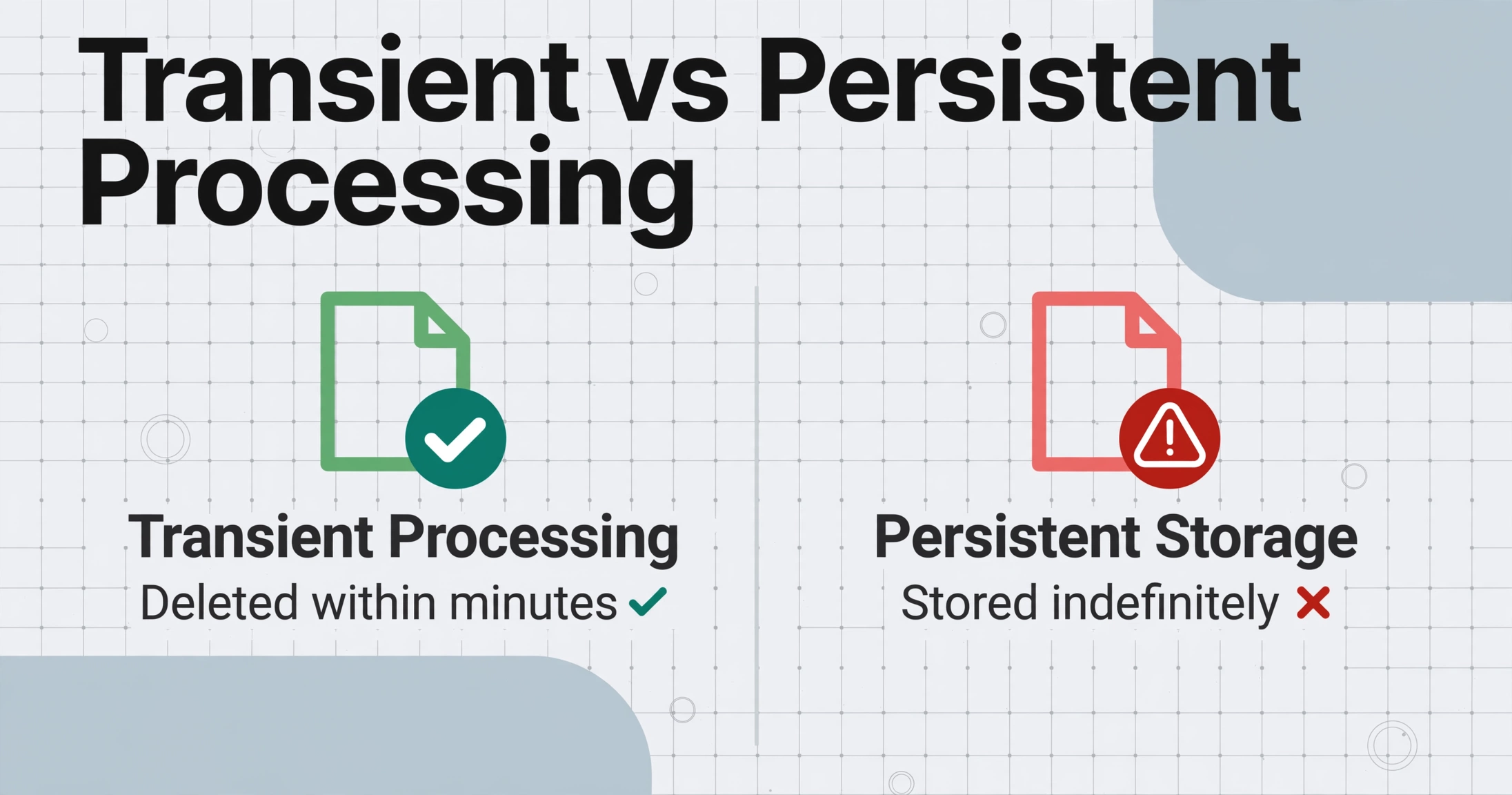
The architecture of an AI extraction tool is not just a technical implementation detail — it is a compliance decision with regulatory consequences. Two architectural characteristics have direct bearing on HIPAA compliance.
Transient Processing Satisfies Multiple Obligations
A tool architected for transient processing — documents uploaded, AI reads and extracts the data, results returned, originals deleted within minutes — simultaneously satisfies §164.504(e)(2)(ii)(I) (return or destroy), §164.502(b) (minimum necessary — data held only as long as needed), and §164.306(a) (reduced attack surface from less stored ePHI). A tool that stores documents indefinitely, caches them in inference pipelines, or retains data for model improvement creates corresponding compliance obligations — and corresponding risk if those obligations are unmet.
Custom Column Extraction as Minimum Necessary by Design
The Minimum Necessary Rule (§164.502(b)(1)) requires limiting PHI to what is needed for the intended purpose. Custom Column Extraction — where you define which fields to extract (patient name, date of service, CPT code, billed amount) and the AI extracts only those — implements minimum necessary at the architectural level. ImageToTable.ai operates on this principle: you name the columns you want, and the AI locates each value by understanding what it means rather than where it sits on the page. Fields you never ask for are never seen by the extraction engine and never stored.
This differs meaningfully from "extract everything and filter later" tools, which process the full document indiscriminately. Under §164.502(b), filtering after extraction does not retroactively make the full processing compliant — the obligation is to limit the use or disclosure itself, not just what you retain afterward.
Provider Selection as Your Compliance Lever
The most effective compliance decision you can make is selecting a provider whose architecture inherently reduces your regulatory burden. A tool with transient processing, column-specific extraction, published retention schedules, SOC 2 Type II certification, and a BAA covering all §164.504(e) provisions closes most compliance gaps before you process a single document.
This guide covers the regulation fundamentals. For operational traps in BAA negotiations — subcontractor flow-down, the return-or-destroy ambiguity in AI pipelines — see HIPAA BAA compliance traps in AI document extraction. For the European counterpart covering GDPR Article 28 DPA requirements, see the GDPR AI extraction compliance guide.
Frequently Asked Questions
Does HIPAA apply to a small medical practice that uses an AI extraction tool for billing documents?
Yes. HIPAA applies to every covered entity regardless of size — a solo practitioner's office is subject to the same Privacy Rule, Security Rule, and BAA requirements as a multi-hospital system. A small practice using AI extraction for patient billing statements needs a signed BAA with the provider just as a hospital does.
If I remove patient names before uploading, is the document still PHI?
De-identification under §164.514(b)(2) requires removing all 18 identifiers, not just names. A document with the name removed but date of birth, MRN, and ZIP code still present is still PHI — uploading it is still a disclosure requiring a BAA. Proper Safe Harbor de-identification requires scrubbing all identifiers through category (R).
Can my extraction provider use uploaded medical documents to improve its AI?
Only if the BAA explicitly permits it — and the default is that the provider may not use or disclose PHI beyond what the contract authorizes (§164.504(e)(2)(ii)(A)). Using patient medical documents for model training is not a permitted use under the Privacy Rule. Most healthcare-focused extraction providers offer dedicated infrastructure or zero-retention processing to avoid this issue. The compliance-safe approach is to require in the BAA that your documents are not used for training.
What happens to our PHI if we switch extraction providers?
Under §164.504(e)(2)(ii)(I), the outgoing provider must return or destroy all PHI received from or created on behalf of your organization. Request a documented deletion confirmation and keep it for your compliance records.
What are the penalties for using a non-compliant extraction tool?
OCR enforces violations under a four-tier structure at 45 CFR §160.404: Tier 1 (entity did not know) starts at $100 per violation up to $28,137 annually; Tier 4 (willful neglect uncorrected) reaches $70,689 per violation with a $1,726,773 annual maximum. Beyond fines, a breach involving an extraction tool without a BAA triggers mandatory notification under Subpart D — meaning affected individuals, HHS, and possibly local media must be notified.
Does HIPAA apply if staff capture medical document photos with a phone and upload them to an extraction tool?
Yes. The medium does not change the regulatory status — a photo of a medical record taken with a smartphone is still PHI under §160.103 if it contains any of the 18 identifiers. The same BAA and minimum necessary requirements apply whether the document is a native PDF or a phone-captured JPEG.
HIPAA compliance for medical document extraction is not about whether AI can be compliant — it is about whether your provider has built the right contractual, security, and architectural safeguards. Section 164.514 defines what counts as PHI. Section 164.504(e) requires a BAA with six specific provisions. Section 164.502(b) demands extracting only what you need. And Section 164.306 requires verifiable security protections for ePHI at every step. Each of these is verifiable before you process a single document, not after. The compliance question has an answer before you upload your first medical record — make sure it is the right one.
This article provides general regulatory guidance and does not constitute legal advice. Consult your compliance officer or healthcare attorney for determinations specific to your organization's workflows.
Verify HIPAA ComplianceFree to try with no sign-up. Documents processed transiently and not retained. BAA available.