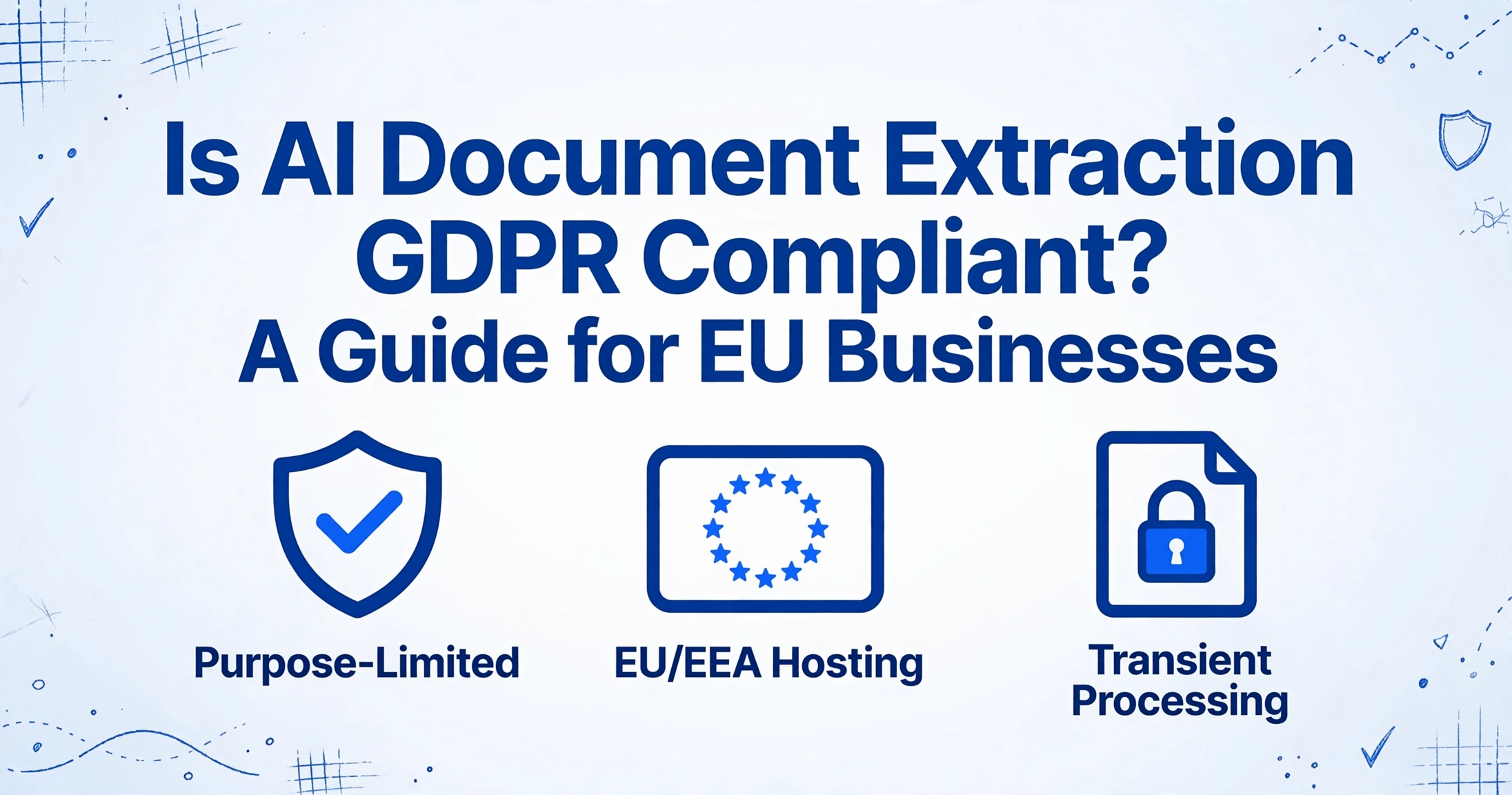
Is AI Document Extraction
GDPR Compliant? A Guide for EU Businesses
If your document extraction tool processes invoices with names, addresses, or bank details belonging to EU residents, you're processing personal data under GDPR — whether your company is in Berlin or Boston. Here's what Article 4(2), Article 28, and Article 17 require, and how to verify your tool provider is compliant.
Key Takeaways
- You think GDPR compliance for document extraction tools is a checkbox — skim the privacy policy, confirm "we're GDPR compliant," and move on.
- But Article 4(2) makes every document upload a processing operation the moment an invoice contains a natural person's name or bank details. Article 5(1)(b) prohibits your provider from training AI on your documents without explicit consent — a clause absent from most SaaS terms.
- Your role shifts from "find a tool that works" to "find a provider with transient processing, no model training, and a DPA covering document extraction." Those three questions asked before you upload settle the compliance answer before a single document is processed.
What the GDPR Requires for Document Processing
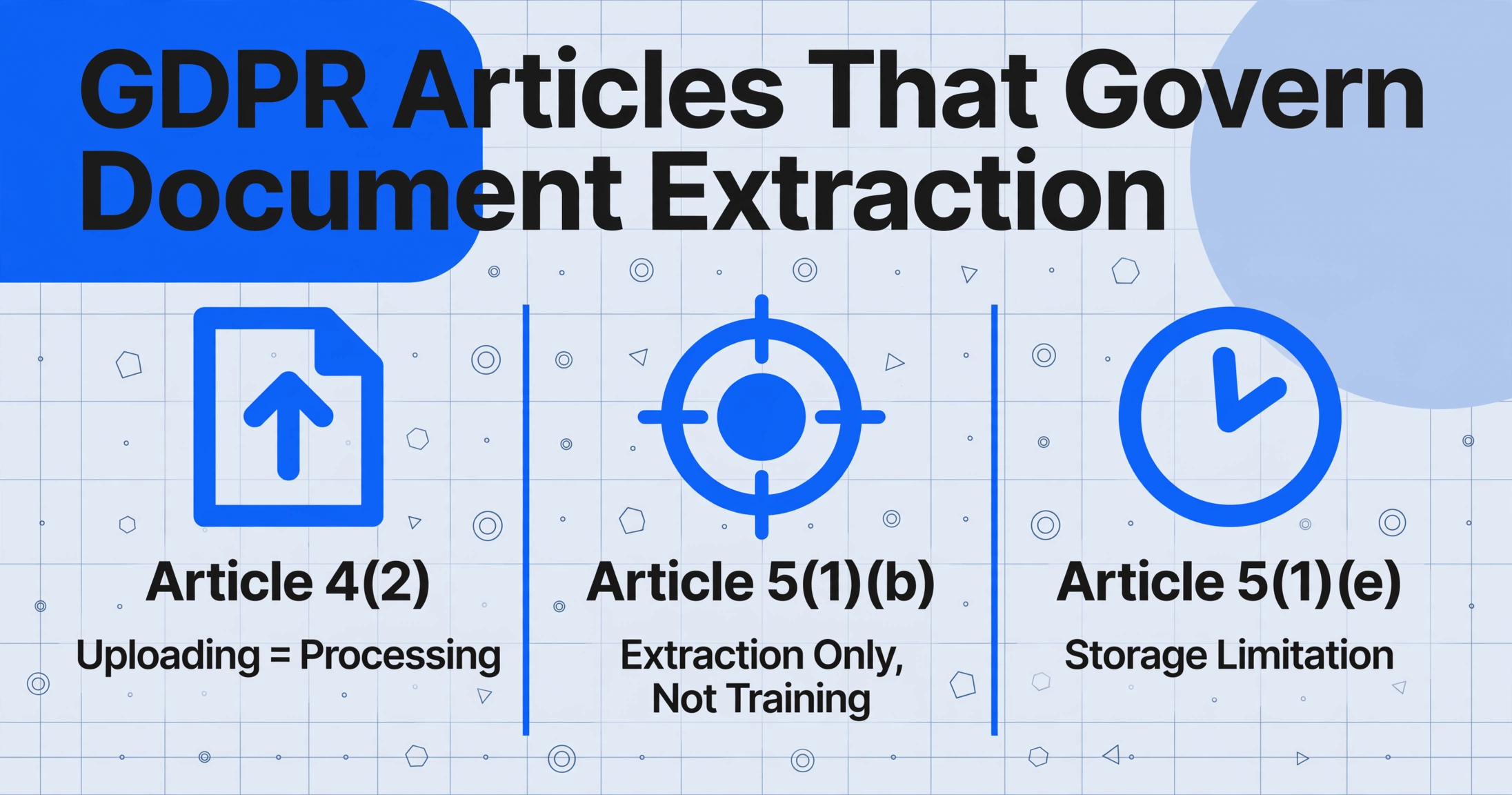
The General Data Protection Regulation (Regulation (EU) 2016/679) does not mention "document extraction" by name. But six articles directly govern how you can use an extraction tool to process invoices, payslips, or contracts that contain personal data. Each creates a specific obligation — for you as the data controller, and for the tool provider as the data processor.
Article 4(2): Uploading a Document Is "Processing"
The regulation defines processing broadly: "any operation or set of operations which is performed on personal data or on sets of personal data, whether or not by automated means, such as collection, recording, organisation, structuring, storage, adaptation or alteration, retrieval, consultation, use, disclosure by transmission, dissemination or otherwise making available, alignment or combination, restriction, erasure or destruction" (Article 4(2), GDPR). If your extraction tool ever touches an invoice that contains a name, address, bank account number, or tax ID belonging to a natural person, you are processing personal data under Article 4(2). The same applies to payslips (employee name + salary), contracts (signatory name + ID), and medical records. The breadth of this definition is intentional — uploading, transmitting, storing, and deleting are all processing operations.
Article 5(1)(b): Purpose Limitation — Extraction Only, Not Training
Article 5(1)(b) establishes that personal data shall be "collected for specified, explicit and legitimate purposes and not further processed in a manner that is incompatible with those purposes." For document extraction, this is the provision that separates compliant tools from non-compliant ones. The purpose of uploading a document to an extraction tool is to extract structured data from it — that purpose is legitimate. But if the provider uses your uploaded document to train its AI models, that constitutes "further processing" under Article 5(1)(b). Unless you have given explicit consent for training use, it is incompatible with the original purpose. A tool that processes documents transiently — reads them, returns extracted data, and discards the originals — naturally satisfies purpose limitation. A tool that retains documents for model improvement creates an Article 5(1)(b) exposure.
Article 28: You Need a Data Processing Agreement
Article 28(3) requires that processing be "governed by a contract or other legal act under Union or Member State law, that is binding on the processor with regard to the controller." This is your Data Processing Agreement (DPA). Under Article 28(3)(a)–(h), the DPA must specify eight minimum provisions: the processor acts only on documented instructions (a); personnel are bound by confidentiality (b); the processor implements Article 32 security measures (c); sub-processors require authorisation (d); the processor helps you respond to data subject rights (e); the processor assists with security and breach obligations (f); the processor deletes or returns data at contract end (g); and the processor allows audits (h). If your extraction provider cannot produce a DPA containing these eight elements, that alone is a compliance gap worth selecting a different provider over.
Article 17: The Right to Erasure
Article 17(1) grants data subjects the right to obtain erasure of their personal data "without undue delay" where grounds apply — including that the data "are no longer necessary in relation to the purposes for which they were collected or otherwise processed" (Article 17(1)(a)). For document extraction, this means: once you have extracted the data you need, the original document and any copies should be deleted on a defined schedule. Article 17(3)(b) provides an exception where processing is necessary for compliance with a legal obligation — if your jurisdiction requires retaining invoice copies for tax audits, that retention is permissible but only for the statutory duration and only when the data is not further processed beyond what the law requires. Your extraction tool should offer a documented deletion policy. Best practice is zero retention by default: documents processed transiently, originals deleted from provider infrastructure within minutes to hours, not days.
Article 32: Security of Processing
Article 32(1) requires "appropriate technical and organisational measures to ensure a level of security appropriate to the risk." For extraction, this baseline includes encryption in transit (TLS 1.2+), encryption at rest, access controls, and independently audited certifications (SOC 2 Type II, ISO 27001).
Data Residency and International Transfers
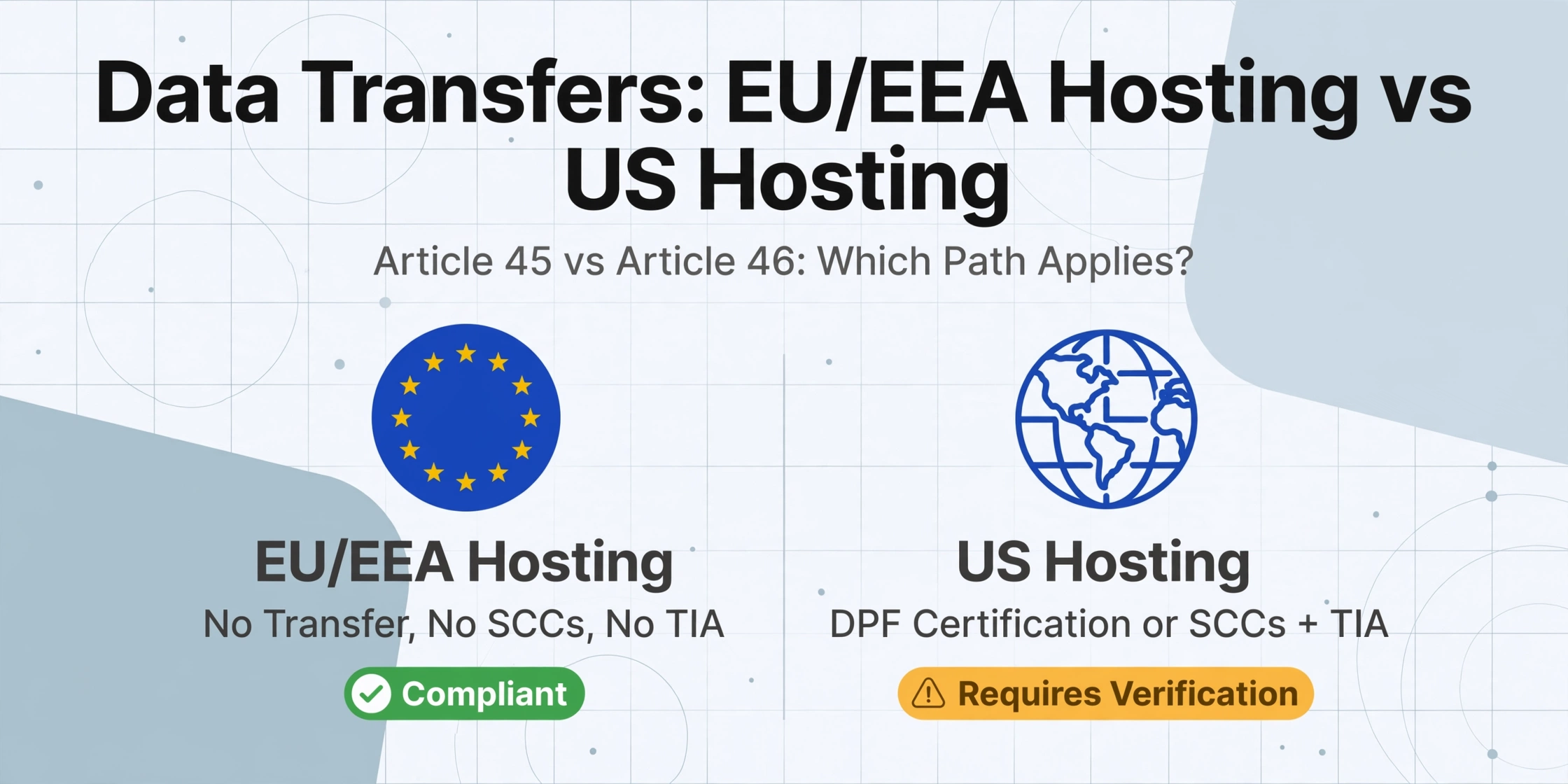
If your extraction tool processes documents on servers outside the European Economic Area, Chapter V (Articles 44–49) applies. Under Article 45(1), data may be transferred to a third country where the European Commission has issued an adequacy decision. The EU–U.S. Data Privacy Framework (DPF), adopted under Commission Implementing Decision 2023/1795 on July 10, 2023, is the current adequacy decision for U.S.-based organisations that self-certify. On September 3, 2025, the EU General Court dismissed a legal challenge to the DPF, confirming its validity. If your provider processes data in the U.S. and holds DPF certification, that satisfies Article 45.
For transfers to countries without an adequacy decision, Article 46(2)(c) provides Standard Contractual Clauses (SCCs) — pre-approved contract terms under Commission Implementing Decision 2021/914 (June 4, 2021). However, the Schrems II judgment (CJEU, Case C-311/18, July 16, 2020) made clear that signing SCCs alone is not sufficient. You must also conduct a Transfer Impact Assessment (TIA) evaluating whether the destination country's legal framework impairs the SCCs' protections, and implement supplementary measures if it does. If your provider processes data outside the EEA, ask: where are your servers? What transfer mechanism do you rely on? Can you provide a TIA? If they offer EU/EEA-based hosting, the data residency question is settled — no international transfer, no SCCs needed, no TIA required.
Article 5(1)(e) adds storage limitation: personal data must be kept "for no longer than is necessary for the purposes for which the personal data are processed." Once extraction is complete, retention should follow a documented schedule tied to statutory periods — not indefinite storage on the provider's servers.
This article covers the regulation itself — what each article requires of you and your provider. For a companion guide on auditing your internal extraction workflows against these requirements, see the Batch I-2 GDPR security audit article. The two work together: understanding the legal obligations comes before auditing your compliance against them.
Practical Compliance Checklist: 7 Steps to Verify Your Extraction Tool
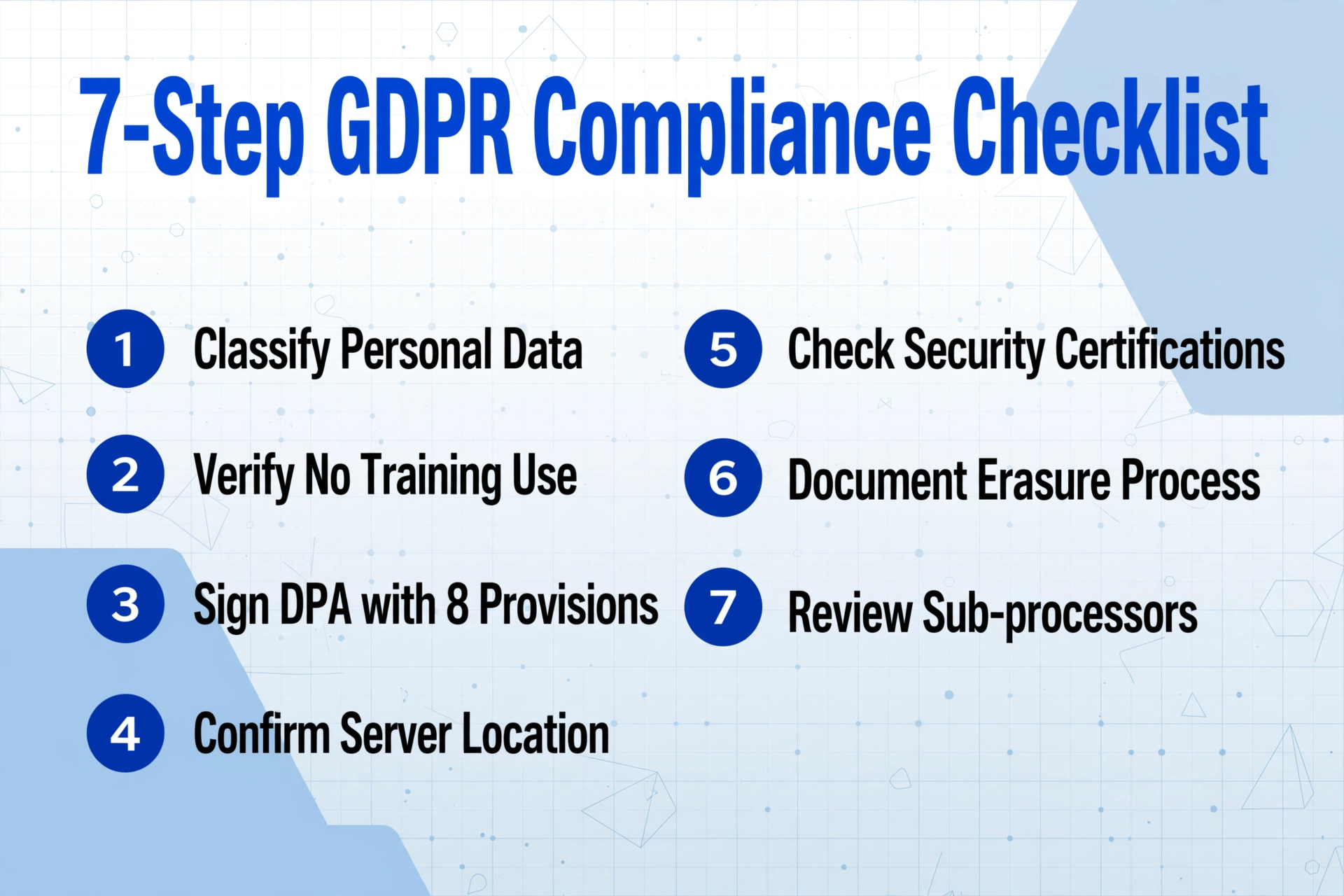
Each step below maps to specific GDPR articles, so you can document compliance with exact regulatory references.
Classify the data in your documents
Identify which fields in the documents you process are personal data under Article 4(1). Names, addresses, bank account numbers, tax IDs, employee IDs, and signatures all qualify. If your documents contain any of these, GDPR applies to the processing.
Verify the provider does not use your data for training
Under Article 5(1)(b), if the provider trains AI models on your uploaded documents, that is "further processing" incompatible with the extraction purpose unless you have given explicit consent. Get a written commitment that your data is not used for training — preferably in the DPA.
Sign a DPA with all eight Article 28(3) provisions
Non-negotiable. Verify the DPA covers the document processing scenario (not just generic SaaS services) and includes provisions (a) through (h) as specified in Article 28(3). If the provider cannot produce a DPA, your compliance gap is already too wide to proceed.
Confirm server location and transfer mechanism
EEA-based hosting = no transfer issue. U.S. hosting = verify DPF certification on the official list. Any other third country = demand SCCs plus a documented TIA under Articles 45–46.
Verify security certifications
Under Article 32(1), verify encryption in transit (TLS 1.2+), encryption at rest, and independently audited certifications (SOC 2 Type II, ISO 27001). Document what your provider holds and when it was last audited.
Establish a retention and deletion schedule
Under Article 5(1)(e) and Article 17(1)(a), define how long the provider retains uploads (should be minutes to hours, not months) and how long you keep extracted data (match statutory periods, then delete or anonymise).
Document an erasure request process
If a data subject requests erasure under Article 17(1), you need to identify documents containing their data in your extraction history, delete or anonymise those records, and confirm completion within the one-month timeline under Article 12(3). If you switch providers, the old provider must delete your documents under Article 28(3)(g).
How AI Document Extraction Fits Into a Compliant Workflow
AI document extraction is not inherently compliant or non-compliant — it depends on how the tool is architected and what commitments the provider makes.
Data Minimisation by Design
Article 5(1)(c) requires data to be "adequate, relevant and limited to what is necessary." Custom column extraction — where you define exactly which fields to extract (invoice number, date, total, supplier name) and the AI extracts only those — maps naturally to this principle. Fields you never ask for are never processed, and therefore never stored. This is the opposite of the "extract everything and filter later" approach that creates unnecessary data exposure.
Transient Processing
Tools architected for transient processing — documents uploaded, AI reads them, data returned, originals deleted within minutes — simultaneously satisfy Article 5(1)(b) (purpose limitation), Article 5(1)(e) (storage limitation), and Article 17 (right to erasure). If you are evaluating tools, provider architecture is not just a technical decision; it is a compliance decision with regulatory implications.
Provider Selection as a Compliance Decision
Two related regulations intersect with your extraction workflow. E-invoicing mandates require structured XML formats — your extraction tool must coexist with those, not replace them. For a phased readiness plan, see the e-invoicing compliance guide. Statutory retention periods define how long you must keep extracted data — see the document retention requirements guide. These three regulations — data protection, e-invoicing mandates, and retention law — form the compliance triangle for document processing in 2026.
Frequently Asked Questions
Does GDPR apply if I run a small business with fewer than 10 employees?
Yes. GDPR has no small-business exemption. Article 3(1) applies to any processing in the context of an EU establishment regardless of size. Article 30(5) exempts businesses under 250 employees from maintaining full processing records, but all substantive obligations — Article 4 definitions, Article 5 principles, Article 28 DPA requirements, Article 17 erasure rights, Article 32 security — apply to every business that processes personal data.
My invoices only have company data, not personal data. Does GDPR still apply?
It likely does. An invoice from a sole trader contains the individual's name and address — personal data under Article 4(1). An invoice from a GmbH that lists a contact person's name or direct email also contains personal data. A payslip with an employee's name and salary is personal data by definition. Even a purchase order referencing an approver's signature qualifies. In practice, very few business documents are completely free of personal data. If a human appears anywhere — as vendor contact, employee, approver, signatory — GDPR applies.
Can I avoid GDPR by anonymising documents before extraction?
Recital 26 states that data protection principles do not apply to genuinely anonymous information. However, the anonymisation step itself — scrubbing names, masking addresses — is processing under Article 4(2), and GDPR attaches to that step. Anonymisation is a valid risk-reduction strategy but does not eliminate the obligations it creates. Most businesses find it more practical to use a compliant provider than to build an anonymisation pipeline.
What happens to my data if I switch providers?
Under Article 28(3)(g), your current provider must delete or return all personal data at contract end. Request a documented export and a deletion confirmation. Article 17(1) supports your right to erasure of any data still held after transition. Keep the confirmation for your compliance records.
Does my provider have to let me audit them?
Article 28(3)(h) requires the processor to "allow for and contribute to audits." In practice, few SaaS providers allow on-site audits for standard plans. Most provide SOC 2 Type II reports or ISO 27001 certificates as substitutes. Verify that your provider's audit documentation covers your specific processing scenarios — that generally satisfies the Article 28(3)(h) obligation.
GDPR compliance for document extraction is not about whether AI can be compliant — it is about whether your provider has built the right contractual, security, and architectural safeguards. Article 4(2) makes every document upload a processing operation. Article 28 requires a DPA with eight specific provisions. Article 5(1)(b) prohibits model training without a lawful basis. Article 17 gives data subjects erasure rights. And Chapter V governs cross-border transfers. Each of these is verifiable before you sign up. The compliance question has an answer before you process a single document — not after.
Verify Your GDPR ComplianceFree to try with no sign-up. Documents processed transiently and not retained.