How Accurate Is Prescription Extraction?
A Field-by-Field Analysis
When a pharmacy software vendor tells you their AI extraction achieves "97% accuracy," what should you actually expect? The question isn't whether the number is true — it's which 3% fails, and whether the failures land on fields where the margin for error is measured in patient outcomes. In prescription data, different fields carry wildly different error risks: confusing metFORMIN for metRONIDAZOLE costs more than a mistyped refill count. And the accuracy of extraction itself depends less on the AI model than on what your incoming documents look like — the same system that reads a crisp e-prescription at 99% may drop to 85% on a faxed script from a clinic still using a thermal fax machine from 2007. This article breaks prescription extraction accuracy down field by field, so you can evaluate tools against the error profile that actually matters for your pharmacy.
Key Takeaways
- Every pharmacy AI vendor quotes a single accuracy number — but "97%" averages across drug names (where a wrong extraction can harm a patient) and refill counts (where it just annoys).
- The fields where extraction errors do the most damage — NDC numbers and DEA identifiers — are the ones your existing workflow is blind to, because no one re-checks an NDC against the original script after data entry.
- A field-by-field accuracy framework turns vendor claims into an operational parameter: which fields need your second set of eyes, and how often — based on your pharmacy's actual input mix, not a marketing slide.
The 5 Seconds You Can't Get Back
A pharmacy technician typing at 50 WPM still needs about 50 seconds to transcribe a single prescription into a pharmacy management system — and 1 in every 25 of those entries will contain at least one error.
The standard efficiency narrative around AI prescription extraction goes like this: manual data entry is slow, AI is fast, therefore adopt AI. It's a clean equation, and it's not wrong — the time savings are real. But the second half of that argument — what happens to accuracy — is where most vendor discussions stop at a single percentage point and move on.
A 2024 systematic review of 62 studies published in Research in Social and Administrative Pharmacy found a global pooled prevalence of pharmacy dispensing errors of 1.6%, with individual studies reporting rates as high as 11.53% depending on detection methodology (Um et al., 2024). In a landmark national observational study, Flynn et al. estimated that 51.5 million dispensing errors occur among the 3 billion prescriptions dispensed annually in the United States — roughly four errors per day in a typical pharmacy (Flynn et al., 2003). The World Health Organization's Medication Without Harm initiative reports that medication-related harm affects roughly 1 in 20 patients globally. And the data entry screen — where a technician or pharmacist reads a prescription and types it into the PMS — is where a significant share of these errors originate, before a pill ever leaves the bottle.
The real question isn't "how fast can AI extract a prescription?" It's "on which fields does the extraction fail, and what happens when it does?" A field-by-field breakdown reveals that accuracy isn't distributed evenly — some fields have built-in validation layers that catch mistakes before they reach a patient; others have none.
Input Quality Sets the Accuracy Floor
Before any AI model touches a prescription, the document's physical condition has already determined the upper bound of achievable accuracy — and no model can recover information that wasn't captured in the image.
Prescriptions arrive at pharmacies through three primary channels, each with its own degradation profile:
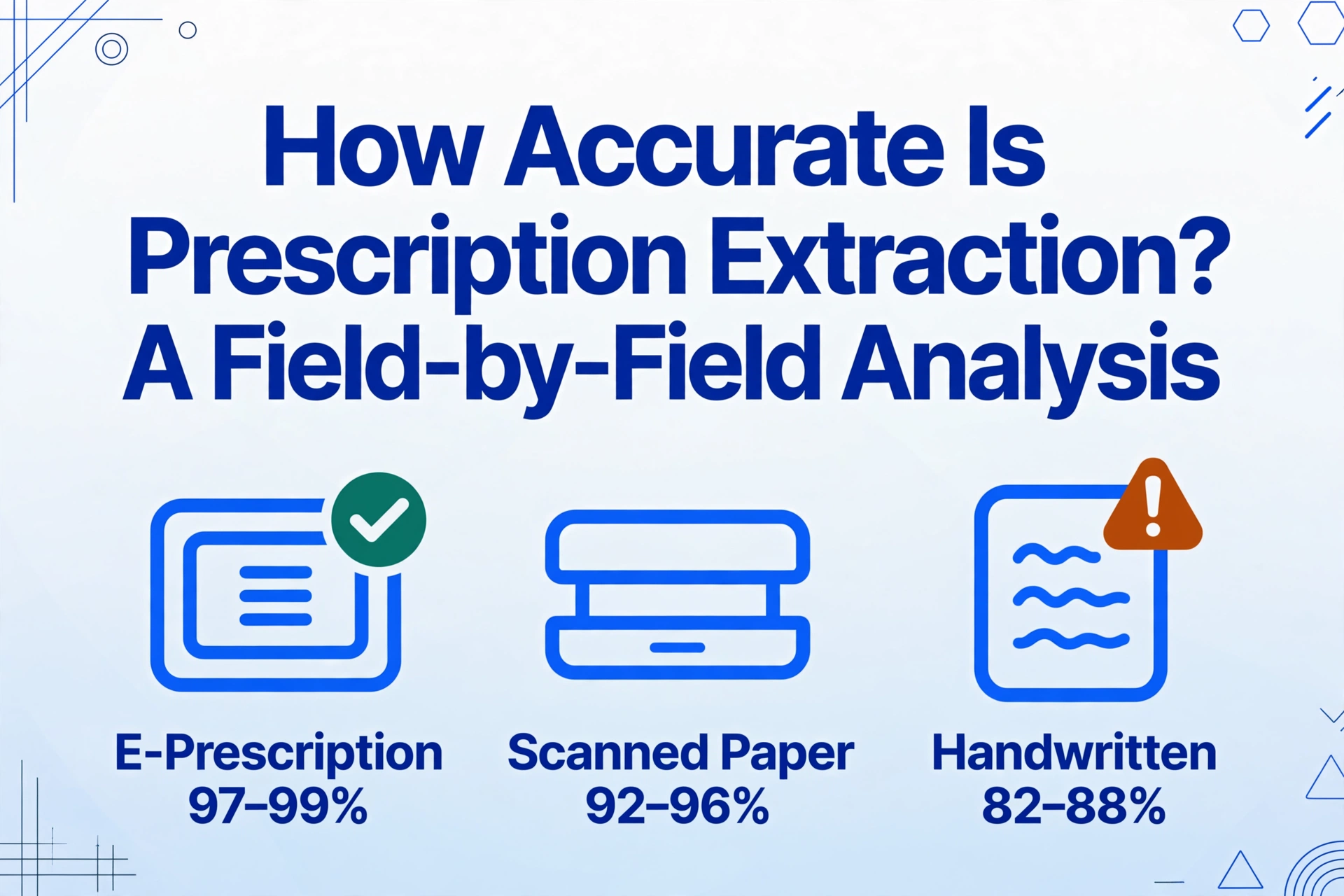
| Input Channel | Typical Image Quality | Expected Extraction Accuracy | Primary Failure Mode |
|---|---|---|---|
| e-Prescription (SureScripts, EPCS) | Digital-native, clear text | 97–99% field-level | Rare; SIG code normalization inconsistencies |
| Scanned paper prescription | 300 DPI flatbed scan, good contrast | 92–96% printed; 82–88% handwritten | Handwriting on multi-line SIG instructions |
| Faxed prescription (thermal paper) | Low resolution, faded, skewed | 85–92% field-level on average | Character fragmentation; smeared numerals in NDC/dosage |
A 2024 study using PaddleOCR on real-world prescriptions found that while printed prescriptions achieved ~95% text extraction accuracy, handwritten prescriptions dropped to ~85% — a 10-point gap that persists even with preprocessing steps like noise reduction and binarization. A separate study on ANN-enhanced prescription OCR reported a Prescription Accuracy Rate (PAR — the percentage of prescriptions where all critical fields were correctly recognized) of 85.7% for an improved system, up from 78.0% for baseline OCR (Gudi, 2025). This is the accuracy floor problem: if your incoming fax volume is high, even the best model starts from a lower baseline.
The practical takeaway isn't to avoid AI extraction for faxed prescriptions — it's to design your verification workflow around the input quality you actually receive, not the best-case scenario. A pharmacy processing 80% e-scripts and 20% faxed scripts needs a different verification checkpoint design than one processing the reverse ratio.
The Drug Name Problem: When Similar Isn't Close Enough
Since 1975, the Institute for Safe Medication Practices (ISMP) has maintained a List of Confused Drug Names — a catalog of medication pairs whose names are similar enough in appearance or pronunciation to cause real dispensing errors. For extraction systems, this list is the difference between "close match" and "wrong drug."
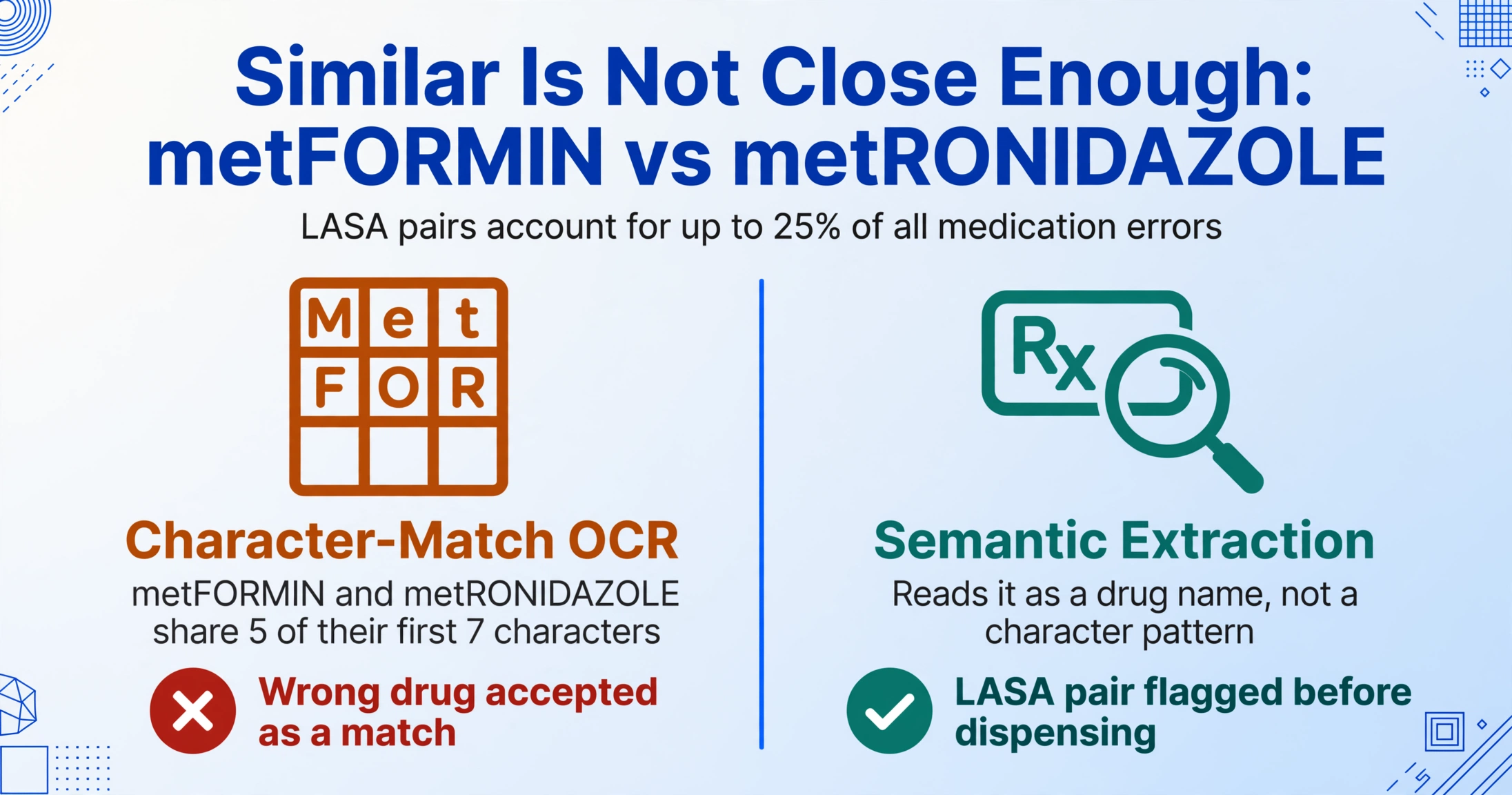
Look-alike, sound-alike (LASA) drug name pairs are estimated to account for up to 25% of all medication errors, and the list is not small — ISMP's current catalog runs to hundreds of entries across brand-brand, brand-generic, and generic-generic pairs (ISMP Confused Drug Names List). The consequences are concrete enough that drug names have been changed to prevent confusion: Losec became Prilosec after repeated mix-ups with Lasix; Brintellix was renamed Trintellix to avoid confusion with Brilinta; Celebrex originally launched as Celebra before concerns arose about confusion with Celexa.
For a human pharmacy technician, the defense against LASA errors is training, tall man lettering (writing hydrOXYzine and hydrALAZINE with mixed case to visually distinguish them), and independent double-checks. For an AI extraction system, the challenge is different but no less serious: an OCR-based system sees character patterns, not drug names. To an OCR engine, "metFORMIN" and "metRONIDAZOLE" share 5 of their first 7 characters — a high-confidence partial match that a naive system might accept. A semantic extraction engine, by contrast, understands that it's reading a prescription from a primary care visit for a diabetes patient and weights the probability toward metformin. It brings context to the character recognition problem.
A related risk that receives less attention: NDC-to-drug-name cross-validation is a second line of defense that most extraction tools don't offer. If a system extracts "lisinopril 10mg" but the NDC on the same line decodes to atorvastatin, a well-designed extraction pipeline flags the inconsistency before the data reaches the PMS. This kind of intra-document validation — checking whether extracted fields are internally consistent — transforms extraction from a one-pass OCR task into a layered accuracy check.
NDC: The 10-Digit Trap
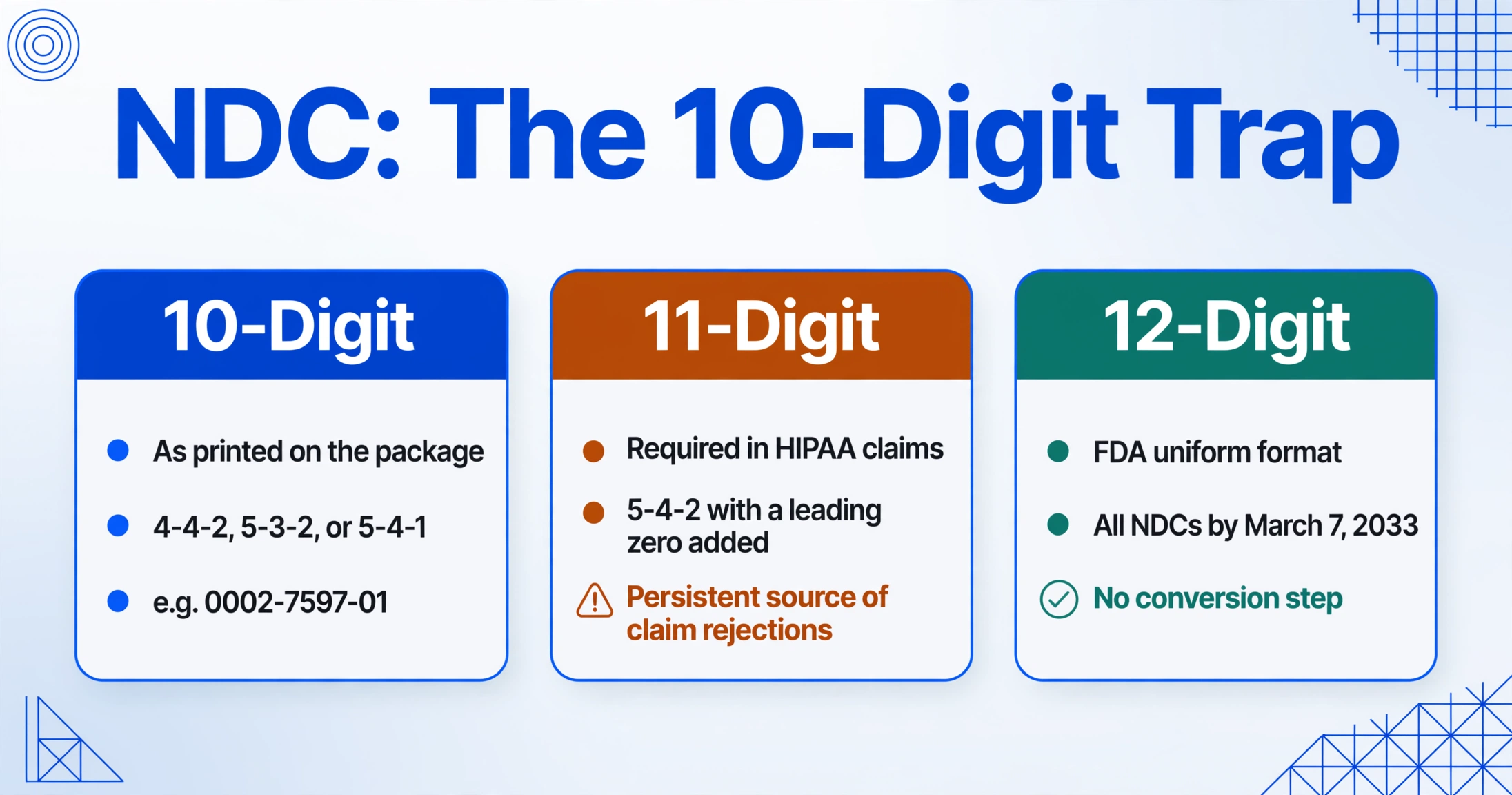
A single NDC has up to three valid representations depending on where it's being used — and the conversion between them is the kind of mechanical task that humans get wrong consistently and AI gets wrong unpredictably.
The National Drug Code is a 10-digit, three-segment identifier: Labeler Code (4 or 5 digits), Product Code (3 or 4 digits), and Package Code (1 or 2 digits). The FDA assigns NDCs in three possible formats — 4-4-2, 5-3-2, or 5-4-1 — meaning the same drug's NDC might appear on packaging as 0002-7597-01 (4-4-2) or 60574-4114-1 (5-4-1). But HIPAA-covered transactions require an 11-digit NDC in a fixed 5-4-2 format, achieved by adding a leading zero to the short segment — and the zero goes in a different position depending on which of the three original formats the NDC uses (FDA NDC Format Guidance).
This conversion — 10 digits to 11 — is a persistent source of claim rejections. The FDA itself acknowledged in its 2023 proposed rule on NDC format revision that "the healthcare system and payors currently convert 10-digit NDCs to 11-digit NDCs, which increases healthcare costs and may be a factor in medication errors" (FDA, 2023). The problem compounds: in March 2026, the FDA finalized a rule transitioning all NDCs to a uniform 12-digit format (6-4-2) by March 7, 2033, with a three-year transition period through March 2036. During this window, a pharmacy's PMS might receive 10-digit, 11-digit, and 12-digit NDCs simultaneously — three different formats for the same product identifier.
For an extraction system, the NDC accuracy challenge has two layers: extracting the correct digits from the image, and knowing which format the extracted digits represent. The first layer is an OCR problem (is that a 0 or an 8? is the hyphen present or a smudge?). The second layer is a domain-knowledge problem: if the system extracts 9 digits from a field labeled "NDC," is that a 5-3-1 format with a missing leading zero, or a 5-4-0 format with a missing terminal zero? The answer determines whether the data flows into your PMS as a valid identifier or a rejected claim.
Dosage, DEA, and the Regulatory Data Chain
Drug name and NDC errors are data-quality problems; dosage and DEA number errors are regulatory-compliance problems. The difference matters when you're evaluating which extraction errors your workflow can tolerate.
Dosage errors in extraction typically fall into three categories: unit confusion (mcg extracted as mg — a 1,000× dosing error), decimal point displacement (0.5mg → 5mg), and strength-to-quantity conflation (10mg tablet vs. quantity of 10 tablets). The ISMP maintains a list of error-prone abbreviations and dose designations specifically to address these failure modes in manual entry — but for AI extraction, the problem is subtler. A vision model that reads "Levothyroxine 0.025 mg" might correctly transcribe the characters but place them in the wrong output column, assigning the strength to the quantity field. The error isn't in reading — it's in field assignment, which requires understanding what each piece of text means, not just what it says.
DEA numbers carry a structural validation built into the format: a valid DEA number is two letters followed by seven digits, where the second letter is the first letter of the prescriber's last name and the seventh digit is a checksum computed from the first six. This means an extraction system can run a format validation immediately — if the extracted string doesn't match the DEA checksum algorithm, it's either misread or invalid. The practical implication: DEA number extraction has a verifiable accuracy rate — you can measure exactly how often the system produces a string that passes the checksum, and flag everything that doesn't for manual review. No other prescription field offers this level of built-in verification.
State PMP data requirements add another layer: prescription monitoring programs in 37 states require prescribers to consult the PMP registry before writing controlled substance prescriptions (Schedule II–IV), and the accuracy of PMP data depends entirely on what pharmacies and dispensers report (NASCSA, 2024 PMP resources). Each dispenser is responsible for the integrity of their submitted data — "assurance that PMP data is accurate and complete is the responsibility of" every dispensing pharmacy (Washington State DOH). An extraction error that reaches the PMP registry creates a permanent discrepancy in a patient's controlled substance history, potentially triggering false flags in future PMP consultations.
| Field | Error Consequence | Built-in Validation? | Human-Detectable at Verification? |
|---|---|---|---|
| Drug Name | Wrong medication dispensed | DUR interaction check (partial) | Yes — if pharmacist checks label against original script |
| NDC | Claim rejection; inventory discrepancy | Format validation possible; no semantic check | No — NDC is invisible to patient on label |
| Dosage/Strength | Overdose or underdose | DUR dosing range check (partial) | Partially — visible on label, but mcg/mg confusion subtle |
| DEA Number | PMP data corruption; controlled substance tracking failure | Checksum validation (full) | No — prescriber ID invisible to patient |
| Quantity | Incorrect days' supply; early refill | DUR utilization check | Yes — visible on label |
| SIG / Directions | Patient takes medication incorrectly | None automated | Yes — patient can verify at counseling |
The table reveals an asymmetry: NDC and DEA errors are the hardest to catch downstream and the easiest to prevent at extraction time — because both have structural validation rules that a properly designed extraction system can apply before the data enters your PMS. Fields without built-in validation (drug name, SIG instructions) require a different strategy: human verification as close to the extraction point as possible, before the data propagates.
Designing an Accuracy-Friendly Extraction Workflow
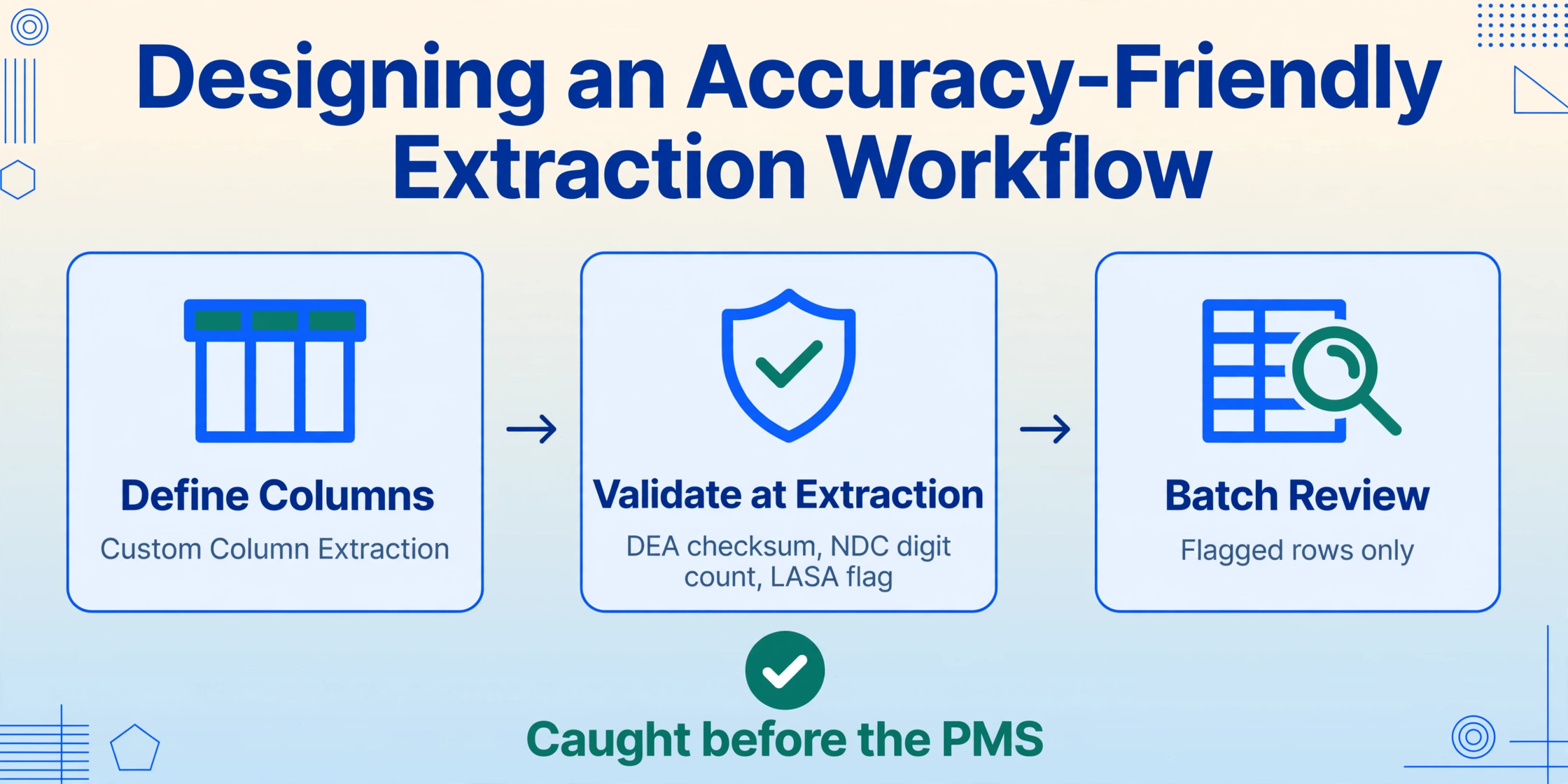
The most accurate extraction system in a pharmacy isn't the one with the highest headline percentage — it's the one whose error patterns match your verification workflow's ability to catch them.
A practical accuracy workflow for prescription extraction doesn't aim for zero errors at the extraction stage. It aims for error patterns that are predictable, verifiable, and caught before they propagate. Here's what that looks like field by field:
Files are processed securely and not stored.
This workflow turns accuracy from a vendor's single percentage into an operational parameter you control. Instead of asking "how accurate is this tool?", you ask "which fields does my verification workflow need to double-check, and at what rate?" — and the answer depends on your input mix, your PMS's built-in validation layers, and which fields carry compliance consequences in your state.
Frequently Asked Questions
How accurate is AI at reading handwritten prescriptions?
Handwritten prescription extraction accuracy typically ranges from 82% to 88% for field-level extraction, compared to 95–99% for printed or e-prescriptions. The variance depends heavily on handwriting legibility, image resolution, and whether the prescription contains multi-line SIG instructions. A prescription with a clearly block-printed drug name and neatly written NDC will extract far more reliably than one with cursive SIG directions spanning four lines. This is a real limitation — no current extraction system achieves above 90% accuracy on the full range of physician handwriting seen in practice.
Does AI extraction reduce medication errors compared to manual data entry?
Yes — but not by being perfectly accurate. The advantage is that AI extraction errors follow predictable patterns (character confusion in low-resolution fields, field-assignment mistakes on complex layouts), while human data entry errors are random and harder to catch systematically. A pharmacy that designs its verification workflow to specifically target AI's known failure modes — NDC digit count checks, DEA checksum validation, LASA drug name flagging — can achieve a lower net error rate than human-only entry, even if the AI's raw accuracy on some fields sits in the high 80s.
Can AI extraction handle NDC format conversion automatically?
An extraction system can detect how many digits it reads and flag NDCs that don't match expected formats, but full 10→11 digit conversion requires knowing the original FDA-assigned format (4-4-2, 5-3-2, or 5-4-1) — information that isn't visible on the prescription label. The safest approach is to use extraction for digit capture and let your PMS or a drug data compendium (which knows each NDC's original format) handle the conversion. The extraction system's job is to tell you "I read 9 digits where I expected 10 or 11" — not to guess where the zero goes.
What prescription fields are most important to verify after extraction?
NDC and drug name should be your top verification priorities — NDC errors are invisible to patients and downstream verification, and drug name errors carry the highest patient-safety risk. DEA numbers are next: they're verifiable via checksum but propagate into state PMP databases where errors are hard to correct. Dosage verification matters most for narrow-therapeutic-index drugs (warfarin, levothyroxine, digoxin) where small dosage errors have outsized clinical consequences. Quantity and refill counts, while important, are the most likely to be caught by existing pharmacy workflow steps like DUR and patient counseling.
Is this approach compatible with pharmacy management systems and e-prescribing networks?
Most AI extraction tools output to CSV or Excel first — not directly into your PMS. This means the extraction output serves as a pre-verification step: you review the structured data in a spreadsheet, make corrections where flagged, and then import or manually enter the verified data into your PMS. Direct PMS integration exists in enterprise pharmacy automation platforms (Asepha, Nodens Health), but for most independent and chain pharmacies, the extraction-to-spreadsheet-to-PMS workflow is the practical path, with the spreadsheet stage functioning as your batch verification checkpoint.
Prescription extraction accuracy isn't a number you discover after adoption. It's a set of expectations you calibrate before — by input channel, by field type, and by the verification workflow that sits between extraction and dispensing. The tools that help most aren't the ones promising 99% accuracy across the board. They're the ones that tell you where they're weakest, so you know exactly where to put your second set of eyes.
Test prescription extraction on a sample file — see which fields extract cleanly and which ones your workflow will need to verify.